
Market Overview:
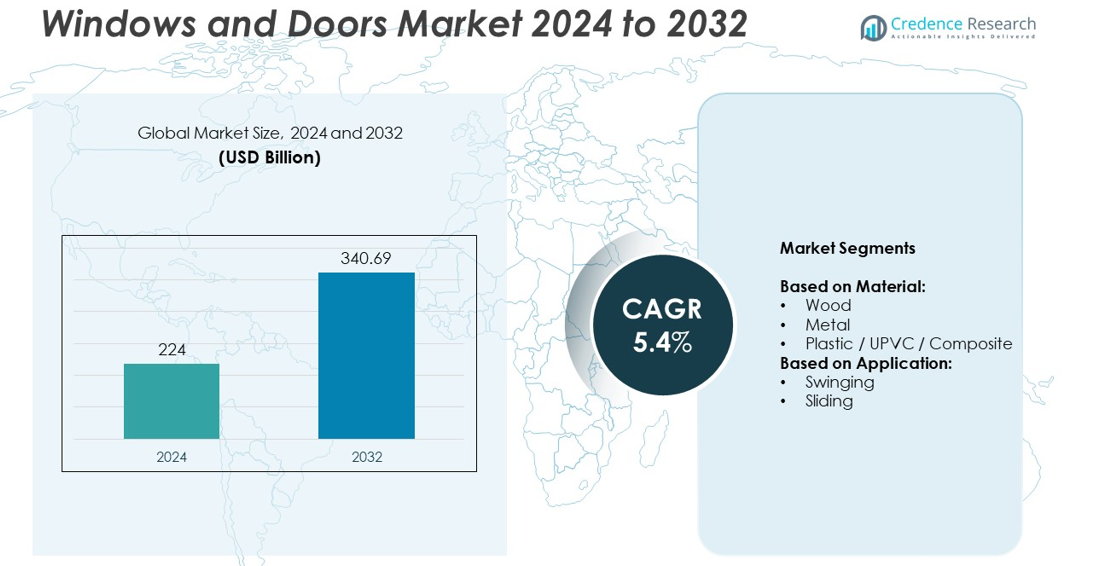
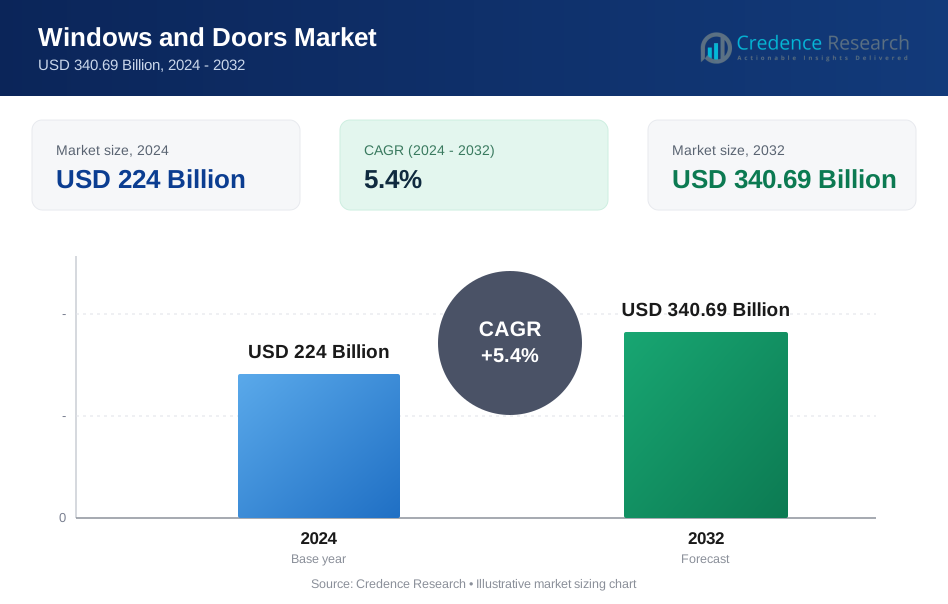
Windows and Doors market size was valued USD 224 Billion in 2024 and is anticipated to reach USD 340.69 Billion by 2032, at a CAGR of 5.4% during the forecast period.
| REPORT ATTRIBUTE | DETAILS |
|---|---|
| Historical Period | 2020-2023 |
| Base Year | 2024 |
| Forecast Period | 2025-2032 |
| Windows and Doors Market Size 2024 | USD 224 Billion |
| Windows and Doors Market, CAGR | 5.4% |
| Windows and Doors Market Size 2032 | USD 340.69 Billion |
Key players in the windows and doors market include Jeld-Wen Holding Inc., Weru GmbH, Pella Corporation, YKK, Andersen Corporation, Masonite, Atrium Corporation, Masco, Ply Gem, and PGT. These companies compete by focusing on product innovation, energy-efficient solutions, and expanding global distribution networks. They invest in advanced glazing technologies, sustainable materials, and smart home integration to meet regulatory standards and consumer preferences. North America led the market with over 35% share in 2024, driven by strong residential construction and renovation activities. Europe followed with nearly 30% share, supported by stringent energy-efficiency regulations and renovation programs.
Market Insights
- The windows and doors market was valued at USD 224 Billion in 2024 and is projected to reach USD 340.69 Billion by 2032, growing at a CAGR of 5.4%.
- Rising urbanization, housing construction, and government incentives for green buildings are major drivers boosting demand.
- Trends include the adoption of energy-efficient triple-glazed products, thermally broken aluminum profiles, and smart automated doors and windows.
- The market is competitive with players focusing on product innovation, sustainable materials, and strategic mergers to expand their presence.
- North America leads with over 35% share, followed by Europe with nearly 30%, while metal windows and doors dominate material segments with more than 45% share globally.
Market Segmentation Analysis:
By Material
Metal windows and doors dominated the market in 2024, accounting for over 45% of the total share. Their strength, durability, and resistance to warping or cracking make them highly preferred in residential and commercial buildings. Aluminum frames, a key metal sub-segment, are popular for their corrosion resistance and sleek design, especially in urban and coastal regions. Rising adoption of thermally broken aluminum profiles supports energy efficiency and compliance with green building standards. Growth in smart cities and infrastructure development continues to drive demand for metal products, keeping them the leading choice among all material types.
- For instance, Asia Aluminum Group (AAG), based in Guangdong, China, was once a very large aluminum extrusion and fabrication group with an annual production capacity exceeding 600,000 metric tons.
By Application
Swinging windows and doors held the largest share, exceeding 60% in 2024, driven by their wide use in residential and commercial spaces. Their simple operation, cost-effectiveness, and compatibility with various designs make them a preferred solution. Demand is supported by rising home renovations, increased construction of single-family homes, and energy-efficient hinged door designs. Weather-sealed swinging doors also improve insulation and lower energy costs, appealing to eco-conscious buyers. The sliding segment grows steadily, favored in urban apartments for space-saving benefits, but swinging systems remain dominant due to their broader application and replacement demand.
- For instance, Since its founding in 1935, the Hörmann Group has delivered more than 20 million doors worldwide, a number higher than the 15 million cited. The company is Europe's leading door supplier and manufactures products for both residential and commercial properties, including a variety of hinged (swinging) doors.
Market Overview
Rising Urbanization and Housing Development
Rapid urbanization drives demand for residential and commercial spaces, boosting the need for windows and doors. Growing populations in emerging economies lead to increased housing construction and infrastructure projects. Smart city initiatives and government-backed affordable housing programs further accelerate installations. The market benefits from a shift toward modern, energy-efficient structures that require advanced materials and glazing solutions. This is the key growth driver shaping overall market expansion and influencing product innovations, particularly in metal and energy-efficient door and window solutions.
- For instance, Western Extrusions issues an environmental product declaration for 1 metric ton of thermally improved aluminum extrusion products (painted and anodized), providing transparency for builders and regulators.
Focus on Energy Efficiency and Sustainability
Energy efficiency regulations and green building standards are fueling demand for insulated windows and thermally efficient doors. Consumers prefer double- and triple-glazed windows that reduce energy loss and help lower utility bills. Builders and contractors integrate eco-friendly materials and low-emission coatings to comply with LEED certifications and regional mandates. Manufacturers are also investing in recyclable materials and energy-saving solutions, aligning with global sustainability goals. This shift creates a long-term growth path and enhances adoption across residential, commercial, and institutional projects worldwide.
- For instance, Since its founding in 1996, Wellste has been exporting aluminum profiles and now produces custom windows and doors for a wide range of projects, including small renovations. The company states a minimum order quantity (MOQ) as low as 6 square meters for some window products.
Home Renovation and Remodeling Activities
Rising disposable incomes and lifestyle upgrades drive demand for home renovation and remodeling, especially in developed markets. Consumers are replacing old windows and doors with modern designs that offer better aesthetics, insulation, and security. Government incentives and tax credits for energy-efficient upgrades encourage homeowners to invest in advanced solutions. The trend supports a steady replacement cycle, contributing significantly to market growth. Manufacturers leverage this demand with customizable, ready-to-install products designed for faster installation and reduced labor costs.
Key Trends & Opportunities
Integration of Smart and Automated Solutions
The market is witnessing growth in smart windows and automated doors equipped with IoT and sensor technology. These systems offer features such as remote locking, light control, and energy management through connected devices. Builders integrate such solutions into smart homes and commercial facilities to improve convenience and security. Rising adoption of AI-driven building automation creates opportunities for manufacturers offering digitally enabled products. This is a key trend and opportunity expected to redefine competition and product differentiation in coming years.
- For instance, View, Inc. manufactures smart electrochromic glass panels that can vary tint up to 99% visible light blockage via app or building management systems.
Growth of uPVC and Composite Materials
uPVC and composite windows and doors are gaining traction due to their affordability, low maintenance, and resistance to moisture and termites. They offer better thermal efficiency and are available in various finishes that mimic wood or metal, appealing to cost-sensitive consumers. Their increasing adoption in mid-range housing projects creates growth opportunities, particularly in Asia-Pacific and Latin America. Manufacturers focusing on recyclable uPVC and composite materials benefit from sustainability-driven purchasing decisions and the growing preference for long-lasting, lightweight solutions.
- For instance, ETEM S.A. was founded in Greece in 1971. For many years, it operated two production facilities: one in Greece and one in Bulgaria, with a combined annual capacity exceeding 40,000 metric tons for aluminum profiles. However, in April 2023, ETEM completed a merger with COSMOS Aluminum S.A.. The new, merged company now operates with a combined production capacity exceeding 70,000 metric tons of aluminum profiles and has continued to develop ETEM's architectural systems brand, particularly in the Balkans and Ukraine.
Key Challenges
Volatility in Raw Material Prices
Fluctuations in prices of key raw materials such as aluminum, steel, and PVC pose a significant challenge. Rising input costs directly impact manufacturing margins and final product prices, limiting affordability for end-users. Frequent price changes make long-term contracts difficult and affect project budgeting for construction companies. This is a key challenge that pushes manufacturers to explore cost optimization strategies and diversify their supplier base to manage risks.
High Installation and Maintenance Costs
Premium windows and doors with advanced glazing or smart features come with higher installation and maintenance costs. This increases the total cost of ownership and can deter adoption, especially in price-sensitive markets. Skilled labor shortages in some regions further raise installation expenses and project delays. Addressing this challenge requires manufacturers to offer modular designs and faster installation systems that reduce labor dependency and overall costs.
Regional Analysis
North America
North America held over 35% of the windows and doors market share in 2024, driven by robust residential construction and renovation activities. The U.S. leads the region with strong demand for energy-efficient and impact-resistant windows supported by federal tax credits and stringent building codes. Rising investments in commercial infrastructure, including offices and healthcare facilities, further boost demand. Canada contributes with growth in urban housing and adoption of triple-glazed products for energy conservation in cold climates. Key players focus on premium and smart solutions to meet consumer preferences for durability, security, and advanced insulation performance.
Europe
Europe accounted for nearly 30% of the market share in 2024, supported by strict energy efficiency regulations such as the EU Green Deal. Countries like Germany, the UK, and France witness strong demand for triple-glazed windows and thermally broken frames in residential and commercial sectors. Renovation programs under EU funding encourage replacement of older installations with sustainable products. Demand for wood-framed windows remains high in Northern Europe due to aesthetic preferences and thermal insulation. Manufacturers increasingly adopt recyclable materials and low-emission coatings to comply with environmental norms and attract eco-conscious consumers in mature markets.
Asia-Pacific
Asia-Pacific captured over 25% of the global market share in 2024, with China and India driving growth through large-scale urbanization and housing projects. Rising disposable incomes and rapid infrastructure development fuel adoption of modern metal and uPVC frames. Government initiatives for smart cities and green buildings support demand for energy-efficient solutions. Japan and South Korea contribute with innovations in smart and automated systems, catering to tech-savvy consumers. The region presents lucrative opportunities for manufacturers as construction activity surges, particularly in affordable housing and commercial spaces, boosting volume sales across multiple material and application segments.
Latin America
Latin America represented around 6% of the market share in 2024, led by Brazil and Mexico with increasing residential construction and government-backed housing programs. The growing middle-class population supports demand for affordable uPVC and composite windows. Rising investments in commercial spaces and hospitality infrastructure also create opportunities for market expansion. However, economic fluctuations and high import dependency for raw materials can affect growth rates. Local players focus on cost-effective solutions to compete with international brands, while demand for energy-efficient and weather-resistant products gradually increases in regions prone to extreme weather conditions.
Middle East & Africa
Middle East and Africa accounted for nearly 4% of the market share in 2024, driven by infrastructure development in GCC nations and urbanization in African economies. Demand is supported by large-scale commercial projects, including hotels, malls, and office complexes. Aluminum and metal frames dominate due to their durability in hot climates and low maintenance needs. South Africa and Nigeria see growing adoption of uPVC windows in residential projects. Increasing focus on sustainable building practices and energy efficiency creates opportunities for advanced glazing solutions, although market growth is moderated by economic instability in parts of the region.
Market Segmentations:
By Material:
- Wood
- Metal
- Plastic / UPVC / Composite
By Application:
- Swinging
- Sliding
By Geography:
- North America
- U.S.
- Canada
- Mexico
- Europe
- UK
- France
- Germany
- Italy
- Spain
- Russia
- Rest of Europe
- Asia Pacific
- China
- Japan
- South Korea
- India
- Australia
- Southeast Asia
- Rest of Asia Pacific
- Latin America
- Brazil
- Argentina
- Rest of Latin America
- Middle East
- GCC Countries
- Israel
- Turkey
- Rest of Middle East
- Africa
- South Africa
- Egypt
- Rest of Africa
Competitive Landscape
Key players in the windows and doors market include Jeld-Wen Holding Inc. (U.S.), Weru GmbH (Germany), Pella Corporation (U.S.), YKK (Japan), Andersen Corporation (U.S.), Masonite (U.S.), Atrium Corporation (U.S.), Masco (U.S.), Ply Gem (U.S.), and PGT (U.S.). The market is highly competitive, with companies focusing on innovation, product differentiation, and expanding their distribution networks. Manufacturers invest heavily in energy-efficient solutions, sustainable materials, and advanced glazing technologies to meet regulatory requirements and rising consumer demand. Strategic initiatives such as mergers, acquisitions, and partnerships strengthen market presence and enhance global reach. Digitalization, smart home integration, and customized product offerings are emerging as key areas of focus. Leading players also emphasize operational efficiency and cost optimization to remain competitive, while catering to both mass-market and premium segments through diversified product portfolios and tailored solutions for residential, commercial, and institutional construction projects.
Key Player Analysis
- Jeld-Wen Holding Inc. (U.S.)
- Weru GmbH (Germany)
- Pella Corporation (U.S.)
- YKK (Japan)
- Andersen Corporation (U.S.)
- Masonite (U.S.)
- Atrium Corporation (U.S.)
- Masco (U.S.)
- Ply Gem (U.S.)
- PGT (U.S.)
Recent Developments
- In 2025, JELD-WEN Holding Inc. (U.S.), expanded its Cradle to Cradle certification across Europe, adding several exterior doors and frames across five countries.
- In 2025, Andersen Corporation (U.S.), published its “2025 Home and Design Trends” report spotlighting sustainability, adaptability, and bold design revivals.
- In 2025, Pella Corporation,acquired Weather Shield to accelerate its growth in the premium window and door market, expanding its product range of architectural wood and aluminum solutions.
Report Coverage
The research report offers an in-depth analysis based on Material, Application and Geography. It details leading market players, providing an overview of their business, product offerings, investments, revenue streams, and key applications. Additionally, the report includes insights into the competitive environment, SWOT analysis, current market trends, as well as the primary drivers and constraints. Furthermore, it discusses various factors that have driven market expansion in recent years. The report also explores market dynamics, regulatory scenarios, and technological advancements that are shaping the industry. It assesses the impact of external factors and global economic changes on market growth. Lastly, it provides strategic recommendations for new entrants and established companies to navigate the complexities of the market.
Future Outlook
- The market will grow steadily driven by urbanization and rising housing construction.
- Energy-efficient and sustainable windows and doors will see strong demand across regions.
- Smart and automated solutions will gain wider adoption in residential and commercial spaces.
- uPVC and composite materials will expand due to low maintenance and durability benefits.
- Renovation and remodeling activities will continue to fuel replacement demand worldwide.
- Asia-Pacific will remain the fastest-growing region supported by infrastructure development.
- Manufacturers will invest more in recyclable materials and eco-friendly production processes.
- Premium and customizable designs will gain traction among high-end consumers.
- Strategic partnerships and acquisitions will shape competition and global market presence.
- Digital sales channels and online customization tools will become major growth enablers.
Request a Free Sample
Fill in your details and we'll send you a free sample report.
- Sample data tables & charts
- Research methodology
Need a Custom Version of This Report?
Tailor the scope, geography, or segments to your exact requirements.
- Custom geography or segment scope
- Direct access to our analyst team
Frequently Asked Questions
What is the current market size for Windows and Doors market, and what is its projected size in 2032?
At what Compound Annual Growth Rate is the Windows and Doors market projected to grow between 2025 and 2032?
Which Windows and Doors market segment held the largest share in 2024?
What are the primary factors fueling the growth of the Windows and Doors market?
5Who are the leading companies in the Windows and Doors market?
Table of Content
Chapter 1. Report Introduction
- 1.1 Report Description & Purpose
- 1.1.1 Report Title & Market Definition
- 1.1.2 Unique Selling Propositions (USP) & Key Differentiators
- 1.1.3 Value Proposition for Stakeholders
- 1.2 Research Objectives
- 1.2.1 Market Sizing Objectives (Volume & Revenue)
- 1.2.2 Segmentation Objectives
- 1.2.3 Competitive Intelligence Objectives
- 1.2.4 Forecast & Scenario Objectives
- 1.3 Report Scope
- 1.3.1 Windows and Doors Scope – Types & Subtypes Covered
- 1.3.2 Geographic Scope – Regions & Countries Covered
- 1.3.3 Historical Period, Base Year & Forecast Period (2024; forecast to 2032)
- 1.3.4 Inclusions & Exclusions
- 1.4 HS Code & Classification Framework
- 1.5 Currency, Units & Pricing Basis
- 1.6 Target Stakeholders
- 1.7 Limitations & Assumptions
Chapter 2. Executive Summary
- 2.1 Global Windows and Doors Market Snapshot
- 2.1.1 Market Size – Historical (2024) & Forecast (2024-2032) (2024: USD 224 Billion → 2032: USD 340.69 Billion)
- 2.1.2 Volume & Revenue – Global Totals
- 2.1.3 Key Market Highlights – Top Five Facts
- 2.2 Windows and Doors Market Segmentation Snapshot
- 2.2.1 Market Split by Region – 2024 vs. 2032
- 2.3 Competitive Snapshot
- 2.3.1 Top 10 Players by Revenue Share – 2024
- 2.3.2 Top 10 Players by Volume Share – 2024
- 2.3.3 Recent Strategic Developments (18-Month Summary)
- 2.4 Key Investment Highlights & Strategic Conclusions
Chapter 3. Windows and Doors Market Dynamics & Industry Analysis
- 3.1 Market Overview & Context
- 3.1.1 Windows and Doors Market Position in the Broader Automotive Value Chain
- 3.1.2 OEM vs. Replacement Market Dynamics
- 3.1.3 Market Maturity & Development Stage by Region
- 3.2 Windows and Doors Market Drivers
- 3.3 Windows and Doors Market Restraints & Challenges
- 3.4 Windows and Doors Market Opportunities
- 3.5 Porter's Five Forces Analysis
- 3.5.1 Threat of New Entrants
- 3.5.2 Bargaining Power of Suppliers
- 3.5.3 Bargaining Power of Buyers
- 3.5.4 Threat of Substitutes
- 3.5.5 Competitive Rivalry – Intensity Assessment
- 3.6 Windows and Doors Value Chain Analysis
- 3.6.1 Upstream – Raw Material/Input Suppliers
- 3.6.1.1 Raw Material/Input 1
- 3.6.1.2 Raw Material/Input 2
- 3.6.1.3 Raw Material/Input 3
- 3.6.2 Midstream – Production/Manufacturing/Service Delivery
- 3.6.2.1 Production/Process Overview
- 3.6.2.2 Key Facility Locations & Capacity by Manufacturer
- 3.6.3 Downstream – Distribution & End Consumer
- 3.6.3.1 Primary Channel – B2B/OEM
- 3.6.3.2 Secondary Channels – Dealer, Retail, Online, Direct
- 3.6.4 Value Chain Profitability Analysis
- 3.6.1 Upstream – Raw Material/Input Suppliers
- 3.7 PESTEL Analysis
- 3.7.1 Political Factors
- 3.7.2 Economic Factors
- 3.7.3 Social Factors
- 3.7.4 Technological Factors
- 3.7.5 Environmental Factors
- 3.7.6 Legal Factors
- 3.8 Windows and Doors Supply Chain Analysis
- 3.8.1 Raw Material/Input Supply Risk Assessment
- 3.8.2 Manufacturing Concentration Risk (Geographic Exposure)
- 3.8.3 Trade Disruption Impact Analysis
- 3.9 Regulatory & Policy Landscape
Note: The regulatory and policy landscape section covers regulations based on their applicability to the market, Windows and Doors category, geography, and scope of the study. Only regulatory frameworks with a material impact on operations, compliance, trade, sustainability, or market access are analyzed in detail.
Chapter 4. Key Investment Pockets & Opportunity Analysis
- 4.1 Windows and Doors Market Attractiveness Analysis
- 4.1.1 By Region – Investment Attractiveness Matrix (Volume × CAGR)
- 4.2 Absolute Revenue Growth Opportunity
- 4.2.1 By Region – Absolute USD Growth Through 2032
- 4.3 Incremental Volume Opportunity
- 4.3.1 By Region – Incremental Volume Through 2032
- 4.3.2 Segment – Incremental Volume
- 4.4 Emerging Submarket Opportunity Deep Dive (Subject to Applicability)
- 4.5 Emerging Market Opportunity Scorecards
- 4.5.1 United States
- 4.5.2 Europe
- 4.5.3 Asia
- 4.5.4 Middle East & Africa
Note: Emerging Market Opportunity Scorecards will be included based on relevance and strategic importance. Regions listed are indicative and may vary depending on data availability and market dynamics.
Chapter 5. Windows and Doors Import-Export Analysis & Trade Flows
- 5.1 Global Trade Overview
- 5.1.1 Global Export Value by Country (2024)
- 5.1.2 Global Export Volume by Country (2024)
- 5.1.3 Global Import Value by Country (2024)
- 5.1.4 Global Import Volume by Country (2024)
- 5.1.5 Net Trade Balance by Country (2024)
- 5.2 Export Analysis – Segment
- 5.2.1 Type 1 (HS Code)
- 5.2.2 Type 2 (HS Code)
- 5.2.3 Type 3 (HS Code)
- 5.2.4 Type 4 (HS Code)
- 5.2.5 Type 5 (HS Code)
- 5.3 Import Analysis – Segment
- 5.3.1 Type 1 (HS Code)
- 5.3.2 Type 2 (HS Code)
- 5.3.3 Type 3 (HS Code)
- 5.3.4 Type 4 (HS Code)
- 5.3.5 Type 5 (HS Code)
- 5.4 Average Unit Trade Prices
- 5.4.1 Average Export Price – Segment & Country
- 5.4.2 Average Import Price – Segment & Source Country
- 5.4.3 Price Trends (2024)
- 5.5 Key Trade Route Analysis
- 5.5.1 Trade Route 1
- 5.5.2 Trade Route 2
- 5.5.3 Trade Route 3
- 5.5.4 Trade Route 4
- 5.5.5 Trade Route 5
- 5.6 Trade Policy Impact Assessment
- 5.6.1 US Anti-Dumping & Section 301 Tariffs
- 5.6.2 EU Customs Union Impact
- 5.6.3 Major Free Trade Agreements
- 5.6.4 USMCA Rules of Origin
Note: Trade policy analysis will be included only where relevant to the Windows and Doors market.
Chapter 6. Competitive Landscape & Company Benchmarking
- 6.1 Windows and Doors Market Concentration & Structure
- 6.1.1 Herfindahl-Hirschman Index (HHI) – vs. 2024
- 6.1.2 Tier 1, Tier 2 & Tier 3 Market Structure
- 6.1.3 Global, Regional & Local Player Dynamics
- 6.2 Windows and Doors Market Share Analysis – 2024
- 6.2.1 Global Revenue Share by Company
- 6.2.2 Global Volume Share by Company
- 6.2.3 Regional Revenue Share
- 6.2.4 Market Share Evolution ( vs. 2024)
- 6.2.5 OEM Segment Share by Company
- 6.2.6 Replacement Segment Share by Company
- 6.3 Production/Delivery Capacity & Facility Analysis
- 6.3.1 Global Installed Capacity
- 6.3.2 Capacity Utilization Rates
- 6.3.3 Production/Output Volume
- 6.3.4 Facility Locations & Capacity Map
- 6.3.5 Planned Capacity Additions
- 6.4 Windows and Doors Competitive Benchmarking Matrix
- 6.4.1 Revenue, Volume, CAGR & Profitability Comparison
- 6.4.2 Channel Revenue Mix
- 6.4.3 Geographic Revenue Exposure
- 6.4.4 R&D Intensity
- 6.4.5 Sustainability Maturity
- 6.5 Strategic Developments in Windows and Doors (Last 24 Months)
- 6.5.1 Mergers, Acquisitions & Divestments
- 6.5.2 New Windows and Doors Launches
- 6.5.3 Facility Expansions
- 6.5.4 Strategic Alliances, Joint Ventures & Partnerships
- 6.5.5 Distribution Expansion & Market Entry
- 6.5.6 Sustainability & ESG Initiatives
- 6.6 Competitive Strategy Mapping
- 6.6.1 Leader, Challenger, Follower & Niche Classification
- 6.6.2 Pricing Strategy Comparison
- 6.6.3 Channel Strategy Matrix
Note: Strategic developments are included based on their materiality and the availability of reliable information.
Chapter 7. Global Windows and Doors Market – By Distribution Channel
- 7.1 Segment Overview
- 7.1.1 Volume & Revenue Split by Channel (2024 & 2032)
- 7.1.2 Channel Mix Evolution (2024-2032)
Chapter 8. Regional Market Analysis – Global Overview
- 8.1 Global Regional Overview
- 8.1.1 Regional Volume Share
- 8.1.2 Regional Revenue Share
- 8.1.3 Regional Volume by Region
- 8.1.4 Regional Revenue by Region
- 8.1.5 Regional Forecast Through 2032
- 8.2 Cross-Regional Segment Analysis
- 8.2.1 By Distribution Channel
- 8.2.2 By Brand/Price Tier
Chapter 9. North America Windows and Doors Market
- 9.1 United States
- 9.2 Canada
- 9.3 Mexico
Chapter 10. Europe Windows and Doors Market
- 10.1 Germany
- 10.2 France
- 10.3 Italy
- 10.4 United Kingdom
- 10.5 Spain
- 10.6 Poland
- 10.7 Russia
- 10.8 Netherlands
- 10.9 Belgium
- 10.10 Sweden
- 10.11 Denmark
- 10.12 Norway
- 10.13 Rest of Europe
Chapter 11. Asia Pacific Windows and Doors Market
- 11.1 China
- 11.2 India
- 11.3 Japan
- 11.4 South Korea
- 11.5 Thailand
- 11.6 Indonesia
- 11.7 Vietnam
- 11.8 Malaysia
- 11.9 Australia
- 11.10 Rest of Asia Pacific
Chapter 12. Latin America Windows and Doors Market
- 12.1 Brazil
- 12.2 Argentina
- 12.3 Colombia
- 12.4 Chile
- 12.5 Rest of Latin America
Chapter 13. Middle East Windows and Doors Market
- 13.1 Saudi Arabia
- 13.2 United Arab Emirates
- 13.3 Turkey
- 13.4 Israel
- 13.5 Iran
- 13.6 Rest of the Middle East
Chapter 14. Africa Windows and Doors Market
- 14.1 South Africa
- 14.2 Egypt
- 14.3 Nigeria
- 14.4 Morocco
- 14.5 Rest of Africa
Chapter 15. Windows and Doors Company Profiles
- 15.1 [Company 01]
- 15.1.1 Company Overview
- 15.1.2 Key Management Personnel
- 15.1.3 Products & Services Portfolio
- 15.1.4 Financial Performance
- 15.1.5 Key Market Focus & Geographic Presence
- 15.1.6 Recent Developments & Strategic Initiatives
Note: The company profile list is preliminary and may change based on research findings, market developments, data availability, and client requirements.
Chapter 16. Appendices
- Appendix A – List of Abbreviations & Acronyms
- Appendix B – Industry Classification Code Reference – Full Series
- Appendix C – Production & Capacity Data Tables
- Appendix D – End-Use & Demand Base Tables
- Appendix E – Consumption & Replacement Rate Assumptions
- Appendix F – ASP Reference Tables
- Appendix G – Manufacturing & Facility Database
- Appendix H – Import-Export Data Tables
- Appendix I – Regulatory Summary Tables
- Appendix J – Primary Research Participant List (Anonymized)
- Appendix K – Primary Research Questionnaire Framework
- Appendix L – Data Sources & Bibliography
- Appendix M – Market Size Divergence & Source Comparison
Chapter 17. Research Methodology
- 17.1 Research Framework & Philosophy
- 17.2 Secondary Research – Sources, Hierarchy & Data Extraction
- 17.3 Data Modeling – Bottom-Up & Top-Down Market Sizing
- 17.4 Primary Research – Stakeholder Framework, LOI & Sample Sizes
- 17.5 Forecast Methodology – Regression, Scenario & Sensitivity Analysis
- 17.6 Quality Control – Four-Layer Validation Framework
- 17.7 Limitations & Standard Assumptions
- 17.8 Disclaimer
