
Market Overview:
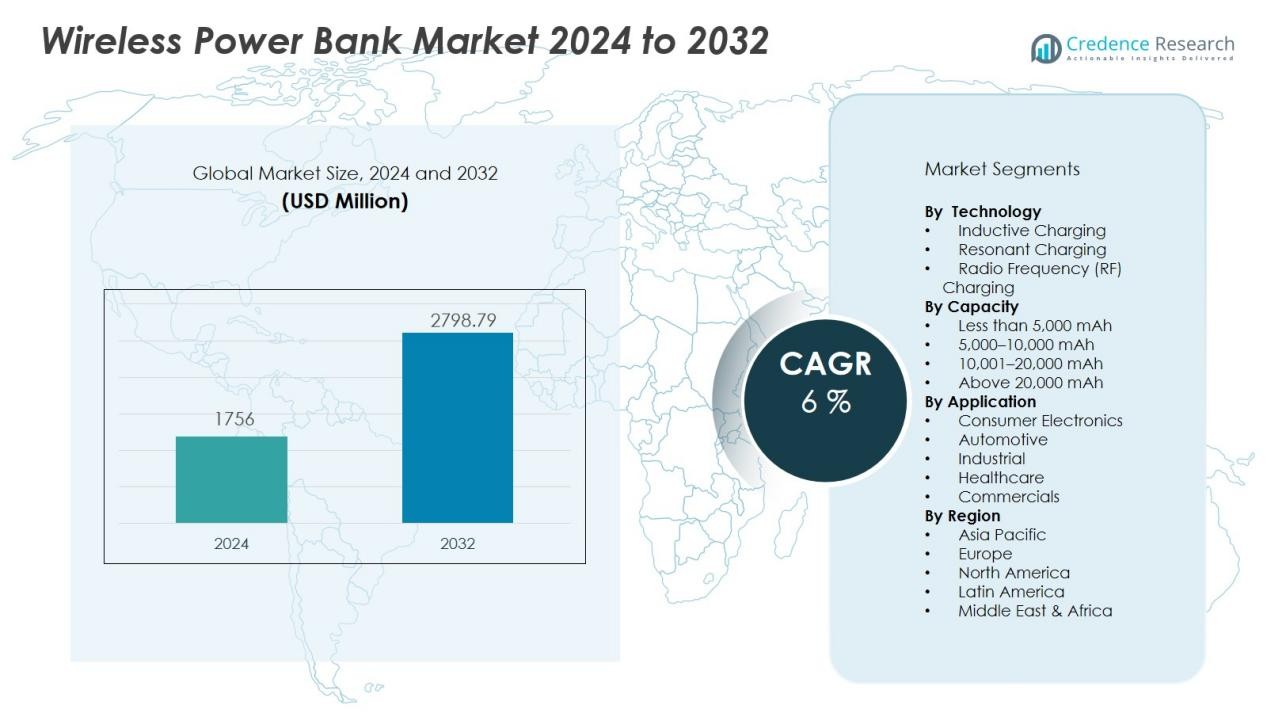
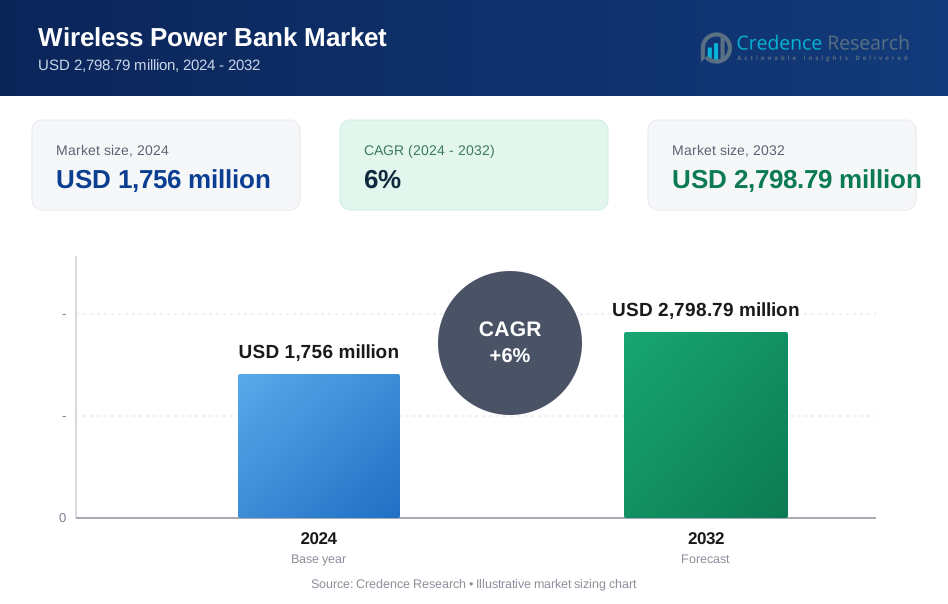
The wireless power bank market size was valued at USD 1756 million in 2024 and is anticipated to reach USD 2798.79 million by 2032, at a CAGR of 6 % during the forecast period (2024-2032).
| REPORT ATTRIBUTE | DETAILS |
|---|---|
| Historical Period | 2020-2024 |
| Base Year | 2024 |
| Forecast Period | 2025-2032 |
| Wireless Power Bank Market Size 2024 | USD 1756 Million |
| Wireless Power Bank Market, CAGR | 6 % |
| Wireless Power Bank Market Size 2032 | USD 2798.79 Million |
Key market drivers include the increasing need for convenient, cable-free charging and the rising penetration of wireless-enabled smart devices worldwide. Growing consumer preference for fast-charging and high-capacity power banks further stimulates demand. The integration of advanced safety features, improved charging efficiency, and compatibility with multiple device brands enhances product appeal. In addition, evolving lifestyles and greater mobility among consumers, particularly in urban areas, are prompting a shift toward portable and reliable charging options.
Regionally, Asia-Pacific dominates the wireless power bank market, supported by high smartphone adoption rates, rapid urbanization, and the presence of leading electronics manufacturers. North America and Europe follow, fueled by strong consumer purchasing power and early adoption of new technologies. Meanwhile, emerging economies in Latin America and the Middle East & Africa are witnessing growing demand, as digital connectivity expands and wireless charging awareness rises.
Market Insights:
- The wireless power bank market was valued at USD 1,756 million in 2024 and is projected to reach USD 2,798.79 million by 2032, driven by a CAGR of 6% from 2024 to 2032.
- Rapid growth in wireless-enabled devices, such as smartphones, smartwatches, and earbuds, is a key driver, making wireless charging a standard feature in modern consumer electronics.
- Rising consumer demand for convenience, mobility, and cable-free solutions fuels the shift toward wireless power banks, especially among urban users and frequent travelers.
- Ongoing advances in battery technology and integration of safety features enhance product reliability, efficiency, and consumer trust in wireless charging solutions.
- Compatibility issues and a lack of universal standards across wireless charging protocols present development challenges and may affect user experience.
- Intense price competition from unorganized players and concerns over product quality highlight the importance of certified, safe, and reliable brands.
- Asia-Pacific leads the market, holding over 45% share, supported by strong manufacturing capabilities, high smartphone adoption, and rapid innovation, while North America and Europe follow with high technology uptake and a focus on quality and sustainability.
Market Drivers:
Rapid Expansion of Wireless-Enabled Device Ecosystem Fuels Market Growth:
The surge in wireless-enabled devices, including smartphones, smartwatches, earbuds, and tablets, drives the wireless power bank market. Manufacturers continue to embed wireless charging capabilities in new product models, making wireless power transfer a standard feature for modern consumer electronics. This growing compatibility propels consumer demand for wireless power banks that offer hassle-free charging experiences. The widespread shift toward wireless accessories supports consistent market growth and pushes innovation across power bank product lines.
Growing Consumer Demand for Convenience and Mobility Enhances Product Appeal:
Consumers seek portable charging solutions that eliminate the need for cables and multiple adapters. The wireless power bank market benefits from the rising preference for minimalistic, cable-free lifestyles, particularly among urban populations and frequent travelers. It offers quick, on-the-go charging for multiple device types, streamlining the user experience. Convenience remains a primary factor influencing consumer purchasing decisions in the portable power segment.
Advances in Battery Technology and Safety Features Increase Market Confidence:
Recent advancements in battery chemistry, fast-charging protocols, and integrated safety features enhance the performance and reliability of wireless power banks. It now delivers higher charging efficiency, longer battery life, and improved thermal management, which addresses concerns about overheating and device safety. These technological improvements foster greater consumer trust and drive repeat purchases in the wireless power bank market. The focus on product reliability supports sustained adoption rates worldwide.
- For instance, EcoFlow’s RAPID Magnetic Power Bank features a real-time temperature sensor that monitors thermal levels 50 times per second—exceeding 4 million checks per day—to proactively prevent overheating and maintain battery safety and performance.
Influence of Digital Lifestyles and Mobile-First Behavior Promotes Adoption:
Rising dependence on smartphones and digital devices for both work and leisure fuels continuous power requirements. It positions wireless power banks as essential accessories for users who rely on uninterrupted connectivity throughout the day. The wireless power bank market responds to evolving digital habits by offering innovative, multi-functional charging solutions tailored for mobile-first consumers. Shifting lifestyle patterns and increased device usage ensure sustained momentum for market expansion.
- For instance, ZMI’s LevPower M10 (WPB100) packs a 10,000 mAh (37 Wh) battery supporting 18 W USB-C PD bi-directional fast charging—recharging itself fully in 4 hours—and delivers up to 10 W Qi wireless output for Samsung and other Qi-enabled devices.
Market Trends:
Integration of Fast-Charging and Multi-Device Capabilities Defines Next-Generation Products:
Fast-charging technology is becoming a defining feature in the wireless power bank market, with brands introducing products that deliver higher wattages and rapid energy transfer for smartphones, tablets, and wearables. It now supports simultaneous charging of multiple devices through both wireless pads and wired ports, meeting the evolving needs of users who carry several gadgets daily. Power banks increasingly incorporate compatibility with popular fast-charging protocols such as Qualcomm Quick Charge and USB Power Delivery. These advancements enable consumers to charge devices more efficiently during short periods of downtime. Compact and lightweight form factors with advanced circuitry also allow for increased portability and convenience. Companies focus on developing all-in-one power banks to strengthen their competitive positioning and attract a broader customer base.
- For instance, the Satechi Duo Wireless Charger Power Stand can simultaneously charge three devices—two wirelessly and one via USB-C PD, with a maximum combined output of 20W, and a 10,000mAh capacity that can fully charge most phones up to three times.
Adoption of Sustainable Materials and Smart Features Gains Traction in Product Development:
Environmental sustainability shapes product innovation in the wireless power bank market, with manufacturers prioritizing the use of recycled plastics, eco-friendly packaging, and energy-efficient designs. It responds to growing consumer interest in green electronics and responsible consumption. Smart features such as battery health monitoring, overcharge protection, and wireless auto-detection are now standard in many new models, delivering a safer and more intuitive user experience. Brands leverage these technologies to differentiate their products and address regulatory pressures around electronic waste. The trend toward sleek, customizable designs also allows users to express their personal style while choosing sustainable technology. The combination of smart, sustainable, and aesthetically pleasing products defines the new direction for market leaders.
- For instance, at CES 2025 Belkin unveiled its BoostCharge Pro lineup featuring housings made with up to 90 percent recycled plastics, reducing virgin plastic use by nearly 1,200 tonnes across global production.
Market Challenges Analysis:
Product Standardization and Compatibility Issues Restrain Market Expansion:
A lack of universal standards across wireless charging technologies creates compatibility challenges for the wireless power bank market. It faces obstacles when integrating with diverse devices that use different charging protocols, such as Qi and proprietary solutions. Consumers often encounter inconsistent charging speeds or failure to connect, reducing user satisfaction and hindering repeat purchases. This fragmentation complicates product development and increases costs for manufacturers. Industry-wide efforts to establish common protocols will play a critical role in resolving these issues. Until then, inconsistent performance may slow market adoption.
Intense Price Competition and Quality Concerns Affect Consumer Trust:
Low-cost offerings from unorganized players introduce quality control issues that impact the wireless power bank market. It must contend with a flood of generic products, many of which lack proper certification or advanced safety features. Reports of overheating, short circuits, and battery failures erode consumer confidence and elevate perceived risks. Reputable brands invest in technology and compliance, but price-sensitive markets often opt for less reliable alternatives. Sustaining long-term growth depends on educating consumers about the importance of certified, high-quality products and enforcing stricter regulatory standards.
Market Opportunities:
Expansion into IoT and Wearable Device Charging Unlocks New Growth Avenues:
Emerging demand for Internet of Things (IoT) devices and wearables presents significant opportunities for the wireless power bank market. It can leverage technological advancements to deliver compact, specialized solutions tailored for smartwatches, fitness bands, and wireless earbuds. Brands that offer multi-device compatibility will address the growing ecosystem of connected devices and appeal to tech-savvy consumers. The integration of low-power charging features and intelligent energy management opens doors to new applications beyond traditional smartphones. This approach enables companies to capture untapped market segments and boost product adoption among a wider user base.
Rising Adoption of Wireless Charging in Public and Commercial Spaces Fuels Market Expansion:
The deployment of wireless charging stations in airports, hotels, cafes, and public transport hubs creates fresh opportunities for the wireless power bank market. It aligns with consumer expectations for convenient, always-available power sources in high-traffic environments. Collaborations with commercial property owners and hospitality brands can help power bank manufacturers secure strategic partnerships and diversify revenue streams. Companies that deliver robust, user-friendly, and interoperable solutions will gain a competitive edge. Continued investment in public infrastructure and smart city initiatives will further support the market’s long-term potential.
Market Segmentation Analysis:
By Technology:
The wireless power bank market categorizes technology into inductive, resonant, and radio frequency (RF) based charging. Inductive charging dominates current sales, favored for its established compatibility with most smartphones and consumer devices. Resonant technology is gaining traction due to its ability to support multi-device charging and greater distance between the device and charger. RF-based solutions remain a niche but present potential for future applications where contactless and long-range wireless power transfer become essential.
- For instance, Energous’ WattUp Mid-Field transmitter has demonstrated delivery of 3 W of power at distances up to 15 ft, allowing simultaneous top-ups for multiple wearables and IoT devices.
By Capacity:
Market segmentation by capacity includes less than 5,000 mAh, 5,000–10,000 mAh, 10,001–20,000 mAh, and above 20,000 mAh. Power banks with capacities between 10,001 and 20,000 mAh see the highest demand, offering an optimal balance of portability and multiple device recharges. It responds to the needs of users with high-power smartphones, tablets, and wearables. The segment above 20,000 mAh targets heavy users and those seeking extended use without frequent recharging, while smaller capacities appeal to minimalists and short-trip travelers.
- For Instance, Market segmentation by capacity includes less than 5,000 mAh, 5,000–10,000 mAh, 10,001–20,000 mAh, and above 20,000 mAh.
By Application:
The wireless power bank market serves consumer electronics, automotive, industrial, healthcare, and commercial sectors. Consumer electronics lead usage, with individuals seeking convenience for phones and gadgets. It also finds growth opportunities in automotive and industrial environments where cable-free operation improves efficiency and safety. Healthcare applications are emerging, focusing on powering portable medical equipment and wearables. The commercial segment grows through adoption in hospitality, retail, and public venues, supporting a seamless customer experience.
Segmentations:
By Technology:
- Inductive Charging
- Resonant Charging
- Radio Frequency (RF) Charging
By Capacity:
- Less than 5,000 mAh
- 5,000–10,000 mAh
- 10,001–20,000 mAh
- Above 20,000 mAh
By Application:
- Consumer Electronics
- Automotive
- Industrial
- Healthcare
- Commercial
By Region:
- Asia-Pacific
- North America
- Europe
- Latin America
- Middle East & Africa
Regional Analysis:
Asia-Pacific :
Asia-Pacific commands a market share exceeding 45% in the wireless power bank market, supported by rapid urbanization, high smartphone penetration, and a strong local electronics industry. China, South Korea, and Japan drive innovation, with leading manufacturers continuously launching new products and integrating advanced technologies. The region’s dense population and fast-growing digital economy ensure steady demand for portable charging solutions. It benefits from a vibrant supply chain ecosystem, enabling cost-effective production and swift product rollouts. Local brands leverage their understanding of consumer preferences to introduce diverse, feature-rich offerings. Government initiatives promoting technology adoption further support long-term market growth.
North America :
North America holds a market share of nearly 25%, reflecting strong consumer purchasing power and a culture that embraces new technology trends. The wireless power bank market in this region thrives on early adoption of wireless charging and the popularity of premium smart devices. Leading brands focus on innovation, integrating fast-charging protocols and smart safety features to differentiate their products. It sees widespread usage across professional, travel, and lifestyle segments, creating consistent sales opportunities. Strategic partnerships with e-commerce platforms and retail chains enhance product accessibility and brand visibility. Regulatory frameworks support high quality and safety standards, reinforcing consumer trust.
Europe :
Europe accounts for a market share near 18%, characterized by its strong focus on product sustainability, energy efficiency, and design excellence. The wireless power bank market here benefits from high environmental awareness and demand for eco-friendly consumer electronics. Regional manufacturers introduce products with recyclable materials, advanced safety features, and sleek aesthetics, aligning with evolving consumer expectations. It targets a discerning customer base that values both functionality and style in portable power solutions. Collaboration between technology firms and design houses fosters continual product evolution. The push for sustainable innovation keeps Europe competitive in the global market landscape.
Key Player Analysis:
Competitive Analysis:
The wireless power bank market features strong competition among both established global brands and innovative regional players. Key companies such as Mophie, Xiaomi, Samsung, AUKEY, CHOETECH, RAVPower, and Anker Innovations shape the market landscape by prioritizing product quality, fast-charging capabilities, and user safety features. It sees continuous investment in research and development, allowing brands to introduce advanced battery technologies, multi-device charging, and sleek form factors. Leading players differentiate themselves through robust distribution networks, customer support, and strategic collaborations with smartphone manufacturers. Price competitiveness remains high, especially in Asia-Pacific, where Xiaomi and Anker Innovations command significant market share. Brand loyalty, ongoing product innovation, and certification for international safety standards are critical for sustaining market position and growth.
Recent Developments:
- In March 2025, marked the announcement of a multi-year partnership between Mophie and Oracle Red Bull Racing for the Formula 1 season, introducing co-branded portable power products.
- June 2025 was also when Xiaomi acquired a 485,134-square-meter site in Beijing for 635 million yuan ($88.5 million) as part of its third-phase EV plant expansion.
- In July 2025, highlighted Samsung’s announcement of the acquisition of U.S.-based digital health startup Xealth to bolster its digital health strategy.
Market Concentration & Characteristics:
The wireless power bank market features a moderately concentrated competitive landscape, with several global and regional players vying for market share. Leading companies focus on product differentiation through technological innovation, safety features, and brand reputation. It attracts continuous investment in research and development to address evolving consumer demands for fast charging, portability, and multi-device compatibility. The market also displays strong price competition, especially in Asia-Pacific, where local brands deliver feature-rich solutions at accessible price points. Product certification and quality standards play a pivotal role, as consumers increasingly value reliability and safety. Established brands maintain a competitive edge through robust distribution networks and strategic partnerships.
Report Coverage:
The research report offers an in-depth analysis based on Technology, Capacity, Application and Region. It details leading Market players, providing an overview of their business, product offerings, investments, revenue streams, and key applications. Additionally, the report includes insights into the competitive environment, SWOT analysis, current Market trends, as well as the primary drivers and constraints. Furthermore, it discusses various factors that have driven Market expansion in recent years. The report also explores Market dynamics, regulatory scenarios, and technological advancements that are shaping the industry. It assesses the impact of external factors and global economic changes on Market growth. Lastly, it provides strategic recommendations for new entrants and established companies to navigate the complexities of the Market.
Future Outlook:
- The introduction of next-generation wireless charging standards will boost charging speeds and device compatibility.
- Manufacturers will increasingly offer multi-device power banks, enabling users to charge smartphones, wearables, and earbuds simultaneously.
- Adoption of advanced battery technologies, such as solid-state batteries, will enhance safety, charging efficiency, and product lifespan.
- Integration of AI and IoT features will optimize charging performance and enable smart diagnostics in premium power banks.
- Companies will prioritize sustainable product development, using recycled materials and eco-friendly packaging to meet consumer and regulatory expectations.
- Growth in wireless charging stations and sharing platforms will expand access in public spaces, transport hubs, and commercial venues.
- Research will focus on extending wireless charging range, allowing for more flexible and convenient user experiences.
- Demand for wireless power banks will rise in new segments, including industrial IoT, healthcare devices, and smart infrastructure.
- Industry-wide adoption of global standards and certifications will drive product reliability, interoperability, and consumer trust.
- Competitive differentiation will center on fast-charging, safety features, magnetic alignment, and user-centric designs, targeting both mainstream and early-adopter markets.
Request a Free Sample
Fill in your details and we'll send you a free sample report.
- Sample data tables & charts
- Research methodology
Need a Custom Version of This Report?
Tailor the scope, geography, or segments to your exact requirements.
- Custom geography or segment scope
- Direct access to our analyst team
Frequently Asked Questions
What is the current market size for the wireless power bank market, and what is its projected size in 2032?
At what compound annual growth rate is the wireless power bank market expected to grow between 2024 and 2032?
Which wireless power bank market segment held the largest share in 2024?
What are the primary factors fueling the growth of the wireless power bank market?
Who are the leading companies in the wireless power bank market?
Which region commanded the largest share of the wireless power bank market in 2024?
Table of Content
Chapter 1. Report Introduction
- 1.1 Report Description & Purpose
- 1.1.1 Report Title & Market Definition
- 1.1.2 Unique Selling Propositions (USP) & Key Differentiators
- 1.1.3 Value Proposition for Stakeholders
- 1.2 Research Objectives
- 1.2.1 Market Sizing Objectives (Volume & Revenue)
- 1.2.2 Segmentation Objectives
- 1.2.3 Competitive Intelligence Objectives
- 1.2.4 Forecast & Scenario Objectives
- 1.3 Report Scope
- 1.3.1 Wireless Power Bank Scope – Types & Subtypes Covered
- 1.3.2 Geographic Scope – Regions & Countries Covered
- 1.3.3 Historical Period, Base Year & Forecast Period (2024; forecast to 2032)
- 1.3.4 Inclusions & Exclusions
- 1.4 HS Code & Classification Framework
- 1.5 Currency, Units & Pricing Basis
- 1.6 Target Stakeholders
- 1.7 Limitations & Assumptions
Chapter 2. Executive Summary
- 2.1 Global Wireless Power Bank Market Snapshot
- 2.1.1 Market Size – Historical (2024) & Forecast (2024-2032) (2024: USD 1,756 million → 2032: USD 2,798.79 million)
- 2.1.2 Volume & Revenue – Global Totals
- 2.1.3 Key Market Highlights – Top Five Facts
- 2.2 Wireless Power Bank Market Segmentation Snapshot
- 2.2.1 Market Split by Region – 2024 vs. 2032
- 2.3 Competitive Snapshot
- 2.3.1 Top 10 Players by Revenue Share – 2024
- 2.3.2 Top 10 Players by Volume Share – 2024
- 2.3.3 Recent Strategic Developments (18-Month Summary)
- 2.4 Key Investment Highlights & Strategic Conclusions
Chapter 3. Wireless Power Bank Market Dynamics & Industry Analysis
- 3.1 Market Overview & Context
- 3.1.1 Wireless Power Bank Market Position in the Broader Automotive Value Chain
- 3.1.2 OEM vs. Replacement Market Dynamics
- 3.1.3 Market Maturity & Development Stage by Region
- 3.2 Wireless Power Bank Market Drivers
- 3.3 Wireless Power Bank Market Restraints & Challenges
- 3.4 Wireless Power Bank Market Opportunities
- 3.5 Porter's Five Forces Analysis
- 3.5.1 Threat of New Entrants
- 3.5.2 Bargaining Power of Suppliers
- 3.5.3 Bargaining Power of Buyers
- 3.5.4 Threat of Substitutes
- 3.5.5 Competitive Rivalry – Intensity Assessment
- 3.6 Wireless Power Bank Value Chain Analysis
- 3.6.1 Upstream – Raw Material/Input Suppliers
- 3.6.1.1 Raw Material/Input 1
- 3.6.1.2 Raw Material/Input 2
- 3.6.1.3 Raw Material/Input 3
- 3.6.2 Midstream – Production/Manufacturing/Service Delivery
- 3.6.2.1 Production/Process Overview
- 3.6.2.2 Key Facility Locations & Capacity by Manufacturer
- 3.6.3 Downstream – Distribution & End Consumer
- 3.6.3.1 Primary Channel – B2B/OEM
- 3.6.3.2 Secondary Channels – Dealer, Retail, Online, Direct
- 3.6.4 Value Chain Profitability Analysis
- 3.6.1 Upstream – Raw Material/Input Suppliers
- 3.7 PESTEL Analysis
- 3.7.1 Political Factors
- 3.7.2 Economic Factors
- 3.7.3 Social Factors
- 3.7.4 Technological Factors
- 3.7.5 Environmental Factors
- 3.7.6 Legal Factors
- 3.8 Wireless Power Bank Supply Chain Analysis
- 3.8.1 Raw Material/Input Supply Risk Assessment
- 3.8.2 Manufacturing Concentration Risk (Geographic Exposure)
- 3.8.3 Trade Disruption Impact Analysis
- 3.9 Regulatory & Policy Landscape
Note: The regulatory and policy landscape section covers regulations based on their applicability to the market, Wireless Power Bank category, geography, and scope of the study. Only regulatory frameworks with a material impact on operations, compliance, trade, sustainability, or market access are analyzed in detail.
Chapter 4. Key Investment Pockets & Opportunity Analysis
- 4.1 Wireless Power Bank Market Attractiveness Analysis
- 4.1.1 By Region – Investment Attractiveness Matrix (Volume × CAGR)
- 4.2 Absolute Revenue Growth Opportunity
- 4.2.1 By Region – Absolute USD Growth Through 2032
- 4.3 Incremental Volume Opportunity
- 4.3.1 By Region – Incremental Volume Through 2032
- 4.3.2 Segment – Incremental Volume
- 4.4 Emerging Submarket Opportunity Deep Dive (Subject to Applicability)
- 4.5 Emerging Market Opportunity Scorecards
- 4.5.1 United States
- 4.5.2 Europe
- 4.5.3 Asia
- 4.5.4 Middle East & Africa
Note: Emerging Market Opportunity Scorecards will be included based on relevance and strategic importance. Regions listed are indicative and may vary depending on data availability and market dynamics.
Chapter 5. Wireless Power Bank Import-Export Analysis & Trade Flows
- 5.1 Global Trade Overview
- 5.1.1 Global Export Value by Country (2024)
- 5.1.2 Global Export Volume by Country (2024)
- 5.1.3 Global Import Value by Country (2024)
- 5.1.4 Global Import Volume by Country (2024)
- 5.1.5 Net Trade Balance by Country (2024)
- 5.2 Export Analysis – Segment
- 5.2.1 Type 1 (HS Code)
- 5.2.2 Type 2 (HS Code)
- 5.2.3 Type 3 (HS Code)
- 5.2.4 Type 4 (HS Code)
- 5.2.5 Type 5 (HS Code)
- 5.3 Import Analysis – Segment
- 5.3.1 Type 1 (HS Code)
- 5.3.2 Type 2 (HS Code)
- 5.3.3 Type 3 (HS Code)
- 5.3.4 Type 4 (HS Code)
- 5.3.5 Type 5 (HS Code)
- 5.4 Average Unit Trade Prices
- 5.4.1 Average Export Price – Segment & Country
- 5.4.2 Average Import Price – Segment & Source Country
- 5.4.3 Price Trends (2024)
- 5.5 Key Trade Route Analysis
- 5.5.1 Trade Route 1
- 5.5.2 Trade Route 2
- 5.5.3 Trade Route 3
- 5.5.4 Trade Route 4
- 5.5.5 Trade Route 5
- 5.6 Trade Policy Impact Assessment
- 5.6.1 US Anti-Dumping & Section 301 Tariffs
- 5.6.2 EU Customs Union Impact
- 5.6.3 Major Free Trade Agreements
- 5.6.4 USMCA Rules of Origin
Note: Trade policy analysis will be included only where relevant to the Wireless Power Bank market.
Chapter 6. Competitive Landscape & Company Benchmarking
- 6.1 Wireless Power Bank Market Concentration & Structure
- 6.1.1 Herfindahl-Hirschman Index (HHI) – vs. 2024
- 6.1.2 Tier 1, Tier 2 & Tier 3 Market Structure
- 6.1.3 Global, Regional & Local Player Dynamics
- 6.2 Wireless Power Bank Market Share Analysis – 2024
- 6.2.1 Global Revenue Share by Company
- 6.2.2 Global Volume Share by Company
- 6.2.3 Regional Revenue Share
- 6.2.4 Market Share Evolution ( vs. 2024)
- 6.2.5 OEM Segment Share by Company
- 6.2.6 Replacement Segment Share by Company
- 6.3 Production/Delivery Capacity & Facility Analysis
- 6.3.1 Global Installed Capacity
- 6.3.2 Capacity Utilization Rates
- 6.3.3 Production/Output Volume
- 6.3.4 Facility Locations & Capacity Map
- 6.3.5 Planned Capacity Additions
- 6.4 Wireless Power Bank Competitive Benchmarking Matrix
- 6.4.1 Revenue, Volume, CAGR & Profitability Comparison
- 6.4.2 Channel Revenue Mix
- 6.4.3 Geographic Revenue Exposure
- 6.4.4 R&D Intensity
- 6.4.5 Sustainability Maturity
- 6.5 Strategic Developments in Wireless Power Bank (Last 24 Months)
- 6.5.1 Mergers, Acquisitions & Divestments
- 6.5.2 New Wireless Power Bank Launches
- 6.5.3 Facility Expansions
- 6.5.4 Strategic Alliances, Joint Ventures & Partnerships
- 6.5.5 Distribution Expansion & Market Entry
- 6.5.6 Sustainability & ESG Initiatives
- 6.6 Competitive Strategy Mapping
- 6.6.1 Leader, Challenger, Follower & Niche Classification
- 6.6.2 Pricing Strategy Comparison
- 6.6.3 Channel Strategy Matrix
Note: Strategic developments are included based on their materiality and the availability of reliable information.
Chapter 7. Global Wireless Power Bank Market – By Distribution Channel
- 7.1 Segment Overview
- 7.1.1 Volume & Revenue Split by Channel (2024 & 2032)
- 7.1.2 Channel Mix Evolution (2024-2032)
Chapter 8. Regional Market Analysis – Global Overview
- 8.1 Global Regional Overview
- 8.1.1 Regional Volume Share
- 8.1.2 Regional Revenue Share
- 8.1.3 Regional Volume by Region
- 8.1.4 Regional Revenue by Region
- 8.1.5 Regional Forecast Through 2032
- 8.2 Cross-Regional Segment Analysis
- 8.2.1 By Distribution Channel
- 8.2.2 By Brand/Price Tier
Chapter 9. North America Wireless Power Bank Market
- 9.1 United States
- 9.2 Canada
- 9.3 Mexico
Chapter 10. Europe Wireless Power Bank Market
- 10.1 Germany
- 10.2 France
- 10.3 Italy
- 10.4 United Kingdom
- 10.5 Spain
- 10.6 Poland
- 10.7 Russia
- 10.8 Netherlands
- 10.9 Belgium
- 10.10 Sweden
- 10.11 Denmark
- 10.12 Norway
- 10.13 Rest of Europe
Chapter 11. Asia Pacific Wireless Power Bank Market
- 11.1 China
- 11.2 India
- 11.3 Japan
- 11.4 South Korea
- 11.5 Thailand
- 11.6 Indonesia
- 11.7 Vietnam
- 11.8 Malaysia
- 11.9 Australia
- 11.10 Rest of Asia Pacific
Chapter 12. Latin America Wireless Power Bank Market
- 12.1 Brazil
- 12.2 Argentina
- 12.3 Colombia
- 12.4 Chile
- 12.5 Rest of Latin America
Chapter 13. Middle East Wireless Power Bank Market
- 13.1 Saudi Arabia
- 13.2 United Arab Emirates
- 13.3 Turkey
- 13.4 Israel
- 13.5 Iran
- 13.6 Rest of the Middle East
Chapter 14. Africa Wireless Power Bank Market
- 14.1 South Africa
- 14.2 Egypt
- 14.3 Nigeria
- 14.4 Morocco
- 14.5 Rest of Africa
Chapter 15. Wireless Power Bank Company Profiles
- 15.1 [Company 01]
- 15.1.1 Company Overview
- 15.1.2 Key Management Personnel
- 15.1.3 Products & Services Portfolio
- 15.1.4 Financial Performance
- 15.1.5 Key Market Focus & Geographic Presence
- 15.1.6 Recent Developments & Strategic Initiatives
Note: The company profile list is preliminary and may change based on research findings, market developments, data availability, and client requirements.
Chapter 16. Appendices
- Appendix A – List of Abbreviations & Acronyms
- Appendix B – Industry Classification Code Reference – Full Series
- Appendix C – Production & Capacity Data Tables
- Appendix D – End-Use & Demand Base Tables
- Appendix E – Consumption & Replacement Rate Assumptions
- Appendix F – ASP Reference Tables
- Appendix G – Manufacturing & Facility Database
- Appendix H – Import-Export Data Tables
- Appendix I – Regulatory Summary Tables
- Appendix J – Primary Research Participant List (Anonymized)
- Appendix K – Primary Research Questionnaire Framework
- Appendix L – Data Sources & Bibliography
- Appendix M – Market Size Divergence & Source Comparison
Chapter 17. Research Methodology
- 17.1 Research Framework & Philosophy
- 17.2 Secondary Research – Sources, Hierarchy & Data Extraction
- 17.3 Data Modeling – Bottom-Up & Top-Down Market Sizing
- 17.4 Primary Research – Stakeholder Framework, LOI & Sample Sizes
- 17.5 Forecast Methodology – Regression, Scenario & Sensitivity Analysis
- 17.6 Quality Control – Four-Layer Validation Framework
- 17.7 Limitations & Standard Assumptions
- 17.8 Disclaimer
