
Market Overview
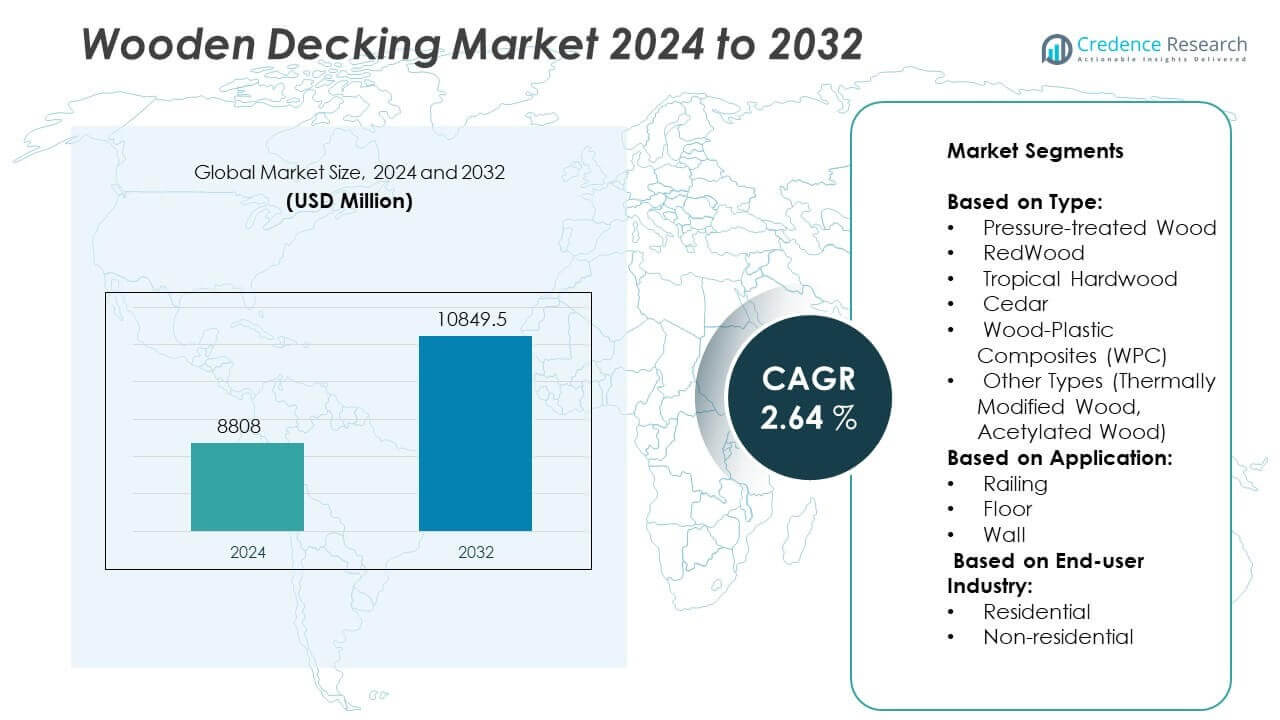
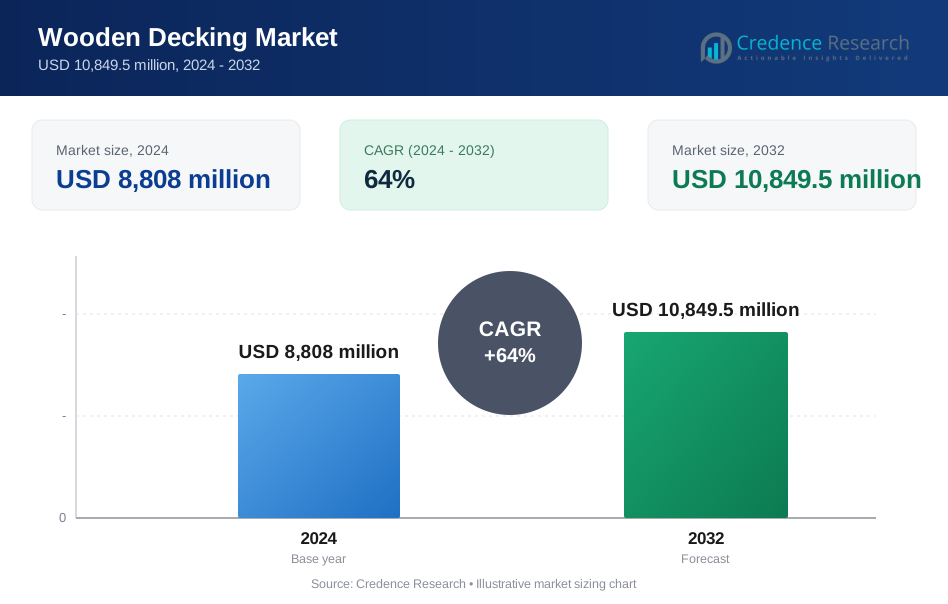
The Wooden Decking Market was valued at USD 8,808 in 2024 and is anticipated to reach USD 10,849.5 million by 2032, growing at a Compound Annual Growth Rate (CAGR) of 2.64% during the forecast period (2024–2032).
| REPORT ATTRIBUTE | DETAILS |
|---|---|
| Historical Period | 2020-2024 |
| Base Year | 2024 |
| Forecast Period | 2025-2032 |
| Wooden Decking Market Size 2024 | USD 8,808 Million |
| Wooden Decking Market ,CAGR | 2.64% |
| Wooden Decking Market Size 2032 | USD 10,849.5 Million |
The Wooden Decking Market is driven by the growing demand for aesthetically pleasing and sustainable outdoor living solutions, particularly in residential construction and renovation projects. Consumers favor natural materials like wood for their visual appeal, design flexibility, and compatibility with eco-conscious building standards. Increasing use of digital planning tools and demand for certified sustainable products further shape market dynamics.
The Wooden Decking Market shows strong presence across North America, Europe, and Asia Pacific, North America leads in demand due to a well-established culture of outdoor living and high residential remodeling activity. Europe emphasizes sustainable and certified wood products, aligning with strict environmental regulations and modern architectural aesthetics. In Asia Latin America and the Middle East & Africa present emerging opportunities, particularly in hospitality and luxury real estate projects. Key players shaping the market include Trex Company Inc., known for its innovative composite decking; Fiberon, offering a broad range of eco-friendly solutions; and The AZEK Company LLC.
Market Insights
- The Wooden Decking Market was valued at USD 8,808 million in 2024 and is projected to reach USD 10,849.5 million by 2032, growing at a CAGR of 2.64% during the forecast period.
- Demand for wooden decking is rising due to increased investment in residential construction, outdoor living spaces, and renovation projects, especially in North America and parts of Europe.
- Market trends include growing adoption of thermally modified wood, wood-plastic composites, and prefabricated modular decking systems that offer design flexibility and reduced maintenance.
- Leading players such as Trex Company Inc., The AZEK Company LLC, and Fiberon are focusing on sustainable decking materials, digital customization tools, and product innovation to strengthen market position.
- Key restraints include fluctuating timber prices, supply chain instability, and strict environmental regulations around timber sourcing and forest management.
- North America maintains a strong market position due to well-established construction practices and consumer preference for outdoor aesthetics, while Europe prioritizes eco-friendly and certified decking solutions.
- Asia Pacific shows strong growth potential driven by urban development, residential expansion, and the introduction of affordable composite decking materials in high-density markets.
Market Drivers
Growing Residential Construction and Outdoor Living Preferences Drive Demand
The Wooden Decking Market benefits significantly from the expansion of residential construction activities and rising consumer interest in outdoor living spaces. Homeowners increasingly prefer wood-based decks to enhance the aesthetic and functional value of their properties. The trend of building patios, garden decks, and poolside platforms using natural wood materials has gained popularity across urban and semi-urban regions. Rising disposable income and changing lifestyle patterns in developed economies support this demand. It responds well to consumer preferences for natural, warm, and durable outdoor environments. The Wooden Decking Market aligns closely with architectural trends favoring sustainability and minimalistic designs.
- For instance, Trex composite decking comprises over 95 percent recycled and reclaimed materials and the company diverts about 170,000 tons of polyethylene plastic film annually into production lines.
Increased Focus on Sustainable and Eco-Friendly Building Materials Supports Market Growth
Environmental awareness among consumers and regulatory bodies encourages the use of sustainable building materials, including wood from certified forests. Builders and developers choose wood decking due to its renewable nature and lower environmental impact compared to synthetic alternatives. Compliance with LEED certification and green building codes further reinforces the demand for wooden products. It strengthens market positioning by promoting low-carbon construction solutions. Manufacturers adopt responsible sourcing and eco-certifications to meet regulatory and consumer expectations. The Wooden Decking Market gains traction in regions with stringent environmental regulations and strong sustainability goals.
- For instance, The AZEK Company diverts about 420 million pounds of scrap and waste into its TimberTech composite products annually, with more than 1 billion pounds reused since 2019
Commercial and Hospitality Sector Expansion Creates New Opportunities
The Wooden Decking Market sees rising demand from commercial infrastructure, particularly in the hospitality and leisure sectors. Hotels, resorts, and restaurants invest in premium outdoor wooden decks to improve guest experience and elevate visual appeal. Architects prefer wood for rooftop lounges, outdoor dining, and poolside installations due to its aesthetic value and versatility. It supports design flexibility and complements natural surroundings in commercial applications. Growing tourism infrastructure in developing countries further boosts demand. Project developers view wooden decking as a premium solution that enhances brand image.
Product Innovations and Enhanced Durability Features Encourage Broader Adoption
Innovation in wood treatment and preservation technologies enhances the durability and weather resistance of wooden decking materials. Manufacturers introduce pressure-treated, thermally modified, and composite-wood variants to meet performance requirements in diverse climates. It allows wooden decks to withstand moisture, termites, and UV exposure more effectively. The market benefits from investments in research and development to improve product lifespan and maintenance ease. Enhanced durability helps overcome traditional concerns regarding wear and degradation. The Wooden Decking Market responds to customer needs by offering technically advanced and long-lasting solutions.
Market Trends
Increased Adoption of Thermally Modified Wood Enhances Market Appeal
The Wooden Decking Market experiences a notable trend toward thermally modified wood due to its improved durability and dimensional stability. This technology modifies wood properties through heat and steam treatment without using chemicals, making it more resistant to moisture, insects, and decay. It attracts environmentally conscious consumers looking for high-performance natural materials. Builders prefer thermally modified options for outdoor use in regions with high humidity and temperature variations. The growing demand for low-maintenance and sustainable decking supports this shift. Manufacturers promote it as a competitive alternative to tropical hardwoods.
- For instance, Thermory heats wood in controlled kilns up to 419 °F during a process that spans over 48 hours, reducing moisture content to zero before cooling and re-moisturizing, which results in equilibrium moisture content levels around five to seven percent—permanent improvements confirmed by CATAS testing to Durability Class 1 for thermo-ash and thermo-spruce, and Class 2 for thermo-pine and radiata pin.
Growing Popularity of Prefabricated and Modular Decking Systems
Rising interest in prefabricated decking systems marks a significant trend in the Wooden Decking Market. These systems offer convenience, reduced labor costs, and faster installation for both residential and commercial projects. It meets the need for efficient construction solutions without compromising design quality. Homeowners and builders increasingly choose modular products to simplify renovation and customization processes. Standardized components ensure consistency and compatibility across multiple applications. The trend reflects a broader industry move toward off-site construction and streamlined building practices.
- For instance, Deckorators’ hidden fastener system allows installers to place boards with consistent simple installation instructions, paying close attention to gapping, spacing and fastener requirements. 16" on-center for residential perpendicular appli-cations.
Design Innovation and Customization Features Gain Prominence
Demand for customized outdoor spaces is driving innovation in decking designs, textures, and finishes. The Wooden Decking Market incorporates trends such as wider plank sizes, intricate patterns, and integrated lighting features. It appeals to homeowners seeking unique outdoor aesthetics aligned with personal style and architecture. Architects and designers use wood decking to create focal points in landscaping and exterior design. Enhanced product variety allows brands to offer premium solutions tailored to different budgets and functional requirements. The emphasis on personalized design adds value across residential and hospitality segments.
Rising Use of Digitally Enabled Planning Tools and Visualization Software
Digital transformation influences how consumers and contractors plan decking projects, with design software and AR tools becoming more common. The Wooden Decking Market supports virtual design environments that allow users to preview materials, textures, and layouts before installation. It empowers buyers to make informed decisions and reduces design errors. Retailers and manufacturers offer digital configurators to improve the customer journey. This trend enhances engagement and drives preference for branded decking solutions. Integration of tech tools increases efficiency and client satisfaction across project lifecycles.
Market Challenges Analysis
Rising Raw Material Costs and Supply Chain Disruptions Impact Profitability
The Wooden Decking Market faces growing pressure from fluctuating raw material prices, particularly timber and treatment chemicals. Volatile lumber costs, driven by global demand and supply imbalances, strain manufacturer margins and raise end-user prices. It creates uncertainty in long-term project planning for builders and developers. Supply chain disruptions, including transportation delays and inconsistent availability of quality wood, further hinder timely delivery and cost control. Small and mid-sized enterprises experience difficulty in maintaining inventory and pricing competitiveness. These challenges affect market stability and reduce profitability for stakeholders across the value chain.
Environmental Regulations and Deforestation Concerns Restrain Growth
Strict environmental regulations regarding timber harvesting and land use pose regulatory hurdles for producers. The Wooden Decking Market must navigate compliance with sustainability standards, such as FSC certification, which limits sourcing flexibility and increases operational costs. It faces scrutiny from both regulators and environmentally conscious consumers concerned about deforestation and illegal logging. Meeting certification requirements often involves complex audits and supply chain transparency measures. Non-compliant suppliers risk reputational damage and restricted market access. These regulatory and ethical concerns slow expansion, particularly in regions with stringent environmental policies.
Market Opportunities
Expansion in Emerging Construction Markets Offers Long-Term Growth Potential
The Wooden Decking Market holds strong opportunities in emerging economies where urbanization and infrastructure development are accelerating. Countries in Asia-Pacific, Latin America, and parts of Africa are witnessing rising investments in residential and commercial construction. It can benefit from the demand for affordable, sustainable, and visually appealing outdoor solutions. Growing middle-class populations and increasing homeownership rates support the adoption of wooden decks for patios, balconies, and garden spaces. Builders and developers in these regions seek cost-effective materials that align with modern architectural trends. The market can gain traction by targeting region-specific design preferences and climate-compatible products.
Product Diversification and Eco-Certified Offerings Can Expand Market Reach
Increasing demand for environmentally responsible products creates scope for expanding certified and innovative wooden decking options. The Wooden Decking Market can capitalize on this by offering treated wood sourced from sustainable forests and processed with eco-friendly technologies. It opens doors to institutional and commercial buyers focused on meeting green building standards. Opportunities also exist in developing customizable and hybrid wood-composite solutions to meet diverse aesthetic and performance needs. Manufacturers that invest in R&D and transparent supply chains can strengthen brand trust and market share. Offering a broader range of finishes, colors, and formats helps cater to niche consumer segments and expand global reach.
Market Segmentation Analysis:
By Type:
The Wooden Decking Market is segmented into pressure-treated wood, redwood, tropical hardwood, cedar, wood-plastic composites (WPC), and other types such as thermally modified and acetylated wood. Pressure-treated wood leads the market due to its affordability and resistance to rot and insects, making it a preferred choice for large-scale applications. Tropical hardwood and redwood hold strong demand among premium users for their natural strength and aesthetic appeal. Cedar attracts interest for its natural oils that provide weather resistance and its distinctive grain pattern. WPC continues to gain traction for its low maintenance and consistent performance in variable climates.
- For instance, The Janka hardness scale measures a wood species resistance to wear and indentation. It quantifies the force needed to embed a 0.444-inch steel ball halfway into the wood’s surface. Developed as a standard, it provides a clear metric for comparing wood durability.
By Application:
The Wooden Decking Market includes railing, floor, and wall segments. Floor decking dominates this category, driven by widespread use in patios, porches, balconies, and rooftop spaces. It accounts for the highest volume due to both residential and commercial installations. Railing applications support safety and aesthetics, particularly in multi-level constructions and elevated decks. Wall applications, though smaller in share, are growing in use for decorative cladding and outdoor living features. It aligns with consumer demand for functional and stylish outdoor extensions of living space.
- For Instance, Timber Tech’s panelized aluminum MAX boards are 1.5" thick and can span up to 24" on center, making them ideal for docks, boardwalks, and many decking applications.
By End-User Industry:
The Wooden Decking Market is divided into residential and non-residential segments. The residential sector generates the highest demand, supported by new housing developments, renovations, and outdoor living trends. Homeowners favor wooden decking for its warmth, design flexibility, and natural appearance. Non-residential applications include hotels, resorts, restaurants, and public infrastructure, where developers aim to create inviting outdoor environments. It benefits from hospitality and commercial projects that prioritize visual appeal and functional design in exterior spaces. The non-residential segment continues to grow in urban centers and tourist destinations.
Segments:
Based on Type:
- Pressure-treated Wood
- RedWood
- Tropical Hardwood
- Cedar
- Wood-Plastic Composites (WPC)
- Other Types (Thermally Modified Wood, Acetylated Wood)
Based on Application:
- Railing
- Floor
- Wall
Based on End-user Industry:
- Residential
- Non-residential
Based on the Geography:
- North America
- U.S.
- Canada
- Mexico
- Europe
- UK
- France
- Germany
- Italy
- Spain
- Russia
- Belgium
- Netherlands
- Austria
- Sweden
- Poland
- Denmark
- Switzerland
- Rest of Europe
- Asia Pacific
- China
- Japan
- South Korea
- India
- Australia
- Thailand
- Indonesia
- Vietnam
- Malaysia
- Philippines
- Taiwan
- Rest of Asia Pacific
- Latin America
- Brazil
- Argentina
- Peru
- Chile
- Colombia
- Rest of Latin America
- Middle East
- UAE
- KSA
- Israel
- Turkey
- Iran
- Rest of Middle East
- Africa
- Egypt
- Nigeria
- Algeria
- Morocco
- Rest of Africa
Regional Analysis
North America
North America holds the largest market share of 36.5% in the global Wooden Decking Market. This dominance stems from high construction activity, widespread homeownership, and a strong culture of outdoor living. The United States drives the majority of regional demand, with homeowners regularly investing in backyard renovations, patios, and decking extensions. Wood remains a preferred material due to its natural aesthetic, availability, and compliance with green building standards. Pressure-treated wood and cedar are among the most commonly used materials in this region, supported by established distribution networks and strong awareness of product benefits. The presence of leading manufacturers and advanced wood treatment technologies further reinforces North America’s position in the market. Continued investment in residential remodeling and outdoor infrastructure sustains steady growth across urban and suburban areas.
Europe
Europe accounts for a market share of 27.1% in the Wooden Decking Market. The region emphasizes sustainability, environmental standards, and modern architectural styles, which drive demand for certified wood products and eco-friendly decking solutions. Countries such as Germany, the UK, and France lead in adopting thermally modified wood and WPC, both of which meet the region's stringent environmental and performance standards. The renovation of historical buildings and the expansion of energy-efficient homes create opportunities for wooden decking in flooring and railing applications. It benefits from growing interest in garden landscaping and private outdoor areas in urban housing developments. European consumers prefer decking materials that offer longevity, low maintenance, and compatibility with local climate conditions. Regulations on deforestation and timber importation shape the market’s dynamics and encourage use of regionally sourced or certified wood.
Asia Pacific
Asia Pacific holds 21.8% of the global Wooden Decking Market share. Rapid urbanization, rising disposable incomes, and a growing middle-class population fuel construction activity across key countries such as China, India, Japan, and Australia. Residential expansion and demand for stylish outdoor living spaces support market growth, particularly in urban residential complexes and gated communities. The market also sees increasing use of wood-plastic composites in humid climates due to their resistance to moisture and warping. Local manufacturers offer a range of products at competitive prices, which attracts price-sensitive buyers.
Latin America
Latin America captures 9.6% of the Wooden Decking Market. Brazil, Mexico, and Chile are major contributors, supported by favorable climates and the growing popularity of outdoor recreational spaces. Tropical hardwoods sourced locally are widely used in both residential and commercial projects. Economic growth and tourism development increase demand for decking in hotels, resorts, and leisure facilities. The market faces occasional fluctuations due to economic instability and variable raw material costs. It shows potential for expansion through infrastructure development and adoption of sustainable construction materials. Awareness of long-term benefits and eco-certifications remains limited, but is expected to grow over time.
The Middle East & Africa
The Middle East & Africa region holds the smallest share at 5.0% of the global Wooden Decking Market. Harsh weather conditions, including extreme heat and sand exposure, challenge the use of untreated wood decking. However, increasing investments in luxury real estate, resorts, and high-end residential communities in the UAE, Saudi Arabia, and South Africa drive demand for treated wood and composite decking. It benefits from tourism-related construction and outdoor hospitality venues that emphasize aesthetics and comfort. Market penetration remains limited by lower consumer awareness and preference for alternative materials like stone or tiles. Growing interest in green construction and international design trends may influence future growth in select urban centers.
Key Player Analysis
- NeoTimber
- Trex Company Inc.
- Metsa Wood
- Shubh Composites
- Mendocino Forest Products Company LLC
- Deck Solutions LLC
- Kebony AS
- Thermory
- Deckorators Inc.
- United Construction Products Inc.
Competitive Analysis
Key players in the Wooden Decking Market include Trex Company Inc., The AZEK Company LLC, Fiberon, NeoTimber, and Deckorators Inc. These companies lead the market by leveraging innovation, strong distribution networks, and sustainability-focused product strategies. Company dominates the composite decking segment with its weather-resistant, low-maintenance solutions that appeal to a broad consumer base. It integrates recycled content into its decking systems, emphasizing environmental responsibility and high-performance finishes.These companies invest in R&D, digital sales platforms, and sustainable sourcing to strengthen market presence. Their efforts shape the competitive landscape by setting benchmarks in durability, customization, and environmental compliance.
Recent Developments
- In February 2025, trends in wooden decking emphasize eco-conscious and weather-resistant materials, with thermally treated wood and advanced composites like Trex and Timbertech gaining popularity for their durability and sustainability
- In January 2025, NeoTimber offered their Deluxe composite decking range with strength, durability, weather resistance, a 25-year residential warranty, and a product launch under the Deluxe range.
- In January 2025, Deckorators Inc. released a report outlining key outdoor living trends for the year. Their focus is on blending durable composite decking with modern design and contractor insights that shape outdoor living spaces
Market Concentration & Characteristics
The Wooden Decking Market exhibits a moderately concentrated structure, with a mix of global and regional players competing on product quality, sustainability, and pricing. Leading companies such as Trex Company Inc., The AZEK Company LLC, and Fiberon maintain strong market presence through established brands, wide distribution networks, and consistent innovation in composite and eco-friendly materials. It reflects characteristics of a mature industry in developed regions, particularly in North America and Europe, where consumer preferences lean toward high-performance and low-maintenance decking solutions. In emerging markets, the industry remains fragmented, with local manufacturers offering cost-effective wood-based alternatives tailored to regional demand. The market is highly influenced by building trends, climate adaptability, and environmental compliance, with increasing emphasis on certified sustainable wood and digital design support. Product differentiation is driven by aesthetics, durability, and ease of installation, creating opportunities for companies that invest in advanced treatment technologies and customizable offerings. It responds well to evolving architectural styles and outdoor lifestyle trends.
Report Coverage
The research report offers an in-depth analysis based on Type, Application, End-User Industry and Geography. It details leading market players, providing an overview of their business, product offerings, investments, revenue streams, and key applications. Additionally, the report includes insights into the competitive environment, SWOT analysis, current market trends, as well as the primary drivers and constraints. Furthermore, it discusses various factors that have driven market expansion in recent years. The report also explores market dynamics, regulatory scenarios, and technological advancements that are shaping the industry. It assesses the impact of external factors and global economic changes on market growth. Lastly, it provides strategic recommendations for new entrants and established companies to navigate the complexities of the market.
Future Outlook
- Demand for sustainable and low-maintenance decking materials will continue to grow across residential and commercial sectors.
- Composite and thermally modified wood products will gain wider acceptance due to their durability and resistance to environmental factors.
- Digital visualization tools and virtual design platforms will enhance customer engagement and influence purchasing decisions.
- Urbanization and rising middle-class income in Asia Pacific will create new opportunities for wooden decking in housing and infrastructure projects.
- Manufacturers will focus on expanding eco-certified product lines to meet stricter environmental regulations.
- Innovation in wood treatment technologies will improve product lifespan and reduce long-term maintenance requirements.
- The shift toward outdoor living and multifunctional exterior spaces will drive demand in both developed and emerging markets.
- Supply chain resilience and sustainable sourcing practices will become critical to maintaining competitive advantage.
- Product customization and modular decking systems will appeal to consumers seeking flexible design options.
- Strategic partnerships and regional expansion efforts by key players will strengthen global market reach.
Request a Free Sample
Fill in your details and we'll send you a free sample report.
- Sample data tables & charts
- Research methodology
Need a Custom Version of This Report?
Tailor the scope, geography, or segments to your exact requirements.
- Custom geography or segment scope
- Direct access to our analyst team
Frequently Asked Questions
What is the current market size for Wooden decking, and what is its projected size in 2032?
At what Compound Annual Growth Rate is the Wooden decking market projected to grow between 2025 and 2032?
Which Wooden decking market segment held the largest share in 2024?
What are the primary factors fueling the growth of the Wooden decking market?
Who are the leading companies in the Wooden decking market?
Which region commanded the largest share of the Wooden decking market in 2024?
Table of Content
Chapter 1. Report Introduction
- 1.1 Report Description & Purpose
- 1.1.1 Report Title & Market Definition
- 1.1.2 Unique Selling Propositions (USP) & Key Differentiators
- 1.1.3 Value Proposition for Stakeholders
- 1.2 Research Objectives
- 1.2.1 Market Sizing Objectives (Volume & Revenue)
- 1.2.2 Segmentation Objectives
- 1.2.3 Competitive Intelligence Objectives
- 1.2.4 Forecast & Scenario Objectives
- 1.3 Report Scope
- 1.3.1 Wooden Decking Scope – Types & Subtypes Covered
- 1.3.2 Geographic Scope – Regions & Countries Covered
- 1.3.3 Historical Period, Base Year & Forecast Period (2024; forecast to 2032)
- 1.3.4 Inclusions & Exclusions
- 1.4 HS Code & Classification Framework
- 1.5 Currency, Units & Pricing Basis
- 1.6 Target Stakeholders
- 1.7 Limitations & Assumptions
Chapter 2. Executive Summary
- 2.1 Global Wooden Decking Market Snapshot
- 2.1.1 Market Size – Historical (2024) & Forecast (2024-2032) (2024: USD 8,808 million → 2032: USD 10,849.5 million)
- 2.1.2 Volume & Revenue – Global Totals
- 2.1.3 Key Market Highlights – Top Five Facts
- 2.2 Wooden Decking Market Segmentation Snapshot
- 2.2.1 Market Split by Region – 2024 vs. 2032
- 2.3 Competitive Snapshot
- 2.3.1 Top 10 Players by Revenue Share – 2024
- 2.3.2 Top 10 Players by Volume Share – 2024
- 2.3.3 Recent Strategic Developments (18-Month Summary)
- 2.4 Key Investment Highlights & Strategic Conclusions
Chapter 3. Wooden Decking Market Dynamics & Industry Analysis
- 3.1 Market Overview & Context
- 3.1.1 Wooden Decking Market Position in the Broader Automotive Value Chain
- 3.1.2 OEM vs. Replacement Market Dynamics
- 3.1.3 Market Maturity & Development Stage by Region
- 3.2 Wooden Decking Market Drivers
- 3.3 Wooden Decking Market Restraints & Challenges
- 3.4 Wooden Decking Market Opportunities
- 3.5 Porter's Five Forces Analysis
- 3.5.1 Threat of New Entrants
- 3.5.2 Bargaining Power of Suppliers
- 3.5.3 Bargaining Power of Buyers
- 3.5.4 Threat of Substitutes
- 3.5.5 Competitive Rivalry – Intensity Assessment
- 3.6 Wooden Decking Value Chain Analysis
- 3.6.1 Upstream – Raw Material/Input Suppliers
- 3.6.1.1 Raw Material/Input 1
- 3.6.1.2 Raw Material/Input 2
- 3.6.1.3 Raw Material/Input 3
- 3.6.2 Midstream – Production/Manufacturing/Service Delivery
- 3.6.2.1 Production/Process Overview
- 3.6.2.2 Key Facility Locations & Capacity by Manufacturer
- 3.6.3 Downstream – Distribution & End Consumer
- 3.6.3.1 Primary Channel – B2B/OEM
- 3.6.3.2 Secondary Channels – Dealer, Retail, Online, Direct
- 3.6.4 Value Chain Profitability Analysis
- 3.6.1 Upstream – Raw Material/Input Suppliers
- 3.7 PESTEL Analysis
- 3.7.1 Political Factors
- 3.7.2 Economic Factors
- 3.7.3 Social Factors
- 3.7.4 Technological Factors
- 3.7.5 Environmental Factors
- 3.7.6 Legal Factors
- 3.8 Wooden Decking Supply Chain Analysis
- 3.8.1 Raw Material/Input Supply Risk Assessment
- 3.8.2 Manufacturing Concentration Risk (Geographic Exposure)
- 3.8.3 Trade Disruption Impact Analysis
- 3.9 Regulatory & Policy Landscape
Note: The regulatory and policy landscape section covers regulations based on their applicability to the market, Wooden Decking category, geography, and scope of the study. Only regulatory frameworks with a material impact on operations, compliance, trade, sustainability, or market access are analyzed in detail.
Chapter 4. Key Investment Pockets & Opportunity Analysis
- 4.1 Wooden Decking Market Attractiveness Analysis
- 4.1.1 By Region – Investment Attractiveness Matrix (Volume × CAGR)
- 4.2 Absolute Revenue Growth Opportunity
- 4.2.1 By Region – Absolute USD Growth Through 2032
- 4.3 Incremental Volume Opportunity
- 4.3.1 By Region – Incremental Volume Through 2032
- 4.3.2 Segment – Incremental Volume
- 4.4 Emerging Submarket Opportunity Deep Dive (Subject to Applicability)
- 4.5 Emerging Market Opportunity Scorecards
- 4.5.1 United States
- 4.5.2 Europe
- 4.5.3 Asia
- 4.5.4 Middle East & Africa
Note: Emerging Market Opportunity Scorecards will be included based on relevance and strategic importance. Regions listed are indicative and may vary depending on data availability and market dynamics.
Chapter 5. Wooden Decking Import-Export Analysis & Trade Flows
- 5.1 Global Trade Overview
- 5.1.1 Global Export Value by Country (2024)
- 5.1.2 Global Export Volume by Country (2024)
- 5.1.3 Global Import Value by Country (2024)
- 5.1.4 Global Import Volume by Country (2024)
- 5.1.5 Net Trade Balance by Country (2024)
- 5.2 Export Analysis – Segment
- 5.2.1 Type 1 (HS Code)
- 5.2.2 Type 2 (HS Code)
- 5.2.3 Type 3 (HS Code)
- 5.2.4 Type 4 (HS Code)
- 5.2.5 Type 5 (HS Code)
- 5.3 Import Analysis – Segment
- 5.3.1 Type 1 (HS Code)
- 5.3.2 Type 2 (HS Code)
- 5.3.3 Type 3 (HS Code)
- 5.3.4 Type 4 (HS Code)
- 5.3.5 Type 5 (HS Code)
- 5.4 Average Unit Trade Prices
- 5.4.1 Average Export Price – Segment & Country
- 5.4.2 Average Import Price – Segment & Source Country
- 5.4.3 Price Trends (2024)
- 5.5 Key Trade Route Analysis
- 5.5.1 Trade Route 1
- 5.5.2 Trade Route 2
- 5.5.3 Trade Route 3
- 5.5.4 Trade Route 4
- 5.5.5 Trade Route 5
- 5.6 Trade Policy Impact Assessment
- 5.6.1 US Anti-Dumping & Section 301 Tariffs
- 5.6.2 EU Customs Union Impact
- 5.6.3 Major Free Trade Agreements
- 5.6.4 USMCA Rules of Origin
Note: Trade policy analysis will be included only where relevant to the Wooden Decking market.
Chapter 6. Competitive Landscape & Company Benchmarking
- 6.1 Wooden Decking Market Concentration & Structure
- 6.1.1 Herfindahl-Hirschman Index (HHI) – vs. 2024
- 6.1.2 Tier 1, Tier 2 & Tier 3 Market Structure
- 6.1.3 Global, Regional & Local Player Dynamics
- 6.2 Wooden Decking Market Share Analysis – 2024
- 6.2.1 Global Revenue Share by Company
- 6.2.2 Global Volume Share by Company
- 6.2.3 Regional Revenue Share
- 6.2.4 Market Share Evolution ( vs. 2024)
- 6.2.5 OEM Segment Share by Company
- 6.2.6 Replacement Segment Share by Company
- 6.3 Production/Delivery Capacity & Facility Analysis
- 6.3.1 Global Installed Capacity
- 6.3.2 Capacity Utilization Rates
- 6.3.3 Production/Output Volume
- 6.3.4 Facility Locations & Capacity Map
- 6.3.5 Planned Capacity Additions
- 6.4 Wooden Decking Competitive Benchmarking Matrix
- 6.4.1 Revenue, Volume, CAGR & Profitability Comparison
- 6.4.2 Channel Revenue Mix
- 6.4.3 Geographic Revenue Exposure
- 6.4.4 R&D Intensity
- 6.4.5 Sustainability Maturity
- 6.5 Strategic Developments in Wooden Decking (Last 24 Months)
- 6.5.1 Mergers, Acquisitions & Divestments
- 6.5.2 New Wooden Decking Launches
- 6.5.3 Facility Expansions
- 6.5.4 Strategic Alliances, Joint Ventures & Partnerships
- 6.5.5 Distribution Expansion & Market Entry
- 6.5.6 Sustainability & ESG Initiatives
- 6.6 Competitive Strategy Mapping
- 6.6.1 Leader, Challenger, Follower & Niche Classification
- 6.6.2 Pricing Strategy Comparison
- 6.6.3 Channel Strategy Matrix
Note: Strategic developments are included based on their materiality and the availability of reliable information.
Chapter 7. Global Wooden Decking Market – By Distribution Channel
- 7.1 Segment Overview
- 7.1.1 Volume & Revenue Split by Channel (2024 & 2032)
- 7.1.2 Channel Mix Evolution (2024-2032)
Chapter 8. Regional Market Analysis – Global Overview
- 8.1 Global Regional Overview
- 8.1.1 Regional Volume Share
- 8.1.2 Regional Revenue Share
- 8.1.3 Regional Volume by Region
- 8.1.4 Regional Revenue by Region
- 8.1.5 Regional Forecast Through 2032
- 8.2 Cross-Regional Segment Analysis
- 8.2.1 By Distribution Channel
- 8.2.2 By Brand/Price Tier
Chapter 9. North America Wooden Decking Market
- 9.1 United States
- 9.2 Canada
- 9.3 Mexico
Chapter 10. Europe Wooden Decking Market
- 10.1 Germany
- 10.2 France
- 10.3 Italy
- 10.4 United Kingdom
- 10.5 Spain
- 10.6 Poland
- 10.7 Russia
- 10.8 Netherlands
- 10.9 Belgium
- 10.10 Sweden
- 10.11 Denmark
- 10.12 Norway
- 10.13 Rest of Europe
Chapter 11. Asia Pacific Wooden Decking Market
- 11.1 China
- 11.2 India
- 11.3 Japan
- 11.4 South Korea
- 11.5 Thailand
- 11.6 Indonesia
- 11.7 Vietnam
- 11.8 Malaysia
- 11.9 Australia
- 11.10 Rest of Asia Pacific
Chapter 12. Latin America Wooden Decking Market
- 12.1 Brazil
- 12.2 Argentina
- 12.3 Colombia
- 12.4 Chile
- 12.5 Rest of Latin America
Chapter 13. Middle East Wooden Decking Market
- 13.1 Saudi Arabia
- 13.2 United Arab Emirates
- 13.3 Turkey
- 13.4 Israel
- 13.5 Iran
- 13.6 Rest of the Middle East
Chapter 14. Africa Wooden Decking Market
- 14.1 South Africa
- 14.2 Egypt
- 14.3 Nigeria
- 14.4 Morocco
- 14.5 Rest of Africa
Chapter 15. Wooden Decking Company Profiles
- 15.1 [Company 01]
- 15.1.1 Company Overview
- 15.1.2 Key Management Personnel
- 15.1.3 Products & Services Portfolio
- 15.1.4 Financial Performance
- 15.1.5 Key Market Focus & Geographic Presence
- 15.1.6 Recent Developments & Strategic Initiatives
Note: The company profile list is preliminary and may change based on research findings, market developments, data availability, and client requirements.
Chapter 16. Appendices
- Appendix A – List of Abbreviations & Acronyms
- Appendix B – Industry Classification Code Reference – Full Series
- Appendix C – Production & Capacity Data Tables
- Appendix D – End-Use & Demand Base Tables
- Appendix E – Consumption & Replacement Rate Assumptions
- Appendix F – ASP Reference Tables
- Appendix G – Manufacturing & Facility Database
- Appendix H – Import-Export Data Tables
- Appendix I – Regulatory Summary Tables
- Appendix J – Primary Research Participant List (Anonymized)
- Appendix K – Primary Research Questionnaire Framework
- Appendix L – Data Sources & Bibliography
- Appendix M – Market Size Divergence & Source Comparison
Chapter 17. Research Methodology
- 17.1 Research Framework & Philosophy
- 17.2 Secondary Research – Sources, Hierarchy & Data Extraction
- 17.3 Data Modeling – Bottom-Up & Top-Down Market Sizing
- 17.4 Primary Research – Stakeholder Framework, LOI & Sample Sizes
- 17.5 Forecast Methodology – Regression, Scenario & Sensitivity Analysis
- 17.6 Quality Control – Four-Layer Validation Framework
- 17.7 Limitations & Standard Assumptions
- 17.8 Disclaimer
