
Bosch to Form Dedicated Semiconductors Division in 2028, Targets €5 Billion in Chip Sales by 2030
Robert Bosch GmbH will move its chip operations into a dedicated Semiconductors division on Jan. 1, 2028, the German technology and engineering group said Nov. 3 from Stuttgart. The company set a goal of about 5 billion euros in semiconductor sales by 2030 and said it will open more of its manufacturing capacity to outside customers. The unit will stay inside the Bosch Mobility business sector, so the change creates a new division rather than a separately owned chip company.
Key developments
- A Semiconductors division begins operating Jan. 1, 2028, taking over chip activities now housed in the Mobility Electronics division, which will keep automotive electronic control units.
- Bosch is targeting about 5 billion euros in chip sales by 2030. The release gives no current semiconductor sales figure for comparison.
- The company plans to offer more manufacturing capacity to external partners and to systematically expand its foundry business.
- Robotics, consumer electronics and demand linked to AI data centers are named as growth areas alongside the core automotive business.
- The network spans about 40 semiconductor sites worldwide, including wafer fabs in Dresden and Reutlingen, Germany, and a plant in Roseville, California.
Industry background
Bosch has worked in semiconductors for more than 60 years, mostly as a supplier to its own systems business. It lists microelectromechanical system (MEMS) sensors, silicon carbide chips and application-specific integrated circuits as its main strengths. Those devices sit inside vehicle systems, smartphones and wearables, and the company says its chips already help control humanoid robots.
Capital spending has followed that position. Bosch said it has invested about 3 billion euros in its Dresden and Reutlingen wafer fabs and is spending about $2 billion to equip the Roseville site for specialized silicon carbide chips. Bosch bought that site through its acquisition of TSI Semiconductors, announced in 2023. At the time, it described a 200-millimeter operation with about 250 employees and planned first silicon carbide output from 2026. The Nov. 3 release does not update that production schedule.
The announcement also follows a wider corporate overhaul. On Oct. 22, Bosch said its Mobility sector and central service units in Germany would move from Robert Bosch GmbH into separate subsidiaries, with new legal entities due to start Aug. 1, 2027. About 62,500 associates in Germany are set to transfer. Mobility generated 55.8 billion euros in 2025, roughly 60% of group sales of 91 billion euros.
Industry implications
Separating chips from control units gives semiconductors their own management line and reporting focus inside Bosch's largest business. Bosch said the structure will better match the pace and requirements of the chip industry. Markus Heyn, deputy chairman of the board of management and chairman of the Mobility sector, called semiconductors "the linchpin of our connected world." Erik Rein, who is responsible for the semiconductor business, said the company wants to build on existing strengths "and leverage them in select new markets."
The word "select" matters. Bosch is not describing a move into leading-edge logic, where capital requirements are far higher. Its stated path runs through sensors, power devices and custom circuits, then extends those products into robotics and other newer uses, with AI data centers cited as a driver of rising chip demand.
The foundry plan may prove the bigger operational shift. A captive fab can schedule around an internal customer, while a foundry must meet outside customers' qualification, confidentiality and delivery demands. Bosch has not named any foundry customers, volumes or capacity allocations.
Competitive and supply chain implications
The plan places Bosch in more direct contact with European and U.S. power and sensor chip suppliers, including Infineon, STMicroelectronics, Onsemi and Wolfspeed in silicon carbide, as well as specialty foundries that serve automotive and industrial customers. Bosch's advantage is that it also builds the systems those chips go into, which gives it long experience with automotive qualification. The same fact could complicate foundry sales to customers that compete with Bosch Mobility, a concern a separate management structure may help address. For automakers, a more visible chip unit at a major Tier 1 supplier offers another source of regionally made devices.
Bosch also holds a 10% stake in European Semiconductor Manufacturing Co. (ESMC), the Dresden joint venture announced in 2023 with majority owner TSMC and fellow 10% partners Infineon and NXP. The partners said then that the plant would target about 40,000 300-millimeter wafers a month on 28/22-nanometer and 16/12-nanometer processes, with production beginning by the end of 2027. That stake gives Bosch a route to more advanced nodes without building them alone.
Regional implications
Germany remains the center of the business. Bosch's wafer fabs in Dresden and Reutlingen anchor the investment it describes, and ESMC is rising in the same Saxon cluster, which strengthens Dresden as a hub for automotive and industrial chipmaking in Europe.
In the United States, Roseville gives Bosch silicon carbide capacity close to North American vehicle and industrial customers. The 2023 acquisition announcement tied the size of the investment to federal CHIPS and Science Act funding and California economic development support.
In Southeast Asia, Bosch plans to expand its semiconductor test center in Penang, Malaysia, by the middle of the next decade. The long timeline points to steady growth in back-end capacity, and it adds to Penang's established role in chip testing and packaging.
Credence Research analysis
The most useful reading of this announcement is organizational rather than financial. Bosch has already made its large fab investments, and the release puts no new investment figure on the plan. What changes is who the chip business answers to and who it can sell to. Automotive-centered chipmakers have faced uneven vehicle demand and slower electric vehicle programs, which makes a broader customer base attractive for fabs that need steady utilization. Opening capacity to outsiders is a practical way to spread that fixed cost.
The 5 billion euro goal should be read with care, since Bosch did not disclose its current chip sales or say how much would come from internal transfers versus external customers. The clearest signals to watch are named foundry customers and design wins outside automotive. Timing also matters. The division starts in 2028 and the sales goal falls in 2030, which leaves about two years to show that a business built around one internal customer can compete for many outside ones.
What comes next
- Aug. 1, 2027: New Bosch legal entities, including the Mobility subsidiary, are scheduled to begin operations.
- End of 2027: ESMC's targeted start of production in Dresden, under the partners' 2023 plan, and the planned completion of Bosch's staged corporate transition.
- Jan. 1, 2028: The Semiconductors division begins operating and Mobility Electronics narrows to electronic control units.
- 2030: Target date for about 5 billion euros in semiconductor sales.
- Mid-2030s: Planned completion window for the expansion of the Penang test center.
Sources
- Bosch: Bosch is strengthening its semiconductor business with a dedicated division (Nov. 3, 2026)
- Bosch: Bosch is reorganizing its corporate structure (Oct. 22, 2026)
- TSMC, Bosch, Infineon and NXP: ESMC joint press release (Aug. 8, 2023)
- Silicon Saxony: Bosch plans to acquire U.S. chipmaker TSI Semiconductors (2023)
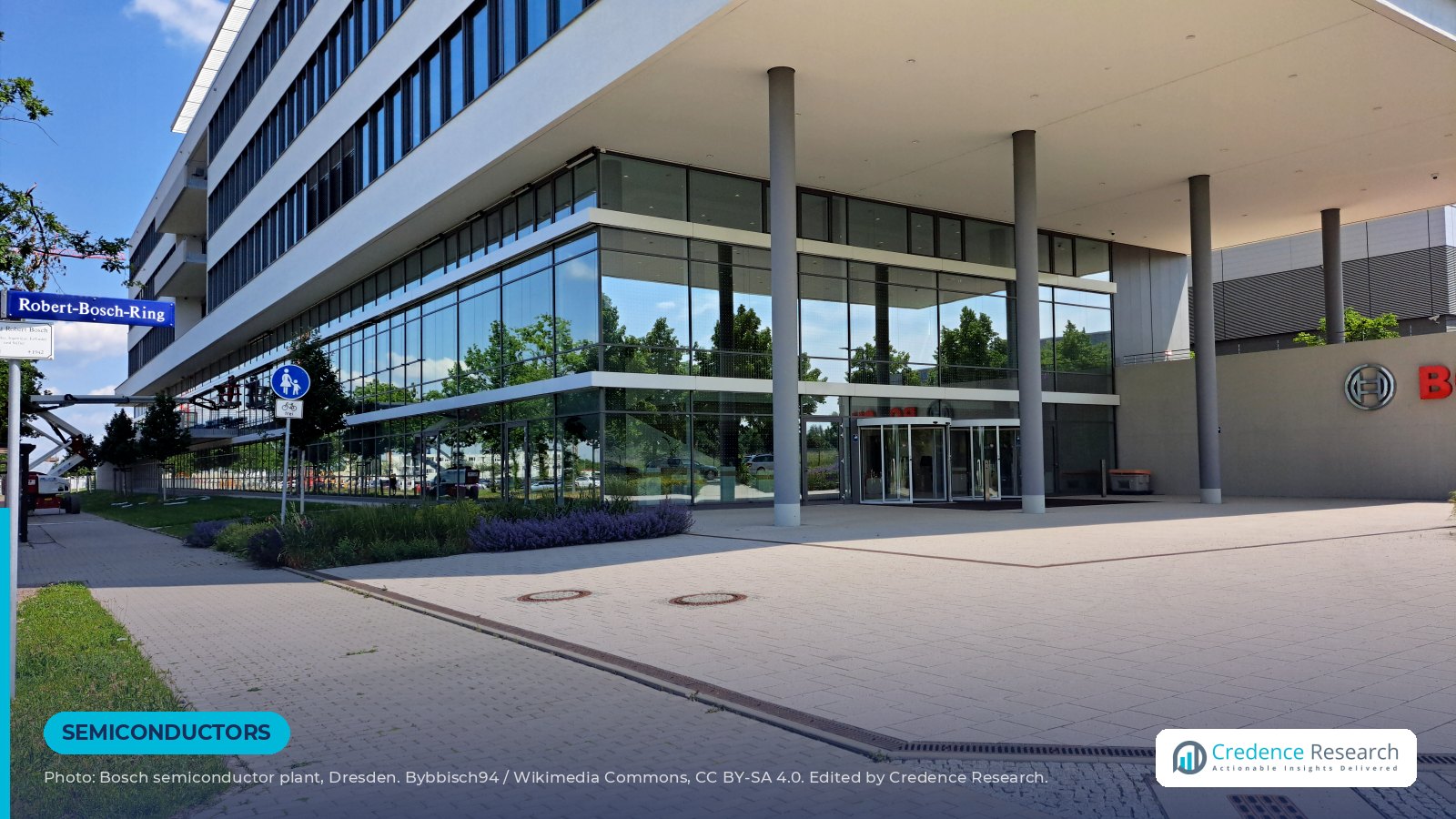
Image: Bosch semiconductor plant in Dresden, Germany, by Bybbisch94 via Wikimedia Commons, CC BY-SA 4.0. Cropped and edited by Credence Research.

About the Author

Senior News Editor at Credence Research Inc