
China volume and retrofit locks shape regional demand
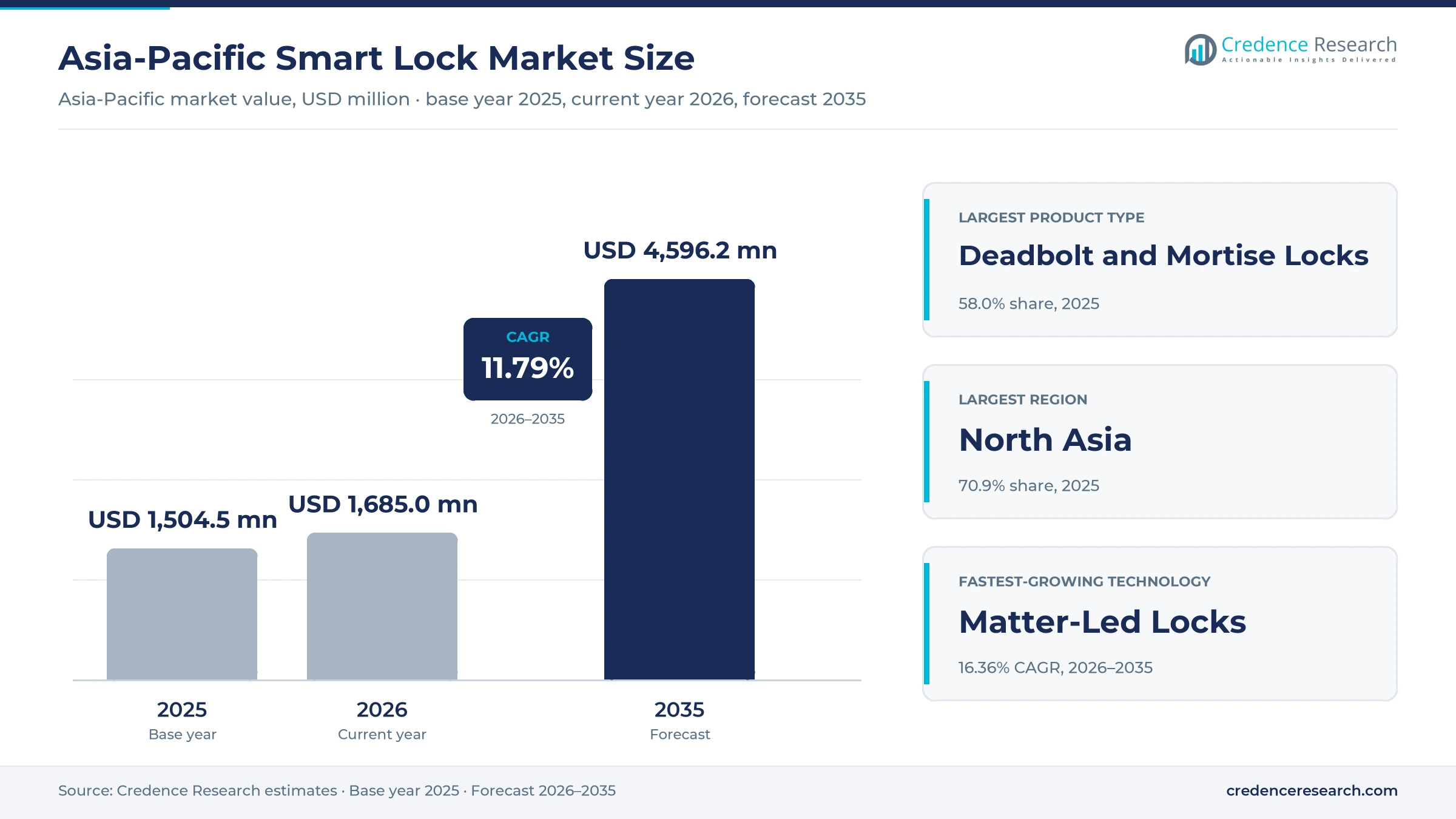
The Asia-Pacific smart lock market was valued at USD 1.50 billion in 2025 and is projected to increase from USD 1.69 billion in 2026 to USD 4.60 billion by 2035, registering a CAGR of 11.79% during 2026–2035. Household upgrades in China, hotel construction across India and Vietnam, and managed-property credential systems supply most of the demand. North Asia held the largest regional share, 70.9% in 2025, because China sold 22.3 million smart locks in 2023 and Japan and South Korea have established mortise and digital door lock bases. South Asia is the fastest-growing region at 13.60% a year, as hotel projects and digital lock ranges multiply in India. The Connectivity Standards Alliance released Aliro 1.0 on Feb. 26, 2026, giving phones a common credential across certified locks. This matters for replacement buyers, because 36Kr puts the replacement cycle in China at about five to seven years, and each cycle now opens a choice between closed and interoperable products.
What does the Asia-Pacific smart lock market cover today?
The market counts electronically controlled deadbolt, mortise, lever, padlock, rim and cylinder locks sold to households, hotels, offices, schools and public buyers across North Asia, South Asia, Southeast Asia and Oceania. Buyers purchase through online stores, specialty hardware chains, developers and security integrators, and installers often handle fitting because door preparation differs by country.
The scope excludes vehicle keys, stand-alone access control panels, cloud subscriptions billed separately and mechanical locks without electronic credentials. The value chain runs from component and module suppliers through lock makers such as Kaadas and Dessmann to brands, retail chains, installers and property operators, and hotel and multifamily projects usually add integration work to the hardware order.
Asia-Pacific Smart Lock Market Insights
- The market grows from USD 1.50 billion in 2025 to USD 4.60 billion by 2035, an 11.79% CAGR across 2026–2035 led by retrofit and hospitality demand.
- North Asia held 70.9% of regional value in 2025, with China as the largest national buyer and Japan and South Korea adding mature property bases.
- Deadbolt and Mortise Locks led product demand with 58.0% of 2025 value, because full door hardware remains the standard for homes in China and Japan.
- The Aliro 1.0 release on Feb. 26, 2026 gave lock makers a shared phone credential standard, and Aqara and Allegion were among its first certified companies.
- Hotel-Online reported 2,262 hotel projects in Asia Pacific excluding China at the close of the third quarter of 2025, which widens the order base for access specialists.
Mortise hardware and specialty stores anchor spending
Why do deadbolt and mortise locks hold the largest share?
Based on product type, the market is categorized into deadbolt and mortise locks, lever handle locks, smart padlocks and rim and cylinder locks. Deadbolt and Mortise Locks led with 58.0% of 2025 value because full door hardware is the default, and Photosynth states that MIWA Lock products secure more than 70% of residences in Japan. Rim and Cylinder Locks grow fastest at 13.23% a year as no-drill models spread, with Xiaomi listing its Self-Install Smart Lock at 12,980 yen in Japan in January 2026. Smart padlocks stay niche, although igloohome models issue time-limited PINs for outdoor sites.
How does hospitality demand change the buyer mix?
Based on end user, the market is categorized into residential, commercial and hospitality, and institutional and government buyers. Residential accounted for 74.0% of 2025 value because household purchases set regional volume, and China Daily reported 22.3 million units sold in China during 2023. Commercial and Hospitality grows fastest at 12.87% a year as hotel building accelerates, with Hotel-Online reporting 434,593 rooms in the pipeline outside China in late 2025. Singapore operator KINN Hospitality shows the scale, installing 53 mortise locks and 192 locker locks. Institutional demand remains smaller, though Photosynth now markets Akerun services to schools and universities.
Which credential technologies are taking share?
Based on technology, the market is categorized into Bluetooth-led locks, Wi-Fi and proprietary hub locks, standalone digital and RFID locks, and Matter-led locks. Bluetooth-Led Locks led with 46.0% of 2025 value because phone pairing is standard on volume products, and Godrej Neo digital locks in India and the Xiaomi M40 in China both ship with Bluetooth and Wi-Fi. Matter-Led Locks grow fastest at 16.36% a year from a small base as Xiaomi’s self-install lock added Matter support in Japan in January 2026, while Aliro 1.0, from the same standards alliance, arrived on Feb. 26, 2026. Hotels still specify RFID credentials because guests rarely install apps for one stay.
Why do stores still outsell online channels?
Based on distribution channel, the market is categorized into online commerce, specialty and DIY retail, developer and OEM procurement, and security integrators. Specialty and DIY Retail led with 38.0% of 2025 value because locks need fitting, and China Daily reported that Dessmann runs over 3,000 physical stores in China. Online Commerce grows fastest at 12.95% a year as 36Kr reported about 5.92 million sets sold online in China in the first three quarters of 2025, up roughly 12%. Godrej expects e-commerce and quick commerce to reach 11% to 12% of its locks business by fiscal 2028.
| Segment Group | Leading Sub-segment | Share, 2025 | Fastest-growing Sub-segment | CAGR, 2026–2035 |
|---|---|---|---|---|
| By Product Type | Deadbolt and Mortise Locks | 58.0% | Rim and Cylinder Locks | 13.23% |
| By End User | Residential | 74.0% | Commercial and Hospitality | 12.87% |
| By Technology | Bluetooth-Led Locks | 46.0% | Matter-Led Locks | 16.36% |
| By Distribution Channel | Specialty and DIY Retail | 38.0% | Online Commerce | 12.95% |
Request a Free Sample
Fill in your details and we'll send you a free sample report.
- Sample data tables & charts
- Research methodology
Standards, hotel pipelines and store networks lift demand
Interoperable residential access reduces platform lock-in
Households have often avoided connected locks that tie them to one phone or one ecosystem, and common standards now reduce that risk. The Connectivity Standards Alliance released Aliro 1.0 on Feb. 26, 2026, covering NFC, Bluetooth LE and ultra-wideband with support from Apple, Google and Samsung, according to MacRumors. Aqara and Allegion were named among the first companies to reach certification, which puts the standard inside the regional supply base. Xiaomi had already reached Japan in January 2026 with a Matter-capable self-install lock listed at 12,980 yen in Japan, according to Notebookcheck. As a result, lock purchases can connect to wider home platforms without proprietary hubs, and Matter-Led Locks grow at 16.36% a year.
Managed-property credential automation cuts staffing needs
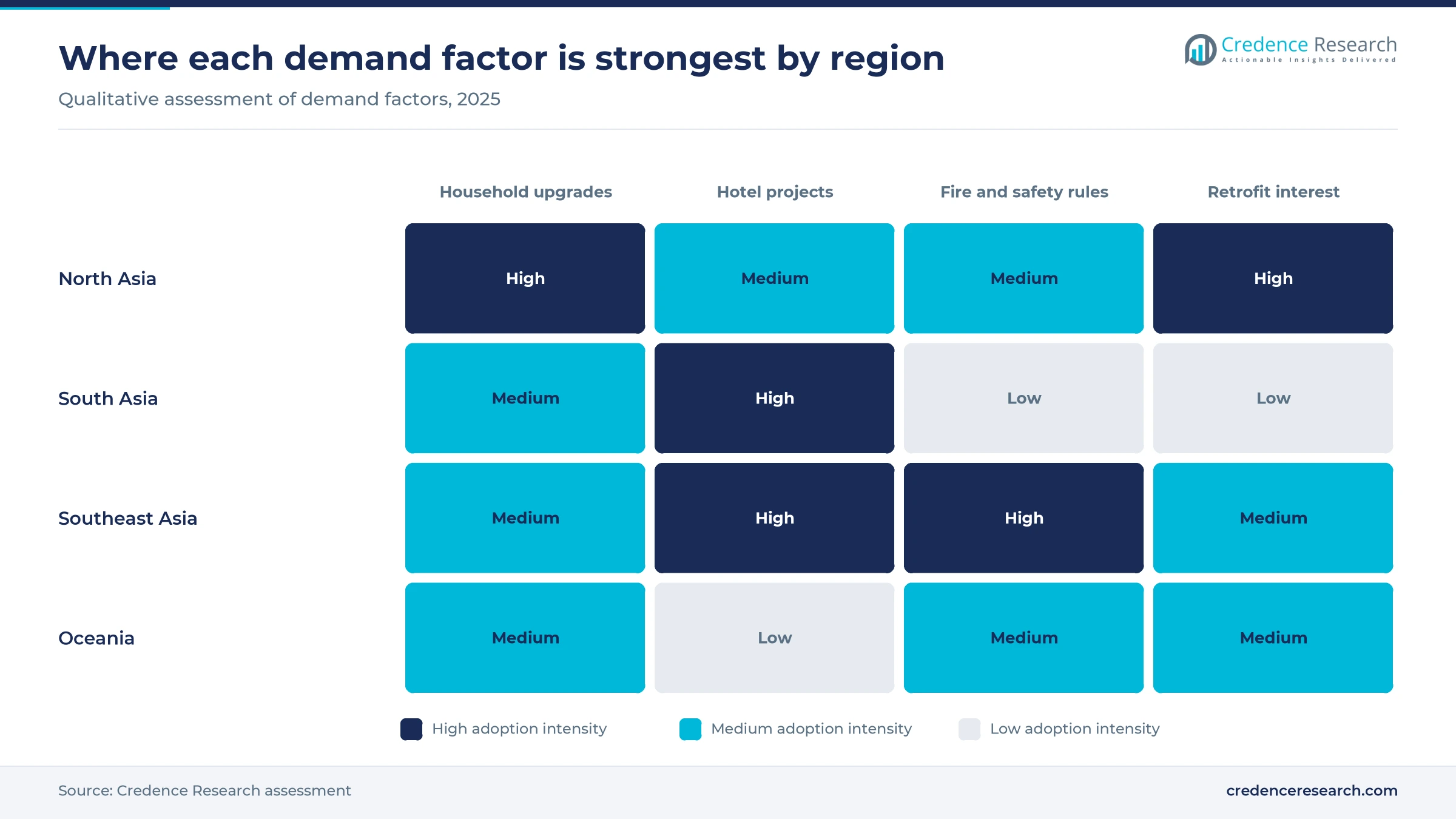
Hotels, serviced apartments and offices buy connected locks because remote credentials reduce front desk work and key handling. Hotel-Online reported 2,262 hotel projects and 434,593 rooms in Asia Pacific excluding China at the close of the third quarter of 2025, a record high. Guest volumes support those projects, with the Japan National Tourism Organization reporting 42,683,600 arrivals in 2025, up 15.8%. Singapore operator KINN Hospitality, which runs capsule hotels and studios, installed 53 mortise and 192 locker locks managed by app. Photosynth also says more than 10,000 companies have adopted its Akerun platform in Japan. Consequently, Commercial and Hospitality grows at 12.87% a year through 2035.
Established smart-home distribution widens product access
Physical store networks and marketplace listings put connected locks within reach of buyers who want a fitting service as well as a price. China Daily reported that Dessmann has over 3,000 stores, with about 800 opened during the first eight months of 2024. Qubo, the Hero Group brand, sells its Nova, Alpha and Optima models through more than 1,500 offline stores in India, according to FoneArena. Godrej said in January 2026 that its service reaches more than 13,000 PIN codes, including Tier II and Tier III cities. These networks help explain why Specialty and DIY Retail held 38.0% of 2025 value, and they also shorten the path to installation in smaller cities.
Replacement cycles and subsidies support household upgrades
China is moving from first purchases toward repeat buying, while public incentives shorten the decision for many households. 36Kr reported in December 2025 that the replacement cycle is about five to seven years, so locks sold during the category’s earlier growth years are now reaching replacement age. Beijing added smart door locks to its 2025 trade-in program, paying 15% of the final price up to 2,000 yuan per product, according to Shanghai Metals Market in June 2025. China Daily reported market reach of only 21.3% in first- and second-tier cities and 16.5% in third- and fourth-tier cities. Together, these facts support both repeat purchases and first-time demand across North Asia, the largest regional base.
Vein recognition and no-drill designs reset buyer choices
Shift toward vein and facial recognition at mid-range prices
Biometric features that once marked flagship products are moving into mid-range models, and this changes how brands defend price. Xiaomi launched the M40 in November 2025, and 36Kr listed it at 3,499 yuan, with the palm vein M40 Pro at 3,799 yuan. Lei Keji, writing in 36Kr in December 2025, said Xiaomi aims near 3,000 yuan rather than the 5,000 to 6,000 yuan flagship range. Kaadas showed its K70 lock with 3D facial recognition and AI monitoring at CES in January 2025. Dessmann has also promoted semi-solid batteries on its Qilin R9, with a claimed single annual charge. As a result, feature leadership now lasts a shorter time and brands must differentiate through service and reliability.
Rise of no-drill retrofit locks in rented and older homes
Renters and owners of older apartments often cannot alter a door, so products that fit over existing hardware are gaining attention. Xiaomi listed its Self-Install Smart Lock in Japan at 12,980 yen in January 2026, with no drilling required, according to Notebookcheck. Photosynth describes Akerun as the first retrofit smart lock and reports more than 10,000 adopting companies. The Korea Consumer Agency adds a practical reason, finding in February 2025 that all 10 overseas direct-purchase locks tested had drilling positions different from domestic norms, raising installation and restoration costs. Zigbang has also removed the keypad from its Haven lock, launched in January 2025, which relies on phone taps and facial recognition. Rim and Cylinder Locks therefore grow at 13.23% a year.
Opportunity in India and Vietnam hotel openings
Access specialists have a clear opening in South and Southeast Asian hotel construction, because new rooms specify electronic locks from the design stage. Hotel-Online reported India with 838 projects and 108,775 rooms in the third quarter of 2025, up 31% and 37% from a year earlier. Vietnam held 248 projects and 91,003 rooms, while Thailand followed with 167 projects and 43,600 rooms. The dormakaba annual report for fiscal 2021/22 named India, China and Australia as core countries in the region and tied growth to hotel projects in Greater China and Southeast Asia. ASSA ABLOY opened an experience center in Chennai in November 2022 showing Yale Access locks. Suppliers that pair electronic access control systems with guest-room hardware can win larger project orders.
Opportunity in first-time ranges for lower-tier cities
Brands can open a large base of first-time buyers by lowering entry prices and simplifying setup in cities that have few installed locks. China Daily reported in October 2024 that more than 80% of Chinese consumers had not used a smart door lock, and reach was 16.5% in third- and fourth-tier cities. In India, Godrej prices its Neo digital locks from INR 8,999 and reports digital lock growth of about 30% a year. Qubo also sells its Optima model at INR 17,990 to first-time users, with no app needed, according to FoneArena. Haier sells its S300 near 2,000 yuan in China, according to 36Kr. This opening favors Specialty and DIY Retail as well as online sellers, because new buyers usually want fitting help and a visible service point.
Fire safety rules and China housing weigh on vendors
Battery and fire safety failures on imported locks
Fire behavior has become a visible risk for low-priced imports. The Korea Consumer Agency reported in February 2025 that all five battery-powered locks it tested ignited or exploded at 170 to 260 degrees Celsius, below the 270 degree test standard. Three of 10 locks also could not be opened manually during fire testing. AliExpress then blocked six flagged products and agreed to refunds, so established brands can respond by publishing test results and using certified cells.
Fire door certification narrows approved models
Certification rules add testing cost and limit the models that retailers can offer. The Singapore Civil Defence Force has required digital locksets on fire doors to carry fire-resistance certification since March 1, 2024, with tests to SS 332 or EN 1634-1. Gyeonggi Province in South Korea reported in December 2023 that four of 10 online models failed safety checks, three of them on fire resistance. Smaller importers carry the heaviest burden, and they can reduce it by sourcing models that already hold certificates.
China housing decline trims developer procurement
Developer orders depend on completed homes, and China has entered a sharp housing downturn. Caixin reported National Bureau of Statistics data showing 881 million square meters of new homes sold in 2025, down 8.7%, with sales value down 12.6% to 8.39 trillion yuan. Lock makers with heavy project exposure face lower volumes as a result. Replacement sales, trade-in programs and store networks offer the clearest way to offset the weaker developer channel.
Tighter standards meet falling feature prices
Compliance costs are rising while prices for advanced features fall, which squeezes smaller makers on both sides. SAMR and SAC issued GB 21556.2-2025 on Aug. 29, 2025, setting safety requirements for mechanical and electronic burglary-resistant locks from March 1, 2026. Xiaomi’s M40 was listed at 3,499 yuan by December, well below the 5,000 to 6,000 yuan flagship range cited by 36Kr. Consequently, smaller brands must redesign products with less margin, and many may turn to contract supply or consolidate.
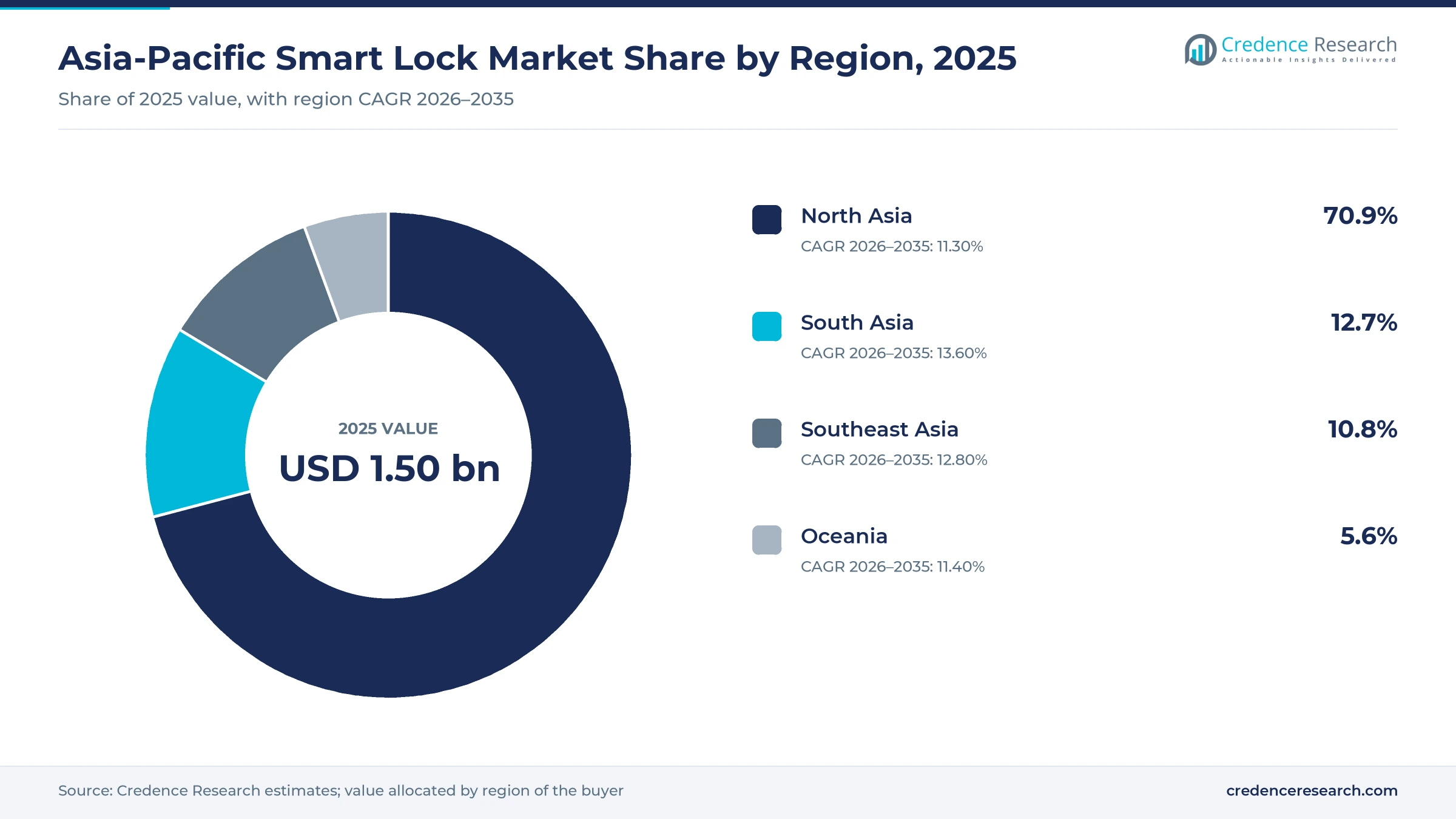
North Asia leads while South Asia grows fastest
| Region | Value, 2025 (USD billion) | Share, 2025 | CAGR, 2026–2035 |
|---|---|---|---|
| North Asia | 1.07 | 70.9% | 11.30% |
| South Asia | 0.19 | 12.7% | 13.60% |
| Southeast Asia | 0.16 | 10.8% | 12.80% |
| Oceania | 0.08 | 5.6% | 11.40% |
North Asia keeps the largest base through China volume
North Asia held 70.9% of 2025 value and grows at 11.30% a year. China anchors the region, with 22.3 million units sold in 2023 and manufacturing clusters in Wenzhou, Zhongshan and Foshan, according to China Daily. Japan adds a large mortise base and strong hospitality demand after 42,683,600 arrivals in 2025. In South Korea, Zigbang acquired the Samsung SDS home IoT business in July 2022 and launched its Haven lock in January 2025. Housing weakness in China explains why this region grows more slowly than the others.
South Asia grows fastest on India hotel and housing gains
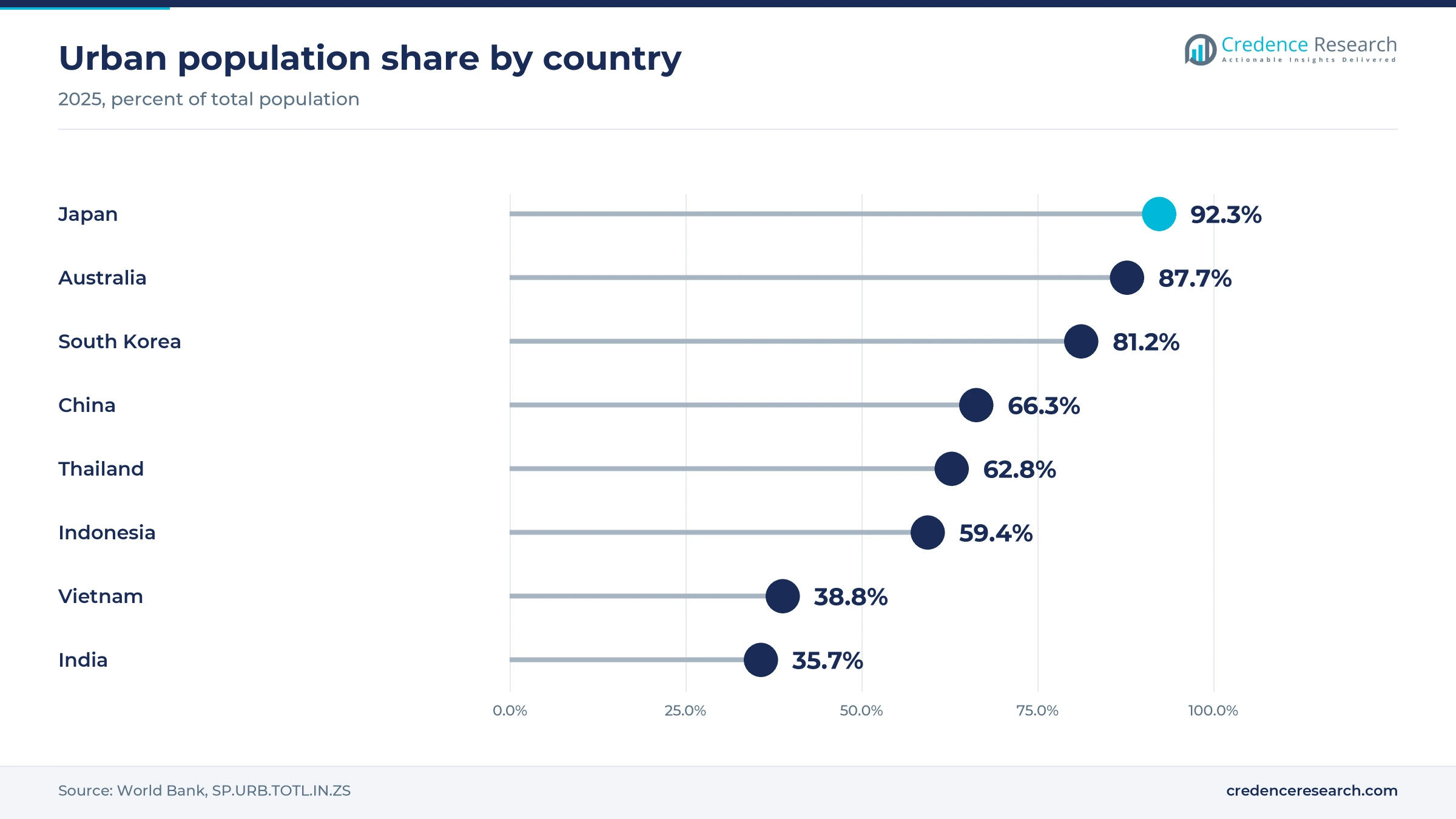
South Asia held 12.7% of 2025 value and is the fastest-growing region at 13.60% a year. World Bank data show urban residents at 35.7% of India's population in 2025, which leaves a long runway for new urban apartments. India also leads the regional hotel pipeline, with 838 projects and 108,775 rooms in the third quarter of 2025, according to Hotel-Online. Godrej reports digital lock growth of about 30% a year, and Qubo has refreshed five models for 2025.
Southeast Asia adds demand via hotels and certified locks
Southeast Asia held 10.8% of 2025 value and grows at 12.80% a year. Singapore is the rule-setting market, because digital locksets on fire doors must be certified for fire resistance under a rule in force since March 1, 2024. Vietnam and Thailand held 91,003 and 43,600 pipeline hotel rooms in the third quarter of 2025, according to Hotel-Online. Singapore-based igloocompany supplies local operators such as KINN Hospitality, while Zigbang launched Haven in Singapore and planned entry into Malaysia and Thailand.
Oceania builds on housing approvals and the Lemaar deal
Oceania held 5.6% of 2025 value and grows at 11.40% a year, the smallest base in the region. The Australian Treasury reported 18,406 dwellings approved in November 2025, up 20.2% from a year earlier, against a National Housing Accord goal of 1.2 million homes over five years. Allegion agreed in February 2025 to buy Victoria-based Lemaar, a maker of digital locks that serves builders, retailers and DIY buyers. Lemaar products also address specialist disability accommodation, which adds a distinct buyer group in Australia.
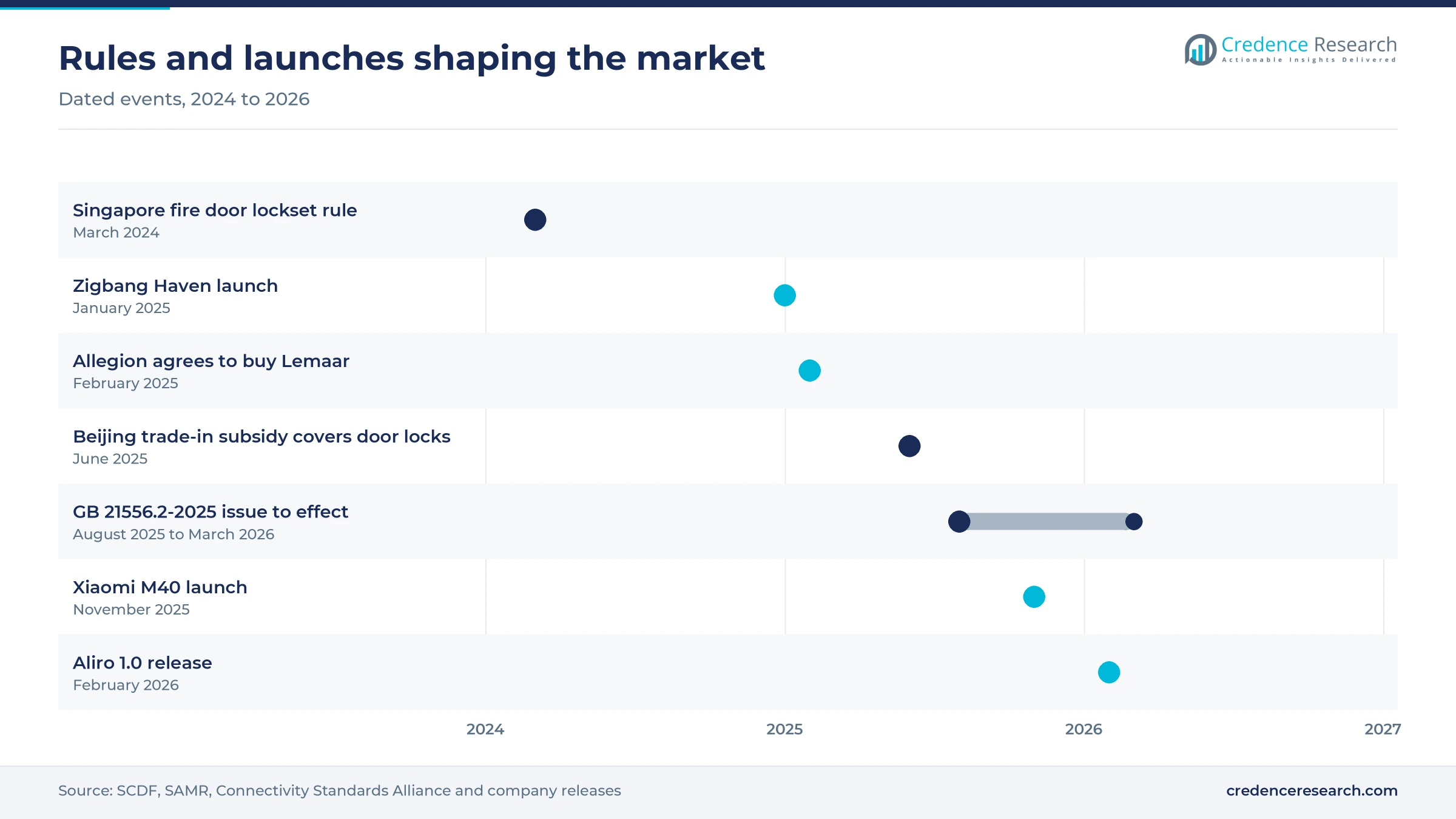
Dated launches and rules from 2024 to 2026
| Development | Status and market relevance |
|---|---|
| In March 2024, the Singapore Civil Defence Force began requiring fire-resistance certification for digital locksets on fire doors. | In force; narrows the approved model list |
| In January 2025, Zigbang announced its Haven lock with AI facial recognition for Singapore, Hong Kong and South Korea. | Launched; expansion planned in Asia |
| In February 2025, Allegion agreed to acquire Lemaar Australia, a maker of door hardware and digital locks. | Agreement announced February 2025; adds Australian residential reach |
| In August 2025, SAMR and SAC issued GB 21556.2-2025 on burglary-resistant locks, effective March 1, 2026. | In force; raises electronic lock requirements |
| In February 2026, the Connectivity Standards Alliance released Aliro 1.0, with Aqara and Allegion among the first certified companies. | Released; supports shared phone credentials |
Credential technology now decides the upgrade path
- Aliro 1.0 sets a common phone credential over NFC, Bluetooth LE and ultra-wideband, and it was released on Feb. 26, 2026.
- Matter connects locks to several home platforms without proprietary hubs, and Xiaomi added support on its self-install lock in January 2026.
- Palm vein and facial recognition remove the need for keys or cards, and Xiaomi uses palm vein recognition on the M40 Pro.
- Time-limited PINs let owners share access without an app, and igloohome padlocks deliver them by SMS, email or WhatsApp.
Need a Custom Version of This Report?
Tailor the scope, geography, or segments to your exact requirements.
- Custom geography or segment scope
- Direct access to our analyst team
Volume brands and access specialists compete by channel
Competition in the region divides into volume consumer brands and access specialists. Xiaomi competes on price and app reach, while Kaadas relies on manufacturing scale with bases in Ouhai, Zhuhai and Zhongshan, and Dessmann relies on its store network in China. Aqara and Allegion use early Aliro certification to reach buyers who want open ecosystems. MIWA Lock holds a strong installed position in Japanese residences, and this gives partners such as Photosynth an entry route. Zigbang took over the Samsung door lock line in 2022 and is expanding across Asia, while igloocompany targets operators and hosts with remote PIN management. Dormakaba leans on hotel and commercial projects, and ASSA ABLOY shows Yale Access products with architect support in Chennai. Allegion strengthened its Australian residential reach with its Lemaar agreement. Buyers increasingly compare certification, service coverage and credential software along with hardware price.
Companies profiled and their roles in this market
| Company | Type | Role in the market |
|---|---|---|
| Xiaomi | Consumer electronics brand | Sells M40 locks in China and a Matter self-install lock in Japan |
| Aqara | Smart home brand | Among the first companies certified to Aliro 1.0 |
| MIWA Lock | Japanese lock maker | Large residential mortise base and partner of Photosynth Akerun |
| dormakaba | Access solutions group | Lodging systems, with India, China and Australia named as core countries |
| ASSA ABLOY | Access solutions group | Shows Yale Access locks at its Chennai experience center |
| Allegion | Security products group | Aliro certified and agreed to buy Lemaar in Australia |
| Kaadas | Lock maker | Facial recognition K70 lock and bases in three Chinese cities |
| Dessmann | Lock maker | Over 3,000 stores in China and semi-solid battery locks |
| Zigbang | Property technology company | Owns the former Samsung SDS door lock line and sells Haven |
| igloocompany | Access management company | Supplies PIN-based locks to Singapore hospitality operators |
Hospitality and retrofit offer the better growth mix
Credence Research's view is that the market is less a China housing story than it first appears. China still sets volume, but the 8.7% fall in floor area sold during 2025 shows why developer exposure is the weak spot. Replacement demand, trade-in support and hotel projects in India and Vietnam offer the better mix for the next decade. Aliro should help open ecosystems, although proprietary apps will keep value in China for several years. Suppliers with certified fire and battery performance should hold pricing better than low-cost importers.
How Credence Research built these estimates
The report uses 2025 as the base year and forecasts values for 2026 through 2035 from the Credence Research market model. Regional and segment splits are Credence Research estimates, informed by public statistics, regulator pages, company releases and trade press opened during research. No interviews or surveys were conducted for this edition, and estimates carry more uncertainty where public data are thin, such as Matter-led lock shipments and institutional purchasing.
Retrofit and hospitality should carry growth to 2035
Through 2035, the market moves toward certified, phone-based access and away from closed products sold on keypad features alone. China should remain the largest national buyer as locks sold in the last decade reach replacement age, although weaker housing will limit project orders. India and Vietnam should add the largest hotel room counts if current pipelines reach opening. Fire and battery rules are likely to spread beyond Singapore and South Korea, and this should favor certified suppliers. Retrofit formats should gain share in rented housing across Japan and Oceania.
Frequently Asked Questions
How big is the Asia-Pacific smart lock market?
Which region leads the Asia-Pacific smart lock market?
Which region grows the fastest?
Which product type is the largest?
What is Aliro and why does it matter for buyers?
How do subsidies affect smart lock demand in China?
What are the main safety concerns for smart locks?
Who are the leading companies in this market?
Table of Content
Chapter 1 Market Segmentation
- 1.1 Segmentation Framework
- 1.1.1 Product and Service Classification
- 1.1.2 Application and End-Use Classification
- 1.1.3 Technology and Solution Classification
- 1.1.4 Customer and Distribution Channel Classification
- 1.1.5 Geographic Segmentation
- 1.1.6 Market Segment Definitions and Boundaries
- 1.2 By Product Type
- 1.2.1 Deadbolt and Mortise Locks
- 1.2.2 Lever Handle Locks
- 1.2.3 Smart Padlocks
- 1.2.4 Rim and Cylinder Locks
- 1.3 By End User
- 1.3.1 Residential
- 1.3.2 Commercial and Hospitality
- 1.3.3 Institutional and Government
- 1.4 By Technology
- 1.4.1 Bluetooth-Led Locks
- 1.4.2 Wi-Fi and Proprietary Hub Locks
- 1.4.3 Standalone Digital and RFID Locks
- 1.4.4 Matter-Led Locks
Chapter 2 Introduction
- 2.1 Report Objectives and Scope
- 2.2 Product Definition and Industry Terminology
- 2.3 Market Inclusions and Exclusions
- 2.4 Research Process
- 2.4.1 Primary Research and Expert Interviews
- 2.4.2 Secondary Research and Source Review
- 2.4.3 Top-Down and Bottom-Up Estimation
- 2.4.4 Data Triangulation and Verification
- 2.5 Market Size Measurement Basis
- 2.5.1 2025: USD 1.50 billion → 2035: USD 4.60 billion
- 2.6 Historical and Forecast Reference Periods
- 2.6.1 Historical Period: 2018-2025
- 2.6.2 Base Year: 2025
- 2.6.3 Forecast Period: 2025-2035
- 2.7 Research Assumptions and Limitations
Chapter 3 Executive Summary
- 3.1 Market Snapshot and Key Findings
- 3.2 Base-Year Market Size, 2025
- 3.3 Forecast Market Size, 2035
- 3.4 Revenue and Volume Growth Outlook
- 3.5 Key Demand and Supply Indicators
- 3.6 Leading Market Segments
- 3.7 Fastest-Growing Market Opportunities
- 3.8 Regional Performance Highlights
- 3.9 Technology and Industry Transformation
- 3.10 Competitive Landscape Summary
- 3.11 Analyst View and Strategic Implications
Chapter 4 Asia-Pacific Smart Lock Market Trends and Developments
- 4.1 Historical Industry Development, 2018-2025
- 4.2 Recent Market Trends and Developments
- 4.3 Demand and Customer Behavior Trends
- 4.4 Technology and Product Innovation
- 4.5 Artificial Intelligence, Automation and Digitalization
- 4.6 Local Manufacturing and Supply Chain Realignment
- 4.7 Industry Partnerships, Mergers and Acquisitions
- 4.8 Sustainability and Circular Economy Developments
- 4.9 Government and Private Sector Investment Trends
- 4.10 Emerging Business Models and Commercialization
- 4.11 Industry Developments and Announcements
Chapter 5 Asia-Pacific Smart Lock Market Production, Supply and Demand Analysis
- 5.1 Demand Trend and Consumption Analysis, 2018-2025
- 5.2 Demand Forecast, 2025-2035
- 5.3 Production and Output Trend, 2018-2025
- 5.4 Production and Output Forecast, 2025-2035
- 5.5 Installed Capacity and Capacity Utilization
- 5.6 Company-Wise Production Plants and Statistics
- 5.6.1 Installed Production Capacity
- 5.6.2 Actual Production
- 5.6.3 Planned Capacity and Expansion Targets
- 5.7 Supply Chain Structure and Procurement Trends
- 5.8 Supply-Demand Gap and Bottlenecks
- 5.9 Import Dependence and Sourcing Structure
- 5.10 Contract Manufacturing and Outsourcing
- 5.11 Regional Supply and Demand Concentration
Chapter 6 Asia-Pacific Smart Lock Market Pricing Analysis
- 6.1 Pricing Structure and Measurement
- 6.2 Historical Pricing Trends, 2018-2025
- 6.3 Pricing Outlook, 2025-2035
- 6.4 Average Selling Price and Unit Economics
- 6.5 Pricing by Product and Market Segment
- 6.6 Geographic Pricing Differences
- 6.7 Key Input, Energy, Labor and Logistics Costs
- 6.8 Contract Pricing and Purchasing Models
- 6.9 Pricing Sensitivity and Competitive Positioning
- 6.10 Price, Margin and Profitability Implications
Chapter 7 Asia-Pacific Smart Lock Market Dynamics
- 7.1 Market Growth Drivers
- 7.1.1 Demand-Side Drivers
- 7.1.2 Technology and Innovation Drivers
- 7.1.3 Infrastructure and Investment Drivers
- 7.1.4 Regulatory and Policy Drivers
- 7.2 Market Restraints
- 7.2.1 Cost and Affordability Constraints
- 7.2.2 Technology and Adoption Barriers
- 7.2.3 Supply Chain and Operational Constraints
- 7.3 Market Challenges
- 7.3.1 Competitive Pressure and Margin Erosion
- 7.3.2 Skills, Infrastructure and Implementation Gaps
- 7.4 Emerging Market Opportunities
- 7.5 Market Dynamics Impact and Time-Horizon Assessment
Chapter 8 Asia-Pacific Smart Lock Value Chain Analysis
- 8.1 Industry Value Chain Overview
- 8.2 Upstream Suppliers and Critical Inputs
- 8.3 Technology and Component Providers
- 8.4 Manufacturing or Service Delivery
- 8.5 Distribution, Channel Partners and Integrators
- 8.6 Downstream Applications and End Users
- 8.7 Value Addition and Profit Pools
- 8.8 Vertical Integration and Outsourcing
- 8.9 Supplier Concentration and Risk
- 8.10 Supply Chain Localization and Resilience
Chapter 9 Asia-Pacific Smart Lock Market Regulations and Policies
- 9.1 Relevant Laws, Standards and Compliance Frameworks
- 9.2 Product, Service, Safety and Quality Requirements
- 9.3 Government Policies, Incentives and Subsidies
- 9.4 Imports, Exports and Trade Barriers
- 9.5 Public Procurement and Local Content Requirements
- 9.6 Environmental and Sustainability Compliance
- 9.7 Upcoming Policy Changes and Market Implications
Chapter 10 Asia-Pacific Smart Lock Market Hotspots and Opportunities
- 10.1 Market Opportunity Mapping and Growth Hotspots
- 10.2 High-Growth Applications and Customer Groups
- 10.3 Underserved Markets and White-Space Opportunities
- 10.4 Emerging Technology and Product Opportunities
- 10.5 New Capacity and Investment Hotspots
- 10.6 Market Entry and Expansion Opportunities
- 10.7 Distribution and Partnership Opportunities
- 10.8 Near-Term and Long-Term Commercial Potential
- 10.9 Opportunity Attractiveness and Execution Risks
Chapter 11 Asia-Pacific Smart Lock Market Outlook, 2025-2035
- 11.1 Market Size and Analysis
- 11.1.1 Revenue (Market Measurement: 2025: USD 1.50 billion → 2035: USD 4.60 billion)
- 11.1.2 Market Volume and Quantity Sold
- 11.1.3 Historical Market Size, 2018-2025
- 11.1.4 Base-Year Market Size, 2025
- 11.2 Market Forecast, 2025-2035
- 11.2.1 Revenue Forecast to 2035
- 11.2.2 Volume Forecast to 2035
- 11.2.3 CAGR and Year-on-Year Growth
- 11.2.4 Incremental Revenue Opportunity
- 11.3 Forecast Assumptions and Scenario Analysis
- 11.3.1 Base-Case Forecast
- 11.3.2 Optimistic and Conservative Scenarios
- 11.3.3 Technology, Pricing and Policy Sensitivities
- 11.4 Market Attractiveness and Growth Outlook
Chapter 12 Asia-Pacific Smart Lock Market Segmentation and Outlook
- 12.1 Segmentation Summary and Market Shares, 2025
- 12.2 Largest and Fastest-Growing Segments
- 12.3 By Product Type - Market Size and Forecast, 2025-2035
- 12.3.1 Segment Definition and Scope
- 12.3.2 Historical Market Size, 2018-2025
- 12.3.3 Revenue Forecast, 2025-2035
- 12.3.4 Volume Forecast, 2025-2035
- 12.3.5 Base-Year Market Share, 2025
- 12.3.6 Segment CAGR and Growth Drivers
- 12.3.7 Subsegment Market Size and Forecast
- 12.3.7.1 Deadbolt and Mortise Locks
- 12.3.7.2 Lever Handle Locks
- 12.3.7.3 Smart Padlocks
- 12.3.7.4 Rim and Cylinder Locks
- 12.3.8 Subsegment Pricing and Adoption Trends
- 12.3.9 Leading Suppliers and Competition
- 12.3.10 Regional Demand and Opportunities
- 12.4 By End User - Market Size and Forecast, 2025-2035
- 12.4.1 Segment Definition and Scope
- 12.4.2 Historical Market Size, 2018-2025
- 12.4.3 Revenue Forecast, 2025-2035
- 12.4.4 Volume Forecast, 2025-2035
- 12.4.5 Base-Year Market Share, 2025
- 12.4.6 Segment CAGR and Growth Drivers
- 12.4.7 Subsegment Market Size and Forecast
- 12.4.7.1 Residential
- 12.4.7.2 Commercial and Hospitality
- 12.4.7.3 Institutional and Government
- 12.4.8 Subsegment Pricing and Adoption Trends
- 12.4.9 Leading Suppliers and Competition
- 12.4.10 Regional Demand and Opportunities
- 12.5 By Technology - Market Size and Forecast, 2025-2035
- 12.5.1 Segment Definition and Scope
- 12.5.2 Historical Market Size, 2018-2025
- 12.5.3 Revenue Forecast, 2025-2035
- 12.5.4 Volume Forecast, 2025-2035
- 12.5.5 Base-Year Market Share, 2025
- 12.5.6 Segment CAGR and Growth Drivers
- 12.5.7 Subsegment Market Size and Forecast
- 12.5.7.1 Bluetooth-Led Locks
- 12.5.7.2 Wi-Fi and Proprietary Hub Locks
- 12.5.7.3 Standalone Digital and RFID Locks
- 12.5.7.4 Matter-Led Locks
- 12.5.8 Subsegment Pricing and Adoption Trends
- 12.5.9 Leading Suppliers and Competition
- 12.5.10 Regional Demand and Opportunities
- 12.6 Segment Growth Comparison
- 12.7 Segment Attractiveness and Priority Matrix
Chapter 13 Asia-Pacific Smart Lock End-Use and Application Market Outlook
- 13.1 End-Use Industry and Customer Demand Structure
- 13.2 Leading Applications and Customer Groups
- 13.3 End-Use Market Size, Share and Forecast
- 13.4 Major End-Use Industry Deep Dives
- 13.4.1 Customer Requirements and Use Cases
- 13.4.2 Demand and Replacement Cycles
- 13.4.3 Technical and Regulatory Considerations
- 13.4.4 Purchasing and Procurement Models
- 13.4.5 Leading Vendors and Distribution Channels
- 13.4.6 Forecast and Commercial Opportunities
- 13.5 Emerging Applications and Cross-Segment Demand
- 13.6 End-Use Industry Investment Priorities
Chapter 14 Asia-Pacific Smart Lock Geographic Market Outlook, 2025-2035
- 14.1 Regional Market Size and Country-Level Shares, 2025
- 14.2 Country Market Size Comparison, 2025
- 14.3 Country Market Forecasts, 2025-2035
- 14.4 Subregional Industrial and Demand Clusters
- 14.5 Intra-Regional Pricing and Cost Differences
- 14.6 Cross-Border Trade and Supply Networks
- 14.7 Regional Supply and Demand Balances
- 14.8 Country Opportunity Comparison and Prioritization
Note: Every listed country is covered on the structure shown under the first country.
Chapter 15 Asia-Pacific Smart Lock Technology, Innovation and Sustainability Outlook
- 15.1 Technology Landscape and Maturity
- 15.2 Product, Process and Service Innovation
- 15.3 AI, Automation and Digital Tools in the Industry
- 15.4 Technology Adoption and Performance Benchmarking
- 15.5 Innovation Pipeline and R&D Investment
- 15.6 Patent and Intellectual Property Trends
- 15.7 Energy Efficiency and Resource Management
- 15.8 Sustainability, Recycling and Circularity
- 15.9 Technology Roadmap, 2025-2035
- 15.10 Risks of Obsolescence and Technology Substitution
Chapter 16 Asia-Pacific Smart Lock Market Key Strategic Imperatives
- 16.1 Growth and Market Entry Priorities
- 16.2 High-Return Products and Segments
- 16.3 Pricing, Profitability and Cost Optimization
- 16.4 Technology Investment and Product Differentiation
- 16.5 Supply Chain Localization and Resilience
- 16.6 Distribution and Customer Acquisition
- 16.7 Partnership, Acquisition and Capacity Strategy
- 16.8 Regional Expansion Priorities
- 16.9 Short-, Medium- and Long-Term Actions
Chapter 17 Competition Outlook
- 17.1 Industry Competition Characteristics
- 17.2 Market Structure and Concentration
- 17.3 Market Share and Competitive Positioning, 2025
- 17.4 Company-Wise Revenue and Product Benchmarking
- 17.5 Production and Service Capacity Benchmarking
- 17.6 Technology, Pricing and Differentiation
- 17.7 Regional Footprint and Distribution Strength
- 17.8 Mergers, Acquisitions and Strategic Alliances
- 17.9 New Entrants and Competitive Threats
- 17.10 Porter's Five Forces and Industry Attractiveness
- 17.11 Competitive Outlook, 2025-2035
Chapter 18 Company Profiles
- 18.1 Company Coverage and Selection Criteria
- 18.2 Xiaomi
- 18.2.1 Business Description
- 18.2.2 Company Ownership and Geographic Presence
- 18.2.3 Product and Service Portfolio
- 18.2.4 Manufacturing and Operating Footprint
- 18.2.5 Production Capacity and Expansion Plans
- 18.2.6 Financial Performance and Investment
- 18.2.7 Market Share and Competitive Position
- 18.2.8 Technology and Innovation Capabilities
- 18.2.9 Strategic Alliances or Partnerships
- 18.2.10 Recent Developments
- 18.2.11 Growth Strategy and Outlook
- 18.3 Aqara
- 18.4 MIWA Lock
- 18.5 dormakaba
- 18.6 ASSA ABLOY
- 18.7 Allegion
- 18.8 Kaadas
- 18.9 Dessmann
- 18.10 Zigbang
- 18.11 igloocompany
- 18.12 Other Relevant Market Participants
Note: Every listed company is profiled on the structure shown under the first company. The company list is preliminary and may change based on research findings, market developments, data availability and client requirements.
Chapter 19 Disclaimer
- 19.1 Research and Forecast Disclaimer
- 19.2 Data Source and Estimation Limitations
Note: The depth of individual sections depends on data availability for this market. Volume, capacity, trade and other unit-based metrics are included where applicable.

