
DOE Designates Helium a Critical Material, Citing Semiconductor Supply Risk
The U.S. Department of Energy has added helium to its Critical Material List, a designation that places the gas used throughout semiconductor fabrication on the same federal priority list as lithium, gallium and silicon carbide. Energy Secretary Chris Wright made the determination under the Energy Act of 2020, and the department announced it in Washington on Friday, Oct. 23, 2026, citing helium's lack of substitutes in chipmaking and a rising risk of supply disruption.
Key developments
- DOE designated helium a critical material under Section 7002 of the Energy Act of 2020, finding that it serves an essential function in energy technologies and faces high supply chain disruption risk.
- The Federal Register notice was signed Oct. 21 by Audrey Robertson, assistant secretary for critical minerals and energy innovation, and posted by DOE on Oct. 23.
- DOE described helium as non-substitutable for multiple critical energy functions, naming semiconductor manufacturing, leak testing of natural gas infrastructure, quantum computing and key medical and scientific uses.
- The department said global helium demand is growing faster than production and that limited refining capacity and lengthy permitting timelines constrain U.S. output, despite large domestic deposits of helium-rich natural gas.
- The action amends the 2023 DOE Critical Materials List, which DOE previously expanded in May 2025 to include metallurgical coal for steelmaking.
Why helium matters to chipmaking
Helium is chemically inert, has the lowest boiling point of any element and conducts heat well. Those properties make it difficult to replace in semiconductor fabs, where it is used to cool wafers during etching and deposition, to purge and protect process chambers, and to detect leaks in vacuum systems. It is also the coolant for the superconducting magnets in MRI scanners and for many quantum computing systems, which operate near absolute zero.
The gas is not manufactured. It is recovered as a byproduct of natural gas processing from fields where it has accumulated over geologic time, and once released it escapes the atmosphere. That geology concentrates supply in a few countries and ties output to decisions made by gas producers, not helium buyers.
The U.S. Geological Survey's Mineral Commodity Summaries 2026 shows the United States remains a net exporter of helium, with about 81 million cubic meters of Grade-A and gaseous helium sold in 2025 against apparent consumption of 51 million cubic meters. The country still imports helium, however, with Canada supplying 47%, Qatar 28%, Algeria 10% and China 5% of imports from 2021 to 2024. USGS lists controlled atmospheres, fiber optics and semiconductors together as 17% of U.S. helium end use in 2025, and estimated the Grade-A base price at about $12 per cubic meter, or $330 per thousand cubic feet, before producer surcharges.
Industry implications
The DOE list is separate from the Interior Department's list of critical minerals, which USGS maintains. USGS dropped helium from its list in its 2022 update, along with potash, rhenium and strontium. The new DOE designation restores federal critical status for helium through the energy side of the government, and DOE framed it as support for U.S. manufacturing, jobs and national and economic security. Wright said helium "is essential to producing the semiconductors and advanced technologies that power our economy."
For chipmakers building new fabs in Arizona, Texas, Ohio and New York, the practical effect is a stronger policy signal rather than an immediate supply change. DOE's release did not announce funding, tax incentives or procurement measures tied to the designation. Critical material status does give the department a basis to prioritize helium in research, supply chain analysis and future programs aimed at domestic refining and storage. The notice ties the move to building U.S. semiconductor infrastructure and cites the January 2025 executive order on advancing U.S. leadership in artificial intelligence infrastructure, linking the gas to the fabs that supply data center chips.
Competitive and supply chain implications
DOE identified refining capacity and permitting, not reserves, as the binding constraints on U.S. production. That puts the focus on midstream infrastructure: purification plants, liquefiers, cryogenic containers and storage. USGS reported that six new helium operations began producing in the United States in 2025, three in New Mexico and one each in Colorado, Kansas and Montana, and that a helium storage cavern in Beaumont, Texas, came online to hold excess output.
The federal government is no longer a market participant. The Bureau of Land Management completed the sale of the Federal Helium System, including the reserve at Cliffside near Amarillo, Texas, to industrial gas company Messer in June 2024, fulfilling the Helium Stewardship Act of 2013. Policy levers now run through permitting, research and federal programs rather than direct sales from a government stockpile.
For industrial gas distributors and fab operators, the designation strengthens the case for long-term contracts with domestic producers, on-site recovery and recycling systems, and dual sourcing that limits exposure to any single export hub. U.S. and European Union sanctions banning imports of Russian helium continued into 2025, according to USGS, which keeps Russian volumes out of Western supply chains.
Regional implications
In the United States, the designation draws attention to helium-bearing gas regions in the Texas Panhandle, Kansas and the Mountain West, where USGS recorded the 2025 start-ups in New Mexico, Colorado, Kansas and Montana. Faster federal permitting on public land would most directly affect projects in Western states.
Internationally, Qatar remains the largest supplier outside the United States and a major source of U.S. imports, while Algeria, Canada and Russia hold large resources, according to USGS. Chip hubs in Taiwan, South Korea and Japan have no meaningful domestic production, so U.S. policy that expands domestic refining could also influence export availability to those fabs over time.
Credence Research analysis
The designation is a low-cost policy move with a clear direction. By placing helium on its critical list without attaching new money, DOE is setting up the gas for inclusion in future funding rounds, permitting reforms and supply chain studies while signaling to investors that domestic helium refining is a federal priority tied to semiconductors and AI infrastructure. DOE's own diagnosis points to refining and permitting as the areas for any follow-on action.
The bigger near-term effect may be on procurement behavior. Fab operators have learned from past helium shortages that a single plant outage or shipping disruption can tighten supply quickly. A federal finding of high disruption risk gives purchasing teams and boards a reference point for funding recovery systems, longer contracts and qualified backup suppliers. The designation also partly reverses the 2022 USGS decision to drop helium, which suggests the government's view of supply risk has shifted as chip manufacturing capacity in the United States has grown.
What comes next
- Publication of the notice in the Federal Register, which DOE says will be the controlling version of the document.
- Any DOE funding opportunities, research calls or loan program activity that name helium refining, storage or recovery as eligible areas.
- Permitting decisions on helium projects on federal land in Western states, the constraint DOE identified alongside refining capacity.
- Industry responses from chipmakers, industrial gas companies and helium explorers on long-term supply contracts and recycling investments.
- The next scheduled reviews of the DOE and USGS critical lists, which will show whether helium's status is aligned across agencies.
Sources
- U.S. Department of Energy: Energy Department Designates Helium as Critical Material
- U.S. Department of Energy: Critical Material List; Addition of Helium (notice)
- U.S. Geological Survey: Mineral Commodity Summaries 2026, Helium and Rare Gases
- Bureau of Land Management: BLM completes sale of Federal Helium System
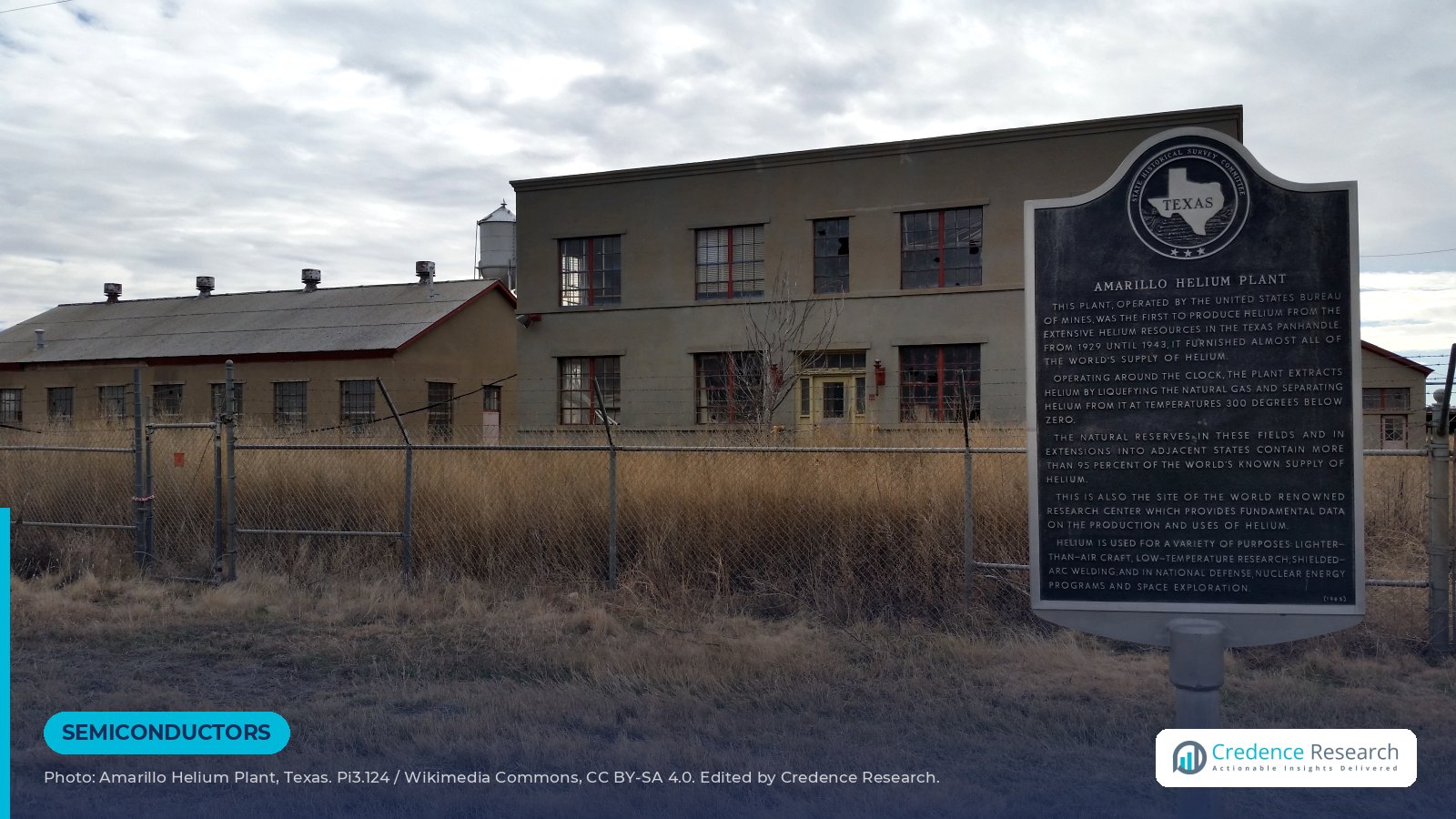
Image: Historic marker and buildings at the Amarillo Helium Plant in Amarillo, Texas, by Pi3.124 via Wikimedia Commons, CC BY-SA 4.0. Cropped and edited by Credence Research.

About the Author

Senior News Editor at Credence Research Inc