
Lilly Breaks Ground on $5 Billion Virginia Plant for Antibody-Drug Conjugates
Eli Lilly and Company broke ground Thursday, Oct. 22, 2026, on a $5 billion manufacturing facility in Goochland County, Virginia, just west of Richmond, moving its first fully integrated plant for active pharmaceutical ingredients and finished medicines from plan to construction. The Indianapolis-based drugmaker said the site will focus on antibody-drug conjugates, a class of targeted cancer treatments, and is expected to employ about 650 people once running, with roughly 1,800 workers needed during construction.
Key developments
- Lilly started construction on a $5 billion facility in Goochland County, Va., first announced on Sept. 16, 2025, as part of more than $50 billion the company has committed to U.S. medicine production since 2020.
- The plant will be the first Lilly site to produce both active pharmaceutical ingredients (API) and finished medicines in one integrated facility, with dedicated API capacity for bioconjugate and large-molecule medicines.
- Lilly expects about 650 high-wage jobs for engineers, scientists, operations personnel and lab technicians, plus about 1,800 construction jobs, and said it is already hiring in Richmond.
- The company committed $40 million to the Virginia Center for Advanced Pharmaceutical Manufacturing, a statewide network that includes a pilot-scale, hands-on training center in Goochland County targeted to open in 2028.
- The site is targeting LEED Gold certification and will use machine learning, artificial intelligence, digitally integrated systems and embedded automation across its operations.
How antibody-drug conjugates are made
Antibody-drug conjugates combine a monoclonal antibody, which seeks out a specific marker on a cell, with a potent drug payload attached through a chemical linker. The design aims to deliver a cell-killing agent directly to tumor cells while limiting exposure to healthy tissue. Lilly said in its announcement that these medicines are being developed for cancer and are also being explored for autoimmune diseases and other conditions.
Producing them is technically demanding because it joins two very different manufacturing worlds. The antibody comes from large-scale biologics production in living cells, while the payload and linker are small-molecule chemistry, often involving highly potent compounds that require containment. The conjugation step that links them, followed by purification and fill-finish, adds further handling and quality requirements. Many developers split these steps across several plants or outside contractors, which makes Lilly's decision to house API and drug product in one facility the central operational feature of the Virginia project.
When Lilly first announced the site in September 2025, it described the plant as its first dedicated, fully integrated site for its bioconjugate platform and monoclonal antibody portfolio and said it expected construction to be completed within five years.
Industry implications
The groundbreaking turns a commitment Lilly first disclosed in 2025 into physical construction. Lilly framed the project as one of 10 new U.S. manufacturing sites it has announced since 2020, including five that will produce API: Richmond; Huntsville, Ala.; Houston; and two sites in Lebanon, Ind. Its other new U.S. sites cover injectable medicines and devices in Research Triangle Park and Concord, N.C., Kenosha, Wis., and Lehigh Valley, Pa., plus a genetic medicines site in Lebanon.
For the broader drug industry, the Virginia plant signals that targeted oncology biologics are now being treated as volume products that justify dedicated domestic capacity, rather than niche therapies made in small batches. Lilly's emphasis on digital tools for "right-first-time execution" also reflects a shift toward data-driven quality control in complex biologics, where batch failures carry high costs.
The project also lands amid federal pressure to reshore drug production. U.S. Trade Representative Jamieson Greer spoke at the event and tied the investment to the resilience of the American economy, underscoring the policy weight now attached to domestic pharmaceutical manufacturing.
Competitive and supply chain implications
Integrating API and finished product under one roof reduces the number of handoffs between facilities, a common source of delay and risk for complex biologics. For Lilly, that could mean tighter control over timelines and quality as its oncology pipeline advances. For contract development and manufacturing organizations that specialize in conjugation and high-potency handling, a large in-house plant from a major drugmaker may limit some future outsourcing opportunities, even as demand from smaller developers continues.
The build also creates near-term demand for suppliers of bioreactors, chromatography systems, containment equipment, automation software and cleanroom construction. Lilly has not disclosed equipment vendors or contractors for the site. Rivals that rely heavily on overseas or third-party capacity for antibody-drug conjugates may face pressure to explain their own domestic supply plans to regulators and payers.
Workforce availability is a practical constraint. Highly potent compound handling and biologics operations require specialized technicians, which helps explain Lilly's $40 million commitment to a statewide training network rather than relying solely on local hiring.
Regional implications
The facility strengthens the Richmond region's emerging biopharmaceutical manufacturing base. Virginia Gov. Abigail Spanberger called the investment a powerful vote of confidence in the state, and Goochland County Board of Supervisors Chairman Jonathan Christy described the groundbreaking as an exciting step forward for the community.
The training center planned for 2028 gives the region a pipeline for skilled operators that could also serve other drug manufacturers. In its 2025 announcement, Lilly said job creation support would come in part through the Virginia Talent Accelerator Program and that its investment and job figures exceeded what it first committed in its state incentive application. The roughly 1,800 construction jobs will add near-term activity for regional trades and contractors.
Credence Research analysis
The Goochland groundbreaking matters less for the headline dollar figure, which was disclosed a year ago, than for what it confirms about Lilly's manufacturing strategy. The company is building specialized, purpose-built plants for distinct modalities: API production in Alabama, Texas and Indiana, injectables and devices in North Carolina, Wisconsin and Pennsylvania, and now conjugated biologics in Virginia. That segmentation suggests Lilly expects its oncology and immunology pipeline to generate enough volume to keep a dedicated integrated site busy, a bet that goes beyond its well-known metabolic franchise.
The key execution risk is time. Lilly's original guidance pointed to completion within five years, and integrated biologics and high-potency facilities typically require lengthy validation before regulators clear commercial supply. Investors and partners will watch whether Lilly can staff and qualify the plant on schedule, and whether its use of AI and automation measurably shortens the path from construction to approved production. The early investment in a training center suggests the company sees skilled labor, not capital, as the binding constraint.
What comes next
- Site construction in Goochland County, with Lilly hiring for permanent roles in the Richmond area as building progresses.
- Opening of the Virginia Center for Advanced Pharmaceutical Manufacturing training center in Goochland County, targeted for 2028.
- Equipment installation, commissioning and validation ahead of regulatory approval for commercial supply, within the five-year completion window Lilly outlined in 2025.
- Further construction milestones at Lilly's other new U.S. API sites, including Huntsville and Houston.
- Updates on the antibody-drug conjugate programs that the facility is designed to supply.
Sources
- Eli Lilly and Company: Lilly breaks ground in Richmond to expand American manufacturing of next-generation cancer medicines (Oct. 22, 2026)
- Eli Lilly and Company: Lilly announces plans to build $5 billion manufacturing facility in Virginia (Sept. 16, 2025)
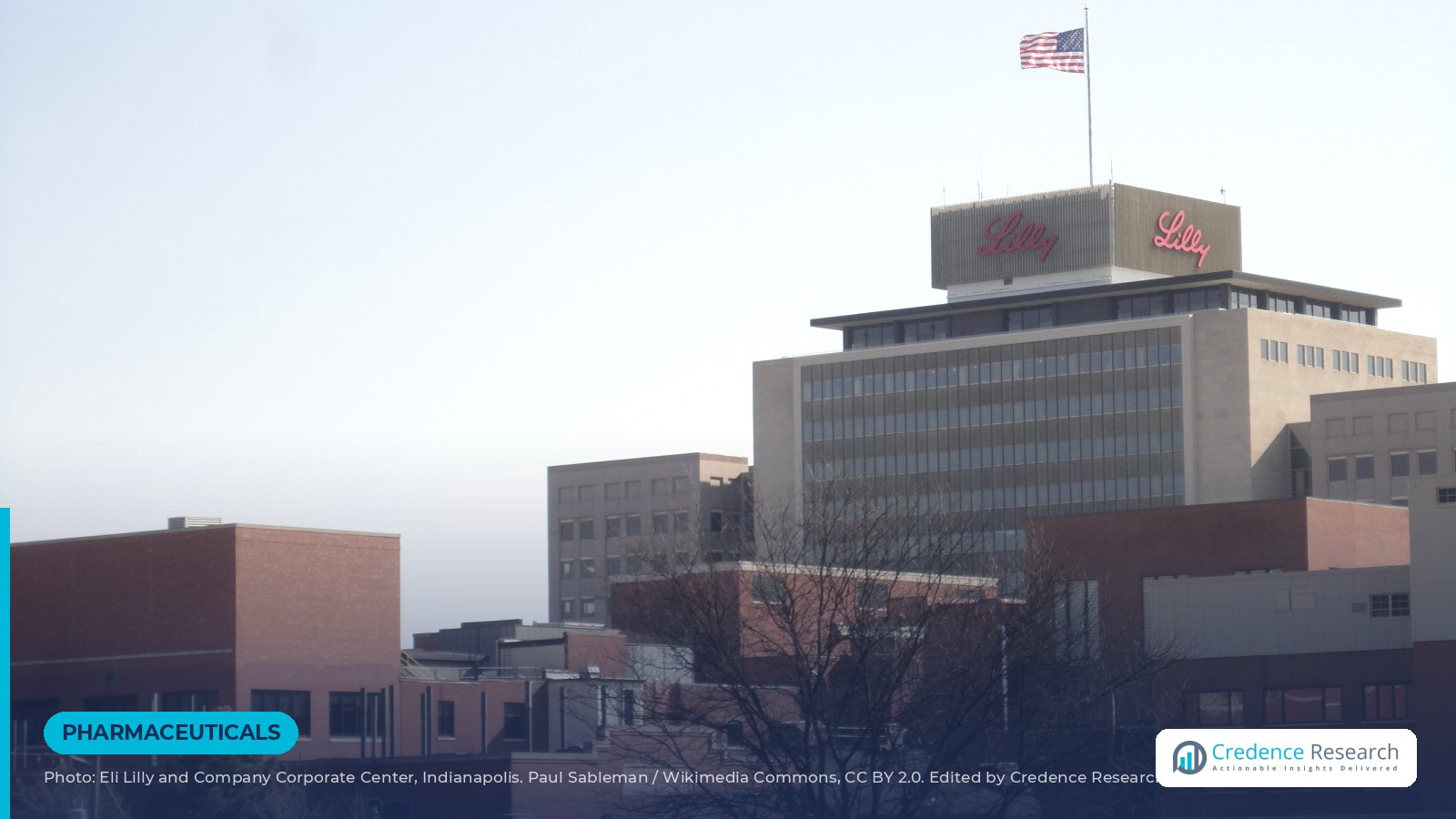
Image: Eli Lilly and Company Corporate Center in Indianapolis, by Paul Sableman via Wikimedia Commons, CC BY 2.0. Cropped and edited by Credence Research.

About the Author

Senior News Editor at Credence Research Inc