
USDA Picks Eight Fertilizer Projects for $573 Million to Expand U.S. Nitrogen, Potash and Sulfur Output
The U.S. Department of Agriculture has selected eight domestic fertilizer projects for about $573 million in proposed federal funding, backing more than $1.34 billion in planned investment across nitrogen, phosphorus, potash and sulfur production. Vice President J.D. Vance and Agriculture Secretary Brooke Rollins announced the awards on Oct. 22, 2026, under USDA's Fertilizer Investment and Expansion for Long-Term Domestic Supply (FIELDS) Program, with Vance speaking from Nebraska. USDA said the projects would add about 1.08 million tons of annual domestic fertilizer production and capacity once they are operating.
Key developments
- Eight projects in 16 states were selected, carrying more than $1.34 billion in proposed total investment and about $573 million in proposed USDA funding.
- The largest federal shares go to Intrepid Potash (about $139 million for a $265 million sulfate of potash facility near Carlsbad, New Mexico), Agriculture Project Holdco (about $116.9 million for a $360 million manure-to-nitrogen project in Kansas and Indiana) and PCI Nitrogen (about $100 million for a $200 million modernization in Texas and Oregon).
- TalusAg was selected for about $99.8 million toward a $270.2 million plan to deploy 20 modular ammonia units at 11 locations in seven states, producing about 130,000 tons of anhydrous ammonia a year.
- AdvanSix, Peace Valley, SUL4R-PLUS Illinois and True Organic Products round out the list with expansions in Virginia, Florida, Illinois, California, Oregon and Arizona.
- The money comes from the $500 million FIELDS Program plus additional funds USDA recovered from projects under the earlier Fertilizer Production Expansion Program (FPEP) that it said had failed.
Program background
USDA opened FIELDS on July 1, 2026, as a $500 million program administered by USDA Rural Development's Rural Business-Cooperative Service using Commodity Credit Corporation authority. The department offered grants of $15 million to $150 million for new or expanded fertilizer facilities and took applications through Aug. 15. It said it would favor financially viable, shovel-ready projects with realistic timelines, committed financing and measurable output.
The program replaced the approach used under FPEP, the previous administration's fertilizer grant effort. According to DTN, USDA inherited 121 FPEP projects, of which 90 lacked signed agreements and only eight had been completed, and it began pulling funds from projects it no longer considered feasible. FIELDS required applicants to bring a 50% private-sector match so that private financing would be in place before federal money is committed. The new awards follow that pattern: in most cases USDA's share is close to half of project cost, while the dairy manure project in Kansas and Indiana carries a federal share of roughly one-third.
Several of the selected companies are not new to federal fertilizer support. AdvanSix received an approximately $12 million FPEP grant in September 2024 for its Hopewell, Virginia, site, where it produces ammonium sulfate. Its new selection, about $47.4 million toward a $98.1 million project, targets modernization and expansion of the Hopewell ammonia plant to produce about 84,000 tons of anhydrous ammonia a year.
Industry implications
The portfolio leans toward nitrogen, the nutrient U.S. corn growers apply in the largest volumes and the one most exposed to natural gas costs and import swings. Five of the eight projects add nitrogen in some form: TalusAg's distributed ammonia units, PCI Nitrogen's ammonium sulfate and urea output at Pasadena, Texas, and St. Helens, Oregon, AdvanSix's Hopewell ammonia, Agriculture Project Holdco's liquid ammonium nitrate from dairy manure, and nitrogen products within Peace Valley's Bartow, Florida, expansion.
The Intrepid Potash award is the single largest federal commitment and addresses a different gap. Most U.S. potash is imported, and a new sulfate of potash facility near Carlsbad with planned output of about 220,000 tons a year would add a specialty potassium product used on chloride-sensitive crops such as fruits, vegetables and tree nuts. Sulfur also receives dedicated support through SUL4R-PLUS Illinois, which will add a manufacturing line at its Marissa plant and expand storage and transport to reach about 100,000 tons a year.
Because the USDA release did not include job counts or construction schedules, the awards should be read as conditional support for projects that still need to finish financing, permitting and construction. USDA described the projects as shovel-ready but tied the output figures to the point when they become operational.
Competitive and supply chain implications
The selections favor smaller and mid-sized producers over the large integrated nitrogen and phosphate companies that dominate North American capacity. That is consistent with USDA's stated aim of adding independent supply and competition rather than funding incumbents' expansions. TalusAg's model is the clearest example: modular, rapidly deployable units that make ammonia close to where it is applied. Earlier reporting on its first commercial deployment with Iowa cooperative Landus described units of up to 20 tons a day that run on renewable power, water and air.
Distributed production could reduce the rail, barge and truck logistics that move anhydrous ammonia from Gulf Coast plants to the Corn Belt, a chain that is vulnerable to weather, rail disruptions and seasonal demand peaks. Organic and byproduct-based inputs get a share as well. True Organic Products will use agricultural byproducts at Helm, California, Boardman, Oregon, and Arlington, Arizona, to produce about 142,805 tons a year, while the Kansas and Indiana project turns dairy manure into about 4,100 tons of liquid ammonium nitrate.
Regional implications
The awards are spread widely. TalusAg's units are planned in Iowa, Kentucky, Minnesota, Tennessee, Nebraska, Illinois and South Dakota, placing supply inside major corn states. PCI Nitrogen's two sites cover the Gulf Coast and the Pacific Northwest, Peace Valley sits in Florida's phosphate region, and Intrepid's project adds to the Permian Basin potash district around Carlsbad. AdvanSix's Hopewell site serves the Mid-Atlantic and Southeast.
For rural communities, the near-term effects are construction activity, local tax base and shorter haul distances for farm supply cooperatives. USDA has not yet provided project-level employment estimates, so the local jobs impact remains to be confirmed by the companies.
Credence Research analysis
FIELDS is a narrower, more selective version of federal fertilizer policy than the program it replaced. The 50% match and the preference for shovel-ready sites shift risk to private investors and should improve completion rates compared with FPEP, where most selected projects never reached signed agreements. The trade-off is scale: the eight projects together add about 1.08 million tons a year, which is meaningful for specific nutrients and regions but does not reshape national supply on its own.
The project mix suggests USDA is testing several supply models at once: modular green ammonia, brownfield modernization of existing nitrogen plants, new potash processing and byproduct-based nutrients. Execution will be the real test. Watch for signed grant agreements, final investment decisions and permits over the next two quarters, since FPEP's record shows that selection announcements and completed plants are very different milestones.
What comes next
- USDA and the eight selectees must finalize grant agreements before federal funds are obligated.
- Companies are expected to disclose construction schedules, job estimates and financing details for individual sites.
- TalusAg will need site agreements for its 11 locations across seven states.
- Intrepid Potash's Carlsbad sulfate of potash facility and PCI Nitrogen's two-site modernization are the largest projects to track for permitting and engineering milestones.
- USDA may announce further awards if additional FPEP funds are recovered.
Sources
- USDA: Trump Administration Announces Major Investment in American Fertilizer Manufacturing (Oct. 22, 2026)
- Fertilizer Daily: USDA launches $500 million FIELDS program (July 1, 2026)
- DTN: Shovel-Ready Fertilizer Plans Sought (July 1, 2026)
- World Fertilizer: Landus and TalusAg deliver first local green ammonia production
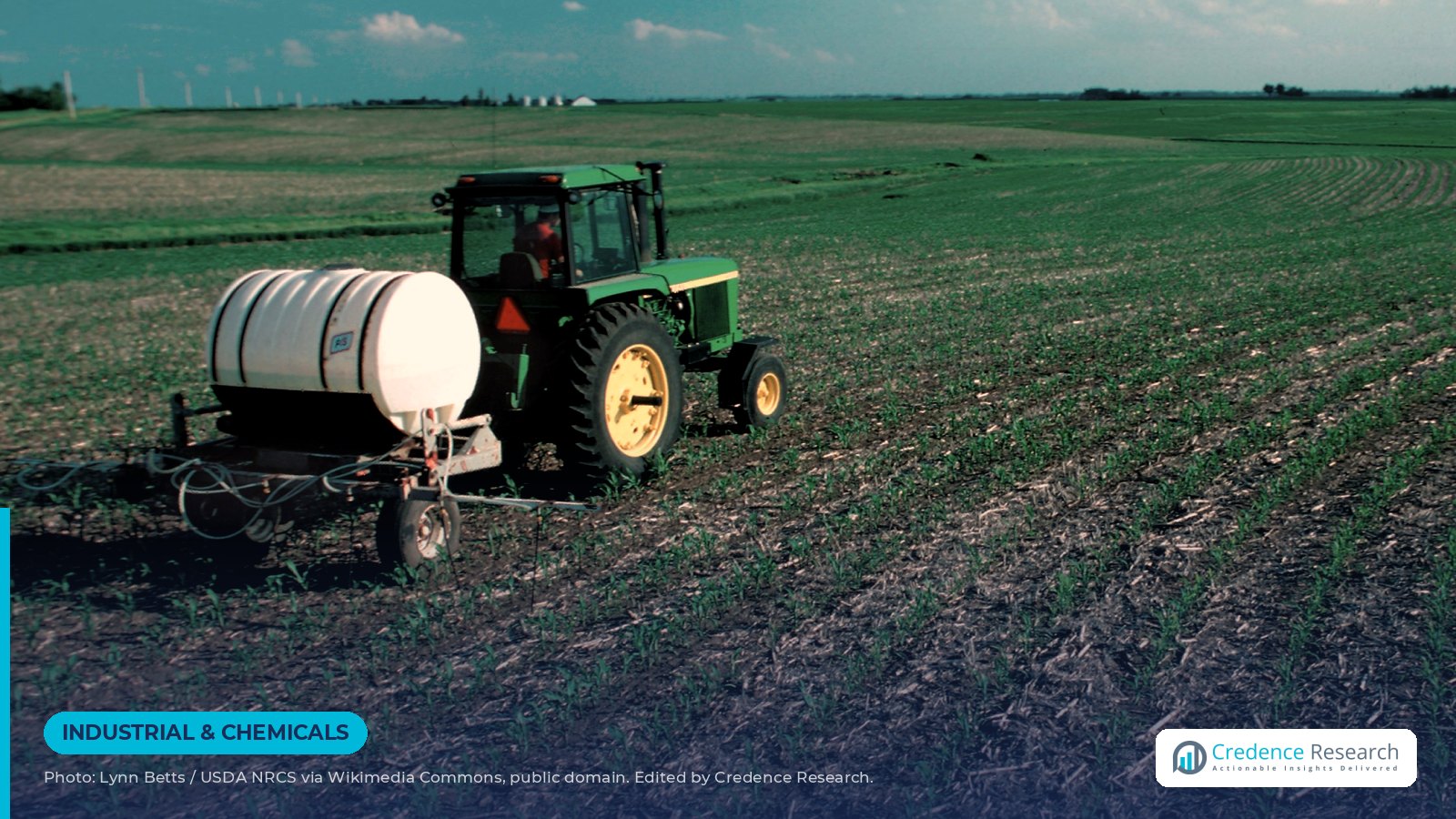
Image: Fertilizer application in a cornfield, by Lynn Betts, USDA Natural Resources Conservation Service, via Wikimedia Commons, public domain. Cropped and edited by Credence Research.

About the Author

Senior News Editor at Credence Research Inc