
Quick answer
A bamboo flooring plant making about 1.2 million sq m of strand woven and laminated planks a year needs total CapEx of roughly USD 16–30 million in an Asian or similar lower-cost location, including land and working capital margin. Gross margin typically runs 16–28% of selling price, and payback falls in a 5–8 year band at about 80% utilization. Culm supply close to the plant and buyers outside China's export chain decide viability.
Feasible next to a reliable bamboo supply with a brand or export offtake; a merchant plant competing on price with Chinese mills faces thin margins and a long payback.
Bamboo Flooring plant: key highlights
| Parameter | Indicative value | Note |
|---|---|---|
| Plant capacity | 1.2 million sq m per year | About 4,000 sq m a day of 14 mm strand woven and laminated planks |
| Total CapEx | USD 16–30 million | Asian or similar lower-cost site; land, machinery, buildings, working capital margin |
| Raw material share of operating cost | 55–65% | Bamboo culms, resin, coatings and packaging |
| Gross margin | 16–28% | After depreciation, on an assumed USD 17–20 per sq m ex-works |
| Payback period | 5–8 years | At about 80% utilization, including an assumed one-year ramp-up |
| IRR | Available in report | Post-tax, 10-year model |
| Break-even | Available in report | Capacity utilization basis |
Ranges assume a 1.2 million sq m a year strand woven and laminated plant on about 6.6 hectares in an Asian or similar lower-cost industrial park, 2026 prices, about 80% utilization, an assumed USD 17–20 per sq m ex-works price and 7.1 yuan to the dollar (assumed). U.S. or EU sites cost more. Tariffs on finished goods are excluded. The full report can be customized to any country.
What is bamboo flooring?
Bamboo flooring is a hard floor covering made from the culms of fast-growing woody grasses, mainly moso bamboo, which are split, dried, glued and pressed into planks that behave much like hardwood. Buyers choose it for hardness, a regrowth cycle of four to six years and a price below most oak or walnut floors.
Of the three main constructions, horizontal and vertical laminated planks are built from flat strips glued face to face or edge to edge, so the knuckles of the culm stay visible. Strand woven bamboo, also called bamboo scrimber, is made from crushed fiber bundles soaked in resin and compressed into dense blocks of about 1.0–1.2 g per cubic cm. Engineered planks put a bamboo wear layer on a plywood or fiberboard core.
Assembled bamboo floor panels fall under HS code 441873, flooring panels of bamboo or with at least a top wear layer of bamboo. Loose tongue-and-groove strips are classified separately under HS 440921. Buyers include flooring brands, home-improvement retailers, hotel and office fit-out contractors, and sellers of outdoor decking.
Bamboo flooring market overview and global demand
Credence Research puts the global market for bamboo floors at USD 1,888.6 million in 2024 and projects USD 2,987.5 million by 2032, a 5.9% CAGR. That implies about USD 2.0 billion in 2025, derived from the 2024 figure and the CAGR. The hard surface flooring market as a whole is many times larger, which matters because bamboo competes for the same rooms as oak, vinyl and laminate.
Supply is overwhelmingly Chinese: China has nearly 8 million hectares of bamboo forest, harvests about 150 million tons a year and counts more than 10,000 bamboo processing firms, according to January 2026 data from the National Forestry and Grassland Administration, which put annual industry output above 520 billion yuan.
Cross-border trade is modest by comparison, which suggests most output is sold inside China or shipped under other tariff lines. UN Comtrade data show reported world exports of assembled bamboo floor panels of USD 46.7 million in 2024, up from USD 38.0 million in 2023 but below USD 66.5 million in 2022. China supplied 81% of the 2024 total, followed by the Netherlands and Italy. Unassembled bamboo strips and friezes under HS 440921 added USD 93.1 million, 86% of it from China. Denmark, the United States, Israel, New Zealand and Japan were the largest reported importers of assembled panels in 2024.
Growth rests on green building rating systems and on bamboo's short harvest cycle, while its weak points are moisture movement in cheaper laminated grades and price pressure from rigid vinyl. For a new plant, the practical question is whether it can secure culms and win buyers outside China's established export chain.
Bamboo flooring manufacturing process
The plant modeled here makes strand woven bamboo, the densest and most widely traded indoor grade, with a side line of laminated planks.
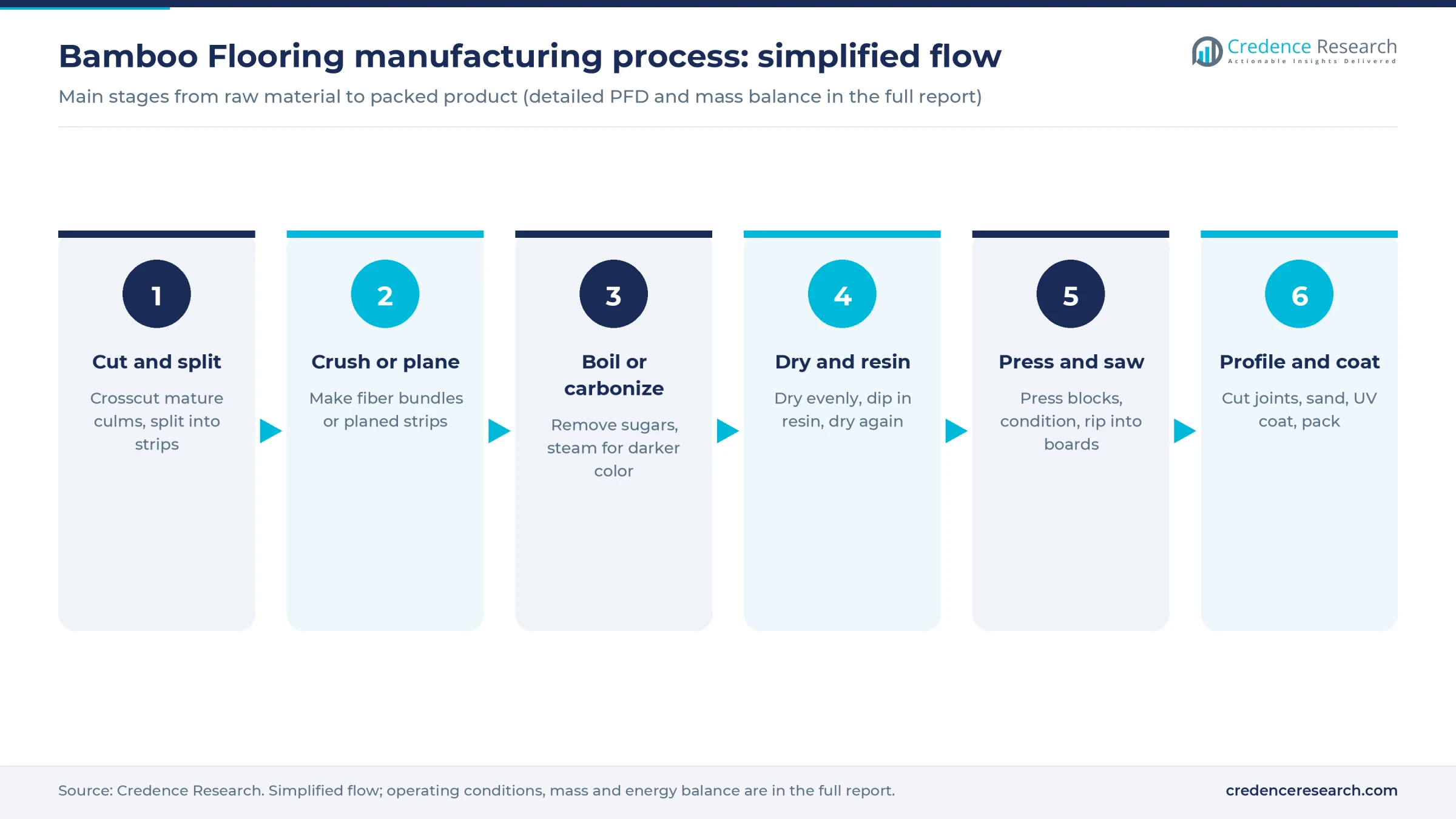
- Culm selection and cutting. Mature culms of four to six years are crosscut to length and split into strips. Younger bamboo is softer and shrinks more, so age control at the gate protects quality later on.
- Planing or crushing. For laminated planks, strips are planed to remove the green skin and inner pith. For strand woven boards, strips are crushed into loose fiber bundles that keep their full length.
- Boiling or carbonizing. Fibers are boiled to strip out sugars and starch, which attract insects and mold, or steamed under pressure to carbonize them to a coffee color. This step drives a large share of fuel use.
- Drying and resin impregnation. Bundles are dried to a low, even moisture content, dipped in phenolic or similar resin, then dried again. Moisture drift at this stage is the main cause of cupping after installation.
- Pressing and curing. Resin-coated bundles are compressed into blocks. One flooring supplier describes hot pressing at about 4,000 tons and 140°C, giving denser boards than cold pressing into molds followed by oven curing.
- Conditioning and sawing. Blocks rest to release stress and are then ripped into boards. The outer edges of a pressed block are less dense and usually go to lower-value products.
- Profiling, sanding and coating. Moulders and double-end tenoners cut tongue-and-groove or click joints, wide-belt sanders level the face, and UV roller lines apply several coats of lacquer or oil.
Offcuts, dust and pith can fire the plant's biomass boiler. Resin fumes, coating solvents, fine dust and sugary boiling water are the main environmental issues a permit will address.
Bamboo flooring plant setup cost
For a plant rated at 1.2 million sq m a year, about 4,000 sq m a day over 300 working days, total project cost is roughly USD 16–30 million in an Asian or similar lower-cost industrial location, including land and a working capital margin. The basis is two disclosed builds at this capacity by one Chinese maker of high-density bamboo. Its Jianyang plant in Fujian, which began trial output in 2021, cost 120 million yuan for up to 100,000 sq m a month, about USD 16.9 million at an assumed 7.1 yuan to the dollar. An earlier plant in Lishui, completed in 2018, cost 200 million yuan, about USD 28.2 million, for 1.2 million sq m a year on a larger site that also makes outdoor furniture. No scaling was needed, and the range brackets both. A U.S. or EU site could cost 1.4–1.8 times as much (assumed), and the full report can be customized to any country.
Land shows how a single line is built. The Jianyang site covers 16.38 acres, about 6.6 hectares. At an assumed USD 20–60 per sq m for a serviced industrial plot, land would cost USD 1.3–4.0 million, or 6–17% of the midpoint budget. Leasing a plot removes most of that outlay.
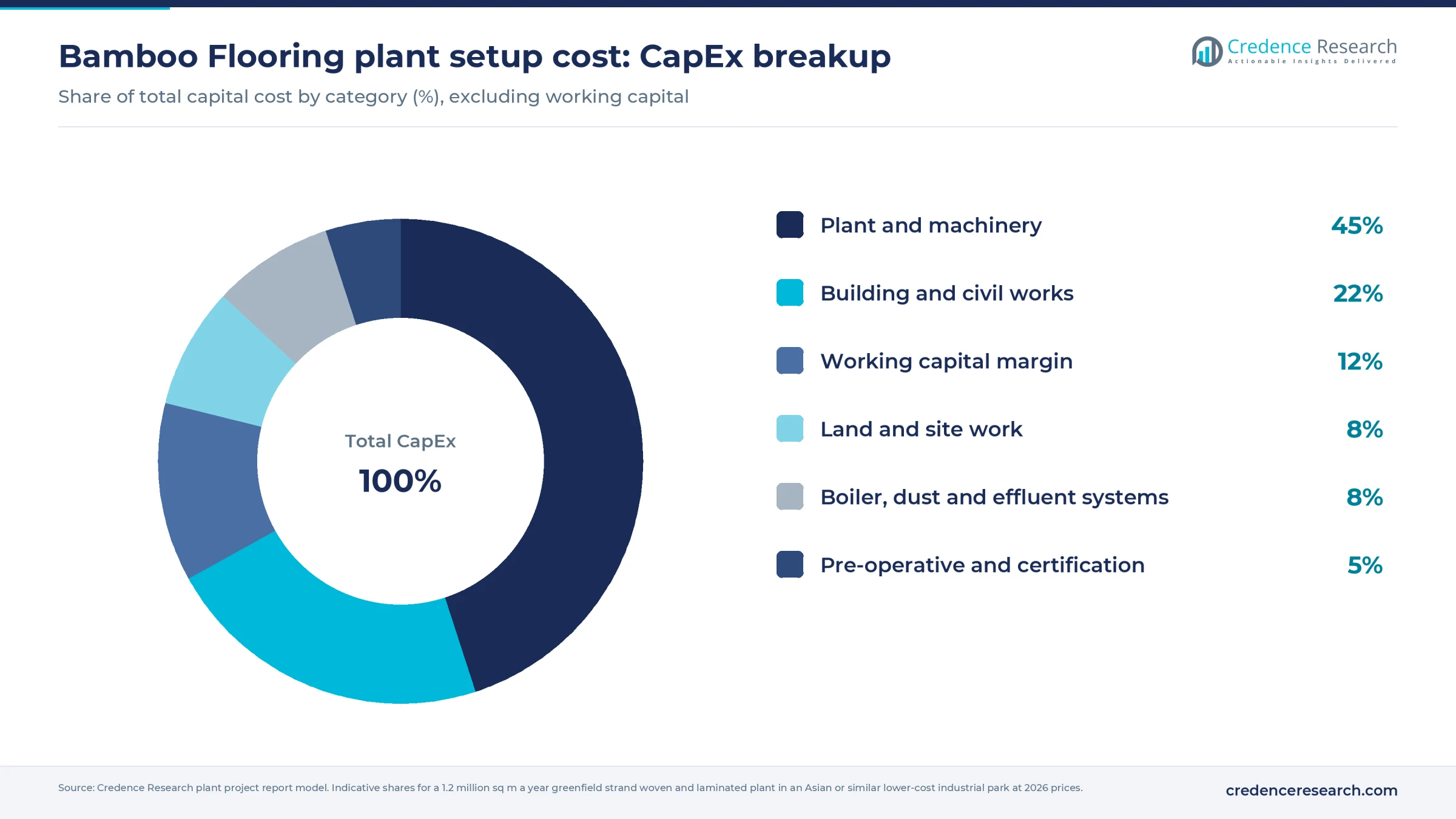
Machinery takes the largest share, led by crushing lines, carbonization vessels, dryers, presses and the finishing line. Buildings are large because bamboo needs covered drying and conditioning space; the Jianyang plant has 66,481 sq m of factory floor.
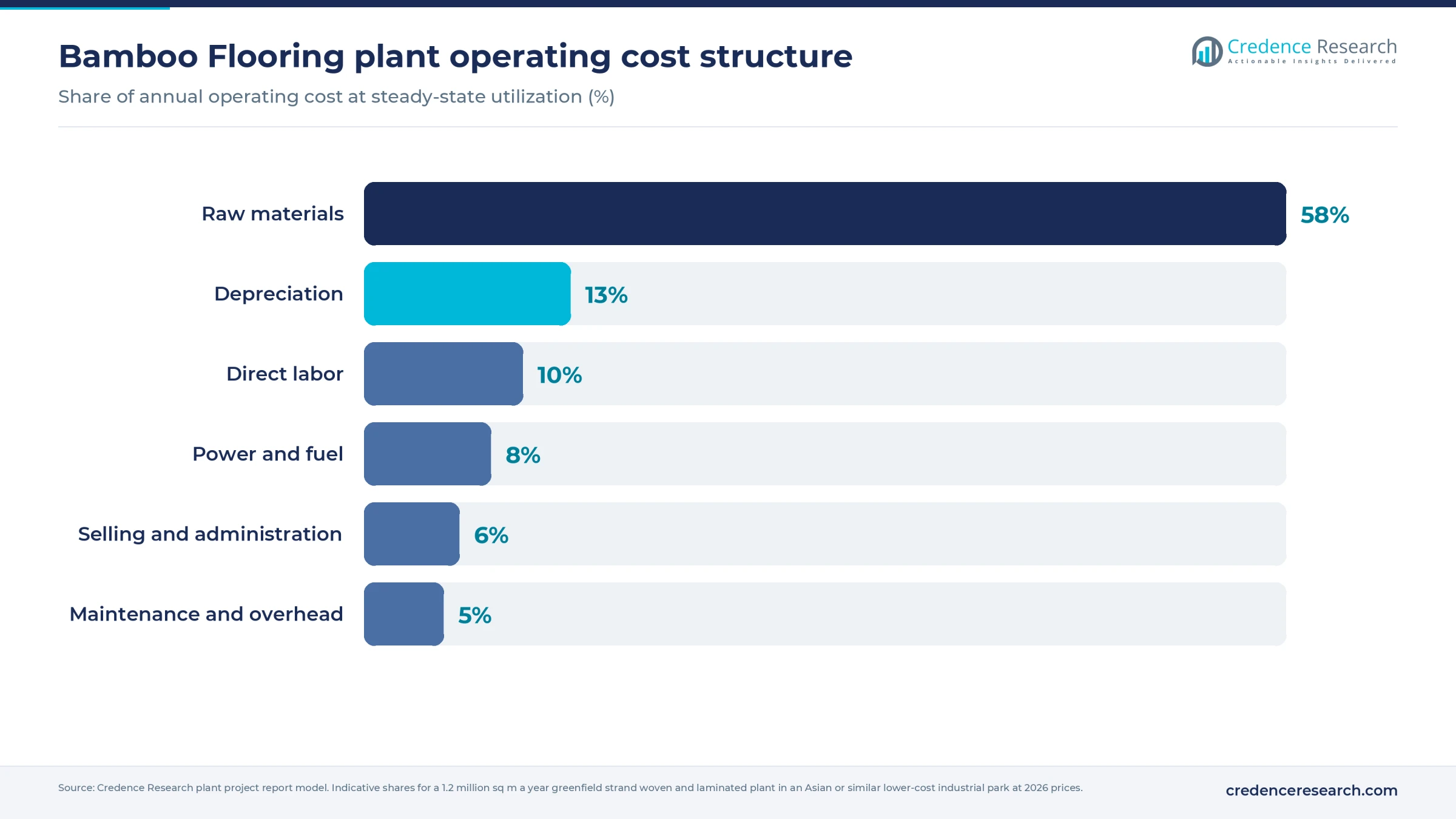
In operation, raw materials take a little under 60% of total cost, split mainly between culms and resin. Depreciation is the next largest item, which is why filling the presses matters so much. Labor weighs more than in fully automated panel plants because sorting and grading remain largely manual.
Machinery and raw materials for a bamboo flooring plant
Core equipment for a strand woven and laminated plant includes:
- Crosscut saws, culm splitters and two-side strip planers
- Fiber crushing and flattening machines for strand production
- Boiling tanks, pressure carbonization vessels and a biomass boiler
- Belt or kiln dryers and resin dipping tanks
- Hydraulic hot presses, or cold presses with curing ovens, and gang rip saws
- Four-side moulders, double-end tenoners, wide-belt sanders and UV coating lines
- Dust extraction, effluent treatment and a testing lab
Bamboo-specific machines come mostly from China, while tenoners, sanders and coating lines are often bought from Germany or Italy. Machine costs and specifications are available in the report.
Raw materials come from these main regions:
- Bamboo culms: moso bamboo from China's Zhejiang, Fujian, Jiangxi, Anhui and Hunan provinces; other thick-walled species from northeast India, Vietnam, Indonesia, Ethiopia and, for guadua, Colombia and Ecuador
- Resins: phenolic, urea-based or MDI adhesives from China, Europe, the United States and India
- Coatings, oils and packaging: China, Germany and other European suppliers
Culms are bulky and lose value with every kilometer, so plants sit near plantations or buy pre-split strips from village mills. Trends in phenolic resin supply shape the cost of the binder, the second largest input.
Bamboo flooring business profit margin and ROI
A plant at about 80% utilization can expect gross margin of roughly 16–28% of selling price, after depreciation. With few published margins, the range is built from costs. Materials come to about USD 8.90 per sq m for a 14 mm strand woven plank: about 53 kg of fresh culm at an assumed USD 70–90 per ton, about 2.3 kg of resin at an assumed USD 1.10–1.40 per kg, plus coating and packaging. Labor, energy, upkeep and depreciation lift cost of goods to about USD 14.20.
The price side is an assumed USD 17–20 per sq m ex-works. It sits near the low end of China's 2024 export unit values in UN Comtrade data, USD 1.32 per kg for assembled panels and USD 1.70 for strips, or roughly USD 17–26 per sq m at 13–15 kg per sq m.
At 960,000 sq m sold, annual cash profit after overhead and tax comes to about USD 3.2–5.5 million. Against a midpoint CapEx of USD 23 million, that gives a 5–8 year payback including a one-year ramp-up. The cheapest build at the best margin pays back in about 4 years, and the costliest at the weakest in more than 10.
Price is the key sensitivity: each USD 1 per sq m shifts gross profit by close to USD 1 million a year. A 10% rise in resin adds about USD 0.29 per sq m, under 2% of price. Running at 60% instead of 80% raises depreciation and labor per sq m by a third.
| Metric | Value |
|---|---|
| IRR | Available in report |
| NPV | Available in report |
| ROI | Available in report |
| DSCR | Available in report |
How to start a bamboo flooring business, licenses and approvals
A new plant needs business and tax registration, land use and building permits, an environmental permit covering boiler stacks, dust, resin fumes and boiling wastewater, occupational safety registration, and import-export registration. Product testing for formaldehyde emission, dimensional stability, hardness and fire behavior follows, since retailers will not list a floor without test reports.
Examples by market
| Market | Plant permits | Product rules |
|---|---|---|
| United States | State environmental agency air permit under the Clean Air Act for boilers, dust and coating emissions; OSHA workplace rules on dust, noise and machine guarding | EPA formaldehyde certification under TSCA Title VI for engineered planks with a plywood, MDF or particleboard core; solid and strand bamboo fall outside that rule |
| European Union | National environmental permit from the member state authority | Declaration of performance and CE marking under EN 17009, the European standard for non-wood flooring such as bamboo; REACH formaldehyde emission limits in force from August 2026 |
| India | State Pollution Control Board consent to establish and operate; factory license from the state labor department; DGFT importer-exporter code | Buyers commonly specify ISO 21629-1 for indoor bamboo floors; bamboo grown outside forests has not been a tree under the Indian Forest Act since a 2017 amendment, though state transit rules vary |
The EU deforestation regulation, which applies to large and medium firms from December 2026, treats products made solely of bamboo as out of scope, but engineered planks with a wood core still need due diligence. Each regulator should confirm its requirements before a site or product mix is fixed.
Key bamboo flooring manufacturers and recent developments
MOSO International of the Netherlands and China's dasso Group are the best-known international brands. Zhejiang Jiahe Bamboo Technology, a MOSO partner since 2011, was credited by China Daily in June 2025 with 70% of China's exports of reconstituted strand bamboo. Zhuart, Malaysia-listed Kanger International with plants in China, U.S. brands Cali, owned by Victoria plc, Teragren and Smith & Fong, and Ethiopia's African Bamboo complete the field, beside a long tail of mills in Zhejiang and Fujian. Their fortunes track the wider bamboo materials market.
No company-level bamboo flooring announcements from the last 12 months could be verified, so the items below are sector developments that affect producers:
- January 2026: China's forestry administration reported bamboo industry output above 520 billion yuan a year and said the 2026–2030 plan period said that during 2026–2030 it would strengthen preferential policies for bamboo processing, improve standards and deepen technological innovation.
- May 2026: The European Commission's 4 May 2026 review package for its deforestation regulation included a draft delegated act stating explicitly that bamboo and rattan are out of scope.
- June 2026: The Asian Development Bank approved a USD 42.2 million facility for the bamboo industry in six northeastern Indian states, with at least one women-led manufacturing unit planned in each state.
For an entrant outside China, these moves ease market access in Europe and raise supply options in India, but Chinese mills still set export prices.
What's inside the Bamboo Flooring project report PDF
The report runs to 21 chapters. Open a chapter to see its sections.
1. Preface
2. Scope and Methodology
- 2.1 Objectives of the Study
- 2.2 Stakeholders
- 2.3 Research Methodology
- 2.4 Data Sources and Key Assumptions
3. Executive Summary
- 3.1 Market Snapshot
- 3.2 Project at a Glance (Capacity, CapEx, OpEx)
- 3.3 Key Financial Indicators (IRR, NPV, Payback, Break-even)
- 3.4 Feasibility Verdict
4. Product Overview
- 4.1 Bamboo Flooring Definition and Properties
- 4.2 Grades and Specifications (BIS / ISO / ASTM)
- 4.3 HS Code and Classification
- 4.4 Key Applications
- 4.5 Substitutes
5. Global Bamboo Flooring Market
- 5.1 Market Overview
- 5.2 Historical and Current Market Performance (Volume and Value)
- 5.3 Market Breakup by Grade / Type
- 5.4 Market Breakup by End-Use Industry
- 5.5 Market Breakup by Region
- 5.6 Market Drivers, Restraints and Trends
- 5.7 Value Chain Analysis
- 5.8 Market Forecast
6. Target Country Bamboo Flooring Market Analysis
- 6.1 Demand and Supply Analysis
- 6.2 Installed Capacity vs Demand Gap
- 6.3 Import Dependence
- 6.4 Demand Forecast by End-Use
7. Trade Analysis
- 7.1 Imports by Volume, Value and Country
- 7.2 Exports by Volume, Value and Country
- 7.3 Trade Balance and Opportunities
8. Price Analysis
- 8.1 Historical Bamboo Flooring Price Trends by Region
- 8.2 Raw Material / Feedstock Price Trends and Linkage
- 8.3 Price Forecast
- 8.4 Margins Across the Value Chain
9. Competitive Landscape
- 9.1 Market Structure
- 9.2 Key Players and Installed Capacities
- 9.3 Profiles of Key Players
- 9.4 Recent Developments (Expansions, M&A, New Plants)
10. Manufacturing Process and Technology
- 10.1 Comparison of Technology Routes
- 10.2 Selected Route and Process Flow Diagram
- 10.3 Unit Operations Involved
- 10.4 Chemical Reactions Involved
- 10.5 Mass Balance and Raw Material Requirements
- 10.6 Energy Balance
- 10.7 Quality Assurance Criteria and Technical Tests
- 10.8 By-products and Waste Handling
- 10.9 Technology Licensors / Providers
11. Project Details, Requirements and Costs
- 11.1 Land, Location and Site Development
- 11.1.1 Site Selection Criteria
- 11.1.2 Location Analysis
- 11.1.3 Land Requirement and Costs
- 11.1.4 Site Development Costs
- 11.2 Plant Layout
- 11.2.1 Layout Principles
- 11.2.2 Proposed Layout
- 11.2.3 Factors Influencing Layout
- 11.3 Civil Works and Buildings
- 11.4 Plant Machinery
- 11.4.1 Machinery Requirements and Specifications
- 11.4.2 Machinery Costs
- 11.4.3 Machinery Suppliers
- 11.5 Raw Materials
- 11.5.1 Requirements per Tonne of Output
- 11.5.2 Procurement and Sourcing
- 11.5.3 Costs
- 11.5.4 Suppliers
- 11.6 Packaging
- 11.6.1 Packaging Requirements
- 11.6.2 Packaging Costs
- 11.6.3 Packaging Suppliers
- 11.7 Storage and Material Handling
- 11.8 Transportation Requirements and Costs
- 11.9 Utilities
- 11.9.1 Power Requirements and Costs
- 11.9.2 Water Requirements and Costs
- 11.9.3 Steam, Fuel and Other Utilities
- 11.10 Manpower Requirements and Wages
12. Environment, Health, Safety and Sustainability
- 12.1 Effluent and Emissions Management
- 12.2 Hazard Classification and Safety Measures
- 12.3 Carbon Footprint
- 12.4 Green / Low-Carbon Process Options
13. Regulatory Procedures, Approvals and Certifications
- 13.1 Licences and Registrations
- 13.2 Environmental Clearances
- 13.3 Product Certifications (BIS, REACH, etc.)
- 13.4 Approval Timeline
14. Project Implementation Schedule
15. Project Economics
- 15.1 Capital Cost of the Project
- 15.2 Techno-Economic Parameters
- 15.3 Capacity Utilization and Ramp-up
- 15.4 Product Pricing and Margins
- 15.5 Income Projections
- 15.6 Expenditure Projections
- 15.7 Working Capital Requirement
- 15.8 Taxation
- 15.9 Depreciation
16. Financial Analysis
- 16.1 Projected Profit and Loss Account
- 16.2 Projected Cash Flow Statement
- 16.3 Projected Balance Sheet
- 16.4 Liquidity Analysis
- 16.5 Profitability Analysis (Payback, NPV, IRR, ROI)
- 16.6 Break-even Analysis
- 16.7 Debt Service Coverage Ratio (DSCR)
- 16.8 Sensitivity Analysis
- 16.9 Scenario and Uncertainty Analysis
17. Funding and Incentives
- 17.1 Means of Finance and Debt-Equity Structure
- 17.2 Loans and Financial Assistance
- 17.3 Government Schemes and Subsidies (PLI, State Policies)
18. Risk Assessment
- 18.1 Key Success Factors
- 18.2 Key Risk Factors
- 18.3 Risk Mitigation
19. Strategic Recommendations
20. Case Study of a Successful Venture
21. Appendix
- 21.1 Detailed Assumptions
- 21.2 Abbreviations
- 21.3 List of Tables and Figures
- 21.4 Sources
This page vs. the full report
| Data point | On this page (free) | In the full report |
|---|---|---|
| Total CapEx | One rounded range at one capacity | Exact figure at three capacities with a line-item breakup |
| CapEx breakup | Category shares (%) only | Cost, quantity and supplier for every machine |
| Operating cost | Share of raw materials, utilities and labor | Per-unit cost sheet with each input price and consumption |
| Profitability | Gross margin range and payback band | Exact IRR, NPV, ROI, break-even and DSCR |
| Financial statements | List of what is included | 10-year P&L, cash flow, balance sheet and Excel model |
| Sensitivity | One directional line | Full sensitivity and scenario tables |
| Process | Simplified flow diagram | Detailed process flow, mass and energy balance, operating conditions |
| Machinery | Names of the main machines | Specifications, capacity, cost and supplier list |
| Market | Headline size, growth and global demand | Segment, region, trade and price forecast tables |
| Suppliers and buyers | Supplier types and sourcing hubs | Named suppliers and buyers |
Bamboo Flooring project report: FAQs
How much does a bamboo flooring plant cost?
What is the profit margin in a bamboo flooring business?
What is the payback period for a bamboo flooring plant?
What is the HS code for bamboo flooring?
What raw materials does a bamboo flooring plant need?
Should a new plant make strand woven or laminated bamboo flooring?
Which approvals does a bamboo flooring factory need?

About the analyst
Nisha Gupta, Senior Research Analyst
Nisha Gupta is a Senior Research Analyst at Credence Research Inc. who works across industry domains, including packaging, automotive parts and machinery. Her focus is the modelling engine behind each study: she builds quantitative market databases and econometric forecasting frameworks, and developed automated Excel-based market modelling templates that cut client turnaround time by 30%.
Related market research
- Bamboo Flooring Market Size, Share, Trends and Forecast 2032
- Hard Surface Flooring Market By Size, Share and Forecast 2032
- Bamboos Market Size, Growth, Analysis & Forecast to 2032
- Phenolic Resins Market Size, Growth, Trend & Forecast 2032
- Flooring Market Size, Growth, Share, Trend and Forecast 2032
- Bamboo Product Market Size, Growth, Trend & Forecast 2032
More plant project reports
- Precast Concrete Manufacturing Plant Project Report (DPR) 2026
- Compressed Stabilized Earth Block Manufacturing Plant Project Report (DPR) 2026
- Mycelium Brick Manufacturing Plant Project Report (DPR) 2026
- Bendable Concrete Manufacturing Plant Project Report (DPR) 2026
- Vitrified Tiles Manufacturing Plant Project Report (DPR) 2026
- Vinyl Flooring Manufacturing Plant Project Report (DPR) 2026