
Bamboo Flooring Market Overview:
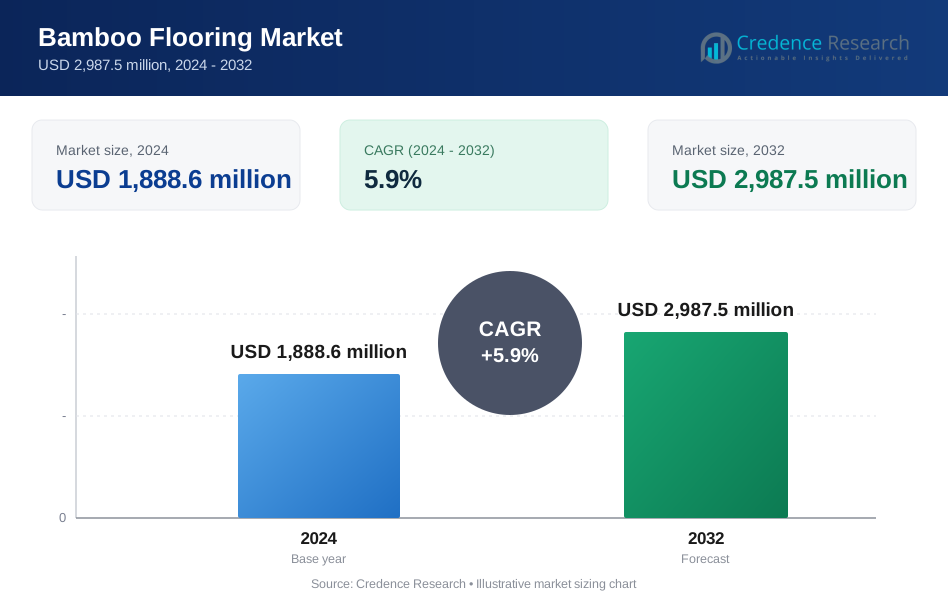
The global bamboo flooring market was valued at USD 1,888.6 million in 2024 and is projected to reach USD 2,987.5 million by 2032, expanding at a CAGR of 5.9% over the forecast period.
| REPORT ATTRIBUTE | DETAILS |
|---|---|
| Historical Period | 2020-2023 |
| Base Year | 2024 |
| Forecast Period | 2025-2032 |
| Bamboo Flooring Market Size 2024 | USD 1,888.6 million |
| Bamboo Flooring Market , CAGR | 5.9% |
| Bamboo Flooring Market Size 2032 | USD 2,987.5 million |
Bamboo Flooring Market Insights
- Growth is primarily driven by increasing demand for sustainable flooring alternatives, rapid urban housing development, and strong preference for engineered bamboo due to its stability and ease of installation, making it the dominant type segment.
- Key market trends include rising use of strand-woven bamboo in high-traffic applications, growing preference for eco-certified and low-emission products, and increased specification of bamboo flooring in green building and renovation projects.
- The competitive landscape is moderately fragmented, with Asia-based manufacturers leading through cost-efficient production, vertical integration, and expanding export presence, while North American and European players focus on branding and sustainability compliance.
- Regionally, Asia-Pacific holds around 49% market share, led by China, followed by North America at ~23% and Europe at ~17%, while residential applications dominate overall demand due to widespread housing and remodeling activity.
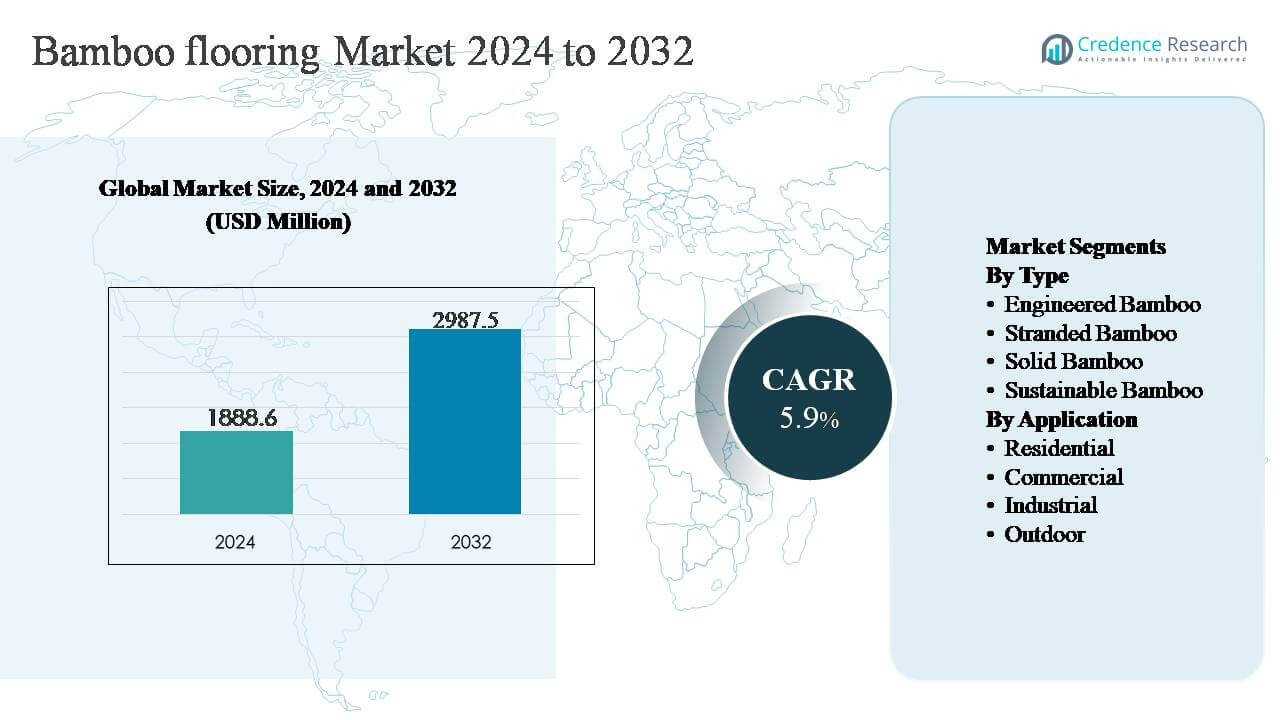
Bamboo Flooring Market Segmentation Analysis:
By Type:
Within the bamboo flooring market, engineered bamboo represents the dominant sub-segment, accounting for the largest market share due to its superior dimensional stability, moisture resistance, and compatibility with concrete subfloors and underfloor heating systems. Its layered construction reduces warping risks, making it preferred for large-scale residential and commercial installations. Stranded bamboo follows, driven by demand for high-density flooring in high-traffic spaces, while solid bamboo maintains relevance in aesthetic-focused residential interiors. Sustainable bamboo continues to gain traction as green building standards and low-emission material requirements increasingly influence procurement decisions.
- For instance, MOSO® Bamboo Products’ engineered and solid flooring panels are manufactured with densities of approximately 1,050 kg/m³ for High Density® ranges and up to 1,150 kg/m³ for UltraDensity® products. These systems are certified for installation over radiant heating when fully glued to the subfloor, provided the flooring surface temperature does not exceed 27 °C, ensuring high dimensional stability and performance consistency in mixed-climate buildings."
By Application:
The residential segment holds the dominant market share in bamboo flooring applications, supported by strong adoption in apartments, villas, and renovation projects where homeowners prioritize sustainable, visually appealing flooring solutions. Growth is driven by urban housing expansion and rising awareness of renewable materials. Commercial applications form the second-largest segment, particularly in offices, retail, and hospitality spaces seeking durable and eco-certified interiors. Industrial use remains niche, limited to light-duty environments, while outdoor applications grow steadily with demand for treated bamboo decking in patios, walkways, and landscape-oriented architectural designs.
- For instance, Teragren’s commercial bamboo flooring systems are tested to ASTM D4060 abrasion standards and exhibit extreme wear resistance, with a minimum of 27,500 Taber cycles before final wear-through. This high performance, combined with a 10-year commercial finish warranty, makes them suitable for high-traffic environments such as hotel lobbies and corporate office corridors."
Key Growth Drivers
Rising Demand for Sustainable and Renewable Flooring Materials
Sustainability remains a primary growth driver for the bamboo flooring market as construction stakeholders increasingly shift toward renewable materials with lower environmental impact. Bamboo’s rapid growth cycle and high yield per hectare support responsible sourcing and reduce pressure on slow-growing hardwood forests. Architects, developers, and homeowners are prioritizing materials that align with green building frameworks, indoor air quality standards, and lifecycle efficiency. Bamboo flooring benefits from low waste generation during processing and growing acceptance of low-emission adhesives and finishes. These attributes strengthen its positioning in residential and commercial projects where sustainability benchmarks influence material selection. Growing consumer awareness around eco-conscious living further accelerates adoption, particularly in urban housing and renovation markets.
- For instance, Cali’s proprietary Fossilized® strand-woven manufacturing process is highly efficient, utilizing nearly 100% of the bamboo culm (from the trunk to the top) to produce finished flooring products. This process involves shredding bamboo into bundles of fiber that are then compressed with a low-VOC adhesive typically comprising 90% bamboo fiber and less than 10% resin to significantly minimize raw material waste compared to traditional wood or laminated bamboo production.
Expansion of Residential Construction and Renovation Activity
Growth in residential construction and remodeling continues to drive bamboo flooring adoption, especially in apartments, condominiums, and single-family homes. Urbanization, housing upgrades, and interior refurbishment trends are increasing demand for durable yet visually appealing flooring solutions. Bamboo flooring appeals to homeowners seeking modern aesthetics combined with functional performance, including ease of maintenance and compatibility with contemporary interiors. Engineered bamboo products, in particular, support faster installation and improved stability, making them attractive for renovation projects with tight timelines. Rising disposable income and preference for value-oriented alternatives to hardwood also reinforce bamboo flooring’s role in residential applications.
- For instance, Huayu Bamboo Industry manufactures engineered bamboo flooring and solid bamboo planks, commonly available in residential dimensions such as 960 mm x 96 mm x 15 mm or 1,000 mm x 182 mm x 22 mm. While they produce 14 mm thickness options for specialized engineered lines (often featuring a 4 mm wear layer), their standard long-format planks typically reach 1,000 mm, supporting visual continuity in apartment living spaces.
Performance Improvements Through Product Engineering and Manufacturing Advances
Ongoing advancements in bamboo processing and flooring design significantly support market growth. Innovations in strand-woven technology, multi-layer construction, and surface finishing enhance hardness, moisture resistance, and wear performance. These improvements expand bamboo flooring’s suitability for high-traffic residential and commercial environments that previously favored traditional hardwood or laminate. Manufacturers continue to refine locking systems, surface coatings, and core structures to improve installation efficiency and long-term durability. As performance parity with premium wood flooring improves, bamboo flooring gains credibility among professional installers, architects, and specifiers, reinforcing its adoption across a broader range of building applications.
Key Trends & Opportunities
Growth of Engineered Bamboo in Commercial and Multi-Family Projects
Engineered bamboo flooring is emerging as a preferred choice in commercial and multi-family developments due to its dimensional stability and consistent performance across varying environmental conditions. The trend toward large-format planks and floating floor systems supports faster installation and reduced labor dependency. This creates opportunities for manufacturers to target office spaces, hospitality projects, and mixed-use developments where installation speed and lifecycle performance are critical decision factors.
- For instance, Jiangxi Feiyu Bamboo Products Group is a prominent Chinese manufacturer based in Fengxin that specializes in multi-layer engineered bamboo panels and flooring. Known for high stability and strength that exceeds traditional timber, their products are increasingly used in structural and high-occupancy applications, including commercial interiors and public facilities across international markets.
Rising Adoption of Eco-Certified and Low-Emission Flooring Solutions
Demand for flooring products that meet indoor air quality and environmental compliance standards presents a strong opportunity for sustainable bamboo offerings. Developers and institutions increasingly specify materials with verified sourcing, low formaldehyde emissions, and environmentally responsible finishes. This trend encourages suppliers to invest in certification-aligned production processes and transparent material traceability, strengthening bamboo flooring’s role in green construction projects.
- For instance, Sinohcon Bamboo Flooring manufactures bamboo panels using no-added urea formaldehyde adhesives and reports formaldehyde emission levels below 0.01 ppm in third-party chamber tests, supporting compliance with stringent indoor air quality specifications in residential and public buildings.
Key Challenges
Moisture Sensitivity and Performance Perception Issues
Despite technical improvements, moisture sensitivity remains a key challenge for bamboo flooring, particularly in humid climates or poorly controlled indoor environments. Concerns around swelling, delamination, or surface degradation can limit adoption in kitchens, basements, and certain commercial settings. Inconsistent product quality across suppliers also contributes to performance perception risks. Addressing this challenge requires continued advancements in core stabilization, protective coatings, and installer education to ensure proper subfloor preparation and installation practices.
Price Volatility and Supply Chain Constraints
Bamboo flooring manufacturers face challenges related to raw material availability, transportation costs, and processing complexity. Variability in bamboo supply, influenced by regional harvesting practices and environmental factors, can affect production consistency and pricing. Additionally, the cost of advanced manufacturing processes and eco-compliant adhesives can pressure margins. These factors may impact competitiveness against laminate and vinyl alternatives, particularly in price-sensitive markets, requiring manufacturers to balance cost control with quality and sustainability commitments.
Regional Analysis
Asia-Pacific
Asia-Pacific dominates the bamboo flooring market, accounting for approximately 48-50% of global market share, driven by abundant raw material availability, established manufacturing bases, and strong domestic consumption. China remains the core production and export hub, supported by vertically integrated supply chains and advanced processing capabilities. Rising urban housing demand in China, India, Southeast Asia, and South Korea continues to stimulate residential installations. Additionally, government support for sustainable construction materials and cost competitiveness versus hardwood flooring strengthen regional adoption. Growing acceptance of engineered and strand-woven bamboo products further supports Asia-Pacific’s leadership position.
North America
North America represents around 22-24% of the global bamboo flooring market, supported by strong demand from residential renovation and green building projects. The United States leads regional consumption, driven by homeowner preference for sustainable alternatives to hardwood and increasing use in multi-family housing developments. Engineered bamboo flooring is particularly favored due to its compatibility with concrete subfloors and underfloor heating systems. Adoption is reinforced by green certification frameworks and growing awareness of indoor air quality. Canada also contributes steadily through residential construction and institutional projects emphasizing renewable materials.
Europe
Europe accounts for approximately 16-18% of the bamboo flooring market, supported by strict environmental regulations and widespread adoption of sustainable building materials. Demand is strongest in Western Europe, particularly Germany, the UK, France, and the Nordic countries, where eco-certified flooring products are actively specified in residential and commercial construction. Engineered and sustainable bamboo variants gain preference due to moisture stability and compliance with low-emission standards. Renovation of aging housing stock and emphasis on lifecycle sustainability continue to drive steady market penetration across the region.
Latin America
Latin America holds an estimated 5-6% market share, reflecting emerging adoption of bamboo flooring in residential and hospitality applications. Brazil, Mexico, and Chile lead regional demand, supported by urban development and increasing exposure to sustainable interior materials. While price sensitivity limits widespread penetration, bamboo flooring benefits from its aesthetic appeal and durability in high-traffic residential spaces. Growth remains gradual as awareness improves and distribution networks expand. Imports from Asia-Pacific dominate supply, with engineered bamboo products gaining traction in mid-range housing and commercial projects.
Middle East & Africa
The Middle East & Africa region accounts for roughly 3-4% of the global bamboo flooring market, driven primarily by premium residential, hospitality, and mixed-use developments. Demand is concentrated in the UAE, Saudi Arabia, and South Africa, where sustainable design concepts are increasingly integrated into high-end construction. Bamboo flooring is used selectively for interiors emphasizing natural aesthetics and environmental responsibility. However, adoption remains limited by climatic conditions, moisture concerns, and higher dependency on imports. Growth opportunities exist as green building standards gain wider acceptance across the region.
Bamboo Flooring Market Segmentations:
By Type
- Engineered Bamboo
- Stranded Bamboo
- Solid Bamboo
- Sustainable Bamboo
By Application
- Residential
- Commercial
- Industrial
- Outdoor
By Geography
- North America
- U.S.
- Canada
- Mexico
- Europe
- Germany
- France
- U.K.
- Italy
- Spain
- Rest of Europe
- Asia Pacific
- China
- Japan
- India
- South Korea
- South-east Asia
- Rest of Asia Pacific
- Latin America
- Brazil
- Argentina
- Rest of Latin America
- Middle East & Africa
- GCC Countries
- South Africa
- Rest of the Middle East and Africa
Competitive Landscape
The bamboo flooring market features a moderately fragmented competitive landscape characterized by the presence of both global flooring manufacturers and specialized bamboo-focused producers. Key participants compete on product quality, manufacturing technology, sustainability credentials, and distribution reach rather than price alone. Companies increasingly emphasize engineered and strand-woven bamboo offerings to address performance expectations related to durability and moisture stability. Strategic priorities include expanding eco-certified product portfolios, improving surface finishing technologies, and strengthening relationships with architects, contractors, and organized retail channels. Many players operate vertically integrated supply chains, particularly in Asia-Pacific, enabling better control over raw material sourcing and processing efficiency. In North America and Europe, competitors focus on branding, compliance with environmental standards, and design-led differentiation. Ongoing investment in innovation, private-label partnerships, and regional distribution expansion continues to shape competitive positioning across residential and commercial flooring segments.
Key Player Analysis
- Dasso
- Tianzhen
- Huayu
- Eco Bamboo and Wood
- Jiangxi Feiyu
- Sinohcon
- Kang Ti Long
- Tengda
- Jiangxi Shanyou
- Yoyu
Recent Developments
- In December 2024, Dasso expanded its XTR series with high-end strand-woven bamboo decking technologies designed for outdoor durability, integrating thermal treatment processes to improve weather resistance and dimensional stability.
- In December 2024, Yoyu highlighted its production ecosystem that leverages advanced machinery such as Homag and Wintersteiger lines to achieve a monthly output of approximately 300,000 m² of bamboo flooring across solid, strand-woven, and engineered varieties, with an annual installed capacity of around 3,500,000 m².
Report Coverage
The research report offers an in-depth analysis based on Type, Application and Geography. It details leading market players, providing an overview of their business, product offerings, investments, revenue streams, and key applications. Additionally, the report includes insights into the competitive environment, SWOT analysis, current market trends, as well as the primary drivers and constraints. Furthermore, it discusses various factors that have driven market expansion in recent years. The report also explores market dynamics, regulatory scenarios, and technological advancements that are shaping the industry. It assesses the impact of external factors and global economic changes on market growth. Lastly, it provides strategic recommendations for new entrants and established companies to navigate the complexities of the market.
Request a Free Sample
Fill in your details and we'll send you a free sample report.
- Sample data tables & charts
- Research methodology
Need a Custom Version of This Report?
Tailor the scope, geography, or segments to your exact requirements.
- Custom geography or segment scope
- Direct access to our analyst team
Frequently Asked Questions
What is the current market size for bamboo flooring, and what is its projected size in 2032?
At what Compound Annual Growth Rate is the bamboo flooring market projected to grow between 2024 and 2032?
Which bamboo flooring segment held the largest share in 2024?
What are the primary factors fueling the growth of the bamboo flooring market?
Who are the leading companies in the bamboo flooring market?
Which region commanded the largest share of the bamboo flooring market in 2024?
Table of Content
Chapter 1. Report Introduction
- 1.1 Report Description & Purpose
- 1.1.1 Report Title & Market Definition
- 1.1.2 Unique Selling Propositions (USP) & Key Differentiators
- 1.1.3 Value Proposition for Stakeholders
- 1.2 Research Objectives
- 1.2.1 Market Sizing Objectives (Volume & Revenue)
- 1.2.2 Segmentation Objectives
- 1.2.3 Competitive Intelligence Objectives
- 1.2.4 Forecast & Scenario Objectives
- 1.3 Report Scope
- 1.3.1 Bamboo Flooring Scope – Types & Subtypes Covered
- 1.3.2 Geographic Scope – Regions & Countries Covered
- 1.3.3 Historical Period, Base Year & Forecast Period (2024; forecast to 2032)
- 1.3.4 Inclusions & Exclusions
- 1.4 HS Code & Classification Framework
- 1.5 Currency, Units & Pricing Basis
- 1.6 Target Stakeholders
- 1.7 Limitations & Assumptions
Chapter 2. Executive Summary
- 2.1 Global Bamboo Flooring Market Snapshot
- 2.1.1 Market Size – Historical (2024) & Forecast (2024-2032) (2024: USD 1,888.6 million → 2032: USD 2,987.5 million)
- 2.1.2 Volume & Revenue – Global Totals
- 2.1.3 Key Market Highlights – Top Five Facts
- 2.2 Bamboo Flooring Market Segmentation Snapshot
- 2.2.1 Market Split by Region – 2024 vs. 2032
- 2.3 Competitive Snapshot
- 2.3.1 Top 10 Players by Revenue Share – 2024
- 2.3.2 Top 10 Players by Volume Share – 2024
- 2.3.3 Recent Strategic Developments (18-Month Summary)
- 2.4 Key Investment Highlights & Strategic Conclusions
Chapter 3. Bamboo Flooring Market Dynamics & Industry Analysis
- 3.1 Market Overview & Context
- 3.1.1 Bamboo Flooring Market Position in the Broader Automotive Value Chain
- 3.1.2 OEM vs. Replacement Market Dynamics
- 3.1.3 Market Maturity & Development Stage by Region
- 3.2 Bamboo Flooring Market Drivers
- 3.3 Bamboo Flooring Market Restraints & Challenges
- 3.4 Bamboo Flooring Market Opportunities
- 3.5 Porter's Five Forces Analysis
- 3.5.1 Threat of New Entrants
- 3.5.2 Bargaining Power of Suppliers
- 3.5.3 Bargaining Power of Buyers
- 3.5.4 Threat of Substitutes
- 3.5.5 Competitive Rivalry – Intensity Assessment
- 3.6 Bamboo Flooring Value Chain Analysis
- 3.6.1 Upstream – Raw Material/Input Suppliers
- 3.6.1.1 Raw Material/Input 1
- 3.6.1.2 Raw Material/Input 2
- 3.6.1.3 Raw Material/Input 3
- 3.6.2 Midstream – Production/Manufacturing/Service Delivery
- 3.6.2.1 Production/Process Overview
- 3.6.2.2 Key Facility Locations & Capacity by Manufacturer
- 3.6.3 Downstream – Distribution & End Consumer
- 3.6.3.1 Primary Channel – B2B/OEM
- 3.6.3.2 Secondary Channels – Dealer, Retail, Online, Direct
- 3.6.4 Value Chain Profitability Analysis
- 3.6.1 Upstream – Raw Material/Input Suppliers
- 3.7 PESTEL Analysis
- 3.7.1 Political Factors
- 3.7.2 Economic Factors
- 3.7.3 Social Factors
- 3.7.4 Technological Factors
- 3.7.5 Environmental Factors
- 3.7.6 Legal Factors
- 3.8 Bamboo Flooring Supply Chain Analysis
- 3.8.1 Raw Material/Input Supply Risk Assessment
- 3.8.2 Manufacturing Concentration Risk (Geographic Exposure)
- 3.8.3 Trade Disruption Impact Analysis
- 3.9 Regulatory & Policy Landscape
Note: The regulatory and policy landscape section covers regulations based on their applicability to the market, Bamboo Flooring category, geography, and scope of the study. Only regulatory frameworks with a material impact on operations, compliance, trade, sustainability, or market access are analyzed in detail.
Chapter 4. Key Investment Pockets & Opportunity Analysis
- 4.1 Bamboo Flooring Market Attractiveness Analysis
- 4.1.1 By Region – Investment Attractiveness Matrix (Volume × CAGR)
- 4.2 Absolute Revenue Growth Opportunity
- 4.2.1 By Region – Absolute USD Growth Through 2032
- 4.3 Incremental Volume Opportunity
- 4.3.1 By Region – Incremental Volume Through 2032
- 4.3.2 Segment – Incremental Volume
- 4.4 Emerging Submarket Opportunity Deep Dive (Subject to Applicability)
- 4.5 Emerging Market Opportunity Scorecards
- 4.5.1 United States
- 4.5.2 Europe
- 4.5.3 Asia
- 4.5.4 Middle East & Africa
Note: Emerging Market Opportunity Scorecards will be included based on relevance and strategic importance. Regions listed are indicative and may vary depending on data availability and market dynamics.
Chapter 5. Bamboo Flooring Import-Export Analysis & Trade Flows
- 5.1 Global Trade Overview
- 5.1.1 Global Export Value by Country (2024)
- 5.1.2 Global Export Volume by Country (2024)
- 5.1.3 Global Import Value by Country (2024)
- 5.1.4 Global Import Volume by Country (2024)
- 5.1.5 Net Trade Balance by Country (2024)
- 5.2 Export Analysis – Segment
- 5.2.1 Type 1 (HS Code)
- 5.2.2 Type 2 (HS Code)
- 5.2.3 Type 3 (HS Code)
- 5.2.4 Type 4 (HS Code)
- 5.2.5 Type 5 (HS Code)
- 5.3 Import Analysis – Segment
- 5.3.1 Type 1 (HS Code)
- 5.3.2 Type 2 (HS Code)
- 5.3.3 Type 3 (HS Code)
- 5.3.4 Type 4 (HS Code)
- 5.3.5 Type 5 (HS Code)
- 5.4 Average Unit Trade Prices
- 5.4.1 Average Export Price – Segment & Country
- 5.4.2 Average Import Price – Segment & Source Country
- 5.4.3 Price Trends (2024)
- 5.5 Key Trade Route Analysis
- 5.5.1 Trade Route 1
- 5.5.2 Trade Route 2
- 5.5.3 Trade Route 3
- 5.5.4 Trade Route 4
- 5.5.5 Trade Route 5
- 5.6 Trade Policy Impact Assessment
- 5.6.1 US Anti-Dumping & Section 301 Tariffs
- 5.6.2 EU Customs Union Impact
- 5.6.3 Major Free Trade Agreements
- 5.6.4 USMCA Rules of Origin
Note: Trade policy analysis will be included only where relevant to the Bamboo Flooring market.
Chapter 6. Competitive Landscape & Company Benchmarking
- 6.1 Bamboo Flooring Market Concentration & Structure
- 6.1.1 Herfindahl-Hirschman Index (HHI) – vs. 2024
- 6.1.2 Tier 1, Tier 2 & Tier 3 Market Structure
- 6.1.3 Global, Regional & Local Player Dynamics
- 6.2 Bamboo Flooring Market Share Analysis – 2024
- 6.2.1 Global Revenue Share by Company
- 6.2.2 Global Volume Share by Company
- 6.2.3 Regional Revenue Share
- 6.2.4 Market Share Evolution ( vs. 2024)
- 6.2.5 OEM Segment Share by Company
- 6.2.6 Replacement Segment Share by Company
- 6.3 Production/Delivery Capacity & Facility Analysis
- 6.3.1 Global Installed Capacity
- 6.3.2 Capacity Utilization Rates
- 6.3.3 Production/Output Volume
- 6.3.4 Facility Locations & Capacity Map
- 6.3.5 Planned Capacity Additions
- 6.4 Bamboo Flooring Competitive Benchmarking Matrix
- 6.4.1 Revenue, Volume, CAGR & Profitability Comparison
- 6.4.2 Channel Revenue Mix
- 6.4.3 Geographic Revenue Exposure
- 6.4.4 R&D Intensity
- 6.4.5 Sustainability Maturity
- 6.5 Strategic Developments in Bamboo Flooring (Last 24 Months)
- 6.5.1 Mergers, Acquisitions & Divestments
- 6.5.2 New Bamboo Flooring Launches
- 6.5.3 Facility Expansions
- 6.5.4 Strategic Alliances, Joint Ventures & Partnerships
- 6.5.5 Distribution Expansion & Market Entry
- 6.5.6 Sustainability & ESG Initiatives
- 6.6 Competitive Strategy Mapping
- 6.6.1 Leader, Challenger, Follower & Niche Classification
- 6.6.2 Pricing Strategy Comparison
- 6.6.3 Channel Strategy Matrix
Note: Strategic developments are included based on their materiality and the availability of reliable information.
Chapter 7. Global Bamboo Flooring Market – By Distribution Channel
- 7.1 Segment Overview
- 7.1.1 Volume & Revenue Split by Channel (2024 & 2032)
- 7.1.2 Channel Mix Evolution (2024-2032)
Chapter 8. Regional Market Analysis – Global Overview
- 8.1 Global Regional Overview
- 8.1.1 Regional Volume Share
- 8.1.2 Regional Revenue Share
- 8.1.3 Regional Volume by Region
- 8.1.4 Regional Revenue by Region
- 8.1.5 Regional Forecast Through 2032
- 8.2 Cross-Regional Segment Analysis
- 8.2.1 By Distribution Channel
- 8.2.2 By Brand/Price Tier
Chapter 9. North America Bamboo Flooring Market
- 9.1 United States
- 9.2 Canada
- 9.3 Mexico
Chapter 10. Europe Bamboo Flooring Market
- 10.1 Germany
- 10.2 France
- 10.3 Italy
- 10.4 United Kingdom
- 10.5 Spain
- 10.6 Poland
- 10.7 Russia
- 10.8 Netherlands
- 10.9 Belgium
- 10.10 Sweden
- 10.11 Denmark
- 10.12 Norway
- 10.13 Rest of Europe
Chapter 11. Asia Pacific Bamboo Flooring Market
- 11.1 China
- 11.2 India
- 11.3 Japan
- 11.4 South Korea
- 11.5 Thailand
- 11.6 Indonesia
- 11.7 Vietnam
- 11.8 Malaysia
- 11.9 Australia
- 11.10 Rest of Asia Pacific
Chapter 12. Latin America Bamboo Flooring Market
- 12.1 Brazil
- 12.2 Argentina
- 12.3 Colombia
- 12.4 Chile
- 12.5 Rest of Latin America
Chapter 13. Middle East Bamboo Flooring Market
- 13.1 Saudi Arabia
- 13.2 United Arab Emirates
- 13.3 Turkey
- 13.4 Israel
- 13.5 Iran
- 13.6 Rest of the Middle East
Chapter 14. Africa Bamboo Flooring Market
- 14.1 South Africa
- 14.2 Egypt
- 14.3 Nigeria
- 14.4 Morocco
- 14.5 Rest of Africa
Chapter 15. Bamboo Flooring Company Profiles
- 15.1 [Company 01]
- 15.1.1 Company Overview
- 15.1.2 Key Management Personnel
- 15.1.3 Products & Services Portfolio
- 15.1.4 Financial Performance
- 15.1.5 Key Market Focus & Geographic Presence
- 15.1.6 Recent Developments & Strategic Initiatives
Note: The company profile list is preliminary and may change based on research findings, market developments, data availability, and client requirements.
Chapter 16. Appendices
- Appendix A – List of Abbreviations & Acronyms
- Appendix B – Industry Classification Code Reference – Full Series
- Appendix C – Production & Capacity Data Tables
- Appendix D – End-Use & Demand Base Tables
- Appendix E – Consumption & Replacement Rate Assumptions
- Appendix F – ASP Reference Tables
- Appendix G – Manufacturing & Facility Database
- Appendix H – Import-Export Data Tables
- Appendix I – Regulatory Summary Tables
- Appendix J – Primary Research Participant List (Anonymized)
- Appendix K – Primary Research Questionnaire Framework
- Appendix L – Data Sources & Bibliography
- Appendix M – Market Size Divergence & Source Comparison
Chapter 17. Research Methodology
- 17.1 Research Framework & Philosophy
- 17.2 Secondary Research – Sources, Hierarchy & Data Extraction
- 17.3 Data Modeling – Bottom-Up & Top-Down Market Sizing
- 17.4 Primary Research – Stakeholder Framework, LOI & Sample Sizes
- 17.5 Forecast Methodology – Regression, Scenario & Sensitivity Analysis
- 17.6 Quality Control – Four-Layer Validation Framework
- 17.7 Limitations & Standard Assumptions
- 17.8 Disclaimer
