
Quick answer
A rigid core vinyl flooring plant making about 6 million sq m a year needs total CapEx of roughly USD 20–35 million in an Asian or similar lower-cost industrial location, including land and working capital margin. Gross margin typically runs 18–26% of selling price, and payback falls in a 4–7 year band at about 80% utilization. Filling the lines is the main risk, because global capacity is ample.
Feasible with a brand or retail offtake and a tariff-aware location; a merchant plant without audited buyers risks long stretches of low utilization.
Vinyl Flooring plant: key highlights
| Parameter | Indicative value | Note |
|---|---|---|
| Plant capacity | 6 million sq m per year | About six extrusion lines of 4–5 mm click rigid core (SPC) planks |
| Total CapEx | USD 20–35 million | Asian or similar lower-cost site; land, machinery, building, working capital margin |
| Raw material share of operating cost | 60–70% | PVC resin, calcium carbonate, wear layer, decor film, stabilizers, underlay |
| Gross margin | 18–26% | After depreciation, on an assumed USD 6.20–6.90 per sq m ex-works |
| Payback period | 4–7 years | At about 80% utilization, including an assumed ramp-up of one year |
| IRR | Available in report | Post-tax, 10-year model |
| Break-even | Available in report | Capacity utilization basis |
Ranges assume a 6 million sq m a year rigid core plant on about 3.5 hectares in an Asian or similar lower-cost industrial park, 2026 prices, about 80% utilization, an assumed USD 6.20–6.90 per sq m ex-works price and 7.2 yuan to the dollar (assumed). U.S. or EU sites cost more. Tariffs on finished goods are excluded. The full report can be customized to any country.
What is vinyl flooring?
Vinyl flooring is a resilient floor covering built mainly from polyvinyl chloride, or PVC, with a printed decor film and a clear wear layer on top. Its appeal is simple: it looks like wood or stone, tolerates water, costs less than most of what it imitates, and installs quickly over an existing floor.
Three formats matter to a plant investor. Sheet vinyl is flexible, sold in rolls and common in hospitals and budget housing. Flexible luxury vinyl tile, or LVT, is a dense glue-down or loose-lay plank suited to commercial work. Rigid core products, known as stone plastic composite or SPC, use a highly filled limestone and PVC core with a click joint. Wood plastic composite, or WPC, uses a foamed core. Thickness and wear layer, commonly 0.3 mm for homes and 0.55 mm for commercial traffic, set the grade.
Under the international Harmonized System, these goods fall under HS code 391810, floor coverings of plastics made from polymers of vinyl chloride. The same line also takes plastic wall and ceiling coverings. Buyers are flooring brands, home-improvement retailers, housing developers and contract installers.
Vinyl flooring market overview and global demand
Credence Research values the global luxury vinyl tile flooring market at USD 25.9 billion in 2024 and projects USD 50.1 billion by 2032, an 8.6% CAGR. That implies about USD 28.1 billion in 2025, derived from the 2024 figure and the CAGR. The wider resilient flooring market, which also covers non-vinyl materials, stood at about USD 43.7 billion in 2024, growing at 6.5%.
Trade is unusually concentrated, which shapes where a plant should go. Trade statistics for HS 391810 show world exports of about USD 9.2 billion in 2023, down from USD 11.8 billion in 2022, led by China at 57%, Belgium at 8.4% and France at 4.6%. The 2023 data omit Vietnam and South Korea, which held 8.5% and 6.8% of exports in 2022. On the import side, the United States alone took 43.7%, followed by Germany at 6.2% and Canada at 5.4%. The line includes wall and ceiling coverings, so it overstates flooring.
U.S. tariffs have since redrawn the supply map. Floor Daily reported in May 2026 that China's share of U.S. LVT and resilient tile imports by value fell from 42% to 19% between the first three quarters of 2024 and 2025, as Vietnam rose from 34% to 46% and Thailand from 2% to 9%. Domestic plants supply only 15–20% of U.S. LVT sales.
Demand is therefore less of a question than access. Floor Daily's review of 2025 says resilient gained share of total flooring consumption in both homes and commercial work, but buyers now choose suppliers partly on country of origin, so location decides whether an otherwise sound plant can sell at a profit.
Vinyl flooring manufacturing process
The route depends on format. Sheet vinyl is made by coating or calendering plasticized PVC onto a carrier, and flexible LVT by calendering and pressing layered sheets. The rigid core route below is the one modeled here, because new export capacity has concentrated in it and it needs no liquid plasticizer in the core.
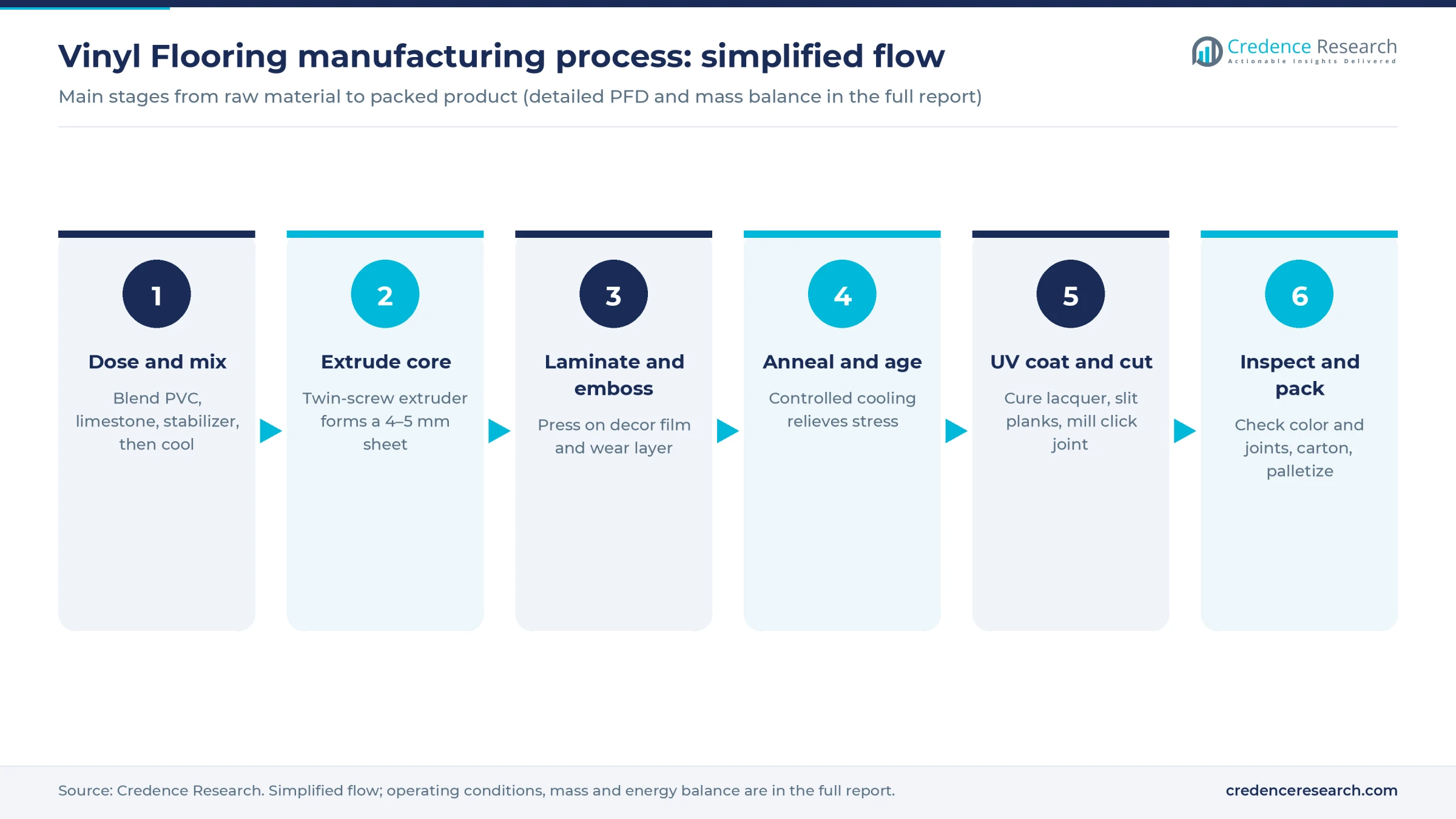
- Dosing and mixing. PVC resin, calcium carbonate, stabilizer and lubricants are weighed automatically, hot mixed and cooled. Inconsistent blends show up later as warped planks, so dosing accuracy pays for itself.
- Extrusion. A conical twin-screw extruder and sheet die form a hot core, typically 4–5 mm thick. A supplier listing puts output for one 4 mm line at 3,000–3,500 sq m a day.
- Lamination and embossing. While the core is still hot, four-roll calenders press on the decor film and wear layer and emboss the surface texture. This inline step fixes the look of the product and most of its scrap.
- Annealing and aging. Boards pass through controlled cooling and rest before further work, which relieves internal stress. Skipping this step causes curling and joint gaps after installation, the most common field complaint.
- UV coating. Lacquer is applied and cured under UV lamps to raise scratch and stain resistance.
- Slitting and click profiling. Boards are cut into planks and multi-head tenoners mill the locking joint. Click systems are often licensed, so royalty terms belong in the budget.
- Underlay, inspection and packing. An attached foam pad is optional. Planks are checked for color, dimensions and joint strength before cartons are palletized.
Scrap can be reground into the core, which helps material yield but demands tight control over filler and contamination. Dust from limestone, heat from extrusion and volatile compounds from lacquers are the main plant emissions.
Vinyl flooring plant setup cost
For a plant rated at 6 million sq m a year, about 20,000 sq m a day over 300 working days, total project cost is roughly USD 20–35 million in an Asian or similar lower-cost industrial location. The anchor is a public benchmark at exactly this scale: an undated Uzbekistan investment ministry profile shows USD 24 million for 6 million sq m a year, including USD 16 million of equipment. A band of 25% either side, plus an assumed USD 2–5 million of working capital margin, gives the range. U.S. or EU sites could cost 1.3–1.6 times as much (assumed), and the full report can be customized to any country.
Disclosed U.S. projects point to higher costs but rarely state capacity. Novalis put USD 30 million into its first Georgia rigid core plant, announced in 2020, and Shaw committed about USD 90 million in 2024 to more than double output at its Ringgold plant.
Land shows how the build works. Six lines, with stores and truck access, fit on about 35,000 sq m. At an assumed USD 30–90 per sq m for a serviced plot, land costs about USD 1.1–3.2 million. Leasing avoids that outlay, a route one China-based exporter says it uses in Vietnam to reduce upfront capital.
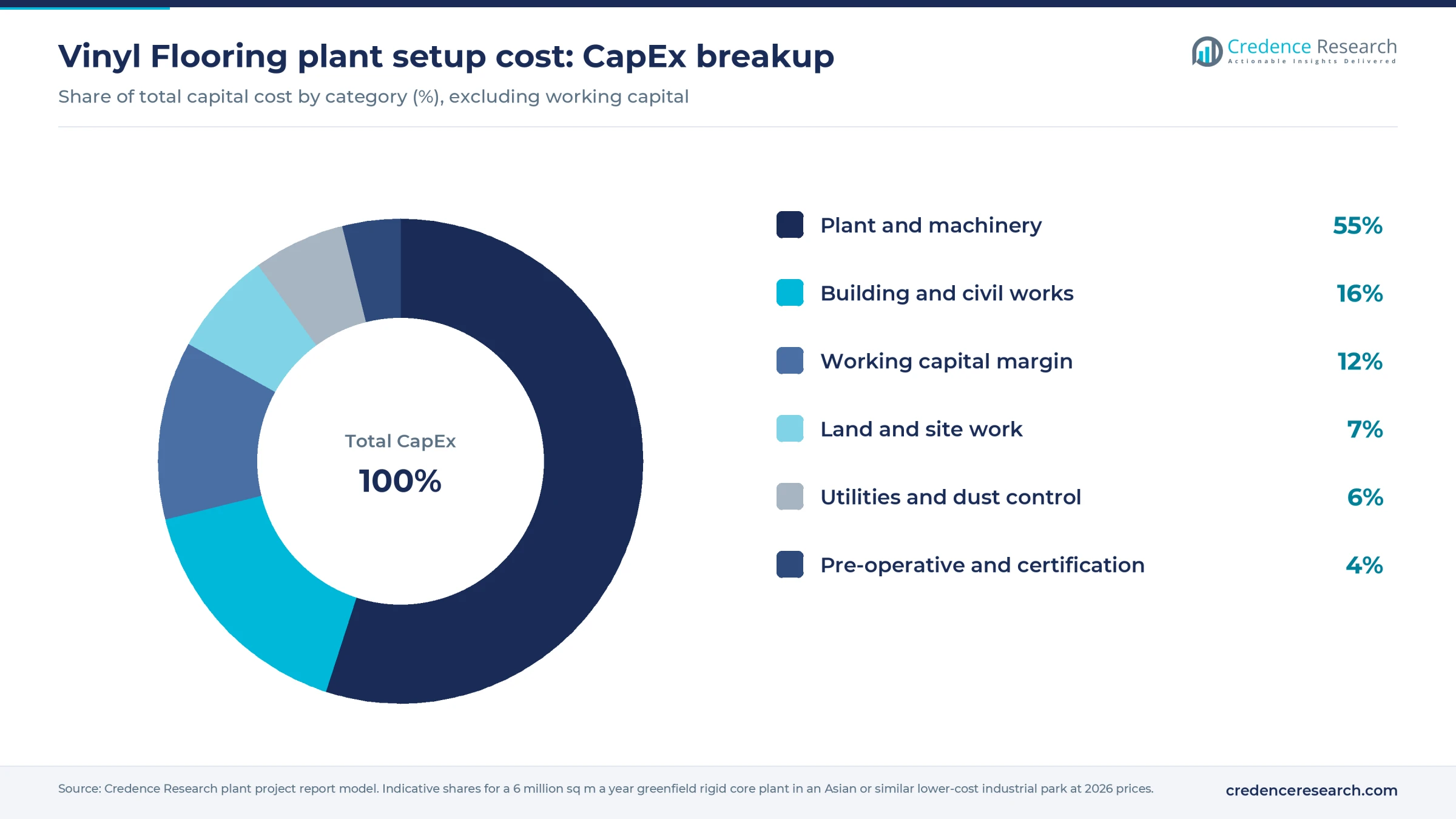
Machinery takes over half of the spending. Bare extruders are cheap, with one listing at USD 179,000 a unit, or about USD 1.1 million for six. Mixing, calendering, UV coating, tenoning and automation account for most of the remainder, and they decide quality. Working capital matters because export buyers often pay late and resin must be held in stock.
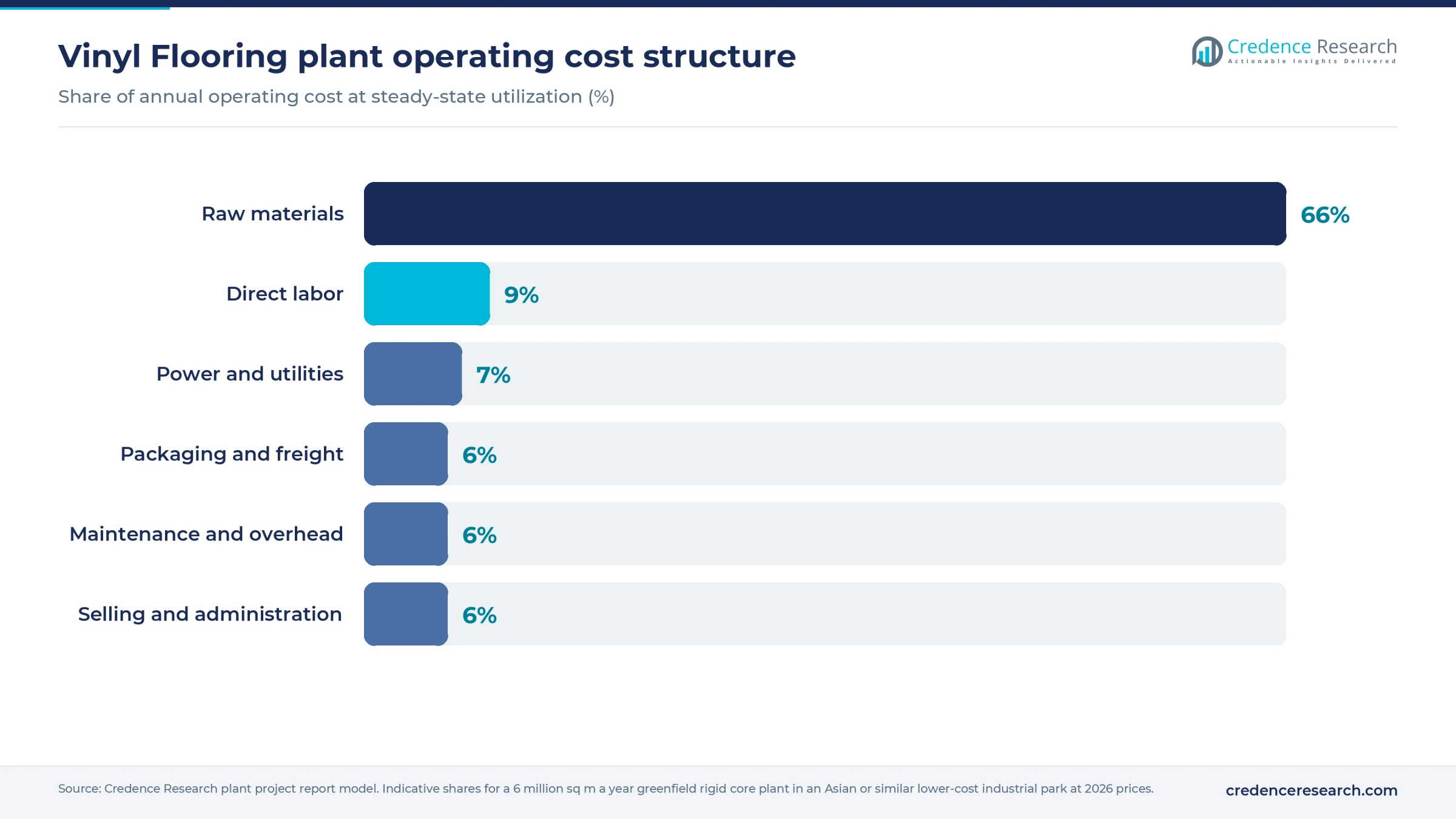
Operating cost is dominated by materials. A 4 mm core weighs about 8 kg per sq m, so resin price moves unit cost directly. A 10% rise in PVC resin adds about USD 0.18 per sq m (assumed mix), or nearly 3% of selling price, so margin narrows quickly without pass-through clauses.
Machinery and raw materials for a vinyl flooring plant
Core equipment for a rigid core plant includes:
- Silos, automatic dosing and hot and cold mixers
- Conical twin-screw extruders, sheet dies and four-roll calenders
- Inline lamination, embossing rollers and annealing tunnels
- UV roller coaters and curing lamps
- Slitters, click tenoners and pad laminators
- Dust collection, chillers, testing lab and packing lines
Extrusion lines come largely from China, while tenoning and coating tools are also sourced from Germany and Italy. Machine costs and specifications are available in the report.
Raw materials come from these main regions:
- PVC resin: China, the U.S. Gulf Coast, Taiwan, South Korea, Japan and Southeast Asia
- Calcium carbonate: widely quarried, with fine grades from China, Vietnam, India and Turkey, usually bought locally because freight outweighs the mineral's value
- Decor film and wear layer: China, South Korea and Germany
- Stabilizers and non-phthalate plasticizers: China, Europe, India and the United States
A trade price report from August 2026 put suspension PVC at USD 760–870 per ton CFR in the Far East and Southeast Asia and USD 830–910 in India. Trade barriers can widen such gaps. In October 2026 the European Commission said any anti-dumping duties on suspension PVC from China, South Korea, Taiwan and Mexico could apply retroactively, though no rates are set. Details on PVC resin supply and demand help in judging whether to buy on contract or at spot.
Vinyl flooring business profit margin and ROI
A plant at sound utilization can expect gross margin of about 18–26% of selling price, after depreciation. The best public check is a draft Hong Kong listing document from January 2026, filed by a China-based exporter with plants in Changzhou and Vietnam. Its PVC flooring gross margin ranged from 19.7% to 27.9% between 2023 and the first nine months of 2025. Raw materials made up 67–76% of its total cost of sales, and its SPC selling price of RMB 48.9–53.5 per sq m equals about USD 6.80–7.40.
Costs built from the bottom up agree. Materials come to about USD 3.50 per sq m, including about 2.2 kg of resin (assumed mix). Conversion and depreciation take the cost to about USD 5, against an assumed USD 6.20–6.90 price, set below that exporter's level because a new entrant has no audit record.
At 4.8 million sq m sold, annual cash profit after overhead and tax would be about USD 5–8 million, which gives a 4–7 year payback including ramp-up. The cheapest build at the highest profit comes in nearer 3.5 years, and the costliest at the lowest profit nearer 8. The undated Uzbekistan profile, which appears to assume full-capacity sales, shows 4.5 years.
Utilization is the key sensitivity. The same exporter ran its PVC flooring lines at 92% in 2023 but only 39.2% in 2024 and 43.7% in the first nine months of 2025. Part of that fall reflects new Vietnam capacity, but a single-site entrant at those levels would struggle to cover fixed costs.
| Metric | Value |
|---|---|
| IRR | Available in report |
| NPV | Available in report |
| ROI | Available in report |
| DSCR | Available in report |
How to start a vinyl flooring business, licenses and approvals
A new plant needs business and tax registration, land use and building permits, an environmental permit covering dust and solvent or VOC emissions, occupational safety registration, and import-export registration for resin and finished goods. Product testing for wear, slip, fire behavior and indoor emissions comes next. Export buyers also audit social compliance and chemical content, so these checks often decide who wins orders.
Examples by market
| Market | Plant permits | Product and chemical rules |
|---|---|---|
| United States | State environmental agency air permit under the Clean Air Act; EPA hazardous waste rules; OSHA workplace standards | ASTM product specifications, usually set by buyers; California warning rules for listed chemicals; voluntary indoor-air certification |
| European Union | National environmental permit from the member state authority, under EU industrial emissions rules where they apply | CE marking under EU construction products rules; REACH chemical restrictions, including on lead in PVC |
| India | State Pollution Control Board consent; factory registration with the state labor department; DGFT importer-exporter registration | BIS standard IS 3462 for unbacked flexible PVC flooring; CPCB producer obligations on plastic packaging waste |
Recycled PVC needs particular care in Europe, since older material can carry legacy additives. Rules vary by state and country, so applicants should confirm requirements with the regulator before fixing a design or a site.
Key vinyl flooring manufacturers and recent developments
Tarkett, Gerflor, Forbo and Beaulieu lead in Europe. Mohawk, Shaw, Mannington and AHF Products anchor North America. In Asia, CFL, LX Hausys, Novalis, Responsive Industries and Vietnam's Amy Grupo are significant exporters or regional leaders, with stone plastic composite flooring a shared focus for many of them.
Recent developments show consolidation in the United States and fresh capital in Vietnam:
- November 2025: AHF Products completed its purchase of the former Wellmade plant in Cartersville, Georgia, a 328,000 sq ft rigid core site, after a bankruptcy sale.
- November 2025: Belgium's Beaulieu International bought the assets of Congoleum, a U.S. maker of sheet vinyl and LVT, as Plastics News reported.
- September 2026: Amy Grupo closed an initial public offering of 16.1 million shares at VND 48,900 each, raising about VND 787 billion, ahead of a planned Vietnamese listing. Most of the funds were earmarked to repay short-term debt and trade payables.
For an entrant, the lesson is that distressed plants can reach the market cheaper than a new build, so buying should be weighed against building before any site is chosen.
What's inside the Vinyl Flooring project report PDF
The report runs to 21 chapters. Open a chapter to see its sections.
1. Preface
2. Scope and Methodology
- 2.1 Objectives of the Study
- 2.2 Stakeholders
- 2.3 Research Methodology
- 2.4 Data Sources and Key Assumptions
3. Executive Summary
- 3.1 Market Snapshot
- 3.2 Project at a Glance (Capacity, CapEx, OpEx)
- 3.3 Key Financial Indicators (IRR, NPV, Payback, Break-even)
- 3.4 Feasibility Verdict
4. Product Overview
- 4.1 Vinyl Flooring Definition and Properties
- 4.2 Grades and Specifications (BIS / ISO / ASTM)
- 4.3 HS Code and Classification
- 4.4 Key Applications
- 4.5 Substitutes
5. Global Vinyl Flooring Market
- 5.1 Market Overview
- 5.2 Historical and Current Market Performance (Volume and Value)
- 5.3 Market Breakup by Grade / Type
- 5.4 Market Breakup by End-Use Industry
- 5.5 Market Breakup by Region
- 5.6 Market Drivers, Restraints and Trends
- 5.7 Value Chain Analysis
- 5.8 Market Forecast
6. Target Country Vinyl Flooring Market Analysis
- 6.1 Demand and Supply Analysis
- 6.2 Installed Capacity vs Demand Gap
- 6.3 Import Dependence
- 6.4 Demand Forecast by End-Use
7. Trade Analysis
- 7.1 Imports by Volume, Value and Country
- 7.2 Exports by Volume, Value and Country
- 7.3 Trade Balance and Opportunities
8. Price Analysis
- 8.1 Historical Vinyl Flooring Price Trends by Region
- 8.2 Raw Material / Feedstock Price Trends and Linkage
- 8.3 Price Forecast
- 8.4 Margins Across the Value Chain
9. Competitive Landscape
- 9.1 Market Structure
- 9.2 Key Players and Installed Capacities
- 9.3 Profiles of Key Players
- 9.4 Recent Developments (Expansions, M&A, New Plants)
10. Manufacturing Process and Technology
- 10.1 Comparison of Technology Routes
- 10.2 Selected Route and Process Flow Diagram
- 10.3 Unit Operations Involved
- 10.4 Chemical Reactions Involved
- 10.5 Mass Balance and Raw Material Requirements
- 10.6 Energy Balance
- 10.7 Quality Assurance Criteria and Technical Tests
- 10.8 By-products and Waste Handling
- 10.9 Technology Licensors / Providers
11. Project Details, Requirements and Costs
- 11.1 Land, Location and Site Development
- 11.1.1 Site Selection Criteria
- 11.1.2 Location Analysis
- 11.1.3 Land Requirement and Costs
- 11.1.4 Site Development Costs
- 11.2 Plant Layout
- 11.2.1 Layout Principles
- 11.2.2 Proposed Layout
- 11.2.3 Factors Influencing Layout
- 11.3 Civil Works and Buildings
- 11.4 Plant Machinery
- 11.4.1 Machinery Requirements and Specifications
- 11.4.2 Machinery Costs
- 11.4.3 Machinery Suppliers
- 11.5 Raw Materials
- 11.5.1 Requirements per Tonne of Output
- 11.5.2 Procurement and Sourcing
- 11.5.3 Costs
- 11.5.4 Suppliers
- 11.6 Packaging
- 11.6.1 Packaging Requirements
- 11.6.2 Packaging Costs
- 11.6.3 Packaging Suppliers
- 11.7 Storage and Material Handling
- 11.8 Transportation Requirements and Costs
- 11.9 Utilities
- 11.9.1 Power Requirements and Costs
- 11.9.2 Water Requirements and Costs
- 11.9.3 Steam, Fuel and Other Utilities
- 11.10 Manpower Requirements and Wages
12. Environment, Health, Safety and Sustainability
- 12.1 Effluent and Emissions Management
- 12.2 Hazard Classification and Safety Measures
- 12.3 Carbon Footprint
- 12.4 Green / Low-Carbon Process Options
13. Regulatory Procedures, Approvals and Certifications
- 13.1 Licences and Registrations
- 13.2 Environmental Clearances
- 13.3 Product Certifications (BIS, REACH, etc.)
- 13.4 Approval Timeline
14. Project Implementation Schedule
15. Project Economics
- 15.1 Capital Cost of the Project
- 15.2 Techno-Economic Parameters
- 15.3 Capacity Utilization and Ramp-up
- 15.4 Product Pricing and Margins
- 15.5 Income Projections
- 15.6 Expenditure Projections
- 15.7 Working Capital Requirement
- 15.8 Taxation
- 15.9 Depreciation
16. Financial Analysis
- 16.1 Projected Profit and Loss Account
- 16.2 Projected Cash Flow Statement
- 16.3 Projected Balance Sheet
- 16.4 Liquidity Analysis
- 16.5 Profitability Analysis (Payback, NPV, IRR, ROI)
- 16.6 Break-even Analysis
- 16.7 Debt Service Coverage Ratio (DSCR)
- 16.8 Sensitivity Analysis
- 16.9 Scenario and Uncertainty Analysis
17. Funding and Incentives
- 17.1 Means of Finance and Debt-Equity Structure
- 17.2 Loans and Financial Assistance
- 17.3 Government Schemes and Subsidies (PLI, State Policies)
18. Risk Assessment
- 18.1 Key Success Factors
- 18.2 Key Risk Factors
- 18.3 Risk Mitigation
19. Strategic Recommendations
20. Case Study of a Successful Venture
21. Appendix
- 21.1 Detailed Assumptions
- 21.2 Abbreviations
- 21.3 List of Tables and Figures
- 21.4 Sources
This page vs. the full report
| Data point | On this page (free) | In the full report |
|---|---|---|
| Total CapEx | One rounded range at one capacity | Exact figure at three capacities with a line-item breakup |
| CapEx breakup | Category shares (%) only | Cost, quantity and supplier for every machine |
| Operating cost | Share of raw materials, utilities and labor | Per-unit cost sheet with each input price and consumption |
| Profitability | Gross margin range and payback band | Exact IRR, NPV, ROI, break-even and DSCR |
| Financial statements | List of what is included | 10-year P&L, cash flow, balance sheet and Excel model |
| Sensitivity | One directional line | Full sensitivity and scenario tables |
| Process | Simplified flow diagram | Detailed process flow, mass and energy balance, operating conditions |
| Machinery | Names of the main machines | Specifications, capacity, cost and supplier list |
| Market | Headline size, growth and global demand | Segment, region, trade and price forecast tables |
| Suppliers and buyers | Supplier types and sourcing hubs | Named suppliers and buyers |
Vinyl Flooring project report: FAQs
How much does a vinyl flooring plant cost?
What is the profit margin in a vinyl flooring business?
What is the payback period for a vinyl flooring plant?
What is the HS code for vinyl flooring?
What raw materials does a vinyl flooring plant need?
Should a new plant choose rigid core or flexible LVT?
Which approvals does a vinyl flooring factory need?

About the analyst
Nisha Gupta, Senior Research Analyst
Nisha Gupta is a Senior Research Analyst at Credence Research Inc. who works across industry domains, including packaging, automotive parts and machinery. Her focus is the modelling engine behind each study: she builds quantitative market databases and econometric forecasting frameworks, and developed automated Excel-based market modelling templates that cut client turnaround time by 30%.
Related market research
- Luxury Vinyl Tile Flooring Market Size, Growth & Forecast 2032
- Resilient Flooring Market Size, Share, Trends and Forecast 2032
- Stone Plastic Composite Flooring Market Size, Share and Forecast 2032
- Polyvinyl Chloride Resins Market Size, Growth and Forecast 2032
- Plasticizers Market Size, Growth, Share, Trends and Forecast 2032
- Flooring Market Size, Growth, Share, Trend and Forecast 2032
More plant project reports
- Bendable Concrete Manufacturing Plant Project Report (DPR) 2026
- Vitrified Tiles Manufacturing Plant Project Report (DPR) 2026
- Cement Manufacturing Plant Project Report (DPR) 2026
- Recycled Plastic Manufacturing Plant Project Report (DPR) 2026
- Whey Protein Manufacturing Plant Project Report (DPR) 2026
- Notebook Manufacturing Plant Project Report (DPR) 2026