
Quick answer
A bendable concrete plant making about 10,000 tons a year of bagged engineered cementitious composite premix needs total CapEx of roughly USD 2–4 million, including a sand dryer, fiber dosing, a testing laboratory and working capital. Gross margin typically runs 30–45% of ex-works price, and payback falls in a 3–8 year band at 40–70% utilization. PVA fiber cost and specification approvals by bridge owners decide whether the plant fills.
Feasible as a niche specialty plant for an entrant with technical sales capability and signed repair or bridge demand; a poor fit for investors expecting commodity mortar volumes.
Bendable Concrete plant: key highlights
| Parameter | Indicative value | Note |
|---|---|---|
| Plant capacity | 10,000 tons of ECC premix per year | About 5,600 cubic meters of placed ECC, single shift on a 5–10 tons-per-hour line |
| Total CapEx | USD 2–4 million | Asian industrial park at the low end, U.S. or EU site at the high end |
| Raw material share of operating cost | 70–80% | PVA fiber alone is about 45–50% of operating cost |
| Gross margin | 30–45% | On an assumed ex-works price of USD 520–640 per ton |
| Payback period | 3–8 years | At 40–70% utilization, before financing costs and tax |
| IRR | Available in report | Post-tax, 10-year model |
| Break-even | Available in report | Capacity utilization basis |
Ranges assume a bagged ECC premix plant of 10,000 tons a year on a single-shift 5–10 tons-per-hour line, a representative greenfield site from an Asian industrial park to a U.S. or EU location, 2026 prices, Japanese-grade PVA fiber at an assumed USD 8–14 per kg, an assumed ex-works price of USD 520–640 per ton and 40–70% utilization. Rupee figures convert at 88 per USD. The full report can be customized to any country.
What is bendable concrete?
Bendable concrete is the common name for engineered cementitious composite, or ECC, a fine-grained cement mortar reinforced with short synthetic fibers that lets it stretch and flex instead of snapping. Ordinary concrete cracks at a tiny tensile strain. ECC spreads the load across many hairline cracks, each narrower than about 0.1 millimeter, so the material keeps carrying load and stays largely watertight. All tons on this page are metric.
A typical mix contains portland cement, a large dose of fly ash or slag, fine silica sand, water, a superplasticizer and about 2% polyvinyl alcohol, or PVA, fiber by volume, with no coarse gravel. University of Michigan researchers, where ECC was invented, put its tensile strain capacity at about 3–5%, or 300–500 times that of normal concrete. Grades include repair and overlay mixes, sprayable versions, high-early-strength mixes and polyethylene-fiber versions for higher strength.
Bagged ECC premix falls under HS code 382450, non-refractory mortars and concretes. The fiber itself trades separately as synthetic staple fiber. Buyers are bridge owners, repair contractors, precast makers and seismic retrofit specialists, who pay a premium for crack control and longer service life rather than raw strength.
Bendable concrete market overview and global demand
Bendable concrete is a small, specialist product, and no reliable standalone global sales figure exists for it. The closest benchmark is the broader category: Credence Research values the global fiber reinforced concrete market at USD 2,663 million in 2024, growing at 6.6% a year to 2032. Carried forward, that implies about USD 2.84 billion in 2025, based on the 2024 figure and that growth rate. ECC is only a slice of that total, which is dominated by steel and polypropylene fiber concrete for floors and tunnels.
Trade data show the wider premix business ECC sits in. Reporters to UN Comtrade exported about USD 1.37 billion of HS 382450 mortars and concretes in 2024, or roughly 4.9 million tons where weight was reported. Germany led at about USD 318 million, ahead of Italy at USD 166 million and Spain, the United States and Poland at about USD 70–78 million each. Iraq, Switzerland and the United States were the largest importers. Average values near USD 280–400 per ton show that ordinary bagged mortar is a low-value, heavy product, which is why most of it moves short distances.
Demand for ECC itself comes from a few clear niches: bridge link slabs that replace leaking expansion joints, thin bonded overlays and patch repairs, seismic dampers and coupling beams, and pavement trials. ECC also competes for the same budgets as ultra-high performance concrete, which is far stronger in compression but much less ductile. Japan and the United States have the longest field records, while China leads in research volume and pilot projects. State transportation agencies in the United States are still writing specifications for ECC overlays, so purchasing is project by project. That makes specification approval, not plant output, the real limit on volume growth.
Bendable concrete manufacturing process
An ECC plant is essentially a precision dry-mortar plant with a fiber-handling step added. The commercial product is a bagged dry premix, often sold with the PVA fiber pre-blended or packed as a separate dosed bag, so the site only adds water. The hard part is not mixing powder but getting consistent particle sizes, fiber dispersion and tensile behavior from batch to batch.
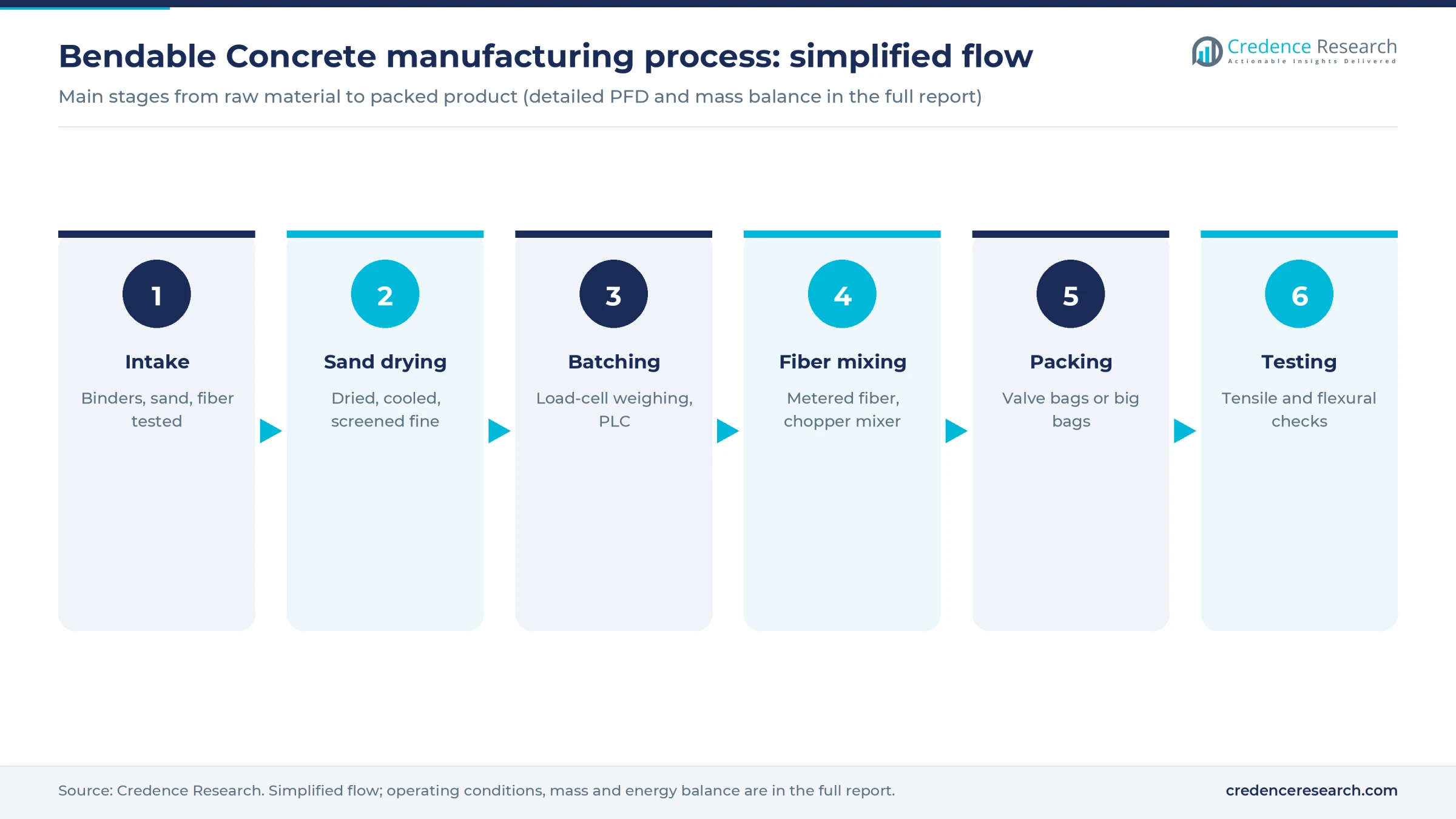
- Raw material intake and testing. Cement, fly ash or slag, fine silica sand, powdered superplasticizer and PVA fiber arrive by bulk tanker, big bag or bale. Each lot is checked for fineness, chemistry and moisture, because ECC is far more sensitive to sand grading and fly ash quality than ordinary mortar.
- Sand drying and screening. Sand is dried below about 0.5% moisture in a rotary or fluid-bed dryer, cooled and screened to a narrow fine grading. Coarse particles raise matrix toughness and stop the multiple-cracking behavior.
- Weighing and batching. Binders, sand and admixtures are dosed by load cells into a weigh hopper under PLC control, with small additives weighed on a separate high-accuracy scale.
- Fiber dosing and mixing. Fiber is fed through a metered opener into a plowshare or twin-shaft mixer equipped with high-speed choppers, which break up clumps. Fiber balling is the most common quality failure.
- Packing. The blend drops to a buffer hopper and into 20–25 kg valve bags or big bags, with dust extracted at every transfer point.
- Quality control and dispatch. Retained samples are cast into dogbone and beam specimens for tensile strain, flexural and compressive tests, then results are tied to the batch record before release.
Plants often add a pilot mixer for customer trials, since most orders follow a site mock-up. Running a single shift on a 5–10 tons-per-hour line leaves headroom, which suits a market where orders arrive in irregular project lots.
Bendable concrete plant setup cost
For a plant making 10,000 tons a year of bagged ECC premix, enough for about 5,600 cubic meters of placed material, total project cost lands at roughly USD 2–4 million, including land, buildings, machinery, a testing laboratory and working capital. The range reflects an Asian industrial park at the low end and a U.S. or EU site at the high end. The full report can be customized to any country.
The machinery anchor is the dry-mortar line. Indian online listings show a fully automatic 5 tons-per-hour line near USD 40,000, and Chinese makers quote basic 1–10 tons-per-hour lines at USD 4,000–15,000. An ECC plant needs much more than that: a sand dryer, multiple silos, fiber dosing, dust control and premium weighing, which lifts plant and machinery to an assumed USD 350,000–700,000. Buildings, land and working capital make up most of the rest, which is why this business is lighter on capital than on know-how.
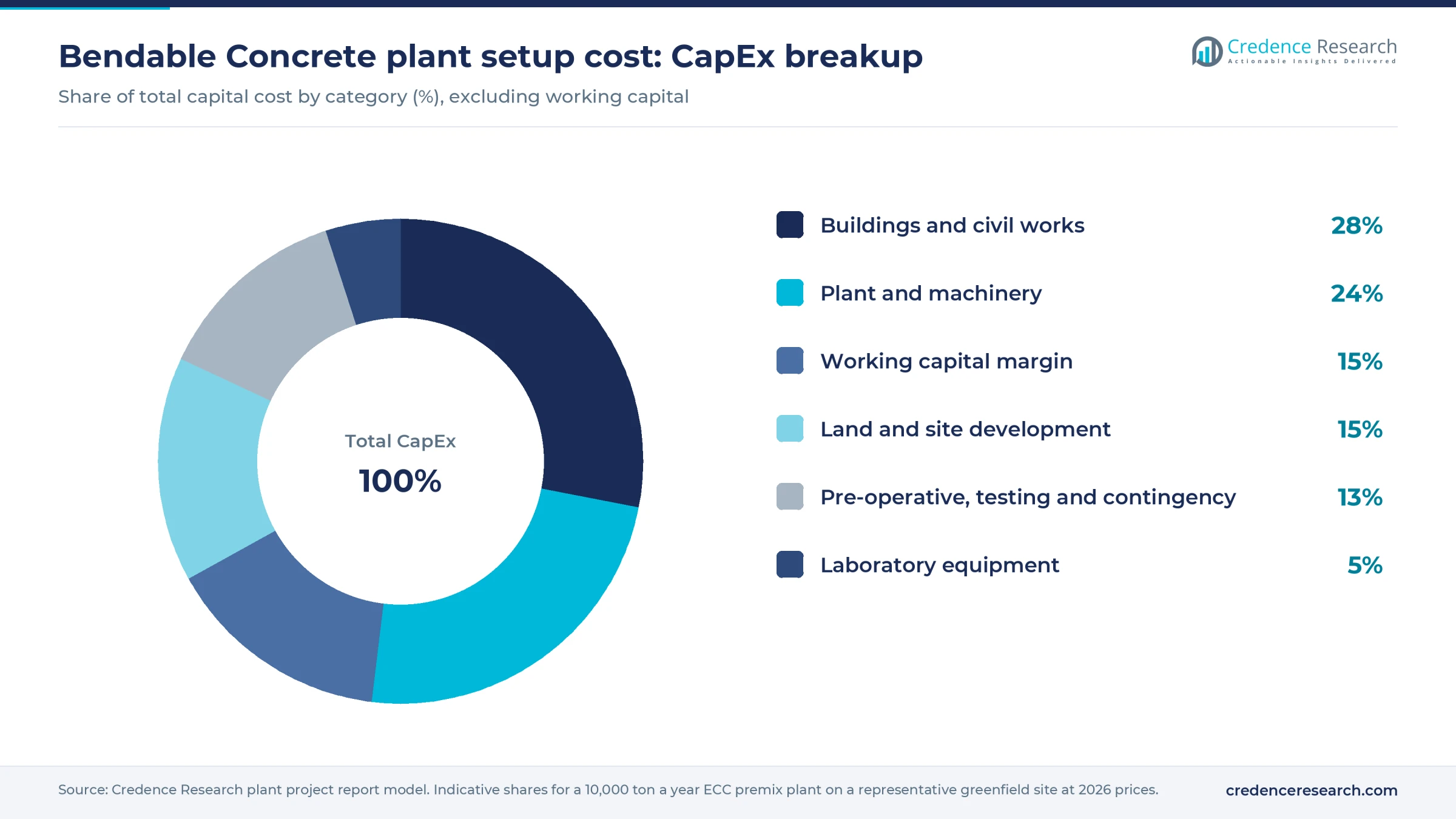
Land shows how the estimate is built. A site of about 1.2 hectares, or 12,000 sq m, holds silos, a 2,500 sq m production and warehouse building, a lab and truck access (assumed). At USD 20–60 per sq m (assumed), land costs about USD 240,000–720,000, with the low end typical of Asian industrial parks and the high end of U.S. or EU sites.
Working capital is unusually heavy for a mortar plant because PVA fiber is expensive and often imported in container loads, so a 3-month stock ties up about USD 400,000–600,000. Certification testing, field trials and contingency add USD 300,000–500,000, an amount many first-time investors leave out.
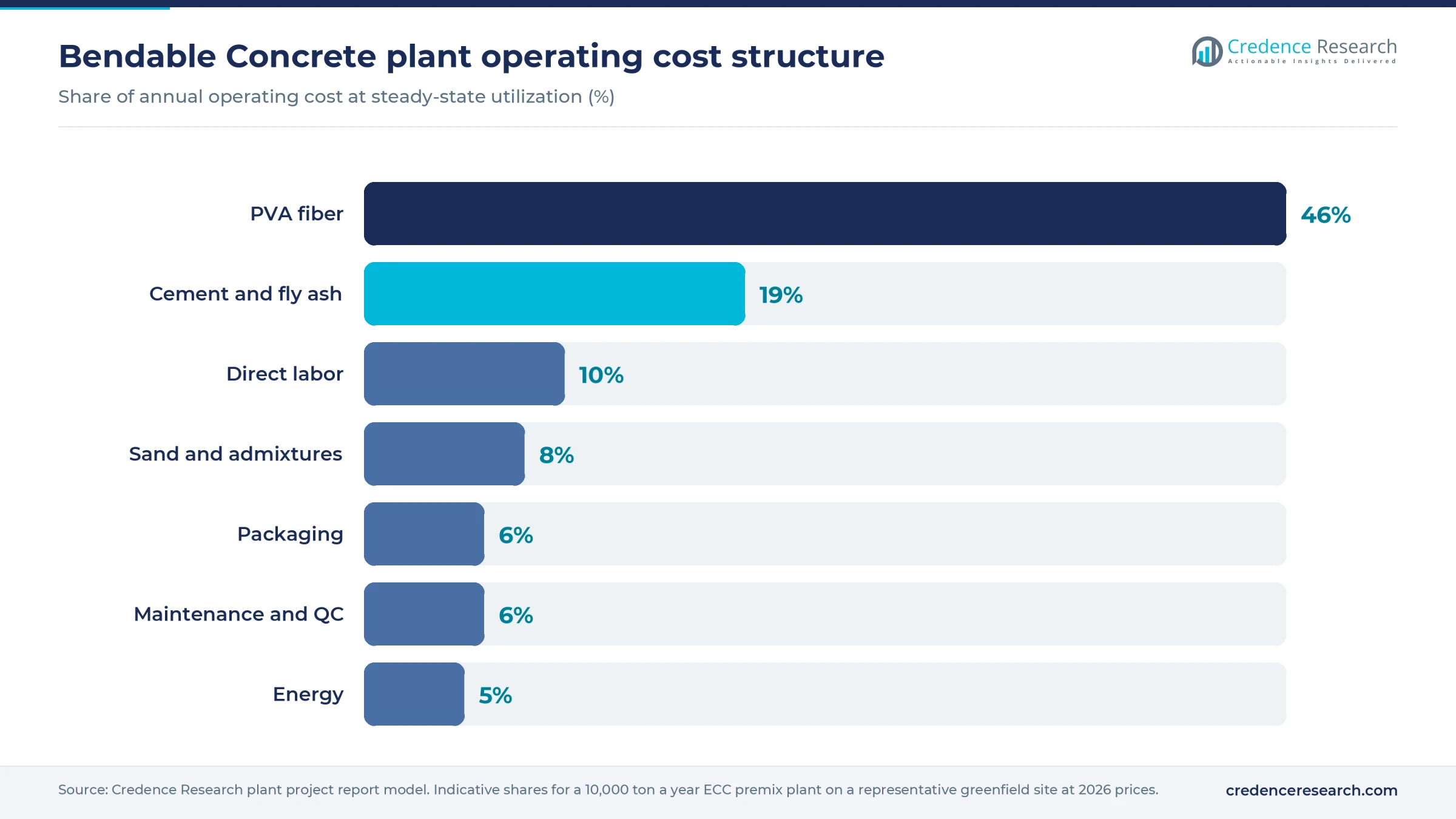
Fiber alone is close to half of running cost, so the fiber contract matters more than any machine choice.
Machinery and raw materials for a bendable concrete plant
The equipment list is compact: a wet sand hopper, rotary or fluid-bed dryer with burner and cooler, vibrating screen, bulk silos for cement, fly ash and dried sand, screw conveyors and bucket elevators, a load-cell weigh hopper and micro-dosing scale, a fiber opener and metered feeder, a plowshare or twin-shaft mixer with choppers, buffer hopper, valve bag packers, a pulse-jet dust collector, air compressor and PLC control. The lab needs a direct tension test frame, flexural and compression machines, a mortar mixer and curing room. Forklifts and a small pilot mixer complete the plant. Detailed equipment specifications and costs are available in the report.
Raw materials come from several distinct supply chains. Cement and fine silica sand are local almost everywhere. Fly ash is plentiful where coal power fleets still run, including China, India, the United States and Southeast Asia, while ground slag suits steel regions such as Japan, South Korea and Europe. Superplasticizers come from the global concrete admixtures industry, with plants in every region.
PVA fiber is the strategic input. Japan's Kuraray supplies the most widely used ECC grades, and Chinese producers sell lower-cost alternatives, with one Shanghai-based listing near USD 3.20 per kg. Fiber quality, coating and length decide whether the ECC actually strain-hardens, so qualifying a second source takes months of testing.
Bendable concrete business profit margin and ROI
ECC premix sells on performance, so its price sits well above bagged mortar. At an assumed ex-works price of USD 520–640 per ton against assumed production costs of USD 330–360 per ton, gross margin runs about 30–45%. For comparison, German exports of ordinary HS 382450 mortar averaged about USD 377 per ton in 2024. The premium has to pay for technical sales, testing and site support, which take a large share of gross profit.
Cost of the finished material frames what buyers will pay. A 2018 Tran-SET study for the U.S. Department of Transportation found ECC mixes cost about 2.8–4.1 times conventional concrete, mostly because of fiber. At 40–70% utilization, or 4,000–7,000 tons sold, and mid-band pricing after selling costs, payback falls in a 3–8 year band on the USD 2–4 million investment. Low prices combined with low volume would stretch it well past that, so the plant should be sized to signed demand.
| Metric | Value |
|---|---|
| Gross margin | 30–45% |
| Payback period | 3–8 years |
| IRR (post-tax) | Available in report |
| NPV | Available in report |
| ROI | Available in report |
| DSCR | Available in report |
Fiber price is the main sensitivity. Each USD 1 per kg rise in PVA fiber cost adds about USD 15 per ton of premix and cuts gross margin by roughly 2.5 percentage points at USD 580 per ton.
How to start a bendable concrete business, licenses and approvals
A new plant needs business and tax registration, land use and building permits, an air or emissions permit for silo, dryer and mixer dust, fuel or boiler permits for the sand dryer, worker safety registration with controls for respirable crystalline silica, and product approval. For ECC, product approval usually means test reports, a safety data sheet and listing on each buyer's approved materials list, since few countries have a standard written specifically for bendable concrete.
| Market | Site and environmental | Product and safety |
|---|---|---|
| United States | State air permit under the Clean Air Act for particulate sources such as silos, dryer and packers; local zoning and building permits | OSHA respirable crystalline silica standard, 29 CFR 1910.1053; state transportation department special provisions and approved product lists for bridge use |
| European Union | National environmental and emissions permit under member state law; local planning consent | CE marking under the Construction Products Regulation, for example to EN 1504-3 for structural repair mortars; REACH safety data sheet and the 2 ppm soluble chromium VI limit for cement mixtures |
| India | Consent to Establish and Consent to Operate from the State Pollution Control Board; factory license under state factory rules | Cement used must carry the BIS Standard Mark under the Cement Quality Control Order; project approval by the client agency or its engineer |
Exporters should budget for testing in each target market, since overlay and repair approvals rarely transfer across borders.
Key bendable concrete manufacturers and recent developments
The ECC supply chain is led by fiber makers rather than premix brands. Kuraray of Japan is the best-known supplier of PVA fiber for ECC, and Chinese PVA producers have entered the field with cheaper grades. In North America, Kuraray and fiber distributor Nycon introduced PVA-ECC to the market, and decorative brand Buddy Rhodes sells an ECC blended mix for countertops and panels. Japanese contractors such as Kajima have used ECC in bridge decks and seismic dampers. Most structural ECC is still batched to project specifications, which leaves room for regional premix plants. New entrants compete mainly with site-batched mixes and established repair mortars, not with other ECC brands.
Recent developments show where cost and demand are moving:
- April 2026. Kuraray raised prices for its PVA fiber products by USD 1.20 per kg for shipments from April 20, citing raw material, energy, logistics and labor costs.
- August 2026. Kuraray America showcased its KURALON PVA fibers at Techtextil North America, describing construction as a primary focus.
- October 2026. A review co-authored by ECC inventor Victor Li set out the emerging deployment of ECC in bridge link slabs, decks and piers.
What's inside the Bendable Concrete project report PDF
The report runs to 21 chapters. Open a chapter to see its sections.
1. Preface
2. Scope and Methodology
- 2.1 Objectives of the Study
- 2.2 Stakeholders
- 2.3 Research Methodology
- 2.4 Data Sources and Key Assumptions
3. Executive Summary
- 3.1 Market Snapshot
- 3.2 Project at a Glance (Capacity, CapEx, OpEx)
- 3.3 Key Financial Indicators (IRR, NPV, Payback, Break-even)
- 3.4 Feasibility Verdict
4. Product Overview
- 4.1 Bendable Concrete Definition and Properties
- 4.2 Grades and Specifications (BIS / ISO / ASTM)
- 4.3 HS Code and Classification
- 4.4 Key Applications
- 4.5 Substitutes
5. Global Bendable Concrete Market
- 5.1 Market Overview
- 5.2 Historical and Current Market Performance (Volume and Value)
- 5.3 Market Breakup by Grade / Type
- 5.4 Market Breakup by End-Use Industry
- 5.5 Market Breakup by Region
- 5.6 Market Drivers, Restraints and Trends
- 5.7 Value Chain Analysis
- 5.8 Market Forecast
6. Target Country Bendable Concrete Market Analysis
- 6.1 Demand and Supply Analysis
- 6.2 Installed Capacity vs Demand Gap
- 6.3 Import Dependence
- 6.4 Demand Forecast by End-Use
7. Trade Analysis
- 7.1 Imports by Volume, Value and Country
- 7.2 Exports by Volume, Value and Country
- 7.3 Trade Balance and Opportunities
8. Price Analysis
- 8.1 Historical Bendable Concrete Price Trends by Region
- 8.2 Raw Material / Feedstock Price Trends and Linkage
- 8.3 Price Forecast
- 8.4 Margins Across the Value Chain
9. Competitive Landscape
- 9.1 Market Structure
- 9.2 Key Players and Installed Capacities
- 9.3 Profiles of Key Players
- 9.4 Recent Developments (Expansions, M&A, New Plants)
10. Manufacturing Process and Technology
- 10.1 Comparison of Technology Routes
- 10.2 Selected Route and Process Flow Diagram
- 10.3 Unit Operations Involved
- 10.4 Chemical Reactions Involved
- 10.5 Mass Balance and Raw Material Requirements
- 10.6 Energy Balance
- 10.7 Quality Assurance Criteria and Technical Tests
- 10.8 By-products and Waste Handling
- 10.9 Technology Licensors / Providers
11. Project Details, Requirements and Costs
- 11.1 Land, Location and Site Development
- 11.1.1 Site Selection Criteria
- 11.1.2 Location Analysis
- 11.1.3 Land Requirement and Costs
- 11.1.4 Site Development Costs
- 11.2 Plant Layout
- 11.2.1 Layout Principles
- 11.2.2 Proposed Layout
- 11.2.3 Factors Influencing Layout
- 11.3 Civil Works and Buildings
- 11.4 Plant Machinery
- 11.4.1 Machinery Requirements and Specifications
- 11.4.2 Machinery Costs
- 11.4.3 Machinery Suppliers
- 11.5 Raw Materials
- 11.5.1 Requirements per Tonne of Output
- 11.5.2 Procurement and Sourcing
- 11.5.3 Costs
- 11.5.4 Suppliers
- 11.6 Packaging
- 11.6.1 Packaging Requirements
- 11.6.2 Packaging Costs
- 11.6.3 Packaging Suppliers
- 11.7 Storage and Material Handling
- 11.8 Transportation Requirements and Costs
- 11.9 Utilities
- 11.9.1 Power Requirements and Costs
- 11.9.2 Water Requirements and Costs
- 11.9.3 Steam, Fuel and Other Utilities
- 11.10 Manpower Requirements and Wages
12. Environment, Health, Safety and Sustainability
- 12.1 Effluent and Emissions Management
- 12.2 Hazard Classification and Safety Measures
- 12.3 Carbon Footprint
- 12.4 Green / Low-Carbon Process Options
13. Regulatory Procedures, Approvals and Certifications
- 13.1 Licences and Registrations
- 13.2 Environmental Clearances
- 13.3 Product Certifications (BIS, REACH, etc.)
- 13.4 Approval Timeline
14. Project Implementation Schedule
15. Project Economics
- 15.1 Capital Cost of the Project
- 15.2 Techno-Economic Parameters
- 15.3 Capacity Utilization and Ramp-up
- 15.4 Product Pricing and Margins
- 15.5 Income Projections
- 15.6 Expenditure Projections
- 15.7 Working Capital Requirement
- 15.8 Taxation
- 15.9 Depreciation
16. Financial Analysis
- 16.1 Projected Profit and Loss Account
- 16.2 Projected Cash Flow Statement
- 16.3 Projected Balance Sheet
- 16.4 Liquidity Analysis
- 16.5 Profitability Analysis (Payback, NPV, IRR, ROI)
- 16.6 Break-even Analysis
- 16.7 Debt Service Coverage Ratio (DSCR)
- 16.8 Sensitivity Analysis
- 16.9 Scenario and Uncertainty Analysis
17. Funding and Incentives
- 17.1 Means of Finance and Debt-Equity Structure
- 17.2 Loans and Financial Assistance
- 17.3 Government Schemes and Subsidies (PLI, State Policies)
18. Risk Assessment
- 18.1 Key Success Factors
- 18.2 Key Risk Factors
- 18.3 Risk Mitigation
19. Strategic Recommendations
20. Case Study of a Successful Venture
21. Appendix
- 21.1 Detailed Assumptions
- 21.2 Abbreviations
- 21.3 List of Tables and Figures
- 21.4 Sources
This page vs. the full report
| Data point | On this page (free) | In the full report |
|---|---|---|
| Total CapEx | One rounded range at one capacity | Exact figure at three capacities with a line-item breakup |
| CapEx breakup | Category shares (%) only | Cost, quantity and supplier for every machine |
| Operating cost | Share of raw materials, utilities and labor | Per-unit cost sheet with each input price and consumption |
| Profitability | Gross margin range and payback band | Exact IRR, NPV, ROI, break-even and DSCR |
| Financial statements | List of what is included | 10-year P&L, cash flow, balance sheet and Excel model |
| Sensitivity | One directional line | Full sensitivity and scenario tables |
| Process | Simplified flow diagram | Detailed process flow, mass and energy balance, operating conditions |
| Machinery | Names of the main machines | Specifications, capacity, cost and supplier list |
| Market | Headline size, growth and global demand | Segment, region, trade and price forecast tables |
| Suppliers and buyers | Supplier types and sourcing hubs | Named suppliers and buyers |
Bendable Concrete project report: FAQs
How much does it cost to set up a bendable concrete plant?
What is the profit margin in bendable concrete manufacturing?
What is the payback period for a bendable concrete plant?
What raw materials are needed to make bendable concrete?
What is the HS code for bendable concrete?
Why is bendable concrete more expensive than normal concrete?
What licenses does a bendable concrete plant need?

About the analyst
Nisha Gupta, Senior Research Analyst
Nisha Gupta is a Senior Research Analyst at Credence Research Inc. who works across industry domains, including packaging, automotive parts and machinery. Her focus is the modelling engine behind each study: she builds quantitative market databases and econometric forecasting frameworks, and developed automated Excel-based market modelling templates that cut client turnaround time by 30%.
Related market research
- Fiber Reinforced Concrete Market Size, Share and Forecast 2032
- Concrete Fibers Market Size, Growth, Share and Forecast 2032
- Self-Healing Concrete Market Size, Growth and Forecast 2032
- Ultra-High Performance Concrete Market Size, Growth and Forecast 2032
- Concrete Admixtures Market Size, Share, Growth and Forecast, 2025-2035
- Ready Mix Concrete Market Size, Trends and Forecast 2032
More plant project reports
- Vitrified Tiles Manufacturing Plant Project Report (DPR) 2026
- Vinyl Flooring Manufacturing Plant Project Report (DPR) 2026
- Cement Manufacturing Plant Project Report (DPR) 2026
- Recycled Plastic Manufacturing Plant Project Report (DPR) 2026
- Whey Protein Manufacturing Plant Project Report (DPR) 2026
- Notebook Manufacturing Plant Project Report (DPR) 2026