
Quick answer
A cashew processing plant turns raw cashew nuts into graded, export-ready kernels by drying, steaming, shelling, peeling and sorting them. A representative semi-automated plant processes 10,000 tons of raw nuts a year and yields about 2,000 tons of kernels. Total CapEx is estimated at USD 6–15 million on a West African or South Asian cost basis, gross margin at 8–22% and payback at 6–11 years, with the raw nut price and kernel recovery as the main swing factors.
Viable in a raw nut origin with seasonal crop finance and kernel buyers lined up; risky as an import-based plant paying full international raw nut prices.
Cashew plant: key highlights
| Parameter | Indicative value | Note |
|---|---|---|
| Plant capacity | 10,000 tons of raw cashew nuts a year | About 2,040 tons of kernels at 85% utilization and 24% kernel recovery |
| Total CapEx | USD 6–15 million | West African or South Asian cost basis, including a working capital margin |
| Raw material share of operating cost | 82–87% | Raw nuts bought mostly in a three-to-four-month harvest window |
| Gross margin | 8–22% | Blended whole and broken kernels at 85% utilization |
| Payback period | 6–11 years | Can exceed 12 years in seasons with a thin raw nut to kernel price spread |
| IRR | Available in report | Post-tax, 10-year model |
| Break-even | Available in report | Capacity utilization basis |
Ranges assume 10,000 tons a year of raw cashew nut capacity at 85% utilization and 24% kernel recovery, a 3-hectare greenfield site with a West African or South Asian cost basis, 2026 prices, raw nuts bought locally in the harvest season with crop finance, and CFA franc figures converted at an assumed 565 CFA per U.S. dollar. Sites in Vietnam's southern industrial parks, the EU or the U.S. cost more. Customizable to any country.
What is cashew processing?
Cashew processing turns the raw nut of the cashew tree (Anacardium occidentale) into the pale, kidney-shaped kernel sold as a snack and food ingredient. The kernel sits inside a hard, double-walled shell filled with cashew nut shell liquid, a caustic, phenol-rich oil that burns skin, so the nut cannot simply be cracked like an almond or a walnut. Processors first condition the shell with steam or heat, cut it open, then dry the kernel and remove its thin brown skin, called the testa, before grading.
In the Harmonized System, cashew nuts in shell fall under code 0801.31 and shelled cashew kernels under 0801.32. Kernels are graded by size and color, from large white wholes such as W180 and W240 to the widely traded W320 and W450, followed by butts, splits and pieces. Most go to roasters, snack packers, bakeries, confectioners and makers of plant-based dairy alternatives. Shells are a by-product that can be pressed for shell liquid or burned as boiler fuel.
Cashew market overview and global demand
Credence Research estimates the global cashew market at USD 7.97 billion in 2025 and expects it to reach about USD 10.07 billion by 2032, a 3.4% CAGR, as set out in its global cashew market report.
Raw nut supply has grown faster than processing capacity. The International Nut and Dried Fruit Council's March 2026 crop update estimated the 2025/26 world crop at about 6.38 million metric tons in shell, a record and roughly 19% above the prior season. Côte d'Ivoire leads with about 1.5 million tons, followed by Cambodia at 930,000 tons, India at 725,000 tons, Tanzania at 500,000 tons and Nigeria at 370,000 tons.
Shelling, however, remains concentrated in Asia. Vietnam imported about 3.12 million tons of raw nuts worth USD 4.66 billion in 2025 and exported about 798,000 tons of kernels worth more than USD 5.4 billion, keeping its place as the top kernel exporter. India processes both domestic and imported nuts and is also the largest consumer, at about 396,000 tons of kernels in 2024 by the council's figures, ahead of the United States at 174,000 tons and Germany at 56,000 tons.
African origins are trying to capture more of that value. Côte d'Ivoire processed about 36% of its 1.3-million-ton harvest in 2024 and targets 50% by 2030, and several West and East African governments now offer incentives for local shelling. A new origin plant gains cheaper nuts but competes with exporters and other processors for them at harvest.
Cashew processing plant manufacturing process
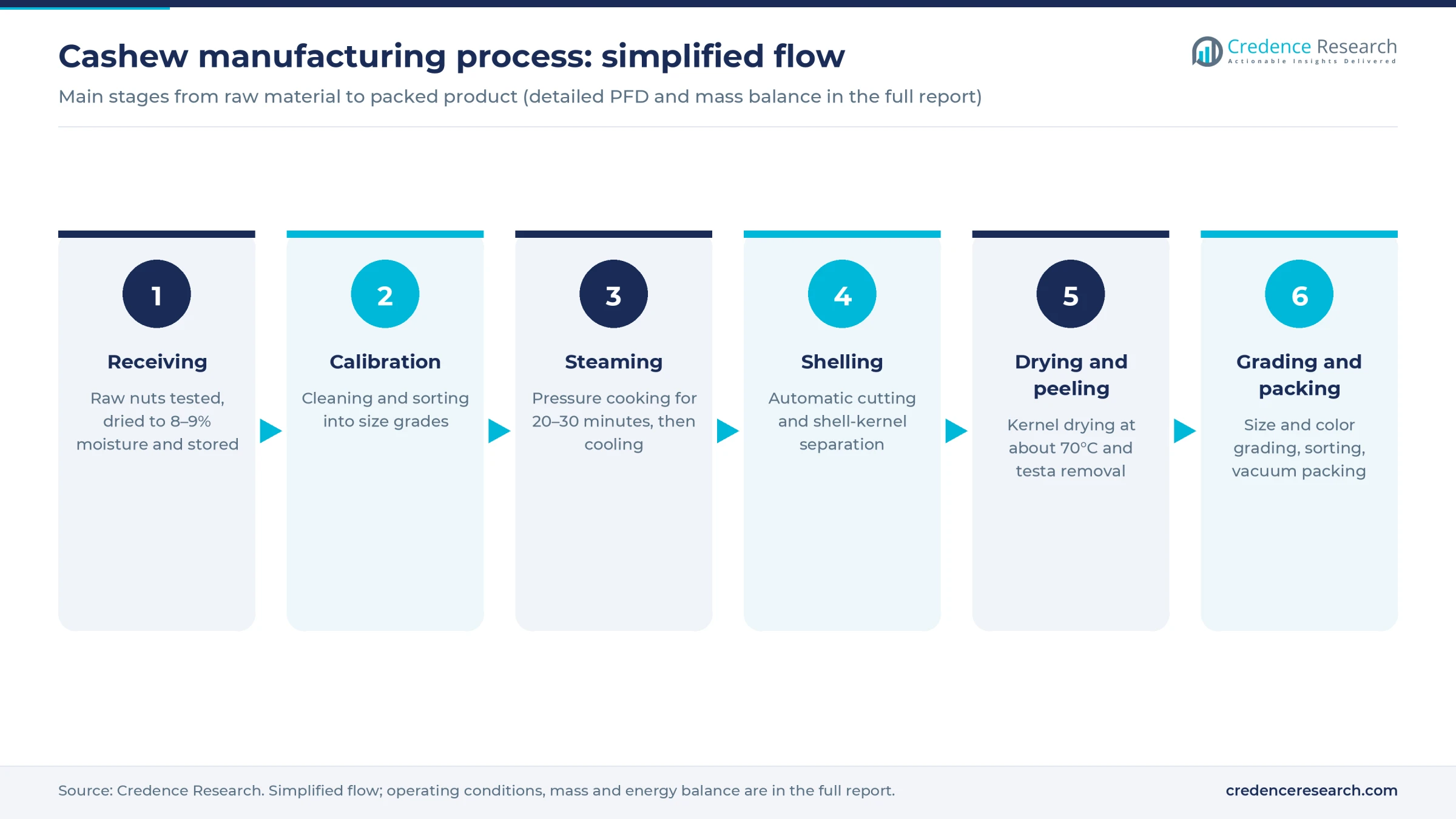
A cashew plant runs year-round on nuts bought in a short harvest window, so drying and storage come before any shelling.
- Receiving, drying and storage. Raw nuts are sampled for moisture and outturn, sun- or machine-dried to about 8–9% moisture and stored in jute bags in ventilated warehouses for up to a year.
- Cleaning and calibration. Nuts are cleaned of stones and debris and sorted into four to six size grades so that shelling blades match each nut.
- Steam conditioning. Each grade is steamed in pressure cookers fed by a shell-fired boiler for about 20–30 minutes, then cooled, which makes the shell brittle and limits shell liquid contamination of the kernel. Some plants use drum roasting instead.
- Shelling and separation. Automatic cutting machines or hand-pedal cutters split the shell, and vibrating screens and air separators pull kernels from shell pieces.
- Kernel drying and peeling. Kernels are dried at about 70°C for several hours to loosen the testa, humidified briefly to prevent breakage, then peeled by compressed-air machines, with workers finishing stubborn pieces by hand.
- Grading, sorting and packing. Kernels are graded by size and color, passed through optical sorters and metal detectors, and packed in vacuum or carbon dioxide-flushed tins or laminated bags, typically 50 pounds (22.68 kilograms) each.
Profitability rests on two figures, starting with outturn, measured in the trade as kernel output ratio, or pounds of kernel per 80-kilogram bag of raw nuts. Good West African and Cambodian lots test about 46–52 pounds, and actual plant recovery typically lands at 22–26% of raw nut weight after process losses. The second is the share of whole kernels, since splits and pieces sell at a deep discount to W240 and W320 wholes. Shells, about two-thirds of raw nut weight, fuel the boiler and kernel dryers or feed a shell liquid expeller supplying the cashew nutshell liquid market. Workers handling shells need gloves, because the liquid causes chemical burns.
Cashew processing plant setup cost
The cost model assumes a semi-automated plant that processes 10,000 tons of raw cashew nuts a year, running about 300 days at 85% utilization, or 8,500 tons. At 24% kernel recovery, that yields about 2,040 tons of kernels. Total project cost is estimated at USD 6–15 million for a greenfield site with a West African or South Asian cost basis, including a working capital margin. Sites in Vietnam's southern industrial parks, the EU or the U.S. cost more.
The range is anchored on disclosed costs of real plants. Valency International's 45,000-ton-a-year plant at Attinguié in Côte d'Ivoire, opened in January 2025, cost about 24 billion CFA francs, or roughly USD 40 million. Scaled down to 10,000 tons with a standard 0.65 capacity exponent, that points to about USD 15 million. Robust International's USD 20 million facility for a 15,000-ton plant at Toumodi scales to a similar figure, while a USD 7.48 million construction tranche for a 30,000-ton plant in Lagos points to leaner builds at the low end.
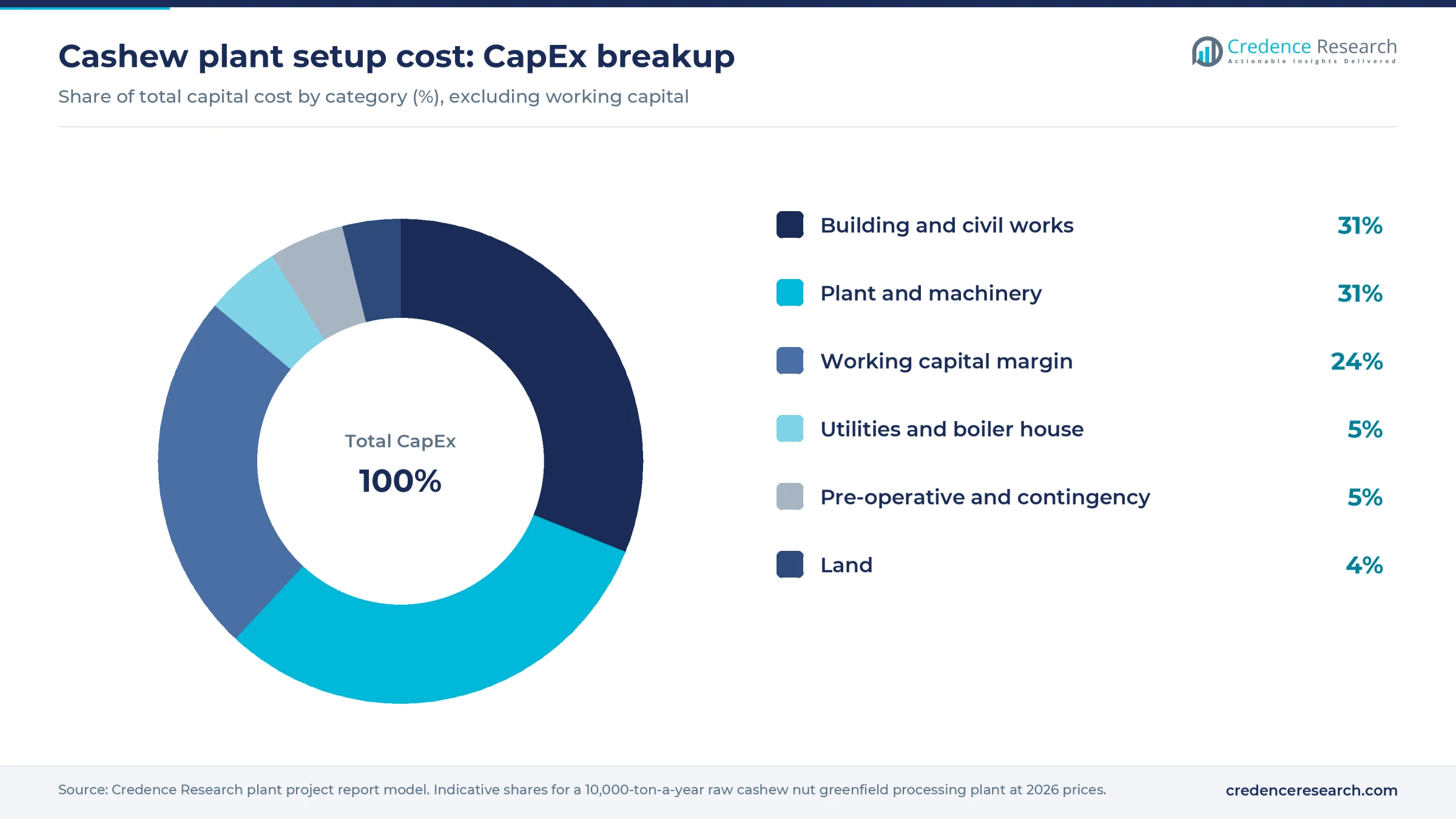
Buildings and civil works, led by raw nut warehouses, and plant and machinery take about 31% of CapEx each, working capital margin 24%, utilities and pre-operative costs 5% each, and land 4%.
Worked example, land: the plant needs about 3 hectares for a raw nut drying yard, warehouses holding up to half a year's nuts, a processing hall of about 4,000 square meters, a boiler house and truck access. At assumed industrial land rates of USD 5–20 per square meter, land costs USD 150,000–600,000. Serviced plots in Vietnamese or Indian industrial parks can cost several times more.
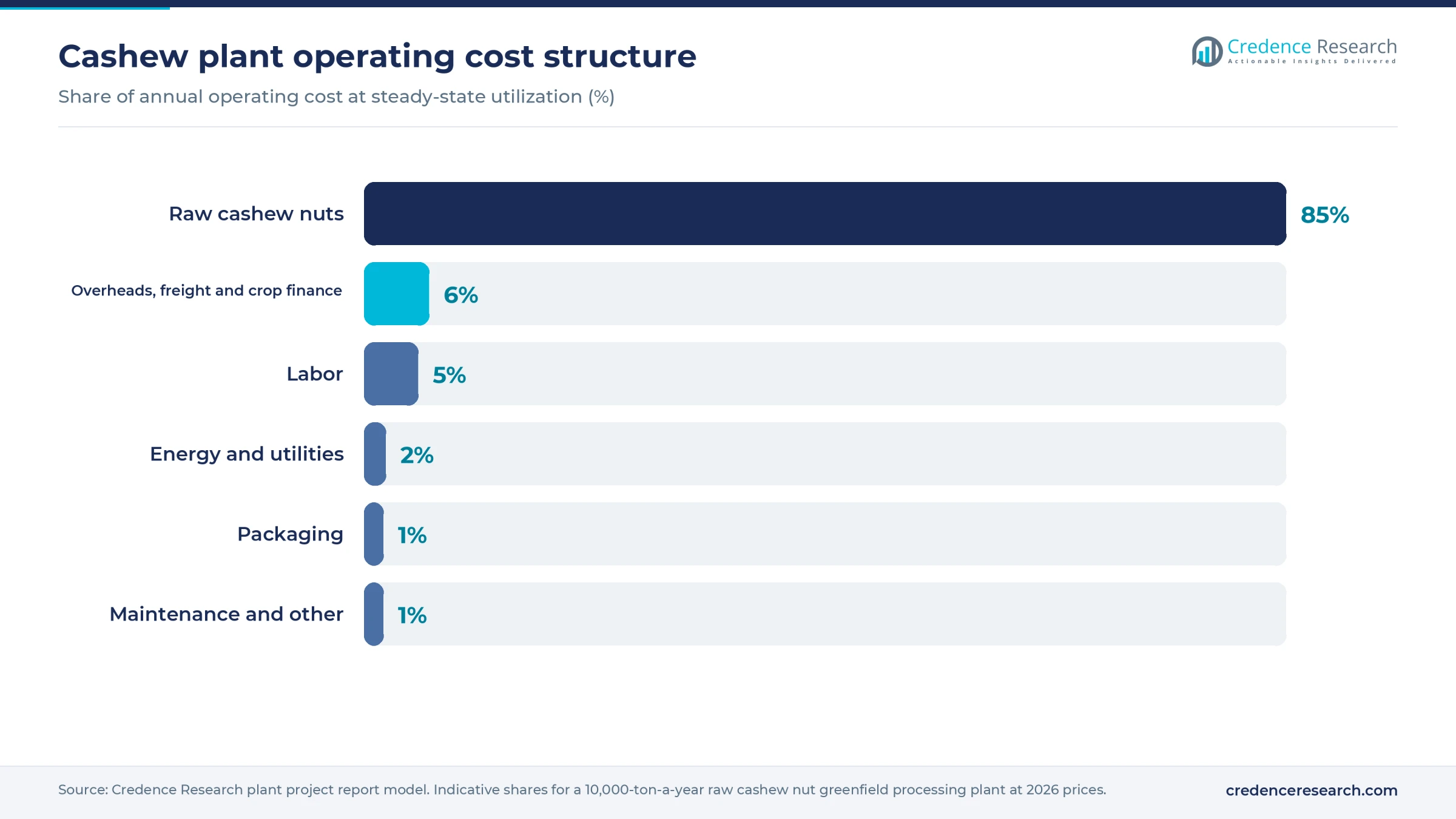
Raw nuts dominate operating cost at about 82–87% of the total. Overheads, freight and crop finance take about 6%, labor 5%, energy and utilities 2%, and packaging and maintenance 1% each. Because most nuts must be bought within three to four months, the plant needs seasonal crop finance well beyond the working capital margin in CapEx. In the Lagos deal, Afreximbank paired the construction tranche with a USD 13.25 million working capital line.
Machinery and raw materials for a cashew processing plant
Main equipment for a 10,000-ton-a-year plant includes the following items.
- Moisture meters, a drying yard or mechanical dryer, pre-cleaner and size calibrator
- Shell-fired steam boiler and batch pressure cookers with cooling conveyors
- Automatic shelling machines, shell and kernel separators and vibrating screens
- Hot-air kernel dryers, a humidification chamber and pneumatic peeling machines
- Size grading machines, optical color sorters and hand-sorting tables
- Metal detector, vacuum or carbon dioxide-flush packing station and a fumigation area
- Optional shell liquid expeller and shell cake handling
Automation levels and machine options are compared in the cashew processing machine market report. Most automatic shelling and peeling lines are built in Vietnam and India.
Raw nuts come from three main belts. West Africa, led by Côte d'Ivoire, Nigeria, Guinea-Bissau, Benin, Ghana and Burkina Faso, harvests from about February to June. Cambodia, India and Vietnam harvest from February to May. Tanzania and Mozambique in East Africa harvest from October to January, while Brazil adds a smaller crop late in the year. Buying from both hemispheres cuts storage time, but an origin plant usually relies on local farmers and cooperatives and carries stock for most of the year.
Cashew processing business profit margin and ROI
Gross margin is estimated at 8–22% at 85% utilization. The base case buys raw nuts at an assumed USD 1,120–1,250 per ton delivered to an origin plant, built up from Côte d'Ivoire's 2026 minimum farmgate price of 400 CFA francs per kilogram, about USD 710 per ton, plus collection, transport and competition from raw nut exporters. Blended kernels are assumed to sell at USD 6,200–6,300 per ton, below the February 2026 Vietnam export quote of USD 6,850 per ton for WW320 because broken grades sell lower. Shells add a small income as fuel. At Vietnam's 2025 average import price of about USD 1,490 per ton, the same plant would earn little at these kernel prices, which is why import-based processors depend on scale, automation and careful buying.
Payback is estimated at 6–11 years, based on steady-state cash profit of about USD 1–1.7 million after overheads, crop finance and tax against mid-range CapEx. Sensitivity: a USD 50 per ton rise in the raw nut price, if not passed on to kernel buyers, cuts gross margin by about 3 percentage points, and seasons with a thin spread can push payback well past 12 years. Processing incentives offered by some origin governments can shorten it.
| Metric | Value |
|---|---|
| IRR (post-tax) | Available in report |
| NPV | Available in report |
| ROI | Available in report |
| DSCR | Available in report |
| Break-even utilization | Available in report |
How to start a cashew processing business, licenses and approvals
A cashew processing plant typically needs the following approvals in most markets.
- Business registration and tax registration
- Land use or zoning clearance, building permit and fire safety approval, plus boiler registration and inspection
- Environmental permit or impact assessment covering boiler smoke, shell liquid handling and shell waste
- Factory and occupational safety license, with protective equipment for workers handling caustic shell liquid
- Food business registration or license, a HACCP-based food safety plan and, for export buyers, GFSI-benchmarked certification such as BRCGS, IFS or FSSC 22000
- Export registration, phytosanitary certificates or import permits for raw nuts, and compliance with aflatoxin and allergen labeling rules in destination markets
Examples by market:
| Market | Sector and food safety | Trade and other |
|---|---|---|
| Côte d'Ivoire | Approval (agrément) from the Conseil du Coton et de l'Anacarde for operators marketing cashew products abroad, under Decree No. 2013-810 | Prior export authorization from the council for each shipment; environmental impact assessment approved by the national environment agency (ANDE) |
| India | FSSAI license under the Food Safety and Standards Act, 2006 | Registration-cum-membership certificate from the cashew Export Promotion Council of India for kernel exporters; plant quarantine import permit for raw nuts under the Plant Quarantine Order, 2003; state pollution control board consent |
| European Union | Food business operator registration under Regulation (EC) No 852/2004 for roasting or packing plants | Aflatoxin limits for nuts under Regulation (EU) 2023/915; tree nut allergen labeling under Regulation (EU) No 1169/2011 |
Several origin countries offer tax holidays or processing incentives, so the full report checks incentives country by country.
Key cashew processors and recent developments
The industry mixes multinational ingredient groups, large Vietnamese and Indian exporters and a growing number of African plants.
- ofi (olam food ingredients) runs cashew processing in Vietnam and Côte d'Ivoire.
- Intersnack cashew Company runs processing in Vietnam for the Intersnack group.
- Long Son and Hoang Son are among Vietnam's large kernel exporters.
- Valency International runs Singapore-backed plants in Côte d'Ivoire, where Singapore-based Robust International is building its first plant.
- Gebana processes organic and fair-trade cashews in Burkina Faso.
- Indian processors such as Kalbavi cashews supply domestic and export buyers.
Recent developments:
- August 2026: Robust International secured a USD 20 million debt facility, backed by a GuarantCo guarantee, for a greenfield 15,000-ton-a-year plant at Toumodi in Côte d'Ivoire and new aggregation warehouses, with about 510 jobs expected.
- August 2026: Nigeria's Cardinal Torch Company announced a 4.5 billion naira, or about USD 3 million, cashew factory at Sagamu in Ogun State, starting at 10 tons a day, with commissioning targeted for the first quarter of 2027.
- June 2026: Gebana Faso commissioned a 10,000-ton-a-year cashew and dried mango complex in Burkina Faso, built with Vietnamese processing technology and supplied by about 7,200 local producers.
What's inside the Cashew project report PDF
The report runs to 21 chapters. Open a chapter to see its sections.
1. Preface
2. Scope and Methodology
- 2.1 Objectives of the Study
- 2.2 Stakeholders
- 2.3 Research Methodology
- 2.4 Data Sources and Key Assumptions
3. Executive Summary
- 3.1 Market Snapshot
- 3.2 Project at a Glance (Capacity, CapEx, OpEx)
- 3.3 Key Financial Indicators (IRR, NPV, Payback, Break-even)
- 3.4 Feasibility Verdict
4. Product Overview
- 4.1 Cashew Definition and Properties
- 4.2 Grades and Specifications (BIS / ISO / ASTM)
- 4.3 HS Code and Classification
- 4.4 Key Applications
- 4.5 Substitutes
5. Global Cashew Market
- 5.1 Market Overview
- 5.2 Historical and Current Market Performance (Volume and Value)
- 5.3 Market Breakup by Grade / Type
- 5.4 Market Breakup by End-Use Industry
- 5.5 Market Breakup by Region
- 5.6 Market Drivers, Restraints and Trends
- 5.7 Value Chain Analysis
- 5.8 Market Forecast
6. Target Country Cashew Market Analysis
- 6.1 Demand and Supply Analysis
- 6.2 Installed Capacity vs Demand Gap
- 6.3 Import Dependence
- 6.4 Demand Forecast by End-Use
7. Trade Analysis
- 7.1 Imports by Volume, Value and Country
- 7.2 Exports by Volume, Value and Country
- 7.3 Trade Balance and Opportunities
8. Price Analysis
- 8.1 Historical Cashew Price Trends by Region
- 8.2 Raw Material / Feedstock Price Trends and Linkage
- 8.3 Price Forecast
- 8.4 Margins Across the Value Chain
9. Competitive Landscape
- 9.1 Market Structure
- 9.2 Key Players and Installed Capacities
- 9.3 Profiles of Key Players
- 9.4 Recent Developments (Expansions, M&A, New Plants)
10. Manufacturing Process and Technology
- 10.1 Comparison of Technology Routes
- 10.2 Selected Route and Process Flow Diagram
- 10.3 Unit Operations Involved
- 10.4 Chemical Reactions Involved
- 10.5 Mass Balance and Raw Material Requirements
- 10.6 Energy Balance
- 10.7 Quality Assurance Criteria and Technical Tests
- 10.8 By-products and Waste Handling
- 10.9 Technology Licensors / Providers
11. Project Details, Requirements and Costs
- 11.1 Land, Location and Site Development
- 11.1.1 Site Selection Criteria
- 11.1.2 Location Analysis
- 11.1.3 Land Requirement and Costs
- 11.1.4 Site Development Costs
- 11.2 Plant Layout
- 11.2.1 Layout Principles
- 11.2.2 Proposed Layout
- 11.2.3 Factors Influencing Layout
- 11.3 Civil Works and Buildings
- 11.4 Plant Machinery
- 11.4.1 Machinery Requirements and Specifications
- 11.4.2 Machinery Costs
- 11.4.3 Machinery Suppliers
- 11.5 Raw Materials
- 11.5.1 Requirements per Tonne of Output
- 11.5.2 Procurement and Sourcing
- 11.5.3 Costs
- 11.5.4 Suppliers
- 11.6 Packaging
- 11.6.1 Packaging Requirements
- 11.6.2 Packaging Costs
- 11.6.3 Packaging Suppliers
- 11.7 Storage and Material Handling
- 11.8 Transportation Requirements and Costs
- 11.9 Utilities
- 11.9.1 Power Requirements and Costs
- 11.9.2 Water Requirements and Costs
- 11.9.3 Steam, Fuel and Other Utilities
- 11.10 Manpower Requirements and Wages
12. Environment, Health, Safety and Sustainability
- 12.1 Effluent and Emissions Management
- 12.2 Hazard Classification and Safety Measures
- 12.3 Carbon Footprint
- 12.4 Green / Low-Carbon Process Options
13. Regulatory Procedures, Approvals and Certifications
- 13.1 Licences and Registrations
- 13.2 Environmental Clearances
- 13.3 Product Certifications (BIS, REACH, etc.)
- 13.4 Approval Timeline
14. Project Implementation Schedule
15. Project Economics
- 15.1 Capital Cost of the Project
- 15.2 Techno-Economic Parameters
- 15.3 Capacity Utilization and Ramp-up
- 15.4 Product Pricing and Margins
- 15.5 Income Projections
- 15.6 Expenditure Projections
- 15.7 Working Capital Requirement
- 15.8 Taxation
- 15.9 Depreciation
16. Financial Analysis
- 16.1 Projected Profit and Loss Account
- 16.2 Projected Cash Flow Statement
- 16.3 Projected Balance Sheet
- 16.4 Liquidity Analysis
- 16.5 Profitability Analysis (Payback, NPV, IRR, ROI)
- 16.6 Break-even Analysis
- 16.7 Debt Service Coverage Ratio (DSCR)
- 16.8 Sensitivity Analysis
- 16.9 Scenario and Uncertainty Analysis
17. Funding and Incentives
- 17.1 Means of Finance and Debt-Equity Structure
- 17.2 Loans and Financial Assistance
- 17.3 Government Schemes and Subsidies (PLI, State Policies)
18. Risk Assessment
- 18.1 Key Success Factors
- 18.2 Key Risk Factors
- 18.3 Risk Mitigation
19. Strategic Recommendations
20. Case Study of a Successful Venture
21. Appendix
- 21.1 Detailed Assumptions
- 21.2 Abbreviations
- 21.3 List of Tables and Figures
- 21.4 Sources
This page vs. the full report
| Data point | On this page (free) | In the full report |
|---|---|---|
| Total CapEx | One rounded range at one capacity | Exact figure at three capacities with a line-item breakup |
| CapEx breakup | Category shares (%) only | Cost, quantity and supplier for every machine |
| Operating cost | Share of raw materials, utilities and labor | Per-unit cost sheet with each input price and consumption |
| Profitability | Gross margin range and payback band | Exact IRR, NPV, ROI, break-even and DSCR |
| Financial statements | List of what is included | 10-year P&L, cash flow, balance sheet and Excel model |
| Sensitivity | One directional line | Full sensitivity and scenario tables |
| Process | Simplified flow diagram | Detailed process flow, mass and energy balance, operating conditions |
| Machinery | Names of the main machines | Specifications, capacity, cost and supplier list |
| Market | Headline size, growth and global demand | Segment, region, trade and price forecast tables |
| Suppliers and buyers | Supplier types and sourcing hubs | Named suppliers and buyers |
Cashew project report: FAQs
How much does it cost to set up a cashew processing plant?
What is the profit margin in cashew processing?
What is cashew outturn and why does it matter?
Why are raw cashew nuts steamed before shelling?
Which licenses are needed to start a cashew processing business?
Where are the best locations for a cashew processing plant?
What is the payback period for a cashew processing plant?

About the analyst
Priyanka Mor, Senior Consultant
Senior Consultant at Credence Research Inc directing strategic market advisory, cross-border commercial due diligence and enterprise intelligence frameworks for global B2B clients. Combines quantitative modeling with executive advisory, translating macroeconomic variables and supply chain data into go-to-market blueprints, M&A screenings and competitive war-gaming strategies.
Related market research
- Cashew Market Size, Share, Analysis, Growth and Forecast 2032
- Cashew Kernel Market Size, Share, Growth and Forecast 2032
- Cashew Processing Machine Market Size, Share and Forecast 2032
- Cashew Nutshell Liquid Market Size, Share and Forecast 2032
- Organic Cashew Nuts Market Size, Trends, Share & Forecast 2032
More plant project reports
- Green Beans Processing Plant Project Report (DPR) 2026
- Peanut Butter Manufacturing Plant Project Report (DPR) 2026
- Banana Powder Manufacturing Plant Project Report (DPR) 2026
- Instant Noodles Manufacturing Plant Project Report (DPR) 2026
- Ginger Processing Plant Project Report (DPR) 2026
- Pre Packaged Soup Manufacturing Plant Project Report (DPR) 2026