
Quick answer
A banana powder plant peels, slices and gently dries green bananas, or dries ripe puree, then mills the product into a fine flour. This overview models a greenfield plant making 1,500 tonnes a year, with estimated CapEx of USD 2–6 million by build standard and region. Gross margin is estimated at 15–35% on an assumed bulk price of USD 2.0–2.8 per kg, with payback at 4–10 years. Cheap reject fruit and steady yields decide returns.
Viable for a processor tied to a steady stream of low-cost reject or contract fruit that sells graded, food-safety-certified flour; a plant buying export-grade bananas at market prices is unlikely to cover its modeled costs.
Banana Powder plant: key highlights
| Parameter | Indicative value | Note |
|---|---|---|
| Plant capacity | 1,500 tonnes of finished product per year | About 6 tonnes a day over 250 operating days, using 8,250–10,500 tonnes of fresh green bananas at full capacity |
| Total CapEx | USD 2–6 million | Greenfield; low end a basic belt-dryer build in a low-cost region, high end an export-grade plant; U.S. or EU sites may exceed it; excludes working capital |
| Raw material share of operating cost | 35–45% | Modeled at 5.5–7 kg of fresh fruit per kg of flour, using assumed reject-grade prices |
| Gross margin | 15–35% | At an assumed USD 2.0–2.8 per kg bulk price and a modeled unit cost of USD 1.4–1.9 per kg |
| Payback period | 4–10 years | From commissioning at 80% utilization; low-price and high-CapEx pairings fall outside this band |
| IRR | Available in report | Post-tax, 10-year model |
| Break-even | Available in report | Capacity utilization basis |
Ranges assume a 1,500 tonnes-per-year greenfield plant making mainly green banana flour, 250 operating days, 80% utilization and 2026 prices. The bulk price of USD 2.0–2.8 per kg, fruit at USD 0.07–0.11 per kg and land rates are assumed. Conversions use assumed rates of 90 rupees, 129 Kenyan shillings and 3,700 Ugandan shillings per USD. CapEx is scaled from published benchmarks and excludes working capital. The full report can be customized to any country or region.
What is banana powder?
Banana powder is a dry, shelf-stable ingredient made from the pulp, and sometimes the peel, of Musa fruit. Two distinct forms reach the market.
Green banana flour comes from unripe fruit that is peeled, sliced, dried at low temperature and milled. It is mostly starch, a large part of it resistant starch, and tastes mild and slightly earthy. Bakers use it in gluten-free bread, pasta and pancakes, supplement makers sell it as a gut-health fiber, and texture suppliers use it to replace gums or modified starch. Ripe banana powder starts as sweet puree that is drum dried, spray dried or freeze dried, often with a carrier such as maltodextrin. It flavors infant cereals, smoothies, dairy desserts and confectionery.
Buyers judge lots on moisture, particle size, color, resistant starch or sugar content, microbial counts and sulfite residues. Plain banana flour and powder fall under Harmonized System subheading 1106.30, which covers flours of the fruits and nuts in Chapter 8, and the U.S. tariff schedule separates banana and plantain at 1106.30.20. Blends with added carriers or sugar may classify elsewhere.
Banana powder market overview and global demand
Credence Research values the global banana flour market at about USD 1.13 billion in 2025, based on its USD 1.06 billion for 2024 and a 6.73% CAGR to 2032. Its separate green banana flour study sizes that narrower segment at USD 676.2 million in 2024, growing 4.6% a year. Both sit inside a far larger fruit powders market, put at USD 19.0 billion in 2024.
Raw fruit is plentiful worldwide, and FAO says the Cavendish variety alone yields about 50 million tonnes a year, just under half of world output, and that India and China are the largest producers, mostly for home consumption. FAO reported world exports of 21.7 million tonnes in 2025, up 10%, led by Ecuador at 6.5 million tonnes, then the Philippines, Colombia, Guatemala and Costa Rica. Export packhouses reject fruit that is undersized, scarred or misshapen. When Givaudan and Dole Asia Holdings launched an upcycled green banana powder in February 2025, they cited an estimated 30–40% of bananas wasted worldwide for missing quality standards. That reject stream is the cheapest feedstock a flour plant can find.
Trade statistics are a weak guide. Subheading 1106.30 also holds almond, hazelnut and coconut flours, which helps explain why Spain, the U.S. and Turkey led its 2024 exports.
Premium demand sits in North America, Western Europe, Japan and Australia, where gluten-free, fiber and upcycled claims carry price premiums. In producing countries the flour goes mainly into porridge, weaning foods and local baking.
Banana powder manufacturing process
Most new plants make green banana flour, because it uses cheaper fruit and simpler drying than ripe powder. The sequence below follows that route. Speed matters throughout, since a green banana starts converting starch to sugar as soon as it begins to ripen.
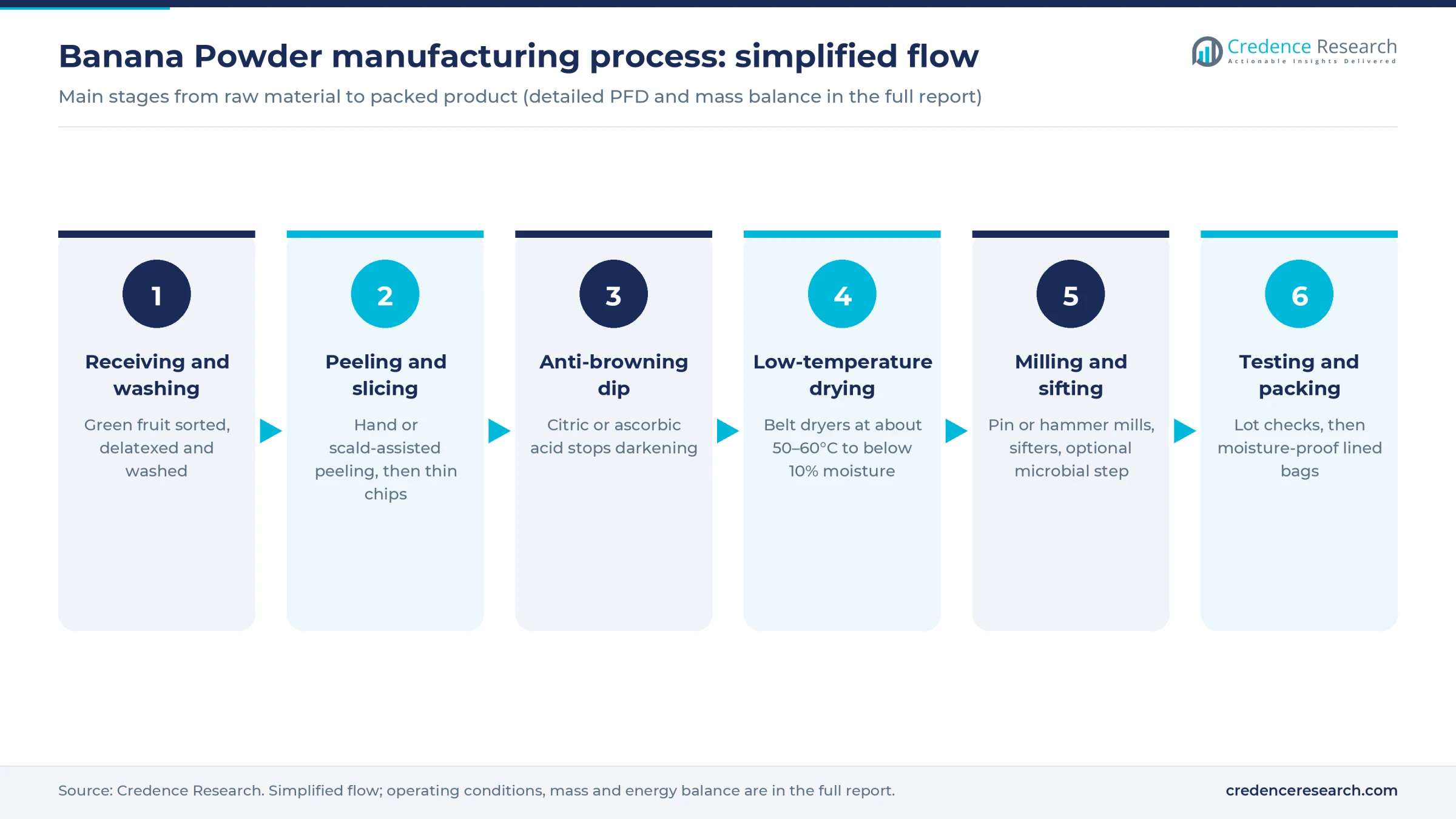
- Receiving and washing. Hands or clusters at full green maturity are weighed, washed to remove latex and field soil, and sorted.
- Peeling and slicing. Green peel clings to the pulp and resists simple machines, so many plants peel by hand or loosen skins with a short steam or hot-water scald. Some mill whole fruit, peel included, for a higher-fiber grade. Slicers then cut chips a few millimeters thick.
- Anti-browning dip. Cut pulp darkens within minutes as enzymes react with air, so slices go straight into citric or ascorbic acid solution. Sodium metabisulfite works too, but sulfites at about 10 mg per kg or more must be declared in the U.S. and EU, and many buyers refuse them.
- Low-temperature drying. Belt or cabinet dryers take chips to below about 10% moisture. Air is held moderate, typically 50–60°C, because heating wet starch past its gelatinization point destroys the resistant starch buyers pay for.
- Milling and sifting. Hammer or pin mills grind chips, sifters set the particle size, and export lots may pass through a validated microbial reduction step.
- Testing and packing. Each lot is checked for moisture, color, microbes and metal, then packed in lined bags that keep out humidity.
Yield drives the economics, and a 2023 feasibility study at Ecuador's ESPOL university recorded flour yields of 18% with peel and 14% without, or about 5.6–7.1 kg of fresh fruit per kg of flour. This overview models 5.5–7 kg. Ripe powder follows a different path, with puree pasteurized and then drum or spray dried. Its natural sugars make the powder sticky and quick to absorb moisture, so it needs a carrier, dehumidified packing rooms and more costly drying equipment.
Banana powder plant setup cost
This overview models a greenfield plant making 1,500 tonnes of banana flour a year, about 6 tonnes a day, at an estimated total CapEx of USD 2–6 million. Few banana flour plants disclose costs, so the range rests on small published benchmarks, scaled with a 0.7 power rule.
The low end draws on two profiles. The ESPOL study put total investment at about USD 171,000 for a plant turning 1 tonne of bananas a day into about 53 tonnes of flour a year, which scales to about USD 1.9 million after an assumed 8% escalation. An Indian food research institute profile for a 100 kg-a-day raw banana powder unit lists about 11.4 million rupees, which scales to about USD 2.2 million. Both extrapolate across a wide size gap.
The high end, USD 6 million, is an assumed allowance for an export-grade build with hygienic zoning, microbial reduction, effluent treatment and backup power. Public projects show how far costs can swing. A Kenyan county plant handling 80 tonnes of fruit a day cost 158 million shillings, about USD 1.2 million, on public land. Uganda's banana research center has absorbed more than 200 billion shillings over two decades.
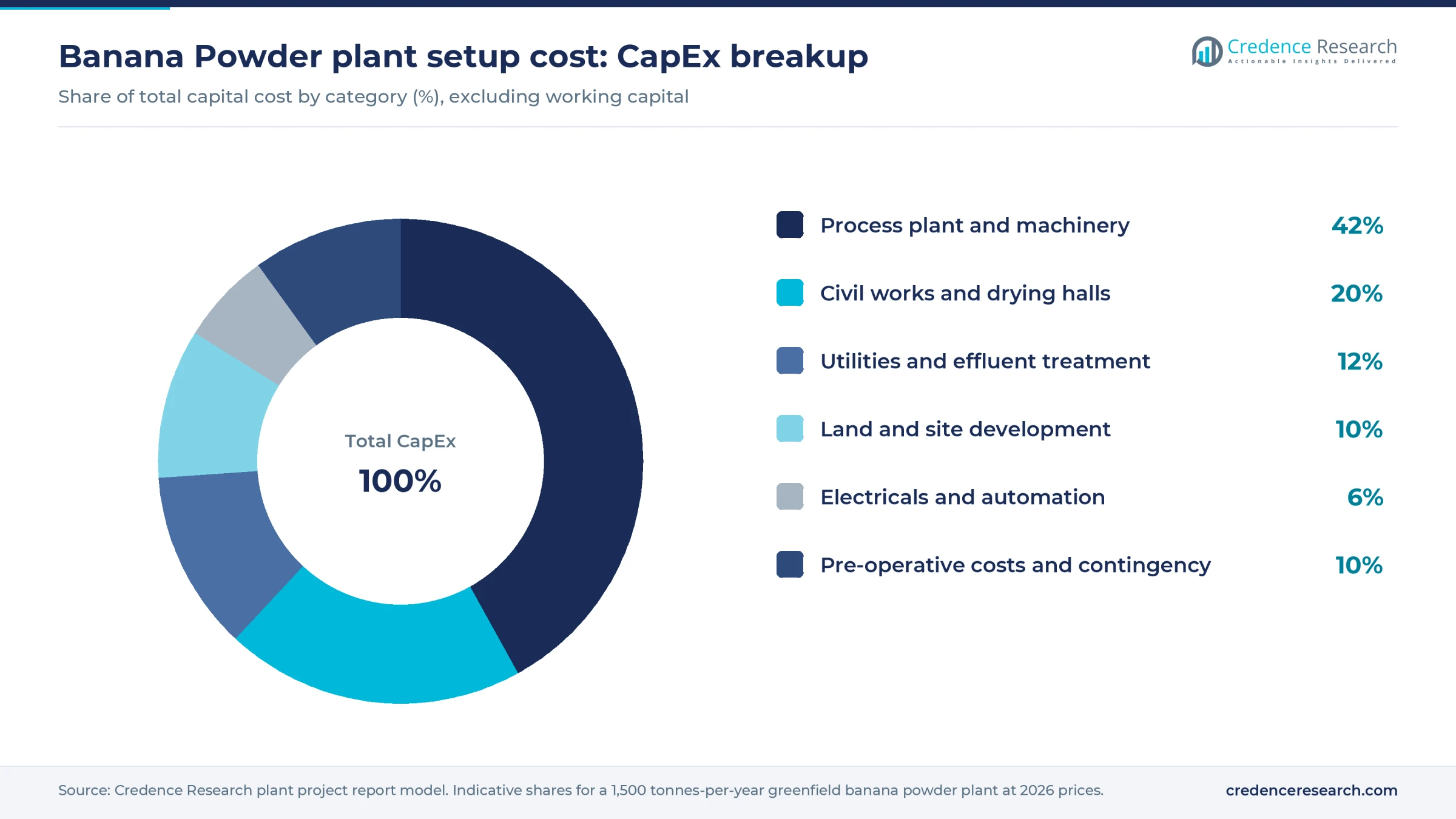
Worked example, land and site development. The plant needs an assumed 8,000–12,000 square meters, including fruit receiving, drying halls and an effluent plant. At an assumed USD 15–40 per square meter in an Asian or African industrial park, the plot costs about USD 120,000–480,000. At an assumed USD 30–80 at a U.S. or EU site, it costs about USD 240,000–960,000. Site works add an assumed USD 50,000–150,000, so this row usually runs 8–12% of CapEx.
Working capital adds an estimated USD 0.4–0.8 million. Bananas fruit year-round, so stocks stay lighter than at plants that buy a single harvest.
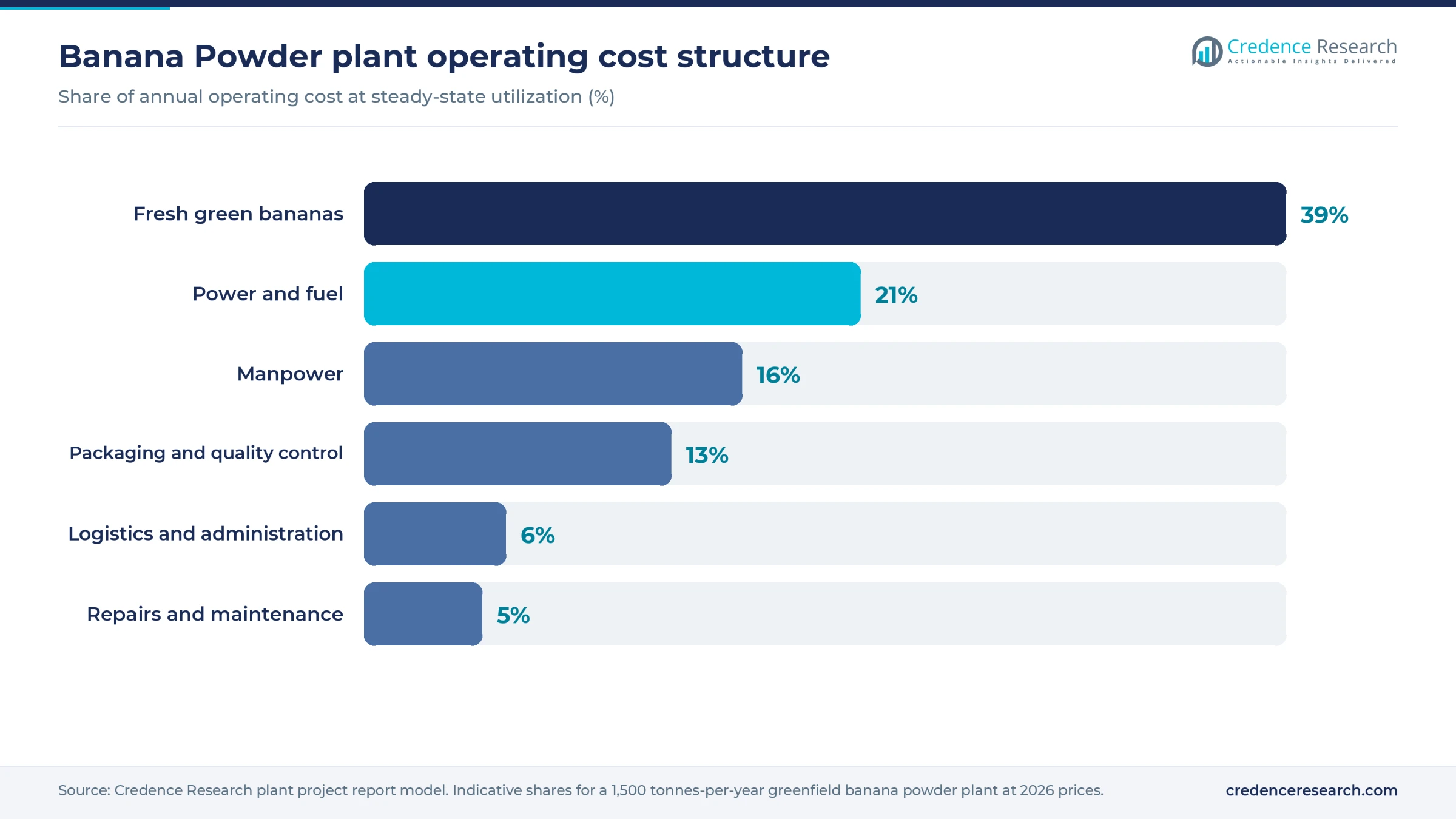
Fresh fruit is the largest operating cost, with drying energy and peeling labor next.
Machinery and raw materials for a banana powder plant
The main machinery groups are listed below; capacities, specifications and quotations are available in the report.
- Receiving: crate dumpers, dehanding tables, bubble washers and inspection conveyors
- Preparation: steam or hot-water scalders, peeling stations, slicers and acid dip tanks
- Drying: multi-tier belt dryers or cabinet dryers, heat exchangers and humidity control
- Finishing: hammer or pin mills, vibrating sifters, metal detectors and bag fillers
- Ripe powder option: pulpers, pasteurizers and drum or spray dryers
- Utilities and quality: boiler or biomass heater, water treatment, effluent plant and a laboratory
The only bulk raw material is fresh fruit, and siting near it is essential, as bananas are mostly water and bruise in transit. Ecuador, Colombia, Central America and the Philippines offer large volumes of export rejects. India, China, Indonesia and Brazil grow mainly for domestic markets, while Uganda and the wider Great Lakes region grow cooking bananas such as matooke. Plants also buy acids, packaging and fuel, and peels can go to compost, feed or biogas.
Disease is the main supply risk. FAO says Fusarium Tropical Race 4, which kills Cavendish plants and persists in soil, has been confirmed in 21 producing countries. A plant tied to one district should contract several growers and keep a second sourcing area in view.
Banana powder business profit margin and ROI
For the modeled plant, gross margin after fruit and direct conversion costs is estimated at 15–35%, at an assumed bulk price of USD 2.0–2.8 per kg. Payback runs 4–10 years after commissioning, with the short end needing a basic build and firm prices. The modeled unit cost is USD 1.4–1.9 per kg, with fruit at an assumed USD 0.07–0.11 per kg and drying energy the second-largest cost.
The assumed price sits below recent trade signals on purpose. Recent Ecuadorian export shipments have averaged roughly USD 3–6 per kg, and retail packs in the ESPOL study were priced near USD 6 per kg. Organic and high resistant starch grades can earn well above the modeled range.
At 1,200 tonnes sold, revenue of about USD 2.4–3.4 million supports gross profit of about USD 0.36–1.2 million, before assumed overheads of USD 0.15–0.3 million. Fruit price is the sharpest risk. Ecuador's 2026 minimum price of USD 7.50 per 18.14 kg box is about USD 0.41 per kg, so a plant forced to buy export-grade fruit would add about USD 2 per kg of flour and lose money. Yield is the next lever, with each extra kg of fruit per kg of flour cutting margin by about 4 percentage points.
| Metric | Value |
|---|---|
| Project IRR (post-tax) | Available in report |
| NPV | Available in report |
| Return on investment | Available in report |
| DSCR | Available in report |
| Break-even utilization | Available in report |
How to start a banana powder business, licenses and approvals
A banana powder plant needs approvals in six areas wherever it is built. These are business and tax registration; land use, zoning and building permits; an environmental permit covering wash water, peel waste and dryer emissions; occupational safety approvals, including dust controls in milling; food facility registration with a written food safety plan; and customs registration for export. Ingredient buyers commonly require FSSC 22000 or BRCGS certification, and organic lines need separate certification for each destination.
| Market | Food and product | Environment and safety |
|---|---|---|
| United States | FDA food facility registration and preventive controls under 21 CFR 117; importers must meet FDA's Foreign Supplier Verification Program; sulfites of 10 ppm or more must be declared | State air permit for dryer burners; NPDES or local pretreatment permit for wash water; OSHA rules, including combustible dust |
| European Union | Food business registration under Regulation (EC) No 852/2004; traceability under Regulation (EC) No 178/2002; pesticide limits under Regulation (EC) No 396/2005 | National environmental permit and water discharge consent; ATEX rules for explosive dust atmospheres |
| India | FSSAI central license, required for exporters; importer-exporter code from DGFT; APEDA registration for processed fruit exports | State pollution control board consents to establish and operate; factory license under state rules |
Low-moisture flours can carry Salmonella if wash water or handling is poor, so buyers often test lots on arrival. A plant should validate its sanitation and any microbial reduction step before its first export order.
Key banana powder manufacturers and recent developments
The industry is fragmented, with no producer of global scale. Dole Specialty Ingredients, part of Singapore-based Dole Asia Holdings, makes green banana powder from upcycled fruit, which Givaudan distributes in key European and American markets. International Agriculture Group sells NuBana green banana flour with at least 65% resistant starch. Natural Evolution in Queensland, Australia, turns rejected fruit into flour, and Uganda's Banana Industrial Research and Development Centre (BIRDC) sells Tooke flour made from matooke. Many smaller processors operate in Ecuador, the Philippines, India and Indonesia.
- November 2025. BIRDC said it produces about 1.4 tonnes of dry banana flour a day and plans to automate toward 14 tonnes, aiming to export packaged premixes to the U.S., Europe and Asia.
- August 2026. PIBID, the program behind BIRDC, told the Daily Monitor that low regional banana output may not sustain its Bushenyi factory at full capacity, a warning for any plant that depends on a single growing district.
- October 2026. Kenya's Kisii County commissioned a banana flour plant built for 158 million shillings with European Union support, sized for about 80 tonnes of fruit a day. A private operator is to be contracted to run it.
What's inside the Banana Powder project report PDF
The report runs to 21 chapters. Open a chapter to see its sections.
1. Preface
2. Scope and Methodology
- 2.1 Objectives of the Study
- 2.2 Stakeholders
- 2.3 Research Methodology
- 2.4 Data Sources and Key Assumptions
3. Executive Summary
- 3.1 Market Snapshot
- 3.2 Project at a Glance (Capacity, CapEx, OpEx)
- 3.3 Key Financial Indicators (IRR, NPV, Payback, Break-even)
- 3.4 Feasibility Verdict
4. Product Overview
- 4.1 Banana Powder Definition and Properties
- 4.2 Grades and Specifications (BIS / ISO / ASTM)
- 4.3 HS Code and Classification
- 4.4 Key Applications
- 4.5 Substitutes
5. Global Banana Powder Market
- 5.1 Market Overview
- 5.2 Historical and Current Market Performance (Volume and Value)
- 5.3 Market Breakup by Grade / Type
- 5.4 Market Breakup by End-Use Industry
- 5.5 Market Breakup by Region
- 5.6 Market Drivers, Restraints and Trends
- 5.7 Value Chain Analysis
- 5.8 Market Forecast
6. Target Country Banana Powder Market Analysis
- 6.1 Demand and Supply Analysis
- 6.2 Installed Capacity vs Demand Gap
- 6.3 Import Dependence
- 6.4 Demand Forecast by End-Use
7. Trade Analysis
- 7.1 Imports by Volume, Value and Country
- 7.2 Exports by Volume, Value and Country
- 7.3 Trade Balance and Opportunities
8. Price Analysis
- 8.1 Historical Banana Powder Price Trends by Region
- 8.2 Raw Material / Feedstock Price Trends and Linkage
- 8.3 Price Forecast
- 8.4 Margins Across the Value Chain
9. Competitive Landscape
- 9.1 Market Structure
- 9.2 Key Players and Installed Capacities
- 9.3 Profiles of Key Players
- 9.4 Recent Developments (Expansions, M&A, New Plants)
10. Manufacturing Process and Technology
- 10.1 Comparison of Technology Routes
- 10.2 Selected Route and Process Flow Diagram
- 10.3 Unit Operations Involved
- 10.4 Chemical Reactions Involved
- 10.5 Mass Balance and Raw Material Requirements
- 10.6 Energy Balance
- 10.7 Quality Assurance Criteria and Technical Tests
- 10.8 By-products and Waste Handling
- 10.9 Technology Licensors / Providers
11. Project Details, Requirements and Costs
- 11.1 Land, Location and Site Development
- 11.1.1 Site Selection Criteria
- 11.1.2 Location Analysis
- 11.1.3 Land Requirement and Costs
- 11.1.4 Site Development Costs
- 11.2 Plant Layout
- 11.2.1 Layout Principles
- 11.2.2 Proposed Layout
- 11.2.3 Factors Influencing Layout
- 11.3 Civil Works and Buildings
- 11.4 Plant Machinery
- 11.4.1 Machinery Requirements and Specifications
- 11.4.2 Machinery Costs
- 11.4.3 Machinery Suppliers
- 11.5 Raw Materials
- 11.5.1 Requirements per Tonne of Output
- 11.5.2 Procurement and Sourcing
- 11.5.3 Costs
- 11.5.4 Suppliers
- 11.6 Packaging
- 11.6.1 Packaging Requirements
- 11.6.2 Packaging Costs
- 11.6.3 Packaging Suppliers
- 11.7 Storage and Material Handling
- 11.8 Transportation Requirements and Costs
- 11.9 Utilities
- 11.9.1 Power Requirements and Costs
- 11.9.2 Water Requirements and Costs
- 11.9.3 Steam, Fuel and Other Utilities
- 11.10 Manpower Requirements and Wages
12. Environment, Health, Safety and Sustainability
- 12.1 Effluent and Emissions Management
- 12.2 Hazard Classification and Safety Measures
- 12.3 Carbon Footprint
- 12.4 Green / Low-Carbon Process Options
13. Regulatory Procedures, Approvals and Certifications
- 13.1 Licences and Registrations
- 13.2 Environmental Clearances
- 13.3 Product Certifications (BIS, REACH, etc.)
- 13.4 Approval Timeline
14. Project Implementation Schedule
15. Project Economics
- 15.1 Capital Cost of the Project
- 15.2 Techno-Economic Parameters
- 15.3 Capacity Utilization and Ramp-up
- 15.4 Product Pricing and Margins
- 15.5 Income Projections
- 15.6 Expenditure Projections
- 15.7 Working Capital Requirement
- 15.8 Taxation
- 15.9 Depreciation
16. Financial Analysis
- 16.1 Projected Profit and Loss Account
- 16.2 Projected Cash Flow Statement
- 16.3 Projected Balance Sheet
- 16.4 Liquidity Analysis
- 16.5 Profitability Analysis (Payback, NPV, IRR, ROI)
- 16.6 Break-even Analysis
- 16.7 Debt Service Coverage Ratio (DSCR)
- 16.8 Sensitivity Analysis
- 16.9 Scenario and Uncertainty Analysis
17. Funding and Incentives
- 17.1 Means of Finance and Debt-Equity Structure
- 17.2 Loans and Financial Assistance
- 17.3 Government Schemes and Subsidies (PLI, State Policies)
18. Risk Assessment
- 18.1 Key Success Factors
- 18.2 Key Risk Factors
- 18.3 Risk Mitigation
19. Strategic Recommendations
20. Case Study of a Successful Venture
21. Appendix
- 21.1 Detailed Assumptions
- 21.2 Abbreviations
- 21.3 List of Tables and Figures
- 21.4 Sources
This page vs. the full report
| Data point | On this page (free) | In the full report |
|---|---|---|
| Total CapEx | One rounded range at one capacity | Exact figure at three capacities with a line-item breakup |
| CapEx breakup | Category shares (%) only | Cost, quantity and supplier for every machine |
| Operating cost | Share of raw materials, utilities and labor | Per-unit cost sheet with each input price and consumption |
| Profitability | Gross margin range and payback band | Exact IRR, NPV, ROI, break-even and DSCR |
| Financial statements | List of what is included | 10-year P&L, cash flow, balance sheet and Excel model |
| Sensitivity | One directional line | Full sensitivity and scenario tables |
| Process | Simplified flow diagram | Detailed process flow, mass and energy balance, operating conditions |
| Machinery | Names of the main machines | Specifications, capacity, cost and supplier list |
| Market | Headline size, growth and global demand | Segment, region, trade and price forecast tables |
| Suppliers and buyers | Supplier types and sourcing hubs | Named suppliers and buyers |
Banana Powder project report: FAQs
How much does it cost to set up a banana powder plant?
How many bananas are needed to make 1 kg of banana flour?
What profit margin can a banana powder plant earn?
What is the difference between green banana flour and ripe banana powder?
Which licenses does a banana powder plant need?
Where should a banana powder plant be located?
Who buys banana powder?

About the analyst
Priyanka Mor, Senior Consultant
Senior Consultant at Credence Research Inc directing strategic market advisory, cross-border commercial due diligence and enterprise intelligence frameworks for global B2B clients. Combines quantitative modeling with executive advisory, translating macroeconomic variables and supply chain data into go-to-market blueprints, M&A screenings and competitive war-gaming strategies.
Related market research
- Banana Flour Market Size, Share, Growth and Forecast 2032
- Green Banana Flour Market Size, Share & Growth Report 2032
- Fruit Powders Market Size, Growth, Share, Trends & Forecast 2032
- Resistant Starch Market Size, Share, Trends and Forecast 2032
- Freeze Dried Fruit Powder Market Size, Growth and Forecast 2032
- Baby Food Market Size, Share, Growth, Trend and Forecast 2032
More plant project reports
- Green Beans Processing Plant Project Report (DPR) 2026
- Peanut Butter Manufacturing Plant Project Report (DPR) 2026
- Instant Noodles Manufacturing Plant Project Report (DPR) 2026
- Cashew Processing Plant Project Report (DPR) 2026
- Ginger Processing Plant Project Report (DPR) 2026
- Pre Packaged Soup Manufacturing Plant Project Report (DPR) 2026