
Quick answer
An instant noodle plant mixes wheat flour with alkaline water, sheets and steams the dough, then fries or air-dries the noodle blocks and packs them with seasoning sachets. This overview models one high-speed fried line making 150 million packs a year, with estimated CapEx of USD 15–45 million depending on cost region. Gross margin is estimated at 28–48% and payback at 3–9 years, because selling price, palm oil and trade spend drive the economics.
Viable for a one-line plant with secured distribution or private-label contracts in fast-growing Asian, African or South Asian markets, but hard to justify as a new brand facing entrenched leaders on price.
Instant Noodles plant: key highlights
| Parameter | Indicative value | Note |
|---|---|---|
| Plant capacity | 150 million packs a year | About 12,750 tonnes at 85 g a pack; 112 million packs sold at 75% utilization |
| Total CapEx | USD 15–45 million | One fried line, greenfield; excludes USD 2–3.5 million working capital |
| Raw material share of operating cost | 45–50% | Wheat flour, palm oil and seasoning; packaging adds about 15% |
| Gross margin | 28–48% | After flour, oil, seasoning, packaging and direct conversion |
| Payback period | 3–9 years | Includes about one year of ramp-up; high-cost sites sit at the top |
| IRR | Available in report | Post-tax, 10-year model |
| Break-even | Available in report | Capacity utilization basis |
Ranges assume one fried instant noodle line of 150 million 85-gram packs a year, three shifts on 330 days, 75% utilization and 2026 prices, in an Asian industrial park at the low end and a U.S. or EU site at the high end. VND converted at about 25,000 per USD as reported. The net price of USD 1.90–2.60 per kg and all flour, oil, seasoning, packaging, wage and land rates are assumed. The full report can be customized to any country or region.
What are instant noodles?
Instant noodles are wheat noodles that are cooked by steaming, then fried in oil or dried with hot air so that they keep for months and rehydrate in boiling water within about three minutes. They are sold as pillow packs or in cups and bowls, almost always with a seasoning sachet, an oil sachet or dried vegetable flakes. Fried noodles still make up most of world volume, while non-fried, air-dried noodles sell at a premium on lower fat and a texture closer to fresh ramen.
The dough differs from bread or pasta dough. Millers supply a flour of moderate protein, often 10–12%, and the plant adds kansui, an alkaline solution of sodium and potassium carbonate that firms the noodle and gives its yellow tint. Frying drops moisture to about 3–6% and leaves the block with roughly 17–20% fat, which is why palm oil prices weigh so heavily on cost.
For customs, instant noodles fall under Harmonized System subheading 1902.30, other pasta whether or not cooked or otherwise prepared, and U.S. Customs ruling N125119 places instant ramen in that heading. The code also covers other prepared pasta, so trade totals run above noodle volumes alone.
Instant noodles market overview and global demand
Credence Research values the global instant noodles market at USD 57.9 billion in 2024 and projects USD 77.4 billion by 2032, a 3.7% CAGR. Carried forward at that rate, the market would be about USD 60.0 billion in 2025, a figure derived from the 2024 base rather than separately reported.
Volume data tell a slower story, as World instant noodles Association figures reported in August 2026 put world demand at 124.21 billion servings in 2025, up only 0.7% from 123.31 billion. China and Hong Kong together ate 43.27 billion servings, down from 43.80 billion, followed by Indonesia at 14.54 billion, India at 9.60 billion, up from 8.82 billion, and Vietnam at about 8.23 billion. Vietnam leads per person at roughly 80 servings a year. Growth has shifted from mature East Asian markets to South Asia, Africa and premium exports.
Trade data confirm that shift toward exports and premium noodles. UN Comtrade data show 129 reporting countries exported USD 5.76 billion of goods under HS 1902.30 in 2024, about 2.26 million tonnes, for an average unit value near USD 2.55 per kg. South Korea led with USD 1.36 billion at about USD 3.86 per kg, then China with USD 982 million at about USD 1.70 per kg, Thailand with USD 452 million and Indonesia with USD 441 million. Korea Customs Service figures show Korean ramyeon exports rose 21.8% in 2025 to a record USD 1.52 billion, driven by spicy premium brands.
For a new plant, the gap between those unit values matters more than headline growth. Economy packs sold in Asia and Africa compete on cents per pack, while premium and export noodles carry roughly twice the price per kilogram.
Instant noodles manufacturing process
The modeled plant runs one continuous fried noodle line at about 400 packs a minute, roughly 150 million 85-gram packs a year on three shifts. A cup line or an air-dried line can be added later on the same building footprint.
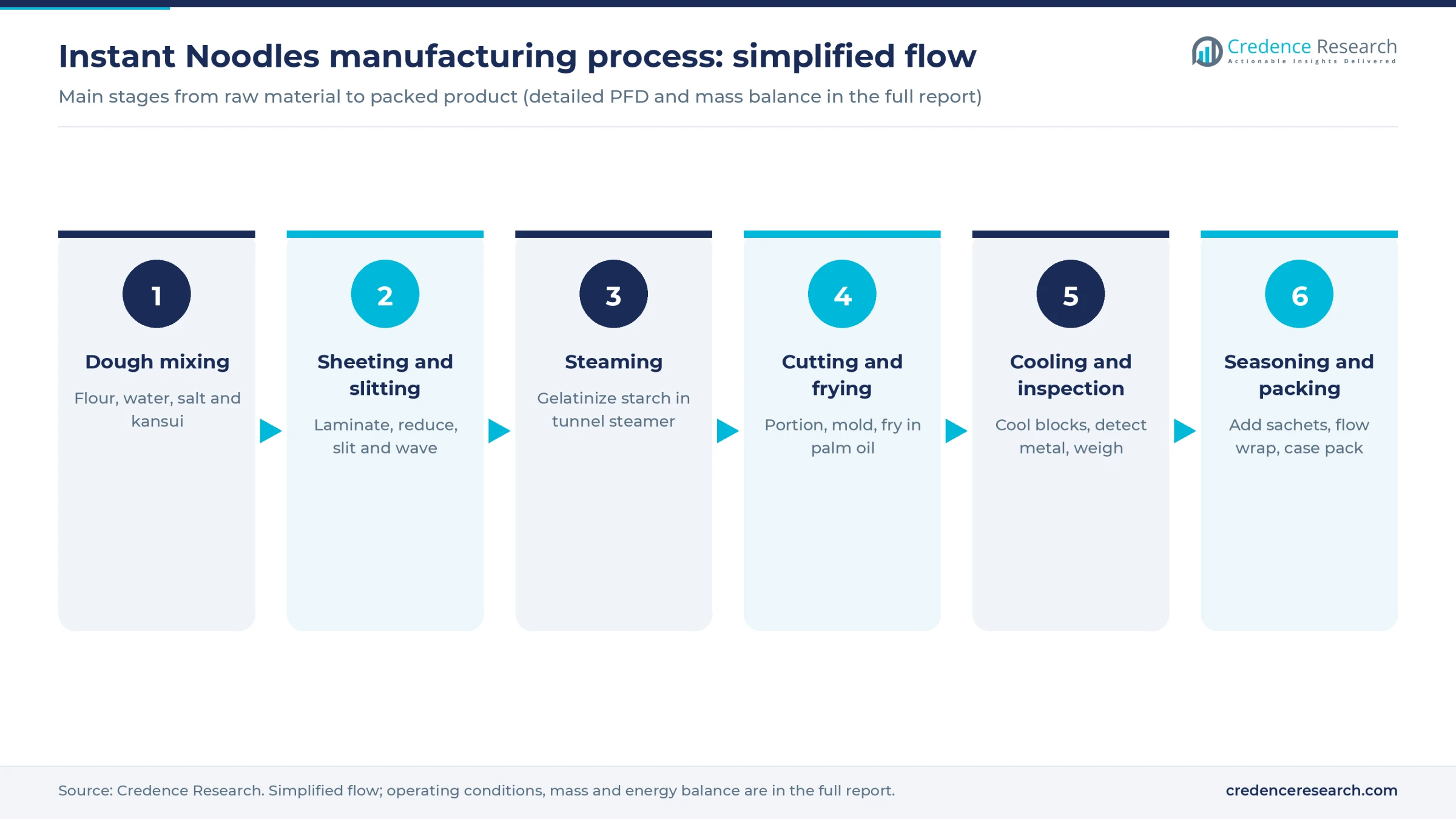
- Dough mixing. Wheat flour, sometimes with 5–15% tapioca or potato starch, is mixed under vacuum with water, salt and kansui to a crumbly dough of about 32–35% moisture. Gluten development here sets the bite, so water temperature and mixing time are tightly held.
- Sheeting and slitting. Compound rollers press the crumbs into two sheets, laminate them and reduce them through a series of roll pairs to about 1 mm. Cutting rolls slit the sheet into strands, and a waving conveyor running slower than the rolls gives the familiar curl, which lets steam and oil reach every strand.
- Steaming. The waved strands pass through a continuous tunnel steamer at about 100°C for one to three minutes, gelatinizing the starch so the noodle cooks again in minutes at home.
- Cutting and frying. Strands are cut and folded into portions, loaded into molds and fried in palm oil at about 140–160°C for one to two minutes. Water flashes off and leaves a porous block. Non-fried lines replace the fryer with a hot-air dryer at about 70–90°C for 30–60 minutes.
- Cooling and inspection. Blocks are cooled on a forced-air conveyor before packing, since warm blocks sweat inside the wrapper and turn the oil rancid faster. Metal detectors and checkweighers reject faulty packs.
- Seasoning and packing. Sachet machines fill powder and oil packets, which drop onto each block before a flow wrapper seals the pillow pack. Packs are cased, coded and palletized.
The fryer is the heart of the line and the main cost and quality control point. Oil turnover must stay fast, with filtration and fresh top-up, to keep free fatty acids and peroxide values low, and fryer fumes need scrubbing. Process settings, yields and oil absorption norms are in the full report.
Instant noodles plant setup cost
This overview models a greenfield plant with one fried line rated at 150 million packs a year, about 12,750 tonnes, selling about 112 million packs, or 9,560 tonnes, at 75% utilization. Estimated CapEx is USD 15–45 million before about USD 2–3.5 million of working capital. The low end reflects an Asian industrial park with Chinese-built line equipment and the high end a U.S. or EU site with Japanese or European machinery.
The range is checked against disclosed plants. Acecook Vietnam began building a VND 2.2 trillion factory, about USD 88 million, in Hung Yen in October 2025, with five lines and 750 million packs a year on 10 hectares. That is about USD 17.6 million a line, near the low end. Nongshim budgeted USD 143 million for its three-line, 500-million-pack export plant in Busan, South Korea, about USD 48 million a line including a large export warehouse, above the high end. The processing line is the largest machinery block, at about 19% of CapEx in the model.
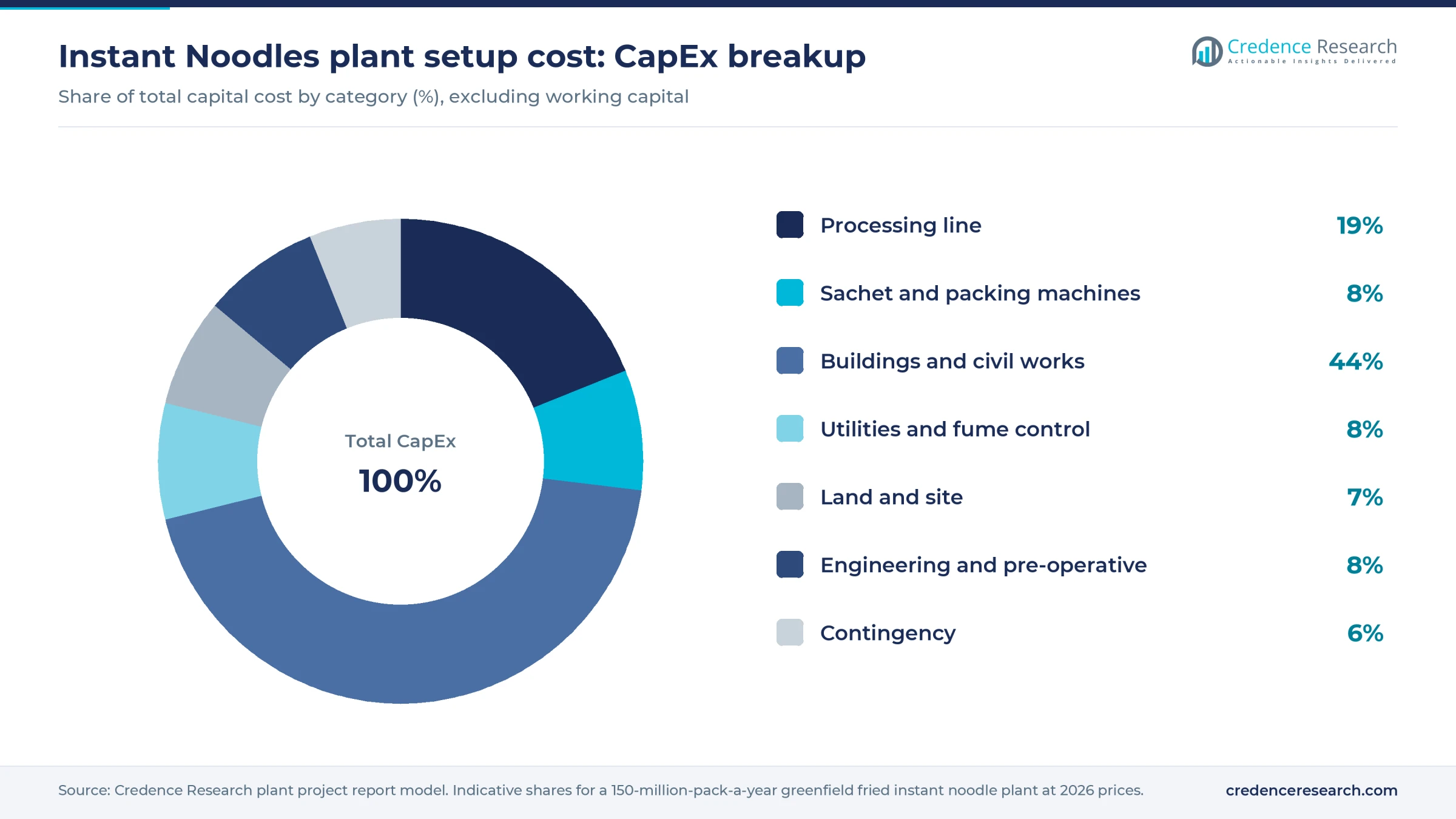
Buildings and civil works take 44% of CapEx and the processing line 19%. Land shows how location moves the total. At an assumed 30,000 square meters, a plot costs about USD 900,000–1.8 million at an assumed USD 30–60 per square meter in an Asian industrial park, and USD 1.8–3.6 million at an assumed USD 60–120 on a U.S. or EU site.
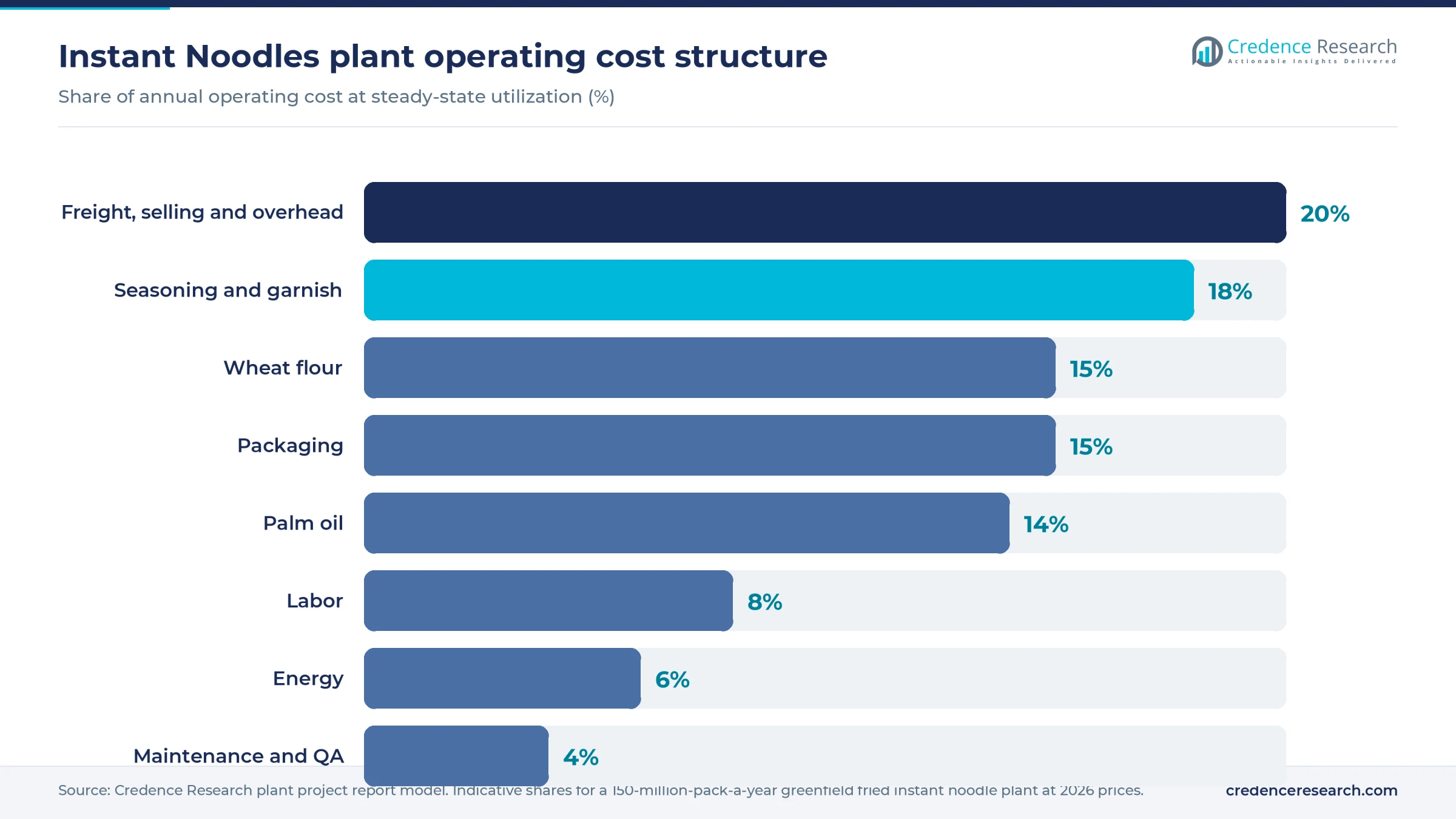
Flour, palm oil and seasoning together form nearly half of operating cost, followed by freight, selling and trade spend, which stays high because noodles sell through millions of small shops. The full report can be customized to any country or region.
Machinery and raw materials for an instant noodles plant
The core machinery for a fried instant noodle line includes:
- Flour silos, sifters, a kansui and brine preparation tank and a vacuum dough mixer
- Compound sheeting rollers, continuous reduction rolls, slitting rolls and a waving conveyor
- Continuous tunnel steamer, cutter and folder, and a mold fryer with oil heat exchanger and filtration
- Thermal fluid heater or boiler, fume scrubber, oil storage tanks and an effluent treatment plant
- Cooling conveyor, metal detector, powder and oil sachet machines, flow wrapper, checkweigher, case packer and palletizer
Machine costs and specifications are in the full report. Line speed is the main choice, since a 400-pack-a-minute line costs far more than a 150-pack line but spreads labor and overheads across more output.
Raw materials are sourced globally, and noodle-grade wheat comes from China, India, the EU, Russia, the United States, Canada and Australia, and many Asian mills blend Australian and North American wheat for protein and color, a supply base covered in the wheat market report. Indonesia and Malaysia produce most of the world's palm oil, and buyers face growing pressure to show certified, deforestation-free supply, as the sustainable palm oil market report details. Tapioca starch comes mainly from Thailand and Vietnam, while dried vegetables, monosodium glutamate and flavor bases are sourced largely from China, Southeast Asia and Europe.
Instant noodles business profit margin and ROI
Noodle margins depend on price tier. Economy packs in Asia and Africa sell for a few cents above cost, while premium spicy, non-fried and export noodles earn far more per kilogram. The model assumes a blended net ex-factory price of USD 1.90–2.60 per kg, about USD 0.16–0.22 a pack, bracketing the 2024 export unit values of China and Indonesia and below the world average lifted by Korean premium brands. That yields about USD 18.2–24.9 million of sales on 9,560 tonnes.
Assumed direct cost is about USD 1.34 per kg, with flour, palm oil and seasoning just under 60% of it and packaging and conversion the rest. That gives an estimated gross margin of 28–48%. After overheads, selling, trade promotion and freight at about 15% of sales, cash profit is an estimated USD 2.6–8.3 million a year.
Payback is estimated at 3–9 years including about a year of ramp-up. An Asian plant with steady distribution sits near the bottom of that band, while a U.S. or EU plant needs premium pricing to avoid the top.
Selling price is the most sensitive variable. A 10% price cut takes about 6–8 percentage points from gross margin, while a 20% rise in palm oil prices takes about 2 points.
| Metric | Value |
|---|---|
| IRR | Available in report |
| NPV | Available in report |
| ROI | Available in report |
| DSCR | Available in report |
How to start an instant noodles business, licenses and approvals
In most countries, founders of a noodle plant register the business and tax accounts, confirm zoning and building permits, and obtain an environmental permit covering fryer fumes, boiler or heater emissions and oily wash water. Fire approval matters more than in most food plants because a fryer holds tonnes of hot oil. Next come food facility registration or licensing, a hazard-based food safety plan, allergen and nutrition labeling, food contact rules for cups and films, pack weight rules and import-export registration.
| Market | Food and product rules | Site and other permits |
|---|---|---|
| United States | FDA food facility registration; preventive controls under 21 CFR Part 117; labeling under 21 CFR Part 101; USDA FSIS inspection only if a product holds enough meat or poultry to fall under its jurisdiction | Local zoning, building and fire permits; state air permit for fryer emissions; wastewater pretreatment permit from the local utility; OSHA rules |
| European Union | Food business registration under Regulation (EC) No 852/2004; labeling under Regulation (EU) No 1169/2011; cups and films under Regulations (EC) No 1935/2004 and (EU) No 10/2011 | National environmental and building permits, since a plant of about 40 tonnes a day sits below the Industrial Emissions Directive threshold for vegetable raw materials; national fire and worker safety rules |
| India | FSSAI license under the Food Safety and Standards Act, 2006; Legal Metrology packer registration | State pollution control board consents to establish and operate; factory license; boiler registration with the state boiler inspectorate where a steam boiler is used; Import Export Code for exports |
Retailers and export buyers usually also require GFSI-benchmarked certification such as BRCGS or FSSC 22000, plus halal certification for Muslim-majority markets. Requirements vary locally, and the full report lists the steps for a chosen country.
Key instant noodles manufacturers and recent developments
Global supply is led by a handful of Asian groups. Nissin Foods of Japan, which invented the product, makes Cup Noodles and Top Ramen across Asia, the Americas and Europe. Tingyi's Master Kong and Uni-President lead in China, Indofood makes Indomie in Indonesia and abroad, and Nongshim, Samyang Foods and Ottogi lead in South Korea. Toyo Suisan sells Maruchan in Japan, the United States and Mexico, Acecook and Masan are major makers in Vietnam, Thai President Foods makes Mama, and Nestlé's Maggi leads in India.
Three developments from the past year show where the industry is investing:
- April 2026. Nongshim said it would open a Moscow subsidiary in June to serve Russia and Central Asia, supplied mainly from its new Busan export plant.
- August 2026. Nissin Foods do Brasil said its BRL 1.05 billion plant in Ponta Grossa, Brazil, would start operating in early 2027, to expand instant noodle output and exports.
- November 2026. Nongshim's Busan export plant was reported to have begun operating, adding 500 million packs a year, while Samyang Foods readied a plant of more than 1.1 billion packs in Jiaxing, China, for January 2027.
What's inside the Instant Noodles project report PDF
The report runs to 21 chapters. Open a chapter to see its sections.
1. Preface
2. Scope and Methodology
- 2.1 Objectives of the Study
- 2.2 Stakeholders
- 2.3 Research Methodology
- 2.4 Data Sources and Key Assumptions
3. Executive Summary
- 3.1 Market Snapshot
- 3.2 Project at a Glance (Capacity, CapEx, OpEx)
- 3.3 Key Financial Indicators (IRR, NPV, Payback, Break-even)
- 3.4 Feasibility Verdict
4. Product Overview
- 4.1 Instant Noodles Definition and Properties
- 4.2 Grades and Specifications (BIS / ISO / ASTM)
- 4.3 HS Code and Classification
- 4.4 Key Applications
- 4.5 Substitutes
5. Global Instant Noodles Market
- 5.1 Market Overview
- 5.2 Historical and Current Market Performance (Volume and Value)
- 5.3 Market Breakup by Grade / Type
- 5.4 Market Breakup by End-Use Industry
- 5.5 Market Breakup by Region
- 5.6 Market Drivers, Restraints and Trends
- 5.7 Value Chain Analysis
- 5.8 Market Forecast
6. Target Country Instant Noodles Market Analysis
- 6.1 Demand and Supply Analysis
- 6.2 Installed Capacity vs Demand Gap
- 6.3 Import Dependence
- 6.4 Demand Forecast by End-Use
7. Trade Analysis
- 7.1 Imports by Volume, Value and Country
- 7.2 Exports by Volume, Value and Country
- 7.3 Trade Balance and Opportunities
8. Price Analysis
- 8.1 Historical Instant Noodles Price Trends by Region
- 8.2 Raw Material / Feedstock Price Trends and Linkage
- 8.3 Price Forecast
- 8.4 Margins Across the Value Chain
9. Competitive Landscape
- 9.1 Market Structure
- 9.2 Key Players and Installed Capacities
- 9.3 Profiles of Key Players
- 9.4 Recent Developments (Expansions, M&A, New Plants)
10. Manufacturing Process and Technology
- 10.1 Comparison of Technology Routes
- 10.2 Selected Route and Process Flow Diagram
- 10.3 Unit Operations Involved
- 10.4 Chemical Reactions Involved
- 10.5 Mass Balance and Raw Material Requirements
- 10.6 Energy Balance
- 10.7 Quality Assurance Criteria and Technical Tests
- 10.8 By-products and Waste Handling
- 10.9 Technology Licensors / Providers
11. Project Details, Requirements and Costs
- 11.1 Land, Location and Site Development
- 11.1.1 Site Selection Criteria
- 11.1.2 Location Analysis
- 11.1.3 Land Requirement and Costs
- 11.1.4 Site Development Costs
- 11.2 Plant Layout
- 11.2.1 Layout Principles
- 11.2.2 Proposed Layout
- 11.2.3 Factors Influencing Layout
- 11.3 Civil Works and Buildings
- 11.4 Plant Machinery
- 11.4.1 Machinery Requirements and Specifications
- 11.4.2 Machinery Costs
- 11.4.3 Machinery Suppliers
- 11.5 Raw Materials
- 11.5.1 Requirements per Tonne of Output
- 11.5.2 Procurement and Sourcing
- 11.5.3 Costs
- 11.5.4 Suppliers
- 11.6 Packaging
- 11.6.1 Packaging Requirements
- 11.6.2 Packaging Costs
- 11.6.3 Packaging Suppliers
- 11.7 Storage and Material Handling
- 11.8 Transportation Requirements and Costs
- 11.9 Utilities
- 11.9.1 Power Requirements and Costs
- 11.9.2 Water Requirements and Costs
- 11.9.3 Steam, Fuel and Other Utilities
- 11.10 Manpower Requirements and Wages
12. Environment, Health, Safety and Sustainability
- 12.1 Effluent and Emissions Management
- 12.2 Hazard Classification and Safety Measures
- 12.3 Carbon Footprint
- 12.4 Green / Low-Carbon Process Options
13. Regulatory Procedures, Approvals and Certifications
- 13.1 Licences and Registrations
- 13.2 Environmental Clearances
- 13.3 Product Certifications (BIS, REACH, etc.)
- 13.4 Approval Timeline
14. Project Implementation Schedule
15. Project Economics
- 15.1 Capital Cost of the Project
- 15.2 Techno-Economic Parameters
- 15.3 Capacity Utilization and Ramp-up
- 15.4 Product Pricing and Margins
- 15.5 Income Projections
- 15.6 Expenditure Projections
- 15.7 Working Capital Requirement
- 15.8 Taxation
- 15.9 Depreciation
16. Financial Analysis
- 16.1 Projected Profit and Loss Account
- 16.2 Projected Cash Flow Statement
- 16.3 Projected Balance Sheet
- 16.4 Liquidity Analysis
- 16.5 Profitability Analysis (Payback, NPV, IRR, ROI)
- 16.6 Break-even Analysis
- 16.7 Debt Service Coverage Ratio (DSCR)
- 16.8 Sensitivity Analysis
- 16.9 Scenario and Uncertainty Analysis
17. Funding and Incentives
- 17.1 Means of Finance and Debt-Equity Structure
- 17.2 Loans and Financial Assistance
- 17.3 Government Schemes and Subsidies (PLI, State Policies)
18. Risk Assessment
- 18.1 Key Success Factors
- 18.2 Key Risk Factors
- 18.3 Risk Mitigation
19. Strategic Recommendations
20. Case Study of a Successful Venture
21. Appendix
- 21.1 Detailed Assumptions
- 21.2 Abbreviations
- 21.3 List of Tables and Figures
- 21.4 Sources
This page vs. the full report
| Data point | On this page (free) | In the full report |
|---|---|---|
| Total CapEx | One rounded range at one capacity | Exact figure at three capacities with a line-item breakup |
| CapEx breakup | Category shares (%) only | Cost, quantity and supplier for every machine |
| Operating cost | Share of raw materials, utilities and labor | Per-unit cost sheet with each input price and consumption |
| Profitability | Gross margin range and payback band | Exact IRR, NPV, ROI, break-even and DSCR |
| Financial statements | List of what is included | 10-year P&L, cash flow, balance sheet and Excel model |
| Sensitivity | One directional line | Full sensitivity and scenario tables |
| Process | Simplified flow diagram | Detailed process flow, mass and energy balance, operating conditions |
| Machinery | Names of the main machines | Specifications, capacity, cost and supplier list |
| Market | Headline size, growth and global demand | Segment, region, trade and price forecast tables |
| Suppliers and buyers | Supplier types and sourcing hubs | Named suppliers and buyers |
Instant Noodles project report: FAQs
How much does an instant noodles plant cost?
What is the profit margin in instant noodle manufacturing?
How long is the payback for an instant noodle plant?
What is the difference between fried and non-fried instant noodles?
Which raw materials does an instant noodle plant need?
What licenses does an instant noodle factory need?

About the analyst
Priyanka Mor, Senior Consultant
Senior Consultant at Credence Research Inc directing strategic market advisory, cross-border commercial due diligence and enterprise intelligence frameworks for global B2B clients. Combines quantitative modeling with executive advisory, translating macroeconomic variables and supply chain data into go-to-market blueprints, M&A screenings and competitive war-gaming strategies.
Related market research
- Instant Noodles Market Size, Growth, Share and Forecast 2032
- Uncooked Pasta And Noodles Market Size, Share and Forecast 2032
- Gluten Free Pasta and Noodles Market Size, Share and Forecast 2032
- Wheat Market Size, Trends, Growth, Share and Forecast 2032
- Sustainable Palm Oil Market Size, Growth and Forecast 2032
- Seasoning Market Size, Growth, Trends, Share and Forecast 2032
More plant project reports
- Green Beans Processing Plant Project Report (DPR) 2026
- Peanut Butter Manufacturing Plant Project Report (DPR) 2026
- Banana Powder Manufacturing Plant Project Report (DPR) 2026
- Cashew Processing Plant Project Report (DPR) 2026
- Ginger Processing Plant Project Report (DPR) 2026
- Pre Packaged Soup Manufacturing Plant Project Report (DPR) 2026