
Quick answer
A castor oil processing plant presses and solvent-extracts castor seed into crude oil, refines part of it into pale and pharmaceutical grades, and sells the de-oiled meal as fertilizer. A representative plant crushing 200 tonnes of seed a day costs about USD 10–13 million, about a third of it working capital for seed. Gross margin after seed runs 4–10% on November 2026 quotes, and payback takes about 3–7 years when the crush spread holds.
Feasible for an operator with secure seed buying, high oil recovery and a share of premium grades; the thin, weather-driven oil-to-seed spread is the main risk, and a plant far from seed markets must first build contract farming.
Castor Oil plant: key highlights
| Parameter | Indicative value | Note |
|---|---|---|
| Plant capacity | 200 tonnes of castor seed per day | 300 days, 80% utilization; about 48,000 tonnes of seed and 22,500–23,500 tonnes of oil a year |
| Total CapEx | USD 10–13 million | Asian greenfield site, scaled from a disclosed castor crushing plant budget; includes seed working capital |
| Raw material share of operating cost | 96–98% | Delivered castor seed at Nov. 6, 2026 Gujarat quotes |
| Gross margin | 4–10% | Oil and meal sales less delivered seed cost, before processing cost |
| Payback period | 3–7 years | Pre-tax, mid to high crush spread, 80% utilization; little cash profit at the low end of the margin band |
| IRR | Available in report | Post-tax, 10-year model |
| Break-even | Available in report | Capacity utilization basis |
Ranges assume a 200 tonne per day castor seed plant with expellers, hexane extraction and refining, 300 days, 80% utilization, a greenfield Asian industrial site, Solvent Extractors' Association quotes of Nov. 6, 2026, 93.89 rupees per dollar, assumed oil recovery of 47–49%, an assumed premium on 30% of oil sold as pale or pharmacopoeia grade and assumed processing cost of USD 22–32 per tonne of seed. Customizable to any country.
What is castor oil?
Castor oil is a pale yellow, viscous oil pressed and extracted from the seeds of Ricinus communis, a hardy shrub grown mainly in the semi-arid tropics. Most of its fatty acid content is ricinoleic acid, which carries a hydroxyl group that no other major vegetable oil has. That chemistry makes castor oil an industrial feedstock rather than a cooking oil: it stays fluid in the cold, dissolves in alcohol and can be split, hydrogenated or dehydrated into a long list of derivatives.
Castor oil and its fractions, refined or not but not chemically modified, are classified under HS code 151530, while castor seed falls under HS code 120730. Trade grades include commercial grade, first special grade, pale pressed grade and pharmacopoeia grades meeting U.S., British, European or Indian standards. Buyers use the oil in lubricants and greases, polyurethane coatings and adhesives, cosmetics, laxatives and drug excipients, and as the starting point for sebacic and undecylenic acid, the routes to bio-based nylons such as polyamide 11 and other high-performance polyamides. Hydrogenated and blown castor oil are separate, chemically modified products made from it.
Castor oil market overview and global demand
Supply is the defining feature of this market. FAOSTAT puts world castor seed output at 1.82 million metric tons in 2024, down from 2.19 million in 2023, with India growing 1.59 million tons, or about 87% of the total. Mozambique, at about 74,000 tons, and Brazil, at about 40,000 tons, are the next largest growers. The Solvent Extractors' Association of India estimated the 2025-26 Indian crop at 1.76 million tons in March 2026, up 11% on the year, and says Indian supply meets more than 90% of world castor oil demand.
Because the crop is concentrated and its users are spread across the world, an unusually large share of castor oil crosses borders. Indian exports reached 694,510 tons in 2024, worth roughly USD 1 billion. The International castor oil Association's November 2025 newsletter put January to October 2025 shipments at about 585,000 tons, down 5.8% on the year, as industrial buyers grew cautious. China is the largest buying country, led by processors such as Hengshui Jinghua Chemical, followed by Europe, where Arkema turns castor oil into polyamide 11, with the United States and Japan among the other large buyers.
Demand rises with bio-based content targets in polymers, coatings and lubricants and softens when industrial output slows, while dependence on monsoon rain makes prices swing more than demand does. Credence Research values the global blown castor oil market, one oxidized derivative, at about USD 1.99 billion in 2025, based on its USD 1.88 billion figure for 2024 and a 5.72% CAGR, with USD 2.93 billion forecast for 2032.
Castor oil manufacturing process
Castor seed is processed much like other high-oil seeds, with two differences. The seed holds roughly half its weight in oil, and the press cake contains ricin, a potent protein toxin, so meal handling is part of the process design rather than an afterthought. The flow below shows a pre-press and solvent extraction plant with its own refining section.
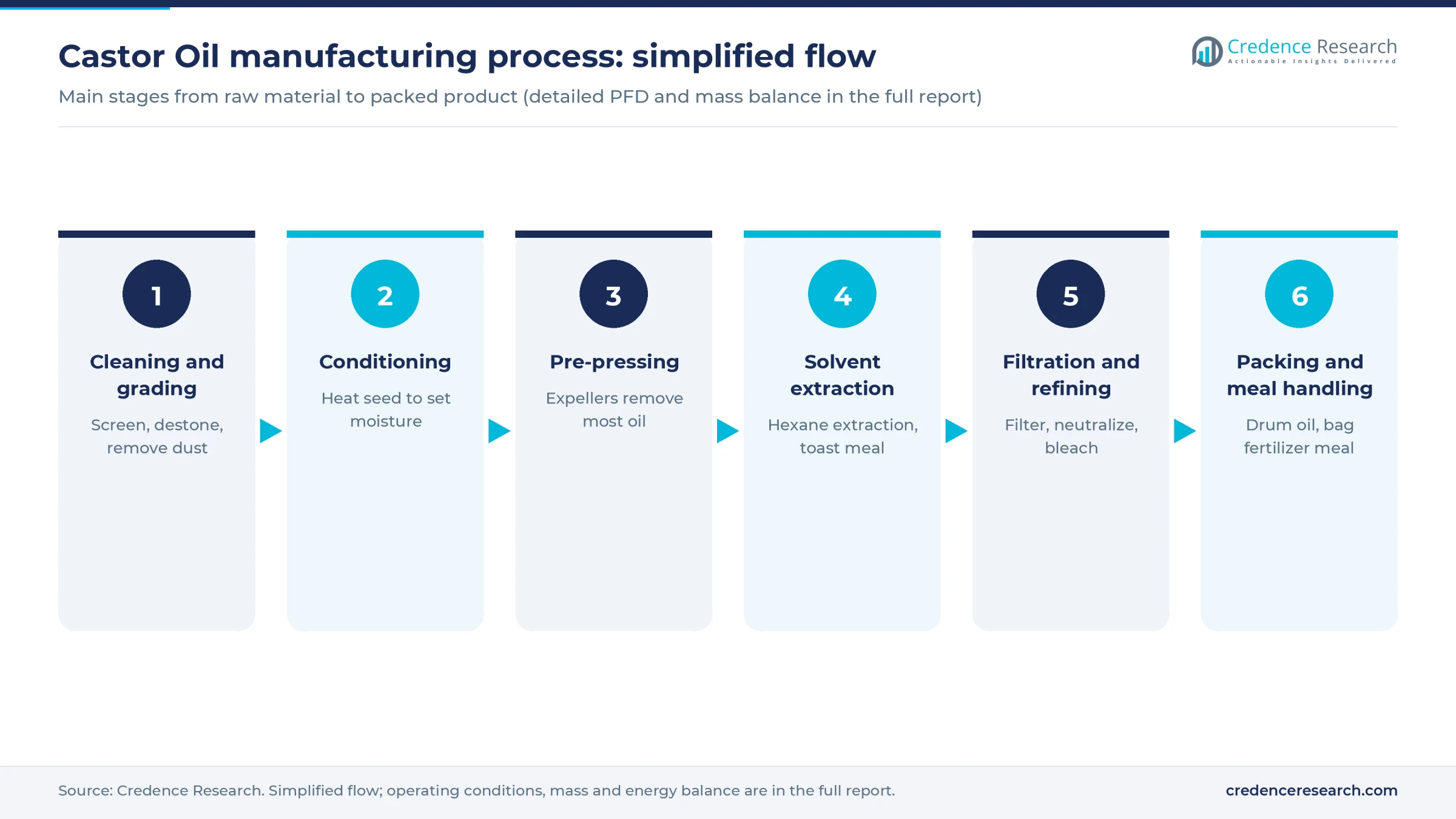
- Cleaning and grading. Vibrating screens, destoners, magnets and aspirators remove sand, stalks and capsule fragments left from field threshing, and dust collection limits worker exposure to allergenic castor dust.
- Conditioning. Seed is heated in stacked kettles to a set moisture and temperature, which ruptures oil cells and makes the oily kernels easier to press.
- Pre-pressing. Screw expellers remove most of the oil and leave a cake that still holds an assumed 10–15% oil. A share of clean seed can be cold pressed without heat for pale and pharmaceutical grades.
- Solvent extraction. Hexane washes the remaining oil from the cake in a continuous extractor, and a desolventizer-toaster recovers solvent from the meal. Its steam and heat also help denature ricin.
- Filtration and refining. Crude oil is filtered to commercial grade, while degumming, neutralizing and bleaching with activated earth give first special and pale grades with low acid value and light color.
- Packing and meal handling. Oil goes to bulk tanks, flexitanks or drums, and the meal is cooled, bagged and labeled for fertilizer use.
Recovery shapes returns most: every percentage point of oil left in the meal costs about USD 17 per tonne of seed on the November 2026 quotes used below, between a fifth and a half of the plant's gross spread, because oil is worth about 15 times as much as meal. Safety comes next: the extraction building is a hazardous area with explosion-proof equipment, solvent losses are a regulated emission, and staff who handle cake and dust need protective equipment. Meal is never sold as animal feed without proven detoxification.
Castor oil plant setup cost
Indicative CapEx for a greenfield plant crushing 200 tonnes of castor seed a day, with pre-press solvent extraction, refining for premium grades and seed storage, is USD 10–13 million at an Asian industrial site using Asian-built equipment. The benchmark is a disclosed project: in 2009, Gokul Refoils and Solvent budgeted the equivalent of about USD 6–7 million at the time for a 600 tonne per day castor crushing plant at Gandhidham in Gujarat. Scaled down to 200 tonnes with a standard 0.6 capacity exponent, escalated by an assumed 60–80% in rupee terms since 2009 and converted at 93.89 rupees per dollar, the crushing and extraction block comes to about USD 2.6–3.5 million.
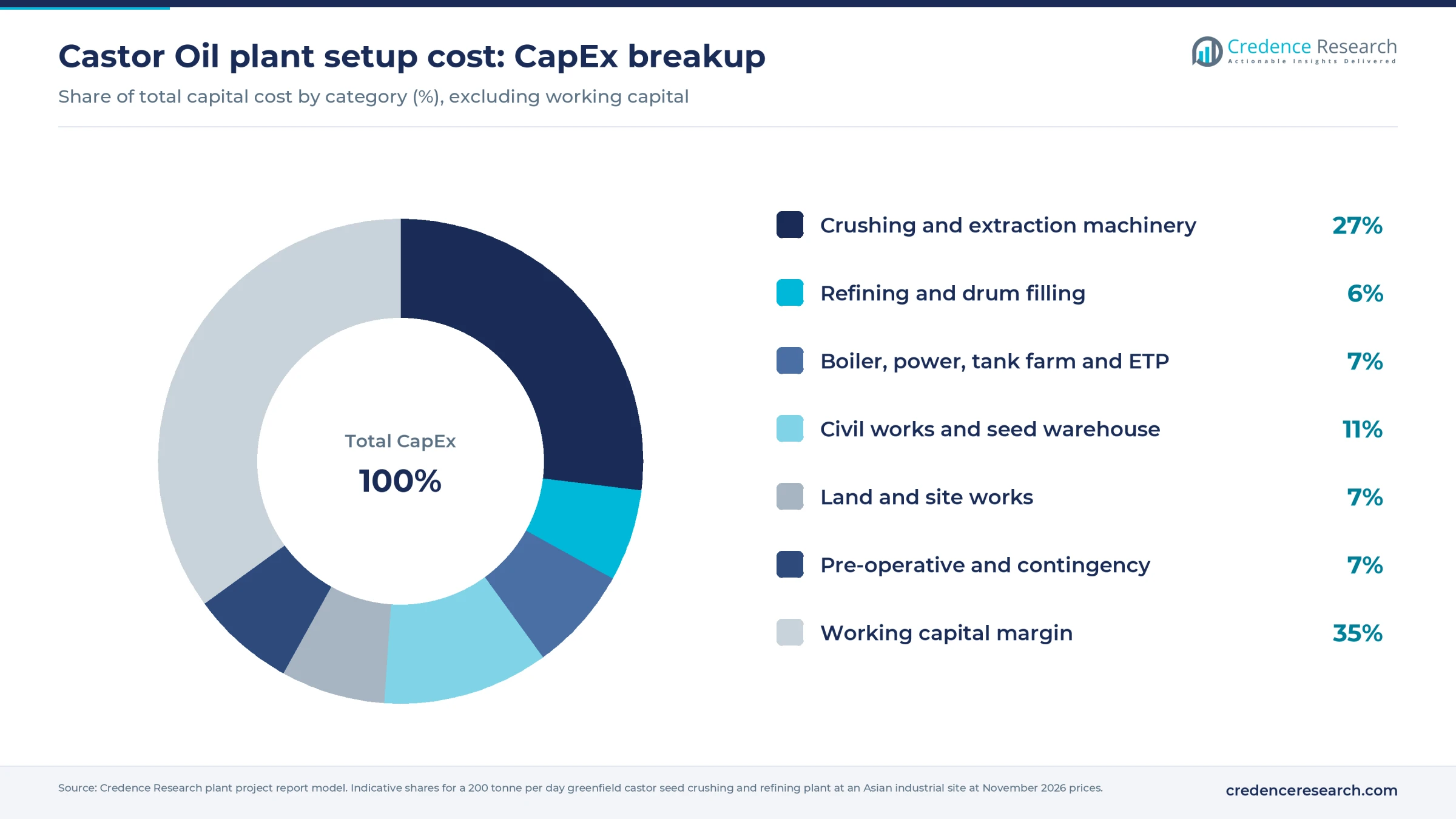
Working capital is the largest line at about 35%, because castor seed is expensive, about USD 880 a tonne in November 2026, and one to 1.25 months of seed stock ties up USD 3.5–4.4 million. Crushing and extraction machinery with erection takes about 27%, civil works and a seed warehouse 11%, the boiler, power, tank farm and effluent treatment 7%, refining and drum filling 6%, and pre-operative expenses and contingency 7%.
Example row, land: about 3 hectares for the plant, warehouse, tank farm and truck yard is budgeted, as an assumption, at USD 15–35 per square meter, or USD 0.45–1.05 million, about 7% of the total. A plot in a South Asian or East African agro-industrial estate near seed markets sits at the low end and serviced port-side land costs more; a U.S. or EU site needs its own budget.
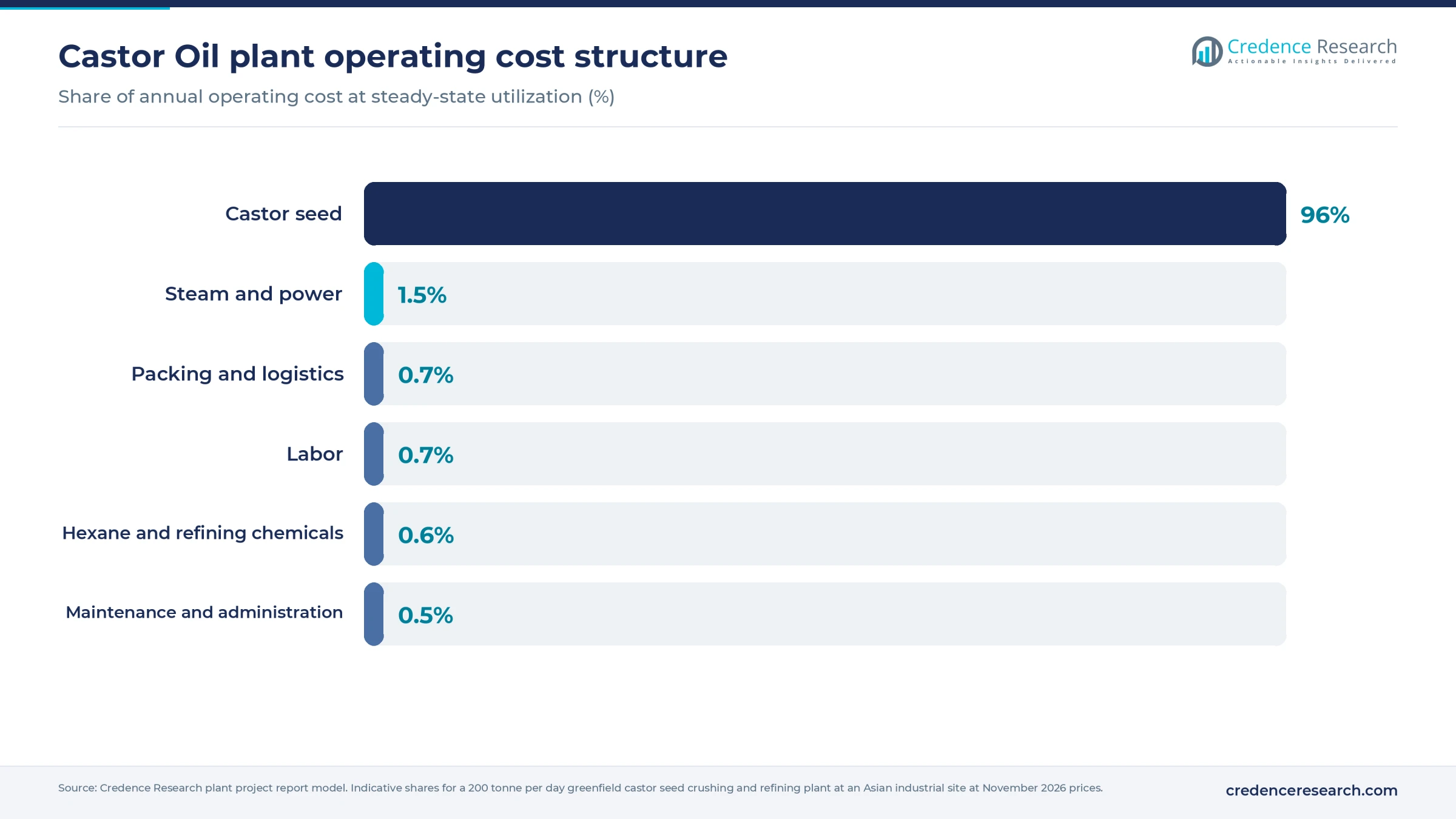
Seed dominates operating cost at about 96–98% of cash cost. Steam and power take about 1.5%, packing and logistics 0.7%, labor 0.7%, hexane and bleaching chemicals 0.6%, and maintenance and administration 0.5%, all assumed for planning. Because seed prices, grade premiums and land vary most between countries, the full report can be customized to any location.
Machinery and raw materials for a castor oil plant
A complete line starts with seed intake pits, bucket elevators, vibrating cleaners, destoners and dust collection, followed by a stack cooker and heavy-duty screw expellers. The solvent plant needs a continuous extractor, desolventizer-toaster, dryer-cooler, miscella distillation and solvent recovery. The refinery adds neutralizing and bleaching vessels with leaf and polishing filters, plus a separate cold-press line for pale grades. Utilities include a steam boiler, cooling towers, nitrogen blanketing, an effluent plant, a laboratory for acid value, hydroxyl value and color tests, and meal bagging. Lead times track the wider oilseed extraction equipment market. Machine costs and supplier lists are held for the report.
The raw material is threshed castor seed, and its supply is unusually concentrated. India's Gujarat and Rajasthan states grow most of the world crop, while Mozambique, Brazil, China, Southeast Asia and East Africa grow smaller volumes, much of it on smallholdings. At 48,000 tonnes a year, the plant described here would need about 2.6% of 2024 world output, roughly the seed from 24,000 hectares at the 1,977 kg per hectare Indian average yield estimated for 2025-26. Plants outside South Asia therefore usually start with contract farming and buy imported seed to fill gaps.
Castor oil business profit margin and ROI
Gross margin here means oil and meal sales less delivered seed cost, before processing, and the band is 4–10%. The Solvent Extractors' Association's quotes for Nov. 6, 2026 put Gujarat castor seed at 82,750 rupees a tonne, commercial castor oil at 166,500 rupees and extracted meal at 10,950 rupees, with first-grade oil at USD 1,780 a tonne FOB Kandla. At 93.89 rupees per dollar, that is about USD 881 for seed, USD 1,773 for oil and USD 117 for meal.
With assumed oil recovery of 47–49%, meal yield of 50–52% and an assumed premium of USD 250–400 a tonne on the 30% of oil sold as pale or pharmacopoeia grade, a tonne of seed brings about USD 929–986 of sales against USD 889–896 of delivered seed. The resulting spread of USD 33–97 a tonne is thin, which is why castor crushers chase recovery, grade premiums and well-timed seed buying after the spring harvest.
After assumed processing and overhead of USD 22–32 a tonne, the mid case leaves about USD 38 a tonne, or USD 1.8 million a year on 48,000 tonnes, and the high case about USD 75, or USD 3.6 million. A USD 10–13 million plant therefore pays back in about 3–7 years, while at the bottom of the margin band cash profit is close to zero. The main sensitivity is the oil-to-seed price ratio, about 2.0 in November 2026: a 5% move in the oil price shifts the spread by about USD 43 a tonne, roughly two-thirds of the mid-case spread.
| Return metric | Value |
|---|---|
| IRR | Available in report |
| NPV | Available in report |
| ROI | Available in report |
| DSCR | Available in report |
How to start a castor oil business, licenses and approvals
The approval path for a castor oil plant resembles that of other seed crushers, with two product-specific additions: hexane, a flammable solvent, and ricin in the meal, which shapes how cake is stored, labeled and sold.
- Business registration, tax identification, zoning clearance and building permits with hazardous-area design.
- An environmental permit covering solvent emissions, dust and wastewater.
- Fire safety approval for hexane storage, boiler inspection and occupational safety controls.
- Chemical inventory checks and drug manufacturing approval for pharmacopoeia grades.
- Fertilizer registration for meal, which is not sold as feed without detoxification.
- Export or import registration.
Unmodified castor oil is exempt from registration under Annex V of the EU REACH regulation unless it meets hazard classification criteria, but hydrogenated castor oil counts as chemically modified and needs registration. Ricin is a U.S. select toxin and a Chemical Weapons Convention Schedule 1 chemical, so plants never concentrate it.
| Market | Key approvals for a castor oil plant |
|---|---|
| United States | State Clean Air Act permit for hexane emissions; OSHA process safety management (29 CFR 1910.119) above 10,000 pounds of hexane; castor oil listed on the EPA TSCA Inventory; FDA drug establishment registration and GMP for USP-grade oil; state fertilizer registration for meal |
| European Union | Solvent emission limits for vegetable oil extraction under the Industrial Emissions Directive 2010/75/EU; REACH registration for modified derivatives; 10 mg/kg castor husk limit in feed under Directive 2002/32/EC; European Pharmacopoeia compliance for pharmaceutical grades |
| India | State pollution control board consent to establish and operate; PESO license for hexane under the Petroleum Rules, 2002; state drug license for pharmacopoeia grades under the Drugs and Cosmetics Act, 1940; importer-exporter code from DGFT and a registration-cum-membership certificate from CHEMEXCIL for exports |
Key castor oil manufacturers and recent developments
Castor crushing is concentrated in Gujarat, where AWL Agri Business, N.K. Proteins, Gokul Overseas, DML Agro Trade and Jayant Agro-Organics are among the largest crushers, exporters and derivative makers recognized at the Global Castor Conference 2026. Buyers matter as much as crushers: Hengshui Jinghua Chemical in China was named the largest importer of castor oil for 2024-25, and France's Arkema, which makes Rilsan polyamide 11 from castor, the second largest. BASF and other specialty chemical makers in Europe, the United States and Japan convert the oil into polyols, esters and lubricant bases, which ties castor demand to the wider oleochemicals market.
Two recent developments show the direction of the industry:
- February 2026. The Pragati sustainable castor program marked nine years with more than 10,000 certified farmers on over 12,000 hectares. Launched in 2016 by Arkema, BASF and Jayant Agro-Organics with Solidaridad, it counts more than 140,000 tons of certified seed since launch.
- April 2026. Casterra Ag, a subsidiary of Evogene, reported commercial castor trials on 74 hectares in Bahia, Brazil, 64 of them rainfed, and planned a Brazilian subsidiary and partnerships with castor oil producers during 2026.
What's inside the Castor Oil project report PDF
The report runs to 21 chapters. Open a chapter to see its sections.
1. Preface
2. Scope and Methodology
- 2.1 Objectives of the Study
- 2.2 Stakeholders
- 2.3 Research Methodology
- 2.4 Data Sources and Key Assumptions
3. Executive Summary
- 3.1 Market Snapshot
- 3.2 Project at a Glance (Capacity, CapEx, OpEx)
- 3.3 Key Financial Indicators (IRR, NPV, Payback, Break-even)
- 3.4 Feasibility Verdict
4. Product Overview
- 4.1 Castor Oil Definition and Properties
- 4.2 Grades and Specifications (BIS / ISO / ASTM)
- 4.3 HS Code and Classification
- 4.4 Key Applications
- 4.5 Substitutes
5. Global Castor Oil Market
- 5.1 Market Overview
- 5.2 Historical and Current Market Performance (Volume and Value)
- 5.3 Market Breakup by Grade / Type
- 5.4 Market Breakup by End-Use Industry
- 5.5 Market Breakup by Region
- 5.6 Market Drivers, Restraints and Trends
- 5.7 Value Chain Analysis
- 5.8 Market Forecast
6. Target Country Castor Oil Market Analysis
- 6.1 Demand and Supply Analysis
- 6.2 Installed Capacity vs Demand Gap
- 6.3 Import Dependence
- 6.4 Demand Forecast by End-Use
7. Trade Analysis
- 7.1 Imports by Volume, Value and Country
- 7.2 Exports by Volume, Value and Country
- 7.3 Trade Balance and Opportunities
8. Price Analysis
- 8.1 Historical Castor Oil Price Trends by Region
- 8.2 Raw Material / Feedstock Price Trends and Linkage
- 8.3 Price Forecast
- 8.4 Margins Across the Value Chain
9. Competitive Landscape
- 9.1 Market Structure
- 9.2 Key Players and Installed Capacities
- 9.3 Profiles of Key Players
- 9.4 Recent Developments (Expansions, M&A, New Plants)
10. Manufacturing Process and Technology
- 10.1 Comparison of Technology Routes
- 10.2 Selected Route and Process Flow Diagram
- 10.3 Unit Operations Involved
- 10.4 Chemical Reactions Involved
- 10.5 Mass Balance and Raw Material Requirements
- 10.6 Energy Balance
- 10.7 Quality Assurance Criteria and Technical Tests
- 10.8 By-products and Waste Handling
- 10.9 Technology Licensors / Providers
11. Project Details, Requirements and Costs
- 11.1 Land, Location and Site Development
- 11.1.1 Site Selection Criteria
- 11.1.2 Location Analysis
- 11.1.3 Land Requirement and Costs
- 11.1.4 Site Development Costs
- 11.2 Plant Layout
- 11.2.1 Layout Principles
- 11.2.2 Proposed Layout
- 11.2.3 Factors Influencing Layout
- 11.3 Civil Works and Buildings
- 11.4 Plant Machinery
- 11.4.1 Machinery Requirements and Specifications
- 11.4.2 Machinery Costs
- 11.4.3 Machinery Suppliers
- 11.5 Raw Materials
- 11.5.1 Requirements per Tonne of Output
- 11.5.2 Procurement and Sourcing
- 11.5.3 Costs
- 11.5.4 Suppliers
- 11.6 Packaging
- 11.6.1 Packaging Requirements
- 11.6.2 Packaging Costs
- 11.6.3 Packaging Suppliers
- 11.7 Storage and Material Handling
- 11.8 Transportation Requirements and Costs
- 11.9 Utilities
- 11.9.1 Power Requirements and Costs
- 11.9.2 Water Requirements and Costs
- 11.9.3 Steam, Fuel and Other Utilities
- 11.10 Manpower Requirements and Wages
12. Environment, Health, Safety and Sustainability
- 12.1 Effluent and Emissions Management
- 12.2 Hazard Classification and Safety Measures
- 12.3 Carbon Footprint
- 12.4 Green / Low-Carbon Process Options
13. Regulatory Procedures, Approvals and Certifications
- 13.1 Licences and Registrations
- 13.2 Environmental Clearances
- 13.3 Product Certifications (BIS, REACH, etc.)
- 13.4 Approval Timeline
14. Project Implementation Schedule
15. Project Economics
- 15.1 Capital Cost of the Project
- 15.2 Techno-Economic Parameters
- 15.3 Capacity Utilization and Ramp-up
- 15.4 Product Pricing and Margins
- 15.5 Income Projections
- 15.6 Expenditure Projections
- 15.7 Working Capital Requirement
- 15.8 Taxation
- 15.9 Depreciation
16. Financial Analysis
- 16.1 Projected Profit and Loss Account
- 16.2 Projected Cash Flow Statement
- 16.3 Projected Balance Sheet
- 16.4 Liquidity Analysis
- 16.5 Profitability Analysis (Payback, NPV, IRR, ROI)
- 16.6 Break-even Analysis
- 16.7 Debt Service Coverage Ratio (DSCR)
- 16.8 Sensitivity Analysis
- 16.9 Scenario and Uncertainty Analysis
17. Funding and Incentives
- 17.1 Means of Finance and Debt-Equity Structure
- 17.2 Loans and Financial Assistance
- 17.3 Government Schemes and Subsidies (PLI, State Policies)
18. Risk Assessment
- 18.1 Key Success Factors
- 18.2 Key Risk Factors
- 18.3 Risk Mitigation
19. Strategic Recommendations
20. Case Study of a Successful Venture
21. Appendix
- 21.1 Detailed Assumptions
- 21.2 Abbreviations
- 21.3 List of Tables and Figures
- 21.4 Sources
This page vs. the full report
| Data point | On this page (free) | In the full report |
|---|---|---|
| Total CapEx | One rounded range at one capacity | Exact figure at three capacities with a line-item breakup |
| CapEx breakup | Category shares (%) only | Cost, quantity and supplier for every machine |
| Operating cost | Share of raw materials, utilities and labor | Per-unit cost sheet with each input price and consumption |
| Profitability | Gross margin range and payback band | Exact IRR, NPV, ROI, break-even and DSCR |
| Financial statements | List of what is included | 10-year P&L, cash flow, balance sheet and Excel model |
| Sensitivity | One directional line | Full sensitivity and scenario tables |
| Process | Simplified flow diagram | Detailed process flow, mass and energy balance, operating conditions |
| Machinery | Names of the main machines | Specifications, capacity, cost and supplier list |
| Market | Headline size, growth and global demand | Segment, region, trade and price forecast tables |
| Suppliers and buyers | Supplier types and sourcing hubs | Named suppliers and buyers |
Castor Oil project report: FAQs
How much does it cost to set up a castor oil plant?
What gross margin does a castor oil plant earn?
What is the payback period for a castor oil plant?
Is castor meal safe to sell?
What is the HS code for castor oil?
Where does castor seed for a plant come from?

About the analyst
Nisha Gupta, Senior Research Analyst
Nisha Gupta is a Senior Research Analyst at Credence Research Inc. who works across industry domains, including packaging, automotive parts and machinery. Her focus is the modelling engine behind each study: she builds quantitative market databases and econometric forecasting frameworks, and developed automated Excel-based market modelling templates that cut client turnaround time by 30%.
Related market research
- Blown Castor Oil Market Size, Share, Growth and Forecast 2032
- Oleochemicals Market Size, Growth, Share and Forecast 2032
- Oilseed Extraction Equipment Market Size, Growth and Forecast 2032
- High Performance Polyamides Market Size, Share and Forecast 2032
- Natural Oil Polyols Market Size, Share and Growth Report 2032
- Polyols and Polyurethane Market Size, Share and Forecast, 2032
More plant project reports
- Vinyl Chloride Manufacturing Plant Project Report (DPR) 2026
- Neopentyl Glycol Manufacturing Plant Project Report (DPR) 2026
- Citric Acid Manufacturing Plant Project Report (DPR) 2026
- Styrene Manufacturing Plant Project Report (DPR) 2026
- Polyvinyl Chloride Manufacturing Plant Project Report (DPR) 2026
- Phosphoric Acid Manufacturing Plant Project Report (DPR) 2026