
Market Overview:
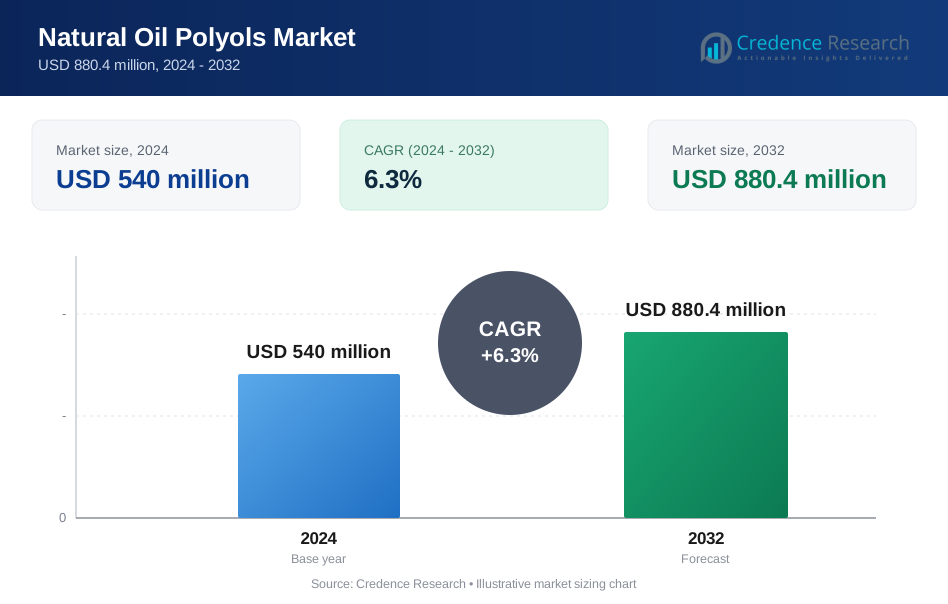
The Natural Oil Polyols (NOP) market is projected to grow from USD 540 million in 2024 to USD 880.4 million by 2032, registering a compound annual growth rate (CAGR) of 6.3% from 2024 to 2032.
| REPORT ATTRIBUTE | DETAILS |
|---|---|
| Historical Period | 2020-2023 |
| Base Year | 2024 |
| Forecast Period | 2025-2032 |
| Natural Oil Polyols (NOP) Market Size 2024 | USD 540 million |
| Natural Oil Polyols (NOP) Market, CAGR | 6.3% |
| Natural Oil Polyols (NOP) Market Size 2032 | USD 880.4 million |
Market drivers include the rising adoption of green building materials, supportive government policies promoting renewable resources, and consumer preference for sustainable products. Expanding applications in insulation, coatings, adhesives, and automotive seating strengthen demand. Additionally, industries are adopting NOPs to lower carbon footprints while ensuring cost efficiency, fueling steady growth across end-use sectors.
Regionally, North America and Europe lead the Natural Oil Polyols (NOP) market due to strong sustainability policies, advanced infrastructure, and established polyurethane industries. Asia-Pacific is emerging as the fastest-growing region, driven by urbanization, rising construction activities, and increasing automotive production in China and India. Meanwhile, Latin America and the Middle East & Africa are gradually adopting NOPs, supported by growing awareness of renewable materials and the push for energy-efficient construction solutions.

Market Insights:
- The Natural oil polyols (NOP) market was valued at USD 540 million in 2024 and is projected to reach USD 880.4 million by 2032, growing at a CAGR of 3% during the forecast period.
- Rising demand for sustainable and renewable materials across construction, automotive, and consumer goods industries drives steady market growth.
- Supportive government policies, energy efficiency regulations, and green building initiatives encourage wider adoption of bio-based polyols.
- High production costs and dependence on agricultural feedstocks act as key restraints, limiting scalability compared to conventional petroleum-based polyols.
- North America and Europe lead the market due to strong sustainability mandates and advanced infrastructure supporting bio-based adoption.
- Asia-Pacific is expected to grow fastest, driven by urbanization, infrastructure expansion, and rising automotive production in China and India.
- Latin America and the Middle East & Africa present emerging opportunities, supported by growing awareness of renewable materials and policy shifts toward sustainable practices.
Market Drivers:
Growing Demand for Sustainable and Eco-Friendly Materials in Industrial Applications:
The Natural oil polyols (NOP) market is driven by the increasing global preference for renewable and sustainable materials. Industries are actively replacing petroleum-based polyols with bio-based alternatives to meet regulatory requirements and corporate sustainability goals. Governments support this shift with incentives, green building standards, and stricter environmental policies. Manufacturers focus on lowering carbon footprints while ensuring product performance and cost efficiency. Rising awareness among consumers also drives companies to invest in eco-friendly solutions. NOPs are particularly attractive due to their renewable origin from plant oils. The versatility of applications in insulation, coatings, and automotive seating further supports adoption. It demonstrates consistent growth potential across multiple industrial sectors.
- For instance, BASF recently expanded its bio-based polyol capacity to 18,800 metric tons per year at its Caojing plant in China, more than doubling production to meet growing demand specifically in automotive and construction applications, employing 100% renewable energy in this facility.
Expanding Use of Natural Oil Polyols in Construction and Infrastructure Development:
Construction and infrastructure projects worldwide increasingly use energy-efficient and sustainable building materials. NOPs are integral in producing rigid polyurethane foams for insulation, roofing, and panels, helping meet green construction standards. The demand for eco-friendly insulation is growing due to the emphasis on reducing energy consumption. Governments worldwide continue to prioritize energy-efficient construction practices, fueling wider adoption. Developers also seek durable yet lightweight materials to enhance building performance. The Natural oil polyols (NOP) market benefits directly from these construction industry preferences. It shows significant opportunities in both residential and commercial sectors. This alignment with green infrastructure trends reinforces its long-term market expansion.
- For instance, Stepan Company launched new renewable polyols derived from soy and castor oils specifically designed for coatings and foams used in insulation, achieving enhanced durability and customer satisfaction in multiple ongoing green construction projects worldwide.
Rising Adoption of Bio-Based Polyols in Automotive and Transportation Industries:
The automotive industry plays a vital role in driving demand for sustainable polyols. NOPs are increasingly used in producing flexible foams, seating systems, and interior components. Manufacturers benefit from reduced weight, cost efficiency, and lower environmental impact. With stricter emissions targets, automakers adopt renewable materials to align with industry regulations. Global demand for lightweight vehicles directly supports the use of NOPs. It provides durability and safety while enhancing vehicle sustainability. The Natural oil polyols (NOP) market grows as automotive suppliers integrate bio-based foams and materials. This adoption strengthens its foothold in the transportation sector.
Increased Applications in Furniture, Coatings, and Consumer Products:
NOPs offer versatility that expands beyond industrial and automotive applications. Furniture manufacturers use bio-based foams in mattresses, cushions, and upholstered products. Coatings and adhesives industries benefit from renewable polyols for durability and environmental compliance. Rising demand for consumer goods with sustainable labels drives adoption further. Household product manufacturers prioritize bio-based content to appeal to environmentally conscious buyers. The Natural oil polyols (NOP) market leverages this demand to enter new product categories. It secures steady growth by serving both B2B and consumer markets. Companies increasingly promote sustainability branding, reinforcing adoption.
Market Trends:
Advancements in Polyol Production Technologies and Innovation in Processing:
The Natural oil polyols (NOP) market is shaped by technological improvements in extraction and processing methods. Innovations improve yield, consistency, and quality of bio-based polyols. Companies invest in R&D to refine plant oil conversion processes. Emerging technologies reduce costs and enhance scalability, making NOPs more competitive with petroleum alternatives. Research focuses on improving compatibility with existing polyurethane systems. It strengthens the material’s appeal across industries with diverse requirements. Collaboration between chemical producers and technology firms accelerates innovation. The trend ensures long-term market resilience and competitive growth.
Strategic Collaborations and Partnerships to Enhance Market Presence:
Companies in the bio-based materials sector pursue partnerships to expand market reach. Collaborations with automotive, construction, and consumer goods firms integrate NOPs into mainstream supply chains. The Natural oil polyols (NOP) market benefits from alliances that align sustainability targets with operational goals. Industry leaders form joint ventures to secure raw material access and develop advanced formulations. It ensures steady supply and reduces risks linked to volatile oilseed prices. Partnerships also help in knowledge sharing and regulatory compliance. This trend strengthens global market presence. Companies achieve wider acceptance through shared innovation.
- For instance, Jayant Agro-Organics reinforced its sustainability commitment by launching the SATVA program in 2025, promoting ethical sourcing and supply chain transparency, which supports scalable production while meeting global sustainability certifications, thus bolstering partnerships across continents.
Rising Preference for Circular Economy and Bio-Based Value Chains:
Global industries are transitioning toward circular economy models emphasizing resource efficiency. Bio-based polyols align with this strategy by reducing dependency on fossil resources. The Natural oil polyols (NOP) market reflects this trend through expanded integration in recycling and renewable supply chains. It supports closed-loop manufacturing by using plant-derived feedstocks. Corporate sustainability reporting pushes organizations to adopt bio-based raw materials. Policy makers also encourage these transitions with stricter environmental guidelines. Increasing alignment with circular practices ensures steady demand growth. This trend establishes NOPs as a central part of bio-based economies.
Growing Market Penetration in Emerging Economies and Niche Applications:
Emerging economies present new avenues for bio-based materials adoption. Rising urbanization and growing middle-class populations create demand for sustainable goods. The Natural oil polyols (NOP) market experiences increasing uptake in Asia-Pacific and Latin America. It finds traction in niche sectors like sports equipment, packaging foams, and specialty coatings. Regional governments support renewable technologies to address environmental challenges. Domestic producers expand investments to meet growing local demand. This trend highlights untapped opportunities beyond traditional industrial users. It indicates strong regional diversification potential for market players.
Market Challenges Analysis:
Competition with Conventional Polyols and High Production Costs:
The Natural oil polyols (NOP) market faces strong competition from petroleum-based polyols that remain cheaper and widely available. Cost-sensitive industries hesitate to fully transition to bio-based options. High production costs linked to oilseed processing and advanced technologies add pressure on profitability. Fluctuations in feedstock availability and prices also challenge consistent output. It creates uncertainty in supply chains that depend heavily on agricultural yields. Limited scalability of bio-based processes further hinders adoption across all sectors. Companies must continue innovating to achieve cost parity with synthetic polyols. These challenges affect overall market penetration speed.
Regulatory Complexities and Dependence on Agricultural Supply Chains:
Regulatory frameworks governing renewable materials vary across regions, creating complexities for manufacturers. Compliance with diverse standards increases operational costs and slows adoption. Agricultural dependency exposes producers to risks of crop failures, climatic disruptions, and market volatility. It affects both pricing stability and long-term raw material availability. The Natural oil polyols (NOP) market must adapt to unpredictable agricultural cycles. Supply disruptions weaken reliability for large-scale industrial applications. Aligning with multiple policies across geographies adds further strain. Addressing these challenges requires stronger collaboration between industry, agriculture, and regulatory authorities.
Market Opportunities:
Expanding Role of Natural Oil Polyols in Bio-Based Economy Transition:
The shift toward renewable materials creates promising opportunities for polyol manufacturers. NOPs are strategically positioned as central components of bio-based economies. The Natural oil polyols (NOP) market benefits from policies that encourage sustainable manufacturing. It allows producers to capture demand from industries focused on green transitions. Rising investments in R&D and infrastructure improve scalability. Growing consumer awareness of eco-friendly products ensures long-term adoption. This opportunity helps position NOPs as core materials in multiple supply chains.
Strong Growth Prospects in Emerging Markets and Specialized Applications:
Emerging markets offer high potential due to rapid industrialization and infrastructure development. NOPs are increasingly integrated into specialized applications like packaging, footwear, and healthcare products. The Natural oil polyols (NOP) market expands its reach by meeting unique sector demands. It provides sustainable alternatives that align with regional policy frameworks. Increased foreign investments in bio-based manufacturing strengthen this growth outlook. Expansion into these specialized areas ensures steady diversification of demand. It opens opportunities for global players to establish regional dominance.
Market Segmentation Analysis:
By Product Type
The Natural oil polyols (NOP) market is segmented into soy oil, castor oil, palm oil, canola oil, sunflower oil, and others. Soy oil dominates owing to its abundant availability, cost-effectiveness, and strong suitability for polyurethane foam production. Castor oil is valued for its high hydroxyl content and application in coatings and elastomers. Palm and canola oils support growth in regions with established agricultural output, while sunflower oil and other feedstocks serve niche specialty applications.
- For instance, Stepan Company recently commercialized renewable polyols from both soy and castor oils featuring hydroxyl values exceeding 380 mg KOH/g, optimizing them for diverse industrial formulations.
By Type
Segmentation by type includes polyester oil and polyether oil. Polyester oils lead the market with strong adoption in coatings, adhesives, and sealants, offering durability and resistance in industrial uses. Polyether oils record notable growth in cushioning and flexible foam production, supported by demand in furniture and automotive interiors. It highlights balanced potential for both categories across industries.
- For example, BASF's polyester resin production capacity in its Asian coatings facility was scaled to support annual volumes of nearly 19,000 metric tons, meeting robust demand with high-performance durable solutions.
By Application
Applications span polyurethane foams, coatings, adhesives, sealants, elastomers (CASE), cushioning, feed stocks, bakery products, and others. Polyurethane foams represent the largest segment, driven by demand for insulation, furniture, and automotive products. CASE applications are expanding rapidly as industries prioritize sustainable inputs. Emerging roles in bakery and feed stock production reflect diversification of bio-based applications.
By End-User
End-users include construction, automotive, transportation, furniture, packaging, electronics and appliances, footwear, food, and others. Construction and automotive dominate, with widespread adoption of sustainable foams and coatings. Furniture and packaging industries strengthen demand for cushioning and adhesives. Electronics, appliances, footwear, and food applications provide niche contributions, ensuring a diversified and resilient market outlook.
Segmentation:
By Product Type
- Soy Oil
- Castor Oil
- Palm Oil
- Canola Oil
- Sunflower Oil
- Others
By Type
- Polyester Oil
- Polyether Oil
By Application
- Polyurethane Foams (Flexible and Rigid)
- Coatings
- Adhesives
- Sealants
- Elastomers (CASE)
- Cushioning
- Feed Stocks
- Bakery Products
- Others
By End-User
- Construction
- Automotive
- Transportation
- Furniture
- Packaging
- Electronics & Appliances
- Footwear
- Food
- Others
By Geography
- North America
- U.S.
- Canada
- Mexico
- Europe
- UK
- France
- Germany
- Italy
- Spain
- Russia
- Belgium
- Netherlands
- Austria
- Sweden
- Poland
- Denmark
- Switzerland
- Rest of Europe
- Asia Pacific
- China
- Japan
- South Korea
- India
- Australia
- Thailand
- Indonesia
- Vietnam
- Malaysia
- Philippines
- Taiwan
- Rest of Asia Pacific
- Latin America
- Brazil
- Argentina
- Peru
- Chile
- Colombia
- Rest of Latin America
- Middle East
- UAE
- KSA
- Israel
- Turkey
- Iran
- Rest of Middle East
- Africa
- Egypt
- Nigeria
- Algeria
- Morocco
- Rest of Africa
Regional Analysis:
North America and Europe
North America holds a significant share of the Natural oil polyols (NOP) market, accounting for over 35% of the global value. Strong emphasis on sustainability, government-backed green initiatives, and the presence of leading polyurethane manufacturers drive adoption across construction, automotive, and furniture sectors. The United States leads regional demand with widespread use of bio-based foams and coatings in infrastructure projects. Europe contributes around 28% of the market share, supported by strict environmental regulations and EU directives promoting renewable raw materials. Germany, the UK, and France act as key markets with advanced chemical manufacturing bases. It continues to experience strong growth as industries seek alternatives to petroleum-based inputs. Together, North America and Europe remain the anchor regions for global demand.
Asia-Pacific
Asia-Pacific represents the fastest-growing region, holding nearly 25% of the global Natural oil polyols (NOP) market share. Rapid urbanization, industrial expansion, and rising automotive production in China, India, and Southeast Asia accelerate demand for bio-based polyols. Governments in the region encourage renewable chemicals through policy incentives and energy efficiency programs. Construction activities and rising middle-class consumption further drive applications in furniture, appliances, and consumer products. Regional producers invest in scaling capacity to meet rising local demand. It shows potential to surpass Europe in the coming years due to the pace of industrialization and population growth. Asia-Pacific is expected to remain the growth engine for the forecast period.
Latin America and Middle East & Africa
Latin America accounts for about 7% of the Natural oil polyols (NOP) market, with Brazil acting as the leading contributor. Expanding construction activity and growing awareness of renewable materials support adoption across key industries. The Middle East & Africa collectively hold nearly 5% of the market share, led by the Gulf states and South Africa. Limited industrial infrastructure slows wider penetration, but supportive government policies create future opportunities. It gains traction in packaging and food applications, where sustainable branding resonates with consumers. Both regions represent emerging opportunities for global players seeking untapped markets. Growth will remain gradual compared to developed and high-growth regions.
Key Player Analysis:
- BASF SE
- Cargill Inc.
- The Dow Chemical Company
- Huntsman Corporation
- Stepan Company
- Emery Oleochemicals
- Covestro AG (Bayer MaterialScience)
- Jayant Agro Organics Ltd.
- Elevance Renewable Sciences Inc.
- IFS Group
- Mitsui Chemicals Inc.
- The Lubrizol Corporation
- Vertellus Specialties
- BioBased Technologies LLC
- Lanxess AG
Competitive Analysis:
The Natural oil polyols (NOP) market is highly competitive, with multinational corporations and regional players focusing on innovation, partnerships, and capacity expansion. Leading companies such as BASF SE, Cargill Inc., Dow Chemical, Huntsman Corporation, and Covestro AG drive the market through strong R&D investments and broad product portfolios. It demonstrates a balance between established chemical giants and specialized producers like Emery Oleochemicals and Jayant Agro Organics. Market participants compete on sustainability, cost efficiency, and performance benefits. Strategic moves such as mergers, acquisitions, and collaborations enhance their global presence. Emerging players concentrate on niche applications and regional markets to strengthen positioning. The market reflects high growth potential supported by regulatory shifts and customer demand for renewable solutions.
Recent Developments:
- In April 2025, BASF SE launched three new natural-based ingredients aimed at sustainable personal care solutions. These include Verdessence® Maize, a natural styling polymer, Lamesoft® OP Plus, a wax-based opacifier dispersion, and Dehyton® PK45 GA/RA, a betaine derived from Rainforest Alliance Certified coconut oil. These biodegradable products were introduced as part of BASF's Longevity Ecosystem at the in-cosmetics Global event in Amsterdam, reflecting the company’s commitment to sustainable innovation in personal care.
- Stepan Company entered an agreement in May 2025 to divest the manufacturing assets of its subsidiary Stepan Philippines Quaternaries, Inc., streamlining its focus on higher-growth areas while maintaining service continuity through a toll manufacturing partnership.
- Emery Oleochemicals continues to champion green chemistry with technical presentations and exhibitions like STLE 2025, emphasizing their commitment to eco-friendly polyol solutions particularly targeting automotive and industrial applications.
- Covestro AG, a key player in polymers, continues innovating in sustainable polyether polyols technology, expanding its bio-based offerings, with latest corporate activities affirming ongoing focus on high-quality sustainable polymer materials as of mid-2025.
Report Coverage:
The research report offers an in-depth analysis based on product type, type, application, and end-user segments. It details leading market players, providing an overview of their business, product offerings, investments, revenue streams, and key applications. Additionally, the report includes insights into the competitive environment, SWOT analysis, current market trends, as well as the primary drivers and constraints. Furthermore, it discusses various factors that have driven market expansion in recent years. The report also explores market dynamics, regulatory scenarios, and technological advancements that are shaping the industry. It assesses the impact of external factors and global economic changes on market growth. Lastly, it provides strategic recommendations for new entrants and established companies to navigate the complexities of the market.
Future Outlook:
- Rising adoption of bio-based foams in construction and automotive will boost demand.
- Continuous technological innovation in oil-to-polyol conversion will improve efficiency.
- Partnerships between chemical producers and end-users will expand supply networks.
- Growth in Asia-Pacific will accelerate due to industrialization and infrastructure expansion.
- Regulatory support for renewable materials will favor market adoption across regions.
- Consumer preference for sustainable goods will increase demand in furniture and packaging.
- Competition with conventional polyols will continue to pressure pricing strategies.
- Expansion into niche applications such as footwear and specialty coatings will drive growth.
- Investments in feedstock diversification will reduce risks linked to agricultural dependency.
- Market consolidation through acquisitions will strengthen the global position of key players.
Request a Free Sample
Fill in your details and we'll send you a free sample report.
- Sample data tables & charts
- Research methodology
Market Dynamics
Adoption of Green Building Materials
The construction industry is increasingly using natural oil polyols in insulation, roofing, and panels to meet green building standards and energy efficiency regulations, driving demand for sustainable materials.
Supportive Government Policies and Regulations
Government incentives, stricter environmental policies, and renewable resource mandates are encouraging manufacturers and end-users to transition from petroleum-based to bio-based polyols, boosting market growth.
Expansion in Automotive and Transportation Applications
Automotive manufacturers are integrating NOPs into seating, interior components, and flexible foams to reduce vehicle weight and carbon footprint, aligning with emissions targets and sustainability goals.
Technological Advancements in Polyol Production
Innovations in extraction and processing technologies are improving the yield, quality, and cost-effectiveness of natural oil polyols, making them more competitive with conventional polyols and expanding their industrial adoption.
Consumer Preference for Sustainable Products
Growing consumer awareness and demand for eco-friendly goods are prompting manufacturers in furniture, packaging, and consumer products to incorporate NOPs, further expanding the market across B2B and B2C segments.
Need a Custom Version of This Report?
Tailor the scope, geography, or segments to your exact requirements.
- Custom geography or segment scope
- Direct access to our analyst team
Frequently Asked Questions
What is the current market size for Natural oil polyols (NOP) market, and what is its projected size in 2032?
At what Compound Annual Growth Rate is the Natural oil polyols (NOP) market projected to grow between 2025 and 2032?
Which Natural oil polyols (NOP) market segment held the largest share in 2024?
Who are the leading companies in the Natural oil polyols (NOP) market?
Table of Content
Chapter 1 Market Segmentation
- 1.1 Segmentation Framework
- 1.1.1 Product and Service Classification
- 1.1.2 Application and End-Use Classification
- 1.1.3 Technology and Solution Classification
- 1.1.4 Customer and Distribution Channel Classification
- 1.1.5 Geographic Segmentation
- 1.1.6 Market Segment Definitions and Boundaries
- 1.2 By Type
- 1.2.1 Polyester Oil
- 1.2.2 Polyether Oil
- 1.3 By End-User
- 1.3.1 Construction
- 1.3.2 Automotive
- 1.3.3 Furniture
- 1.3.4 Packaging
- 1.3.5 Electronics & Appliances
- 1.3.6 Footwear
- 1.3.7 Food
- 1.3.8 Others
- 1.4 By Application
- 1.4.1 Polyurethane Foams (Flexible and Rigid)
- 1.4.2 Coatings
- 1.4.3 Adhesives
- 1.4.4 Sealants
- 1.4.5 Elastomers (CASE)
- 1.4.6 Cushioning
- 1.4.7 Feed Stocks
- 1.4.8 Bakery Products
- 1.4.9 Others
- 1.5 By Product Type
- 1.5.1 Soy Oil
- 1.5.2 Castor Oil
- 1.5.3 Palm Oil
- 1.5.4 Canola Oil
- 1.5.5 Sunflower Oil
- 1.5.6 Others
Chapter 2 Introduction
- 2.1 Report Objectives and Scope
- 2.2 Product Definition and Industry Terminology
- 2.3 Market Inclusions and Exclusions
- 2.4 Research Process
- 2.4.1 Primary Research and Expert Interviews
- 2.4.2 Secondary Research and Source Review
- 2.4.3 Top-Down and Bottom-Up Estimation
- 2.4.4 Data Triangulation and Verification
- 2.5 Market Size Measurement Basis
- 2.5.1 2024: USD 540 million → 2032: USD 880.4 million
- 2.6 Historical and Forecast Reference Periods
- 2.6.1 Base Year: 2024
- 2.6.2 Forecast Period: 2024-2032
- 2.7 Research Assumptions and Limitations
Chapter 3 Executive Summary
- 3.1 Market Snapshot and Key Findings
- 3.2 Base-Year Market Size, 2024
- 3.3 Forecast Market Size, 2032
- 3.4 Revenue and Volume Growth Outlook
- 3.5 Key Demand and Supply Indicators
- 3.6 Leading Market Segments
- 3.7 Fastest-Growing Market Opportunities
- 3.8 Regional Performance Highlights
- 3.9 Technology and Industry Transformation
- 3.10 Competitive Landscape Summary
- 3.11 Analyst View and Strategic Implications
Chapter 4 Global Natural Oil Polyols Market Trends and Developments
- 4.1 Historical Industry Development
- 4.2 Recent Market Trends and Developments
- 4.3 Demand and Customer Behavior Trends
- 4.4 Technology and Product Innovation
- 4.5 Artificial Intelligence, Automation and Digitalization
- 4.6 Local Manufacturing and Supply Chain Realignment
- 4.7 Industry Partnerships, Mergers and Acquisitions
- 4.8 Sustainability and Circular Economy Developments
- 4.9 Government and Private Sector Investment Trends
- 4.10 Emerging Business Models and Commercialization
- 4.11 Industry Developments and Announcements
Chapter 5 Global Natural Oil Polyols Market Production, Supply and Demand Analysis
- 5.1 Demand Trend and Consumption Analysis
- 5.2 Demand Forecast, 2024-2032
- 5.3 Production and Output Trend
- 5.4 Production and Output Forecast, 2024-2032
- 5.5 Installed Capacity and Capacity Utilization
- 5.6 Company-Wise Production Plants and Statistics
- 5.6.1 Installed Production Capacity
- 5.6.2 Actual Production
- 5.6.3 Planned Capacity and Expansion Targets
- 5.7 Supply Chain Structure and Procurement Trends
- 5.8 Supply-Demand Gap and Bottlenecks
- 5.9 Import Dependence and Sourcing Structure
- 5.10 Contract Manufacturing and Outsourcing
- 5.11 Regional Supply and Demand Concentration
Chapter 6 Global Natural Oil Polyols Market Pricing Analysis
- 6.1 Pricing Structure and Measurement
- 6.2 Historical Pricing Trends
- 6.3 Pricing Outlook, 2024-2032
- 6.4 Average Selling Price and Unit Economics
- 6.5 Pricing by Product and Market Segment
- 6.6 Geographic Pricing Differences
- 6.7 Key Input, Energy, Labor and Logistics Costs
- 6.8 Contract Pricing and Purchasing Models
- 6.9 Pricing Sensitivity and Competitive Positioning
- 6.10 Price, Margin and Profitability Implications
Chapter 7 Global Natural Oil Polyols Market Dynamics
- 7.1 Market Growth Drivers
- 7.1.1 Demand-Side Drivers
- 7.1.2 Technology and Innovation Drivers
- 7.1.3 Infrastructure and Investment Drivers
- 7.1.4 Regulatory and Policy Drivers
- 7.2 Market Restraints
- 7.2.1 Cost and Affordability Constraints
- 7.2.2 Technology and Adoption Barriers
- 7.2.3 Supply Chain and Operational Constraints
- 7.3 Market Challenges
- 7.3.1 Competitive Pressure and Margin Erosion
- 7.3.2 Skills, Infrastructure and Implementation Gaps
- 7.4 Emerging Market Opportunities
- 7.5 Market Dynamics Impact and Time-Horizon Assessment
Chapter 8 Global Natural Oil Polyols Value Chain Analysis
- 8.1 Industry Value Chain Overview
- 8.2 Upstream Suppliers and Critical Inputs
- 8.3 Technology and Component Providers
- 8.4 Manufacturing or Service Delivery
- 8.5 Distribution, Channel Partners and Integrators
- 8.6 Downstream Applications and End Users
- 8.7 Value Addition and Profit Pools
- 8.8 Vertical Integration and Outsourcing
- 8.9 Supplier Concentration and Risk
- 8.10 Supply Chain Localization and Resilience
Chapter 9 Global Natural Oil Polyols Market Regulations and Policies
- 9.1 Relevant Laws, Standards and Compliance Frameworks
- 9.2 Product, Service, Safety and Quality Requirements
- 9.3 Government Policies, Incentives and Subsidies
- 9.4 Imports, Exports and Trade Barriers
- 9.5 Public Procurement and Local Content Requirements
- 9.6 Environmental and Sustainability Compliance
- 9.7 Upcoming Policy Changes and Market Implications
Chapter 10 Global Natural Oil Polyols Market Hotspots and Opportunities
- 10.1 Market Opportunity Mapping and Growth Hotspots
- 10.2 High-Growth Applications and Customer Groups
- 10.3 Underserved Markets and White-Space Opportunities
- 10.4 Emerging Technology and Product Opportunities
- 10.5 New Capacity and Investment Hotspots
- 10.6 Market Entry and Expansion Opportunities
- 10.7 Distribution and Partnership Opportunities
- 10.8 Near-Term and Long-Term Commercial Potential
- 10.9 Opportunity Attractiveness and Execution Risks
Chapter 11 Global Natural Oil Polyols Market Outlook, 2024-2032
- 11.1 Market Size and Analysis
- 11.1.1 Revenue (Market Measurement: 2024: USD 540 million → 2032: USD 880.4 million)
- 11.1.2 Market Volume and Quantity Sold
- 11.1.3 Historical Market Size
- 11.1.4 Base-Year Market Size, 2024
- 11.2 Market Forecast, 2024-2032
- 11.2.1 Revenue Forecast to 2032
- 11.2.2 Volume Forecast to 2032
- 11.2.3 CAGR and Year-on-Year Growth
- 11.2.4 Incremental Revenue Opportunity
- 11.3 Forecast Assumptions and Scenario Analysis
- 11.3.1 Base-Case Forecast
- 11.3.2 Optimistic and Conservative Scenarios
- 11.3.3 Technology, Pricing and Policy Sensitivities
- 11.4 Market Attractiveness and Growth Outlook
Chapter 12 Global Natural Oil Polyols Market Segmentation and Outlook
- 12.1 Segmentation Summary and Market Shares, 2024
- 12.2 Largest and Fastest-Growing Segments
- 12.3 By Type - Market Size and Forecast, 2024-2032
- 12.3.1 Segment Definition and Scope
- 12.3.2 Historical Market Size
- 12.3.3 Revenue Forecast, 2024-2032
- 12.3.4 Volume Forecast, 2024-2032
- 12.3.5 Base-Year Market Share, 2024
- 12.3.6 Segment CAGR and Growth Drivers
- 12.3.7 Subsegment Market Size and Forecast
- 12.3.7.1 Polyester Oil
- 12.3.7.2 Polyether Oil
- 12.3.8 Subsegment Pricing and Adoption Trends
- 12.3.9 Leading Suppliers and Competition
- 12.3.10 Regional Demand and Opportunities
- 12.4 By End-User - Market Size and Forecast, 2024-2032
- 12.4.1 Segment Definition and Scope
- 12.4.2 Historical Market Size
- 12.4.3 Revenue Forecast, 2024-2032
- 12.4.4 Volume Forecast, 2024-2032
- 12.4.5 Base-Year Market Share, 2024
- 12.4.6 Segment CAGR and Growth Drivers
- 12.4.7 Subsegment Market Size and Forecast
- 12.4.7.1 Construction
- 12.4.7.2 Automotive
- 12.4.7.3 Furniture
- 12.4.7.4 Packaging
- 12.4.7.5 Electronics & Appliances
- 12.4.7.6 Footwear
- 12.4.7.7 Food
- 12.4.7.8 Others
- 12.4.8 Subsegment Pricing and Adoption Trends
- 12.4.9 Leading Suppliers and Competition
- 12.4.10 Regional Demand and Opportunities
- 12.5 By Application - Market Size and Forecast, 2024-2032
- 12.5.1 Segment Definition and Scope
- 12.5.2 Historical Market Size
- 12.5.3 Revenue Forecast, 2024-2032
- 12.5.4 Volume Forecast, 2024-2032
- 12.5.5 Base-Year Market Share, 2024
- 12.5.6 Segment CAGR and Growth Drivers
- 12.5.7 Subsegment Market Size and Forecast
- 12.5.7.1 Polyurethane Foams (Flexible and Rigid)
- 12.5.7.2 Coatings
- 12.5.7.3 Adhesives
- 12.5.7.4 Sealants
- 12.5.7.5 Elastomers (CASE)
- 12.5.7.6 Cushioning
- 12.5.7.7 Feed Stocks
- 12.5.7.8 Bakery Products
- 12.5.7.9 Others
- 12.5.8 Subsegment Pricing and Adoption Trends
- 12.5.9 Leading Suppliers and Competition
- 12.5.10 Regional Demand and Opportunities
- 12.6 By Product Type - Market Size and Forecast, 2024-2032
- 12.6.1 Segment Definition and Scope
- 12.6.2 Historical Market Size
- 12.6.3 Revenue Forecast, 2024-2032
- 12.6.4 Volume Forecast, 2024-2032
- 12.6.5 Base-Year Market Share, 2024
- 12.6.6 Segment CAGR and Growth Drivers
- 12.6.7 Subsegment Market Size and Forecast
- 12.6.7.1 Soy Oil
- 12.6.7.2 Castor Oil
- 12.6.7.3 Palm Oil
- 12.6.7.4 Canola Oil
- 12.6.7.5 Sunflower Oil
- 12.6.7.6 Others
- 12.6.8 Subsegment Pricing and Adoption Trends
- 12.6.9 Leading Suppliers and Competition
- 12.6.10 Regional Demand and Opportunities
- 12.7 Segment Growth Comparison
- 12.8 Segment Attractiveness and Priority Matrix
Chapter 13 Global Natural Oil Polyols End-Use and Application Market Outlook
- 13.1 End-Use Industry and Customer Demand Structure
- 13.2 Leading Applications and Customer Groups
- 13.3 End-Use Market Size, Share and Forecast
- 13.4 Major End-Use Industry Deep Dives
- 13.4.1 Customer Requirements and Use Cases
- 13.4.2 Demand and Replacement Cycles
- 13.4.3 Technical and Regulatory Considerations
- 13.4.4 Purchasing and Procurement Models
- 13.4.5 Leading Vendors and Distribution Channels
- 13.4.6 Forecast and Commercial Opportunities
- 13.5 Emerging Applications and Cross-Segment Demand
- 13.6 End-Use Industry Investment Priorities
Chapter 14 Global Natural Oil Polyols Geographic Market Outlook, 2024-2032
- 14.1 Regional Market Size and Share, 2024
- 14.2 Regional Market Forecast, 2024-2032
- 14.3 Regional Pricing, Production and Demand Differences
- 14.4 North America
- 14.4.1 United States
- 14.4.2 Canada
- 14.4.3 Mexico
- 14.5 Europe
- 14.5.1 Germany
- 14.5.2 France
- 14.5.3 Italy
- 14.5.4 United Kingdom
- 14.5.5 Spain
- 14.5.6 Poland
- 14.5.7 Russia
- 14.5.8 Netherlands
- 14.5.9 Belgium
- 14.5.10 Sweden
- 14.5.11 Denmark
- 14.5.12 Norway
- 14.5.13 Rest of Europe
- 14.6 Asia Pacific
- 14.6.1 China
- 14.6.2 India
- 14.6.3 Japan
- 14.6.4 South Korea
- 14.6.5 Thailand
- 14.6.6 Indonesia
- 14.6.7 Vietnam
- 14.6.8 Malaysia
- 14.6.9 Australia
- 14.6.10 Rest of Asia Pacific
- 14.7 Latin America
- 14.7.1 Brazil
- 14.7.2 Argentina
- 14.7.3 Colombia
- 14.7.4 Chile
- 14.7.5 Rest of Latin America
- 14.8 Middle East
- 14.8.1 Saudi Arabia
- 14.8.2 United Arab Emirates
- 14.8.3 Turkey
- 14.8.4 Israel
- 14.8.5 Iran
- 14.8.6 Rest of the Middle East
- 14.9 Africa
- 14.9.1 South Africa
- 14.9.2 Egypt
- 14.9.3 Nigeria
- 14.9.4 Morocco
- 14.9.5 Rest of Africa
- 14.10 Regional Investment, Policy and Supply Chain Differences
- 14.11 Regional Competitive Landscape
- 14.12 Geographic Growth Hotspots
Chapter 15 Global Natural Oil Polyols Technology, Innovation and Sustainability Outlook
- 15.1 Technology Landscape and Maturity
- 15.2 Product, Process and Service Innovation
- 15.3 AI, Automation and Digital Tools in the Industry
- 15.4 Technology Adoption and Performance Benchmarking
- 15.5 Innovation Pipeline and R&D Investment
- 15.6 Patent and Intellectual Property Trends
- 15.7 Energy Efficiency and Resource Management
- 15.8 Sustainability, Recycling and Circularity
- 15.9 Technology Roadmap, 2024-2032
- 15.10 Risks of Obsolescence and Technology Substitution
Chapter 16 Global Natural Oil Polyols Market Key Strategic Imperatives
- 16.1 Growth and Market Entry Priorities
- 16.2 High-Return Products and Segments
- 16.3 Pricing, Profitability and Cost Optimization
- 16.4 Technology Investment and Product Differentiation
- 16.5 Supply Chain Localization and Resilience
- 16.6 Distribution and Customer Acquisition
- 16.7 Partnership, Acquisition and Capacity Strategy
- 16.8 Regional Expansion Priorities
- 16.9 Short-, Medium- and Long-Term Actions
Chapter 17 Competition Outlook
- 17.1 Industry Competition Characteristics
- 17.2 Market Structure and Concentration
- 17.3 Market Share and Competitive Positioning, 2024
- 17.4 Company-Wise Revenue and Product Benchmarking
- 17.5 Production and Service Capacity Benchmarking
- 17.6 Technology, Pricing and Differentiation
- 17.7 Regional Footprint and Distribution Strength
- 17.8 Mergers, Acquisitions and Strategic Alliances
- 17.9 New Entrants and Competitive Threats
- 17.10 Porter's Five Forces and Industry Attractiveness
- 17.11 Competitive Outlook, 2024-2032
Chapter 18 Company Profiles
- 18.1 Company Coverage and Selection Criteria
- 18.2 BASF SE
- 18.2.1 Business Description
- 18.2.2 Company Ownership and Geographic Presence
- 18.2.3 Product and Service Portfolio
- 18.2.4 Manufacturing and Operating Footprint
- 18.2.5 Production Capacity and Expansion Plans
- 18.2.6 Financial Performance and Investment
- 18.2.7 Market Share and Competitive Position
- 18.2.8 Technology and Innovation Capabilities
- 18.2.9 Strategic Alliances or Partnerships
- 18.2.10 Recent Developments
- 18.2.11 Growth Strategy and Outlook
- 18.3 Cargill Inc.
- 18.4 The Dow Chemical Company
- 18.5 Huntsman Corporation
- 18.6 Stepan Company
- 18.7 Emery Oleochemicals
- 18.8 Covestro AG
- 18.9 Jayant Agro Organics Ltd.
- 18.10 Mitsui Chemicals Inc.
- 18.11 The Lubrizol Corporation
- 18.12 Other Relevant Market Participants
Note: Every listed company is profiled on the structure shown under the first company. The company list is preliminary and may change based on research findings, market developments, data availability and client requirements.
Chapter 19 Disclaimer
- 19.1 Research and Forecast Disclaimer
- 19.2 Data Source and Estimation Limitations
Note: The depth of individual sections depends on data availability for this market. Volume, capacity, trade and other unit-based metrics are included where applicable.

