
Quick answer
A polyvinyl chloride (PVC) plant polymerizes vinyl chloride monomer into resin for pipes, window profiles, cables and flooring. A greenfield suspension PVC unit of 200,000 metric tons a year that buys its monomer needs an estimated USD 170–250 million of CapEx. VCM is about 87% of operating cost, so gross margin of 10–24% follows the PVC-VCM spread. Payback is about 7–11 years at mid-range CapEx, and longer at trough spreads.
Viable as an integrated chlorovinyl project or as a stand-alone polymerizer with port access and a long-term VCM contract, but thin and slow to pay back as a merchant VCM buyer in an oversupplied market.
Polyvinyl Chloride plant: key highlights
| Parameter | Indicative value | Note |
|---|---|---|
| Plant capacity | 200,000 metric tons a year of suspension PVC | About 600 tons a day over 330 operating days, purchased VCM, K57–K70 grades |
| Total CapEx | USD 170–250 million | Greenfield; low end reflects an Asian port site with shared infrastructure, top end a U.S. or EU site |
| Raw material share of operating cost | 86–88% | VCM at an assumed USD 520–560 per ton delivered |
| Gross margin | 10–24% | Resin price minus VCM and direct conversion cost |
| Payback period | 7–11 years | 90% utilization, mid-range CapEx of USD 210 million; past 20 years at trough spreads |
| IRR | Available in report | Post-tax, 10-year model |
| Break-even | Available in report | Capacity utilization basis |
Ranges assume a 200,000-ton-a-year greenfield suspension PVC plant on purchased VCM, Asian to U.S. or EU sites, 2026 prices, 90% utilization, an assumed realized resin price of USD 700–760 per ton and delivered VCM at an assumed USD 520–560 per ton. CapEx is scaled from disclosed plants with a 0.6 exponent and assumed escalation, at an assumed 48 rupees per dollar for 2009. Customizable to any country.
What is polyvinyl chloride?
Polyvinyl chloride (PVC) is a thermoplastic made by polymerizing vinyl chloride monomer (VCM). Pure resin is a white, odorless powder that holds about 57% chlorine by weight, so each ton needs far less ethylene than polyethylene. It is never processed on its own: converters blend it with heat stabilizers, lubricants, fillers and, for flexible grades, plasticizers before extrusion, calendering or molding.
Most resin is made by suspension polymerization, which gives porous grains of roughly 100 to 180 microns. Grades are sold by K-value, a measure of chain length. K57 to K60 resins suit injection-molded fittings and clear bottles, K65 to K67 suit pipes, profiles and window frames, and K70 and above suit cable insulation, films and soft compounds. Emulsion or paste resin serves flooring and coated fabrics.
Unmixed PVC falls under Harmonized System subheading 3904.10, with mixed PVC in 3904.21 (non-plasticized) and 3904.22 (plasticized). Construction takes the largest share of demand through pipes, window profiles, siding and flooring, followed by wire insulation, medical tubing and blood bags, packaging film and automotive parts. Resin blended with additives feeds the PVC compound business.
Polyvinyl chloride market overview and global demand
Credence Research values the global polyvinyl chloride market at about USD 72.1 billion in 2025, based on its USD 70.1 billion estimate for 2024 and a 2.85% CAGR, reaching about USD 87.8 billion by 2032. Growth follows housing, water infrastructure and power cable spending.
Chinese industry data put China's capacity on track to pass 29.72 million metric tons a year by the end of 2025 after about 2.5 million tons of additions, split between coal-based carbide plants in the northwest and newer ethylene-based lines on the coast. The U.S. Gulf Coast, Taiwan, South Korea, Japan and Western Europe hold most other export-oriented capacity.
Trade is large for a commodity resin. UN Comtrade data for HS 390410 show reported exports of about USD 11.6 billion in 2024 and USD 10.9 billion, or 12.4 million tons, in 2025. China shipped about 3.9 million tons in 2025 at near USD 628 per ton and the United States about 3.5 million tons at near USD 719, ahead of Germany, South Korea, Japan and Indonesia. India was the largest importer, taking about 3.2 million tons worth USD 2.2 billion in 2025, followed by Turkey, Italy, Brazil and Canada.
U.S. export PVC was assessed at USD 630 per metric ton on July 24, 2025, down 22% from a year earlier and a five-year low. India then withdrew mandatory BIS certification for PVC homopolymers, including imports, on Nov. 12, 2025. Western producers have answered with closures, while South and Southeast Asian demand keeps growing.
Polyvinyl chloride manufacturing process
The reference plant buys VCM and runs batch suspension polymerization, the dominant commercial route. Water, VCM and small amounts of suspending agent and initiator are agitated in jacketed reactors so the monomer breaks into fine droplets, each of which polymerizes into a porous grain. Reaction temperature, usually about 50–70 degrees Celsius, sets the K-value, so one line can switch between pipe, profile and cable grades.
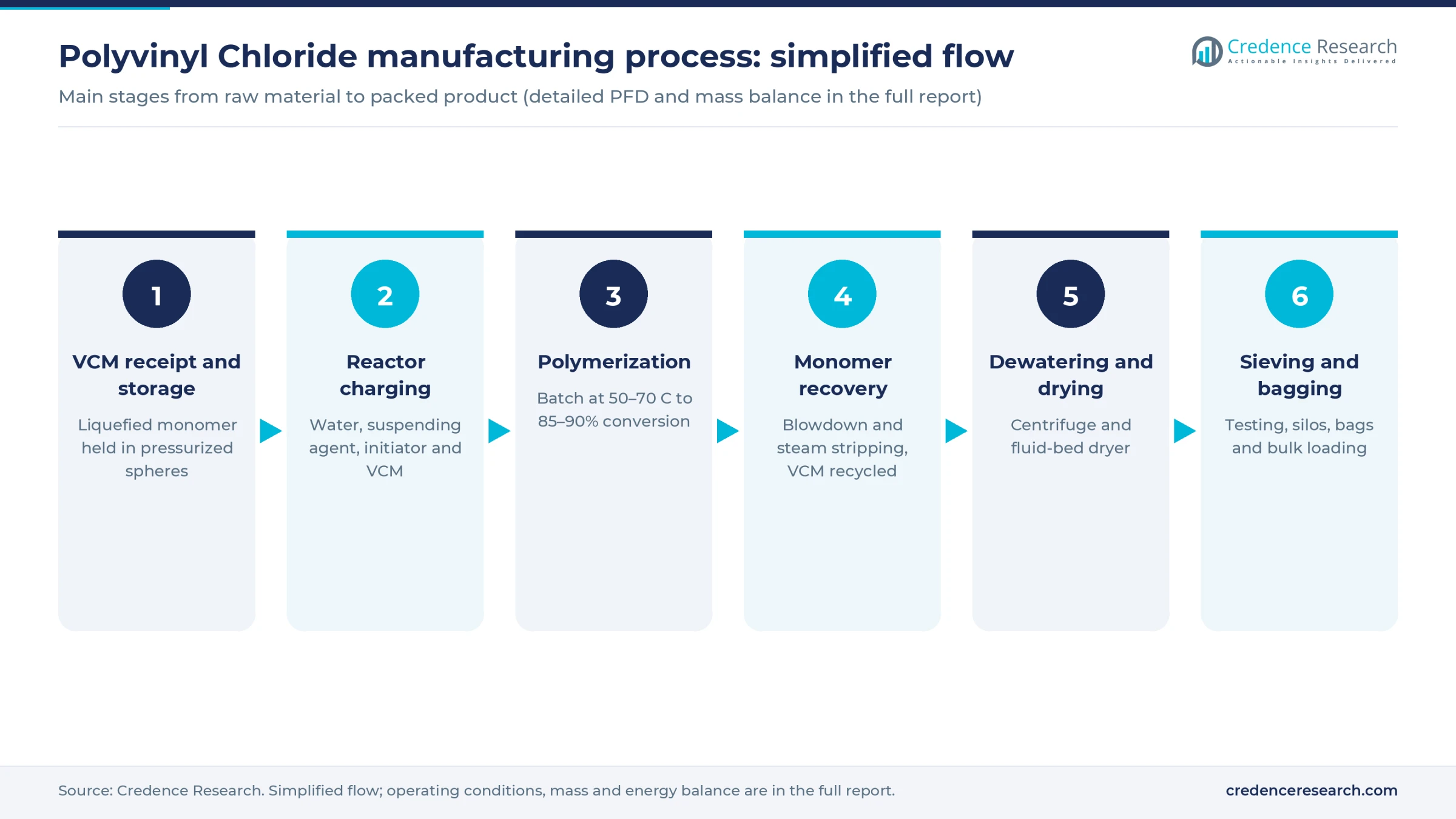
- VCM receipt and storage. Monomer arrives by ship, rail or pipeline as a liquefied gas and is held in pressurized spheres or bullets.
- Reactor charging. Demineralized water, polyvinyl alcohol or cellulose suspending agents, peroxide initiators and VCM are charged into reactors with anti-fouling coated walls, which limit wall build-up.
- Polymerization. The exothermic batch runs for roughly four to eight hours under pressure while chilled water in the jacket and reflux condensers remove heat. A short-stop agent ends the reaction at about 85–90% conversion.
- Monomer recovery and stripping. Unreacted VCM is vented to a blowdown tank, then steam stripping in a column cuts residual monomer in the slurry to parts per million. Recovered gas is compressed, condensed and fed back to the reactors.
- Dewatering and drying. Decanter centrifuges remove most of the water, and fluid-bed or flash dryers bring moisture below about 0.3%.
- Sieving, storage and bagging. Dry resin is screened, tested for K-value, bulk density, porosity and residual VCM, stored in silos and packed in 25-kilogram bags, jumbo bags or bulk trucks.
Centrifuge water and reactor rinse pass through a wastewater stripper and biological treatment, and process vents go to a thermal oxidizer.
Polyvinyl chloride plant setup cost
The reference plant makes 200,000 metric tons a year of suspension PVC, about 600 tons a day over 330 operating days, from purchased VCM delivered through a port terminal. Total CapEx is estimated at USD 170–250 million, covering land, process units, VCM storage, utilities, license, engineering, preoperative costs and working capital.
Three disclosed projects anchor the range. Chemplast Sanmar built a greenfield 170,000-ton plant at Cuddalore, India, running on imported VCM through its own marine terminal, for 6 billion rupees in 2009, about USD 125 million at an assumed 48 rupees per dollar. Scaled with a 0.6 capacity exponent and an assumed 50–60% cost escalation to 2026, that points to about USD 205–220 million. Qatar Vinyl Co. put the cost of its 350,000-ton plant at Mesaieed, fed by existing VCM units, at USD 239 million in April 2022, which scales to about USD 170 million, or USD 190–225 million after assumed escalation and a stand-alone VCM terminal. Engro Polymer and Chemicals' 100,000-ton expansion in Pakistan was estimated at USD 92.3 million in 2018, which scales to roughly USD 175–245 million depending on escalation and greenfield additions. Asian sites that share port and utility infrastructure sit at the low end, while U.S. and EU builds sit at the top.
For the land row, the plant needs about 120,000 square meters for reactors, VCM spheres with fire spacing, silos, bagging and a finished goods warehouse. At an assumed USD 20–70 per square meter, land costs USD 2.4–8.4 million, about 3% of CapEx at the midpoint.
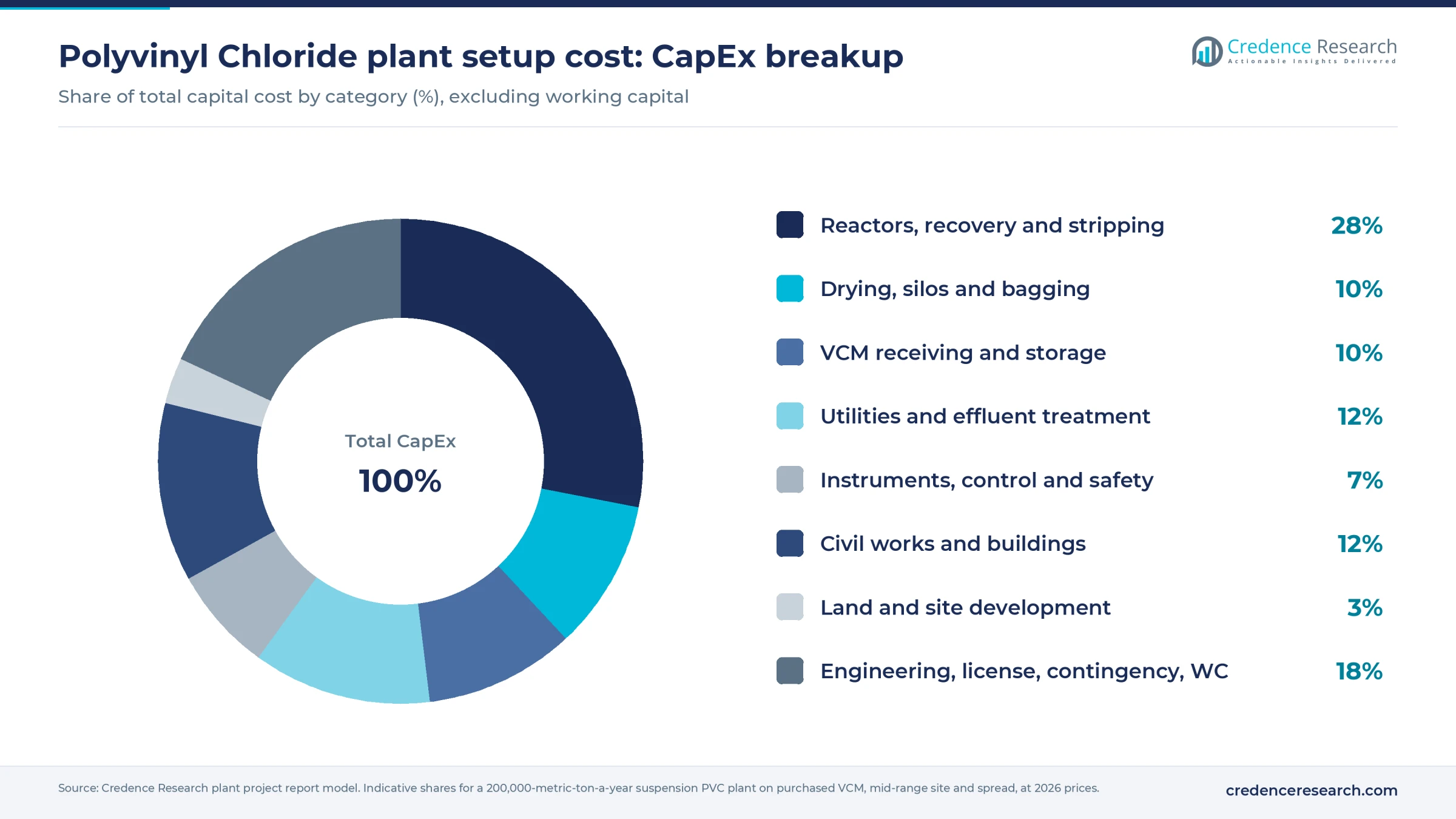
Reactors, monomer recovery and stripping take about 28% of CapEx, and engineering, license fees, contingency and working capital another 18%.
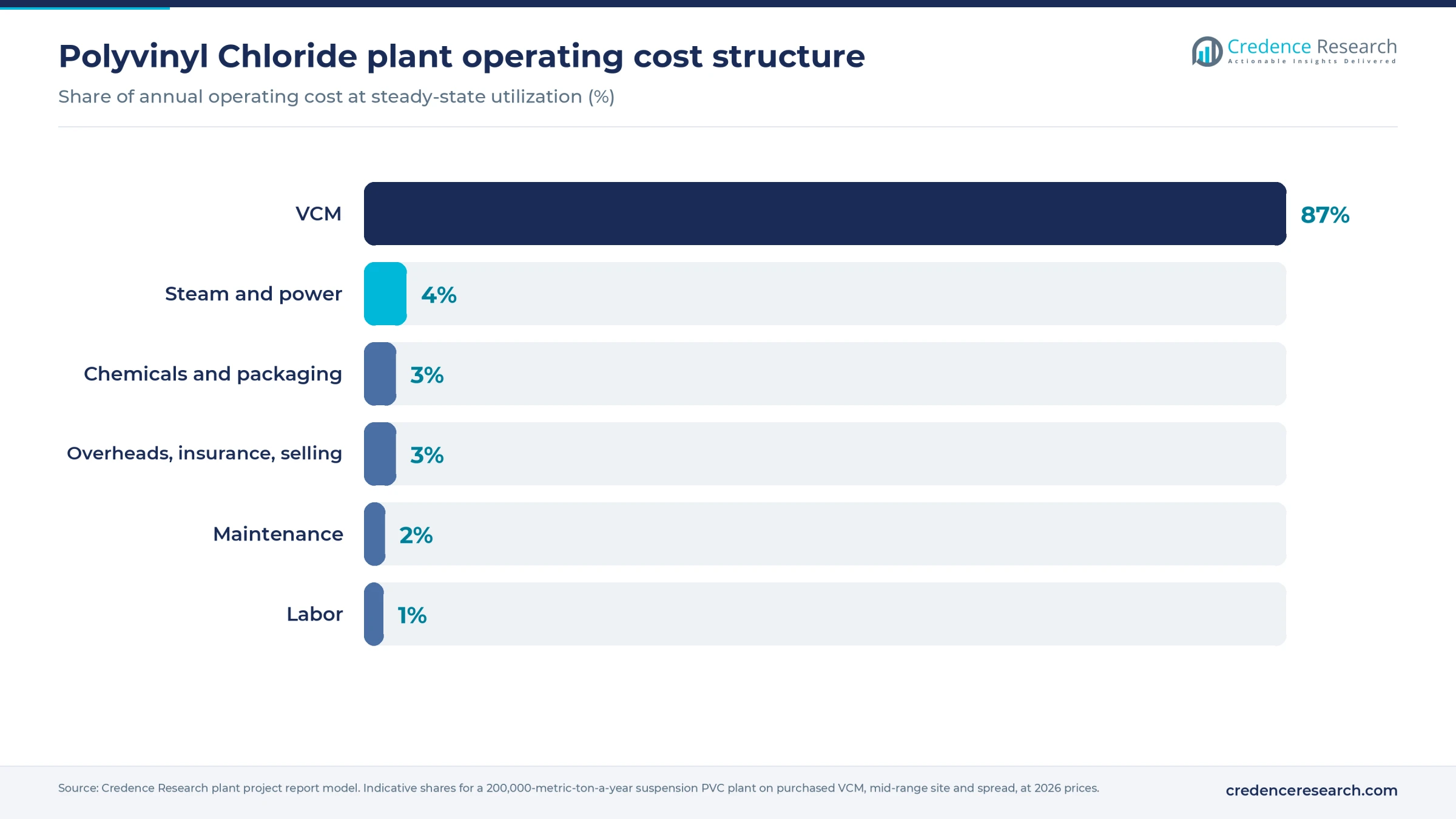
VCM makes up about 87% of operating cost in the central case, so the feedstock contract decides most of the economics. The full report can be tailored to any country or region.
Machinery and raw materials for a polyvinyl chloride plant
The main equipment groups are listed below; ratings and the full schedule are in the report.
- VCM unloading arms or rail station, pressurized storage spheres, transfer pumps and vapor recovery
- Stainless steel or clad polymerization reactors with agitators, cooling jackets, reflux condensers and an anti-fouling coating system
- Initiator and additive preparation and dosing skids, a demineralized water plant and chilled water units
- Blowdown tanks, slurry stripping column, VCM gas holder, recovery compressors and condensers
- Decanter centrifuges and a fluid-bed or flash dryer with cyclones and bag filters
- Vibrating sieves, pneumatic conveying, storage silos, automatic bagging and palletizing lines
- Wastewater VCM stripper, thermal oxidizer, steam boiler, cooling towers, nitrogen, laboratory and a distributed control system with emergency shutdown
At 90% utilization the plant uses about 181,000 tons of VCM a year, or about 1.005 tons per ton of resin. Merchant VCM is a thinner market than resin. Comtrade lists reported exports of about 3.2 million tons in 2025, led by the United States, Japan, Belgium, South Korea and the Netherlands, with Asian sellers averaging about USD 450–485 per ton. Producers without that access integrate back into chlor-alkali, ethylene dichloride and cracking, using ethylene from the U.S. Gulf Coast, the Middle East and Asia, or carbide feedstock in China. High-purity homopolymer can also be chlorinated further for CPVC hot-water pipe and fittings.
Polyvinyl chloride business profit margin and ROI
Gross margin is estimated at 10–24%, measured as the resin price minus VCM and direct conversion cost, as a share of price. A stand-alone polymerizer in an import market buys VCM at delivered prices and sells resin near import parity, so freight largely cancels out and the margin follows the PVC-VCM spread. The build uses an assumed realized price of USD 700–760 per metric ton, in line with India's 2025 import unit value of about USD 707 and CFR India quotes near USD 715 in July 2025. VCM is taken at an assumed USD 520–560 per ton delivered, against 2025 Asian export unit values of about USD 450–485 plus freight, at 1.005 tons per ton. Direct conversion for steam, power, chemicals, packaging, labor and maintenance is assumed at USD 55–70 per ton.
At 90% utilization, or 180,000 tons, revenue is about USD 131 million in the central case. Annual cash profit after an assumed USD 3–4 million of overheads ranges from about USD 8 million to USD 30 million, putting payback at about 7–11 years on mid-range CapEx of USD 210 million in central to strong spread years. In the weak case payback stretches past 20 years.
The key sensitivity is the spread. Each USD 10 per ton change moves annual gross profit by about USD 1.8 million.
| Indicator | Result |
|---|---|
| Gross margin | 10–24% |
| Payback period | 7–11 years |
| Post-tax IRR | Available in report |
| Net present value | Available in report |
| Return on investment | Available in report |
| Debt service coverage | Available in report |
| Break-even capacity use | Available in report |
How to start a polyvinyl chloride business, licenses and approvals
Approvals follow a common sequence: company and tax registration, industrial zoning and building permits in an area cleared for flammable gas storage, an air permit covering VCM emissions, wastewater approval, fire protection for pressurized monomer storage, process safety and major accident plans, worker exposure monitoring, and VCM import registration. Vinyl chloride is a known human carcinogen linked to liver angiosarcoma, so closed reactor opening, residual monomer limits and medical surveillance shape the design.
| Market | Key approvals for a PVC plant |
|---|---|
| United States | State Clean Air Act construction and Title V operating permits under the EPA emission standard for PVC and copolymers production, 40 CFR Part 63 Subpart HHHHHHH; the OSHA vinyl chloride standard, 29 CFR 1910.1017, with a 1 ppm eight-hour limit and a 5 ppm 15-minute limit; OSHA process safety management and an EPA risk management program for VCM storage; DOT hazardous materials rules |
| European Union | Integrated permit under the Industrial Emissions Directive; Seveso III screening of the VCM inventory as a flammable gas; binding exposure limit of 1 ppm for vinyl chloride monomer under the Carcinogens, Mutagens and Reprotoxic Substances Directive; REACH registration and CLP labeling of the monomer, with the polymer exempt from registration; REACH Annex XVII limit on lead in PVC articles |
| India | Environmental clearance under the EIA Notification 2006; consent to establish and operate from the state pollution control board; PESO license for VCM storage under the Static and Mobile Pressure Vessels (Unfired) Rules 2016; factory license, safety audit and on-site emergency plan under the MSIHC Rules 1989; BIS certification to IS 17658, voluntary since the quality control order was withdrawn on Nov. 12, 2025 |
The air permit and the VCM terminal usually set the timeline, since regulators review tank spacing, dispersion modeling and vent controls.
Key polyvinyl chloride manufacturers and recent developments
Shin-Etsu Chemical, through Shintech in Louisiana and Texas and units in Europe and Asia, describes itself as the world's largest PVC producer. Westlake, OxyVinyls, Formosa Plastics, INEOS Inovyn, Orbia, LG Chem and Hanwha Solutions follow among integrated chlorovinyl groups. Xinjiang Zhongtai Chemical and other Chinese makers run large carbide-based plants, while Reliance Industries, Finolex Industries, Chemplast Sanmar, Braskem, Thai Plastic and Chemicals, Engro Polymer and Qatar Vinyl serve regional markets.
- December 2025: Westlake announced the shutdown of its Aberdeen, Mississippi, PVC plant, about 1 billion pounds a year of suspension resin, with related VCM and chlor-alkali units in Louisiana.
- March 2026: Shin-Etsu approved a USD 3.4 billion expansion at Shintech's Plaquemine, Louisiana, site, adding a second ethylene unit of 625,000 tons a year, 500,000 tons of VCM and 310,000 tons of caustic soda to feed PVC output, with completion planned toward the end of 2030.
- October 2026: Westlake said it would close its Cologne PVC plant in Germany, about 165,000 tons a year, in the first quarter of 2027, citing weak demand, energy costs and Asian imports.
Integrated, low-cost chains gain share, while stand-alone plants depend on secure VCM contracts.
What's inside the Polyvinyl Chloride project report PDF
The report runs to 21 chapters. Open a chapter to see its sections.
1. Preface
2. Scope and Methodology
- 2.1 Objectives of the Study
- 2.2 Stakeholders
- 2.3 Research Methodology
- 2.4 Data Sources and Key Assumptions
3. Executive Summary
- 3.1 Market Snapshot
- 3.2 Project at a Glance (Capacity, CapEx, OpEx)
- 3.3 Key Financial Indicators (IRR, NPV, Payback, Break-even)
- 3.4 Feasibility Verdict
4. Product Overview
- 4.1 Polyvinyl Chloride Definition and Properties
- 4.2 Grades and Specifications (BIS / ISO / ASTM)
- 4.3 HS Code and Classification
- 4.4 Key Applications
- 4.5 Substitutes
5. Global Polyvinyl Chloride Market
- 5.1 Market Overview
- 5.2 Historical and Current Market Performance (Volume and Value)
- 5.3 Market Breakup by Grade / Type
- 5.4 Market Breakup by End-Use Industry
- 5.5 Market Breakup by Region
- 5.6 Market Drivers, Restraints and Trends
- 5.7 Value Chain Analysis
- 5.8 Market Forecast
6. Target Country Polyvinyl Chloride Market Analysis
- 6.1 Demand and Supply Analysis
- 6.2 Installed Capacity vs Demand Gap
- 6.3 Import Dependence
- 6.4 Demand Forecast by End-Use
7. Trade Analysis
- 7.1 Imports by Volume, Value and Country
- 7.2 Exports by Volume, Value and Country
- 7.3 Trade Balance and Opportunities
8. Price Analysis
- 8.1 Historical Polyvinyl Chloride Price Trends by Region
- 8.2 Raw Material / Feedstock Price Trends and Linkage
- 8.3 Price Forecast
- 8.4 Margins Across the Value Chain
9. Competitive Landscape
- 9.1 Market Structure
- 9.2 Key Players and Installed Capacities
- 9.3 Profiles of Key Players
- 9.4 Recent Developments (Expansions, M&A, New Plants)
10. Manufacturing Process and Technology
- 10.1 Comparison of Technology Routes
- 10.2 Selected Route and Process Flow Diagram
- 10.3 Unit Operations Involved
- 10.4 Chemical Reactions Involved
- 10.5 Mass Balance and Raw Material Requirements
- 10.6 Energy Balance
- 10.7 Quality Assurance Criteria and Technical Tests
- 10.8 By-products and Waste Handling
- 10.9 Technology Licensors / Providers
11. Project Details, Requirements and Costs
- 11.1 Land, Location and Site Development
- 11.1.1 Site Selection Criteria
- 11.1.2 Location Analysis
- 11.1.3 Land Requirement and Costs
- 11.1.4 Site Development Costs
- 11.2 Plant Layout
- 11.2.1 Layout Principles
- 11.2.2 Proposed Layout
- 11.2.3 Factors Influencing Layout
- 11.3 Civil Works and Buildings
- 11.4 Plant Machinery
- 11.4.1 Machinery Requirements and Specifications
- 11.4.2 Machinery Costs
- 11.4.3 Machinery Suppliers
- 11.5 Raw Materials
- 11.5.1 Requirements per Tonne of Output
- 11.5.2 Procurement and Sourcing
- 11.5.3 Costs
- 11.5.4 Suppliers
- 11.6 Packaging
- 11.6.1 Packaging Requirements
- 11.6.2 Packaging Costs
- 11.6.3 Packaging Suppliers
- 11.7 Storage and Material Handling
- 11.8 Transportation Requirements and Costs
- 11.9 Utilities
- 11.9.1 Power Requirements and Costs
- 11.9.2 Water Requirements and Costs
- 11.9.3 Steam, Fuel and Other Utilities
- 11.10 Manpower Requirements and Wages
12. Environment, Health, Safety and Sustainability
- 12.1 Effluent and Emissions Management
- 12.2 Hazard Classification and Safety Measures
- 12.3 Carbon Footprint
- 12.4 Green / Low-Carbon Process Options
13. Regulatory Procedures, Approvals and Certifications
- 13.1 Licences and Registrations
- 13.2 Environmental Clearances
- 13.3 Product Certifications (BIS, REACH, etc.)
- 13.4 Approval Timeline
14. Project Implementation Schedule
15. Project Economics
- 15.1 Capital Cost of the Project
- 15.2 Techno-Economic Parameters
- 15.3 Capacity Utilization and Ramp-up
- 15.4 Product Pricing and Margins
- 15.5 Income Projections
- 15.6 Expenditure Projections
- 15.7 Working Capital Requirement
- 15.8 Taxation
- 15.9 Depreciation
16. Financial Analysis
- 16.1 Projected Profit and Loss Account
- 16.2 Projected Cash Flow Statement
- 16.3 Projected Balance Sheet
- 16.4 Liquidity Analysis
- 16.5 Profitability Analysis (Payback, NPV, IRR, ROI)
- 16.6 Break-even Analysis
- 16.7 Debt Service Coverage Ratio (DSCR)
- 16.8 Sensitivity Analysis
- 16.9 Scenario and Uncertainty Analysis
17. Funding and Incentives
- 17.1 Means of Finance and Debt-Equity Structure
- 17.2 Loans and Financial Assistance
- 17.3 Government Schemes and Subsidies (PLI, State Policies)
18. Risk Assessment
- 18.1 Key Success Factors
- 18.2 Key Risk Factors
- 18.3 Risk Mitigation
19. Strategic Recommendations
20. Case Study of a Successful Venture
21. Appendix
- 21.1 Detailed Assumptions
- 21.2 Abbreviations
- 21.3 List of Tables and Figures
- 21.4 Sources
This page vs. the full report
| Data point | On this page (free) | In the full report |
|---|---|---|
| Total CapEx | One rounded range at one capacity | Exact figure at three capacities with a line-item breakup |
| CapEx breakup | Category shares (%) only | Cost, quantity and supplier for every machine |
| Operating cost | Share of raw materials, utilities and labor | Per-unit cost sheet with each input price and consumption |
| Profitability | Gross margin range and payback band | Exact IRR, NPV, ROI, break-even and DSCR |
| Financial statements | List of what is included | 10-year P&L, cash flow, balance sheet and Excel model |
| Sensitivity | One directional line | Full sensitivity and scenario tables |
| Process | Simplified flow diagram | Detailed process flow, mass and energy balance, operating conditions |
| Machinery | Names of the main machines | Specifications, capacity, cost and supplier list |
| Market | Headline size, growth and global demand | Segment, region, trade and price forecast tables |
| Suppliers and buyers | Supplier types and sourcing hubs | Named suppliers and buyers |
Polyvinyl Chloride project report: FAQs
How much does it cost to set up a PVC plant?
Should a new PVC plant buy VCM or make its own?
What is the profit margin in PVC manufacturing?
What is the payback period for a PVC plant?
Which approvals does a PVC plant need?
Which grades can one suspension PVC line make?
Where does demand for PVC resin come from?

About the analyst
Nisha Gupta, Senior Research Analyst
Nisha Gupta is a Senior Research Analyst at Credence Research Inc. who works across industry domains, including packaging, automotive parts and machinery. Her focus is the modelling engine behind each study: she builds quantitative market databases and econometric forecasting frameworks, and developed automated Excel-based market modelling templates that cut client turnaround time by 30%.
Related market research
- Polyvinyl Chloride Market Size, Share, Growth and Forecast 2032
- Polyvinyl Chloride Resins Market Size, Growth and Forecast 2032
- PVC Compound Market Size, Share, Trends and Forecast 2032
- Chlorinated Polyvinyl Chloride Market Size, Growth and Forecast 2032
- UPVC Doors Windows Market Size, Growth and Forecast 2032
- Plasticizers Market Size, Growth, Share, Trends and Forecast 2032
More plant project reports
- Vinyl Chloride Manufacturing Plant Project Report (DPR) 2026
- Neopentyl Glycol Manufacturing Plant Project Report (DPR) 2026
- Citric Acid Manufacturing Plant Project Report (DPR) 2026
- Castor Oil Processing Plant Project Report (DPR) 2026
- Styrene Manufacturing Plant Project Report (DPR) 2026
- Phosphoric Acid Manufacturing Plant Project Report (DPR) 2026