Market Overview:
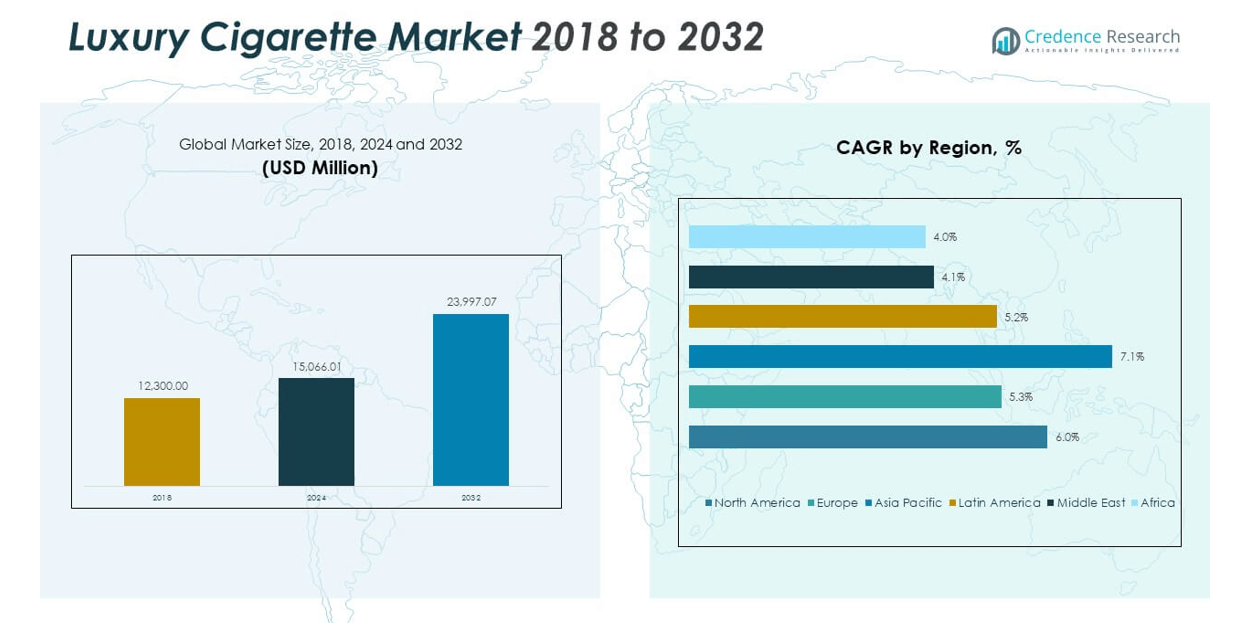
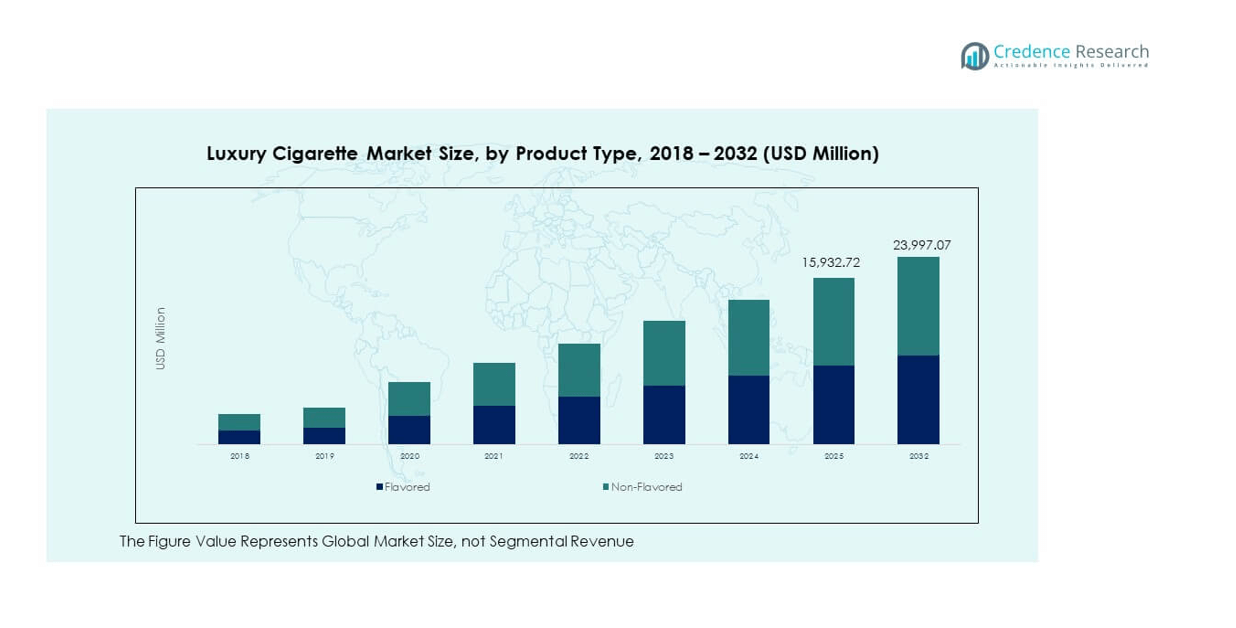
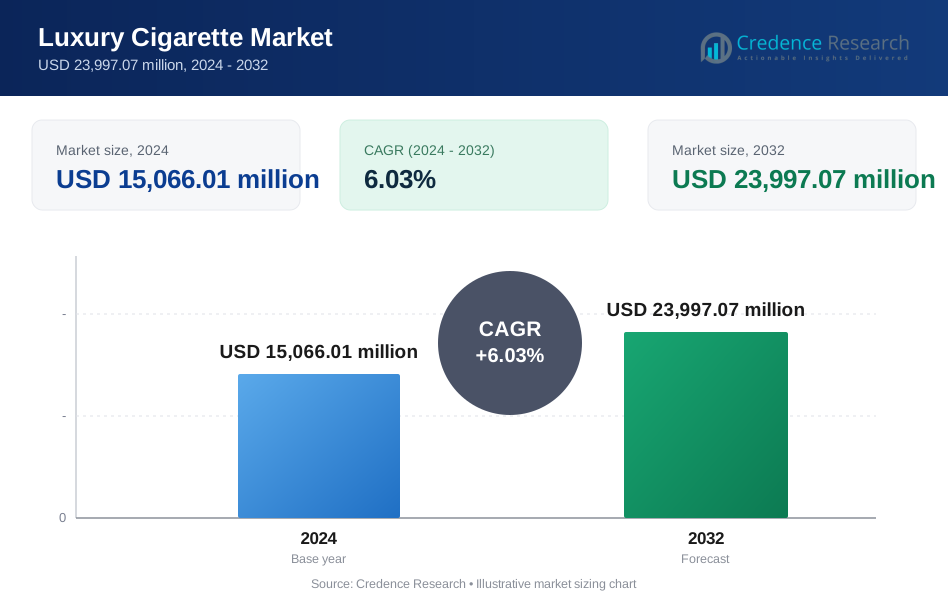
The Global Luxury Cigarette Market size was valued at USD 12,300.00 million in 2018, increasing to USD 15,066.01 million in 2024, and is anticipated to reach USD 23,997.07 million by 2032, at a CAGR of 6.03% during the forecast period.
| REPORT ATTRIBUTE | DETAILS |
|---|---|
| Historical Period | 2020-2023 |
| Base Year | 2024 |
| Forecast Period | 2025-2032 |
| Luxury Cigarette Market Size 2024 | USD 15,066.01 million |
| Luxury Cigarette Market, CAGR | 6.03% |
| Luxury Cigarette Market Size 2032 | USD 23,997.07 million |
The market growth is driven by rising consumer preference for premium and high-quality tobacco products. Growing disposable income, urbanization, and the demand for superior smoking experiences are fueling adoption. Manufacturers are emphasizing product innovation, including unique flavors, sleek packaging, and advanced filter technologies, to attract affluent consumers. Branding strategies and limited-edition launches by global tobacco companies are also strengthening market competitiveness.
Regionally, Europe holds a dominant position due to strong consumer demand for branded and premium cigarette products. North America follows, supported by established luxury brands and loyal customer bases. The Asia-Pacific region is emerging as a key growth hub, driven by rising income levels, urban lifestyle shifts, and expanding tobacco retail networks in countries such as China, Japan, and South Korea.
Market Insights:
- The Global Luxury Cigarette Market was valued at USD 12,300.00 million in 2018, increased to USD 15,066.01 million in 2024, and is projected to reach USD 23,997.07 million by 2032, growing at a CAGR of 6.03% during the forecast period.
- Asia Pacific (34%), North America (32%), and Europe (23%) together dominate the global market, driven by strong brand presence, mature retail channels, and high consumer spending on premium tobacco products.
- Asia Pacific is the fastest-growing region, supported by rising disposable incomes, urbanization, and growing preference for luxury lifestyle products in China, Japan, and South Korea.
- The flavored segment accounts for around 55% of total market revenue, driven by consumer demand for enhanced aroma, smooth taste, and diverse product innovation.
- The non-flavored segment holds nearly 45% share, appealing to traditional smokers valuing authenticity, classic blends, and brand heritage across established markets.
Market Drivers:
Rising Disposable Income and Growing Demand for Premium Tobacco Experiences
Increasing disposable income among consumers is fueling the demand for high-end tobacco products. The Global Luxury Cigarette Market benefits from growing urbanization and shifting lifestyle choices among affluent populations. Consumers associate premium cigarettes with social status and exclusivity, encouraging them to explore distinctive brands. Manufacturers are capitalizing on this by launching sophisticated products with innovative packaging and refined flavor blends. Global tobacco companies are targeting premium segments through brand diversification. Demand for luxury smoking experiences is rising in emerging economies, further strengthening global sales. Marketing campaigns emphasize craftsmanship and heritage to attract loyal customers. The market’s steady growth reflects changing consumer perceptions of luxury consumption.
- For instance, British American Tobacco’s South Korean subsidiary BAT Rothmans launched three new Dunhill Global Editions in May 2025, featuring New York, Paris, and London-inspired blends with dual-capsule technology, advanced aroma-pack design, and precise tar/nicotine ratios tailored to premium buyers.
Product Innovation and Expansion of High-End Offerings Across Leading Brands
Manufacturers are focusing on product differentiation to attract discerning consumers. The Global Luxury Cigarette Market is seeing increased innovation in filter design, tobacco sourcing, and sensory enhancement. Premium blends using natural ingredients are gaining preference among quality-conscious users. Companies are investing in modern packaging aesthetics, limited editions, and personalization features. These strategies help brands maintain exclusivity and justify premium pricing. Investments in advanced production technologies ensure consistent product quality across regions. Brand collaborations with luxury fashion and lifestyle entities are creating unique market appeal. This combination of innovation and design sophistication supports sustained premium growth.
- For instance, Japan Tobacco International (JTI) is prioritizing its Ploom brand in travel retail for 2025, with a continued rollout of the Ploom AURA heated tobacco device in locations like Japan and Dubai. This expansion responds to the growing demand for reduced-risk products among duty-free buyers, with JTI committing significant investment to the heated tobacco segment between 2025 and 2027.
Influence of Western Culture and Rising Urban Lifestyles in Developing Nations
The adoption of Western habits is influencing smoking patterns in Asia-Pacific, the Middle East, and Africa. The Global Luxury Cigarette Market benefits from rapid urban expansion and aspirational consumer behavior. Younger demographics are more willing to spend on luxury products that reflect identity and taste. International travel and exposure to global luxury trends reinforce the demand for imported cigarette brands. Urbanization and digitized retail channels make premium cigarettes more accessible. Advertising campaigns featuring lifestyle influencers further normalize luxury consumption. Retail expansions in airports and duty-free shops are key growth contributors. The cultural shift toward sophistication and individuality continues to drive product demand.
Brand Loyalty, Emotional Connection, and Strategic Premium Branding Efforts
Tobacco companies are emphasizing emotional branding to retain customers in a competitive environment. The Global Luxury Cigarette Market is witnessing deeper brand engagement through storytelling and heritage-driven promotion. Premium brands such as Dunhill, Davidoff, and Cartier are positioning cigarettes as lifestyle icons. Emotional marketing connects personal identity with brand heritage and craftsmanship. Loyalty programs and exclusive events strengthen brand attachment. Companies use meticulous quality control and signature packaging to maintain prestige. Limited-edition launches create urgency and exclusivity, enhancing consumer appeal. Strong brand identity ensures consistent customer retention in luxury markets.
Market Trends:
Growing Shift Toward Sustainable and Eco-Friendly Luxury Cigarette Production
Manufacturers are adopting sustainable practices to meet evolving consumer values. The Global Luxury Cigarette Market is transitioning toward eco-conscious production and biodegradable materials. Paper-based packaging and reduced plastic usage appeal to environmentally aware buyers. Companies are investing in renewable tobacco cultivation methods to reduce their carbon footprint. Ethical sourcing certifications are becoming a marketing advantage in mature markets. Premium brands highlight sustainability as part of their identity to align with modern luxury principles. This trend reflects consumers’ growing preference for brands committed to environmental responsibility. The balance between luxury appeal and ecological impact defines the next phase of brand evolution.
- For instance, in March 2024, Philip Morris International launched the IQOS ILUMA i device in Japan with an aluminum door produced from renewable energy and a PRIME wrap made of 100% recycled plastic, along with other design improvements intended to reduce electronic waste and plastic usage in next-generation heated tobacco devices.
Digital Retail Expansion and the Rise of Online Premium Tobacco Platforms
Digitalization is transforming the buying experience for premium tobacco products. The Global Luxury Cigarette Market is seeing rapid online retail expansion, offering convenience and privacy. E-commerce platforms and brand-owned websites allow direct access to curated collections. Retailers use digital marketing, virtual tours, and premium subscriptions to engage buyers. Online availability is helping brands reach international consumers efficiently. Enhanced payment systems and secure delivery options build buyer trust. Personalized online recommendations elevate the customer journey and support brand loyalty. Digital growth strengthens global reach and reduces dependence on traditional retail stores.
- For instance, Davidoff Cigars reopened its flagship Madison Avenue boutique in August 2025 following a complete renovation. The new and reimagined space, originally opened in 1987, is designed to create a more immersive and elevated shopping experience, reflecting a trend towards enhancing the physical retail space within a broader omnichannel strategy. The renovated boutique features a striking glass walk-in humidor and new lounges.
Increasing Customization and Personalization in Cigarette Design and Packaging
The demand for custom-designed luxury cigarettes is reshaping the market landscape. The Global Luxury Cigarette Market benefits from personalization features that cater to individual taste and style. Companies now offer engraved cases, signature scents, and tailored blends. Personalized packaging adds emotional value and strengthens brand differentiation. These bespoke offerings attract elite customers seeking exclusivity. Manufacturers use design innovation to connect smoking with art, luxury, and identity. Customization enhances the perception of value, allowing brands to command higher prices. This trend reinforces the premium positioning of leading cigarette producers.
Integration of Technology and Smart Packaging in Premium Cigarette Brands
Technology integration is reshaping the premium tobacco experience. The Global Luxury Cigarette Market is witnessing the adoption of smart packaging and digital authenticity features. QR codes and NFC tags help buyers verify product origin and prevent counterfeiting. Smart packaging also supports digital loyalty programs and limited-edition promotions. Brands are investing in digital engagement tools that enhance customer relationships. Such technology-driven initiatives create transparency and strengthen brand credibility. Smart retail displays and AR-based product showcases improve consumer interaction. These advancements align traditional luxury branding with modern digital innovation.
Market Challenges Analysis:
Stringent Regulatory Policies and Growing Global Anti-Smoking Campaigns
Governments are implementing strict regulations on tobacco advertising and product labeling. The Global Luxury Cigarette Market faces rising restrictions on marketing, distribution, and public smoking. Health warnings and plain packaging mandates are reducing brand visibility in several countries. Tax increases on tobacco products are affecting price-sensitive consumers in emerging regions. Global anti-smoking movements and awareness campaigns discourage cigarette consumption. Companies must adapt to evolving health policies without compromising product identity. Legal compliance adds complexity to global operations and branding efforts. These regulatory barriers are expected to limit market expansion in certain territories.
Changing Consumer Perception and the Rise of Alternative Nicotine Products
Consumer preferences are gradually shifting toward reduced-risk alternatives such as e-cigarettes and heated tobacco. The Global Luxury Cigarette Market is witnessing reduced loyalty among health-conscious consumers. Increased awareness of health hazards and lifestyle diseases is driving substitution. Premium tobacco users are exploring smoke-free experiences that retain luxury appeal. The emergence of nicotine pouches and vaping devices adds competitive pressure. Innovation and adaptation are crucial for traditional cigarette brands to remain relevant. Companies must balance heritage with health-focused modernization strategies. Sustaining brand prestige amid evolving consumption patterns remains a key challenge.
Market Opportunities:
Expansion in Emerging Economies and Demand for Premium Lifestyle Products
Rising urbanization and wealth growth in Asia-Pacific, Latin America, and the Middle East are creating strong market opportunities. The Global Luxury Cigarette Market is positioned to benefit from changing lifestyle aspirations and growing middle-class populations. Increased tourism and travel retail also support the visibility of premium brands. Local partnerships and distribution expansions in emerging economies are enhancing access. Strategic investments in luxury lounges, airport stores, and exclusive outlets attract affluent customers. The aspirational appeal of Western luxury continues to drive adoption. Market players can capitalize on cultural alignment and localized branding strategies. Sustained demand for exclusivity and prestige ensures long-term market growth.
Innovation in Product Design and Transition Toward Sustainable Premium Offerings
Manufacturers are focusing on innovation to meet evolving consumer values. The Global Luxury Cigarette Market presents opportunities for eco-conscious designs and biodegradable materials. Premium brands can differentiate through sustainability commitments without compromising luxury appeal. Advancements in filter technology and organic tobacco sourcing create unique selling points. Collaboration with technology and fashion brands can expand visibility and attract new demographics. Investments in environmentally friendly packaging enhance brand reputation. Sustainable innovation ensures alignment with future regulatory expectations. This opportunity positions brands for responsible and profitable expansion.
Market Segmentation Analysis:
By Product Type
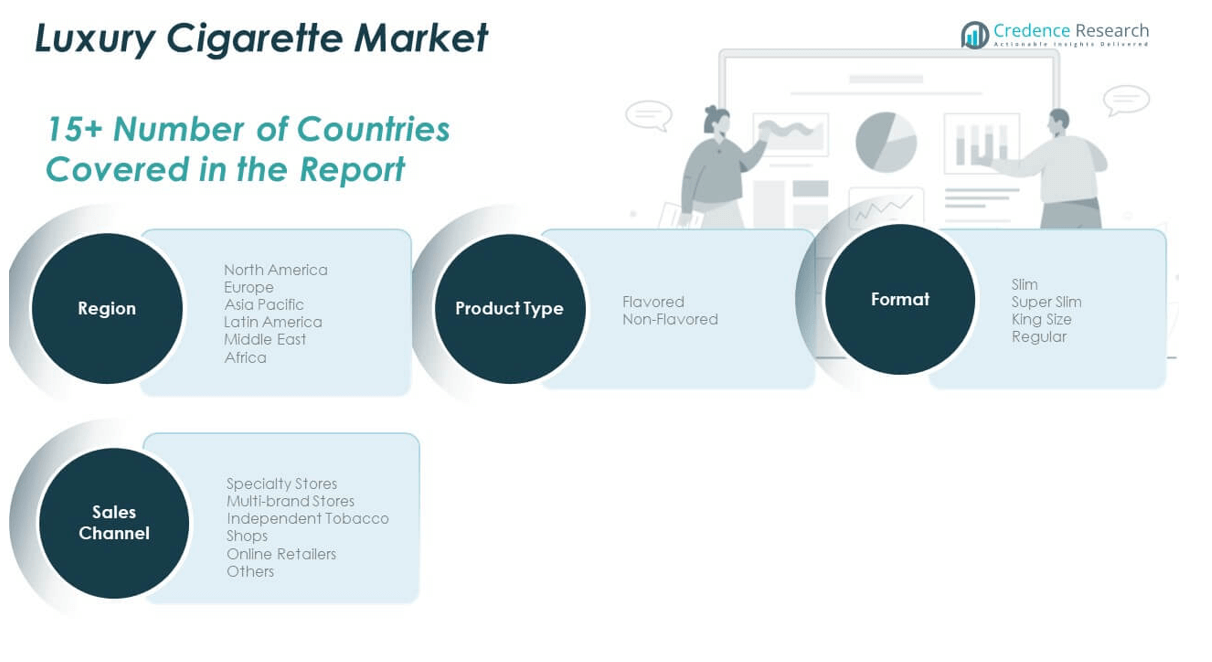
The Global Luxury Cigarette Market is segmented into flavored and non-flavored variants. Flavored cigarettes dominate the premium category due to consumer preference for rich aromas and smooth taste profiles. They attract younger demographics seeking distinct sensory experiences. Non-flavored products retain steady demand among traditional users valuing authenticity and tobacco purity. Leading brands focus on premium tobacco blends and refined flavor combinations to maintain loyalty. The segment balance reflects varying regional preferences and evolving consumption patterns. Product diversification supports sustained market engagement and broader audience reach.
By Format
The market is divided into slim, super slim, king size, and regular formats. Slim and super slim cigarettes hold strong appeal among urban consumers, driven by their sleek design and perceived sophistication. King size formats remain popular in regions valuing traditional smoking habits. Regular formats sustain presence through established user bases and affordability within the luxury tier. Manufacturers continue to innovate designs and packaging aesthetics to enhance visual identity. Format differentiation enables brands to target diverse income levels and cultural preferences effectively.
- For instance, KT&G launched four new premium ESSE Superslim products in India in May 2025, featuring ultra-slim design and contemporary packaging, with distribution channels expanding through quick commerce and modern retail networks to reach urban markets and digitally active buyers.
By Sales Channel
Sales channels include specialty stores, multi-brand outlets, independent tobacco shops, online retailers, and others. Specialty and multi-brand stores dominate due to curated collections and personalized services. Independent tobacco shops maintain consistent regional loyalty. Online retailers are expanding due to convenience, privacy, and access to exclusive editions. It benefits from digital retail strategies, offering seamless purchase experiences. Brands leverage e-commerce to strengthen customer engagement and enhance global accessibility.
Segmentation:
- By Product Type
- Flavored
- Non-Flavored
- By Format
- Slim
- Super Slim
- King Size
- Regular
- By Sales Channel
- Specialty Stores
- Multi-brand Stores
- Independent Tobacco Shops
- Online Retailers
- Others
- By Region
- North America
- U.S.
- Canada
- Europe
- Germany
- France
- Italy
- U.K.
- Russia
- Rest of Europe
- Asia-Pacific
- India
- China
- Japan
- Rest of Asia-Pacific
- Latin America
- Brazil
- Mexico
- Rest of Latin America
- Middle East and Africa
- GCC Countries
- South Africa
- Rest of Middle East and Africa
- North America
Regional Analysis:
North America
The North America Global Luxury Cigarette Market size was valued at USD 4,009.80 million in 2018, rising to USD 4,845.14 million in 2024, and is anticipated to reach USD 7,705.50 million by 2032, at a CAGR of 6.0% during the forecast period. North America holds around 32% market share. The region benefits from established premium brands, a strong retail infrastructure, and high disposable incomes. Consumers prioritize refined tobacco blends and innovative packaging aesthetics. The U.S. remains the key revenue hub due to robust brand presence and demand for personalized luxury products. Canada follows with growing adoption of premium offerings emphasizing sustainable production. Marketing strategies focus on heritage, craftsmanship, and exclusivity to attract loyal customers. High brand awareness and consumer sophistication sustain consistent market growth.
Europe
The Europe Global Luxury Cigarette Market size was valued at USD 3,124.20 million in 2018, increasing to USD 3,672.68 million in 2024, and is expected to reach USD 5,513.39 million by 2032, at a CAGR of 5.3% during the forecast period. Europe contributes nearly 23% market share. It remains a mature market with strong demand for traditional and premium cigarette formats. Countries like the UK, France, and Germany lead consumption due to established luxury smoking culture. Regulatory standards encourage product quality and innovation among top brands. European consumers favor craftsmanship, fine tobacco blends, and aesthetic appeal. Manufacturers focus on limited editions and cultural branding to retain exclusivity. Stable economic conditions and luxury retail access continue to support the market trajectory.
Asia Pacific
The Asia Pacific Global Luxury Cigarette Market size was valued at USD 3,616.20 million in 2018, growing to USD 4,592.81 million in 2024, and is projected to reach USD 7,950.25 million by 2032, at a CAGR of 7.1% during the forecast period. Asia Pacific dominates with about 34% market share. Rising disposable incomes and rapid urbanization are fueling luxury consumption. China, Japan, and South Korea are the key contributors, with expanding premium retail networks. The market benefits from cultural influence and growing preference for exclusive lifestyle products. Local manufacturers are collaborating with global brands to expand presence. Digitized distribution channels are driving convenience and accessibility. Evolving social trends and aspirational consumerism strengthen the region’s leadership.
Latin America
The Latin America Global Luxury Cigarette Market size was valued at USD 885.60 million in 2018, growing to USD 1,075.56 million in 2024, and is expected to reach USD 1,604.68 million by 2032, at a CAGR of 5.2% during the forecast period. Latin America holds around 7% market share. The market is expanding due to changing lifestyle patterns and increasing acceptance of premium tobacco products. Brazil and Argentina lead regional demand with growing urban middle-class populations. International brands are strengthening distribution through duty-free and specialty retail stores. Economic improvements are fostering brand adoption among affluent consumers. Manufacturers are investing in local production and promotional campaigns. The region’s youthful demographics are driving long-term potential for luxury cigarette consumption.
Middle East
The Middle East Global Luxury Cigarette Market size was valued at USD 344.40 million in 2018, rising to USD 385.59 million in 2024, and is anticipated to reach USD 530.47 million by 2032, at a CAGR of 4.1% during the forecast period. The region accounts for nearly 2% market share. Demand is concentrated in GCC nations, driven by premium hospitality and tourism sectors. Luxury smoking lounges and airport retail contribute significantly to revenue. Consumers prefer international brands that emphasize exclusivity and refined taste. The UAE and Saudi Arabia lead in high-end cigarette imports. Companies focus on niche branding aligned with cultural sophistication. Stable income levels and lifestyle diversification encourage gradual market growth.
Africa
The Africa Global Luxury Cigarette Market size was valued at USD 319.80 million in 2018, increasing to USD 494.23 million in 2024, and is projected to reach USD 692.78 million by 2032, at a CAGR of 4.0% during the forecast period. Africa represents about 2% market share. The region is witnessing steady growth supported by urbanization and rising consumer spending. South Africa remains the leading market with established brand presence and retail access. Nigeria and Egypt are emerging with expanding middle-income groups. Companies are introducing smaller pack sizes and targeted promotions to capture demand. Premium cigarette awareness is increasing among young professionals. Distribution improvements and evolving lifestyles are strengthening regional market participation.
Key Player Analysis:
- Reynolds American Inc.
- Imperial Tobacco Group
- J. Reynolds Tobacco Company
- Parliament Hybrid
- ITG Brands
- The Chancellor Tobacco Company
- China Tobacco
- JTI-Macdonald Corp.
- British American Tobacco PLC
- Philip Morris USA Inc.
- Thailand Tobacco Monopoly
- Wilh. von Eicken GmbH
- The Nat Sherman Company
- Gallaher Group
Competitive Analysis:
The Global Luxury Cigarette Market is characterized by strong competition among established international tobacco brands. It features a mix of premium heritage manufacturers and emerging niche brands focused on innovation. Companies such as Philip Morris, British American Tobacco, and Japan Tobacco International dominate through brand prestige, product innovation, and wide distribution networks. Leading firms emphasize flavor diversity, sleek design, and advanced filtration to sustain market leadership. Strategic marketing, regional expansion, and consumer loyalty programs enhance brand visibility. New entrants face high barriers due to regulations, brand dominance, and consumer preferences. The market’s competitive environment is defined by quality, exclusivity, and evolving lifestyle appeal.
Recent Developments:
- In August 2025, Reynolds American Inc. planned the launch of “Vuse One,” a new disposable synthetic nicotine e-cigarette, in Florida, Georgia, and South Carolina. The product aims to target diverse consumer preferences with fruit flavors such as Raspberry Chill, Watermelon Chill, and Berry-Melon. This launch is part of their effort to expand their luxury and premium portfolio despite ongoing regulatory challenges, with sales expected to commence in late Q4 2025.
- In June and April 2025, British American Tobacco PLC (BAT), through its U.S. subsidiary R.J. Reynolds Vapor Company, acquired a total of fifteen PACHA synthetic vape products from Charlie's Holdings. The acquisitions comprised twelve products acquired in April and three more in June, with a total price of $6.5 million and additional contingent payments based on commercialization volume. These products are supported by FDA premarket tobacco applications, allowing BAT to test market them in the U.S. legal luxury segment.
Report Coverage:
The research report offers an in-depth analysis based on product type, format, and sales channel. It details leading market players, providing an overview of their business, product offerings, investments, revenue streams, and key applications. Additionally, the report includes insights into the competitive environment, SWOT analysis, current market trends, as well as the primary drivers and constraints. Furthermore, it discusses various factors that have driven market expansion in recent years. The report also explores market dynamics, regulatory scenarios, and technological advancements that are shaping the industry. It assesses the impact of external factors and global economic changes on market growth. Lastly, it provides strategic recommendations for new entrants and established companies to navigate the complexities of the market.
Future Outlook:
- Growing demand for premium and eco-friendly cigarette variants will drive brand innovation.
- Consumer preference for luxury experiences will support expansion of high-end tobacco lines.
- Digital sales channels and e-commerce will strengthen global product accessibility.
- Emerging economies in Asia-Pacific will lead new demand growth.
- Regulatory compliance and sustainability commitments will shape production strategies.
- Product personalization and limited-edition collections will attract affluent consumers.
- Strategic alliances with fashion and lifestyle brands will enhance brand image.
- Smart packaging and digital authentication will boost product transparency.
- Airport retail and travel-exclusive offerings will remain strong revenue streams.
- Evolving social trends and premium branding will sustain steady global market expansion.
Request a Free Sample
Fill in your details and we'll send you a free sample report.
- Sample data tables & charts
- Research methodology
Market Dynamics
Rising Disposable Income and Urbanization
Increasing disposable incomes and rapid urbanization, especially in Asia-Pacific and Latin America, are enabling more consumers to afford premium tobacco products, fueling demand for luxury cigarettes as symbols of status and lifestyle.
Product Innovation and Premiumization
Manufacturers are differentiating through unique flavors, advanced filter technologies, and sleek packaging, attracting affluent consumers seeking superior smoking experiences and justifying higher price points.
Branding, Exclusivity, and Limited Editions
Strategic branding efforts, including limited-edition launches and collaborations with luxury lifestyle brands, are enhancing the exclusivity and desirability of luxury cigarette products, strengthening consumer loyalty and market competitiveness.
Expansion of Digital and Specialty Retail Channels
The growth of e-commerce, online premium tobacco platforms, and curated specialty stores is making luxury cigarettes more accessible to global consumers, supporting market expansion beyond traditional retail environments.
Influence of Western Culture and Lifestyle Trends
The adoption of Western luxury consumption habits and aspirational lifestyles in emerging markets is increasing demand for branded, high-end cigarette products, particularly among younger, urban demographics.
Need a Custom Version of This Report?
Tailor the scope, geography, or segments to your exact requirements.
- Custom geography or segment scope
- Direct access to our analyst team
Frequently Asked Questions
What is the current market size for Global Luxury Cigarette Market, and what is its projected size in 2032?
At what Compound Annual Growth Rate is the Global Luxury Cigarette Market projected to grow between 2025 and 2032?
What is the major growth driving factors for global Luxury Cigarette market?
Which is major segment in Luxury Cigarette market by end-user?
Who are the leading companies in the Global Luxury Cigarette Market?.
Table of Content
Chapter 1 Market Segmentation
- 1.1 Segmentation Framework
- 1.1.1 Product and Service Classification
- 1.1.2 Application and End-Use Classification
- 1.1.3 Technology and Solution Classification
- 1.1.4 Customer and Distribution Channel Classification
- 1.1.5 Geographic Segmentation
- 1.1.6 Market Segment Definitions and Boundaries
- 1.2 By Format
- 1.2.1 Slim
- 1.2.2 Super Slim
- 1.2.3 King Size
- 1.2.4 Regular
- 1.3 By Product Type
- 1.3.1 Flavored
- 1.3.2 Non-Flavored
- 1.4 By Sales Channel
- 1.4.1 Specialty Stores
- 1.4.2 Multi-brand Stores
- 1.4.3 Independent Tobacco Shops
- 1.4.4 Online Retailers
- 1.4.5 Others
Chapter 2 Introduction
- 2.1 Report Objectives and Scope
- 2.2 Product Definition and Industry Terminology
- 2.3 Market Inclusions and Exclusions
- 2.4 Research Process
- 2.4.1 Primary Research and Expert Interviews
- 2.4.2 Secondary Research and Source Review
- 2.4.3 Top-Down and Bottom-Up Estimation
- 2.4.4 Data Triangulation and Verification
- 2.5 Market Size Measurement Basis
- 2.5.1 2024: USD 15,066.01 million → 2032: USD 23,997.07 million
- 2.6 Historical and Forecast Reference Periods
- 2.6.1 Base Year: 2024
- 2.6.2 Forecast Period: 2024-2032
- 2.7 Research Assumptions and Limitations
Chapter 3 Executive Summary
- 3.1 Market Snapshot and Key Findings
- 3.2 Base-Year Market Size, 2024
- 3.3 Forecast Market Size, 2032
- 3.4 Revenue and Volume Growth Outlook
- 3.5 Key Demand and Supply Indicators
- 3.6 Leading Market Segments
- 3.7 Fastest-Growing Market Opportunities
- 3.8 Regional Performance Highlights
- 3.9 Technology and Industry Transformation
- 3.10 Competitive Landscape Summary
- 3.11 Analyst View and Strategic Implications
Chapter 4 Global Luxury Cigarette Market Trends and Developments
- 4.1 Historical Industry Development
- 4.2 Recent Market Trends and Developments
- 4.3 Demand and Customer Behavior Trends
- 4.4 Technology and Product Innovation
- 4.5 Artificial Intelligence, Automation and Digitalization
- 4.6 Local Manufacturing and Supply Chain Realignment
- 4.7 Industry Partnerships, Mergers and Acquisitions
- 4.8 Sustainability and Circular Economy Developments
- 4.9 Government and Private Sector Investment Trends
- 4.10 Emerging Business Models and Commercialization
- 4.11 Industry Developments and Announcements
Chapter 5 Global Luxury Cigarette Market Production, Supply and Demand Analysis
- 5.1 Demand Trend and Consumption Analysis
- 5.2 Demand Forecast, 2024-2032
- 5.3 Production and Output Trend
- 5.4 Production and Output Forecast, 2024-2032
- 5.5 Installed Capacity and Capacity Utilization
- 5.6 Company-Wise Production Plants and Statistics
- 5.6.1 Installed Production Capacity
- 5.6.2 Actual Production
- 5.6.3 Planned Capacity and Expansion Targets
- 5.7 Supply Chain Structure and Procurement Trends
- 5.8 Supply-Demand Gap and Bottlenecks
- 5.9 Import Dependence and Sourcing Structure
- 5.10 Contract Manufacturing and Outsourcing
- 5.11 Regional Supply and Demand Concentration
Chapter 6 Global Luxury Cigarette Market Pricing Analysis
- 6.1 Pricing Structure and Measurement
- 6.2 Historical Pricing Trends
- 6.3 Pricing Outlook, 2024-2032
- 6.4 Average Selling Price and Unit Economics
- 6.5 Pricing by Product and Market Segment
- 6.6 Geographic Pricing Differences
- 6.7 Key Input, Energy, Labor and Logistics Costs
- 6.8 Contract Pricing and Purchasing Models
- 6.9 Pricing Sensitivity and Competitive Positioning
- 6.10 Price, Margin and Profitability Implications
Chapter 7 Global Luxury Cigarette Market Dynamics
- 7.1 Market Growth Drivers
- 7.1.1 Demand-Side Drivers
- 7.1.2 Technology and Innovation Drivers
- 7.1.3 Infrastructure and Investment Drivers
- 7.1.4 Regulatory and Policy Drivers
- 7.2 Market Restraints
- 7.2.1 Cost and Affordability Constraints
- 7.2.2 Technology and Adoption Barriers
- 7.2.3 Supply Chain and Operational Constraints
- 7.3 Market Challenges
- 7.3.1 Competitive Pressure and Margin Erosion
- 7.3.2 Skills, Infrastructure and Implementation Gaps
- 7.4 Emerging Market Opportunities
- 7.5 Market Dynamics Impact and Time-Horizon Assessment
Chapter 8 Global Luxury Cigarette Value Chain Analysis
- 8.1 Industry Value Chain Overview
- 8.2 Upstream Suppliers and Critical Inputs
- 8.3 Technology and Component Providers
- 8.4 Manufacturing or Service Delivery
- 8.5 Distribution, Channel Partners and Integrators
- 8.6 Downstream Applications and End Users
- 8.7 Value Addition and Profit Pools
- 8.8 Vertical Integration and Outsourcing
- 8.9 Supplier Concentration and Risk
- 8.10 Supply Chain Localization and Resilience
Chapter 9 Global Luxury Cigarette Market Regulations and Policies
- 9.1 Relevant Laws, Standards and Compliance Frameworks
- 9.2 Product, Service, Safety and Quality Requirements
- 9.3 Government Policies, Incentives and Subsidies
- 9.4 Imports, Exports and Trade Barriers
- 9.5 Public Procurement and Local Content Requirements
- 9.6 Environmental and Sustainability Compliance
- 9.7 Upcoming Policy Changes and Market Implications
Chapter 10 Global Luxury Cigarette Market Hotspots and Opportunities
- 10.1 Market Opportunity Mapping and Growth Hotspots
- 10.2 High-Growth Applications and Customer Groups
- 10.3 Underserved Markets and White-Space Opportunities
- 10.4 Emerging Technology and Product Opportunities
- 10.5 New Capacity and Investment Hotspots
- 10.6 Market Entry and Expansion Opportunities
- 10.7 Distribution and Partnership Opportunities
- 10.8 Near-Term and Long-Term Commercial Potential
- 10.9 Opportunity Attractiveness and Execution Risks
Chapter 11 Global Luxury Cigarette Market Outlook, 2024-2032
- 11.1 Market Size and Analysis
- 11.1.1 Revenue (Market Measurement: 2024: USD 15,066.01 million → 2032: USD 23,997.07 million)
- 11.1.2 Market Volume and Quantity Sold
- 11.1.3 Historical Market Size
- 11.1.4 Base-Year Market Size, 2024
- 11.2 Market Forecast, 2024-2032
- 11.2.1 Revenue Forecast to 2032
- 11.2.2 Volume Forecast to 2032
- 11.2.3 CAGR and Year-on-Year Growth
- 11.2.4 Incremental Revenue Opportunity
- 11.3 Forecast Assumptions and Scenario Analysis
- 11.3.1 Base-Case Forecast
- 11.3.2 Optimistic and Conservative Scenarios
- 11.3.3 Technology, Pricing and Policy Sensitivities
- 11.4 Market Attractiveness and Growth Outlook
Chapter 12 Global Luxury Cigarette Market Segmentation and Outlook
- 12.1 Segmentation Summary and Market Shares, 2024
- 12.2 Largest and Fastest-Growing Segments
- 12.3 By Format - Market Size and Forecast, 2024-2032
- 12.3.1 Segment Definition and Scope
- 12.3.2 Historical Market Size
- 12.3.3 Revenue Forecast, 2024-2032
- 12.3.4 Volume Forecast, 2024-2032
- 12.3.5 Base-Year Market Share, 2024
- 12.3.6 Segment CAGR and Growth Drivers
- 12.3.7 Subsegment Market Size and Forecast
- 12.3.7.1 Slim
- 12.3.7.2 Super Slim
- 12.3.7.3 King Size
- 12.3.7.4 Regular
- 12.3.8 Subsegment Pricing and Adoption Trends
- 12.3.9 Leading Suppliers and Competition
- 12.3.10 Regional Demand and Opportunities
- 12.4 By Product Type - Market Size and Forecast, 2024-2032
- 12.4.1 Segment Definition and Scope
- 12.4.2 Historical Market Size
- 12.4.3 Revenue Forecast, 2024-2032
- 12.4.4 Volume Forecast, 2024-2032
- 12.4.5 Base-Year Market Share, 2024
- 12.4.6 Segment CAGR and Growth Drivers
- 12.4.7 Subsegment Market Size and Forecast
- 12.4.7.1 Flavored
- 12.4.7.2 Non-Flavored
- 12.4.8 Subsegment Pricing and Adoption Trends
- 12.4.9 Leading Suppliers and Competition
- 12.4.10 Regional Demand and Opportunities
- 12.5 By Sales Channel - Market Size and Forecast, 2024-2032
- 12.5.1 Segment Definition and Scope
- 12.5.2 Historical Market Size
- 12.5.3 Revenue Forecast, 2024-2032
- 12.5.4 Volume Forecast, 2024-2032
- 12.5.5 Base-Year Market Share, 2024
- 12.5.6 Segment CAGR and Growth Drivers
- 12.5.7 Subsegment Market Size and Forecast
- 12.5.7.1 Specialty Stores
- 12.5.7.2 Multi-brand Stores
- 12.5.7.3 Independent Tobacco Shops
- 12.5.7.4 Online Retailers
- 12.5.7.5 Others
- 12.5.8 Subsegment Pricing and Adoption Trends
- 12.5.9 Leading Suppliers and Competition
- 12.5.10 Regional Demand and Opportunities
- 12.6 Segment Growth Comparison
- 12.7 Segment Attractiveness and Priority Matrix
Chapter 13 Global Luxury Cigarette Geographic Market Outlook, 2024-2032
- 13.1 Regional Market Size and Share, 2024
- 13.2 Regional Market Forecast, 2024-2032
- 13.3 Regional Pricing, Production and Demand Differences
- 13.4 North America
- 13.4.1 United States
- 13.4.2 Canada
- 13.4.3 Mexico
- 13.5 Europe
- 13.5.1 Germany
- 13.5.2 France
- 13.5.3 Italy
- 13.5.4 United Kingdom
- 13.5.5 Spain
- 13.5.6 Poland
- 13.5.7 Russia
- 13.5.8 Netherlands
- 13.5.9 Belgium
- 13.5.10 Sweden
- 13.5.11 Denmark
- 13.5.12 Norway
- 13.5.13 Rest of Europe
- 13.6 Asia Pacific
- 13.6.1 China
- 13.6.2 India
- 13.6.3 Japan
- 13.6.4 South Korea
- 13.6.5 Thailand
- 13.6.6 Indonesia
- 13.6.7 Vietnam
- 13.6.8 Malaysia
- 13.6.9 Australia
- 13.6.10 Rest of Asia Pacific
- 13.7 Latin America
- 13.7.1 Brazil
- 13.7.2 Argentina
- 13.7.3 Colombia
- 13.7.4 Chile
- 13.7.5 Rest of Latin America
- 13.8 Middle East
- 13.8.1 Saudi Arabia
- 13.8.2 United Arab Emirates
- 13.8.3 Turkey
- 13.8.4 Israel
- 13.8.5 Iran
- 13.8.6 Rest of the Middle East
- 13.9 Africa
- 13.9.1 South Africa
- 13.9.2 Egypt
- 13.9.3 Nigeria
- 13.9.4 Morocco
- 13.9.5 Rest of Africa
- 13.10 Regional Investment, Policy and Supply Chain Differences
- 13.11 Regional Competitive Landscape
- 13.12 Geographic Growth Hotspots
Chapter 14 Global Luxury Cigarette Technology, Innovation and Sustainability Outlook
- 14.1 Technology Landscape and Maturity
- 14.2 Product, Process and Service Innovation
- 14.3 AI, Automation and Digital Tools in the Industry
- 14.4 Technology Adoption and Performance Benchmarking
- 14.5 Innovation Pipeline and R&D Investment
- 14.6 Patent and Intellectual Property Trends
- 14.7 Energy Efficiency and Resource Management
- 14.8 Sustainability, Recycling and Circularity
- 14.9 Technology Roadmap, 2024-2032
- 14.10 Risks of Obsolescence and Technology Substitution
Chapter 15 Global Luxury Cigarette Market Key Strategic Imperatives
- 15.1 Growth and Market Entry Priorities
- 15.2 High-Return Products and Segments
- 15.3 Pricing, Profitability and Cost Optimization
- 15.4 Technology Investment and Product Differentiation
- 15.5 Supply Chain Localization and Resilience
- 15.6 Distribution and Customer Acquisition
- 15.7 Partnership, Acquisition and Capacity Strategy
- 15.8 Regional Expansion Priorities
- 15.9 Short-, Medium- and Long-Term Actions
Chapter 16 Competition Outlook
- 16.1 Industry Competition Characteristics
- 16.2 Market Structure and Concentration
- 16.3 Market Share and Competitive Positioning, 2024
- 16.4 Company-Wise Revenue and Product Benchmarking
- 16.5 Production and Service Capacity Benchmarking
- 16.6 Technology, Pricing and Differentiation
- 16.7 Regional Footprint and Distribution Strength
- 16.8 Mergers, Acquisitions and Strategic Alliances
- 16.9 New Entrants and Competitive Threats
- 16.10 Porter's Five Forces and Industry Attractiveness
- 16.11 Competitive Outlook, 2024-2032
Chapter 17 Company Profiles
- 17.1 Company Coverage and Selection Criteria
- 17.2 British American Tobacco PLC
- 17.2.1 Business Description
- 17.2.2 Company Ownership and Geographic Presence
- 17.2.3 Product and Service Portfolio
- 17.2.4 Manufacturing and Operating Footprint
- 17.2.5 Production Capacity and Expansion Plans
- 17.2.6 Financial Performance and Investment
- 17.2.7 Market Share and Competitive Position
- 17.2.8 Technology and Innovation Capabilities
- 17.2.9 Strategic Alliances or Partnerships
- 17.2.10 Recent Developments
- 17.2.11 Growth Strategy and Outlook
- 17.3 Philip Morris International
- 17.4 Japan Tobacco International
- 17.5 China Tobacco
- 17.6 Imperial Brands PLC
- 17.7 Reynolds American Inc.
- 17.8 ITG Brands
- 17.9 Wilh. von Eicken GmbH
- 17.10 The Nat Sherman Company
- 17.11 Gallaher Group
- 17.12 Other Relevant Market Participants
Note: Every listed company is profiled on the structure shown under the first company. The company list is preliminary and may change based on research findings, market developments, data availability and client requirements.
Chapter 18 Disclaimer
- 18.1 Research and Forecast Disclaimer
- 18.2 Data Source and Estimation Limitations
Note: The depth of individual sections depends on data availability for this market. Volume, capacity, trade and other unit-based metrics are included where applicable.