Seasoning Market Overview:
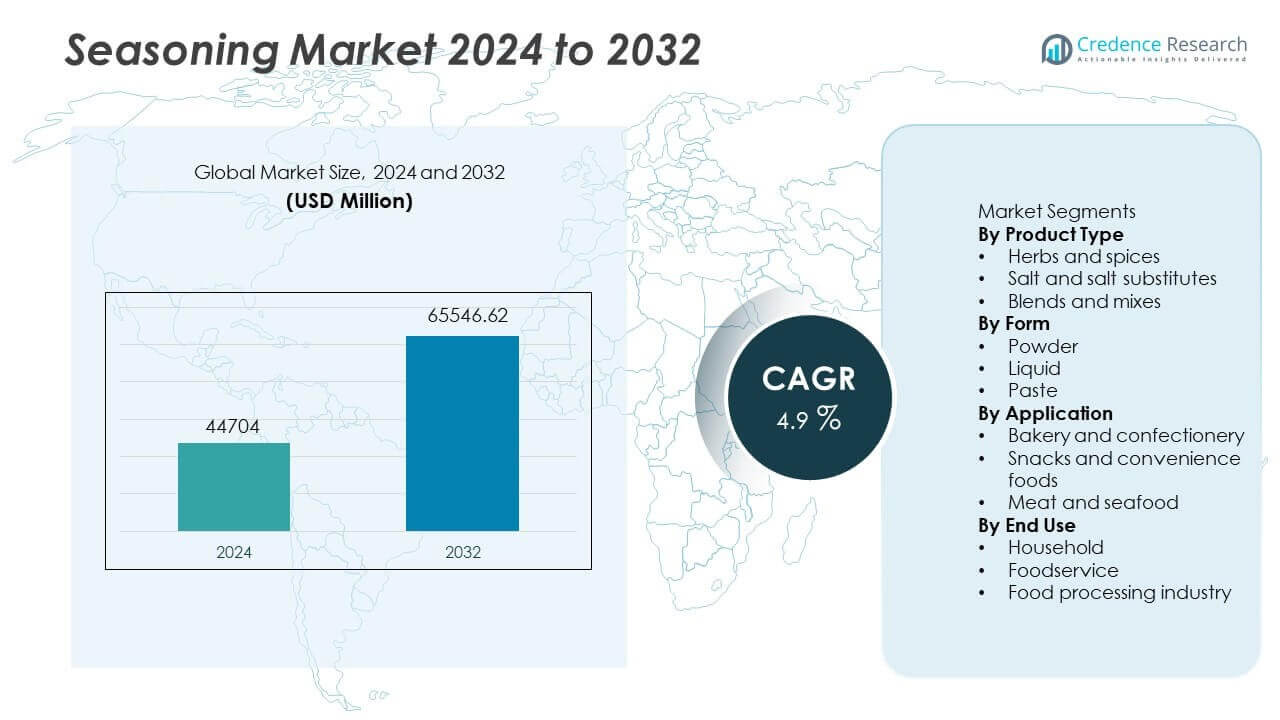
The Seasoning market was valued at USD 44704 million in 2024 and is anticipated to reach USD 65546.62 million by 2032, growing at a CAGR of 4.9% during the forecast period.
| REPORT ATTRIBUTE | DETAILS |
|---|---|
| Historical Period | 2020-2023 |
| Base Year | 2024 |
| Forecast Period | 2025-2032 |
| Seasoning Market Size 2024 | USD 44704 million |
| Seasoning Market, CAGR | 4.9% |
| Seasoning Market Size 2032 | USD 65546.62 million |
Seasoning Market Insights
- Convenience food growth drives the Seasoning market, with herbs and spices leading the segment at a 46% share due to clean-label demand.
- Market trends show powdered seasonings dominating the Seasoning market with a 58% share, supported by long shelf life and ease of use.
- Competitive analysis indicates a fragmented Seasoning market, where leading players focus on flavor innovation, sourcing strength, and customized blends.
- Regional analysis shows Asia Pacific leading the Seasoning market with a 34% share, followed by North America at 26% and Europe at 24%, driven by packaged food demand and culinary diversity.
Seasoning Market Segmentation Analysis:
By Product Type
The By Product Type segment of the Seasoning market is led by herbs and spices, which account for a 46% market share. Herbs and spices remain essential ingredients across global cuisines due to strong flavor profiles and natural positioning. Rising consumer preference for clean-label and minimally processed foods supports this dominance. Increased home cooking and interest in ethnic cuisines further drive demand. Salt and salt substitutes hold a significant share, supported by daily household usage and food processing demand. Blends and mixes follow, driven by convenience trends and growing demand from ready-to-cook and packaged food manufacturers seeking consistent taste solutions.
- For instance, McCormick runs more than 80 global brands and operates 30 manufacturing plants, which help scale herb and spice output for major food processors.
By Form
Within the By Form segment, powdered seasonings dominate the Seasoning market with a 58% share. Powdered formats offer long shelf life, ease of storage, and uniform flavor distribution. Food processors and households widely prefer powders for seasoning blends, snacks, and processed foods. High usage in dry mixes and spice blends supports volume growth. Liquid seasonings hold a smaller share, driven by sauces and marinades in foodservice applications. Paste seasonings account for the remaining share, supported by regional cuisines and premium cooking applications, though limited shelf life restricts broader adoption.
- For instance, Ajinomoto uses precise spray-dry technology in production sites across 35 countries, which supports large-scale powdered seasoning output measured in metric tons per day.
By Application
The By Application segment is led by snacks and convenience foods, holding a 41% share of the Seasoning market. Strong growth in packaged snacks, instant foods, and ready meals drives high seasoning consumption. Manufacturers rely on seasonings for flavor differentiation and product innovation. Meat and seafood applications follow, supported by demand for marinades, rubs, and processed meat products. Bakery and confectionery hold a smaller share, driven by use of spices and flavor enhancers in baked goods. Despite diversified usage, snacks and convenience foods remain dominant due to high consumption frequency.
Key Growth Drivers
Rising Demand for Convenience and Ready-to-Eat Foods
Growing consumption of convenience and ready-to-eat foods strongly drives the Seasoning market. Urban lifestyles increase demand for quick meal solutions. Food manufacturers use seasonings to enhance taste and product appeal. Snacks, instant meals, and frozen foods rely heavily on seasoning blends. Flavor innovation supports brand differentiation in crowded retail shelves. Busy consumers prefer consistent taste and easy preparation. Expansion of packaged food categories boosts seasoning volumes. Foodservice chains also increase seasoning usage for standardized flavors. This driver sustains steady demand across retail and industrial segments.
- For instance, Kerry Group operates manufacturing sites globally and produces a vast range of taste and nutrition solutions, supporting high-volume seasoning supply for global packaged food brands.
Growing Preference for Global and Ethnic Cuisines
Rising interest in global cuisines fuels Seasoning market growth. Consumers experiment with international flavors at home. Herbs, spices, and blends support diverse taste profiles. Social media and cooking shows influence flavor adoption. Food brands launch region-inspired seasoning mixes. Restaurants expand ethnic menus to attract consumers. Increased migration supports multicultural food demand. This driver accelerates seasoning innovation and portfolio expansion. Global flavor exposure strengthens long-term consumption trends.
- For instance, Ajinomoto distributes culinary ingredients in more than 130 countries and operates 35 production facilities, which help deliver ethnic and regional seasoning blends at scale to global markets.
Expansion of Food Processing and Foodservice Industries
Growth of food processing industries drives the Seasoning market. Processed meat, snacks, and bakery products require consistent seasoning quality. Foodservice expansion increases bulk seasoning demand. QSR chains rely on standardized seasoning formulations. Institutional catering boosts volume consumption. Industrial seasoning solutions support scalability and efficiency. Investments in food manufacturing capacity increase ingredient demand. This driver ensures stable offtake from commercial and industrial users. Long-term food industry growth supports seasoning market expansion.
Key Trends & Opportunities
Shift Toward Clean-Label and Natural Ingredients
Clean-label demand creates strong opportunities in the Seasoning market. Consumers prefer natural herbs and spices over artificial additives. Manufacturers reduce synthetic flavor enhancers. Organic and non-GMO seasonings gain popularity. Transparency in ingredient sourcing improves brand trust. Clean-label positioning supports premium pricing. Natural seasoning blends attract health-conscious consumers. This trend encourages innovation in plant-based and minimally processed seasonings. Suppliers investing in natural solutions gain competitive advantage.
- For instance, McCormick sources ingredients from more than 80 countries and validates purity through 30 internal quality labs, which test thousands of herb and spice samples each day to meet clean-label standards.
Product Innovation and Custom Flavor Development
Customization trends open new opportunities in the Seasoning market. Brands develop tailored seasoning blends for specific applications. Regional taste customization supports market penetration. Advanced blending technologies improve consistency. Limited-edition flavors attract consumer interest. Collaboration with chefs enhances flavor authenticity. Innovation supports premium and specialty seasoning segments. This trend strengthens differentiation in competitive markets. Custom solutions improve long-term customer relationships.
- For instance, Sensient Technologies operates over 50 R&D and application labs and supports more than 10,000 annual custom flavor development projects using precise batch-control systems that ensure blend accuracy down to 0.01 grams.
Key Challenges
Volatility in Raw Material Prices
Raw material price fluctuations challenge the Seasoning market. Spices and herbs depend on agricultural output. Climate changes affect crop yield and quality. Supply disruptions increase cost pressure. Price volatility impacts margins and pricing strategies. Import dependence raises sourcing risks. Managing consistent supply remains complex. Companies must diversify sourcing regions. Raw material uncertainty continues to affect market stability.
Regulatory and Quality Compliance Challenges
Regulatory requirements create challenges for the Seasoning market. Food safety standards vary across regions. Compliance increases operational costs. Labeling and additive regulations require frequent updates. Quality consistency becomes critical for global brands. Traceability requirements add complexity. Smaller producers face higher compliance burdens. Managing regulations remains essential for market access. Compliance challenges influence product development and distribution strategies.
Regional Analysis
Asia Pacific
Asia Pacific leads the Seasoning market with a 34% market share, driven by strong consumption of spices and regional flavors. Countries such as China, India, Japan, and Southeast Asia show high usage across household and foodservice channels. Traditional cooking practices rely heavily on herbs, spices, and blended seasonings. Rapid urbanization increases demand for packaged and convenience foods. Expanding middle-class income supports premium seasoning adoption. Growth of local food processing industries strengthens bulk demand. Regional cuisine diversity fuels continuous flavor innovation. Strong retail penetration sustains high-volume seasoning consumption across the region.
North America
North America holds a 26% share of the Seasoning market, supported by high consumption of packaged and convenience foods. The United States drives demand through snacks, meat products, and ready meals. Consumers prefer bold and innovative flavors. Clean-label and low-sodium seasonings gain traction. Strong food processing and foodservice industries support consistent demand. Product innovation and brand-driven marketing influence purchasing decisions. Rising interest in global cuisines expands seasoning variety. Well-developed retail infrastructure ensures wide product availability. North America remains a key market for premium and blended seasonings.
Europe
Europe accounts for a 24% share of the Seasoning market, driven by strong culinary traditions and food quality standards. Countries such as Germany, France, Italy, and the United Kingdom show steady demand across households and food manufacturers. Herbs and spices remain essential in regional cuisines. Clean-label and organic seasoning demand continues to rise. Processed food consumption supports industrial seasoning usage. Regulatory focus on food safety and labeling shapes product formulation. Innovation in reduced-salt blends gains attention. Europe maintains stable growth through premiumization and health-focused seasoning trends.
Latin America
Latin America represents a 9% share of the Seasoning market, supported by rich regional cuisines and growing packaged food consumption. Brazil and Mexico lead demand through snacks, meat products, and traditional dishes. Urbanization increases use of ready-to-cook foods. Local spice blends remain popular in household cooking. Foodservice expansion supports bulk seasoning demand. Economic growth improves access to branded products. Regional producers focus on authentic flavor profiles. Despite price sensitivity, steady consumption growth supports market expansion across the region.
Middle East and Africa
The Middle East and Africa hold a 7% share of the Seasoning market, driven by strong cultural use of spices and herbs. Middle Eastern cuisines rely heavily on blended seasonings and marinades. Urban population growth increases demand for packaged foods. Foodservice and hospitality sectors support seasoning consumption. Import dependence influences pricing and product availability. Africa shows gradual growth due to rising urbanization and retail expansion. Local spice traditions sustain baseline demand. Long-term growth depends on food processing development and distribution improvements.
Seasoning Market Segmentations:
By Product Type
- Herbs and spices
- Salt and salt substitutes
- Blends and mixes
By Form
- Powder
- Liquid
- Paste
By Application
- Bakery and confectionery
- Snacks and convenience foods
- Meat and seafood
By End Use
- Household
- Foodservice
- Food processing industry
By Geography
- North America
- U.S.
- Canada
- Mexico
- Europe
- Germany
- France
- U.K.
- Italy
- Spain
- Rest of Europe
- Asia Pacific
- China
- Japan
- India
- South Korea
- South-east Asia
- Rest of Asia Pacific
- Latin America
- Brazil
- Argentina
- Rest of Latin America
- Middle East & Africa
- GCC Countries
- South Africa
- Rest of the Middle East and Africa
Competitive Landscape
Competitive landscape analysis highlights a fragmented and highly competitive Seasoning market led by McCormick & Company, Kerry Group, Ajinomoto, Olam Group, and DSM-Firmenich. These players compete through broad product portfolios, strong sourcing networks, and continuous flavor innovation. Leading companies focus on clean-label, low-sodium, and natural seasoning solutions to meet evolving consumer preferences. Investments in research and development support new blend creation and application-specific seasonings. Strategic acquisitions and partnerships help expand geographic presence and strengthen supply chains. Foodservice and industrial customers favor suppliers offering customized and consistent flavor profiles. Regional brands maintain strong positions through local taste expertise and competitive pricing. Sustainability initiatives, including responsible sourcing and traceability, influence competitive positioning. Overall, competition centers on innovation, quality consistency, distribution reach, and alignment with health-focused and convenience food trends.
Key Player Analysis
- McCormick & Company, Inc.
- Kerry Group plc
- Ajinomoto Co., Inc.
- Olam Group Limited
- Associated British Foods plc
- DSM-Firmenich
- Kikkoman Corporation
- Sensient Technologies Corporation
- Everest Spices
- Tata Consumer Products Limited
Recent Developments
- In December 2025, McCormick & Company, Inc. announced its 2026 Flavor of the Year – Black Currant, with planned trend reports and product celebrations throughout 2026.
- In March 2025, Ajinomoto Co., Inc. took part in an agricultural restoration project under the Japan-Brazil Green Partnership Initiative.
- In January 2025, McCormick & Company, Inc. unveiled its 2025 Flavor of the Year – Aji Amarillo, and launched a limited-time Aji Amarillo seasoning and a Flavor Night Market event.
Report Coverage
The research report offers an in-depth analysis based on Product Type, Form, Application, End Use and Geography. It details leading market players, providing an overview of their business, product offerings, investments, revenue streams, and key applications. Additionally, the report includes insights into the competitive environment, SWOT analysis, current market trends, as well as the primary drivers and constraints. Furthermore, it discusses various factors that have driven market expansion in recent years. The report also explores market dynamics, regulatory scenarios, and technological advancements that are shaping the industry. It assesses the impact of external factors and global economic changes on market growth. Lastly, it provides strategic recommendations for new entrants and established companies to navigate the complexities of the market.
Future Outlook
- Demand for seasonings will rise with growth in convenience and packaged foods.
- Herbs and spices will remain the core product segment in the Seasoning market.
- Clean-label and natural seasoning solutions will gain stronger adoption.
- Flavor innovation will drive differentiation among seasoning brands.
- Ready-to-cook and ready-to-eat foods will increase bulk seasoning demand.
- Foodservice expansion will support steady Seasoning market consumption.
- Regional and ethnic flavor blends will attract new consumer segments.
- Sustainable sourcing practices will influence supplier selection.
- Emerging markets will contribute incremental volume growth.
- Product customization will strengthen long-term Seasoning market competitiveness.

Request a Free Sample
Fill in your details and we'll send you a free sample report.
- Sample data tables & charts
- Research methodology
Need a Custom Version of This Report?
Tailor the scope, geography, or segments to your exact requirements.
- Custom geography or segment scope
- Direct access to our analyst team
Frequently Asked Questions
What is the current market size for Seasoning market, and what is its projected size in 2032?
At what Compound Annual Growth Rate is the Seasoning market projected to grow between 2024 and 2032?
Which Seasoning market segment held the largest share in 2024?
What are the primary factors fueling the growth of the Seasoning market?
Who are the leading companies in the Seasoning market?
Which region commanded the largest share of the Seasoning market in 2024?
Table of Content
Chapter 1 Market Segmentation
- 1.1 Segmentation Framework
- 1.1.1 Product and Service Classification
- 1.1.2 Application and End-Use Classification
- 1.1.3 Technology and Solution Classification
- 1.1.4 Customer and Distribution Channel Classification
- 1.1.5 Geographic Segmentation
- 1.1.6 Market Segment Definitions and Boundaries
Chapter 2 Introduction
- 2.1 Report Objectives and Scope
- 2.2 Product Definition and Industry Terminology
- 2.3 Market Inclusions and Exclusions
- 2.4 Research Process
- 2.4.1 Primary Research and Expert Interviews
- 2.4.2 Secondary Research and Source Review
- 2.4.3 Top-Down and Bottom-Up Estimation
- 2.4.4 Data Triangulation and Verification
- 2.5 Market Size Measurement Basis
- 2.5.1 2024: USD 44704 million → 2032: USD 65546.62 million
- 2.6 Historical and Forecast Reference Periods
- 2.6.1 Base Year: 2024
- 2.6.2 Forecast Period: 2024-2032
- 2.7 Research Assumptions and Limitations
Chapter 3 Executive Summary
- 3.1 Market Snapshot and Key Findings
- 3.2 Base-Year Market Size, 2024
- 3.3 Forecast Market Size, 2032
- 3.4 Revenue and Volume Growth Outlook
- 3.5 Key Demand and Supply Indicators
- 3.6 Leading Market Segments
- 3.7 Fastest-Growing Market Opportunities
- 3.8 Regional Performance Highlights
- 3.9 Technology and Industry Transformation
- 3.10 Competitive Landscape Summary
- 3.11 Analyst View and Strategic Implications
Chapter 4 Global Seasoning Market Trends and Developments
- 4.1 Historical Industry Development
- 4.2 Recent Market Trends and Developments
- 4.3 Demand and Customer Behavior Trends
- 4.4 Technology and Product Innovation
- 4.5 Artificial Intelligence, Automation and Digitalization
- 4.6 Local Manufacturing and Supply Chain Realignment
- 4.7 Industry Partnerships, Mergers and Acquisitions
- 4.8 Sustainability and Circular Economy Developments
- 4.9 Government and Private Sector Investment Trends
- 4.10 Emerging Business Models and Commercialization
- 4.11 Industry Developments and Announcements
Chapter 5 Global Seasoning Market Production, Supply and Demand Analysis
- 5.1 Demand Trend and Consumption Analysis
- 5.2 Demand Forecast, 2024-2032
- 5.3 Production and Output Trend
- 5.4 Production and Output Forecast, 2024-2032
- 5.5 Installed Capacity and Capacity Utilization
- 5.6 Company-Wise Production Plants and Statistics
- 5.6.1 Installed Production Capacity
- 5.6.2 Actual Production
- 5.6.3 Planned Capacity and Expansion Targets
- 5.7 Supply Chain Structure and Procurement Trends
- 5.8 Supply-Demand Gap and Bottlenecks
- 5.9 Import Dependence and Sourcing Structure
- 5.10 Contract Manufacturing and Outsourcing
- 5.11 Regional Supply and Demand Concentration
Chapter 6 Global Seasoning Market Pricing Analysis
- 6.1 Pricing Structure and Measurement
- 6.2 Historical Pricing Trends
- 6.3 Pricing Outlook, 2024-2032
- 6.4 Average Selling Price and Unit Economics
- 6.5 Pricing by Product and Market Segment
- 6.6 Geographic Pricing Differences
- 6.7 Key Input, Energy, Labor and Logistics Costs
- 6.8 Contract Pricing and Purchasing Models
- 6.9 Pricing Sensitivity and Competitive Positioning
- 6.10 Price, Margin and Profitability Implications
Chapter 7 Global Seasoning Market Dynamics
- 7.1 Market Growth Drivers
- 7.1.1 Demand-Side Drivers
- 7.1.2 Technology and Innovation Drivers
- 7.1.3 Infrastructure and Investment Drivers
- 7.1.4 Regulatory and Policy Drivers
- 7.2 Market Restraints
- 7.2.1 Cost and Affordability Constraints
- 7.2.2 Technology and Adoption Barriers
- 7.2.3 Supply Chain and Operational Constraints
- 7.3 Market Challenges
- 7.3.1 Competitive Pressure and Margin Erosion
- 7.3.2 Skills, Infrastructure and Implementation Gaps
- 7.4 Emerging Market Opportunities
- 7.5 Market Dynamics Impact and Time-Horizon Assessment
Chapter 8 Global Seasoning Value Chain Analysis
- 8.1 Industry Value Chain Overview
- 8.2 Upstream Suppliers and Critical Inputs
- 8.3 Technology and Component Providers
- 8.4 Manufacturing or Service Delivery
- 8.5 Distribution, Channel Partners and Integrators
- 8.6 Downstream Applications and End Users
- 8.7 Value Addition and Profit Pools
- 8.8 Vertical Integration and Outsourcing
- 8.9 Supplier Concentration and Risk
- 8.10 Supply Chain Localization and Resilience
Chapter 9 Global Seasoning Market Regulations and Policies
- 9.1 Relevant Laws, Standards and Compliance Frameworks
- 9.2 Product, Service, Safety and Quality Requirements
- 9.3 Government Policies, Incentives and Subsidies
- 9.4 Imports, Exports and Trade Barriers
- 9.5 Public Procurement and Local Content Requirements
- 9.6 Environmental and Sustainability Compliance
- 9.7 Upcoming Policy Changes and Market Implications
Chapter 10 Global Seasoning Market Hotspots and Opportunities
- 10.1 Market Opportunity Mapping and Growth Hotspots
- 10.2 High-Growth Applications and Customer Groups
- 10.3 Underserved Markets and White-Space Opportunities
- 10.4 Emerging Technology and Product Opportunities
- 10.5 New Capacity and Investment Hotspots
- 10.6 Market Entry and Expansion Opportunities
- 10.7 Distribution and Partnership Opportunities
- 10.8 Near-Term and Long-Term Commercial Potential
- 10.9 Opportunity Attractiveness and Execution Risks
Chapter 11 Global Seasoning Market Outlook, 2024-2032
- 11.1 Market Size and Analysis
- 11.1.1 Revenue (Market Measurement: 2024: USD 44704 million → 2032: USD 65546.62 million)
- 11.1.2 Market Volume and Quantity Sold
- 11.1.3 Historical Market Size
- 11.1.4 Base-Year Market Size, 2024
- 11.2 Market Forecast, 2024-2032
- 11.2.1 Revenue Forecast to 2032
- 11.2.2 Volume Forecast to 2032
- 11.2.3 CAGR and Year-on-Year Growth
- 11.2.4 Incremental Revenue Opportunity
- 11.3 Forecast Assumptions and Scenario Analysis
- 11.3.1 Base-Case Forecast
- 11.3.2 Optimistic and Conservative Scenarios
- 11.3.3 Technology, Pricing and Policy Sensitivities
- 11.4 Market Attractiveness and Growth Outlook
Chapter 12 Global Seasoning Market Segmentation and Outlook
- 12.1 Segmentation Summary and Market Shares, 2024
- 12.2 Largest and Fastest-Growing Segments
- 12.3 Segment Growth Comparison
- 12.4 Segment Attractiveness and Priority Matrix
Chapter 13 Global Seasoning Geographic Market Outlook, 2024-2032
- 13.1 Regional Market Size and Share, 2024
- 13.2 Regional Market Forecast, 2024-2032
- 13.3 Regional Pricing, Production and Demand Differences
- 13.4 North America
- 13.4.1 United States
- 13.4.2 Canada
- 13.4.3 Mexico
- 13.5 Europe
- 13.5.1 Germany
- 13.5.2 France
- 13.5.3 Italy
- 13.5.4 United Kingdom
- 13.5.5 Spain
- 13.5.6 Poland
- 13.5.7 Russia
- 13.5.8 Netherlands
- 13.5.9 Belgium
- 13.5.10 Sweden
- 13.5.11 Denmark
- 13.5.12 Norway
- 13.5.13 Rest of Europe
- 13.6 Asia Pacific
- 13.6.1 China
- 13.6.2 India
- 13.6.3 Japan
- 13.6.4 South Korea
- 13.6.5 Thailand
- 13.6.6 Indonesia
- 13.6.7 Vietnam
- 13.6.8 Malaysia
- 13.6.9 Australia
- 13.6.10 Rest of Asia Pacific
- 13.7 Latin America
- 13.7.1 Brazil
- 13.7.2 Argentina
- 13.7.3 Colombia
- 13.7.4 Chile
- 13.7.5 Rest of Latin America
- 13.8 Middle East
- 13.8.1 Saudi Arabia
- 13.8.2 United Arab Emirates
- 13.8.3 Turkey
- 13.8.4 Israel
- 13.8.5 Iran
- 13.8.6 Rest of the Middle East
- 13.9 Africa
- 13.9.1 South Africa
- 13.9.2 Egypt
- 13.9.3 Nigeria
- 13.9.4 Morocco
- 13.9.5 Rest of Africa
- 13.10 Regional Investment, Policy and Supply Chain Differences
- 13.11 Regional Competitive Landscape
- 13.12 Geographic Growth Hotspots
Chapter 14 Global Seasoning Technology, Innovation and Sustainability Outlook
- 14.1 Technology Landscape and Maturity
- 14.2 Product, Process and Service Innovation
- 14.3 AI, Automation and Digital Tools in the Industry
- 14.4 Technology Adoption and Performance Benchmarking
- 14.5 Innovation Pipeline and R&D Investment
- 14.6 Patent and Intellectual Property Trends
- 14.7 Energy Efficiency and Resource Management
- 14.8 Sustainability, Recycling and Circularity
- 14.9 Technology Roadmap, 2024-2032
- 14.10 Risks of Obsolescence and Technology Substitution
Chapter 15 Global Seasoning Market Key Strategic Imperatives
- 15.1 Growth and Market Entry Priorities
- 15.2 High-Return Products and Segments
- 15.3 Pricing, Profitability and Cost Optimization
- 15.4 Technology Investment and Product Differentiation
- 15.5 Supply Chain Localization and Resilience
- 15.6 Distribution and Customer Acquisition
- 15.7 Partnership, Acquisition and Capacity Strategy
- 15.8 Regional Expansion Priorities
- 15.9 Short-, Medium- and Long-Term Actions
Chapter 16 Competition Outlook
- 16.1 Industry Competition Characteristics
- 16.2 Market Structure and Concentration
- 16.3 Market Share and Competitive Positioning, 2024
- 16.4 Company-Wise Revenue and Product Benchmarking
- 16.5 Production and Service Capacity Benchmarking
- 16.6 Technology, Pricing and Differentiation
- 16.7 Regional Footprint and Distribution Strength
- 16.8 Mergers, Acquisitions and Strategic Alliances
- 16.9 New Entrants and Competitive Threats
- 16.10 Porter's Five Forces and Industry Attractiveness
- 16.11 Competitive Outlook, 2024-2032
Chapter 17 Company Profiles
- 17.1 Company Coverage and Selection Criteria
- 17.2 Leading Market Participants – Standard Profile Structure
- 17.2.1 Business Description
- 17.2.2 Company Ownership and Geographic Presence
- 17.2.3 Product and Service Portfolio
- 17.2.4 Manufacturing and Operating Footprint
- 17.2.5 Production Capacity and Expansion Plans
- 17.2.6 Financial Performance and Investment
- 17.2.7 Market Share and Competitive Position
- 17.2.8 Technology and Innovation Capabilities
- 17.2.9 Strategic Alliances or Partnerships
- 17.2.10 Recent Developments
- 17.2.11 Growth Strategy and Outlook
- 17.3 Other Relevant Market Participants
Note: Every listed company is profiled on the structure shown under the first company. The company list is preliminary and may change based on research findings, market developments, data availability and client requirements.
Chapter 18 Disclaimer
- 18.1 Research and Forecast Disclaimer
- 18.2 Data Source and Estimation Limitations
Note: The depth of individual sections depends on data availability for this market. Volume, capacity, trade and other unit-based metrics are included where applicable.