Market Overview:
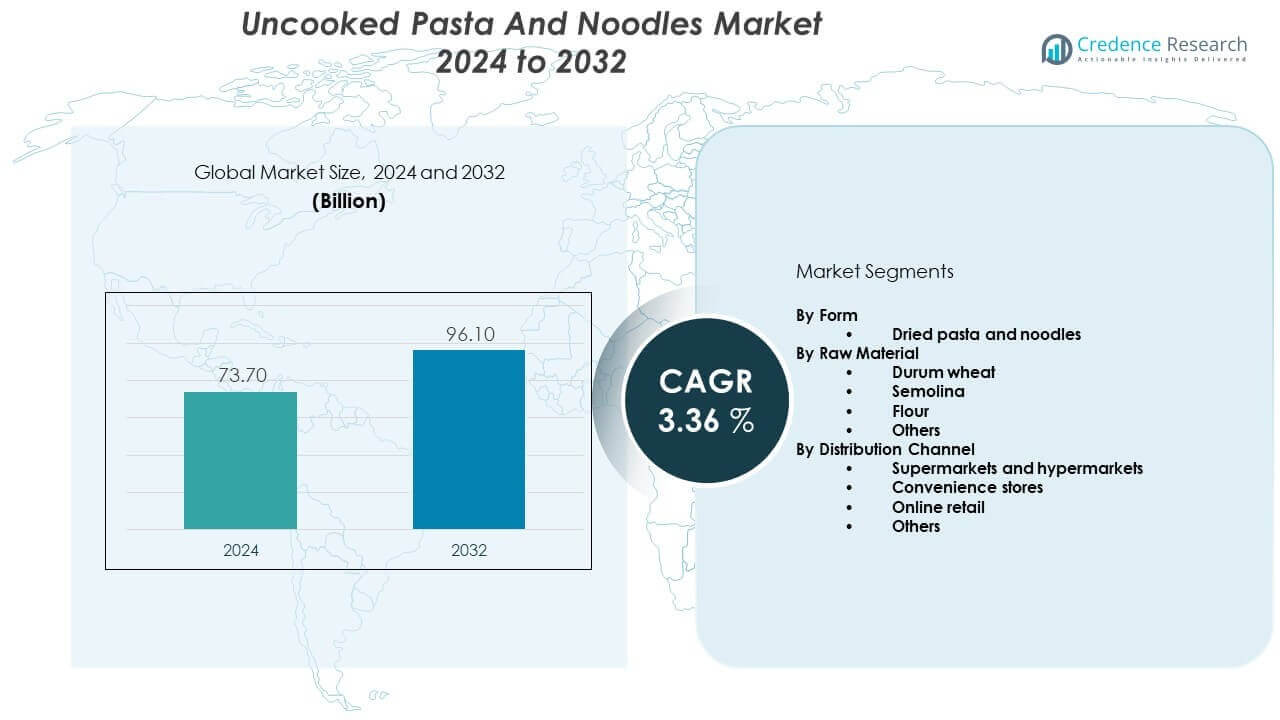
The uncooked pasta and noodles market is projected to grow from USD 73.7 billion in 2024 to an estimated USD 96.1 billion by 2032, with a compound annual growth rate (CAGR) of 3.36% from 2024 to 2032.
| REPORT ATTRIBUTE | DETAILS |
|---|---|
| Historical Period | 2020-2023 |
| Base Year | 2024 |
| Forecast Period | 2025-2032 |
| Uncooked Pasta And Noodles Market Size 2024 | USD 73.7 billion |
| Uncooked Pasta And Noodles Market, CAGR | 3.36% |
| Uncooked Pasta And Noodles Market Size 2032 | USD 96.1 billion |
The market growth is driven by shifting consumer lifestyles, increasing urbanization, and the rising demand for affordable yet nutritious meal options. Health-conscious buyers are encouraging manufacturers to innovate with fortified, gluten-free, and whole-grain variants, while traditional pasta and noodles continue to attract loyal consumers. Expanding retail networks, coupled with the rising adoption of e-commerce platforms, further strengthen accessibility. Strong marketing campaigns and product diversification strategies are also helping brands capture wider consumer bases.
Geographically, Europe remains a leading region due to its long-established pasta consumption culture, particularly in Italy and surrounding countries, while North America benefits from strong demand for both traditional and innovative products. Asia-Pacific is emerging as a high-growth region, supported by increasing disposable incomes, large populations, and strong culinary integration of noodles. Meanwhile, Latin America and the Middle East & Africa are gaining traction, driven by rising urban populations and expanding retail infrastructures, which enhance product availability and consumption.
Market Insights:
- The uncooked pasta and noodles market was valued at USD 73.7 billion in 2024 and is projected to reach USD 96.1 billion by 2032, growing at a CAGR of 3.36% during the forecast period.
- Strong market drivers include rising demand for convenient, affordable staple foods and increasing consumption across both developed and emerging economies.
- The market benefits from innovation in health-oriented formulations such as gluten-free, organic, and fortified pasta and noodle variants appealing to health-conscious consumers.
- Expanding retail networks and e-commerce penetration enhance product accessibility, with online platforms accelerating brand visibility and consumer engagement.
- Key restraints include volatile raw material costs, supply chain disruptions, and intense competition from private labels and alternative staple foods.
- Europe leads the market due to its deep-rooted pasta culture, while North America shows strong demand for both traditional and innovative variants.
- Asia-Pacific emerges as the fastest-growing region, supported by large populations, rising disposable incomes, and increasing integration of noodles into mainstream diets.
Market Drivers:
Rising Demand for Convenient and Affordable Staples:
The uncooked pasta and noodles market is driven by increasing demand for convenient, cost-effective food products that suit busy lifestyles. Urbanization has created a shift in meal preferences toward quick-to-prepare items without compromising on taste. It benefits from affordability, which makes pasta and noodles accessible to middle- and low-income groups globally. Growing working-class populations continue to prioritize foods that save preparation time while ensuring satiety. Retail promotions and bulk packaging formats strengthen affordability appeal for households. Younger consumers and students, in particular, rely heavily on noodles as part of daily diets. It sustains growth by being an adaptable base for diverse recipes across multiple cuisines. Expanding product availability in both modern trade and online platforms amplifies market penetration across urban and semi-urban regions.
- For instance, Barilla recorded significant shipment volumes with 646 shipments worldwide between Sep 2023 and Aug 2024, showing steady presence globally.
Expanding Global Food Culture and Culinary Integration:
The uncooked pasta and noodles market gains traction from increasing globalization of food culture and culinary exchanges. Consumers are more exposed to international cuisines through travel, social media, and restaurant dining experiences. It benefits from pasta being synonymous with European cuisine and noodles symbolizing Asian culinary heritage, driving cultural acceptance. Multinational food brands promote cross-border product launches, which integrate traditional recipes with local preferences. Fusion dishes such as noodle-based salads or pasta with regional spices support broader consumer appeal. Younger generations actively seek diverse food experiences, and pasta and noodles act as affordable gateways. It thrives in both home cooking and quick-service restaurants, where menu versatility enhances demand. Growth continues as foodservice chains popularize pasta and noodles through value meals and family-oriented menus.
- For instance, In late 2023, Nissin announced replacing polystyrene packaging with 40% recycled fiber paper cups across all Cup Noodles products aiming to eliminate plastic wrap and polystyrene use.
Innovation in Health-Oriented Product Formulations:
The uncooked pasta and noodles market is propelled by rising health awareness and demand for nutritionally enhanced alternatives. Consumers are moving toward whole-grain, multigrain, and fortified options to align with healthier eating patterns. It responds with gluten-free, organic, and high-protein variants designed to target specific dietary needs. Manufacturers emphasize clean-label products that highlight transparency in ingredients and production. Increasing obesity and lifestyle-related health conditions motivate buyers to choose options perceived as healthier. It also benefits from government dietary campaigns that encourage fiber-rich and balanced diets. Innovations in plant-based formulations, such as lentil or quinoa pasta, expand market appeal among vegan and vegetarian consumers. Wider adoption is further supported by premium retail sections and specialty health stores carrying niche products.
Expanding Distribution Networks and E-Commerce Penetration:
The uncooked pasta and noodles market experiences strong momentum from the rapid expansion of retail and e-commerce networks. Supermarkets and hypermarkets offer bulk discounts, boosting household-level adoption rates. It strengthens accessibility in rural and semi-urban regions through wholesale distributors and local retailers. Online grocery platforms have emerged as growth accelerators, providing convenience and wider product assortments. Digital platforms also enable promotional campaigns, subscription services, and home delivery options. It benefits from enhanced product visibility through social media-driven marketing strategies. Cross-border trade agreements and improved logistics make imported pasta and noodles more affordable. Growth is further supported by strategic partnerships between manufacturers and retail giants to ensure consistent product availability.
Market Trends:
Premiumization and Gourmet Product Preferences:
The uncooked pasta and noodles market is witnessing strong interest in premium and gourmet products. Affluent consumers are willing to pay higher prices for artisanal pasta or authentic regional noodle varieties. It gains traction through specialty retail channels that highlight high-quality ingredients and traditional production techniques. Growing restaurant dining experiences drive demand for gourmet pasta dishes with unique sauces and flavors. Social media influencers and food bloggers showcase gourmet recipes, amplifying consumer interest. It benefits from limited-edition launches and chef-endorsed product lines. Premium products also align with gifting culture in select markets, boosting value sales. The focus on craftsmanship and exclusivity is shaping consumer perceptions toward pasta and noodles as indulgent options.
- For instance, Maruchan's 2023 annual report showed segment sales from bag-type noodles, with steady sales growth from core lines like Maruchan Seimen and introduction of new product series.
Sustainability and Eco-Friendly Packaging Innovations:
The uncooked pasta and noodles market is influenced by sustainability-driven trends. Consumers are increasingly seeking eco-friendly packaging and products with minimal environmental impact. It benefits from biodegradable, recyclable, and compostable packaging innovations that appeal to environmentally conscious buyers. Global brands highlight sustainable sourcing of wheat, rice, or alternative grains to strengthen brand trust. Partnerships with NGOs and sustainability certifications further boost consumer confidence. It aligns with rising government policies supporting plastic reduction and green packaging adoption. Consumer awareness about carbon footprints is shaping purchase choices across urban areas. It encourages manufacturers to invest in circular economy practices and closed-loop recycling initiatives. This trend positions sustainability as a long-term competitive differentiator.
Digital Marketing and Consumer Engagement Strategies:
The uncooked pasta and noodles market is evolving through innovative digital marketing campaigns and consumer engagement. Brands leverage online platforms to launch interactive cooking tutorials and live recipe sessions. It benefits from influencer marketing and user-generated content that fosters authentic brand connections. Mobile applications offer recipe suggestions linked to specific pasta and noodle types, increasing product use frequency. Online reviews and food community platforms build product credibility among new buyers. It supports sales through loyalty programs integrated into e-commerce platforms. Regional campaigns often highlight cultural ties to pasta and noodles, making products relatable. It demonstrates how digital channels extend consumer interaction beyond purchase, reinforcing long-term loyalty.
Emergence of Plant-Based and Functional Variants:
The uncooked pasta and noodles market reflects the rising interest in plant-based and functional foods. Demand for products infused with protein, probiotics, or vitamins continues to grow. It captures attention through pasta made from chickpeas, peas, or seaweed, which appeals to vegan and flexitarian consumers. Functional variants cater to wellness-focused buyers seeking digestive or energy-boosting benefits. It benefits from scientific research linking certain ingredients with long-term health advantages. Global food startups experiment with novel formulations to differentiate their offerings. Specialty stores and health-focused aisles in supermarkets highlight these innovations prominently. The movement toward functional foods aligns pasta and noodles with broader wellness and nutrition goals.
Market Challenges Analysis:
Volatile Raw Material Costs and Supply Chain Disruptions:
The uncooked pasta and noodles market faces significant challenges from raw material price volatility and supply chain disruptions. Wheat, rice, and specialty grains form the core inputs, and fluctuations in agricultural yields directly impact production costs. It is vulnerable to climate change, which affects harvest cycles and overall quality of inputs. Transportation bottlenecks, global trade conflicts, and rising fuel costs further complicate supply chains. Manufacturers face pressure to balance pricing strategies without alienating cost-sensitive consumers. It also struggles with currency fluctuations in import-dependent countries. The combined effect reduces profitability margins and creates uncertainty for long-term planning. Addressing these disruptions requires strong partnerships with local suppliers and investments in resilient logistics infrastructure.
Intense Competition and Shifting Consumer Preferences:
The uncooked pasta and noodles market experiences intense competition from both global players and regional manufacturers. It is challenged by private labels that offer low-cost alternatives with comparable quality. Shifting consumer preferences toward fresh or ready-to-eat products also create substitution risks. Health-conscious buyers sometimes replace pasta and noodles with alternatives like brown rice, millet, or spiralized vegetables. It must also address the challenge of maintaining loyalty among younger consumers with evolving tastes. Aggressive promotional strategies from competitors drive price wars, reducing profit margins. It faces the additional complexity of adapting to regional dietary habits and flavor demands. Long-term success requires constant innovation and brand differentiation to counteract commoditization pressures.
Market Opportunities:
Rising Penetration in Emerging Economies:
The uncooked pasta and noodles market is positioned for strong opportunities in emerging economies with growing disposable incomes. Expanding middle-class populations in Asia-Pacific, Latin America, and Africa are driving greater adoption of packaged foods. It benefits from increasing retail infrastructure and government-backed initiatives supporting food processing industries. Rising urbanization brings lifestyle changes that favor convenient food formats. It also aligns with youth-driven demand for international cuisines and affordable meals. Localized flavors and packaging innovations enhance accessibility in culturally diverse markets. Partnerships with regional distributors ensure wider availability, fueling expansion opportunities. Long-term, emerging markets will contribute substantially to overall growth.
Innovation in Product Differentiation and Niche Categories:
The uncooked pasta and noodles market can leverage innovation in niche categories to capture untapped segments. Functional, fortified, and plant-based variants present avenues for differentiation in competitive landscapes. It creates opportunities for premiumization through artisanal, organic, or specialty ethnic products. Collaborations with chefs and restaurants enhance visibility of unique offerings. Growing online food communities encourage experimentation and trial of innovative products. It also benefits from consumer willingness to explore healthier indulgence options. Manufacturers investing in research and development for flavor innovation strengthen their brand edge. Niche positioning allows companies to command premium pricing and build loyal consumer bases.
Market Segmentation Analysis:
By Form
The uncooked pasta and noodles market is led by dried pasta and noodles, which dominate due to their extended shelf life, affordability, and convenience. It caters to diverse consumer groups ranging from households to foodservice operators. Dried formats benefit from easy storage and transport, making them popular across both developed and emerging economies. It also allows manufacturers to offer varied packaging sizes to suit bulk buyers and individual consumers. Consumer loyalty to traditional dried pasta continues to sustain this segment. Growing demand in semi-urban areas further strengthens its presence.
- For instance, TreeHouse Foods implemented operational improvements in 2024 by optimizing its supply chain and logistics while expanding production capacity to meet increasing demand for dried pasta and noodles in foodservice channels. Despite challenges, they continue enhancing capacity allocation to meet bulk and individual consumer needs, supported by ongoing system upgrades.
By Raw Material
The uncooked pasta and noodles market is strongly influenced by raw material selection, with durum wheat holding a prominent position for its protein-rich and firm-texture qualities. Semolina remains integral in traditional pasta-making regions, supporting authenticity in taste and texture. Flour-based pasta appeals to cost-conscious consumers and regions with limited access to durum wheat. It also benefits from innovation in other raw materials such as multigrain, rice, and plant-based options that address health trends. Alternative blends are gaining traction among wellness-focused buyers. The diversity of raw material use supports product differentiation and wider market appeal.
- For instance, La Molisana achieved sales of over €300 million in 2023, positioning itself as a leading premium pasta producer with traditional Italian raw materials and high protein content products.
By Distribution Channel
The uncooked pasta and noodles market secures a large share through supermarkets and hypermarkets, where extensive assortments and promotional strategies attract shoppers. Convenience stores remain critical in urban environments, serving quick-purchase needs of busy consumers. Online retail has become a fast-growing channel, supported by rising e-commerce adoption, promotional campaigns, and subscription-based services. It offers expanded access to niche and specialty pasta varieties, appealing to adventurous and health-conscious buyers. Other channels, such as local grocery outlets and wholesale distributors, ensure strong reach in price-sensitive markets. Together, these channels reinforce market accessibility and sustained growth.
Segmentation:
By Form
- Dried pasta and noodles
By Raw Material
- Durum wheat
- Semolina
- Flour
- Others
By Distribution Channel
- Supermarkets and hypermarkets
- Convenience stores
- Online retail
- Others
By Region
- North America
- U.S.
- Canada
- Mexico
- Europe
- Germany
- France
- U.K.
- Italy
- Spain
- Rest of Europe
- Asia Pacific
- China
- Japan
- India
- South Korea
- South-east Asia
- Rest of Asia Pacific
- Latin America
- Brazil
- Argentina
- Rest of Latin America
- Middle East & Africa
- GCC Countries
- South Africa
- Rest of the Middle East and Africa
Regional Analysis:
North America and Europe
North America and Europe together account for a significant share of the uncooked pasta and noodles market, contributing nearly 45% of global sales. Europe leads with its deep-rooted pasta culture, particularly in Italy, where pasta consumption is among the highest worldwide. The region’s strong demand for durum wheat and semolina-based pasta ensures continued dominance. North America follows closely, supported by strong retail networks and consumer preference for both traditional pasta and innovative variants. It benefits from rising demand for healthier options such as gluten-free and organic pasta. Established foodservice chains and restaurant culture further strengthen market growth in these regions.
Asia-Pacific
Asia-Pacific holds the largest regional share, contributing around 40% of the uncooked pasta and noodles market. The region is driven by the cultural integration of noodles into daily diets, particularly in China, Japan, South Korea, and Southeast Asia. It gains momentum from large populations, rapid urbanization, and rising disposable incomes that expand demand for both affordable and premium products. Strong retail development and the expansion of convenience stores further enhance market penetration. It also benefits from growing interest in Western-style pasta, especially among younger consumers in metropolitan areas. Asia-Pacific’s dual demand for traditional noodles and modern pasta varieties sustains its strong position.
Latin America, Middle East, and Africa
Latin America, the Middle East, and Africa collectively account for nearly 15% of the global market share, with steady growth opportunities. Latin America shows strong adoption of pasta as a staple food, particularly in Brazil and Argentina, where consumption patterns are culturally ingrained. The Middle East is experiencing growing interest in packaged pasta, supported by rising urbanization and an expanding retail infrastructure. Africa remains an emerging market, driven by affordability, rising middle-class populations, and the availability of flour-based pasta products. It gains further support from multinational brands expanding into these regions through partnerships with local distributors. These markets provide growth potential as rising populations fuel steady consumption.
Key Player Analysis:
- Barilla Group
- Nestlé
- ITC
- Kraft Heinz Company
- Unilever
- Toyo Suisan Kaisha
- Nissin Foods Holdings
- Campbell Soup Company
- TreeHouse Foods
- Ebro Foods
- De Cecco
- Ting Hsin International Group
- Acecook Vietnam JSC
- Del Monte Foods
- Conagra Brands
- General Mills
- Bambino Agro Industries
- Jinmailang Foods
- Nongshim
Competitive Analysis:
The uncooked pasta and noodles market is highly competitive, with global players such as Barilla Group, Nestlé, Nissin Foods, and Unilever holding strong positions alongside regional manufacturers. It is defined by continuous product innovation, strategic acquisitions, and portfolio diversification aimed at addressing evolving consumer preferences. Multinationals focus on expanding distribution networks and building strong brand recognition, while local firms leverage price competitiveness and cultural relevance. The market experiences constant rivalry in both premium and value segments, with companies investing in health-focused, gluten-free, and organic variants to differentiate themselves. It also sees strong private-label competition from retail chains, intensifying pressure on margins.
Recent Developments:
- In June 2025, Barilla Group launched a limited edition of tropical-flavored Pavesini biscuits featuring mango, coconut, and pineapple, designed for on-the-go consumption over a 12-month period. Concurrently, Barilla opened a temporary "Bar by Pesto" bistro in Milan to showcase new sensory experiences including a special pesto featuring Basilico e Mozzarella di Bufala Campana DOP. The company is also advancing innovation through its "Good Food Makers 2025" program, fostering collaboration with startups to create sustainable food system solutions.
- Kraft Heinz announced in July 2025 its intent to spin off its grocery business into a segment focused on legacy brands such as Kraft cheese and Oscar Mayer, aiming to sharpen focus on faster-growing condiments and sauces under the remaining company. The spin-off is expected to complete by end of 2025. Additionally, Kraft Heinz is removing artificial colors from all US products by 2027 to improve nutritional profiles.
- Unilever in June 2025 acquired the men’s personal care brand Dr. Squatch, expanding its portfolio into premium natural care products with a strong digital presence. This deal is part of Unilever's strategy to optimize its brand portfolio towards high-growth spaces.
- Nissin Foods Holdings entered a partnership with WWE in February 2025 to promote its Hot Cup Noodles brand through WWE platforms, enhancing its brand visibility in new markets.
Market Concentration & Characteristics:
The uncooked pasta and noodles market is moderately concentrated, with a mix of multinational corporations and regional firms competing across segments. It is characterized by strong brand loyalty in Europe and Asia, where pasta and noodles are integral to daily diets. Leading companies dominate premium categories, while private labels and local producers maintain influence in price-sensitive markets. It thrives on continuous innovation in flavors, formulations, and packaging, while global players focus on expanding through partnerships and acquisitions. Market competitiveness remains high, requiring strategic investments in marketing, sustainability, and product differentiation.
Report Coverage:
The research report offers an in-depth analysis based on form, raw material, and distribution channels. It details leading market players, providing an overview of their business, product offerings, investments, revenue streams, and key applications. Additionally, the report includes insights into the competitive environment, SWOT analysis, current market trends, as well as the primary drivers and constraints. Furthermore, it discusses various factors that have driven market expansion in recent years. The report also explores market dynamics, regulatory scenarios, and technological advancements that are shaping the industry. It assesses the impact of external factors and global economic changes on market growth. Lastly, it provides strategic recommendations for new entrants and established companies to navigate the complexities of the market.
Future Outlook:
- Demand for health-oriented variants such as gluten-free and wholegrain pasta will continue to expand.
- Online retail will emerge as a major distribution channel, supported by e-commerce penetration.
- Asia-Pacific will strengthen its dominance due to large populations and rising disposable incomes.
- Europe will maintain leadership in premium and artisanal pasta categories.
- Product innovation in plant-based and fortified pasta will diversify consumer choices.
- Sustainability initiatives in packaging and sourcing will gain traction.
- Private labels will expand market presence in cost-sensitive regions.
- Partnerships and acquisitions will remain central to growth strategies.
- Foodservice and quick-service restaurants will enhance product visibility and adoption.
- Emerging economies will provide long-term opportunities for volume growth.

Request a Free Sample
Fill in your details and we'll send you a free sample report.
- Sample data tables & charts
- Research methodology
Market Dynamics
Convenience and Urbanization
Busy lifestyles and increasing urban populations are driving demand for quick-to-prepare, affordable staple foods like uncooked pasta and noodles, making them a preferred choice for both households and students.
Health-Oriented Product Innovation
Rising health awareness is pushing manufacturers to develop gluten-free, wholegrain, organic, and fortified pasta and noodle variants, appealing to consumers seeking healthier meal options.
Expanding Retail and E-Commerce Networks
The growth of supermarkets, hypermarkets, and especially online retail platforms is making uncooked pasta and noodles more accessible, boosting market penetration in both urban and semi-urban areas.
Culinary Globalization and Fusion Trends
Exposure to international cuisines and the integration of pasta and noodles into diverse culinary traditions are broadening consumer appeal, with fusion dishes and cross-cultural recipes driving consumption.
Sustainability and Eco-Friendly Packaging
Consumer demand for sustainable, recyclable, and biodegradable packaging is encouraging brands to innovate in packaging solutions, enhancing brand loyalty and meeting regulatory requirements.
Need a Custom Version of This Report?
Tailor the scope, geography, or segments to your exact requirements.
- Custom geography or segment scope
- Direct access to our analyst team
Frequently Asked Questions
What is the current market size for Uncooked pasta and noodles market, and what is its projected size in 2032?
At what Compound Annual Growth Rate is the Uncooked pasta and noodles market projected to grow between 2025 and 2032?
What are the primary factors fueling the growth of the Uncooked pasta and noodles market?
Who are the leading companies in the Uncooked pasta and noodles market?
Table of Content
Chapter 1 Market Segmentation
- 1.1 Segmentation Framework
- 1.1.1 Product and Service Classification
- 1.1.2 Application and End-Use Classification
- 1.1.3 Technology and Solution Classification
- 1.1.4 Customer and Distribution Channel Classification
- 1.1.5 Geographic Segmentation
- 1.1.6 Market Segment Definitions and Boundaries
- 1.2 By Form
- 1.2.1 Dried pasta and noodles
- 1.2.2 Fresh pasta and noodles
- 1.2.3 Others
- 1.3 By Raw Material
- 1.3.1 Durum wheat
- 1.3.2 Semolina
- 1.3.3 Flour
- 1.3.4 Multigrain/Alternative grains
- 1.3.5 Rice-based
- 1.3.6 Others
Chapter 2 Introduction
- 2.1 Report Objectives and Scope
- 2.2 Product Definition and Industry Terminology
- 2.3 Market Inclusions and Exclusions
- 2.4 Research Process
- 2.4.1 Primary Research and Expert Interviews
- 2.4.2 Secondary Research and Source Review
- 2.4.3 Top-Down and Bottom-Up Estimation
- 2.4.4 Data Triangulation and Verification
- 2.5 Market Size Measurement Basis
- 2.5.1 2024: USD 73.7 billion → 2032: USD 96.1 billion
- 2.6 Historical and Forecast Reference Periods
- 2.6.1 Base Year: 2024
- 2.6.2 Forecast Period: 2024-2032
- 2.7 Research Assumptions and Limitations
Chapter 3 Executive Summary
- 3.1 Market Snapshot and Key Findings
- 3.2 Base-Year Market Size, 2024
- 3.3 Forecast Market Size, 2032
- 3.4 Revenue and Volume Growth Outlook
- 3.5 Key Demand and Supply Indicators
- 3.6 Leading Market Segments
- 3.7 Fastest-Growing Market Opportunities
- 3.8 Regional Performance Highlights
- 3.9 Technology and Industry Transformation
- 3.10 Competitive Landscape Summary
- 3.11 Analyst View and Strategic Implications
Chapter 4 Global Uncooked Pasta And Noodles Market Trends and Developments
- 4.1 Historical Industry Development
- 4.2 Recent Market Trends and Developments
- 4.3 Demand and Customer Behavior Trends
- 4.4 Technology and Product Innovation
- 4.5 Artificial Intelligence, Automation and Digitalization
- 4.6 Local Manufacturing and Supply Chain Realignment
- 4.7 Industry Partnerships, Mergers and Acquisitions
- 4.8 Sustainability and Circular Economy Developments
- 4.9 Government and Private Sector Investment Trends
- 4.10 Emerging Business Models and Commercialization
- 4.11 Industry Developments and Announcements
Chapter 5 Global Uncooked Pasta And Noodles Market Production, Supply and Demand Analysis
- 5.1 Demand Trend and Consumption Analysis
- 5.2 Demand Forecast, 2024-2032
- 5.3 Production and Output Trend
- 5.4 Production and Output Forecast, 2024-2032
- 5.5 Installed Capacity and Capacity Utilization
- 5.6 Company-Wise Production Plants and Statistics
- 5.6.1 Installed Production Capacity
- 5.6.2 Actual Production
- 5.6.3 Planned Capacity and Expansion Targets
- 5.7 Supply Chain Structure and Procurement Trends
- 5.8 Supply-Demand Gap and Bottlenecks
- 5.9 Import Dependence and Sourcing Structure
- 5.10 Contract Manufacturing and Outsourcing
- 5.11 Regional Supply and Demand Concentration
Chapter 6 Global Uncooked Pasta And Noodles Market Pricing Analysis
- 6.1 Pricing Structure and Measurement
- 6.2 Historical Pricing Trends
- 6.3 Pricing Outlook, 2024-2032
- 6.4 Average Selling Price and Unit Economics
- 6.5 Pricing by Product and Market Segment
- 6.6 Geographic Pricing Differences
- 6.7 Key Input, Energy, Labor and Logistics Costs
- 6.8 Contract Pricing and Purchasing Models
- 6.9 Pricing Sensitivity and Competitive Positioning
- 6.10 Price, Margin and Profitability Implications
Chapter 7 Global Uncooked Pasta And Noodles Market Dynamics
- 7.1 Market Growth Drivers
- 7.1.1 Demand-Side Drivers
- 7.1.2 Technology and Innovation Drivers
- 7.1.3 Infrastructure and Investment Drivers
- 7.1.4 Regulatory and Policy Drivers
- 7.2 Market Restraints
- 7.2.1 Cost and Affordability Constraints
- 7.2.2 Technology and Adoption Barriers
- 7.2.3 Supply Chain and Operational Constraints
- 7.3 Market Challenges
- 7.3.1 Competitive Pressure and Margin Erosion
- 7.3.2 Skills, Infrastructure and Implementation Gaps
- 7.4 Emerging Market Opportunities
- 7.5 Market Dynamics Impact and Time-Horizon Assessment
Chapter 8 Global Uncooked Pasta And Noodles Value Chain Analysis
- 8.1 Industry Value Chain Overview
- 8.2 Upstream Suppliers and Critical Inputs
- 8.3 Technology and Component Providers
- 8.4 Manufacturing or Service Delivery
- 8.5 Distribution, Channel Partners and Integrators
- 8.6 Downstream Applications and End Users
- 8.7 Value Addition and Profit Pools
- 8.8 Vertical Integration and Outsourcing
- 8.9 Supplier Concentration and Risk
- 8.10 Supply Chain Localization and Resilience
Chapter 9 Global Uncooked Pasta And Noodles Market Regulations and Policies
- 9.1 Relevant Laws, Standards and Compliance Frameworks
- 9.2 Product, Service, Safety and Quality Requirements
- 9.3 Government Policies, Incentives and Subsidies
- 9.4 Imports, Exports and Trade Barriers
- 9.5 Public Procurement and Local Content Requirements
- 9.6 Environmental and Sustainability Compliance
- 9.7 Upcoming Policy Changes and Market Implications
Chapter 10 Global Uncooked Pasta And Noodles Market Hotspots and Opportunities
- 10.1 Market Opportunity Mapping and Growth Hotspots
- 10.2 High-Growth Applications and Customer Groups
- 10.3 Underserved Markets and White-Space Opportunities
- 10.4 Emerging Technology and Product Opportunities
- 10.5 New Capacity and Investment Hotspots
- 10.6 Market Entry and Expansion Opportunities
- 10.7 Distribution and Partnership Opportunities
- 10.8 Near-Term and Long-Term Commercial Potential
- 10.9 Opportunity Attractiveness and Execution Risks
Chapter 11 Global Uncooked Pasta And Noodles Market Outlook, 2024-2032
- 11.1 Market Size and Analysis
- 11.1.1 Revenue (Market Measurement: 2024: USD 73.7 billion → 2032: USD 96.1 billion)
- 11.1.2 Market Volume and Quantity Sold
- 11.1.3 Historical Market Size
- 11.1.4 Base-Year Market Size, 2024
- 11.2 Market Forecast, 2024-2032
- 11.2.1 Revenue Forecast to 2032
- 11.2.2 Volume Forecast to 2032
- 11.2.3 CAGR and Year-on-Year Growth
- 11.2.4 Incremental Revenue Opportunity
- 11.3 Forecast Assumptions and Scenario Analysis
- 11.3.1 Base-Case Forecast
- 11.3.2 Optimistic and Conservative Scenarios
- 11.3.3 Technology, Pricing and Policy Sensitivities
- 11.4 Market Attractiveness and Growth Outlook
Chapter 12 Global Uncooked Pasta And Noodles Market Segmentation and Outlook
- 12.1 Segmentation Summary and Market Shares, 2024
- 12.2 Largest and Fastest-Growing Segments
- 12.3 By Form - Market Size and Forecast, 2024-2032
- 12.3.1 Segment Definition and Scope
- 12.3.2 Historical Market Size
- 12.3.3 Revenue Forecast, 2024-2032
- 12.3.4 Volume Forecast, 2024-2032
- 12.3.5 Base-Year Market Share, 2024
- 12.3.6 Segment CAGR and Growth Drivers
- 12.3.7 Subsegment Market Size and Forecast
- 12.3.7.1 Dried pasta and noodles
- 12.3.7.2 Fresh pasta and noodles
- 12.3.7.3 Others
- 12.3.8 Subsegment Pricing and Adoption Trends
- 12.3.9 Leading Suppliers and Competition
- 12.3.10 Regional Demand and Opportunities
- 12.4 By Raw Material - Market Size and Forecast, 2024-2032
- 12.4.1 Segment Definition and Scope
- 12.4.2 Historical Market Size
- 12.4.3 Revenue Forecast, 2024-2032
- 12.4.4 Volume Forecast, 2024-2032
- 12.4.5 Base-Year Market Share, 2024
- 12.4.6 Segment CAGR and Growth Drivers
- 12.4.7 Subsegment Market Size and Forecast
- 12.4.7.1 Durum wheat
- 12.4.7.2 Semolina
- 12.4.7.3 Flour
- 12.4.7.4 Multigrain/Alternative grains
- 12.4.7.5 Rice-based
- 12.4.7.6 Others
- 12.4.8 Subsegment Pricing and Adoption Trends
- 12.4.9 Leading Suppliers and Competition
- 12.4.10 Regional Demand and Opportunities
- 12.5 Segment Growth Comparison
- 12.6 Segment Attractiveness and Priority Matrix
Chapter 13 Global Uncooked Pasta And Noodles Geographic Market Outlook, 2024-2032
- 13.1 Regional Market Size and Share, 2024
- 13.2 Regional Market Forecast, 2024-2032
- 13.3 Regional Pricing, Production and Demand Differences
- 13.4 North America
- 13.4.1 United States
- 13.4.2 Canada
- 13.4.3 Mexico
- 13.5 Europe
- 13.5.1 Germany
- 13.5.2 France
- 13.5.3 Italy
- 13.5.4 United Kingdom
- 13.5.5 Spain
- 13.5.6 Poland
- 13.5.7 Russia
- 13.5.8 Netherlands
- 13.5.9 Belgium
- 13.5.10 Sweden
- 13.5.11 Denmark
- 13.5.12 Norway
- 13.5.13 Rest of Europe
- 13.6 Asia Pacific
- 13.6.1 China
- 13.6.2 India
- 13.6.3 Japan
- 13.6.4 South Korea
- 13.6.5 Thailand
- 13.6.6 Indonesia
- 13.6.7 Vietnam
- 13.6.8 Malaysia
- 13.6.9 Australia
- 13.6.10 Rest of Asia Pacific
- 13.7 Latin America
- 13.7.1 Brazil
- 13.7.2 Argentina
- 13.7.3 Colombia
- 13.7.4 Chile
- 13.7.5 Rest of Latin America
- 13.8 Middle East
- 13.8.1 Saudi Arabia
- 13.8.2 United Arab Emirates
- 13.8.3 Turkey
- 13.8.4 Israel
- 13.8.5 Iran
- 13.8.6 Rest of the Middle East
- 13.9 Africa
- 13.9.1 South Africa
- 13.9.2 Egypt
- 13.9.3 Nigeria
- 13.9.4 Morocco
- 13.9.5 Rest of Africa
- 13.10 Regional Investment, Policy and Supply Chain Differences
- 13.11 Regional Competitive Landscape
- 13.12 Geographic Growth Hotspots
Chapter 14 Global Uncooked Pasta And Noodles Technology, Innovation and Sustainability Outlook
- 14.1 Technology Landscape and Maturity
- 14.2 Product, Process and Service Innovation
- 14.3 AI, Automation and Digital Tools in the Industry
- 14.4 Technology Adoption and Performance Benchmarking
- 14.5 Innovation Pipeline and R&D Investment
- 14.6 Patent and Intellectual Property Trends
- 14.7 Energy Efficiency and Resource Management
- 14.8 Sustainability, Recycling and Circularity
- 14.9 Technology Roadmap, 2024-2032
- 14.10 Risks of Obsolescence and Technology Substitution
Chapter 15 Global Uncooked Pasta And Noodles Market Key Strategic Imperatives
- 15.1 Growth and Market Entry Priorities
- 15.2 High-Return Products and Segments
- 15.3 Pricing, Profitability and Cost Optimization
- 15.4 Technology Investment and Product Differentiation
- 15.5 Supply Chain Localization and Resilience
- 15.6 Distribution and Customer Acquisition
- 15.7 Partnership, Acquisition and Capacity Strategy
- 15.8 Regional Expansion Priorities
- 15.9 Short-, Medium- and Long-Term Actions
Chapter 16 Competition Outlook
- 16.1 Industry Competition Characteristics
- 16.2 Market Structure and Concentration
- 16.3 Market Share and Competitive Positioning, 2024
- 16.4 Company-Wise Revenue and Product Benchmarking
- 16.5 Production and Service Capacity Benchmarking
- 16.6 Technology, Pricing and Differentiation
- 16.7 Regional Footprint and Distribution Strength
- 16.8 Mergers, Acquisitions and Strategic Alliances
- 16.9 New Entrants and Competitive Threats
- 16.10 Porter's Five Forces and Industry Attractiveness
- 16.11 Competitive Outlook, 2024-2032
Chapter 17 Company Profiles
- 17.1 Company Coverage and Selection Criteria
- 17.2 Barilla Group
- 17.2.1 Business Description
- 17.2.2 Company Ownership and Geographic Presence
- 17.2.3 Product and Service Portfolio
- 17.2.4 Manufacturing and Operating Footprint
- 17.2.5 Production Capacity and Expansion Plans
- 17.2.6 Financial Performance and Investment
- 17.2.7 Market Share and Competitive Position
- 17.2.8 Technology and Innovation Capabilities
- 17.2.9 Strategic Alliances or Partnerships
- 17.2.10 Recent Developments
- 17.2.11 Growth Strategy and Outlook
- 17.3 Nestlé
- 17.4 Nissin Foods Holdings
- 17.5 Unilever
- 17.6 Kraft Heinz Company
- 17.7 Toyo Suisan Kaisha
- 17.8 Ebro Foods
- 17.9 De Cecco
- 17.10 TreeHouse Foods
- 17.11 General Mills
- 17.12 Other Relevant Market Participants
Note: Every listed company is profiled on the structure shown under the first company. The company list is preliminary and may change based on research findings, market developments, data availability and client requirements.
Chapter 18 Disclaimer
- 18.1 Research and Forecast Disclaimer
- 18.2 Data Source and Estimation Limitations
Note: The depth of individual sections depends on data availability for this market. Volume, capacity, trade and other unit-based metrics are included where applicable.