
Quick answer
A parboiled white rice plant soaks, steams and dries paddy before milling, which hardens the grain and cuts breakage. This overview models a greenfield mill processing 400 tonnes of paddy per day, about 120,000 tonnes a year, with estimated CapEx of USD 8–45 million depending on cost region and specification. Gross margin after paddy and direct conversion costs is estimated at 6–18% at assumed realization of USD 400–480 per tonne, above recent bulk export quotes, with payback at 3–12 years.
Viable for mills that secure paddy at harvest and sell into packed or duty-protected markets; thin at bulk export prices, and expensive builds rarely pay back without a price premium.
Parboiled White Rice plant: key highlights
| Parameter | Indicative value | Note |
|---|---|---|
| Plant capacity | 400 tonnes of paddy per day | About 120,000 tonnes of paddy a year over 300 days, or about 80,000 tonnes of milled rice |
| Total CapEx | USD 8–45 million | Greenfield; low end Asian build, high end integrated plant at a high-cost site |
| Raw material share of operating cost | 85–90% | Paddy at an assumed USD 230–280 per tonne delivered |
| Gross margin | 6–18% | After paddy and direct conversion costs, at assumed realization of USD 400–480 per tonne, above recent bulk export quotes |
| Payback period | 3–12 years | From commissioning; the upper CapEx range needs a domestic price premium |
| IRR | Available in report | Post-tax, 10-year model |
| Break-even | Available in report | Capacity utilization basis |
Ranges assume a greenfield mill processing 400 tonnes of paddy a day for 300 days, 85% steady-state utilization and 2026 prices; assumed rice realization of USD 400–480 per tonne, assumed paddy at USD 230–280 per tonne, and about 69% total rice recovery. CapEx is scaled from public project data and excludes working capital. Other currencies converted at stated rates. The full report can be customized to any country or region.
What is parboiled white rice?
Parboiled white rice is paddy that has been soaked, heated with steam and dried while still in its husk, then milled and polished. Heat gelatinizes the starch inside the kernel and seals internal cracks, so the grain comes through milling harder and with fewer breaks. Its color ranges from pale cream to light amber, and cooked grains stay separate and firm, which is why it holds well in restaurant, catering and institutional kitchens.
Commercial grades are set mainly by the share of broken kernels, with 5% broken as the main export benchmark, and by grain type and color. Long-grain IR64-type rice dominates West African trade, while sella basmati serves Gulf and South Asian buyers. U.S. converted rice is sold in retail boxes and to foodservice. Boiled rice for domestic consumption in South Asia is the same basic product made to local taste. Milled parboiled rice falls under Harmonized System subheading 1006.30, which covers semi-milled or wholly milled rice; the parboiled split appears only in national tariff lines, such as U.S. 1006.30.10.
Parboiled white rice market overview and global demand
No official series isolates parboiled rice, so buyers and investors read the wider rice balance. The FAO Cereal Supply and Demand Brief of October 2026 forecasts world rice production of 552.5 million tonnes, milled basis, in 2026/27, down 2.4% from the 2025/26 record, against use of 559.1 million tonnes and closing stocks of 216.9 million tonnes. FAO puts world trade at 61.2 million tonnes in 2027, about one-ninth of output. Large stocks are a price risk for any new mill.
India is the leading supplier in the parboiled trade. UN Comtrade data show India exporting 20.4 million tonnes of milled rice under subheading 1006.30 in 2025, worth about USD 11.6 billion, up from 16.5 million tonnes in 2024. That total includes white and basmati rice. Sub-Saharan Africa is the main destination: the USDA reported that the region took nearly 5 million tonnes from India from October 2024 to April 2025, and that it accounted for 70% of India's parboiled shipments over that time. In May 2026, it forecast record regional imports of 19.3 million tonnes in 2026/27, led by Nigeria at 2.9 million tonnes, Côte d'Ivoire at 1.7 million tonnes and Senegal at 1.4 million tonnes.
Export prices can move quickly within a season. Indian 5% broken parboiled was quoted at USD 337–344 per tonne in May 2026 and near USD 387–392 by late October 2026, according to one trade update, still below Thai and Vietnamese white rice. Credence Research sizes the equipment side in its rice milling machinery market study, at about USD 6.92 billion in 2025, based on its USD 6.67 billion for 2024 and a 3.63% CAGR. Buyers include wholesalers, importers, government tenders, retail packers and caterers.
Parboiled white rice manufacturing process
Parboiling is a hydrothermal treatment added ahead of a normal rice mill. Most value is won or lost in controlling water uptake and drying, because uneven soaking leaves white-bellied kernels and rushed drying cracks the grain again.
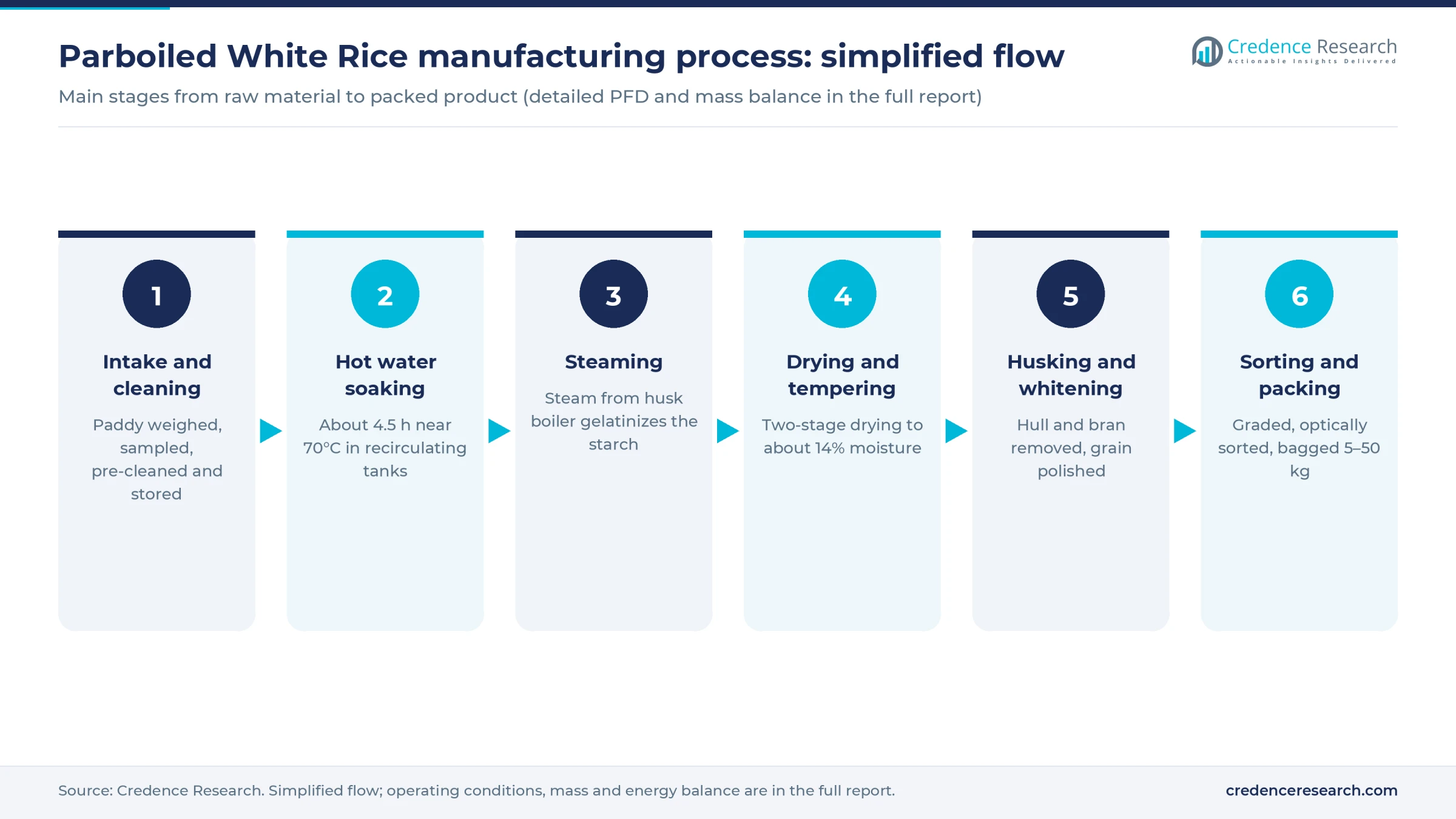
- Paddy intake and cleaning. Trucks are weighed and sampled, then paddy passes through pre-cleaners and destoners into silos. Mixed varieties soak unevenly, so lots are kept separate.
- Hot water soaking. Paddy soaks in insulated stainless steel tanks with recirculated water. In a 2018 CIGR Journal study, modern hot soaking took about 4.5 hours at 70°C against about 30 hours in ambient water, the traditional method.
- Steaming. Saturated steam from a husk-fired boiler gelatinizes the starch in a few minutes at atmospheric pressure. Pressure parboiling shortens the cycle and darkens the grain.
- Drying and tempering. Hot air column or fluidized bed dryers bring paddy down in two stages, with tempering at about 16–17% moisture, to about 14% for safe milling. Sun drying survives only at small scale.
- Husking, whitening and polishing. Rubber roll huskers remove the hull, and paddy separators return unhusked grain. Parboiled kernels are harder, so whitening takes more power, and the bran is oilier than raw rice bran.
- Grading, sorting and packing. Sifters and length graders split out brokens, optical sorters reject discolored grains, and rice is packed in 5 kg to 50 kg bags.
The payoff shows up at the end of the line. Laboratory head rice in that study reached about 71% of paddy with broken grains near 3%, and this overview uses a more cautious 66–68% head rice for a commercial mill. Each added point of head rice on 120,000 tonnes of paddy adds 1,200 tonnes of higher-priced whole grain a year.
Parboiled white rice plant setup cost
Parboiling lines are modular, so plants range from cooperative units of a few tonnes an hour to integrated complexes. This overview models a greenfield plant processing 400 tonnes of paddy per day, about 17 tonnes per hour over 24 hours, at an estimated total CapEx of USD 8–45 million. The spread is large because public benchmarks differ in location, age and scope.
The low end scales a project profile from India's National Cooperative Development Corporation for a 2.5 tonnes-per-hour raw and boiled rice mill, escalated to 2026 costs and uplifted for continuous operation, optical sorting and effluent treatment. The middle uses a World Bank Group IFC disclosure for a 1,000 tonnes-per-day mill in Bangladesh, not stated as parboiled, costed at about USD 53 million with a bran oil plant and husk co-generation, scaled to about USD 21–25 million without those additions. The high end draws on a parboiled rice mill in Kebbi State, Nigeria, built for about 10 billion naira in 2017 with a 120,000 tonnes-a-year paddy capacity, or roughly USD 28–33 million then and USD 40–47 million at 2026 plant costs.
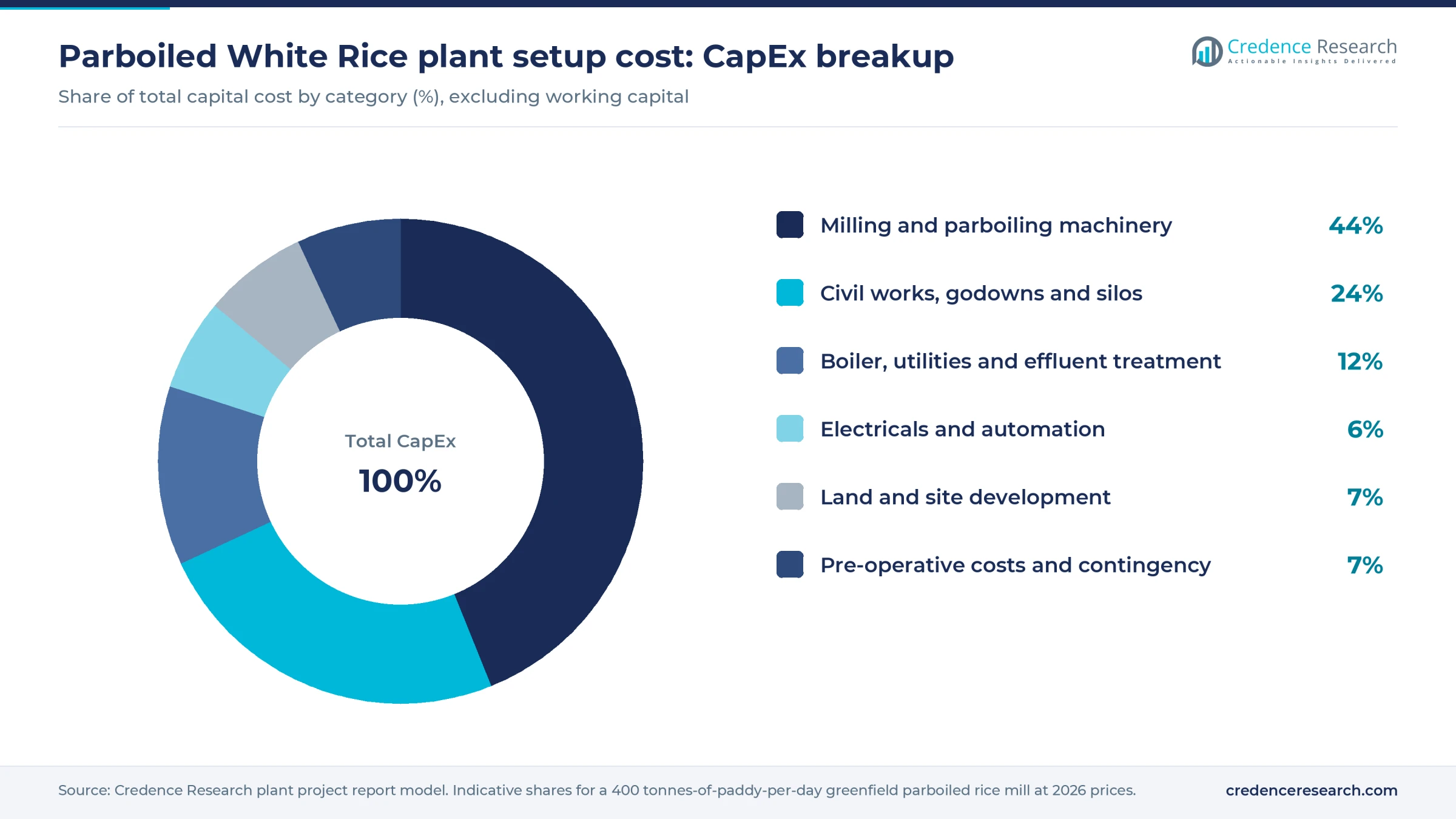
Worked example, land and site development. The plant needs an assumed 6–10 hectares, or 60,000–100,000 square meters, for silos, soaking and drying sections, godowns, boiler, effluent plant and truck queues. At an assumed USD 5–15 per square meter in an Asian industrial park, land costs USD 0.3–1.5 million. At an assumed USD 10–40 per square meter in a U.S. or EU location, it costs USD 0.6–4 million. Site works add an assumed USD 0.2–1 million, so this row ranges from about 6% to 11% of CapEx.
Working capital is a separate requirement. Stocking one to three months of paddy after harvest ties up roughly USD 2–6.5 million.
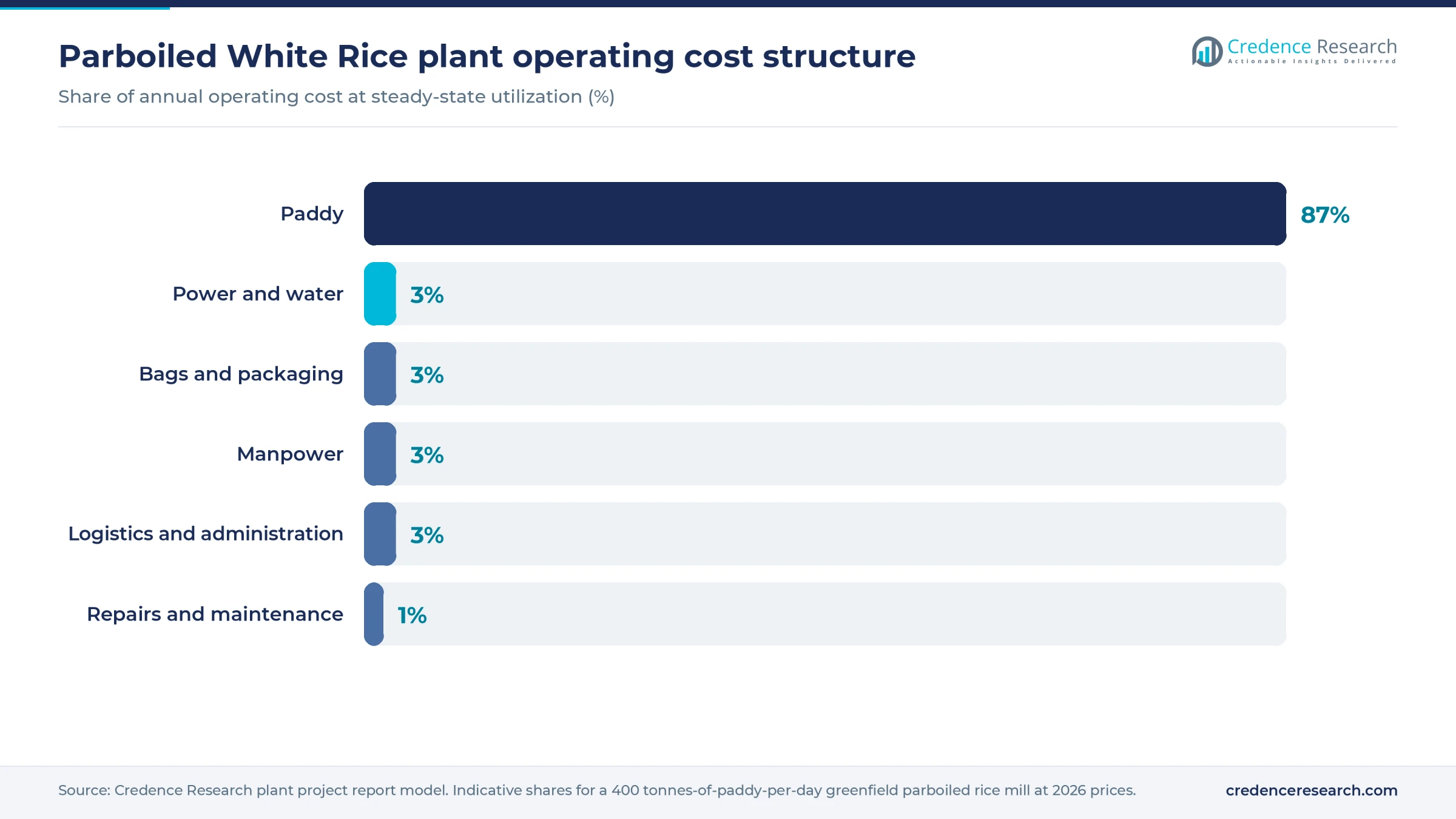
Paddy dominates operating cost at about 85–90%. Burning husk in the boiler replaces purchased fuel, which is why energy remains a small share.
Machinery and raw materials for a parboiled white rice plant
The main machinery groups are listed below; capacities, specifications and quotations are available in the report.
- Intake and storage: weighbridge, pre-cleaner, destoner, moisture meters, bucket elevators and steel silos
- Parboiling: paddy pre-heater, insulated soaking tanks with water recirculation, steaming vessels, husk-fired boiler
- Drying: column or fluidized bed dryers, tempering bins, furnace or heat exchanger
- Milling: rubber roll huskers, paddy separators, whitening and polishing machines, sifters, length graders
- Finishing and utilities: optical sorter, weigh-and-bag lines, dust collection, water treatment, effluent treatment and backup power
Paddy is the only bulk raw material, at about 1.45 tonnes per tonne of rice. Main sourcing regions are eastern and southern India, Bangladesh, the Mekong and Chao Phraya deltas, southern China, northern Nigeria and the Senegal River valley, and the U.S. Mid-South and Gulf Coast. Mills sit inside growing areas because husk and hauling costs make long-distance paddy unattractive. India's 2026/27 support price of 2,441 rupees per quintal for common paddy equals about USD 257 per tonne at 94.9 rupees per dollar, a useful regional marker. Buyers favor uniform, long-grain, low-moisture lots, and clean soak water matters because the grain absorbs it. Consumables include bags, water treatment chemicals, rubber rolls and optional micronutrient premix for fortified rice programs.
Parboiled white rice business profit margin and ROI
A parboiled rice mill earns a spread between paddy and rice, plus by-product credit. For the modeled 400 tonnes-per-day plant, with paddy at USD 230–280 per tonne, gross margin after paddy and direct conversion costs is estimated at 6–18% at assumed realization of USD 400–480 per tonne, above recent bulk export quotes. Payback runs 3–12 years after commissioning, at 85% utilization.
The range depends on where the rice is sold. At bulk export quotes near USD 390 per tonne, a mill paying the Indian support price earns little, so export millers rely on open-market paddy, co-products and bagged sales. Mills selling packed rice or supplying duty-protected domestic markets capture more, and that premium is what makes a USD 40 million-plus build pay back at all. At those realizations the cash profit, estimated at about USD 0.7–4 million a year, only supports the lower CapEx range, and the bottom of that range would not repay a plant within 12 years unless CapEx is near the low end.
Co-products matter more than their tonnage suggests. Bran sells to feed makers and to solvent extractors in the rice bran oil market, brokens go to brewers and flour millers, and husk fuels the boiler. A USD 10 per tonne rise in paddy cost that cannot be passed through cuts gross margin by about 3 percentage points.
| Metric | Value |
|---|---|
| Project IRR (post-tax) | Available in report |
| NPV | Available in report |
| Return on investment | Available in report |
| DSCR | Available in report |
| Break-even utilization | Available in report |
How to start a parboiled white rice business, licenses and approvals
A parboiled rice plant needs approvals in five areas almost everywhere. These are business and tax registration; land use, zoning and building permits; an environmental permit covering boiler and dryer emissions, soak water discharge and water abstraction; safety approvals for boilers, pressure vessels and grain dust; and food registration, with feed registration where bran is sold for animal feed. Exporters also need customs registration and phytosanitary certificates where the destination requires them.
| Market | Food and feed | Environment and safety |
|---|---|---|
| United States | FDA food facility registration and Preventive Controls for Human Food (21 CFR 117); 21 CFR 507 for bran sold as animal food | EPA effluent guidelines for parboiled rice processing (40 CFR 406, Subpart F) through an NPDES or pretreatment permit; state air permits; OSHA grain handling standard (29 CFR 1910.272) |
| European Union | Food business registration under Regulation (EC) No 852/2004; feed registration under Regulation (EC) No 183/2005; inorganic arsenic limits under Regulation (EU) 2023/915, which sets a separate level for parboiled rice | National environmental permit, or an Industrial Emissions Directive permit above 300 tonnes of finished product a day; ATEX rules for dust explosion zones |
| India | FSSAI central license above 2 tonnes a day of installed capacity; APEDA registration for exporters | State pollution control board consents, with parboiling often treated more strictly than plain hulling; boiler registration under the Boilers Act 2025; factory registration |
Soak water is a main compliance issue, because it carries high organic load, so sites should plan effluent treatment before fixing the layout.
Key parboiled white rice manufacturers and recent developments
Parboiled rice comes from global brands and from dense regional milling clusters. Mars makes Ben's Original converted rice, Ebro Foods sells parboiled rice through its Riviana unit, and Supreme Rice added parboil facilities in Louisiana under a USD 16.2 million program announced in 2022. LT Foods and KRBL sell branded sella basmati, while dense mill clusters in southern and eastern India supply bulk exports. In Nigeria, WACOT Rice, part of TGI Group, sells parboiled rice under the Big Bull and Patriot brands.
The moves below were not announced as parboiled capacity, and they show wider rice milling investment.
- December 2025. LT Foods disclosed a 30,000 tonnes-a-year packed rice unit at Raichur, Karnataka, for regional varieties including Sona Masoori, budgeted at about USD 0.67 million.
- August 2026. BlackHorse Holding launched a rice mill in Kano, Nigeria, operated as Crescent Rice, with a 400 tonnes-per-day target and a plant making rice sacks. Announcements did not specify parboiling.
- October 2026. State-owned Faso Agropôles inaugurated a 100 tonnes-per-day paddy mill at Bagré, Burkina Faso, funded from the national budget, reflecting West African efforts to replace imports.
What's inside the Parboiled White Rice project report PDF
The report runs to 21 chapters. Open a chapter to see its sections.
1. Preface
2. Scope and Methodology
- 2.1 Objectives of the Study
- 2.2 Stakeholders
- 2.3 Research Methodology
- 2.4 Data Sources and Key Assumptions
3. Executive Summary
- 3.1 Market Snapshot
- 3.2 Project at a Glance (Capacity, CapEx, OpEx)
- 3.3 Key Financial Indicators (IRR, NPV, Payback, Break-even)
- 3.4 Feasibility Verdict
4. Product Overview
- 4.1 Parboiled White Rice Definition and Properties
- 4.2 Grades and Specifications (BIS / ISO / ASTM)
- 4.3 HS Code and Classification
- 4.4 Key Applications
- 4.5 Substitutes
5. Global Parboiled White Rice Market
- 5.1 Market Overview
- 5.2 Historical and Current Market Performance (Volume and Value)
- 5.3 Market Breakup by Grade / Type
- 5.4 Market Breakup by End-Use Industry
- 5.5 Market Breakup by Region
- 5.6 Market Drivers, Restraints and Trends
- 5.7 Value Chain Analysis
- 5.8 Market Forecast
6. Target Country Parboiled White Rice Market Analysis
- 6.1 Demand and Supply Analysis
- 6.2 Installed Capacity vs Demand Gap
- 6.3 Import Dependence
- 6.4 Demand Forecast by End-Use
7. Trade Analysis
- 7.1 Imports by Volume, Value and Country
- 7.2 Exports by Volume, Value and Country
- 7.3 Trade Balance and Opportunities
8. Price Analysis
- 8.1 Historical Parboiled White Rice Price Trends by Region
- 8.2 Raw Material / Feedstock Price Trends and Linkage
- 8.3 Price Forecast
- 8.4 Margins Across the Value Chain
9. Competitive Landscape
- 9.1 Market Structure
- 9.2 Key Players and Installed Capacities
- 9.3 Profiles of Key Players
- 9.4 Recent Developments (Expansions, M&A, New Plants)
10. Manufacturing Process and Technology
- 10.1 Comparison of Technology Routes
- 10.2 Selected Route and Process Flow Diagram
- 10.3 Unit Operations Involved
- 10.4 Chemical Reactions Involved
- 10.5 Mass Balance and Raw Material Requirements
- 10.6 Energy Balance
- 10.7 Quality Assurance Criteria and Technical Tests
- 10.8 By-products and Waste Handling
- 10.9 Technology Licensors / Providers
11. Project Details, Requirements and Costs
- 11.1 Land, Location and Site Development
- 11.1.1 Site Selection Criteria
- 11.1.2 Location Analysis
- 11.1.3 Land Requirement and Costs
- 11.1.4 Site Development Costs
- 11.2 Plant Layout
- 11.2.1 Layout Principles
- 11.2.2 Proposed Layout
- 11.2.3 Factors Influencing Layout
- 11.3 Civil Works and Buildings
- 11.4 Plant Machinery
- 11.4.1 Machinery Requirements and Specifications
- 11.4.2 Machinery Costs
- 11.4.3 Machinery Suppliers
- 11.5 Raw Materials
- 11.5.1 Requirements per Tonne of Output
- 11.5.2 Procurement and Sourcing
- 11.5.3 Costs
- 11.5.4 Suppliers
- 11.6 Packaging
- 11.6.1 Packaging Requirements
- 11.6.2 Packaging Costs
- 11.6.3 Packaging Suppliers
- 11.7 Storage and Material Handling
- 11.8 Transportation Requirements and Costs
- 11.9 Utilities
- 11.9.1 Power Requirements and Costs
- 11.9.2 Water Requirements and Costs
- 11.9.3 Steam, Fuel and Other Utilities
- 11.10 Manpower Requirements and Wages
12. Environment, Health, Safety and Sustainability
- 12.1 Effluent and Emissions Management
- 12.2 Hazard Classification and Safety Measures
- 12.3 Carbon Footprint
- 12.4 Green / Low-Carbon Process Options
13. Regulatory Procedures, Approvals and Certifications
- 13.1 Licences and Registrations
- 13.2 Environmental Clearances
- 13.3 Product Certifications (BIS, REACH, etc.)
- 13.4 Approval Timeline
14. Project Implementation Schedule
15. Project Economics
- 15.1 Capital Cost of the Project
- 15.2 Techno-Economic Parameters
- 15.3 Capacity Utilization and Ramp-up
- 15.4 Product Pricing and Margins
- 15.5 Income Projections
- 15.6 Expenditure Projections
- 15.7 Working Capital Requirement
- 15.8 Taxation
- 15.9 Depreciation
16. Financial Analysis
- 16.1 Projected Profit and Loss Account
- 16.2 Projected Cash Flow Statement
- 16.3 Projected Balance Sheet
- 16.4 Liquidity Analysis
- 16.5 Profitability Analysis (Payback, NPV, IRR, ROI)
- 16.6 Break-even Analysis
- 16.7 Debt Service Coverage Ratio (DSCR)
- 16.8 Sensitivity Analysis
- 16.9 Scenario and Uncertainty Analysis
17. Funding and Incentives
- 17.1 Means of Finance and Debt-Equity Structure
- 17.2 Loans and Financial Assistance
- 17.3 Government Schemes and Subsidies (PLI, State Policies)
18. Risk Assessment
- 18.1 Key Success Factors
- 18.2 Key Risk Factors
- 18.3 Risk Mitigation
19. Strategic Recommendations
20. Case Study of a Successful Venture
21. Appendix
- 21.1 Detailed Assumptions
- 21.2 Abbreviations
- 21.3 List of Tables and Figures
- 21.4 Sources
This page vs. the full report
| Data point | On this page (free) | In the full report |
|---|---|---|
| Total CapEx | One rounded range at one capacity | Exact figure at three capacities with a line-item breakup |
| CapEx breakup | Category shares (%) only | Cost, quantity and supplier for every machine |
| Operating cost | Share of raw materials, utilities and labor | Per-unit cost sheet with each input price and consumption |
| Profitability | Gross margin range and payback band | Exact IRR, NPV, ROI, break-even and DSCR |
| Financial statements | List of what is included | 10-year P&L, cash flow, balance sheet and Excel model |
| Sensitivity | One directional line | Full sensitivity and scenario tables |
| Process | Simplified flow diagram | Detailed process flow, mass and energy balance, operating conditions |
| Machinery | Names of the main machines | Specifications, capacity, cost and supplier list |
| Market | Headline size, growth and India demand trend | Segment, region, trade and price forecast tables |
| Suppliers and buyers | Supplier types and sourcing hubs | Named suppliers and buyers |
Parboiled White Rice project report: FAQs
How much does it cost to set up a parboiled white rice plant?
How is parboiled white rice different from ordinary white rice?
What profit margin can a parboiled rice mill earn?
Which countries buy the most parboiled rice?
Which licenses does a parboiled rice plant need?
Why does a parboiled rice mill need effluent treatment?

About the analyst
Priyanka Mor, Senior Consultant
Senior Consultant at Credence Research Inc directing strategic market advisory, cross-border commercial due diligence and enterprise intelligence frameworks for global B2B clients. Combines quantitative modeling with executive advisory, translating macroeconomic variables and supply chain data into go-to-market blueprints, M&A screenings and competitive war-gaming strategies.
Related market research
More plant project reports
- Shrimp Processing Plant Project Report (DPR) 2026
- Instant Coffee Manufacturing Plant Project Report (DPR) 2026
- Pectin Manufacturing Plant Project Report (DPR) 2026
- Potato Processing Plant Prefeasibility Report 2026
- Corn Starch Manufacturing Plant Project Report (DPR) 2026
- Cassava Starch Manufacturing Plant Project Report (DPR) 2026