
Market Overview
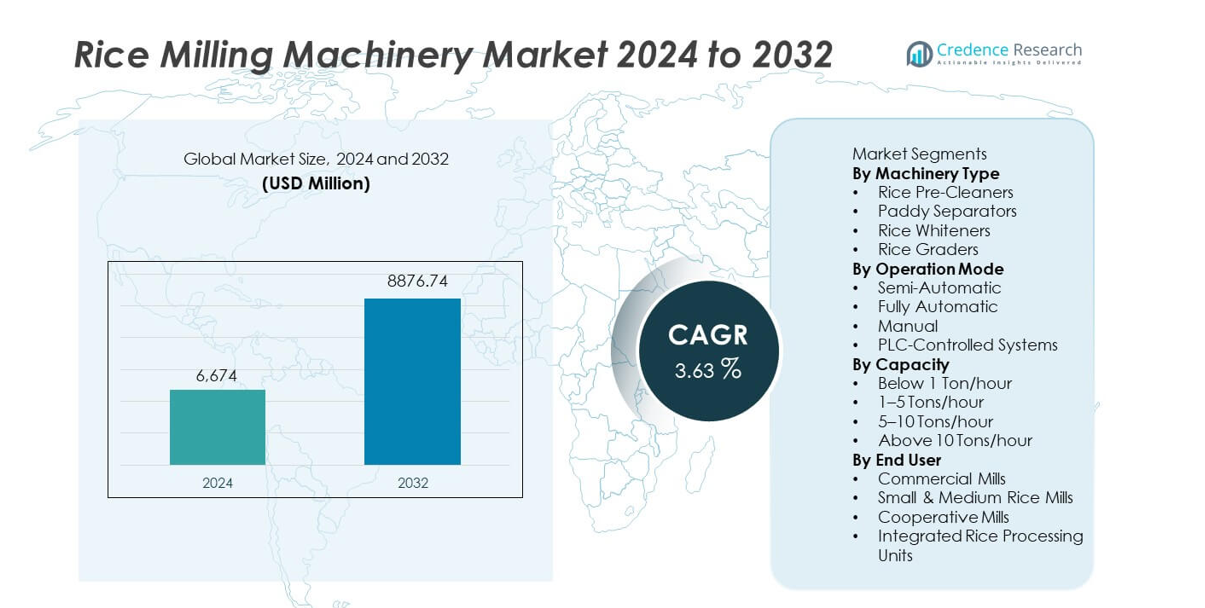
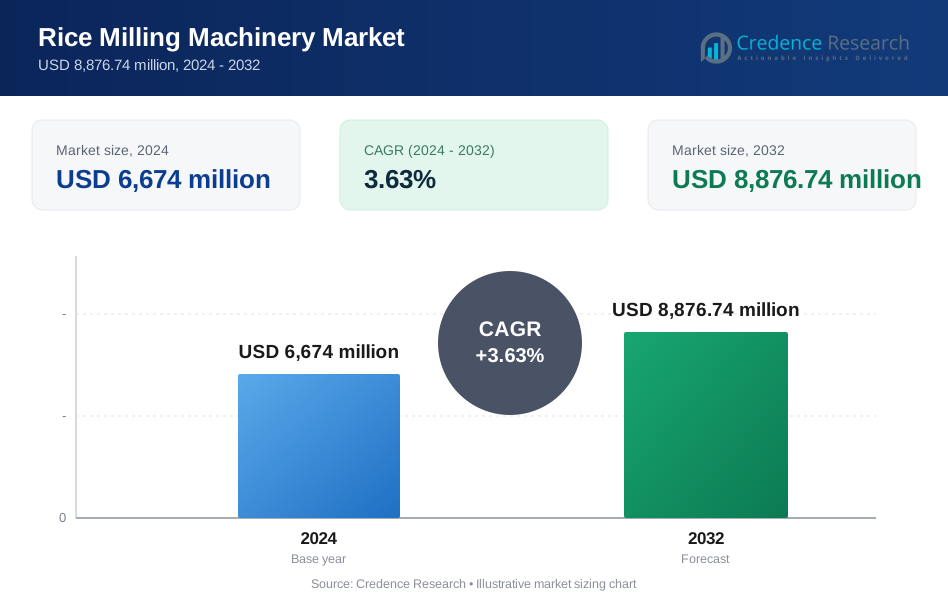
The Rice Milling Machinery Market was valued at USD 6,674 million in 2024 and is projected to reach USD 8,876.74 million by 2032, expanding at a CAGR of 3.63% during the forecast period.
| REPORT ATTRIBUTE | DETAILS |
|---|---|
| Historical Period | 2020-2023 |
| Base Year | 2024 |
| Forecast Period | 2025-2032 |
| Rice Milling Machinery Market Size 2024 | USD 6,674 million |
| Rice Milling Machinery Market , CAGR | 3.63% |
| Rice Milling Machinery Market Size 2032 | USD 8,876.74 million |
Top players in the Rice Milling Machinery market include Bühler Group, Satake Corporation, Milltech Machinery Pvt. Ltd., G.D. Rice Machinery, Perfect Equipments, Mitsun Engineering, Fowler Westrup, Hunan Chenzhou Grain & Oil Machinery, Zhengzhou VOS Machinery, and Patker Engineers Pvt. Ltd. These companies lead through advanced milling technologies, high-capacity systems, and strong after-sales support that help mills improve grain quality and operational efficiency. Asia Pacific remains the dominant region with a 58% market share, driven by large-scale rice production and modernization programs. Latin America follows with 12%, while North America holds 14%, supported by rising demand for premium processed rice.
Market Insights
- The Rice Milling Machinery market reached USD 6,674 million in 2024 and will grow at a CAGR of 3.63% through 2032, driven by rising modernization of rice mills.
- Fully automatic machines lead the operation mode segment with a 44% share, supported by strong demand for higher productivity, reduced labor dependence, and improved milling consistency.
- Automation, energy-efficient systems, and digital monitoring shape major trends as mills adopt smart machinery to reduce grain loss, enhance quality, and improve processing accuracy.
- Competition intensifies as global players invest in advanced technologies while regional manufacturers expand cost-effective and modular solutions, creating pressure on pricing and product differentiation.
- Asia Pacific dominates the market with a 58% share, followed by North America at 14% and Latin America at 12%, reflecting strong production hubs, rising rice consumption, and ongoing milling infrastructure upgrades.
Market Segmentation Analysis:
By Machinery Type
Rice whiteners dominate the machinery type segment with a 38% market share, driven by rising demand for high-quality polished rice across commercial mills. Their ability to deliver consistent texture, reduce bran residue, and improve grain appearance strengthens adoption in both small- and large-scale milling facilities. Rice pre-cleaners and paddy separators also gain traction as mills focus on improving efficiency and reducing impurities before processing. Rice graders support premium packaging needs by ensuring uniform grain size. Growing modernization of milling plants and rising output requirements continue to reinforce demand for advanced whitening and grading machinery.
- For instance, Bühler’s TopWhite rice whitener processes 7,000 kg/hour (within a range of 3,500–8,000 kg/hour) with uniform polishing accuracy supported by a 37–55 kW drive system.
By Operation Mode
Fully automatic machines lead the operation mode segment with a 44% market share, supported by increasing adoption of automation to enhance productivity, reduce labor dependency, and minimize processing errors. These systems offer precise control, high throughput, and consistent milling quality, making them preferred in large industrial mills. Semi-automatic machines continue to serve small and medium units due to lower initial investment, while manual systems retain limited use in rural setups. PLC-controlled systems gain popularity as mills integrate digital monitoring and predictive maintenance. Rising focus on operational efficiency drives widespread adoption of automation.
- For instance, Fowler Westrup offers fully automated, PLC-based processing solutions for seeds and grains with capacities that can reach up to 20 TPH (20,000 kg/hour) depending on the specific machine and product type.
By Capacity
The 1–5 tons/hour segment holds the largest share at 41%, driven by strong demand from small and medium rice mills across Asia, Africa, and Latin America. These mills adopt mid-capacity machinery to balance productivity, cost efficiency, and space optimization. Units below 1 ton/hour remain relevant for micro enterprises, while the 5–10 tons/hour range grows due to expanding commercial operations. Above 10 tons/hour machinery supports large-scale industrial milling with high output needs and advanced automation. Rising rice consumption, production growth, and modernization programs continue to boost demand for versatile mid-capacity milling systems.
Key Growth Drivers
Rising Demand for High-Quality Milled Rice
Growing consumer preference for clean, polished, and uniform rice drives increased adoption of advanced milling machinery. Modern equipment such as whiteners, graders, and paddy separators enhances grain appearance and improves yield quality, supporting premium rice production. Expanding food retail networks and rising export demand further push mills to upgrade machinery. Governments in major rice-producing nations promote modernization to reduce post-harvest losses and improve processing efficiency. These factors collectively strengthen the need for high-performance milling systems.
- For instance, Satake offers a range of vertical rice whiteners, such as the VTA10AB model, which processes 4 to 5 tons/hour of parboiled rice (5 to 6 tons/hour of non-parboiled) with a controlled-air system to maintain uniform polishing.
Modernization of Rice Mills and Automation Adoption
The industry experiences strong growth as mills shift from traditional, labor-intensive processes to automated and semi-automated systems. Automation improves throughput, reduces operational costs, and enhances consistency in milling outcomes. Fully automatic and PLC-controlled machinery gain traction due to their ability to optimize processes and support continuous production. Government-backed schemes for mill modernization also encourage adoption among small and medium enterprises. This shift toward digital and automated solutions significantly boosts demand for advanced milling equipment.
- For instance, Mitsun Engineering’s fully automatic mill (Model MIT-50) uses a 50 HP (approximately 37 kW) motor drive and delivers approximately 480 to 525 kgs per hour with automated pressure control in the horizontal kettle.
Growth in Rice Production and Global Consumption
Rising rice consumption across Asia, Africa, and Latin America increases the need for efficient milling infrastructure. Higher production volumes create demand for machines that offer higher capacity, lower grain breakage, and better sorting accuracy. Expanding commercial rice mills and integrated processing units accelerate machinery upgrades. Export-oriented nations improve milling standards to meet international quality requirements. Continuous growth in global rice supply chains remains a key driver for machinery market expansion.
Key Trends & Opportunities
Increasing Use of Smart and Energy-Efficient Machinery
Manufacturers introduce smart milling systems with digital controls, IoT integration, and energy-saving features. These technologies improve machine performance, reduce downtime, and lower operational costs. Real-time monitoring and predictive maintenance enhance equipment reliability, making them attractive for large-scale mills. The trend toward sustainability also accelerates adoption of energy-efficient motors and lower-emission machinery. This shift creates strong opportunities for suppliers offering advanced and eco-friendly equipment.
- For instance, Zhengzhou VOS Machinery sells various rice milling machines with a range of motor sizes and features. The company offers models with power ratings like 2.2 kW and 29.2 kW, which are designed for different capacities, and some listings mention features like low power consumption.
Expansion of Mid-Capacity and Modular Milling Solutions
Demand rises for modular, scalable machinery that supports flexible capacity expansion in small and medium mills. The 1–5 tons/hour range gains popularity due to its affordability and easy integration into existing facilities. Manufacturers provide compact, customizable milling lines to serve rural and semi-urban markets. Growth in rice cooperatives and regional processing units increases adoption of modular systems. This trend opens new opportunities for cost-effective, upgrade-friendly machinery designs.
- For instance, Hunan Chenzhou Grain & Oil Machinery’s MPGT series includes models such as the MPGT40, which delivers a capacity range of 2.5-4 t/h (2,500-4,000 kg/hour), or the MPGT50, which has a capacity of 5 t/h (5,000 kg/hour).
Key Challenges
High Initial Investment and Maintenance Costs
Advanced rice milling machinery requires significant upfront investment, limiting adoption among small and micro enterprises. Fully automatic and digital-controlled systems also involve higher maintenance expenses and require skilled operators. Limited financing options in developing regions slow modernization efforts. These cost pressures challenge widespread adoption of advanced milling technologies, especially for rural mills with low profit margins.
Infrastructure Limitations and Inconsistent Grain Supply
Poor electricity infrastructure, limited access to skilled technicians, and inconsistent paddy supply affect machinery performance and utilization in several regions. Frequent power fluctuations reduce machine efficiency and increase wear. Seasonal variations in rice harvests lead to underutilized machinery outside peak periods. These constraints impact operational stability and hinder machinery adoption in emerging markets.
Regional Analysis
North America
North America holds a 14% market share, driven by adoption of automated milling systems and strong demand for high-quality packaged rice. Commercial mills invest in advanced machinery to improve yield, reduce breakage, and meet premium product standards. The region benefits from modern processing infrastructure and rising interest in specialty rice varieties. Technological upgrades such as PLC-controlled machines and energy-efficient equipment support operational efficiency. Although rice production is limited compared to Asia, growing consumption and modernization of existing mills continue to support steady machinery demand across the region.
Europe
Europe accounts for a 10% market share, supported by rising consumption of long-grain, organic, and specialty rice varieties. The region focuses on high-efficiency milling machines that ensure strict quality and sustainability standards. Demand grows among rice importers and processing companies that refine imported paddy for regional markets. Technological innovation and automation adoption remain strong as mills prioritize energy savings and minimal grain loss. Regulatory focus on food quality and traceability further drives upgrades in milling systems. Expansion of packaged rice products continues to influence machinery investments across Europe.
Asia Pacific
Asia Pacific dominates the global market with a 58% market share, driven by high rice production and extensive milling activity in countries such as India, China, Thailand, Vietnam, and Indonesia. Strong demand for mid-capacity and high-capacity milling machines supports the region’s large processing network. Government programs promoting mill modernization and reduced post-harvest loss accelerate machinery adoption. Growing exports of polished and specialty rice also require advanced sorting, whitening, and grading technologies. Rapid urbanization and rising consumption strengthen long-term growth prospects for milling equipment across the region.
Latin America
Latin America holds a 12% market share, influenced by growing rice production in Brazil, Colombia, and Peru. Mills increasingly adopt semi-automatic and fully automatic machinery to improve processing efficiency and meet rising domestic demand. Investment in agricultural modernization enhances adoption of pre-cleaners, paddy separators, and mid-capacity milling systems. Export-oriented countries focus on improving rice quality to remain competitive in global markets. Infrastructure development and government support for grain processing modernization further contribute to expanding machinery demand in the region.
Middle East & Africa
The Middle East & Africa region captures a 6% market share, driven by rising rice consumption and gradual expansion of local milling capacities. Many countries depend heavily on imported paddy, which creates demand for machinery that enhances processing quality and reduces grain loss. Small and medium mills invest in cost-effective equipment, while larger facilities adopt automated systems to meet market requirements. Improvements in food supply infrastructure and government initiatives to boost local grain processing support market growth. Increasing adoption of packaged rice strengthens the need for reliable and efficient milling systems.
Market Segmentations:
By Machinery Type
- Rice Pre-Cleaners
- Paddy Separators
- Rice Whiteners
- Rice Graders
By Operation Mode
- Semi-Automatic
- Fully Automatic
- Manual
- PLC-Controlled Systems
By Capacity
- Below 1 Ton/hour
- 1–5 Tons/hour
- 5–10 Tons/hour
- Above 10 Tons/hour
By End User
- Commercial Mills
- Small & Medium Rice Mills
- Cooperative Mills
- Integrated Rice Processing Units
By Geography
- North America
- U.S.
- Canada
- Mexico
- Europe
- Germany
- France
- U.K.
- Italy
- Spain
- Rest of Europe
- Asia Pacific
- China
- Japan
- India
- South Korea
- South-east Asia
- Rest of Asia Pacific
- Latin America
- Brazil
- Argentina
- Rest of Latin America
- Middle East & Africa
- GCC Countries
- South Africa
- Rest of the Middle East and Africa
Competitive Landscape
The competitive landscape features leading players such as Bühler Group, Satake Corporation, Milltech Machinery Pvt. Ltd., G.D. Rice Machinery, Perfect Equipments, Mitsun Engineering, Fowler Westrup, Hunan Chenzhou Grain & Oil Machinery, Zhengzhou VOS Machinery, and Patker Engineers Pvt. Ltd. These companies strengthen market presence through advanced milling technologies, high-capacity machinery, and integrated processing solutions. They focus on improving grain quality, reducing breakage, and enhancing energy efficiency to meet the evolving needs of commercial and medium-sized mills. Global leaders emphasize automation, digital monitoring, and research-driven innovation, while regional manufacturers offer cost-effective and modular systems for emerging markets. Strategic partnerships, capacity expansions, and strong after-sales networks help maintain competitiveness. Growing demand for polished rice, rising modernization of milling facilities, and expansion of rice exports continue to shape competitive strategies across the industry.
Key Player Analysis
- Bühler Group
- Satake Corporation
- Milltech Machinery Private Limited
- D. Rice Machinery
- Perfect Equipments
- Mitsun Engineering
- Fowler Westrup
- Hunan Chenzhou Grain & Oil Machinery Co., Ltd
- Zhengzhou VOS Machinery Equipment Co., Ltd
- Patker Engineers Pvt. Ltd
Recent Developments
- In October 2025, Satake expanded its global footprint by delivering a state-of-the-art rice milling plant in Australia. The installation features advanced milling technology designed to improve processing efficiency and product quality. This move aligns with Satake’s strategy to strengthen its presence in high-potential markets and offer localized solutions for diverse rice varieties.
- In July 2025, an article was published by UKRI and other partners highlighting the successful development and validation of Koolmill's third-generation rice milling technology in India, a project backed by UKRI (specifically Innovate UK) and India’s Department of Biotechnology.
- In June 2025 Satake introduced the Pellet Sorter II, an innovative sorting solution aimed at enhancing precision in plastic pellet processing lines. The system leverages advanced optical technology, including 4K cameras and high-intensity LED lighting, to ensure superior sorting accuracy and operational reliability, capable of detecting defects as small as 0.1mm
Report Coverage
The research report offers an in-depth analysis based on Machinery Type, Operation Mode, Capacity, End User and Geography. It details leading market players, providing an overview of their business, product offerings, investments, revenue streams, and key applications. Additionally, the report includes insights into the competitive environment, SWOT analysis, current market trends, as well as the primary drivers and constraints. Furthermore, it discusses various factors that have driven market expansion in recent years. The report also explores market dynamics, regulatory scenarios, and technological advancements that are shaping the industry. It assesses the impact of external factors and global economic changes on market growth. Lastly, it provides strategic recommendations for new entrants and established companies to navigate the complexities of the market.
Future Outlook
- Demand for automated milling systems will rise as mills focus on improving efficiency and consistency.
- Energy-efficient machinery will gain traction as manufacturers adopt sustainability-focused production practices.
- Smart milling solutions with IoT and digital monitoring will expand across commercial processing units.
- Mid-capacity systems will see strong adoption in developing regions due to growing small and medium mills.
- Advanced whitening, grading, and sorting technologies will support premium rice production.
- Government programs promoting modernization will accelerate upgrades in traditional milling facilities.
- Global rice export growth will drive demand for high-quality processing equipment.
- Modular and compact machinery designs will expand adoption among rural and low-investment mills.
- Skilled technician demand will increase as more mills adopt automated and PLC-controlled systems.
- Competitive pressure will grow as regional manufacturers expand affordable solutions and global players innovate.
Request a Free Sample
Fill in your details and we'll send you a free sample report.
- Sample data tables & charts
- Research methodology
Need a Custom Version of This Report?
Tailor the scope, geography, or segments to your exact requirements.
- Custom geography or segment scope
- Direct access to our analyst team
Frequently Asked Questions
What is the current market size for Rice Milling Machinery market, and what is its projected size in 2032?
At what Compound Annual Growth Rate is the Rice Milling Machinery market projected to grow between 2025 and 2032?
Which capacity segment will post the highest CAGR in the forecast period?
What are the primary factors fueling the growth of the Rice Milling Machinery market?
Who are the leading companies in the Rice Milling Machinery market?
Table of Content
Chapter 1. Report Introduction
- 1.1 Report Description & Purpose
- 1.1.1 Report Title & Market Definition
- 1.1.2 Unique Selling Propositions (USP) & Key Differentiators
- 1.1.3 Value Proposition for Stakeholders
- 1.2 Research Objectives
- 1.2.1 Market Sizing Objectives (Volume & Revenue) (Volume Where Applicable)
- 1.2.2 Segmentation Objectives
- 1.2.3 Competitive Intelligence Objectives
- 1.2.4 Forecast & Scenario Objectives
- 1.3 Report Scope
- 1.3.1 Rice Milling Machinery Scope – Segments & Subsegments Covered
- 1.3.2 Geographic Scope – Regions & Countries Covered
- 1.3.3 Historical Period, Base Year & Forecast Period (2024; forecast to 2032)
- 1.3.4 Inclusions & Exclusions
- 1.4 Industry Classification & Applicable Codes
- 1.5 Currency, Measurement Units & Valuation Basis
- 1.6 Target Stakeholders
- 1.7 Limitations & Assumptions
Chapter 2. Executive Summary
- 2.1 Global Rice Milling Machinery Market Snapshot
- 2.1.1 Market Size – Historical (2024) & Forecast (2024-2032) (2024: USD 6,674 million → 2032: USD 8,876.74 million)
- 2.1.2 Volume & Revenue – Global Totals (Volume Where Applicable)
- 2.1.3 Key Market Highlights – Top Five Facts
- 2.2 Rice Milling Machinery Market Segmentation Snapshot
- 2.2.1 Market Split by Region – 2024 vs. 2032
- 2.3 Competitive Snapshot
- 2.3.1 Top 10 Players by Revenue Share – 2024
- 2.3.2 Top 10 Players by Volume Share – 2024 (Volume Where Applicable)
- 2.3.3 Recent Strategic Developments (18-Month Summary)
- 2.4 Key Investment Highlights & Strategic Conclusions
Chapter 3. Rice Milling Machinery Market Dynamics & Industry Analysis
- 3.1 Market Overview & Context
- 3.1.1 Rice Milling Machinery Market Position in the Broader Industry Value Chain
- 3.1.2 Demand Structure & Purchasing Dynamics
- 3.1.3 Market Maturity & Development Stage by Region
- 3.2 Rice Milling Machinery Market Drivers
- 3.3 Rice Milling Machinery Market Restraints & Challenges
- 3.4 Rice Milling Machinery Market Opportunities
- 3.5 Porter's Five Forces Analysis
- 3.5.1 Threat of New Entrants
- 3.5.2 Bargaining Power of Suppliers
- 3.5.3 Bargaining Power of Buyers
- 3.5.4 Threat of Substitutes
- 3.5.5 Competitive Rivalry – Intensity Assessment
- 3.6 Rice Milling Machinery Value Chain Analysis
- 3.6.1 Upstream – Key Inputs, Resources & Suppliers
- 3.6.1.1 Key Input/Resource 1
- 3.6.1.2 Key Input/Resource 2
- 3.6.1.3 Key Input/Resource 3
- 3.6.2 Midstream – Core Operations & Value Creation
- 3.6.2.1 Operating Model & Process Overview
- 3.6.2.2 Key Operating Locations & Capabilities by Company
- 3.6.3 Downstream – Market Channels & End Users
- 3.6.3.1 Direct Sales & Customer Engagement Channels
- 3.6.3.2 Indirect Sales, Intermediaries & Partner Channels
- 3.6.4 Value Chain Profitability Analysis
- 3.6.1 Upstream – Key Inputs, Resources & Suppliers
- 3.7 PESTEL Analysis
- 3.7.1 Political Factors
- 3.7.2 Economic Factors
- 3.7.3 Social Factors
- 3.7.4 Technological Factors
- 3.7.5 Environmental Factors
- 3.7.6 Legal Factors
- 3.8 Rice Milling Machinery Supply Chain Analysis
- 3.8.1 Critical Input & Resource Availability Risk Assessment
- 3.8.2 Supplier & Operational Concentration Risk (Geographic Exposure)
- 3.8.3 Supply & Service Disruption Impact Analysis
- 3.9 Regulatory & Policy Landscape
Note: The regulatory and policy landscape section covers regulations based on their applicability to the market, Rice Milling Machinery category, geography, and scope of the study. Only regulatory frameworks with a material impact on operations, compliance, trade, sustainability, or market access are analyzed in detail.
Chapter 4. Key Investment Pockets & Opportunity Analysis
- 4.1 Rice Milling Machinery Market Attractiveness Analysis
- 4.1.1 By Region – Investment Attractiveness Matrix (Market Size × CAGR)
- 4.2 Absolute Revenue Growth Opportunity
- 4.2.1 By Region – Absolute Revenue Growth Through 2032
- 4.3 Incremental Demand Opportunity
- 4.3.1 By Region – Incremental Demand Through 2032
- 4.3.2 Segment – Incremental Demand
- 4.4 Emerging Submarket Opportunity Deep Dive (Subject to Applicability)
- 4.5 Priority Market Opportunity Scorecards
- 4.5.1 United States
- 4.5.2 Europe
- 4.5.3 Asia
- 4.5.4 Middle East & Africa
Note: Priority market opportunity scorecards reflect the geographic scope and strategic relevance of the study. Listed markets are indicative and may be adapted to the industry.
Chapter 5. Rice Milling Machinery Cross-Border Trade & Market Access Analysis
- 5.1 International Trade & Cross-Border Activity Overview
- 5.1.1 Global Export Value by Country (2024)
- 5.1.2 Global Export Volume by Country (2024) (Volume Where Applicable)
- 5.1.3 Global Import Value by Country (2024)
- 5.1.4 Global Import Volume by Country (2024) (Volume Where Applicable)
- 5.1.5 Net Trade Balance by Country (2024)
- 5.2 Export Analysis – Segment
- 5.2.1 Category 1 (Applicable Classification Code)
- 5.2.2 Category 2 (Applicable Classification Code)
- 5.2.3 Category 3 (Applicable Classification Code)
- 5.2.4 Category 4 (Applicable Classification Code)
- 5.2.5 Category 5 (Applicable Classification Code)
- 5.3 Import Analysis – Segment
- 5.3.1 Category 1 (Applicable Classification Code)
- 5.3.2 Category 2 (Applicable Classification Code)
- 5.3.3 Category 3 (Applicable Classification Code)
- 5.3.4 Category 4 (Applicable Classification Code)
- 5.3.5 Category 5 (Applicable Classification Code)
- 5.4 Cross-Border Pricing & Transaction Benchmarks
- 5.4.1 Export Pricing – Segment & Country
- 5.4.2 Import Pricing – Segment & Source Country
- 5.4.3 Price Trends (2024)
- 5.5 Key Cross-Border Trade & Delivery Routes
- 5.5.1 Cross-Border Trade/Delivery Route 1
- 5.5.2 Cross-Border Trade/Delivery Route 2
- 5.5.3 Cross-Border Trade/Delivery Route 3
- 5.5.4 Cross-Border Trade/Delivery Route 4
- 5.5.5 Cross-Border Trade/Delivery Route 5
- 5.6 Trade Policy & Market Access Impact Assessment
- 5.6.1 Tariff & Non-Tariff Barriers
- 5.6.2 Regional Trade & Economic Integration Frameworks
- 5.6.3 Bilateral & Multilateral Trade Agreements
- 5.6.4 Cross-Border Operating, Licensing & Localization Requirements
Note: This chapter applies where cross-border trade or delivery is relevant to Rice Milling Machinery. Goods, services, and digital offerings are assessed using applicable classifications and transaction measures. Import-export volumes, trade balances, and route analyses are included only where meaningful to the market.
Chapter 6. Competitive Landscape & Company Benchmarking
- 6.1 Rice Milling Machinery Market Concentration & Structure
- 6.1.1 Herfindahl-Hirschman Index (HHI) – the historical period vs. 2024
- 6.1.2 Leading, Mid-Sized & Emerging Player Structure
- 6.1.3 Global, Regional & Local Player Dynamics
- 6.2 Rice Milling Machinery Market Share Analysis – 2024
- 6.2.1 Global Revenue Share by Company
- 6.2.2 Global Volume Share by Company (Volume Where Applicable)
- 6.2.3 Regional Revenue Share
- 6.2.4 Market Share Evolution (the historical period vs. 2024)
- 6.2.5 Company Market Share by Key Segment
- 6.2.6 Company Market Share by Customer Group
- 6.3 Operating Scale, Capacity & Infrastructure Analysis
- 6.3.1 Global Operating Scale & Supply Capacity
- 6.3.2 Resource Utilization & Operating Efficiency
- 6.3.3 Output, Service Delivery & Activity Metrics
- 6.3.4 Operating Footprint & Infrastructure Map
- 6.3.5 Planned Operational & Capacity Expansion
- 6.4 Rice Milling Machinery Competitive Benchmarking Matrix
- 6.4.1 Revenue, Growth, Profitability & Operating Metric Comparison
- 6.4.2 Channel Revenue Mix
- 6.4.3 Geographic Revenue Exposure
- 6.4.4 R&D Intensity
- 6.4.5 Sustainability Maturity
- 6.5 Strategic Developments in Rice Milling Machinery (Last 24 Months)
- 6.5.1 Mergers, Acquisitions & Divestments
- 6.5.2 New Products, Services & Solutions in Rice Milling Machinery
- 6.5.3 Operational & Infrastructure Expansions
- 6.5.4 Strategic Alliances, Joint Ventures & Partnerships
- 6.5.5 Distribution Expansion & Market Entry
- 6.5.6 Sustainability & ESG Initiatives
- 6.6 Competitive Strategy Mapping
- 6.6.1 Leader, Challenger, Follower & Niche Classification
- 6.6.2 Pricing Strategy Comparison
- 6.6.3 Channel Strategy Matrix
Note: Strategic developments are included based on their materiality and the availability of reliable information.
Chapter 7. Global Rice Milling Machinery Market – By Sales & Delivery Channel
- 7.1 Segment Overview
- 7.1.1 Volume & Revenue Split by Channel (2024 & 2032) (Volume Where Applicable)
- 7.1.2 Channel Mix Evolution (2024-2032)
Chapter 8. Regional Market Analysis – Global Overview
- 8.1 Global Regional Overview
- 8.1.1 Regional Volume Share (Volume Where Applicable)
- 8.1.2 Regional Revenue Share
- 8.1.3 Regional Volume by Region (Volume Where Applicable)
- 8.1.4 Regional Revenue by Region
- 8.1.5 Regional Forecast Through 2032
- 8.2 Cross-Regional Segment Analysis
- 8.2.1 By Sales & Delivery Channel
- 8.2.2 By Competitive Positioning & Price Tier
Chapter 9. North America Rice Milling Machinery Market
- 9.1 United States
- 9.2 Canada
- 9.3 Mexico
Chapter 10. Europe Rice Milling Machinery Market
- 10.1 Germany
- 10.2 France
- 10.3 Italy
- 10.4 United Kingdom
- 10.5 Spain
- 10.6 Poland
- 10.7 Russia
- 10.8 Netherlands
- 10.9 Belgium
- 10.10 Sweden
- 10.11 Denmark
- 10.12 Norway
- 10.13 Rest of Europe
Chapter 11. Asia Pacific Rice Milling Machinery Market
- 11.1 China
- 11.2 India
- 11.3 Japan
- 11.4 South Korea
- 11.5 Thailand
- 11.6 Indonesia
- 11.7 Vietnam
- 11.8 Malaysia
- 11.9 Australia
- 11.10 Rest of Asia Pacific
Chapter 12. Latin America Rice Milling Machinery Market
- 12.1 Brazil
- 12.2 Argentina
- 12.3 Colombia
- 12.4 Chile
- 12.5 Rest of Latin America
Chapter 13. Middle East Rice Milling Machinery Market
- 13.1 Saudi Arabia
- 13.2 United Arab Emirates
- 13.3 Turkey
- 13.4 Israel
- 13.5 Iran
- 13.6 Rest of the Middle East
Chapter 14. Africa Rice Milling Machinery Market
- 14.1 South Africa
- 14.2 Egypt
- 14.3 Nigeria
- 14.4 Morocco
- 14.5 Rest of Africa
Chapter 15. Rice Milling Machinery Company Profiles
- 15.1 [Company 01]
- 15.1.1 Company Overview
- 15.1.2 Key Management Personnel
- 15.1.3 Products & Services Portfolio
- 15.1.4 Financial Performance
- 15.1.5 Key Market Focus & Geographic Presence
- 15.1.6 Recent Developments & Strategic Initiatives
Note: The company profile list is preliminary and may change based on research findings, market developments, data availability, and client requirements.
Chapter 16. Appendices
- Appendix A – List of Abbreviations & Acronyms
- Appendix B – Industry Classification Code Reference – Full Series
- Appendix C – Supply, Output & Operating Capacity Data Tables
- Appendix D – End-Use & Demand Base Tables
- Appendix E – Demand, Adoption & Usage Assumptions
- Appendix F – Pricing & Revenue Metric Reference Tables
- Appendix G – Company Operations & Infrastructure Database
- Appendix H – Cross-Border Trade & Activity Data Tables (Where Applicable)
- Appendix I – Regulatory Summary Tables
- Appendix J – Primary Research Participant List (Anonymized)
- Appendix K – Primary Research Questionnaire Framework
- Appendix L – Data Sources & Bibliography
- Appendix M – Market Size Divergence & Source Comparison
Chapter 17. Research Methodology
- 17.1 Research Framework & Philosophy
- 17.2 Secondary Research – Sources, Hierarchy & Data Extraction
- 17.3 Data Modeling – Bottom-Up & Top-Down Market Sizing
- 17.4 Primary Research – Stakeholder Framework, LOI & Sample Sizes
- 17.5 Forecast Methodology – Regression, Scenario & Sensitivity Analysis
- 17.6 Quality Control – Four-Layer Validation Framework
- 17.7 Limitations & Standard Assumptions
- 17.8 Disclaimer
