
Quick answer
An instant coffee plant roasts green coffee, extracts it with hot water and dries the concentrate into soluble powder or granules. This overview models a greenfield spray-dried plant making 5,000 tonnes a year, with estimated CapEx of USD 25–45 million depending on cost region. Gross margin after green coffee and direct conversion costs is estimated at 12–24%, with payback at 4–9 years, because coffee prices drive nearly all of the cost.
Viable for operators with origin access to robusta, hedging discipline and contracted private-label or bulk buyers; thin margins and heavy working capital make it risky for a standalone merchant plant.
Instant Coffee plant: key highlights
| Parameter | Indicative value | Note |
|---|---|---|
| Plant capacity | 5,000 tonnes of instant coffee per year | About 17 tonnes a day over 300 operating days, spray-dried and agglomerated |
| Total CapEx | USD 25–45 million | Greenfield, excluding working capital; a freeze-dried plant of this size would run about USD 75–80 million |
| Raw material share of operating cost | 75–85% | About 2.4–2.6 kg of green coffee per kg of instant coffee |
| Gross margin | 12–24% | After green coffee and direct conversion costs, at USD 12–14.5 per kg |
| Payback period | 4–9 years | From commissioning, including ramp-up; longer in years of squeezed margins |
| IRR | Available in report | Post-tax, 10-year model |
| Break-even | Available in report | Capacity utilization basis |
Ranges assume a 5,000 tonnes-per-year greenfield spray-dried plant, 300 operating days, 85% steady-state utilization and 2026 prices. Robusta at USD 3.6–4.1 per kg from 2026 ICO monthly averages; selling price USD 12–14.5 per kg, assumed from export unit values; conversion cost assumed at USD 1–1.5 per kg. INR converted at an assumed 82.5 per USD for 2023. The full report can be customized to any country or region.
What is instant coffee?
Instant coffee, also called soluble coffee, is the dried water extract of roasted coffee beans. It dissolves in hot or cold water without brewing equipment, which explains its hold on households in tea-drinking and emerging markets, and on food makers that need a stable coffee ingredient.
Three commercial forms dominate. Spray-dried powder is the cheapest and suits bulk sales and mixes. Agglomerated granules look and pour better and dissolve with less dust. Freeze-dried granules keep more aroma and sell at a premium, but cost far more to make. Plants also sell liquid concentrate in drums to beverage and flavor customers.
Buyers include national brands, retailers' private labels, three-in-one sachet packers, ready-to-drink makers, and bakery and confectionery producers. The product falls under Harmonized System subheading 2101.11, extracts, essences and concentrates of coffee. EU rules on coffee extracts require at least 95% coffee-based dry matter in the dried product and allow water as the only extraction medium.
Instant coffee market overview and global demand
Credence Research does not publish a dedicated instant coffee market value, so this overview relies on physical and trade indicators. For wider context, Credence Research values the global coffee beans market at USD 35.11 billion in 2024 with a 7.7% CAGR through 2032, which implies about USD 37.8 billion in 2025. The roasted coffee segment is the main rival for the same beans.
UN Comtrade records for 2024 show reporting countries exporting about USD 7.1 billion and more than 600,000 tonnes under HS 2101.11. Germany and Brazil led at about USD 950 million and USD 920 million, followed by Spain, India, Mexico and the Netherlands. Germany and Spain reflect processing and re-export rather than coffee growing. Vietnam does not appear among the leading reporters in that dataset, so totals understate true trade. An undated trade tally ranks the U.S., Germany, the UK, Poland and the Netherlands as top buyers.
The International Coffee Organization's monthly data fill that gap. Soluble exports reached 1.82 million 60-kg bags, in green equivalent, in March 2026, led by Vietnam at 0.56 million, Brazil at 0.4 million and India at 0.28 million. June 2026 shipments slipped 1.3% to 1.35 million bags.
Origin countries are also winning domestic demand. Brazil exported 85,082 tonnes in 2025, down 10.6% after a 50% U.S. tariff imposed in August 2025 and later cut to 10%, while Brazilian soluble export earnings still set a record on higher coffee prices. Domestic Brazilian consumption rose 9.5% to a record 27,008 tonnes. USDA forecasts India's 2026/27 soluble exports at 2.53 million bags, about 41% of its coffee exports. Tariffs and trade deals can quickly redirect orders, so a new plant needs several export lanes.
Instant coffee manufacturing process
The process separates into a coffee side, where flavor and yield are set, and a water removal side, where most of the energy goes. Every kilogram of finished product requires driving off large volumes of water, so evaporator design and heat recovery matter as much as the dryer.
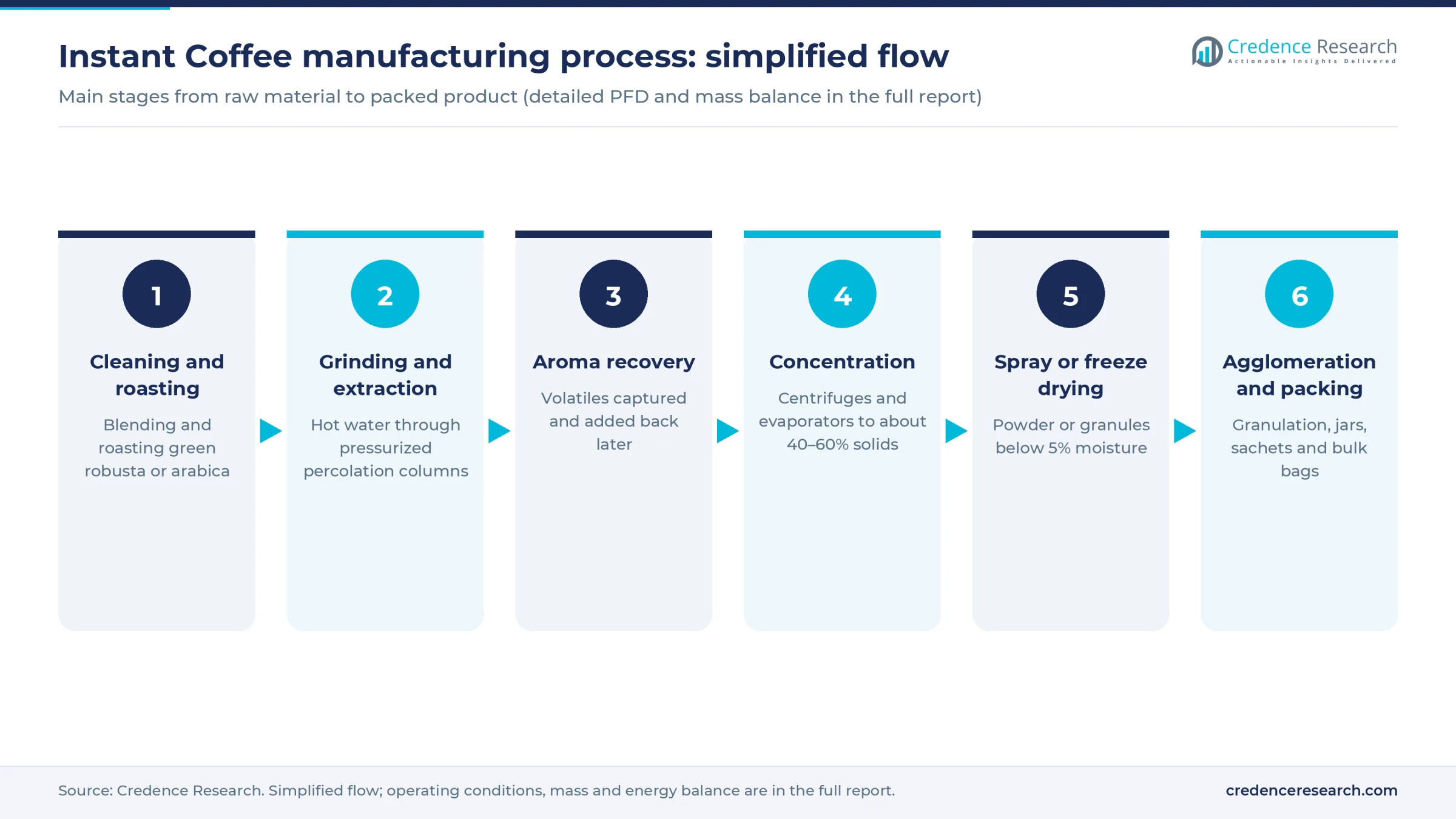
- Cleaning, blending and roasting. Green beans are cleaned of foreign matter, blended to a recipe and roasted. Robusta dominates spray-dried products because it costs less and yields more solubles, while arabica is added for premium blends.
- Grinding and extraction. Coarsely ground coffee passes through a battery of pressurized columns, with hot water flowing counter-current so the freshest water meets the most exhausted coffee. Higher temperatures raise yield but can harm taste, which is the central tradeoff in the plant.
- Aroma recovery. Volatile compounds are stripped from the extract early and added back later, because evaporation and drying would otherwise lose them.
- Clarification and concentration. Centrifuges remove fines. Evaporators, or freeze concentration in premium lines, raise solids to about 40–60%.
- Drying. In spray drying, concentrate falls through a tower against hot air and leaves as powder below 5% moisture. Freeze drying instead freezes the extract at about minus 50°C, grinds it and sublimes the ice under vacuum.
- Agglomeration and packing. Powder can be wetted slightly and clustered into granules. Product is then packed in cartons, jumbo bags, jars, sticks or sachets, with protection from moisture and oxygen.
The International Coffee Organization's conversion factor counts 2.6 kg of green beans per kg of soluble coffee. This overview uses 2.4–2.6 kg because well-run robusta lines can beat the convention, a yield figure assumed here. Spent grounds can be pressed and burned as boiler fuel, which cuts fuel bills and solves a disposal problem; ofi's plant in Linhares, Brazil, runs biomass boilers on coffee production waste.
Instant coffee plant setup cost
This overview models a greenfield spray-dried and agglomerated plant making 5,000 tonnes a year, about 17 tonnes a day, at an estimated total CapEx of USD 25–45 million. That excludes working capital. The scale sits close to the 4,500-tonne line that Vintage Coffee added in India in 2026, and a smaller plant struggles because extraction, evaporation and drying carry high fixed costs.
The low end rests on CCL Products' 2023 announcement of about 4 billion Indian rupees, roughly USD 48 million, for a 16,000-tonne spray-dried plant in Andhra Pradesh. Scaling down with a standard capacity exponent gives about USD 23 million at Indian build costs. The top assumes a 1.5–2 times premium for international-standard construction and equipment in higher-cost regions, a judgment rather than a disclosed figure.
Drying route changes the budget sharply. Future Enterprises disclosed about USD 81 million for a 5,400-tonne freeze-dried plant in Vietnam in 2024, which scales to about USD 75–80 million at this capacity.
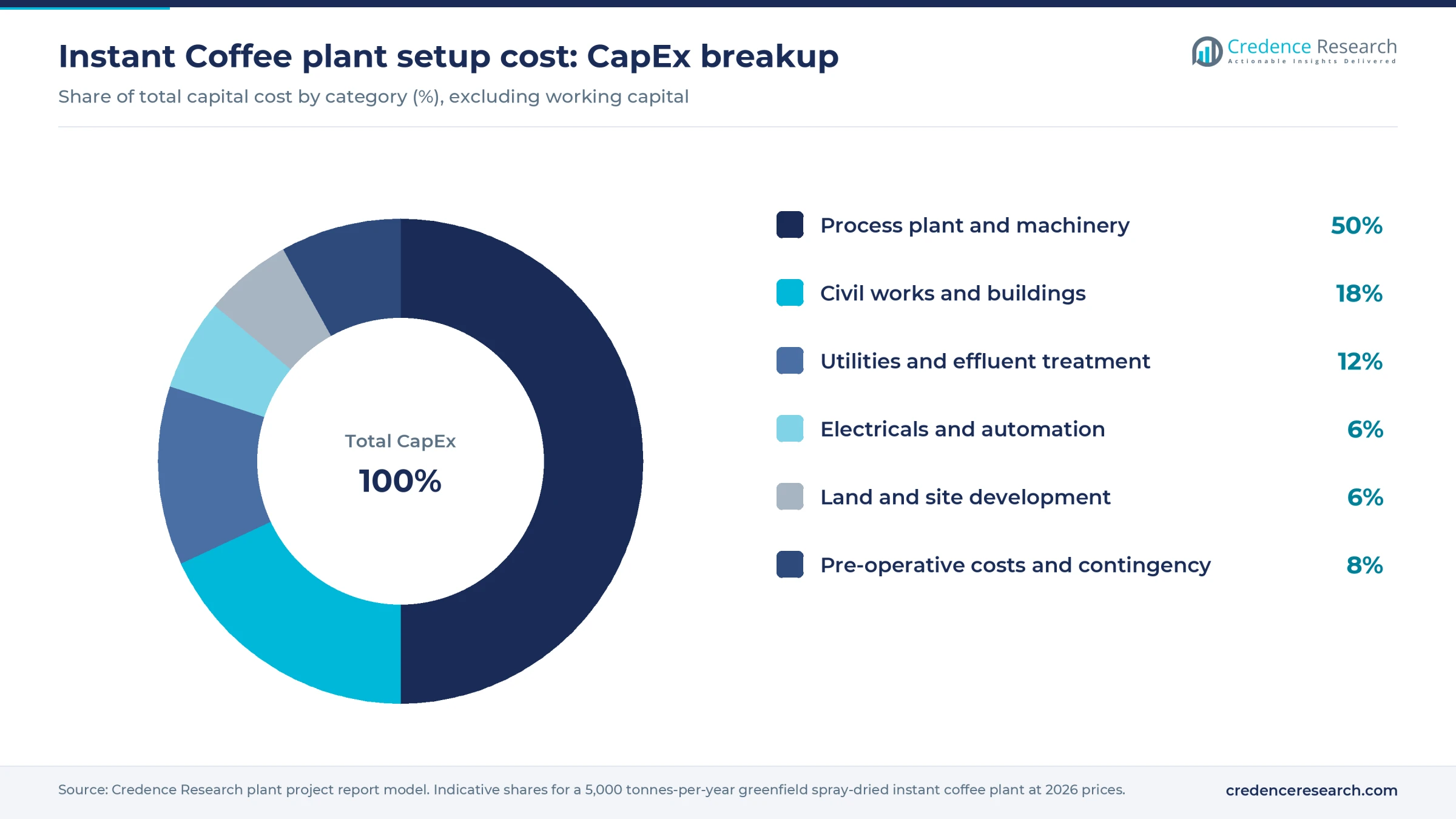
Worked example, land and site development. The plant needs an assumed 30,000–50,000 square meters. At an assumed USD 20–60 per square meter in an Asian industrial park, the plot costs about USD 0.6–3 million, and at an assumed USD 30–80 at a U.S. or EU site, about USD 0.9–4 million. Site works add an assumed USD 0.5–1 million, so this row runs about 4–11% of CapEx, since cheap land usually pairs with a lower-cost build.
Working capital is unusually heavy. About two to three months of green coffee, 60 days of receivables and finished goods tie up an estimated USD 15–22 million at 2026 coffee prices, a sum that can equal half of CapEx or more.
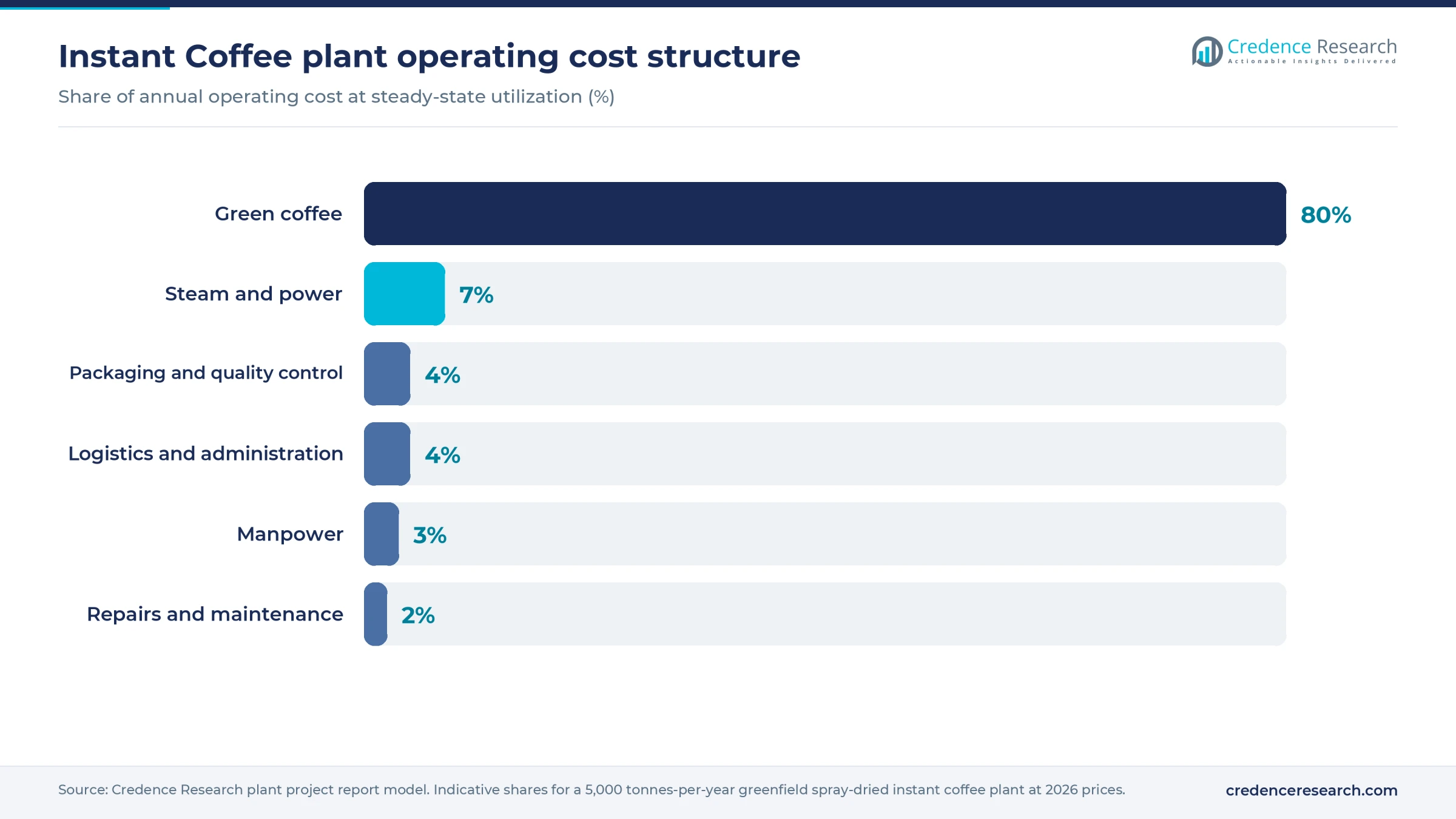
Green coffee dwarfs every other line, followed by steam and power for evaporation and drying. Exact line items and cost sheets remain in the full report.
Machinery and raw materials for an instant coffee plant
The main machinery groups are listed below; capacities, specifications and quotations are available in the report.
- Bean handling: intake, silos, destoners, blending system, roasters with afterburners
- Extraction: grinders, percolation column battery, aroma recovery unit, clarifying centrifuges
- Concentration: multiple-effect or mechanical vapor recompression evaporators, extract tanks and chillers
- Drying: spray tower with fines recovery, agglomerator; freeze dryers and refrigeration on premium lines
- Packing: sieves, jar, sachet and bulk filling lines, nitrogen flushing, quality laboratory
- Utilities: biomass boiler for spent grounds, cooling towers, water treatment, effluent treatment plant, dust extraction
Green robusta is the main input. Vietnam, Brazil's conilon belt in Espírito Santo, Indonesia, India and Uganda supply most of it, while Colombia, Brazil, Ethiopia and Central America provide arabica for premium blends. Siting near origin shortens freight and can avoid import duty, which is why new capacity has clustered in Vietnam, India and Brazil. Consuming-country plants trade that away for proximity to customers. Buyers should grade for defects, moisture and solubles yield, since solubles yield directly sets coffee cost per kg. Readers can compare origin economics in the coffee value chain study. Other inputs are process water, boiler fuel, nitrogen and packaging.
Instant coffee business profit margin and ROI
Instant coffee is a conversion business, so the spread over green coffee matters more than the selling price. For the modeled plant, gross margin after coffee and direct conversion costs is estimated at 12–24%, at USD 12–14.5 per kg. Payback runs 4–9 years after commissioning, including ramp-up, assuming overheads of USD 2–4 million a year.
Brazil's reported 2025 exports work out to about USD 12.9 per kg and its February 2026 shipments to about USD 12.2, while 2024 values for Germany, Mexico and the Netherlands ran near USD 14.4–14.8. Robusta at 165–185 U.S. cents per pound in April–July 2026, ICO figures show, equals USD 3.6–4.1 per kg, or about USD 8.7–10.6 of coffee per kg of product. Listed producer CCL Products reported EBITDA of about USD 1.5 per kg for fiscal 2026, at an assumed 90 rupees per dollar, a useful check on the band.
Coffee price risk is the key sensitivity. A rise of 10 U.S. cents per pound in robusta that cannot be passed through cuts gross margin by about 4 percentage points, and a bad year could erase it, so hedging and back-to-back contracts are essential. Selling agglomerated, private-label and branded packs widens the spread. Yield is second, because each lost point adds coffee cost directly. Interest on working capital can also consume much of the operating profit when prices peak.
| Metric | Value |
|---|---|
| Project IRR (post-tax) | Available in report |
| NPV | Available in report |
| Return on investment | Available in report |
| DSCR | Available in report |
| Break-even utilization | Available in report |
How to start an instant coffee business, licenses and approvals
An instant coffee plant needs approvals in six areas wherever it is built. These are business and tax registration; land use, zoning and building permits; an environmental permit covering roaster emissions, boiler stacks and high-strength wastewater; occupational safety, boiler and pressure vessel approvals, with attention to combustible coffee dust; food facility registration and product standards; and customs registration for trade. Roaster smoke and odor often draw the earliest local objections, so site distance from homes deserves early attention.
| Market | Food product | Environment, safety and trade |
|---|---|---|
| United States | FDA food facility registration and preventive controls under 21 CFR 117; for decaffeinated lines using methylene chloride, a 10 parts per million residue limit | State air permit for roasters and boilers; NPDES or local pretreatment permit; OSHA standards |
| European Union | Food business registration under Regulation (EC) No 852/2004; composition and labeling under Directive 1999/4/EC, as transposed nationally | National environmental permit, with this size well below the Industrial Emissions Directive's 300-tonne daily threshold for vegetable raw materials; ATEX rules for dust atmospheres |
| India | FSSAI central license, required above 2 tonnes a day of installed capacity; coffee standards under regulation 2.10.2 of the 2011 food product standards | State pollution control board consents to establish and operate; factory license and boiler registration; Coffee Board registration under the Coffee Act, 1942, plus shipment export permits |
Large buyers commonly also require certified food safety systems such as FSSC 22000, plus kosher, halal, organic or Rainforest Alliance certification depending on the customer. Requirements vary locally, and the full report lists the steps for a chosen country.
Key instant coffee manufacturers and recent developments
Nestlé, through Nescafé, leads the global industry, and JDE Peet's is a major branded rival. Private-label, bulk and regional brand supply comes from CCL Products, Tata Consumer Products, Food Empire and Vintage Coffee and Beverages in India, ofi and Cacique in Brazil, and Trung Nguyen Legend and Vinacafe in Vietnam. Specialty buyers can compare premium trends in the specialty coffee market study.
- October 2026. Nestlé began building a Nescafé factory in Samut Prakan, Thailand, a THB 23 billion project announced in July, covering instant coffee and ready-to-drink products. Commercial production is expected in late 2028.
- April 2026. Keurig Dr Pepper completed its acquisition of JDE Peet's, valued at about USD 18 billion, and plans to separate a global coffee company after an interim period.
- March 2026. Vintage Coffee commissioned a further 4,500 tonnes a year of spray-dried and agglomerated capacity in Telangana, India, raising its total to 11,000 tonnes.
Together these moves show large groups consolidating brands while new capacity keeps gathering in Asia, so a new entrant should expect stronger price competition for private-label contracts.
What's inside the Instant Coffee project report PDF
The report runs to 21 chapters. Open a chapter to see its sections.
1. Preface
2. Scope and Methodology
- 2.1 Objectives of the Study
- 2.2 Stakeholders
- 2.3 Research Methodology
- 2.4 Data Sources and Key Assumptions
3. Executive Summary
- 3.1 Market Snapshot
- 3.2 Project at a Glance (Capacity, CapEx, OpEx)
- 3.3 Key Financial Indicators (IRR, NPV, Payback, Break-even)
- 3.4 Feasibility Verdict
4. Product Overview
- 4.1 Instant Coffee Definition and Properties
- 4.2 Grades and Specifications (BIS / ISO / ASTM)
- 4.3 HS Code and Classification
- 4.4 Key Applications
- 4.5 Substitutes
5. Global Instant Coffee Market
- 5.1 Market Overview
- 5.2 Historical and Current Market Performance (Volume and Value)
- 5.3 Market Breakup by Grade / Type
- 5.4 Market Breakup by End-Use Industry
- 5.5 Market Breakup by Region
- 5.6 Market Drivers, Restraints and Trends
- 5.7 Value Chain Analysis
- 5.8 Market Forecast
6. Target Country Instant Coffee Market Analysis
- 6.1 Demand and Supply Analysis
- 6.2 Installed Capacity vs Demand Gap
- 6.3 Import Dependence
- 6.4 Demand Forecast by End-Use
7. Trade Analysis
- 7.1 Imports by Volume, Value and Country
- 7.2 Exports by Volume, Value and Country
- 7.3 Trade Balance and Opportunities
8. Price Analysis
- 8.1 Historical Instant Coffee Price Trends by Region
- 8.2 Raw Material / Feedstock Price Trends and Linkage
- 8.3 Price Forecast
- 8.4 Margins Across the Value Chain
9. Competitive Landscape
- 9.1 Market Structure
- 9.2 Key Players and Installed Capacities
- 9.3 Profiles of Key Players
- 9.4 Recent Developments (Expansions, M&A, New Plants)
10. Manufacturing Process and Technology
- 10.1 Comparison of Technology Routes
- 10.2 Selected Route and Process Flow Diagram
- 10.3 Unit Operations Involved
- 10.4 Chemical Reactions Involved
- 10.5 Mass Balance and Raw Material Requirements
- 10.6 Energy Balance
- 10.7 Quality Assurance Criteria and Technical Tests
- 10.8 By-products and Waste Handling
- 10.9 Technology Licensors / Providers
11. Project Details, Requirements and Costs
- 11.1 Land, Location and Site Development
- 11.1.1 Site Selection Criteria
- 11.1.2 Location Analysis
- 11.1.3 Land Requirement and Costs
- 11.1.4 Site Development Costs
- 11.2 Plant Layout
- 11.2.1 Layout Principles
- 11.2.2 Proposed Layout
- 11.2.3 Factors Influencing Layout
- 11.3 Civil Works and Buildings
- 11.4 Plant Machinery
- 11.4.1 Machinery Requirements and Specifications
- 11.4.2 Machinery Costs
- 11.4.3 Machinery Suppliers
- 11.5 Raw Materials
- 11.5.1 Requirements per Tonne of Output
- 11.5.2 Procurement and Sourcing
- 11.5.3 Costs
- 11.5.4 Suppliers
- 11.6 Packaging
- 11.6.1 Packaging Requirements
- 11.6.2 Packaging Costs
- 11.6.3 Packaging Suppliers
- 11.7 Storage and Material Handling
- 11.8 Transportation Requirements and Costs
- 11.9 Utilities
- 11.9.1 Power Requirements and Costs
- 11.9.2 Water Requirements and Costs
- 11.9.3 Steam, Fuel and Other Utilities
- 11.10 Manpower Requirements and Wages
12. Environment, Health, Safety and Sustainability
- 12.1 Effluent and Emissions Management
- 12.2 Hazard Classification and Safety Measures
- 12.3 Carbon Footprint
- 12.4 Green / Low-Carbon Process Options
13. Regulatory Procedures, Approvals and Certifications
- 13.1 Licences and Registrations
- 13.2 Environmental Clearances
- 13.3 Product Certifications (BIS, REACH, etc.)
- 13.4 Approval Timeline
14. Project Implementation Schedule
15. Project Economics
- 15.1 Capital Cost of the Project
- 15.2 Techno-Economic Parameters
- 15.3 Capacity Utilization and Ramp-up
- 15.4 Product Pricing and Margins
- 15.5 Income Projections
- 15.6 Expenditure Projections
- 15.7 Working Capital Requirement
- 15.8 Taxation
- 15.9 Depreciation
16. Financial Analysis
- 16.1 Projected Profit and Loss Account
- 16.2 Projected Cash Flow Statement
- 16.3 Projected Balance Sheet
- 16.4 Liquidity Analysis
- 16.5 Profitability Analysis (Payback, NPV, IRR, ROI)
- 16.6 Break-even Analysis
- 16.7 Debt Service Coverage Ratio (DSCR)
- 16.8 Sensitivity Analysis
- 16.9 Scenario and Uncertainty Analysis
17. Funding and Incentives
- 17.1 Means of Finance and Debt-Equity Structure
- 17.2 Loans and Financial Assistance
- 17.3 Government Schemes and Subsidies (PLI, State Policies)
18. Risk Assessment
- 18.1 Key Success Factors
- 18.2 Key Risk Factors
- 18.3 Risk Mitigation
19. Strategic Recommendations
20. Case Study of a Successful Venture
21. Appendix
- 21.1 Detailed Assumptions
- 21.2 Abbreviations
- 21.3 List of Tables and Figures
- 21.4 Sources
This page vs. the full report
| Data point | On this page (free) | In the full report |
|---|---|---|
| Total CapEx | One rounded range at one capacity | Exact figure at three capacities with a line-item breakup |
| CapEx breakup | Category shares (%) only | Cost, quantity and supplier for every machine |
| Operating cost | Share of raw materials, utilities and labor | Per-unit cost sheet with each input price and consumption |
| Profitability | Gross margin range and payback band | Exact IRR, NPV, ROI, break-even and DSCR |
| Financial statements | List of what is included | 10-year P&L, cash flow, balance sheet and Excel model |
| Sensitivity | One directional line | Full sensitivity and scenario tables |
| Process | Simplified flow diagram | Detailed process flow, mass and energy balance, operating conditions |
| Machinery | Names of the main machines | Specifications, capacity, cost and supplier list |
| Market | Headline size, growth and India demand trend | Segment, region, trade and price forecast tables |
| Suppliers and buyers | Supplier types and sourcing hubs | Named suppliers and buyers |
Instant Coffee project report: FAQs
How much does it cost to set up an instant coffee plant?
How much green coffee does a plant need per kg of instant coffee?
What profit margin can an instant coffee plant earn?
Is spray drying or freeze drying better for a new plant?
Which licenses does an instant coffee plant need?
Where is instant coffee produced and who buys it?
Where should an instant coffee plant be located?

About the analyst
Priyanka Mor, Senior Consultant
Senior Consultant at Credence Research Inc directing strategic market advisory, cross-border commercial due diligence and enterprise intelligence frameworks for global B2B clients. Combines quantitative modeling with executive advisory, translating macroeconomic variables and supply chain data into go-to-market blueprints, M&A screenings and competitive war-gaming strategies.
Related market research
- Coffee Beans Market Size, Trends, Share and Forecast 2032
- Roasted Coffee Market Size, Share and Growth Report 2032
- Specialty Coffee Market Size, Growth, Share and Forecast 2032
- Coffee Value Chain Analysis Market Size, Share and Forecast 2032
- White Coffee Market Size, Trends, Share & Forecast 2032
- Europe Coffee Market Size, Share, Growth and Forecast, 2025-2035
More plant project reports
- Shrimp Processing Plant Project Report (DPR) 2026
- Pectin Manufacturing Plant Project Report (DPR) 2026
- Parboiled White Rice Processing Plant Project Report (DPR) 2026
- Potato Processing Plant Prefeasibility Report 2026
- Corn Starch Manufacturing Plant Project Report (DPR) 2026
- Cassava Starch Manufacturing Plant Project Report (DPR) 2026