
Quick answer
A tissue paper manufacturing plant turns market pulp into creped parent reels and converts them into bath tissue, towels, napkins and facial tissue. A greenfield integrated mill with one conventional machine of about 30,000 metric tons a year needs an estimated USD 45–70 million of CapEx. Fiber, chemicals and packaging take 65–75% of operating cost, leaving a gross margin of 18–29%. Payback is about 6–10 years at 85% utilization, so the business rewards secure pulp and contracted volume.
Viable for an investor with patient capital, contracted retail or private-label volume and secure pulp and energy, but risky for a stand-alone mill selling commodity jumbo rolls against low-priced Chinese exports.
Tissue Paper plant: key highlights
| Parameter | Indicative value | Note |
|---|---|---|
| Plant capacity | About 30,000 metric tons per year | One crescent-former machine, about 100 tons a day, with roll, napkin and facial tissue converting |
| Total CapEx | USD 45–70 million | Greenfield, Asian site; a European-built line or U.S. and EU sites at or above the top |
| Raw material share of operating cost | 65–75% | Pulp is about 59%; chemicals and packaging add the rest |
| Gross margin | 18–29% | Ex-works price minus fiber, chemicals, packaging, energy and direct conversion |
| Payback period | 6–10 years | At 85% utilization, mid-range CapEx of about USD 57 million and mid-to-upper margin |
| IRR | Available in report | Post-tax, 10-year model |
| Break-even | Available in report | Capacity utilization basis |
Ranges assume about 30,000 metric tons a year from one conventional crescent-former machine with converting, a greenfield Asian industrial park (U.S. and EU costs higher), 2026 prices, 85% utilization, an assumed blended ex-works price of USD 1,500 per ton, Asian hardwood pulp near USD 590–600 per ton list, assumed softwood, energy and land rates, and USD at 88 rupees and 1.15 per euro. Customizable to any country.
What is tissue paper?
Tissue paper is a lightweight, creped paper, usually 12–40 grams per square meter, made for softness, absorbency and strength rather than for printing. A tissue mill spreads a very dilute pulp suspension on a fast-running fabric, dries it on a large steam-heated Yankee cylinder and scrapes it off with a doctor blade. That scraping creates the crepe that gives the sheet bulk and stretch. The mill's output is a parent reel, or jumbo roll, which converting lines turn into finished packs.
The main grades are bath tissue, kitchen towels, facial tissue, table napkins and hand towels, split between retail, or at-home, products and away-from-home products sold to offices, hotels, hospitals and restaurants. Fiber choice separates the quality tiers. Virgin hardwood pulp gives softness, softwood pulp adds strength, and recycled fiber keeps economy and away-from-home grades cheap. In the Harmonized System, parent reels wider than 36 centimeters fall under subheading 4803.00, while converted toilet paper is 4818.10, facial tissue and towels 4818.20, and napkins 4818.30.
Tissue paper market overview and global demand
Credence Research valued the global market for household and away-from-home tissue products at USD 20.86 billion in 2024 and projects USD 32.20 billion by 2032, a 5.58% CAGR. Applying that rate gives about USD 22.0 billion for 2025, a value derived from the 2024 figure rather than separately reported.
Tissue is a local product in most places, because a truck of bath tissue carries mostly air, yet trade is sizable. World exports of toilet paper were about USD 5.3 billion in 2025, led by China, Germany, Canada and Poland, while parent reel exports under 4803.00 were about USD 4.9 billion in 2023, with Indonesia, Turkey, Italy and China in front, based on UN Comtrade and ITC trade data.
China's household paper industry association reported that Chinese tissue exports rose 22% to 1.21 million metric tons in January through September 2025, with finished products about 69% of the volume, while about 1.49 million tons of new modern capacity started up in China during 2025.
Demand follows population, urbanization and hygiene habits. North America and Western Europe use the most tissue per person and grow slowly, while China, Southeast Asia, India, Latin America and Africa add most new volume as households shift to retail rolls and facial tissue. Wider tissue and hygiene product demand also shapes how brand owners buy private-label supply. For a new mill, regional balance matters more than world growth, because Chinese export prices and new European and U.S. machines can squeeze an entrant that relies on commodity jumbo rolls.
Tissue paper manufacturing process from pulp to finished rolls
An integrated tissue plant runs two linked operations: a continuous paper machine that runs around the clock, and converting lines that follow customer orders.
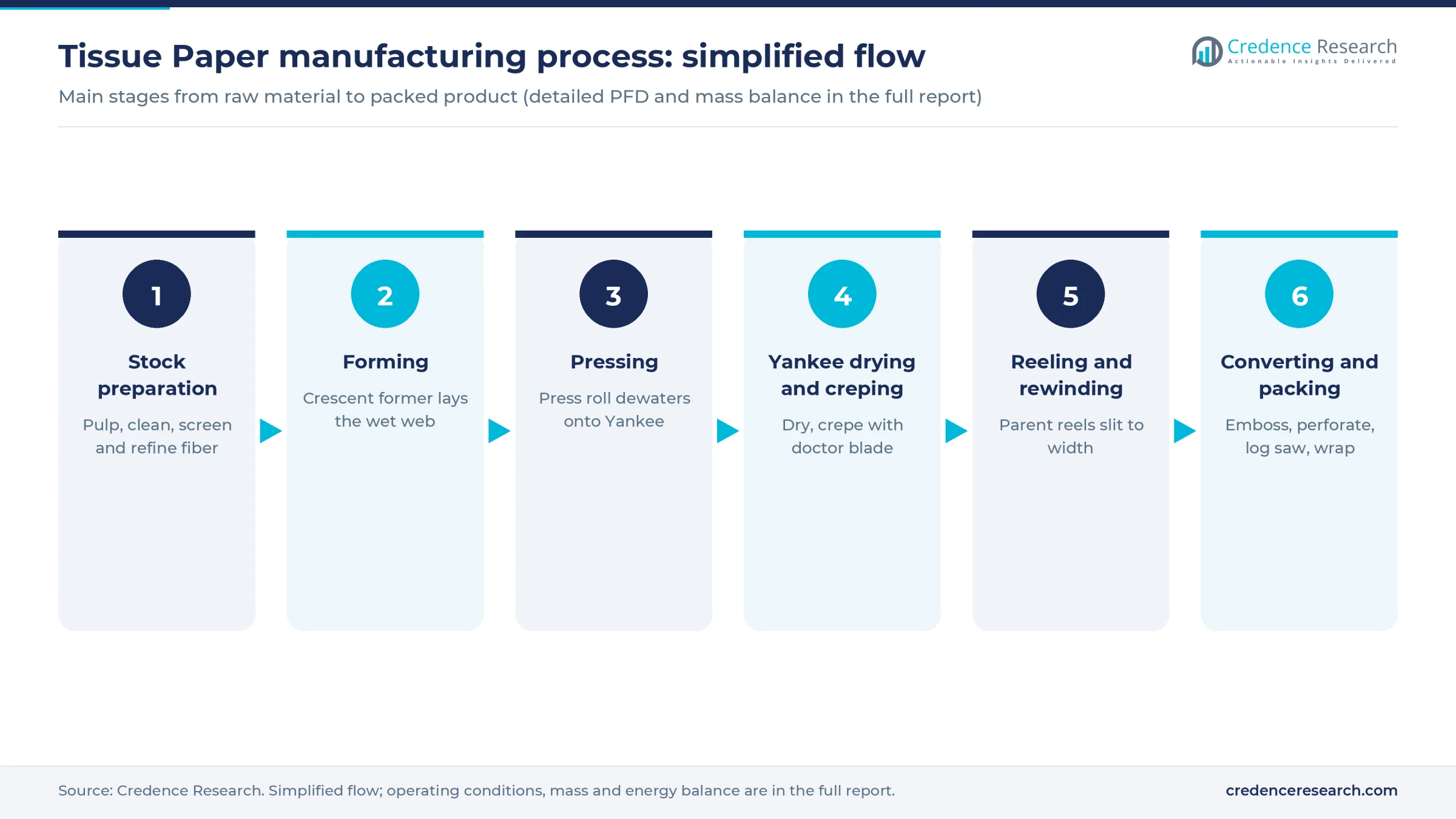
- Pulping and stock preparation. Bales of market pulp, and recycled paper where used, are slushed in a hydrapulper, then cleaned, screened and lightly refined. Hardwood and softwood are often refined separately, so the mill can tune softness against strength for each grade.
- Forming. The approach flow dilutes stock to well under 1% fiber, and a headbox jets it between a forming fabric and a felt in a crescent former. New conventional lines typically run at 1,400–2,000 meters per minute.
- Pressing. A suction press roll or shoe press squeezes water from the wet web onto the Yankee cylinder. Each point of dryness gained here cuts steam demand in the dryer.
- Yankee drying and creping. The web dries on the steam-heated Yankee under a gas-fired or steam hood, then a doctor blade scrapes it off and forms the crepe. Coating chemistry on the cylinder controls adhesion, and therefore softness, more than almost any other variable.
- Reeling and rewinding. The dry sheet winds into parent reels, which are rewound and slit to converting widths or sold to outside converters.
- Converting and packing. Roll lines unwind two or more plies, emboss and laminate them, perforate, wind logs on cores, saw them into rolls and wrap them in film. Separate lines fold napkins, facial tissue and hand towels.
Through-air drying, used for ultra-premium bath tissue and towels, replaces most pressing with hot air blown through the sheet. It gives more bulk and absorbency but costs far more to build and run, so the reference plant uses a conventional crescent-former line. Water loops are largely closed, yet an effluent treatment plant is still essential for the fiber, fillers and chemicals that leave with the discharge.
Tissue paper plant setup cost
The reference plant is a greenfield integrated mill with one conventional crescent-former tissue machine of about 2.8 meters trim width, producing about 30,000 metric tons a year, or roughly 100 tons a day, plus roll, napkin and facial tissue converting lines. At this scale, total CapEx is estimated at USD 45–70 million, including land, buildings, utilities, preoperative costs and working capital margin.
The low end assumes an Asian-built tissue line, while the high end follows disclosed Indian capital cost for a modern machine. Andhra Paper budgeted about USD 31 million for a 100-ton-per-day tissue machine of 35,000 tons a year in 2024, converted at 88 rupees per dollar, on an existing mill site. Converting lines, buildings, steam and power, effluent treatment and working capital are then added to reach a greenfield total. European projects show why location matters. The Navigator Company plans about EUR 115 million for a 70,000-ton machine in Portugal, and Grigeo more than EUR 97 million for a 70,000-ton machine with two converting lines in Lithuania. Scaled to 30,000 tons, those budgets sit near or above the top of the range.
For the land row, the mill needs about 8 hectares for the machine hall, pulp and finished goods warehouses, effluent plant and truck yards. At an assumed USD 10–25 per square meter in an Asian industrial park, land costs about USD 0.8–2.0 million, under 3% of CapEx. U.S. and European sites vary far more, so the full report models the chosen location.
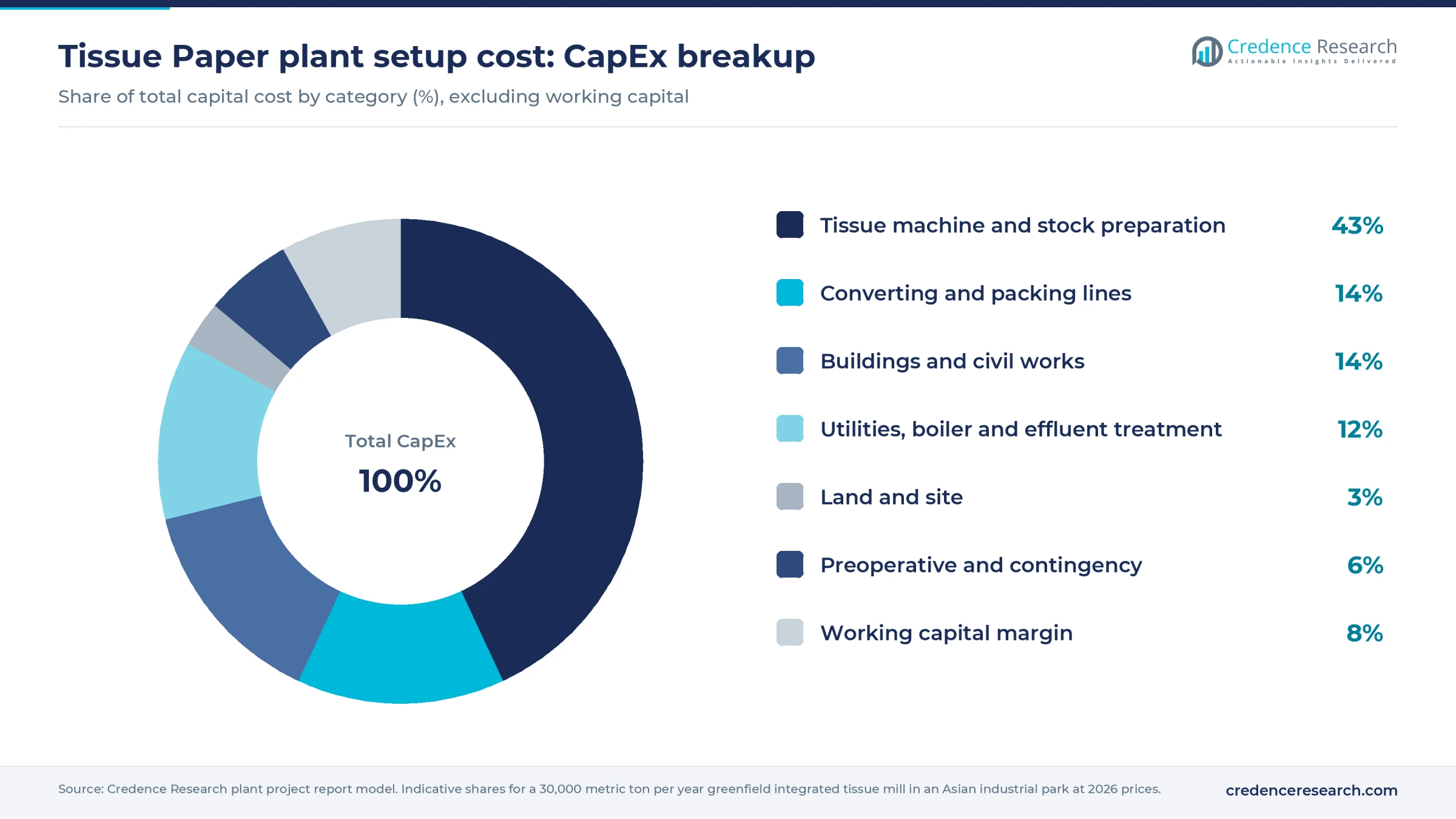
The tissue machine with stock preparation takes about 43% of CapEx, and converting and packing lines about 14%. Utilities carry unusual weight, about 12%, because a tissue mill needs a steam boiler, a large electrical substation, a water intake and effluent treatment.
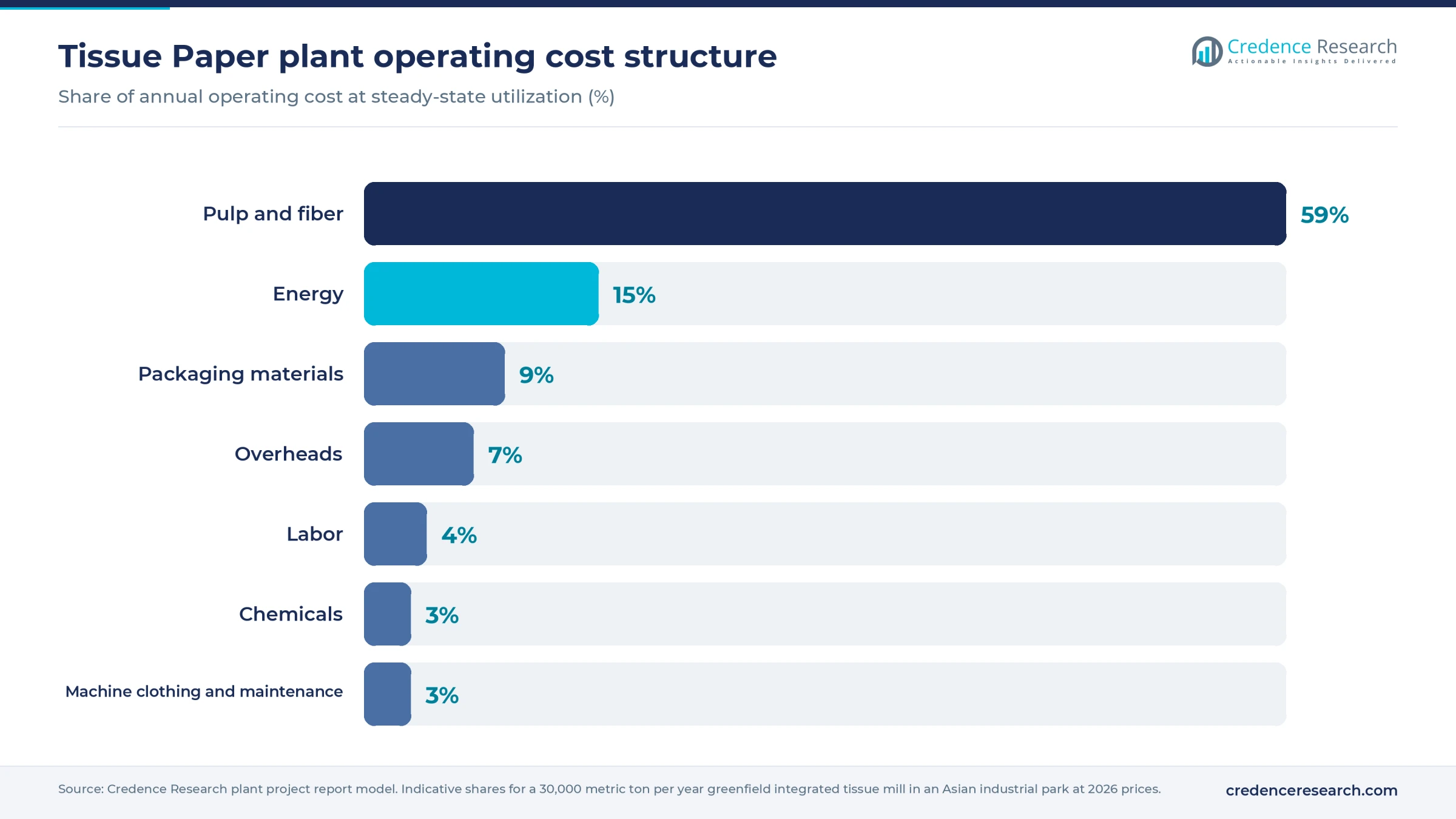
Pulp dominates operating cost at about 59%, followed by energy at about 15%. Mills that can burn biomass or buy cheap natural gas hold a lasting cost edge over those relying on grid power and fuel oil.
Machinery and raw materials for a tissue paper plant
The main equipment groups are listed below; makes, capacities and the costed schedule are in the report.
- Bale handling, hydrapulpers, cleaners, screens and refiners
- Approach flow system with fan pump and headbox
- Crescent former with suction press roll or shoe press
- Yankee cylinder with hood, creping and coating systems
- Reel, rewinder and parent reel handling
- Bath and kitchen roll converting lines with embossers, log saws and wrappers
- Napkin, facial tissue and hand towel folding lines
- Steam boiler, vacuum pumps, air handling, dust control and effluent treatment
Bleached eucalyptus hardwood pulp comes mainly from Brazil, Uruguay and Chile, with acacia pulp from Indonesia. Northern bleached softwood kraft comes from Canada, Finland and Sweden, and southern softwood from the southeastern United States. Recycled office paper is collected in most industrial economies, while bamboo and bagasse pulp serve parts of China and India. Wet-strength resins, creping adhesives and release agents come from specialty chemical makers with regional plants, and paper chemicals supply is concentrated in a few global groups.
Pulp price is the main supply risk. The reference mill uses about 28,000 tons of fiber a year at 85% utilization, so most mills sign annual contracts with two or more pulp producers and hold several weeks of bales on site.
Tissue paper business profit margin and ROI
Gross margin for the reference plant is estimated at 18–29%, measured as ex-works price minus fiber, chemicals, packaging, energy and direct conversion cost. The build uses an assumed blended price of USD 1,500 per metric ton for a mix of mostly converted products, slightly below the roughly USD 1,570 average value of China's household paper exports in the first half of 2025. Fiber is costed from Suzano's October 2026 Asia list price of about USD 590–600 per ton for hardwood pulp, with assumed softwood, freight and discounts, for a fiber bill of about USD 690–760 per ton of tissue.
At 85% utilization, or about 25,500 tons a year, revenue is about USD 38 million. After assumed overheads of USD 2.0–2.5 million, annual cash profit is about USD 4.4–9.1 million. On mid-range CapEx of about USD 57 million, payback is roughly 6–10 years when margin sits in the middle or upper part of the range, and it stretches past 12 years near the bottom.
Sensitivity runs through pulp and energy. A USD 100 per ton rise in pulp cuts gross margin by about 7 points unless selling prices follow, while branded or contracted private-label volume protects margin better than spot jumbo roll sales.
| Metric | Value |
|---|---|
| Gross margin | 18–29% |
| Payback period | 6–10 years |
| IRR (post-tax) | Available in report |
| NPV | Available in report |
| Return on investment | Available in report |
| DSCR | Available in report |
| Break-even utilization | Available in report |
How to start a tissue paper business with licenses and approvals
The approval path is similar in most jurisdictions: register the company and tax accounts, secure land use, zoning and building permits, obtain an environmental permit covering wastewater discharge, boiler emissions and solid waste, register under factory and occupational safety law, and secure a water abstraction right if the mill draws its own water. Packaged retail tissue must meet net quantity and labeling rules in each market. Kitchen towels and napkins that touch food need food-contact compliance, and many buyers ask for FSC or PEFC chain-of-custody certification. Exporters need import-export registration, and sellers into Europe must prove that wood fiber is deforestation-free.
| Market | Plant and environmental permits | Product and supply chain rules |
|---|---|---|
| United States | EPA or state NPDES discharge permit applying 40 CFR Part 430 Subpart L limits for tissue made from purchased pulp; state air permit for boilers; OSHA pulp and paper mill standard 29 CFR 1910.261 | Fair Packaging and Labeling Act net quantity rules enforced by the FTC; FDA food-contact rules, such as 21 CFR 176.170, for towels and napkins used with food |
| European Union | Integrated permit under the Industrial Emissions Directive 2010/75/EU, required for paper production above 20 tons a day, applying the pulp and paper BAT conclusions | EU Deforestation Regulation, applying from 30 December 2026 for most operators after Regulation 2025/2650; Regulation 1935/2004 for food-contact napkins and towels; voluntary EU Ecolabel |
| India | State Pollution Control Board Consent to Establish and Consent to Operate, with paper mills in the red category; factory license under state factory rules | Legal Metrology (Packaged Commodities) Rules, 2011 registration and labeling; Plastic Waste Management Rules producer responsibility for plastic wrap on retail packs |
Key tissue paper manufacturers and recent developments
Global leaders include Essity (Sweden), Kimberly-Clark, Procter & Gamble and Georgia-Pacific (United States), Sofidel (Italy), WEPA (Germany), Kruger Products (Canada) and Asia Pulp & Paper (Indonesia). Large Asian makers include Vinda, Hengan, Lee & Man and Sun Paper in China, while Suzano and CMPC's Softys in Latin America, Hayat in Turkey and many regional private-label mills serve their home markets. Most leaders own pulp or run large integrated sites, the main edge a smaller entrant has to work around.
Recent moves show both consolidation and new capacity, which also lift orders for tissue converting machinery:
- March 2026: The Navigator Company approved about EUR 115 million for a 70,000-ton tissue machine at Aveiro, Portugal, due to start in 2028 and supply its UK converting business.
- June 2026: Baotuo Paper Machinery said it would supply Vinda with six crescent-former tissue machines of 30,000 tons a year each in China.
- July 2026: Suzano completed its purchase of 51% of Kimberly-Clark's international tissue business, now named Arbex, with 22 mills in 14 countries.
What's inside the Tissue Paper project report PDF
The report runs to 21 chapters. Open a chapter to see its sections.
1. Preface
2. Scope and Methodology
- 2.1 Objectives of the Study
- 2.2 Stakeholders
- 2.3 Research Methodology
- 2.4 Data Sources and Key Assumptions
3. Executive Summary
- 3.1 Market Snapshot
- 3.2 Project at a Glance (Capacity, CapEx, OpEx)
- 3.3 Key Financial Indicators (IRR, NPV, Payback, Break-even)
- 3.4 Feasibility Verdict
4. Product Overview
- 4.1 Tissue Paper Definition and Properties
- 4.2 Grades and Specifications (BIS / ISO / ASTM)
- 4.3 HS Code and Classification
- 4.4 Key Applications
- 4.5 Substitutes
5. Global Tissue Paper Market
- 5.1 Market Overview
- 5.2 Historical and Current Market Performance (Volume and Value)
- 5.3 Market Breakup by Grade / Type
- 5.4 Market Breakup by End-Use Industry
- 5.5 Market Breakup by Region
- 5.6 Market Drivers, Restraints and Trends
- 5.7 Value Chain Analysis
- 5.8 Market Forecast
6. Target Country Tissue Paper Market Analysis
- 6.1 Demand and Supply Analysis
- 6.2 Installed Capacity vs Demand Gap
- 6.3 Import Dependence
- 6.4 Demand Forecast by End-Use
7. Trade Analysis
- 7.1 Imports by Volume, Value and Country
- 7.2 Exports by Volume, Value and Country
- 7.3 Trade Balance and Opportunities
8. Price Analysis
- 8.1 Historical Tissue Paper Price Trends by Region
- 8.2 Raw Material / Feedstock Price Trends and Linkage
- 8.3 Price Forecast
- 8.4 Margins Across the Value Chain
9. Competitive Landscape
- 9.1 Market Structure
- 9.2 Key Players and Installed Capacities
- 9.3 Profiles of Key Players
- 9.4 Recent Developments (Expansions, M&A, New Plants)
10. Manufacturing Process and Technology
- 10.1 Comparison of Technology Routes
- 10.2 Selected Route and Process Flow Diagram
- 10.3 Unit Operations Involved
- 10.4 Chemical Reactions Involved
- 10.5 Mass Balance and Raw Material Requirements
- 10.6 Energy Balance
- 10.7 Quality Assurance Criteria and Technical Tests
- 10.8 By-products and Waste Handling
- 10.9 Technology Licensors / Providers
11. Project Details, Requirements and Costs
- 11.1 Land, Location and Site Development
- 11.1.1 Site Selection Criteria
- 11.1.2 Location Analysis
- 11.1.3 Land Requirement and Costs
- 11.1.4 Site Development Costs
- 11.2 Plant Layout
- 11.2.1 Layout Principles
- 11.2.2 Proposed Layout
- 11.2.3 Factors Influencing Layout
- 11.3 Civil Works and Buildings
- 11.4 Plant Machinery
- 11.4.1 Machinery Requirements and Specifications
- 11.4.2 Machinery Costs
- 11.4.3 Machinery Suppliers
- 11.5 Raw Materials
- 11.5.1 Requirements per Tonne of Output
- 11.5.2 Procurement and Sourcing
- 11.5.3 Costs
- 11.5.4 Suppliers
- 11.6 Packaging
- 11.6.1 Packaging Requirements
- 11.6.2 Packaging Costs
- 11.6.3 Packaging Suppliers
- 11.7 Storage and Material Handling
- 11.8 Transportation Requirements and Costs
- 11.9 Utilities
- 11.9.1 Power Requirements and Costs
- 11.9.2 Water Requirements and Costs
- 11.9.3 Steam, Fuel and Other Utilities
- 11.10 Manpower Requirements and Wages
12. Environment, Health, Safety and Sustainability
- 12.1 Effluent and Emissions Management
- 12.2 Hazard Classification and Safety Measures
- 12.3 Carbon Footprint
- 12.4 Green / Low-Carbon Process Options
13. Regulatory Procedures, Approvals and Certifications
- 13.1 Licences and Registrations
- 13.2 Environmental Clearances
- 13.3 Product Certifications (BIS, REACH, etc.)
- 13.4 Approval Timeline
14. Project Implementation Schedule
15. Project Economics
- 15.1 Capital Cost of the Project
- 15.2 Techno-Economic Parameters
- 15.3 Capacity Utilization and Ramp-up
- 15.4 Product Pricing and Margins
- 15.5 Income Projections
- 15.6 Expenditure Projections
- 15.7 Working Capital Requirement
- 15.8 Taxation
- 15.9 Depreciation
16. Financial Analysis
- 16.1 Projected Profit and Loss Account
- 16.2 Projected Cash Flow Statement
- 16.3 Projected Balance Sheet
- 16.4 Liquidity Analysis
- 16.5 Profitability Analysis (Payback, NPV, IRR, ROI)
- 16.6 Break-even Analysis
- 16.7 Debt Service Coverage Ratio (DSCR)
- 16.8 Sensitivity Analysis
- 16.9 Scenario and Uncertainty Analysis
17. Funding and Incentives
- 17.1 Means of Finance and Debt-Equity Structure
- 17.2 Loans and Financial Assistance
- 17.3 Government Schemes and Subsidies (PLI, State Policies)
18. Risk Assessment
- 18.1 Key Success Factors
- 18.2 Key Risk Factors
- 18.3 Risk Mitigation
19. Strategic Recommendations
20. Case Study of a Successful Venture
21. Appendix
- 21.1 Detailed Assumptions
- 21.2 Abbreviations
- 21.3 List of Tables and Figures
- 21.4 Sources
This page vs. the full report
| Data point | On this page (free) | In the full report |
|---|---|---|
| Total CapEx | One rounded range at one capacity | Exact figure at three capacities with a line-item breakup |
| CapEx breakup | Category shares (%) only | Cost, quantity and supplier for every machine |
| Operating cost | Share of raw materials, utilities and labor | Per-unit cost sheet with each input price and consumption |
| Profitability | Gross margin range and payback band | Exact IRR, NPV, ROI, break-even and DSCR |
| Financial statements | List of what is included | 10-year P&L, cash flow, balance sheet and Excel model |
| Sensitivity | One directional line | Full sensitivity and scenario tables |
| Process | Simplified flow diagram | Detailed process flow, mass and energy balance, operating conditions |
| Machinery | Names of the main machines | Specifications, capacity, cost and supplier list |
| Market | Headline size, growth and global demand | Segment, region, trade and price forecast tables |
| Suppliers and buyers | Supplier types and sourcing hubs | Named suppliers and buyers |
Tissue Paper project report: FAQs
How much does it cost to set up a tissue paper manufacturing plant?
What is the profit margin in tissue paper manufacturing?
How long is the payback period for a tissue paper plant?
What raw materials does a tissue paper plant need?
What is the HS code for tissue paper?
Is it better to start with converting or with a tissue machine?
Which rules matter most for selling tissue into Europe?

About the analyst
Rajdeep Kumar Deb, Lead Analyst - Consumer & Finance
Rajdeep brings a decade of consumer goods and financial services insight to strategic market analysis.
Related market research
- Tissue Paper Market Size, Share, Growth and Forecast 2032
- Tissue and Hygiene Products Market Size, Growth & Forecast 2032
- Tissue Paper Converting Machines Market Size, Share and Forecast 2032
- Specialty Pulp and Paper Chemicals Market Size and Forecast 2032
- Hardwood Pulp Market Size, Share, Growth and Forecast 2032
- Paper Napkin Making Machine Market Size, Share and Forecast 2032
More plant project reports
- Rice Bran Oil Processing Plant Project Report (DPR) 2026
- Walnut Oil Processing Plant Project Report (DPR) 2026
- Notebook Manufacturing Plant Project Report (DPR) 2026
- Mustard Oil Processing Plant Project Report (DPR) 2026
- Liquid Detergent Manufacturing Plant Project Report (DPR) 2026
- Hair Color Manufacturing Plant Project Report (DPR) 2026