
Quick answer
A walnut oil processing plant presses shelled walnut kernels into virgin, roasted and refined oil, with pressed cake as a by-product. A representative plant pressing 2 tonnes of kernels a day costs USD 0.9–1.4 million in a lower-cost region. Gross margin runs 25–38% with kernels at an assumed USD 3.4–4.1 per kg and a mix of bulk and bottled sales, and payback takes 3–5 years. Kernel price decides feasibility.
Feasible for a mill that locks in off-grade kernels from crackers and sells a large share as bottled oil; a bulk-only mill buying kernels on the spot market carries thin, volatile margins.
Walnut Oil plant: key highlights
| Parameter | Indicative value | Note |
|---|---|---|
| Plant capacity | 2 tonnes of kernels a day (about 600 TPA) | One shift, 300 days; 210–245 tonnes of oil a year at 70% utilization |
| Total CapEx | USD 0.9–1.4 million | Lower-cost region with a Chinese-built press line; a European line at a U.S. or EU site can reach USD 2.5–3.5 million |
| Raw material share of operating cost | 65–75% | Amber and broken kernels at an assumed USD 3.0–4.5 per kg delivered |
| Gross margin | 25–38% | Kernels at USD 3.4–4.1 per kg; 60% bulk and 40% bottled oil |
| Payback period | 3–5 years | Pre-tax, including a ramp-up year |
| IRR | Available in report | Post-tax, 10-year model |
| Break-even | Available in report | Capacity utilization basis |
Ranges assume a 2 tonne-per-day kernel press line, one shift, 300 days, 70% utilization, a greenfield site in a lower-cost region (Asian or Eastern European industrial park), 2026 prices, kernels at an assumed USD 3.0–4.5 per kg, a 50–58% oil yield, a 60:40 bulk and bottled mix, RMB 7.1 and EUR 0.86 per USD. Land and building rates are assumed. Customizable to any country.
What is walnut oil?
Walnut oil is the fixed oil pressed from the kernels of the Persian or English walnut (Juglans regia). Kernels hold roughly 60–70% fat, so a press can recover more than half the kernel weight as oil without solvents. The oil is dominated by polyunsaturated fatty acids, mainly linoleic acid with a notable share of alpha-linolenic acid, which gives it nutritional appeal and also makes it prone to rancidity.
Commercial grades fall into three groups. Virgin or cold-pressed oil is expelled from raw kernels below about 50 °C and keeps a pale gold color and a mild nutty taste. Roasted oil, the traditional French style, is pressed from kernels heated in kettles, giving a darker oil with a stronger aroma that is used as a finishing oil. Refined oil is neutralized, bleached and deodorized for cosmetic and pharmaceutical buyers that want low odor.
Under the Harmonized System walnut oil is classified in subheading 1515.90, other fixed vegetable fats and oils, and the U.S. schedule carries it on a national line for nut oils, 1515.90.21. Main uses are salad dressings, finishing and baking oil, infant nutrition blends, skin care and artists' oil paints.
Walnut oil market overview and global demand
Credence Research values the global walnut oil market at about USD 467 million in 2025, based on its USD 445 million for 2024 and a 5% CAGR, and projects USD 657.46 million by 2032. At bulk prices near USD 10 per kg, that value implies a world oil trade measured in tens of thousands of tonnes, small enough that a new mill must plan its sales channels before it buys presses.
Raw material supply is far larger and growing. The USDA Foreign Agricultural Service put world walnut production at 2.76 million tonnes in-shell for 2025/26 and forecast 2.75 million tonnes for 2026/27, with China at 1.6 million tonnes, the United States at about 617,000 tonnes, Chile at 170,000 tonnes, the European Union at 135,000 tonnes and Ukraine at 97,000 tonnes. World exports were forecast at 1.43 million tonnes, and China's exports have more than doubled since 2023/24 to a forecast 675,000 tonnes, which pushes more low-priced kernels into global trade.
Consumption of the oil is concentrated in France, Germany, the United States, South Korea and China. In Western Europe it is a traditional salad and finishing oil, and roasted French oils set price benchmarks. In China, brands sell walnut oil for infant and child nutrition and as a premium cooking oil. Most oil mills sit near cracking operations in China, California, France, Chile and Ukraine, because the cheapest feedstock is the broken and amber kernel that sells poorly as a snack nut.
Walnut oil manufacturing process
A walnut oil mill starts with shelled kernels bought from crackers, so it needs no hulling or cracking line. The process is dry and mechanical, and quality depends on keeping kernels cold and dry, keeping heat low during pressing and keeping oxygen away from the finished oil.
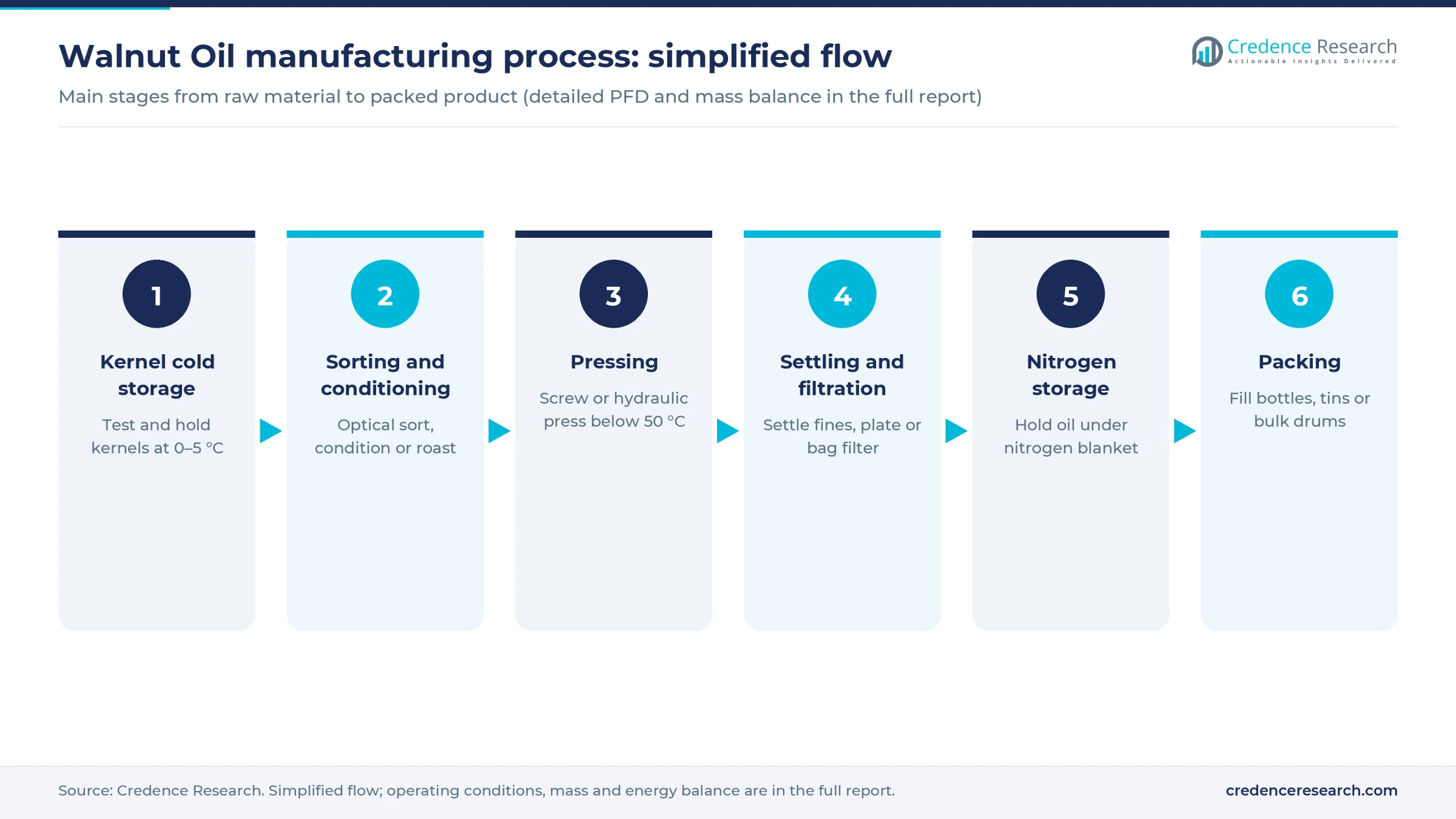
- Kernel receiving and cold storage. Pieces and amber halves are checked for moisture, free fatty acids, peroxide value and aflatoxin, then held at about 0–5 °C in low humidity. Kernels bought after the September and October harvest must last the year, so cold storage is a core asset.
- Sorting and conditioning. An optical sorter and inspection belt reject shell fragments, mold and dark kernels. For virgin oil, kernels are conditioned to roughly 6–8% moisture at low heat; for roasted oil they are heated in kettles or a drum roaster until the aroma develops.
- Screw or hydraulic pressing. Continuous screw presses handle most volume, while hydraulic presses suit small roasted-oil batches. Industrial trials by Martínez and colleagues recovered up to 84.5% of the oil in walnut kernels containing 69.2% oil, pressing at 35–40 °C.
- Settling and filtration. Crude oil rests in settling tanks, then passes a plate or bag filter to remove fines.
- Nitrogen storage and packing. Oil is stored under nitrogen in stainless tanks and filled into dark glass bottles, tins or bulk drums with headspace flushing.
- Refining, where required. Cosmetic grades are degummed, neutralized, bleached and deodorized, usually by a toll refiner at this scale.
Oil yield on kernel weight usually lands at about 50–58%, depending on kernel oil content, moisture and die setting, so each tonne of kernels returns roughly 540 kg of oil and 430–470 kg of cake. The same trials measured about 14% alpha-linolenic acid in the oil, which is why shelf life is short, often 6–12 months unopened, and why many mills add natural tocopherols and press to order rather than build large oil stocks.
Walnut oil plant setup cost
Indicative CapEx for a walnut oil plant pressing 2 tonnes of kernels a day, one shift over 300 days, or about 600 tonnes of kernels a year at nameplate, is USD 0.9–1.4 million for a greenfield site in a lower-cost region such as an Asian or Eastern European industrial park. The estimate starts from a Chinese equipment supplier's 2026 budget of RMB 2–3 million, about USD 280,000–420,000, for a 5–10 tonne-per-day cold-press plant, scaled down to 2 tonnes a day and raised for duty, freight, installation and food-grade stainless upgrades. It then adds a 150-tonne kernel cold store, an optical sorter, a nitrogen generator, a semi-automatic bottling line and a quality lab.
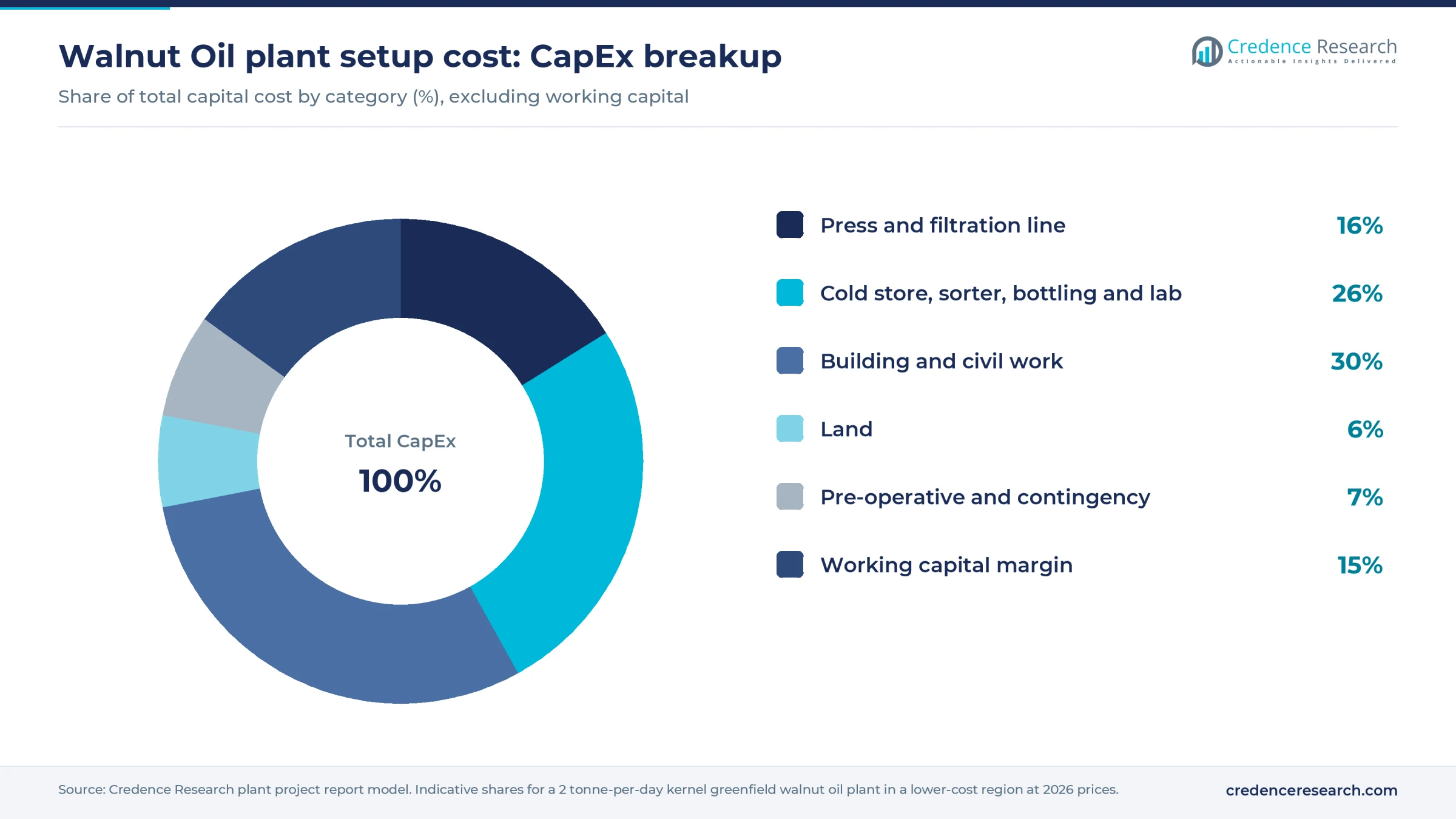
Building and civil work for about 1,000 square meters of process hall, cold rooms, bottling area and warehouse take the largest share, about 30%, at an assumed USD 300–400 per square meter. Support systems take 26% and the pressing and filtration line only 16%, so cold storage and packing, not the presses, drive the budget.
Example row, land: about 0.75 acre, or roughly 3,000 square meters, in an industrial zone is budgeted, as an assumption, at USD 40,000–100,000 in lower-cost regions, about 6% of the total. A comparable plot in the United States or the European Union can cost several times more. Pre-operative expenses and contingency take about 7%, and working capital margin about 15%, because kernels are bought at harvest for year-round pressing.
A European press line on a U.S. or EU site lifts the budget to an estimated USD 2.5–3.5 million. As a cross-check, a walnut oil line in Zuogong County, Tibet, was reported to have cost more than RMB 7 million, about USD 1 million, for the production line.
Operating cost is dominated by a single input.
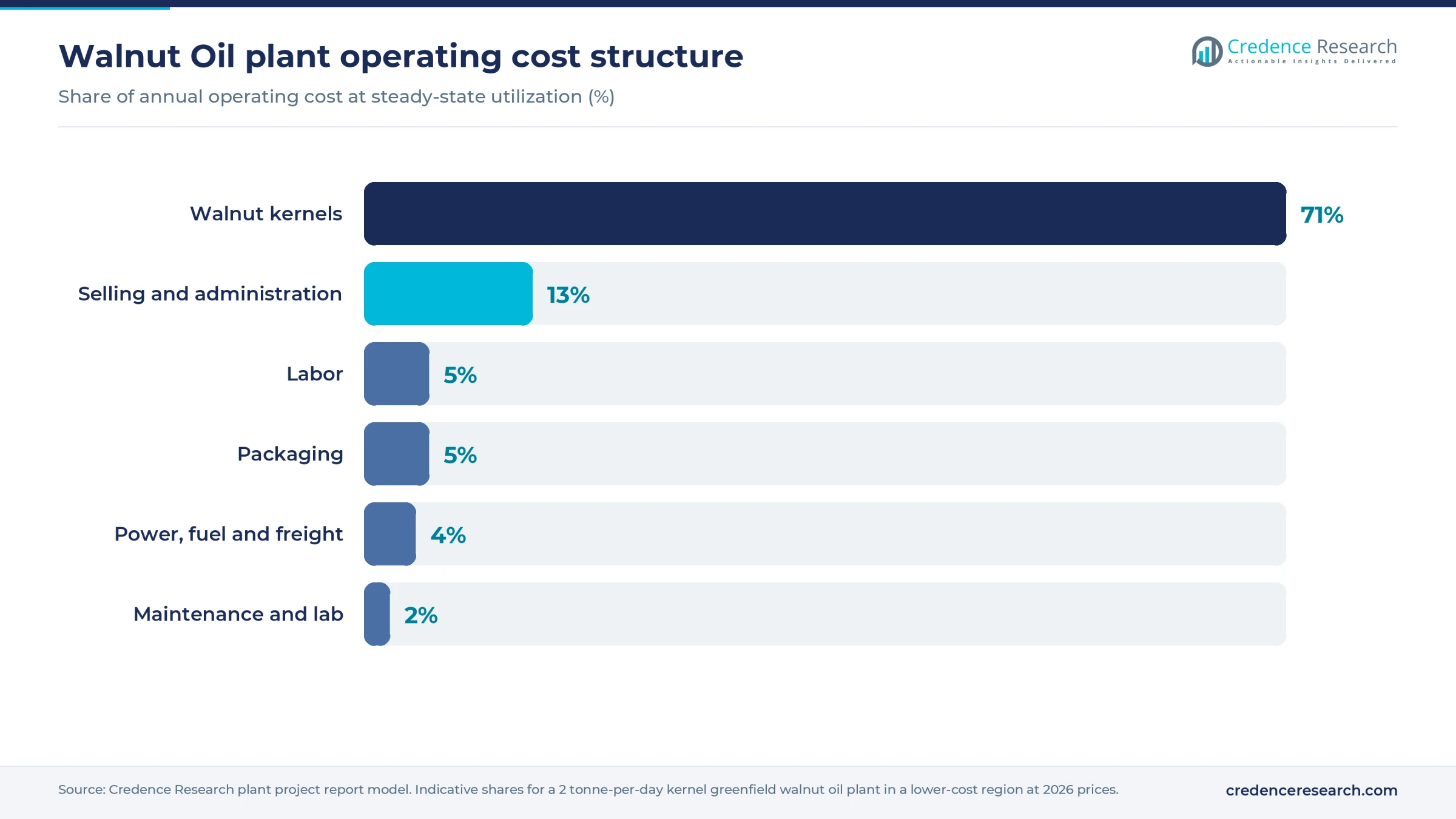
Kernels take about 71% of operating cost at an assumed delivered price of USD 3.0–4.5 per kg for light amber and broken pieces, benchmarked to Chinese FOB quotations near EUR 2.40 per kg in October 2026. Selling and administration take 13%, labor 5%, packaging 5%, power, fuel and freight 4%, and maintenance and lab tests 2%. Kernel cost and labor rates differ widely by country, so the full report can be customized to any location.
Machinery and raw materials for a walnut oil plant
The core machinery list covers a kernel receiving scale and moisture meter, a cold room with dehumidification, an inspection belt and optical color sorter, a low-temperature conditioner, a roasting kettle or drum roaster for roasted oil, two to four continuous screw presses or a hydraulic press for batch work, a cake breaker and mill, settling tanks, a plate or bag filter, nitrogen-blanketed stainless tanks with a nitrogen generator, bottle and tin filling, capping and labeling machines, and a lab for free fatty acids, peroxide value, moisture and aflatoxin screening. No cracking or shelling equipment is needed when the plant buys kernels.
Oil mills buy the grades that sell poorly as snack nuts, mainly amber and light amber pieces, broken kernels and halves with cosmetic defects, at a discount to light halves. The main sourcing regions are Xinjiang, Yunnan and Shaanxi in China, the Central Valley of California, Maule and O'Higgins in Chile, the Dordogne and Isère valleys in France, central and western Ukraine, Moldova and Romania, and the Kashmir valley in India. Price swings in the wider walnut market pass straight into oil cost, so many mills sign supply contracts with crackers before harvest, and some pair with a cracking plant to secure a steady flow of off-grade kernels.
Walnut oil business profit margin and ROI
At 70% utilization a 2 tonne-per-day mill presses about 420 tonnes of kernels and produces roughly 210–245 tonnes of oil and 180 tonnes of cake a year. With kernels at an assumed USD 3.4–4.1 per kg, 60% of the oil sold in bulk at an assumed USD 8–11 per kg, near the global wholesale average of about USD 9.50 per kg for 2024 on trade-data platforms, 40% as bottled oil at an assumed ex-factory USD 13–18 per kg, and cake at an assumed USD 0.6–1.2 per kg, gross margin after kernels, packaging and conversion costs comes to 25–38%. Payback, including a ramp-up year, falls in a 3–5 year band.
The kernel-to-oil spread is the whole business. Each USD 0.50 per kg rise in kernel price adds about USD 210,000 a year in cost, roughly 7 percentage points of gross margin. Bottled sales are the main lever, since branded virgin and roasted oils earn far more per kg than bulk drums. Rancidity is the main quality risk, because oil that fails a buyer's peroxide test becomes a write-off. Competition from other premium oils in the edible oils and fats market, including avocado and cold-pressed seed oils, caps retail prices.
| Metric | Value |
|---|---|
| Project IRR (post-tax) | Available in report |
| NPV | Available in report |
| Return on investment | Available in report |
| DSCR | Available in report |
| Break-even utilization | Available in report |
How to start a walnut oil business, licenses and approvals
Approvals for a walnut oil mill follow a similar sequence in most countries.
- Business registration and tax identification.
- Land use or zoning clearance and building permits.
- Environmental permit or consent, mainly for roaster emissions, heater exhaust and cleaning water.
- Food business registration or license, with a HACCP-based plan that covers aflatoxin and allergen controls.
- Occupational safety approvals for presses, nitrogen systems and refrigeration plant.
- Allergen and nutrition labeling for packaged oil, since walnut is a regulated tree nut allergen in most major markets.
- Cosmetic product notification where oil is sold for skin care, plus import or export registration.
| Market | Key approvals for a walnut oil plant |
|---|---|
| United States | FDA food facility registration, renewed every two years; preventive controls for human food under 21 CFR Part 117; walnut declared as a tree nut allergen under the Food Allergen Labeling and Consumer Protection Act, which exempts only highly refined oils |
| European Union | Registration with the national food authority under Regulation (EC) No 852/2004; nut allergen labeling under Regulation (EU) No 1169/2011; contaminant limits, including PAHs in oils and aflatoxins in nuts, under Regulation (EU) 2023/915; Regulation (EC) No 1223/2009, including CPNP notification, where the mill sells finished skin care products |
| India | FSSAI license; registration and returns under the Vegetable Oil Products, Production and Availability (Regulation) Order; state pollution control board consent; Legal Metrology packer registration |
Key walnut oil manufacturers and recent developments
The industry combines French heritage mills, U.S. specialty brands and fast-growing Chinese processors. La Tourangelle roasts and presses walnut oil in Saumur, France, and Woodland, California. Cauvin in southern France sells walnut oil within a wider premium oil range, Emile Noël produces organic virgin walnut oil, and Moulin de la Veyssière in Périgord traces its walnut oil pressing to 1857. In China, Houshengfang runs a dedicated walnut oil line in Luoning County, Henan.
- August 2026. China's Science and Technology Daily reported that Zuogong Wangda Food in Tibet had expanded capacity on its walnut oil line, which began operating in 2023, after buying about 305 tonnes of walnuts in 2025.
- October 2026. Trade press reported a USDA forecast putting California's 2026 walnut crop at 680,000 short tons, down 16% from 809,000 short tons in 2025, tightening feedstock for U.S. mills.
- October 2026. The USDA Foreign Agricultural Service forecast China's 2026/27 walnut crop at 1.6 million tonnes and its exports at 675,000 tonnes, widening the supply of low-cost kernels for oil.
What's inside the Walnut Oil project report PDF
The report runs to 21 chapters. Open a chapter to see its sections.
1. Preface
2. Scope and Methodology
- 2.1 Objectives of the Study
- 2.2 Stakeholders
- 2.3 Research Methodology
- 2.4 Data Sources and Key Assumptions
3. Executive Summary
- 3.1 Market Snapshot
- 3.2 Project at a Glance (Capacity, CapEx, OpEx)
- 3.3 Key Financial Indicators (IRR, NPV, Payback, Break-even)
- 3.4 Feasibility Verdict
4. Product Overview
- 4.1 Walnut Oil Definition and Properties
- 4.2 Grades and Specifications (BIS / ISO / ASTM)
- 4.3 HS Code and Classification
- 4.4 Key Applications
- 4.5 Substitutes
5. Global Walnut Oil Market
- 5.1 Market Overview
- 5.2 Historical and Current Market Performance (Volume and Value)
- 5.3 Market Breakup by Grade / Type
- 5.4 Market Breakup by End-Use Industry
- 5.5 Market Breakup by Region
- 5.6 Market Drivers, Restraints and Trends
- 5.7 Value Chain Analysis
- 5.8 Market Forecast
6. Target Country Walnut Oil Market Analysis
- 6.1 Demand and Supply Analysis
- 6.2 Installed Capacity vs Demand Gap
- 6.3 Import Dependence
- 6.4 Demand Forecast by End-Use
7. Trade Analysis
- 7.1 Imports by Volume, Value and Country
- 7.2 Exports by Volume, Value and Country
- 7.3 Trade Balance and Opportunities
8. Price Analysis
- 8.1 Historical Walnut Oil Price Trends by Region
- 8.2 Raw Material / Feedstock Price Trends and Linkage
- 8.3 Price Forecast
- 8.4 Margins Across the Value Chain
9. Competitive Landscape
- 9.1 Market Structure
- 9.2 Key Players and Installed Capacities
- 9.3 Profiles of Key Players
- 9.4 Recent Developments (Expansions, M&A, New Plants)
10. Manufacturing Process and Technology
- 10.1 Comparison of Technology Routes
- 10.2 Selected Route and Process Flow Diagram
- 10.3 Unit Operations Involved
- 10.4 Chemical Reactions Involved
- 10.5 Mass Balance and Raw Material Requirements
- 10.6 Energy Balance
- 10.7 Quality Assurance Criteria and Technical Tests
- 10.8 By-products and Waste Handling
- 10.9 Technology Licensors / Providers
11. Project Details, Requirements and Costs
- 11.1 Land, Location and Site Development
- 11.1.1 Site Selection Criteria
- 11.1.2 Location Analysis
- 11.1.3 Land Requirement and Costs
- 11.1.4 Site Development Costs
- 11.2 Plant Layout
- 11.2.1 Layout Principles
- 11.2.2 Proposed Layout
- 11.2.3 Factors Influencing Layout
- 11.3 Civil Works and Buildings
- 11.4 Plant Machinery
- 11.4.1 Machinery Requirements and Specifications
- 11.4.2 Machinery Costs
- 11.4.3 Machinery Suppliers
- 11.5 Raw Materials
- 11.5.1 Requirements per Tonne of Output
- 11.5.2 Procurement and Sourcing
- 11.5.3 Costs
- 11.5.4 Suppliers
- 11.6 Packaging
- 11.6.1 Packaging Requirements
- 11.6.2 Packaging Costs
- 11.6.3 Packaging Suppliers
- 11.7 Storage and Material Handling
- 11.8 Transportation Requirements and Costs
- 11.9 Utilities
- 11.9.1 Power Requirements and Costs
- 11.9.2 Water Requirements and Costs
- 11.9.3 Steam, Fuel and Other Utilities
- 11.10 Manpower Requirements and Wages
12. Environment, Health, Safety and Sustainability
- 12.1 Effluent and Emissions Management
- 12.2 Hazard Classification and Safety Measures
- 12.3 Carbon Footprint
- 12.4 Green / Low-Carbon Process Options
13. Regulatory Procedures, Approvals and Certifications
- 13.1 Licences and Registrations
- 13.2 Environmental Clearances
- 13.3 Product Certifications (BIS, REACH, etc.)
- 13.4 Approval Timeline
14. Project Implementation Schedule
15. Project Economics
- 15.1 Capital Cost of the Project
- 15.2 Techno-Economic Parameters
- 15.3 Capacity Utilization and Ramp-up
- 15.4 Product Pricing and Margins
- 15.5 Income Projections
- 15.6 Expenditure Projections
- 15.7 Working Capital Requirement
- 15.8 Taxation
- 15.9 Depreciation
16. Financial Analysis
- 16.1 Projected Profit and Loss Account
- 16.2 Projected Cash Flow Statement
- 16.3 Projected Balance Sheet
- 16.4 Liquidity Analysis
- 16.5 Profitability Analysis (Payback, NPV, IRR, ROI)
- 16.6 Break-even Analysis
- 16.7 Debt Service Coverage Ratio (DSCR)
- 16.8 Sensitivity Analysis
- 16.9 Scenario and Uncertainty Analysis
17. Funding and Incentives
- 17.1 Means of Finance and Debt-Equity Structure
- 17.2 Loans and Financial Assistance
- 17.3 Government Schemes and Subsidies (PLI, State Policies)
18. Risk Assessment
- 18.1 Key Success Factors
- 18.2 Key Risk Factors
- 18.3 Risk Mitigation
19. Strategic Recommendations
20. Case Study of a Successful Venture
21. Appendix
- 21.1 Detailed Assumptions
- 21.2 Abbreviations
- 21.3 List of Tables and Figures
- 21.4 Sources
This page vs. the full report
| Data point | On this page (free) | In the full report |
|---|---|---|
| Total CapEx | One rounded range at one capacity | Exact figure at three capacities with a line-item breakup |
| CapEx breakup | Category shares (%) only | Cost, quantity and supplier for every machine |
| Operating cost | Share of raw materials, utilities and labor | Per-unit cost sheet with each input price and consumption |
| Profitability | Gross margin range and payback band | Exact IRR, NPV, ROI, break-even and DSCR |
| Financial statements | List of what is included | 10-year P&L, cash flow, balance sheet and Excel model |
| Sensitivity | One directional line | Full sensitivity and scenario tables |
| Process | Simplified flow diagram | Detailed process flow, mass and energy balance, operating conditions |
| Machinery | Names of the main machines | Specifications, capacity, cost and supplier list |
| Market | Headline size, growth and global demand | Segment, region, trade and price forecast tables |
| Suppliers and buyers | Supplier types and sourcing hubs | Named suppliers and buyers |
Walnut Oil project report: FAQs
How much does it cost to set up a walnut oil plant?
How much oil do walnut kernels yield?
What is the profit margin in walnut oil processing?
Does a walnut oil plant need its own cracking line?
What is the difference between cold-pressed and roasted walnut oil?
Which licenses are needed to start a walnut oil business?
What is the payback period for a walnut oil plant?

About the analyst
Rajdeep Kumar Deb, Lead Analyst - Consumer & Finance
Rajdeep brings a decade of consumer goods and financial services insight to strategic market analysis.
Related market research
More plant project reports
- Rice Bran Oil Processing Plant Project Report (DPR) 2026
- Tissue Paper Manufacturing Plant Project Report (DPR) 2026
- Notebook Manufacturing Plant Project Report (DPR) 2026
- Mustard Oil Processing Plant Project Report (DPR) 2026
- Liquid Detergent Manufacturing Plant Project Report (DPR) 2026
- Hair Color Manufacturing Plant Project Report (DPR) 2026