
Quick answer
A rice bran oil processing plant stabilizes fresh bran from rice mills, extracts the oil with hexane and refines it into a high smoke point cooking oil, selling de-oiled bran as feed. A representative plant handling 200 tonnes of bran a day costs USD 6–10 million at an Asian industrial site. Gross margin after bran cost runs 21–35% on Indian 2026 prices, and payback takes about 2–6 years. Bran freshness decides oil quality and yield.
Feasible where a plant sits inside a rice milling cluster that can deliver fresh bran within hours; refining losses from high free fatty acids and weak de-oiled bran prices are the main risks.
Rice Bran Oil plant: key highlights
| Parameter | Indicative value | Note |
|---|---|---|
| Plant capacity | 200 tonnes of rice bran per day | 300 days, 85% utilization; about 51,000 tonnes of bran and 7,650–8,160 tonnes of crude oil a year |
| Total CapEx | USD 6–10 million | Asian greenfield site with physical refinery, built from Indian equipment list prices; small imported plants cost more per tonne |
| Raw material share of operating cost | 85–89% | Delivered rice bran at an assumed USD 235–255 per tonne |
| Gross margin | 21–35% | Refined oil, fatty acid distillate and de-oiled bran less bran cost, before processing cost |
| Payback period | 2–6 years | Pre-tax, USD 8 million mid-case CapEx, 85% utilization |
| IRR | Available in report | Post-tax, 10-year model |
| Break-even | Available in report | Capacity utilization basis |
Ranges assume a 200 tonne per day rice bran plant with stabilization, pelletizing, solvent extraction and physical refining with dewaxing, 300 days, 85% utilization, a greenfield Asian industrial site, Indian equipment list prices and September 2026 Indian oil prices at an assumed 88 rupees per dollar, 15–16% crude oil yield, and assumed bran cost of USD 235–255 and processing cost of USD 33–42 per tonne. Customizable to any country.
What is rice bran oil?
Rice bran oil is the edible oil extracted from rice bran, the brown outer layer and germ removed when brown rice is polished into white rice. Bran makes up only a small part of the grain but holds most of its fat, typically 15–20% oil by weight. A rice bran oil processing plant collects bran from nearby mills, extracts the oil and refines it into a light, mild cooking oil with a smoke point above 230 degrees Celsius. It is a favorite frying oil in Japan, India and Thailand.
The oil carries gamma oryzanol, a group of antioxidants unique to rice, along with tocopherols and tocotrienols, which support its heart health marketing. It is classified under HS code 151590, the subheading for other fixed vegetable fats and oils, where national schedules list rice bran oil separately. Beyond cooking, refined grades go into snack frying, margarine and bakery fats, cosmetics and soap, while the plant's side streams yield rice bran wax, fatty acids and de-oiled bran for animal feed.
Rice bran oil market overview and global demand
At the International Conference on rice bran oil 2026 in Bangkok, the International Association of rice bran oil estimated current world output at about 2.4 million tonnes a year, against a potential of nearly 7.95 million tonnes if all available bran were processed.
Asia dominates: India makes about 1.1 million tonnes, almost half the world total, followed by China at about 740,000 tonnes and Bangladesh at about 250,000 tonnes. Indonesia, the Philippines and Cambodia have large rice crops but few extraction plants. Most oil is eaten in the country that makes it, so a new plant usually sells into its home market and competes with imported palm, soybean and sunflower oil on price.
Import-dependent edible oil markets such as India, Bangladesh, the Philippines and Indonesia see bran oil as a domestic substitute for imported palm and soybean oil. India alone produces 1.1 million tonnes against an estimated 2.3 million tonnes of potential, and new plants in Bangladesh and Myanmar follow the same logic.
Credence Research values the global rice bran oil market at about USD 9.96 billion in 2025, based on its USD 9.07 billion figure for 2024 and a 9.82% CAGR, with USD 19.19 billion forecast for 2032. Demand rises with interest in heart health, frying stability and clean label snack oils, while Japanese and Western buyers also pay for oryzanol-rich grades.
Rice bran oil manufacturing process
Rice bran starts to spoil the moment it leaves the polisher. Natural lipase enzymes split the oil into free fatty acids, which can climb several percentage points within a day, and every point lost in the bran becomes a refining loss later. The flow below shows the main stages of a solvent extraction plant with its own physical refinery.
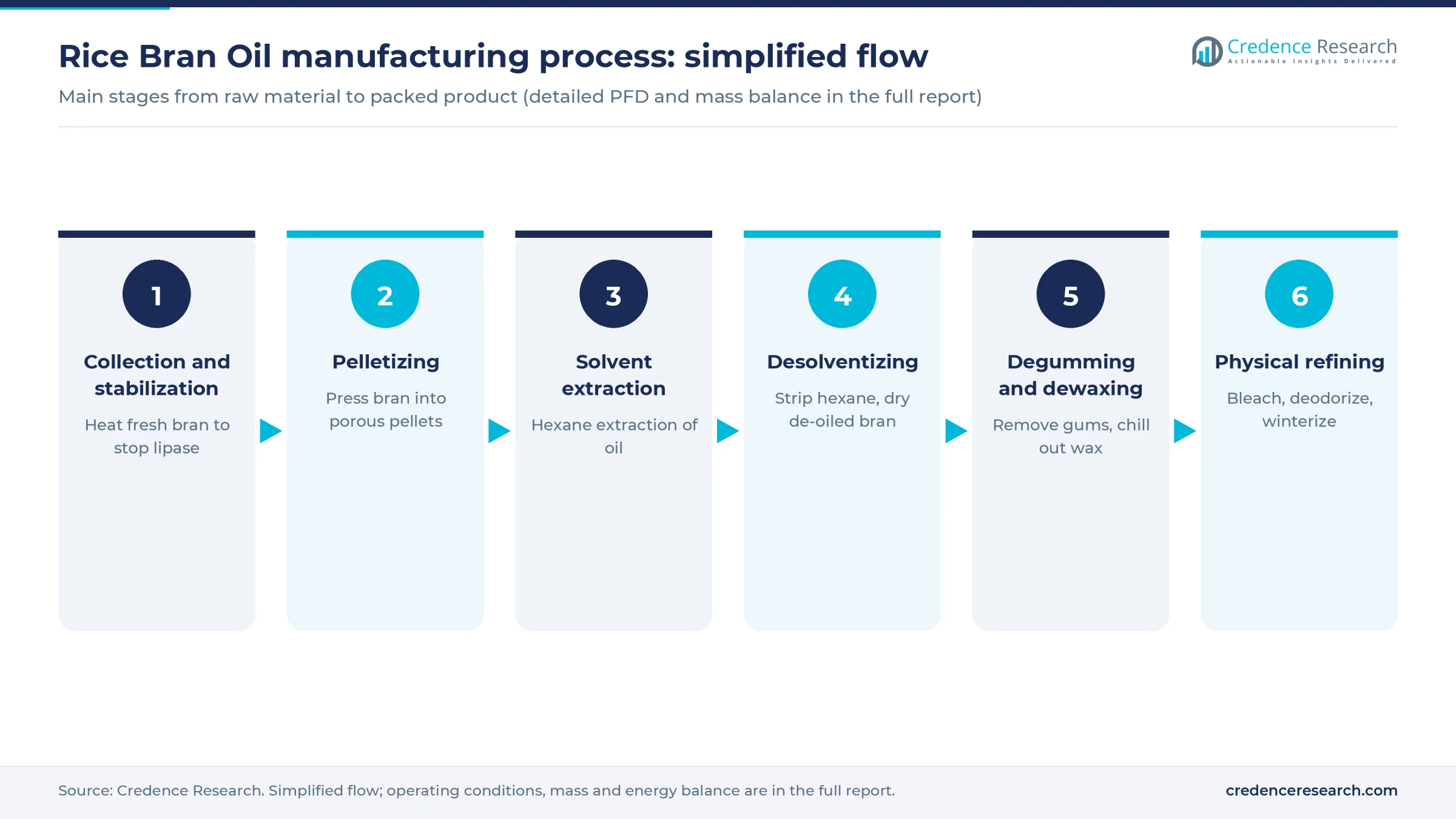
- Collection and stabilization. Fresh bran is trucked from mills within hours and heated, usually in an extruder or steam conditioner, to deactivate lipase.
- Pelletizing. Fine bran powder resists solvent flow, so it is conditioned and pressed into pellets that let hexane percolate evenly and reduce fines in the oil.
- Solvent extraction. Hexane washes the oil from the pellets in a continuous extractor. Few plants use expellers alone, because bran oil content is too low for efficient pressing.
- Desolventizing. A desolventizer-toaster strips hexane from the de-oiled bran, which is dried, cooled and sold as feed, while miscella distillation recovers solvent from the crude oil.
- Degumming and dewaxing. Crude oil is degummed, then chilled so rice bran wax crystallizes and can be filtered out, a step most other oils do not need.
- Bleaching, deodorizing and winterization. Bleaching earth removes color, steam distillation under vacuum strips free fatty acids as fatty acid distillate, and a final chill keeps the oil clear in cold weather.
Physical refining suits rice bran oil because its free fatty acid content is high, and it keeps more gamma oryzanol in the finished oil than alkali refining, which pulls oryzanol into soapstock. Hexane makes the extraction building a hazardous area, and solvent losses are both a cost and a regulated emission.
Rice bran oil plant setup cost
Indicative CapEx for a greenfield plant handling 200 tonnes of rice bran a day, with stabilization, pelletizing, solvent extraction and a physical refinery with dewaxing for its own crude oil, is USD 6–10 million at an Asian industrial location using Asian-built equipment. The budget starts from Indian equipment list prices: one supplier lists a 200 tonne per day rice bran solvent extraction plant at 10 million rupees and a 100 tonne per day plant is listed at 9.5 million rupees, while complete edible oil refineries are listed at 25–26 million rupees. Since list prices understate full scope, the budget assumes 30–50 million rupees for extraction, 15–25 million for stabilization and pelletizing and 35–45 million for refining and winterization, or about USD 0.9–1.4 million of process equipment at an assumed 88 rupees per dollar.
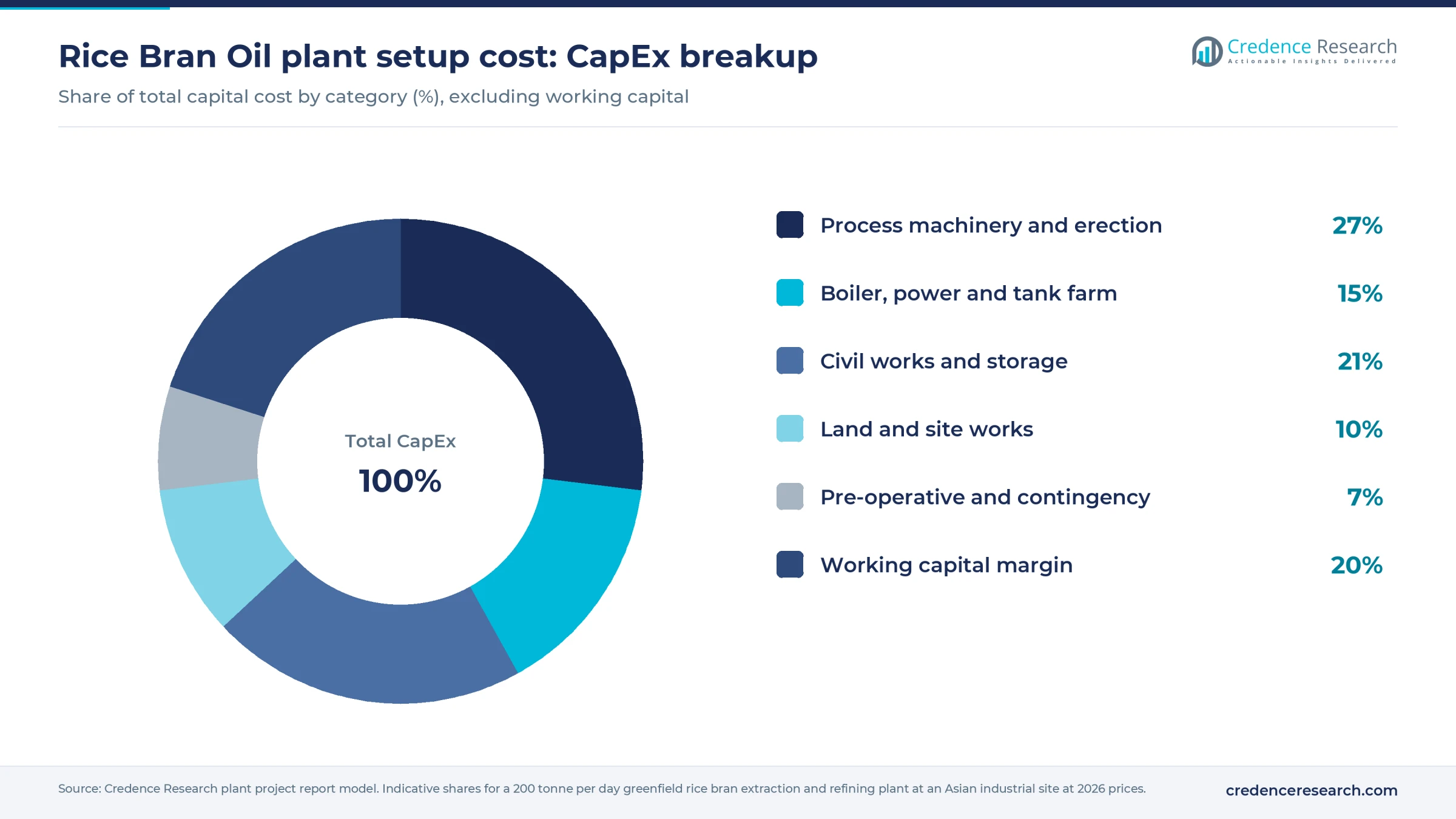
Process machinery and its erection take about 27% of the budget, and the boiler, power, cooling and hexane tank farm 15%, because stabilization and extraction use much steam. Civil works with bran and de-oiled bran storage take 21%. Working capital is about 20%, lower than for seasonal oilseeds because rice mills run most of the year. Pre-operative expenses and contingency take about 7%.
Example row, land: about 3 hectares for the plant, storage and truck yard is budgeted, as an assumption, at USD 15–35 per square meter, or USD 450,000–1.05 million, about 10% of the total. Rice milling districts in South or Southeast Asia sit at the low end.
Bangladesh's Emerald Oil Industries planned about USD 35 million to reach 100 tonnes of rice bran oil a day in the Jamalpur Economic Zone, and a Cambodian refinery handling 50–100 tonnes of bran was reported at USD 6 million in 2023, showing that imported equipment, wider scope and small scale can push cost per tonne well above the Indian-equipment estimate.
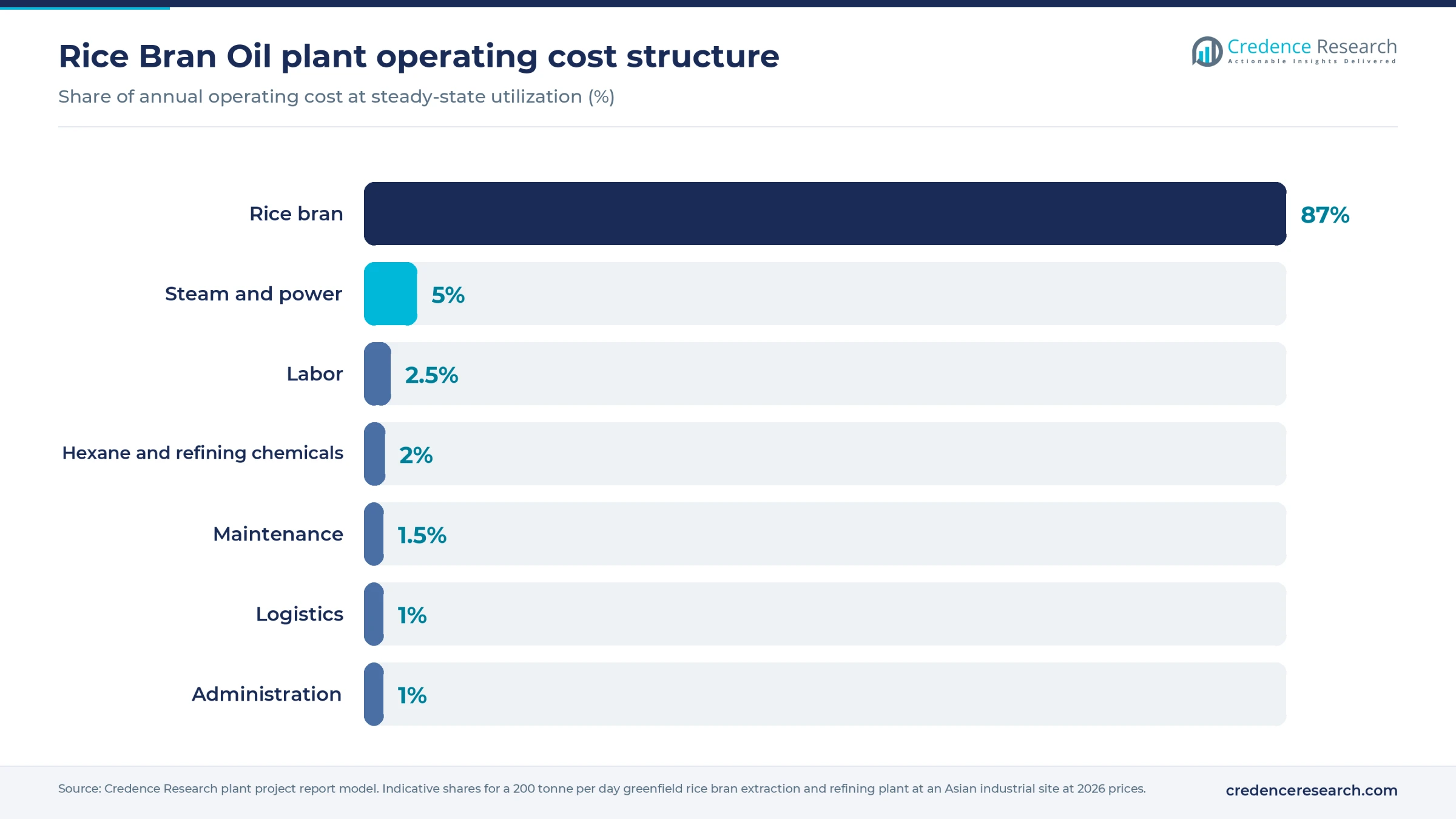
Bran dominates operating cost at about 85–89% of cash cost. Steam and power take about 5%, labor 2.5%, hexane, bleaching earth and chemicals 2%, maintenance 1.5%, logistics 1% and administration 1%. These non-bran shares are planning assumptions. Bran, land and labor costs vary most by country, so the full report can be customized to any location.
Machinery and raw materials for a rice bran oil plant
A complete line starts with a bran receiving hopper, sifters to remove broken rice and husk, a stabilizer or extruder and a pellet mill with cooler. The solvent plant has a continuous extractor, desolventizer-toaster, dryer-cooler, miscella distillation and solvent recovery. The refinery adds degumming vessels, a dewaxing crystallizer with filter press, a bleacher with leaf filters, a physical refining deodorizer, a winterization unit and fatty acid distillate recovery. Utilities include a boiler, cooling towers, a hexane tank farm and a laboratory. Supply conditions in the oilseed extraction equipment market shape lead times and prices. Machine costs and supplier lists are held for the report.
The raw material is fresh bran from commercial rice mills, so supply follows the rice belt: China, India, Bangladesh, Indonesia, Vietnam, Thailand, Myanmar, the Philippines, Pakistan and Japan, plus Brazil, the United States and West Africa. At bran equal to about 8.5% of rice output, a plant taking 51,000 tonnes a year needs bran from mills producing roughly 600,000 tonnes of rice. Plants work best close to large mills fitted with modern rice milling machinery, because small village hullers mix bran with husk and broken grains and lower oil yield.
Rice bran oil business profit margin and ROI
Gross margin here means product sales less delivered bran cost, before processing cost, and the band is 21–35%. Assumed Indian wholesale prices for late September 2026 put crude rice bran oil near 13,000 rupees per quintal and refined oil near 15,000, or about USD 1,705 a tonne for refined oil at the assumed rate. De-oiled bran is assumed at 11,000–13,000 rupees a tonne, or USD 125–148, a little above the roughly 10,000 rupees the Solvent Extractors' Association of India cited when India reopened exports in October 2025.
On those prices, one tonne of bran yields 15–16% crude oil, about 82% of which becomes refined oil worth USD 210–224, plus USD 11–15 of fatty acid distillate at an assumed USD 600–800 a tonne and USD 103–121 of de-oiled bran. Against assumed bran costs of USD 235–255 a tonne, the spread is USD 68–125 per tonne of bran.
Payback follows from cash profit: after assumed processing and overhead costs of USD 33–42 per tonne, cash profit of about USD 26–92 per tonne on 51,000 tonnes gives USD 1.3–4.7 million a year, so a USD 8 million plant pays back in about 2–6 years. The main sensitivity is bran freshness: each extra point of free fatty acids raises refining loss, and a one-point drop in oil yield cuts the spread by about USD 14 per tonne.
| Return metric | Value |
|---|---|
| IRR | Available in report |
| NPV | Available in report |
| ROI | Available in report |
| DSCR | Available in report |
How to start a rice bran oil business, licenses and approvals
Approvals are similar in most countries, with two product-specific additions: hexane, a flammable solvent, and de-oiled bran, which is regulated as animal feed.
- Business registration and tax identification.
- Land use or zoning clearance and building permits, including hazardous-area design for the extraction plant.
- An environmental permit or consent covering solvent emissions, boiler stack emissions and refinery wastewater.
- Fire safety approval for hexane storage, plus boiler and pressure vessel inspection.
- Food business licensing or registration for refined oil.
- Feed registration for de-oiled bran.
- Export or import registration.
Permit rules change, so each should be confirmed locally.
| Market | Key approvals for a rice bran oil plant |
|---|---|
| United States | FDA food facility registration and preventive controls rules for human food (21 CFR Part 117) and animal food (21 CFR Part 507); a state Clean Air Act air permit covering hexane, a listed hazardous air pollutant; OSHA flammable liquids standard (29 CFR 1910.106) for hexane storage; state commercial feed registration for de-oiled bran |
| European Union | Food business registration under Regulation (EC) No 852/2004 and feed business registration under Regulation (EC) No 183/2005; solvent emission limits for vegetable oil extraction and refining under Chapter V of the Industrial Emissions Directive 2010/75/EU; limits on glycidyl fatty acid esters and 3-MCPD in refined vegetable oils under Regulation (EU) 2023/915 |
| India | FSSAI license, with oil meeting FSSAI standards for rice bran oil; registration and monthly returns with the Directorate of Sugar and Vegetable Oils under the Vegetable Oil Products, Production and Availability (Regulation) Order, 2011, as amended in August 2025; PESO license for hexane storage under the Petroleum Rules, 2002; state pollution control board consent to establish and operate |
Key rice bran oil manufacturers and recent developments
In India, Ricela Group is among the largest dedicated producers, AWL Agri Business sells rice bran oil under its Fortune brand, Marico uses it in Saffola blends, and basmati exporter KRBL has moved into the category. Japan's Tsuno Food Industrial, Boso Oil and Fat and Oryza Oil and Fat Chemical focus on premium oil and oryzanol-based ingredients. Thai Edible Oil sells the King brand in Thailand, Emerald Oil Industries makes the Spondon brand in Bangladesh, and Myanmar rice bran oil Company has been building the country's first plant at Pyinmana. Refined oil competes for shelf space across the wider edible oils and fats market.
Two recent developments show the direction of the industry:
- December 2025. Oryza Oil and Fat Chemical and Kindai University reported three previously unknown lipids from rice bran, named oryzaceramides A to C, one of which strengthened the skin barrier in lab models, pointing to cosmetic and functional food uses for bran side streams.
- June 2026. Thai rice miller LPP Group, which showcased its LPP OIL rice bran oil brand at THAIFEX Anuga Asia 2026, planned a 400–500 million baht capacity expansion, with Japan and South Korea as its main export markets and a stock market listing of its oil unit targeted for 2030–31.
What's inside the Rice Bran Oil project report PDF
The report runs to 21 chapters. Open a chapter to see its sections.
1. Preface
2. Scope and Methodology
- 2.1 Objectives of the Study
- 2.2 Stakeholders
- 2.3 Research Methodology
- 2.4 Data Sources and Key Assumptions
3. Executive Summary
- 3.1 Market Snapshot
- 3.2 Project at a Glance (Capacity, CapEx, OpEx)
- 3.3 Key Financial Indicators (IRR, NPV, Payback, Break-even)
- 3.4 Feasibility Verdict
4. Product Overview
- 4.1 Rice Bran Oil Definition and Properties
- 4.2 Grades and Specifications (BIS / ISO / ASTM)
- 4.3 HS Code and Classification
- 4.4 Key Applications
- 4.5 Substitutes
5. Global Rice Bran Oil Market
- 5.1 Market Overview
- 5.2 Historical and Current Market Performance (Volume and Value)
- 5.3 Market Breakup by Grade / Type
- 5.4 Market Breakup by End-Use Industry
- 5.5 Market Breakup by Region
- 5.6 Market Drivers, Restraints and Trends
- 5.7 Value Chain Analysis
- 5.8 Market Forecast
6. Target Country Rice Bran Oil Market Analysis
- 6.1 Demand and Supply Analysis
- 6.2 Installed Capacity vs Demand Gap
- 6.3 Import Dependence
- 6.4 Demand Forecast by End-Use
7. Trade Analysis
- 7.1 Imports by Volume, Value and Country
- 7.2 Exports by Volume, Value and Country
- 7.3 Trade Balance and Opportunities
8. Price Analysis
- 8.1 Historical Rice Bran Oil Price Trends by Region
- 8.2 Raw Material / Feedstock Price Trends and Linkage
- 8.3 Price Forecast
- 8.4 Margins Across the Value Chain
9. Competitive Landscape
- 9.1 Market Structure
- 9.2 Key Players and Installed Capacities
- 9.3 Profiles of Key Players
- 9.4 Recent Developments (Expansions, M&A, New Plants)
10. Manufacturing Process and Technology
- 10.1 Comparison of Technology Routes
- 10.2 Selected Route and Process Flow Diagram
- 10.3 Unit Operations Involved
- 10.4 Chemical Reactions Involved
- 10.5 Mass Balance and Raw Material Requirements
- 10.6 Energy Balance
- 10.7 Quality Assurance Criteria and Technical Tests
- 10.8 By-products and Waste Handling
- 10.9 Technology Licensors / Providers
11. Project Details, Requirements and Costs
- 11.1 Land, Location and Site Development
- 11.1.1 Site Selection Criteria
- 11.1.2 Location Analysis
- 11.1.3 Land Requirement and Costs
- 11.1.4 Site Development Costs
- 11.2 Plant Layout
- 11.2.1 Layout Principles
- 11.2.2 Proposed Layout
- 11.2.3 Factors Influencing Layout
- 11.3 Civil Works and Buildings
- 11.4 Plant Machinery
- 11.4.1 Machinery Requirements and Specifications
- 11.4.2 Machinery Costs
- 11.4.3 Machinery Suppliers
- 11.5 Raw Materials
- 11.5.1 Requirements per Tonne of Output
- 11.5.2 Procurement and Sourcing
- 11.5.3 Costs
- 11.5.4 Suppliers
- 11.6 Packaging
- 11.6.1 Packaging Requirements
- 11.6.2 Packaging Costs
- 11.6.3 Packaging Suppliers
- 11.7 Storage and Material Handling
- 11.8 Transportation Requirements and Costs
- 11.9 Utilities
- 11.9.1 Power Requirements and Costs
- 11.9.2 Water Requirements and Costs
- 11.9.3 Steam, Fuel and Other Utilities
- 11.10 Manpower Requirements and Wages
12. Environment, Health, Safety and Sustainability
- 12.1 Effluent and Emissions Management
- 12.2 Hazard Classification and Safety Measures
- 12.3 Carbon Footprint
- 12.4 Green / Low-Carbon Process Options
13. Regulatory Procedures, Approvals and Certifications
- 13.1 Licences and Registrations
- 13.2 Environmental Clearances
- 13.3 Product Certifications (BIS, REACH, etc.)
- 13.4 Approval Timeline
14. Project Implementation Schedule
15. Project Economics
- 15.1 Capital Cost of the Project
- 15.2 Techno-Economic Parameters
- 15.3 Capacity Utilization and Ramp-up
- 15.4 Product Pricing and Margins
- 15.5 Income Projections
- 15.6 Expenditure Projections
- 15.7 Working Capital Requirement
- 15.8 Taxation
- 15.9 Depreciation
16. Financial Analysis
- 16.1 Projected Profit and Loss Account
- 16.2 Projected Cash Flow Statement
- 16.3 Projected Balance Sheet
- 16.4 Liquidity Analysis
- 16.5 Profitability Analysis (Payback, NPV, IRR, ROI)
- 16.6 Break-even Analysis
- 16.7 Debt Service Coverage Ratio (DSCR)
- 16.8 Sensitivity Analysis
- 16.9 Scenario and Uncertainty Analysis
17. Funding and Incentives
- 17.1 Means of Finance and Debt-Equity Structure
- 17.2 Loans and Financial Assistance
- 17.3 Government Schemes and Subsidies (PLI, State Policies)
18. Risk Assessment
- 18.1 Key Success Factors
- 18.2 Key Risk Factors
- 18.3 Risk Mitigation
19. Strategic Recommendations
20. Case Study of a Successful Venture
21. Appendix
- 21.1 Detailed Assumptions
- 21.2 Abbreviations
- 21.3 List of Tables and Figures
- 21.4 Sources
This page vs. the full report
| Data point | On this page (free) | In the full report |
|---|---|---|
| Total CapEx | One rounded range at one capacity | Exact figure at three capacities with a line-item breakup |
| CapEx breakup | Category shares (%) only | Cost, quantity and supplier for every machine |
| Operating cost | Share of raw materials, utilities and labor | Per-unit cost sheet with each input price and consumption |
| Profitability | Gross margin range and payback band | Exact IRR, NPV, ROI, break-even and DSCR |
| Financial statements | List of what is included | 10-year P&L, cash flow, balance sheet and Excel model |
| Sensitivity | One directional line | Full sensitivity and scenario tables |
| Process | Simplified flow diagram | Detailed process flow, mass and energy balance, operating conditions |
| Machinery | Names of the main machines | Specifications, capacity, cost and supplier list |
| Market | Headline size, growth and global demand | Segment, region, trade and price forecast tables |
| Suppliers and buyers | Supplier types and sourcing hubs | Named suppliers and buyers |
Rice Bran Oil project report: FAQs
How much does it cost to set up a rice bran oil plant?
What gross margin does a rice bran oil plant earn?
What is the payback period for a rice bran oil plant?
How much oil does a tonne of rice bran yield?
Why must rice bran be processed quickly?
What is the HS code for rice bran oil?
Which licenses does a rice bran oil plant need?

About the analyst
Rajdeep Kumar Deb, Lead Analyst - Consumer & Finance
Rajdeep brings a decade of consumer goods and financial services insight to strategic market analysis.
Related market research
- Rice Bran Oil Market Size, Growth, Share and Forecast 2032
- Edible Oils and Fats Market Size, Trends, Share and Forecast 2032
- Oilseed Extraction Equipment Market Size, Growth and Forecast 2032
- Rice Milling Machinery Market Size, Growth and Forecast 2032
- Edible Oils Market Size, Growth, Analysis & Forecast 2032
- Edible Oil Packaging Market Size, Share, Growth & Forecast 2032
More plant project reports
- Walnut Oil Processing Plant Project Report (DPR) 2026
- Tissue Paper Manufacturing Plant Project Report (DPR) 2026
- Notebook Manufacturing Plant Project Report (DPR) 2026
- Mustard Oil Processing Plant Project Report (DPR) 2026
- Liquid Detergent Manufacturing Plant Project Report (DPR) 2026
- Hair Color Manufacturing Plant Project Report (DPR) 2026