
Quick answer
A notebook manufacturing plant converts reels of writing paper into ruled, covered and bound exercise books, spiral notebooks and registers. A mid-size unit with three automatic lines making about 35 million notebooks a year needs an estimated USD 2.5–6 million of CapEx. Paper and other materials take 78–85% of operating cost, leaving a gross margin of 16–28% at mid-market prices. Payback is about 2.5–5.5 years at 85% utilization, provided the plant buys paper well.
Viable for a converter that secures paper supply and school-season distribution, but thin margins per ton make paper buying and working capital the deciding factors.
Notebook plant: key highlights
| Parameter | Indicative value | Note |
|---|---|---|
| Plant capacity | About 35 million notebooks per year | A5-equivalent 160-page books, three reel-fed lines plus one spiral line |
| Total CapEx | USD 2.5–6 million | Greenfield, Asian machinery basis; U.S. and EU sites toward or above the top |
| Raw material share of operating cost | 78–85% | Writing paper alone is about 71%; cover board, wire, ink and packing add the rest |
| Gross margin | 16–28% | Ex-works price minus materials and direct conversion, at an assumed mid-market price |
| Payback period | 2.5–5.5 years | At 85% utilization and mid-range CapEx of about USD 4 million |
| IRR | Available in report | Post-tax, 10-year model |
| Break-even | Available in report | Capacity utilization basis |
Ranges assume about 35 million A5-equivalent 160-page notebooks a year from three reel-fed lines and one spiral line, a greenfield Asian or African industrial park (U.S. and EU costs higher), 2026 prices, 85% utilization, paper at USD 850–1,000 per metric ton, an assumed USD 1.55/kg ex-works price, assumed land, building and ancillary equipment costs, and INR 88 and NPR 141 per USD. Customizable to any country.
What is a notebook manufacturing plant?
A notebook, in the stationery sense, is a bound book of blank, ruled or squared writing paper inside a paper or board cover. A notebook plant buys finished writing paper in reels or sheets and converts it, printing the ruling, cutting and gathering leaves, adding covers, binding and trimming. It does not make paper, so its economics are those of a converter that lives on paper price, yield and volume.
Products range from staple-stitched school exercise books and long books to spiral and wire-bound notebooks, perfect-bound and thread-sewn office notebooks, hardbound registers and premium journals with elastic closures. Typical inner paper runs from 45 to 80 gsm, with covers of 200–300 gsm board. In the Harmonized System, school exercise books are classified under subheading 4820.20, while note books, registers, diaries and memo pads fall under 4820.10, according to the World Customs Organization's HS nomenclature for heading 48.20. Students, schools and education departments are the largest buyers, followed by offices, retailers, corporate gifting and private-label programs for supermarket chains.
Notebook market overview and global demand
Notebooks sit inside the wider school and office stationery trade. Credence Research values the global school stationery supplies market at USD 98.71 billion in 2024 and projects USD 143.63 billion by 2032, a 4.8% CAGR. That implies about USD 103 billion in 2025, derived from the 2024 figure and the forecast growth rate. The broader stationery products market was about USD 158.3 billion in 2024 in Credence Research's estimate, growing at 5.12% a year. Neither figure isolates paper notebooks as a separate category.
Trade data show how local this business remains. Reporter-country trade statistics for HS 4820.20 put world exports of exercise books at more than USD 756 million in 2023, up from USD 655 million in 2022. China supplied about 24%, India 14%, Indonesia 8% and the United Arab Emirates 5%, while the United Kingdom, Ethiopia, Mexico, France and Spain were the largest importers. Against a stationery market worth tens of billions of dollars, that trade is small, because notebooks are bulky, low in value per container and printed to local ruling formats. Most volume is therefore made within the country or region of sale.
Demand follows school enrollment, the academic calendar and public procurement. South Asia, Sub-Saharan Africa and Southeast Asia add volume as enrollment rises, while North America, Europe and Japan are mature markets where growth comes from premium journals, licensed designs and recycled-paper ranges. Trade policy also matters, as U.S. import tariffs in 2025 and 2026 hit Asian exporters and pushed buyers to seek discounts or new supply bases.
Notebook manufacturing process from paper reel to packed book
Notebook production is a dry converting process. The main design choices concern format, binding style and whether ruling is printed in line from the reel or on separate sheet-fed presses. The sequence below describes a reel-fed automatic line, the format that dominates volume school exercise books.
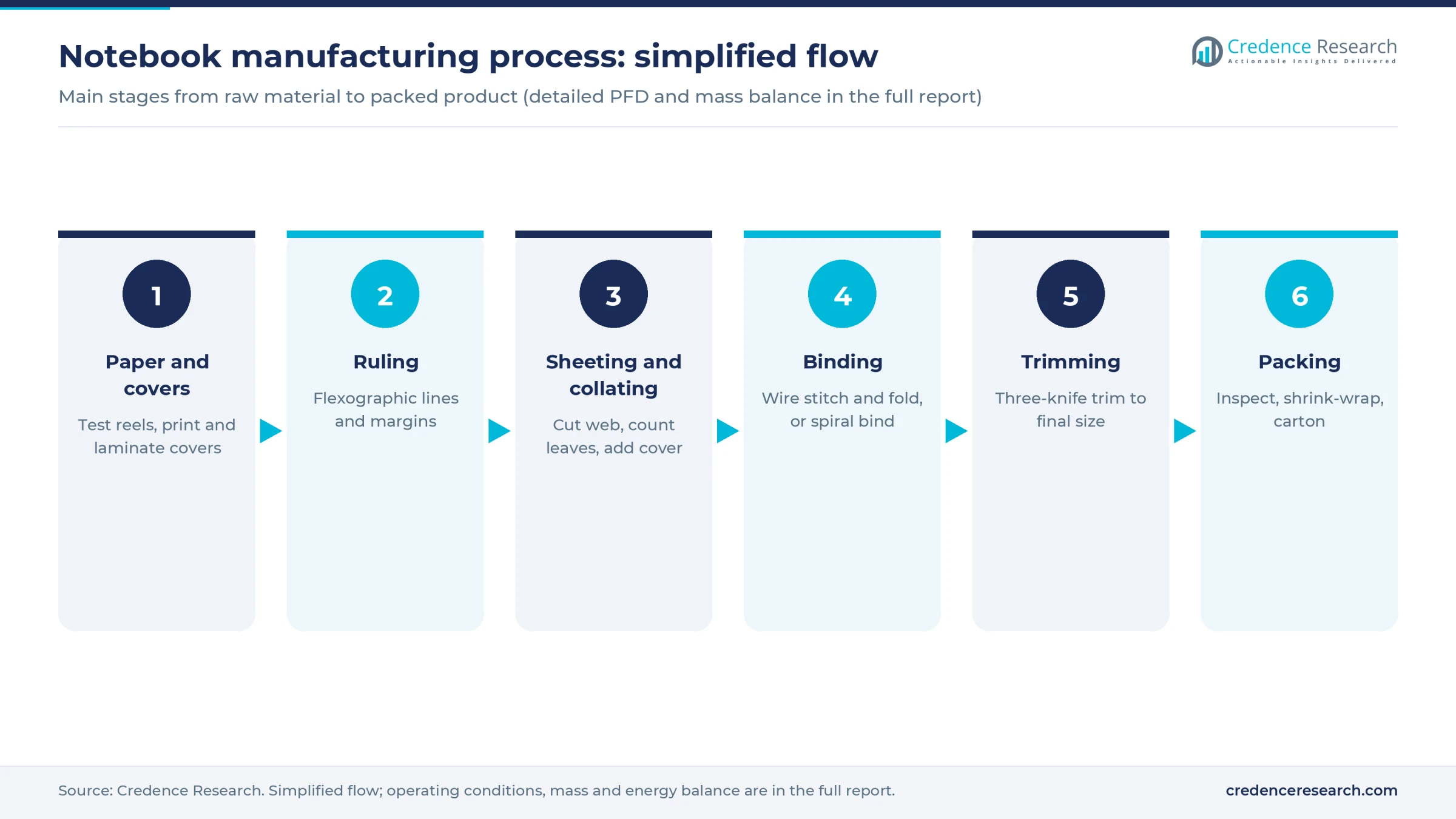
- Paper and cover preparation. Reels of writing paper are checked for grammage, brightness, opacity and moisture, since thin or damp paper causes ink show-through and jams. Covers are printed separately on offset or flexographic presses, often with lamination or varnish for durability.
- Ruling. The web passes through one- or two-color flexographic units that print lines, margins, grids or page headers with water-based inks. Ruling plates change quickly, which lets one line serve several school formats.
- Sheeting and collating. A rotary cutter sheets the web across its width, and counting units stack the leaves into book blocks. A cover is fed onto each block from a separate station.
- Binding. Most school books are wire-stitched and folded in line. Office and premium products use thread sewing, hot-melt perfect binding or spiral and wire-o binding on sheet-fed lines, where blocks are punched before the spiral is inserted and crimped.
- Trimming. Folded books pass a three-knife trimmer or front and side trimmers that square the edges. Trim settings and slitting layout determine paper yield, the largest single lever on cost.
- Inspection and packing. Books are counted and checked for missing pages, misaligned ruling and loose staples, then shrink-wrapped in bundles and cartoned for distributors.
Automatic lines quoted by equipment builders run at about 60 books per minute and take reels up to about 1,020 mm wide, with inner paper from 40 to 120 gsm. Real output is lower, because format changes, reel splices and stoppages for stitching wire cut running time. Paper trim is clean and can be sold to recycled-fiber mills, which recovers part of the 5–7% yield loss.
Notebook plant setup cost
The reference plant is a greenfield unit with three reel-fed automatic exercise book lines and one sheet-fed spiral line, producing about 35 million notebooks a year. Output is measured as A5-equivalent, 160-page books weighing about 150 grams, or roughly 5,250 metric tons of finished product. At that scale, total CapEx is estimated at USD 2.5–6 million, including land, buildings, utilities, preoperative costs and a working capital margin.
The range is built up from equipment prices. Chinese suppliers list complete exercise book lines at USD 20,000–180,000, while Indian maker Sundaram Multi Pap reported spending about USD 340,000 at 2026 exchange rates on a single automatic notebook machine at its Palghar plant. Adding assumed costs for cover printing, spiral binding, trimmers, packing and material handling gives plant and machinery of about USD 1.0–2.3 million. That block is taken as about 40% of project cost, an assumed share for light converting plants, which yields the total range. Two disclosed projects support the order of magnitude. Navneet Education estimated about USD 3.4 million for machinery at a planned UAE facility in existing buildings, and a Nepalese group reported NPR 150 million, about USD 1.1 million, for a far smaller factory making 10,000 notebooks a day.
For the land row, the plant needs about 6,000 square meters for production halls, paper reel storage, seasonal finished goods and truck access. At an assumed USD 30–100 per square meter in an Asian or African industrial park, land costs about USD 180,000–600,000, near 9% of mid-range CapEx. U.S. and EU sites cost more and vary widely, so the full report prices the selected location.
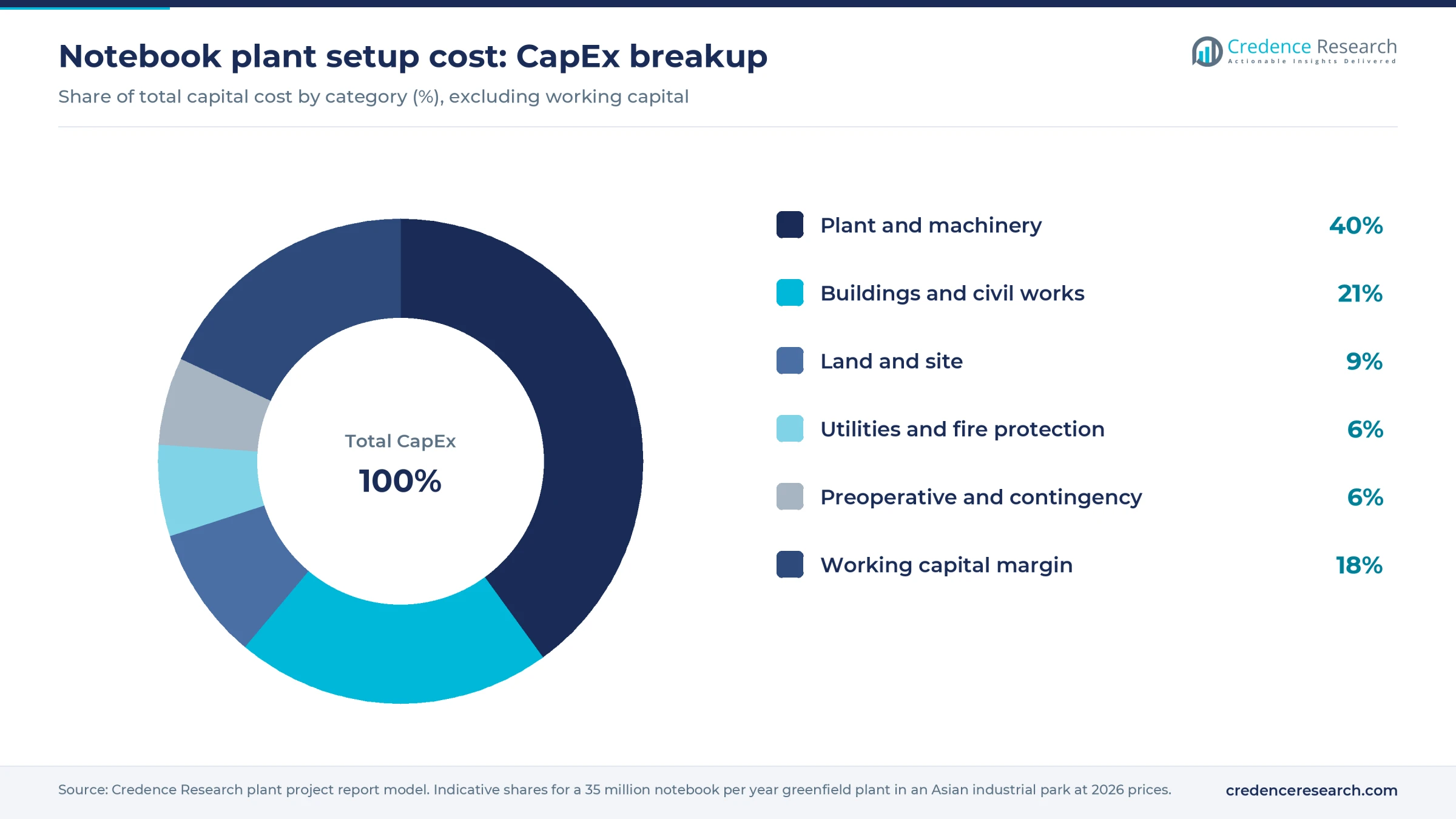
Plant and machinery take about 40% of CapEx and buildings about 21%. Working capital is unusually large at about 18%, because plants build stock for months ahead of the school season while distributors and government buyers often pay late.
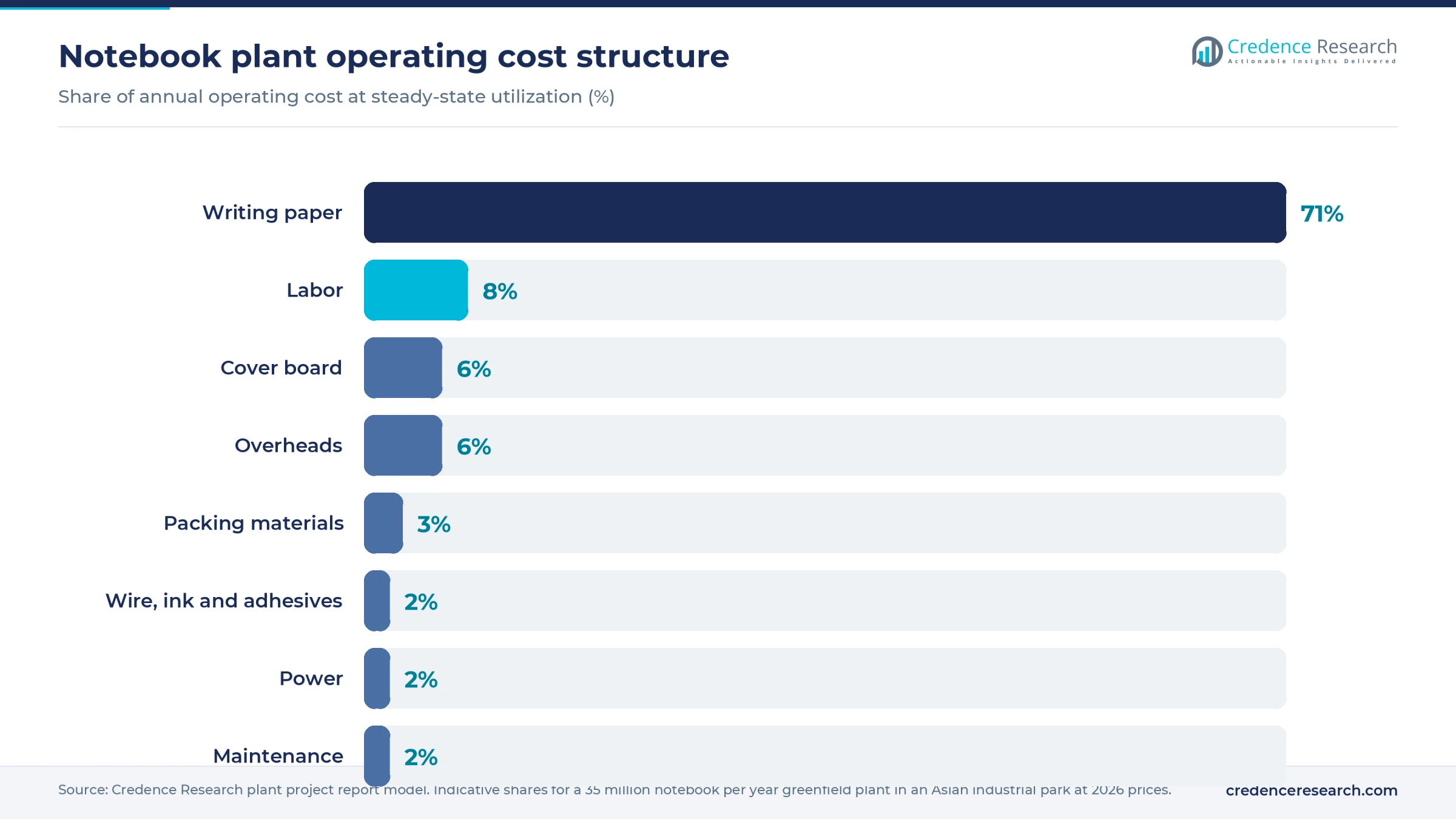
Writing paper dominates operating cost at about 71%, with cover board adding 6%. Labor, overheads and power follow, and their shares rise in high-wage markets, where extra automation usually earns its cost.
Machinery and raw materials for a notebook plant
A reel-fed notebook plant relies on the following equipment groups, with makes, speeds and the costed list kept in the full report.
- Unwind stands, web guides and reel handling
- Flexographic ruling units with plate mounting
- Rotary sheeters, counters and collators with cover feeders
- Wire stitchers, folders and three-knife or side trimmers
- Sheet-fed punching and spiral or wire-o binders
- Offset or flexographic cover presses and laminators
- Shrink wrappers, carton sealers, compressors, trim balers and fire protection
Writing and printing paper is the main input. Large uncoated woodfree mills operate in Indonesia, China, India, Brazil, Finland, Sweden and the United States, and hardwood pulp from eucalyptus and acacia plantations in Brazil, Indonesia and Uruguay underpins many Asian grades. Supply and pricing trends for this grade are tracked in the uncoated woodfree paper market study. Cover board comes from duplex and folding boxboard mills in China, India and Europe, stitching wire and spirals from steel wire drawers, and water-based inks from global ink makers with regional plants.
The reference plant uses about 4,400 metric tons of inner paper a year at 85% utilization. Because paper prices swing with pulp cycles, converters often hold supply agreements with two mills, buy ahead of the school season and track brightness and opacity tightly, since end buyers notice show-through at once.
Notebook business profit margin and ROI
Gross margin for the reference plant is estimated at 16–28%, measured as ex-works price minus materials and direct conversion cost. The build uses an assumed ex-works price of about USD 1.55 per kilogram of finished notebooks, roughly USD 0.23 for a 150-gram book, and writing paper at USD 850–1,000 per metric ton delivered, based on recent Asian offers of about USD 800–950 plus assumed freight. Cover board, wire, ink, packing, labor and power add about USD 0.26–0.32 per kilogram; the full cost sheet is in the report.
At 85% utilization, sales reach about 30 million books, or 4,460 metric tons, worth about USD 6.9 million a year. After assumed overheads of USD 350,000, annual cash profit is about USD 0.7–1.6 million, which puts payback at about 2.5–5.5 years on mid-range CapEx of USD 4 million.
Paper price is the main sensitivity. A rise of USD 100 per ton removes roughly six points of margin unless selling prices follow, which tends to happen only at the next school season. Branded and premium formats earn more than plain government-tender books, and steady private-label contracts shorten the stock cycle.
| Metric | Value |
|---|---|
| Gross margin | 16–28% |
| Payback period | 2.5–5.5 years |
| IRR (post-tax) | Available in report |
| NPV | Available in report |
| Return on investment | Available in report |
| DSCR | Available in report |
| Break-even utilization | Available in report |
How to start a notebook business with licenses and approvals
The path is similar in most countries. A promoter registers the company and tax accounts, obtains land use, building and fire permits, secures any environmental permit or consent covering printing inks and waste paper, registers the factory under occupational safety rules and gets import-export registration for traded paper and finished books. Product approval is light for paper goods, but school-age buyers bring child-safety rules, and large retailers usually ask for FSC or PEFC chain-of-custody certification and social compliance audits. Deforestation rules are the newest requirement for exporters to Europe.
| Market | Product rules | Plant and environmental permits |
|---|---|---|
| United States | CPSC children's product rules for notebooks made mainly for children 12 and under, including the 100 ppm total lead limit; ordinary books and paper-based printed materials are not subject to third-party testing, but plastic covers or coated spirals may need testing and a Children's Product Certificate | Local zoning and building permits, a state air permit only where ink emissions exceed thresholds, OSHA workplace rules |
| European Union | General Product Safety Regulation (EU) 2023/988; Deforestation Regulation (EU) 2023/1115 covers Chapter 48 paper articles, with due diligence from 30 December 2026 for large and medium operators and 30 June 2027 for micro and small ones | National environmental and building permits, national workplace safety law |
| India | No product license for plain notebooks; public school-supply tenders often set ruling, paper weight and page-count specifications | State Pollution Control Board consent, where Maharashtra lists binding-only notebook units as white category while plants that also print need Consent to Establish and Consent to Operate; factory registration, GST registration and an Importer-Exporter Code for exports |
Key notebook manufacturers and recent developments
Leading manufacturers and brand owners include Kokuyo (Japan), Navneet Education and ITC's Classmate brand (India), ACCO Brands with Five Star and Mead (United States), Hamelin with Oxford and Exacompta Clairefontaine (France), Moleskine (Italy), Leuchtturm1917 (Germany), Deli Group (China) and Asia Pulp & Paper's Tjiwi Kimia (Indonesia), which converts its own paper into school books. Thousands of regional converters supply local formats, so the market stays fragmented outside Japan and Western Europe.
Recent moves show investment shifting toward automation and toward supply bases outside the main exporting countries:
- April 2026: Indian maker Sundaram Multi Pap said it had commissioned an automatic notebook machine at its Palghar plant and planned more automated lines.
- May 2026: Navneet Education's investor presentation said its planned UAE manufacturing facility was on hold because of geopolitical tensions, after U.S. tariffs hurt its stationery exports.
- September 2026: Vietnam's competition authority approved the first step of Kokuyo's planned purchase of up to 65% of stationery maker Thien Long Group, according to Inside Retail Asia.
What's inside the Notebook project report PDF
The report runs to 21 chapters. Open a chapter to see its sections.
1. Preface
2. Scope and Methodology
- 2.1 Objectives of the Study
- 2.2 Stakeholders
- 2.3 Research Methodology
- 2.4 Data Sources and Key Assumptions
3. Executive Summary
- 3.1 Market Snapshot
- 3.2 Project at a Glance (Capacity, CapEx, OpEx)
- 3.3 Key Financial Indicators (IRR, NPV, Payback, Break-even)
- 3.4 Feasibility Verdict
4. Product Overview
- 4.1 Notebook Definition and Properties
- 4.2 Grades and Specifications (BIS / ISO / ASTM)
- 4.3 HS Code and Classification
- 4.4 Key Applications
- 4.5 Substitutes
5. Global Notebook Market
- 5.1 Market Overview
- 5.2 Historical and Current Market Performance (Volume and Value)
- 5.3 Market Breakup by Grade / Type
- 5.4 Market Breakup by End-Use Industry
- 5.5 Market Breakup by Region
- 5.6 Market Drivers, Restraints and Trends
- 5.7 Value Chain Analysis
- 5.8 Market Forecast
6. Target Country Notebook Market Analysis
- 6.1 Demand and Supply Analysis
- 6.2 Installed Capacity vs Demand Gap
- 6.3 Import Dependence
- 6.4 Demand Forecast by End-Use
7. Trade Analysis
- 7.1 Imports by Volume, Value and Country
- 7.2 Exports by Volume, Value and Country
- 7.3 Trade Balance and Opportunities
8. Price Analysis
- 8.1 Historical Notebook Price Trends by Region
- 8.2 Raw Material / Feedstock Price Trends and Linkage
- 8.3 Price Forecast
- 8.4 Margins Across the Value Chain
9. Competitive Landscape
- 9.1 Market Structure
- 9.2 Key Players and Installed Capacities
- 9.3 Profiles of Key Players
- 9.4 Recent Developments (Expansions, M&A, New Plants)
10. Manufacturing Process and Technology
- 10.1 Comparison of Technology Routes
- 10.2 Selected Route and Process Flow Diagram
- 10.3 Unit Operations Involved
- 10.4 Chemical Reactions Involved
- 10.5 Mass Balance and Raw Material Requirements
- 10.6 Energy Balance
- 10.7 Quality Assurance Criteria and Technical Tests
- 10.8 By-products and Waste Handling
- 10.9 Technology Licensors / Providers
11. Project Details, Requirements and Costs
- 11.1 Land, Location and Site Development
- 11.1.1 Site Selection Criteria
- 11.1.2 Location Analysis
- 11.1.3 Land Requirement and Costs
- 11.1.4 Site Development Costs
- 11.2 Plant Layout
- 11.2.1 Layout Principles
- 11.2.2 Proposed Layout
- 11.2.3 Factors Influencing Layout
- 11.3 Civil Works and Buildings
- 11.4 Plant Machinery
- 11.4.1 Machinery Requirements and Specifications
- 11.4.2 Machinery Costs
- 11.4.3 Machinery Suppliers
- 11.5 Raw Materials
- 11.5.1 Requirements per Tonne of Output
- 11.5.2 Procurement and Sourcing
- 11.5.3 Costs
- 11.5.4 Suppliers
- 11.6 Packaging
- 11.6.1 Packaging Requirements
- 11.6.2 Packaging Costs
- 11.6.3 Packaging Suppliers
- 11.7 Storage and Material Handling
- 11.8 Transportation Requirements and Costs
- 11.9 Utilities
- 11.9.1 Power Requirements and Costs
- 11.9.2 Water Requirements and Costs
- 11.9.3 Steam, Fuel and Other Utilities
- 11.10 Manpower Requirements and Wages
12. Environment, Health, Safety and Sustainability
- 12.1 Effluent and Emissions Management
- 12.2 Hazard Classification and Safety Measures
- 12.3 Carbon Footprint
- 12.4 Green / Low-Carbon Process Options
13. Regulatory Procedures, Approvals and Certifications
- 13.1 Licences and Registrations
- 13.2 Environmental Clearances
- 13.3 Product Certifications (BIS, REACH, etc.)
- 13.4 Approval Timeline
14. Project Implementation Schedule
15. Project Economics
- 15.1 Capital Cost of the Project
- 15.2 Techno-Economic Parameters
- 15.3 Capacity Utilization and Ramp-up
- 15.4 Product Pricing and Margins
- 15.5 Income Projections
- 15.6 Expenditure Projections
- 15.7 Working Capital Requirement
- 15.8 Taxation
- 15.9 Depreciation
16. Financial Analysis
- 16.1 Projected Profit and Loss Account
- 16.2 Projected Cash Flow Statement
- 16.3 Projected Balance Sheet
- 16.4 Liquidity Analysis
- 16.5 Profitability Analysis (Payback, NPV, IRR, ROI)
- 16.6 Break-even Analysis
- 16.7 Debt Service Coverage Ratio (DSCR)
- 16.8 Sensitivity Analysis
- 16.9 Scenario and Uncertainty Analysis
17. Funding and Incentives
- 17.1 Means of Finance and Debt-Equity Structure
- 17.2 Loans and Financial Assistance
- 17.3 Government Schemes and Subsidies (PLI, State Policies)
18. Risk Assessment
- 18.1 Key Success Factors
- 18.2 Key Risk Factors
- 18.3 Risk Mitigation
19. Strategic Recommendations
20. Case Study of a Successful Venture
21. Appendix
- 21.1 Detailed Assumptions
- 21.2 Abbreviations
- 21.3 List of Tables and Figures
- 21.4 Sources
This page vs. the full report
| Data point | On this page (free) | In the full report |
|---|---|---|
| Total CapEx | One rounded range at one capacity | Exact figure at three capacities with a line-item breakup |
| CapEx breakup | Category shares (%) only | Cost, quantity and supplier for every machine |
| Operating cost | Share of raw materials, utilities and labor | Per-unit cost sheet with each input price and consumption |
| Profitability | Gross margin range and payback band | Exact IRR, NPV, ROI, break-even and DSCR |
| Financial statements | List of what is included | 10-year P&L, cash flow, balance sheet and Excel model |
| Sensitivity | One directional line | Full sensitivity and scenario tables |
| Process | Simplified flow diagram | Detailed process flow, mass and energy balance, operating conditions |
| Machinery | Names of the main machines | Specifications, capacity, cost and supplier list |
| Market | Headline size, growth and global demand | Segment, region, trade and price forecast tables |
| Suppliers and buyers | Supplier types and sourcing hubs | Named suppliers and buyers |
Notebook project report: FAQs
How much does it cost to set up a notebook manufacturing plant?
What is the profit margin in notebook manufacturing?
How long is the payback period for a notebook plant?
What raw materials does a notebook plant need?
What is the HS code for notebooks?
Which machine is used to make notebooks?
Do paper notebooks need EU deforestation compliance?

About the analyst
Rajdeep Kumar Deb, Lead Analyst - Consumer & Finance
Rajdeep brings a decade of consumer goods and financial services insight to strategic market analysis.
Related market research
- School Stationery Supplies Market Size, Share, Trends and Forecast 2032
- Stationery Product Market Size, Growth, Share and Forecast 2032
- Uncoated Woodfree Paper Market Size, Share & Growth Report 2032
- Printing Paper Market Size, Growth, Share and Forecast 2032
- South Africa Stationery Products Market Size, Share & Growth Report 2032
- Paperboard Market Size, Share, Trends, Growth and Forecast 2032
More plant project reports
- Mustard Oil Processing Plant Project Report (DPR) 2026
- Liquid Detergent Manufacturing Plant Project Report (DPR) 2026
- Hair Color Manufacturing Plant Project Report (DPR) 2026
- Cotton Seed Oil Processing Plant Project Report (DPR) 2026
- Detergent Powder Manufacturing Plant Project Report (DPR) 2026
- Essential Oil Manufacturing Plant Project Report (DPR) 2026