
3- Hydroxybenzaldehyde Reagent Market Overview:
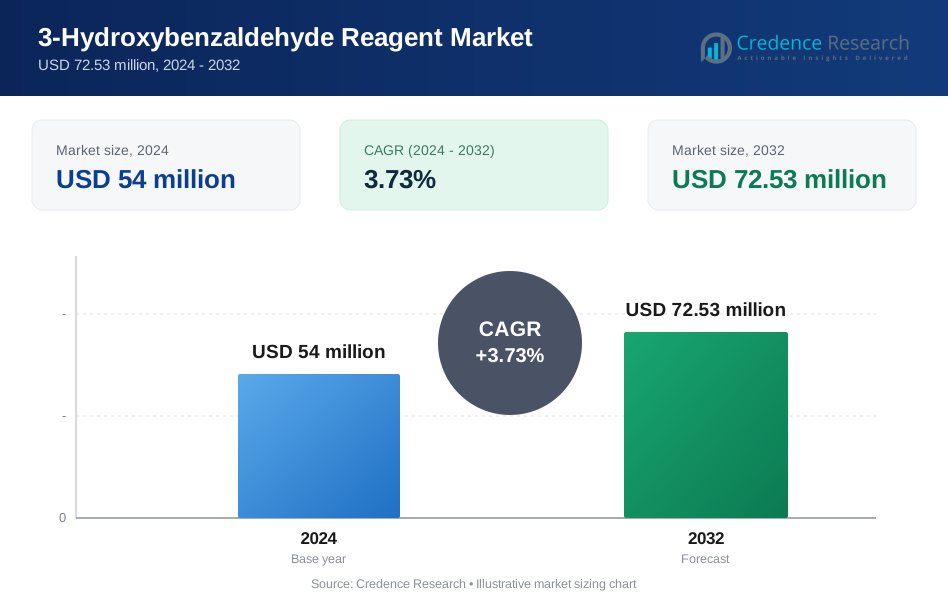
3- Hydroxybenzaldehyde Reagent Market was valued at USD 54 million in 2024 and is anticipated to reach USD 72.53 million by 2032, growing at a CAGR of 3.73% during the forecast period.
| REPORT ATTRIBUTE | DETAILS |
|---|---|
| Historical Period | 2020-2023 |
| Base Year | 2024 |
| Forecast Period | 2025-2032 |
| 3- Hydroxybenzaldehyde Reagent Market Size 2024 | USD 54 million |
| 3- Hydroxybenzaldehyde Reagent Market, CAGR | 3.73% |
| 3- Hydroxybenzaldehyde Reagent Market Size 2032 | USD 72.53 million |
3- Hydroxybenzaldehyde Reagent Market Insights
- Growing demand from pharmaceutical intermediates remains the key driver, supported by rising synthesis activity in drug discovery and expanding reagent use in analytical research across global labs.
- Trends include higher adoption of pharmaceutical-grade and electronic-grade 3-HBA, with technical-grade holding the largest segment share at about 32% due to broad industrial use in polymers, dyes, and intermediates.
- The competitive landscape remains strong as Merck, Sigma-Aldrich, Biosynth, Alfa Chemistry, TCI, and others expand purity ranges and improve documentation, while smaller suppliers enhance online availability and global distribution reach.
- North America leads with around 32% share, driven by strong R&D investments, while Asia Pacific sees rapid growth from chemicals and pharma production; Europe follows with stable demand from regulated manufacturing sectors.
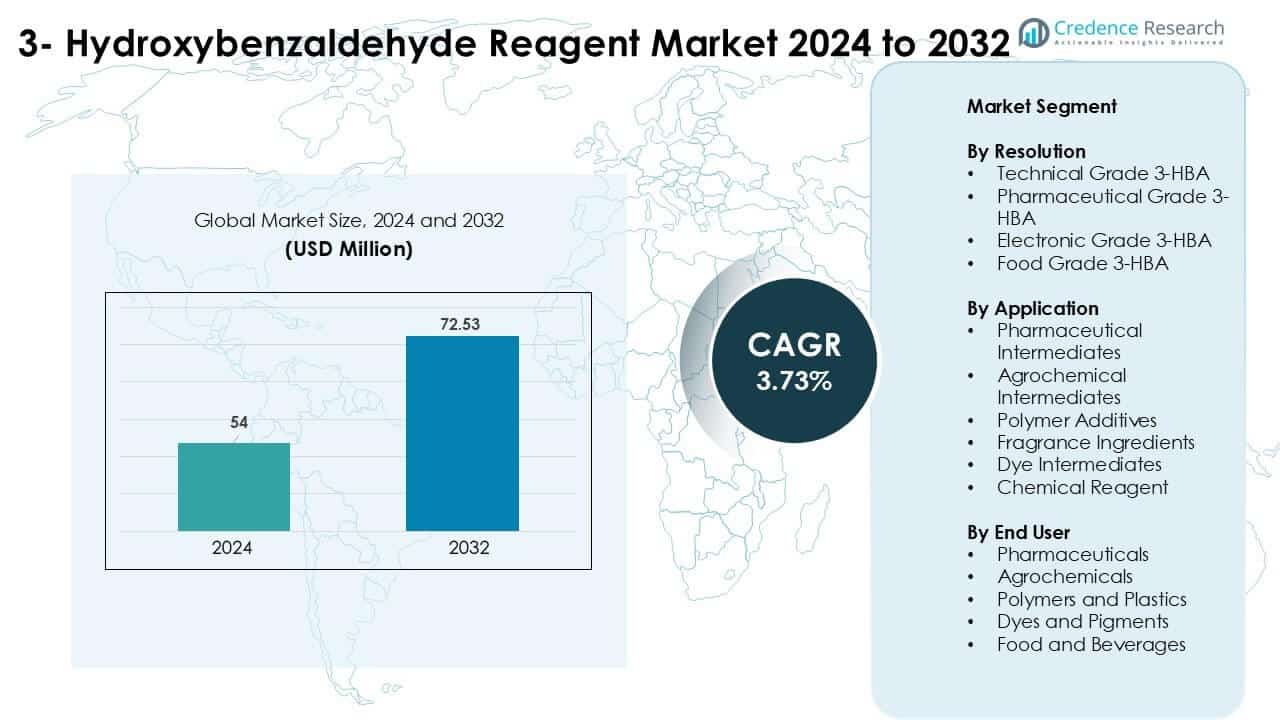
3- Hydroxybenzaldehyde Reagent Market Segmentation Analysis:
By Resolution
Technical grade 3-HBA holds the leading position with about 42% share due to wide use in bulk synthesis across chemicals and intermediates. This grade supports large-scale manufacturing because producers value its cost efficiency and stable performance in non-pharma applications. Pharmaceutical grade follows, driven by strict purity rules in drug intermediates. Electronic and food grades show smaller shares, shaped by niche demand in circuit materials and flavor compounds. Growth across all grades reflects rising downstream needs in pharmaceuticals, polymers, and fine chemicals.
- For instance, Merck KGaA (via its life science business, MilliporeSigma) is a supplier of 3-hydroxybenzaldehyde and operates under ISO 9001 and ISO 14001 certified systems.
By Application
Pharmaceutical intermediates dominate this segment with nearly 46% share because 3-HBA is a key building block in anti-infective and anti-inflammatory molecules. Strong R&D pipelines and increased production of complex APIs support steady uptake. Agrochemical intermediates follow due to herbicide and fungicide synthesis needs. Polymer additives, fragrance ingredients, dye intermediates, and chemical reagent uses grow at moderate rates as manufacturers expand specialty chemical portfolios and look for reliable aromatic aldehydes.
- For instance, Thermo Fisher Scientific does offer 3-hydroxybenzaldehyde as a research/fine chemical (under the Thermo Scientific Chemicals brand, formerly Alfa Aesar). They also provide extensive analytical solutions and services for the pharmaceutical industry and support cGMP guidelines and impurity analysis generally.
By End User
Pharmaceuticals account for the largest share at about 38% due to high reliance on 3-HBA for regulated intermediate production. Strict quality standards push sustained demand from API manufacturers. Agrochemicals follow with steady consumption tied to rising pesticide formulation volumes. Polymers and plastics, dyes and pigments, and food and beverages contribute smaller shares, supported by specialty additive, colorant, and flavor applications.Market expansion remains linked to industrial diversification and consistent downstream procurement.
Key Growth Drivers
Rising Demand for High-Purity Intermediates in Pharmaceuticals
Growing demand for high-purity intermediates drives strong adoption of 3-hydroxybenzaldehyde in regulated drug manufacturing. Pharmaceutical companies continue expanding production of anti-infective, anti-inflammatory, and specialty molecules that require reliable aromatic aldehydes. Stringent quality rules push manufacturers to source stable, consistent, and traceable reagent-grade materials. Rising chronic disease prevalence increases API output, which supports long-term procurement. Expansion of contract development and manufacturing organizations also raises consumption due to multi-step synthesis work. Increased R&D spending across emerging markets strengthens the need for high-performance intermediates, making pharmaceutical reliance a primary growth driver.
- For instance, Merck (through its life science business, MilliporeSigma/Sigma-Aldrich/SAFC) does offer 3-hydroxybenzaldehyde with a high purity (typically ≥99.0%) for synthesis and as an analytical standard.
Expansion of Agrochemical Formulations and Crop Protection Chemistry
The global agrochemical sector boosts demand for 3-hydroxybenzaldehyde due to its role in producing herbicides, fungicides, and selective crop protection agents. Farmers require advanced formulations to improve yield and tackle climate-driven pest pressure, which expands agrochemical synthesis volumes. Manufacturers depend on aromatic aldehydes for stable and effective active ingredient creation. rising adoption of precision farming also drives better chemical performance needs. Countries with growing agricultural exports strengthen local formulation capacity, raising reagent consumption. This trend aligns with ongoing innovation in eco-friendly and lower-toxicity agrochemicals, securing steady use of 3-HBA as a core intermediate.
- For instance, BASF’s Tirexor Active herbicide was approved in Australia and Canada and controls weeds resistant to other PPO inhibitors.
Growing Use in Specialty Polymers, Fragrances, and Industrial Chemicals
Industrial diversification increases 3-hydroxybenzaldehyde usage in polymers, fragrances, dyes, and specialty chemicals. Manufacturers rely on this reagent for producing tailored additives, stabilizers, and aromatic derivatives that support advanced material performance. Demand grows in packaging, automotive components, and engineered plastics that use functionalized polymers. The fragrance industry strengthens consumption because aromatic aldehydes build complex scent molecules. Dye and pigment manufacturers favor 3-HBA for consistent chromophore development. Industrial expansion in Asia and Europe accelerates adoption, supported by modernization of chemical plants and wider use of fine chemicals across value chains.
Key Trends & Opportunities
Strong Shift Toward High-Purity and Controlled Grades
Across pharmaceuticals, electronics, and fine chemicals, market players shift toward high-purity 3-HBA grades to meet rising regulatory and performance requirements. Manufacturers invest in advanced purification systems and automated production lines to ensure consistency, traceability, and batch reliability. Increased adoption of precision synthesis, including continuous-flow chemistry, encourages use of highly refined reagent grades. Electronics and specialty materials also value purity for ensuring stability in coatings, semiconductor materials, and functional additives. This trend strengthens supplier differentiation and supports premium-grade production expansion.
- For instance, Merck does have advanced production facilities in Darmstadt for high-quality inorganic salts and has invested in new modular pharmaceutical production lines and research centers.
Rising Adoption in Eco-Friendly and Bio-Based Chemical Development
Growing interest in sustainable chemistry encourages use of 3-hydroxybenzaldehyde in developing cleaner agrochemicals, biodegradable polymers, and low-toxicity fragrance compounds. Companies explore greener synthesis routes, including catalytic oxidation and renewable feedstocks, to reduce emissions and hazardous by-products. Regulatory momentum toward safer chemicals pushes manufacturers to adopt intermediates that fit evolving compliance rules. R&D teams also use 3-HBA in designing novel molecules aligned with environmental standards. This shift toward eco-friendly products opens new high-value opportunities across specialty materials and consumer goods.
- For instance, TCI sells many different catalysts and reagents, including those for oxidation reactions, and mentions their use in green chemistry efforts generally.
Expansion of Chemical Manufacturing in Emerging Markets
Developing regions invest in API plants, agrochemical units, and polymer facilities, driving rising consumption of 3-HBA. Local manufacturers expand intermediate production to reduce import reliance and support cost-effective sourcing. Governments promote industrial corridors, R&D incentives, and skill development programs that boost specialty chemical output. As domestic companies scale operations, suppliers of 3-HBA gain stronger distribution reach and long-term demand stability. Growing integration of supply chains in Asia, Latin America, and the Middle East also enables new partnerships and forward-integration opportunities.
Key Challenges
Volatile Raw Material Prices and Production Costs
Fluctuations in raw material prices impact 3-HBA manufacturing, increasing overall production costs and reducing supplier margins. Aromatic feedstock availability varies with crude oil trends, refinery operations, and global supply constraints. Smaller producers struggle to maintain stable pricing due to high dependence on external suppliers. Energy-intensive synthesis steps further strain operational budgets. As cost pressure rises, manufacturers face difficulty offering competitive rates while meeting purity and performance requirements. This volatility challenges long-term contracts and restricts capacity expansion for many regional players.
Regulatory Restrictions in Pharmaceuticals and Agrochemicals
Strict compliance requirements in pharmaceuticals and agrochemicals create barriers for suppliers of 3-hydroxybenzaldehyde. Regulatory bodies enforce controls on purity, contaminants, manufacturing practices, and environmental impact. Meeting these standards demands investment in upgraded equipment, quality systems, and documentation. Smaller companies face delays in approval processes, which limit their ability to serve global drug manufacturers. Agrochemical rules also tighten around toxicity, environmental persistence, and worker safety. These constraints raise operational complexity and restrict rapid commercialization of new applications, slowing overall market growth.
Regional Analysis
North America
North America holds about 32% share of the 3-hydroxybenzaldehyde reagent market, supported by strong pharmaceutical and agrochemical manufacturing. The region benefits from advanced API production, high R&D spending, and strict quality rules that drive demand for high-purity intermediates. Growing investments in specialty chemicals and polymer additives also support procurement. The United States leads due to its large drug development ecosystem and strong chemical innovation base. Expansion of contract manufacturing and increasing adoption of regulated synthesis processes reinforce steady reagent consumption across the region.
Europe
Europe accounts for nearly 28% market share, driven by established pharmaceutical clusters, strong agrochemical production, and strict regulatory frameworks. Manufacturers in Germany, France, and the UK rely on consistent-quality reagents for complex intermediates and specialty chemical synthesis. The region shows rising use in fragrances, dyes, and engineered polymers due to advanced material innovation. Sustainability rules push companies toward high-purity and eco-aligned intermediates, further increasing demand. Expanding R&D pipelines and modernization of chemical facilities strengthen Europe’s role as a key consumer of 3-hydroxybenzaldehyde.
Asia Pacific
Asia Pacific leads growth momentum and holds about 30% share, supported by large-scale chemical manufacturing, rising pharmaceutical production, and expanding agrochemical industries. China and India dominate due to cost-efficient synthesis capacity and strong export orientation for APIs and crop-protection chemicals. The region’s polymer and fragrance sectors also expand rapidly, pushing higher consumption of aromatic intermediates. Increasing investment in specialty chemicals, coupled with government support for industrial modernization, boosts reagent adoption. Asia Pacific remains the fastest-growing region, driven by strong domestic demand and global supply chain integration.
Latin America
Latin America captures nearly 6% share, shaped by moderate growth in agrochemicals, dyes, and polymers. Brazil and Mexico drive consumption due to their sizable agricultural and industrial bases. Demand for 3-hydroxybenzaldehyde rises as local manufacturers expand pesticide formulations and diversify chemical portfolios. The region benefits from growing investment in food ingredients and fragrances, which use aromatic aldehydes in formulation. However, reliance on imported intermediates and limited high-purity production constrain rapid expansion. Gradual improvements in manufacturing capability support stable, incremental market growth across Latin America.
Middle East & Africa
The Middle East & Africa region holds around 4% share, supported by emerging chemical production and increasing interest in specialty intermediates. Industrial development in the UAE, Saudi Arabia, and South Africa promotes gradual adoption of high-value reagents for pharmaceuticals, polymers, and agrochemicals. Growing investment in industrial diversification encourages chemical manufacturers to expand sourcing of aromatic aldehydes. However, limited domestic synthesis capacity and dependence on imports slow market acceleration. As regional healthcare and agricultural sectors grow, consumption of 3-hydroxybenzaldehyde is expected to rise steadily.
3- Hydroxybenzaldehyde Reagent Market Segmentations:
By Resolution
- Technical Grade 3-HBA
- Pharmaceutical Grade 3-HBA
- Electronic Grade 3-HBA
- Food Grade 3-HBA
By Application
- Pharmaceutical Intermediates
- Agrochemical Intermediates
- Polymer Additives
- Fragrance Ingredients
- Dye Intermediates
- Chemical Reagent
By End User
- Pharmaceuticals
- Agrochemicals
- Polymers and Plastics
- Dyes and Pigments
- Food and Beverages
By Geography
- North America
- U.S.
- Canada
- Mexico
- Europe
- Germany
- France
- U.K.
- Italy
- Spain
- Rest of Europe
- Asia Pacific
- China
- Japan
- India
- South Korea
- South-east Asia
- Rest of Asia Pacific
- Latin America
- Brazil
- Argentina
- Rest of Latin America
- Middle East & Africa
- GCC Countries
- South Africa
- Rest of the Middle East and Africa
Competitive Landscape
The 3-Hydroxybenzaldehyde Reagent Market features a competitive mix of global chemical suppliers and specialized research-grade producers. Companies such as Merck, Sigma-Aldrich, Biosynth, Alfa Chemistry, TCI, Toronto Research Chemicals, Glentham Life Sciences, BioCrick, Thermo Scientific Chemicals, and Indagoo Research Chemicals play a central role through wide product portfolios and high-purity reagent grades that support pharmaceutical, agrochemical, polymer, and electronic applications. These suppliers compete by improving batch consistency, expanding analytical documentation, and offering faster global delivery for laboratory and industrial buyers. Many players invest in upgraded production lines to meet rising regulatory expectations for purity and traceability. Partnerships with pharmaceutical and specialty chemical manufacturers strengthen long-term supply stability. Online catalog expansion and digital ordering systems increase customer access and reduce procurement time. Competitive pressure remains strong, pushing suppliers to enhance quality, broaden grade options, and maintain reliable technical support for end-user industries.
Key Player Analysis
- Merck
- BioCrick
- Alfa Chemistry
- Biosynth
- Sigma-Aldrich
- Glentham LIFE SCIENCES
- Toronto Research Chemicals
- TCI
- Thermo Scientific Chemicals
- Indagoo Research Chemicals
Recent Developments
- In February 2025, Thermo Fisher Scientific, parent of Thermo Scientific Chemicals, agreed to acquire Solventum’s purification and filtration business to strengthen its bioprocessing and lab consumables portfolio. A broader integrated chemicals and consumables offering supports global reagent supply chains, including catalog products such as Thermo Scientific 3-hydroxybenzaldehyde in multiple pack sizes.
- In May 2024, Indagoo Research Chemicals was profiled as a leading supplier of over 10,000 building-block products for premium chemical and biochemical components. Earlier announcements added Indagoo as a brand contributing more than 100,000 compounds to distributor portfolios, reinforcing its role in supplying specialty intermediates and building blocks that support markets for reagents like 3-hydroxybenzaldehyde.
- In January 2024, Alfa Chemistry announced a new line of bio-based polymers for sustainable material applications. This portfolio expansion complements its existing aromatic intermediates catalog, which includes 3-hydroxybenzaldehyde.
Report Coverage
The research report offers an in-depth analysis based on Resolution, Application, End-User and Geography. It details leading market players, providing an overview of their business, product offerings, investments, revenue streams, and key applications. Additionally, the report includes insights into the competitive environment, SWOT analysis, current market trends, as well as the primary drivers and constraints. Furthermore, it discusses various factors that have driven market expansion in recent years. The report also explores market dynamics, regulatory scenarios, and technological advancements that are shaping the industry. It assesses the impact of external factors and global economic changes on market growth. Lastly, it provides strategic recommendations for new entrants and established companies to navigate the complexities of the market.
Future Outlook
- Demand for high-purity 3-HBA will rise as pharma R&D expands worldwide.
- Electronic-grade 3-HBA will gain stronger adoption in semiconductor and sensor production.
- Automated synthesis platforms will increase consumption in research labs and CROs.
- Suppliers will invest in upgraded purification systems to meet tighter quality standards.
- Asia Pacific will emerge as the fastest-growing production hub for bulk 3-HBA.
- Digital ordering systems will streamline procurement for research and industrial buyers.
- Sustainability programs will push manufacturers to adopt greener synthesis routes.
- Custom reagent formulations will grow as specialty chemical demand increases.
- Strategic partnerships will expand long-term supply agreements with pharma and agrochemical firms.
- Market consolidation will rise as global players acquire niche reagent producers.
Request a Free Sample
Fill in your details and we'll send you a free sample report.
- Sample data tables & charts
- Research methodology
Need a Custom Version of This Report?
Tailor the scope, geography, or segments to your exact requirements.
- Custom geography or segment scope
- Direct access to our analyst team
Frequently Asked Questions
What is the current market size for 3-Hydroxybenzaldehyde Reagent Market, and what is its projected size in 2032?
At what Compound Annual Growth Rate is 3-Hydroxybenzaldehyde Reagent Market projected to grow between 2024 and 2032?
Which 3-Hydroxybenzaldehyde Reagent Market segment held the largest share in 2024?
What are the primary factors fueling the growth of 3-Hydroxybenzaldehyde Reagent Market?
Who are the leading companies in 3-Hydroxybenzaldehyde Reagent Market?
Which region commanded the largest share of 3-Hydroxybenzaldehyde Reagent Market?
Table of Content
Chapter 1. Report Introduction
- 1.1 Report Description & Purpose
- 1.1.1 Report Title & Market Definition
- 1.1.2 Unique Selling Propositions (USP) & Key Differentiators
- 1.1.3 Value Proposition for Stakeholders
- 1.2 Research Objectives
- 1.2.1 Market Sizing Objectives (Volume & Revenue)
- 1.2.2 Segmentation Objectives
- 1.2.3 Competitive Intelligence Objectives
- 1.2.4 Forecast & Scenario Objectives
- 1.3 Report Scope
- 1.3.1 3-Hydroxybenzaldehyde Reagent Scope – Types & Subtypes Covered
- 1.3.2 Geographic Scope – Regions & Countries Covered
- 1.3.3 Historical Period, Base Year & Forecast Period (2024; forecast to 2032)
- 1.3.4 Inclusions & Exclusions
- 1.4 HS Code & Classification Framework
- 1.5 Currency, Units & Pricing Basis
- 1.6 Target Stakeholders
- 1.7 Limitations & Assumptions
Chapter 2. Executive Summary
- 2.1 Global 3-Hydroxybenzaldehyde Reagent Market Snapshot
- 2.1.1 Market Size – Historical (2024) & Forecast (2024-2032) (2024: USD 54 million → 2032: USD 72.53 million)
- 2.1.2 Volume & Revenue – Global Totals
- 2.1.3 Key Market Highlights – Top Five Facts
- 2.2 3-Hydroxybenzaldehyde Reagent Market Segmentation Snapshot
- 2.2.1 Market Split by Region – 2024 vs. 2032
- 2.3 Competitive Snapshot
- 2.3.1 Top 10 Players by Revenue Share – 2024
- 2.3.2 Top 10 Players by Volume Share – 2024
- 2.3.3 Recent Strategic Developments (18-Month Summary)
- 2.4 Key Investment Highlights & Strategic Conclusions
Chapter 3. 3-Hydroxybenzaldehyde Reagent Market Dynamics & Industry Analysis
- 3.1 Market Overview & Context
- 3.1.1 3-Hydroxybenzaldehyde Reagent Market Position in the Broader Automotive Value Chain
- 3.1.2 OEM vs. Replacement Market Dynamics
- 3.1.3 Market Maturity & Development Stage by Region
- 3.2 3-Hydroxybenzaldehyde Reagent Market Drivers
- 3.3 3-Hydroxybenzaldehyde Reagent Market Restraints & Challenges
- 3.4 3-Hydroxybenzaldehyde Reagent Market Opportunities
- 3.5 Porter's Five Forces Analysis
- 3.5.1 Threat of New Entrants
- 3.5.2 Bargaining Power of Suppliers
- 3.5.3 Bargaining Power of Buyers
- 3.5.4 Threat of Substitutes
- 3.5.5 Competitive Rivalry – Intensity Assessment
- 3.6 3-Hydroxybenzaldehyde Reagent Value Chain Analysis
- 3.6.1 Upstream – Raw Material/Input Suppliers
- 3.6.1.1 Raw Material/Input 1
- 3.6.1.2 Raw Material/Input 2
- 3.6.1.3 Raw Material/Input 3
- 3.6.2 Midstream – Production/Manufacturing/Service Delivery
- 3.6.2.1 Production/Process Overview
- 3.6.2.2 Key Facility Locations & Capacity by Manufacturer
- 3.6.3 Downstream – Distribution & End Consumer
- 3.6.3.1 Primary Channel – B2B/OEM
- 3.6.3.2 Secondary Channels – Dealer, Retail, Online, Direct
- 3.6.4 Value Chain Profitability Analysis
- 3.6.1 Upstream – Raw Material/Input Suppliers
- 3.7 PESTEL Analysis
- 3.7.1 Political Factors
- 3.7.2 Economic Factors
- 3.7.3 Social Factors
- 3.7.4 Technological Factors
- 3.7.5 Environmental Factors
- 3.7.6 Legal Factors
- 3.8 3-Hydroxybenzaldehyde Reagent Supply Chain Analysis
- 3.8.1 Raw Material/Input Supply Risk Assessment
- 3.8.2 Manufacturing Concentration Risk (Geographic Exposure)
- 3.8.3 Trade Disruption Impact Analysis
- 3.9 Regulatory & Policy Landscape
Note: The regulatory and policy landscape section covers regulations based on their applicability to the market, 3-Hydroxybenzaldehyde Reagent category, geography, and scope of the study. Only regulatory frameworks with a material impact on operations, compliance, trade, sustainability, or market access are analyzed in detail.
Chapter 4. Key Investment Pockets & Opportunity Analysis
- 4.1 3-Hydroxybenzaldehyde Reagent Market Attractiveness Analysis
- 4.1.1 By Region – Investment Attractiveness Matrix (Volume × CAGR)
- 4.2 Absolute Revenue Growth Opportunity
- 4.2.1 By Region – Absolute USD Growth Through 2032
- 4.3 Incremental Volume Opportunity
- 4.3.1 By Region – Incremental Volume Through 2032
- 4.3.2 Segment – Incremental Volume
- 4.4 Emerging Submarket Opportunity Deep Dive (Subject to Applicability)
- 4.5 Emerging Market Opportunity Scorecards
- 4.5.1 United States
- 4.5.2 Europe
- 4.5.3 Asia
- 4.5.4 Middle East & Africa
Note: Emerging Market Opportunity Scorecards will be included based on relevance and strategic importance. Regions listed are indicative and may vary depending on data availability and market dynamics.
Chapter 5. 3-Hydroxybenzaldehyde Reagent Import-Export Analysis & Trade Flows
- 5.1 Global Trade Overview
- 5.1.1 Global Export Value by Country (2024)
- 5.1.2 Global Export Volume by Country (2024)
- 5.1.3 Global Import Value by Country (2024)
- 5.1.4 Global Import Volume by Country (2024)
- 5.1.5 Net Trade Balance by Country (2024)
- 5.2 Export Analysis – Segment
- 5.2.1 Type 1 (HS Code)
- 5.2.2 Type 2 (HS Code)
- 5.2.3 Type 3 (HS Code)
- 5.2.4 Type 4 (HS Code)
- 5.2.5 Type 5 (HS Code)
- 5.3 Import Analysis – Segment
- 5.3.1 Type 1 (HS Code)
- 5.3.2 Type 2 (HS Code)
- 5.3.3 Type 3 (HS Code)
- 5.3.4 Type 4 (HS Code)
- 5.3.5 Type 5 (HS Code)
- 5.4 Average Unit Trade Prices
- 5.4.1 Average Export Price – Segment & Country
- 5.4.2 Average Import Price – Segment & Source Country
- 5.4.3 Price Trends (2024)
- 5.5 Key Trade Route Analysis
- 5.5.1 Trade Route 1
- 5.5.2 Trade Route 2
- 5.5.3 Trade Route 3
- 5.5.4 Trade Route 4
- 5.5.5 Trade Route 5
- 5.6 Trade Policy Impact Assessment
- 5.6.1 US Anti-Dumping & Section 301 Tariffs
- 5.6.2 EU Customs Union Impact
- 5.6.3 Major Free Trade Agreements
- 5.6.4 USMCA Rules of Origin
Note: Trade policy analysis will be included only where relevant to the 3-Hydroxybenzaldehyde Reagent market.
Chapter 6. Competitive Landscape & Company Benchmarking
- 6.1 3-Hydroxybenzaldehyde Reagent Market Concentration & Structure
- 6.1.1 Herfindahl-Hirschman Index (HHI) – vs. 2024
- 6.1.2 Tier 1, Tier 2 & Tier 3 Market Structure
- 6.1.3 Global, Regional & Local Player Dynamics
- 6.2 3-Hydroxybenzaldehyde Reagent Market Share Analysis – 2024
- 6.2.1 Global Revenue Share by Company
- 6.2.2 Global Volume Share by Company
- 6.2.3 Regional Revenue Share
- 6.2.4 Market Share Evolution ( vs. 2024)
- 6.2.5 OEM Segment Share by Company
- 6.2.6 Replacement Segment Share by Company
- 6.3 Production/Delivery Capacity & Facility Analysis
- 6.3.1 Global Installed Capacity
- 6.3.2 Capacity Utilization Rates
- 6.3.3 Production/Output Volume
- 6.3.4 Facility Locations & Capacity Map
- 6.3.5 Planned Capacity Additions
- 6.4 3-Hydroxybenzaldehyde Reagent Competitive Benchmarking Matrix
- 6.4.1 Revenue, Volume, CAGR & Profitability Comparison
- 6.4.2 Channel Revenue Mix
- 6.4.3 Geographic Revenue Exposure
- 6.4.4 R&D Intensity
- 6.4.5 Sustainability Maturity
- 6.5 Strategic Developments in 3-Hydroxybenzaldehyde Reagent (Last 24 Months)
- 6.5.1 Mergers, Acquisitions & Divestments
- 6.5.2 New 3-Hydroxybenzaldehyde Reagent Launches
- 6.5.3 Facility Expansions
- 6.5.4 Strategic Alliances, Joint Ventures & Partnerships
- 6.5.5 Distribution Expansion & Market Entry
- 6.5.6 Sustainability & ESG Initiatives
- 6.6 Competitive Strategy Mapping
- 6.6.1 Leader, Challenger, Follower & Niche Classification
- 6.6.2 Pricing Strategy Comparison
- 6.6.3 Channel Strategy Matrix
Note: Strategic developments are included based on their materiality and the availability of reliable information.
Chapter 7. Global 3-Hydroxybenzaldehyde Reagent Market – By Distribution Channel
- 7.1 Segment Overview
- 7.1.1 Volume & Revenue Split by Channel (2024 & 2032)
- 7.1.2 Channel Mix Evolution (2024-2032)
Chapter 8. Regional Market Analysis – Global Overview
- 8.1 Global Regional Overview
- 8.1.1 Regional Volume Share
- 8.1.2 Regional Revenue Share
- 8.1.3 Regional Volume by Region
- 8.1.4 Regional Revenue by Region
- 8.1.5 Regional Forecast Through 2032
- 8.2 Cross-Regional Segment Analysis
- 8.2.1 By Distribution Channel
- 8.2.2 By Brand/Price Tier
Chapter 9. North America 3-Hydroxybenzaldehyde Reagent Market
- 9.1 United States
- 9.2 Canada
- 9.3 Mexico
Chapter 10. Europe 3-Hydroxybenzaldehyde Reagent Market
- 10.1 Germany
- 10.2 France
- 10.3 Italy
- 10.4 United Kingdom
- 10.5 Spain
- 10.6 Poland
- 10.7 Russia
- 10.8 Netherlands
- 10.9 Belgium
- 10.10 Sweden
- 10.11 Denmark
- 10.12 Norway
- 10.13 Rest of Europe
Chapter 11. Asia Pacific 3-Hydroxybenzaldehyde Reagent Market
- 11.1 China
- 11.2 India
- 11.3 Japan
- 11.4 South Korea
- 11.5 Thailand
- 11.6 Indonesia
- 11.7 Vietnam
- 11.8 Malaysia
- 11.9 Australia
- 11.10 Rest of Asia Pacific
Chapter 12. Latin America 3-Hydroxybenzaldehyde Reagent Market
- 12.1 Brazil
- 12.2 Argentina
- 12.3 Colombia
- 12.4 Chile
- 12.5 Rest of Latin America
Chapter 13. Middle East 3-Hydroxybenzaldehyde Reagent Market
- 13.1 Saudi Arabia
- 13.2 United Arab Emirates
- 13.3 Turkey
- 13.4 Israel
- 13.5 Iran
- 13.6 Rest of the Middle East
Chapter 14. Africa 3-Hydroxybenzaldehyde Reagent Market
- 14.1 South Africa
- 14.2 Egypt
- 14.3 Nigeria
- 14.4 Morocco
- 14.5 Rest of Africa
Chapter 15. 3-Hydroxybenzaldehyde Reagent Company Profiles
- 15.1 [Company 01]
- 15.1.1 Company Overview
- 15.1.2 Key Management Personnel
- 15.1.3 Products & Services Portfolio
- 15.1.4 Financial Performance
- 15.1.5 Key Market Focus & Geographic Presence
- 15.1.6 Recent Developments & Strategic Initiatives
Note: The company profile list is preliminary and may change based on research findings, market developments, data availability, and client requirements.
Chapter 16. Appendices
- Appendix A – List of Abbreviations & Acronyms
- Appendix B – Industry Classification Code Reference – Full Series
- Appendix C – Production & Capacity Data Tables
- Appendix D – End-Use & Demand Base Tables
- Appendix E – Consumption & Replacement Rate Assumptions
- Appendix F – ASP Reference Tables
- Appendix G – Manufacturing & Facility Database
- Appendix H – Import-Export Data Tables
- Appendix I – Regulatory Summary Tables
- Appendix J – Primary Research Participant List (Anonymized)
- Appendix K – Primary Research Questionnaire Framework
- Appendix L – Data Sources & Bibliography
- Appendix M – Market Size Divergence & Source Comparison
Chapter 17. Research Methodology
- 17.1 Research Framework & Philosophy
- 17.2 Secondary Research – Sources, Hierarchy & Data Extraction
- 17.3 Data Modeling – Bottom-Up & Top-Down Market Sizing
- 17.4 Primary Research – Stakeholder Framework, LOI & Sample Sizes
- 17.5 Forecast Methodology – Regression, Scenario & Sensitivity Analysis
- 17.6 Quality Control – Four-Layer Validation Framework
- 17.7 Limitations & Standard Assumptions
- 17.8 Disclaimer
