Pharmaceutical Intermediates Market Overview:
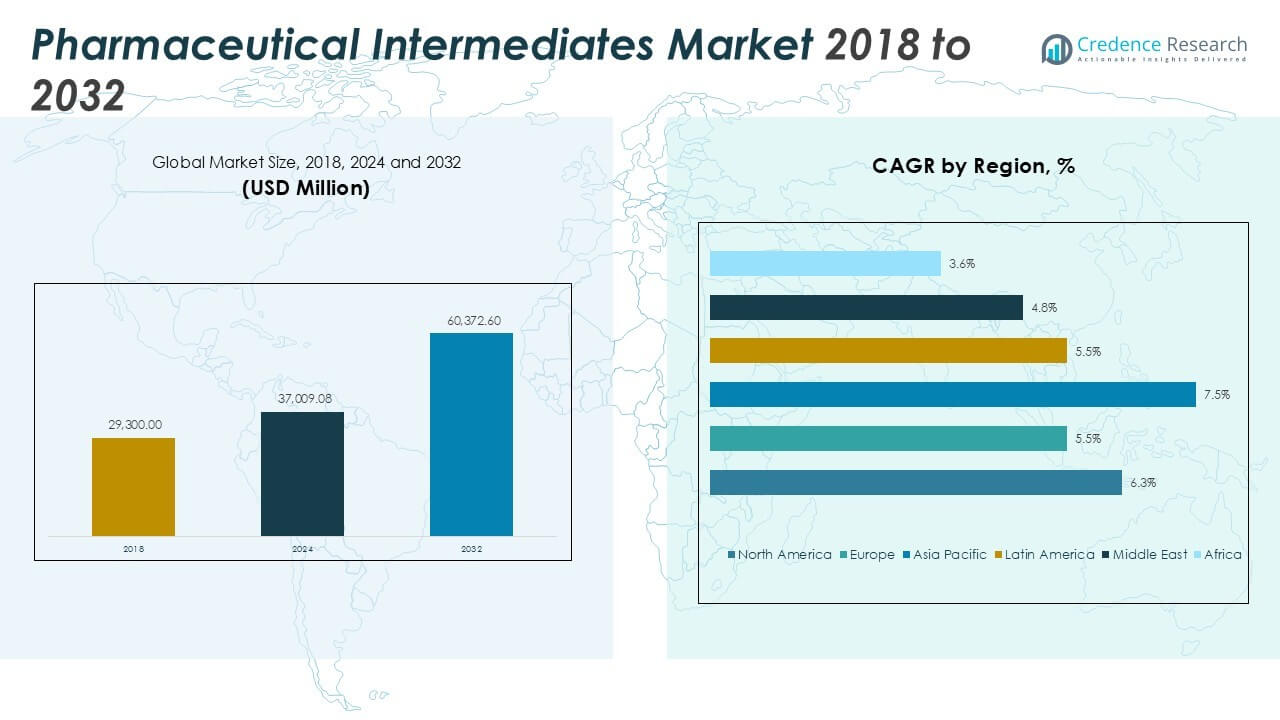
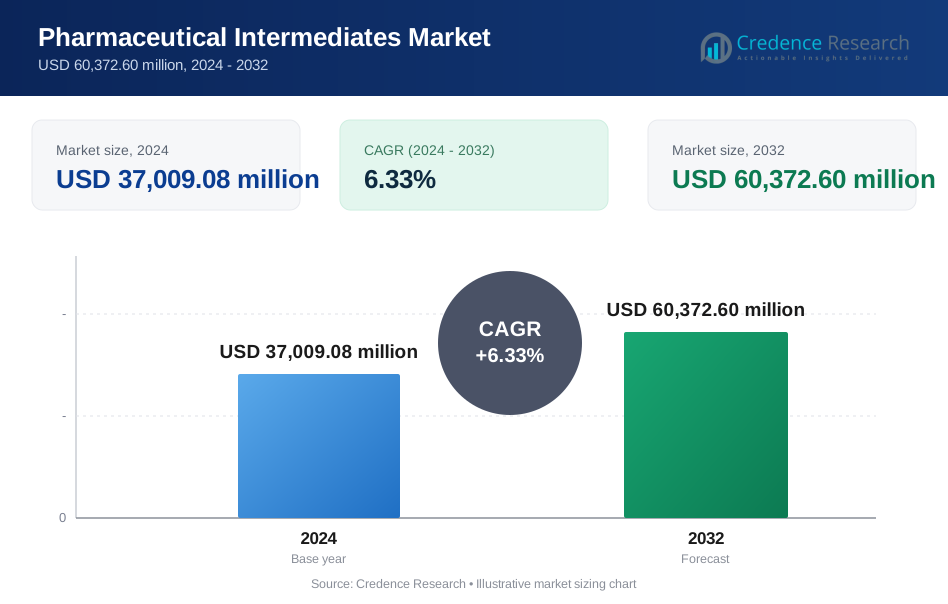
The Pharmaceutical Intermediates market size was valued at USD 29,300.00 million in 2018, reached USD 37,009.08 million in 2024, and is anticipated to reach USD 60,372.60 million by 2032, at a CAGR of 6.33% during the forecast period.
| REPORT ATTRIBUTE | DETAILS |
|---|---|
| Historical Period | 2020-2023 |
| Base Year | 2024 |
| Forecast Period | 2025-2032 |
| Pharmaceutical Intermediates Market Size 2024 | USD 37,009.08 Million |
| Pharmaceutical Intermediates Market, CAGR | 6.33% |
| Pharmaceutical Intermediates Market Size 2032 | USD 60,372.60 Million |
Top players in the Pharmaceutical Intermediates market include BASF SE, Sanofi SA, Thermo Fisher Scientific Inc., Merck KGaA, Lonza Group AG, and Aurobindo Pharma Limited. These companies lead through diversified portfolios, global distribution networks, and strong regulatory compliance. BASF and Merck dominate in Europe with high-purity and specialty intermediates, while Lonza and Thermo Fisher hold strong positions in custom manufacturing. Aurobindo Pharma and Wuxi AppTec support Asia Pacific’s bulk intermediate production strength. North America emerged as the leading region in 2024, capturing a 35.35% market share, driven by innovation, advanced R&D infrastructure, and increasing demand for high-quality APIs.
Pharmaceutical Intermediates Market Insights
- The Pharmaceutical Intermediates market was valued at USD 37,009.08 million in 2024 and is projected to reach USD 60,372.60 million by 2032, growing at a CAGR of 6.33%.
- Growth is driven by increasing global API production, rising chronic disease prevalence, and expanding generic and branded drug pipelines.
- High demand for chiral and custom intermediates, along with outsourcing to CMOs and CROs, is shaping market trends.
- The market is highly competitive with key players like BASF SE, Merck KGaA, Thermo Fisher Scientific, and Aurobindo Pharma focusing on high-purity and specialty intermediates; however, raw material price volatility and strict regulatory requirements limit rapid expansion.
- North America leads with 35.35% share, followed by Asia Pacific at 29.20% and Europe at 22.38%; by product, Bulk Drug Intermediates dominate the market, while Anti-Cancer Drugs hold the largest application share due to increasing oncology drug development.
Pharmaceutical Intermediates Market Segmentation Analysis:
By Product
In the Pharmaceutical Intermediates Market, Bulk Drug Intermediates held the largest market share in 2024. Their dominance stems from widespread use in producing active pharmaceutical ingredients (APIs) for high-volume therapeutic classes. These intermediates are essential for streamlined synthesis in generic and branded drug manufacturing. The segment benefits from rising chronic disease prevalence and growing API production across Asia-Pacific. Chemical Intermediates also remain critical, supporting key chemical synthesis stages. Meanwhile, Chiral Intermediates gain traction due to demand for enantiomerically pure drugs. Custom Intermediates see growth in contract manufacturing projects supporting niche formulations.
- For instance, Aurobindo Pharma operates over 20 API manufacturing facilities and produces more than 300 APIs, supplying bulk drug intermediates for antibiotics, cardiovascular, and anti-diabetic drugs.
By Application
Anti-Cancer Drugs emerged as the leading application segment in 2024, capturing the highest market share due to growing oncology drug pipelines and targeted therapy developments. The increasing global cancer burden accelerates R&D activities, driving intermediate demand for cytotoxic and biologically active compounds. Anti-Diabetic and Cardiovascular Drugs followed closely, supported by aging populations and lifestyle-related disorders. Antimicrobial Drugs also maintained steady demand amid rising AMR concerns. Analgesics and Anti-Inflammatory Drugs cater to chronic pain and autoimmune conditions, contributing to consistent intermediate consumption. The “Others” segment includes CNS and dermatological therapies with moderate but rising demand.
- For instance, Lonza supports oncology drug production through its Small Molecules division, which currently manages a portfolio of over 330 programs (including >125 commercial and >205 pre-clinical/clinical programs) as part of a total company-wide portfolio of more than 1,105 small and large molecules.
By End-User
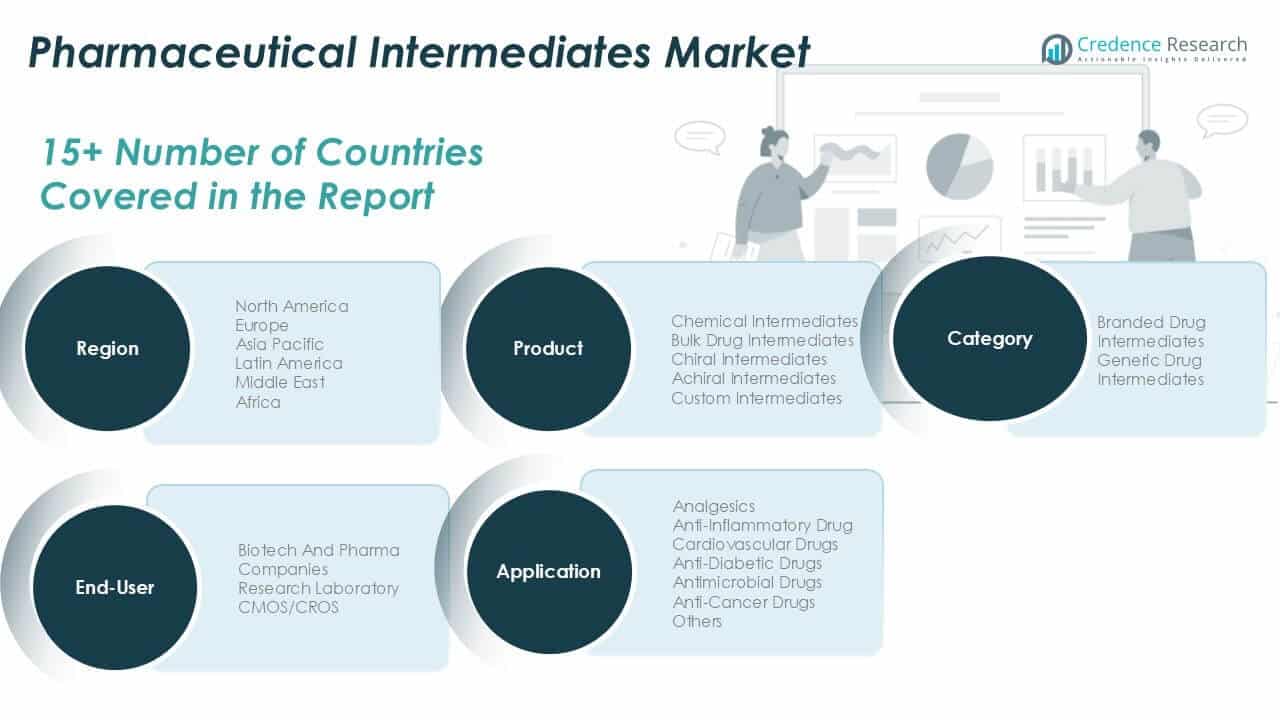
Biotech and Pharma Companies represented the dominant end-user segment in 2024, driven by large-scale in-house API production and new drug development initiatives. These firms invest heavily in high-purity intermediates to meet regulatory standards and accelerate time-to-market. CMOs and CROs also gained market traction, supported by increasing outsourcing trends, especially among small-to-mid-sized pharmaceutical players. These organizations focus on cost efficiency, process optimization, and specialized production capacity. Research Laboratories accounted for a smaller share but showed steady demand driven by early-stage drug discovery and academic-industry collaborations focused on novel compound synthesis.
Pharmaceutical Intermediates Market Key Growth Drivers
Rising Global API Manufacturing Demand
The Pharmaceutical Intermediates market grows with rising API production worldwide. Generic drug expansion increases intermediate consumption across therapeutic classes. Chronic disease prevalence drives sustained API volume demand. Governments promote domestic pharmaceutical manufacturing to reduce import dependence. Asia Pacific leads bulk API output, supporting intermediate scale-up. North America and Europe focus on high-purity intermediates for regulated markets. Cost optimization pressures encourage efficient intermediate sourcing. Contract manufacturing growth strengthens backward integration strategies. Regulatory compliance pushes demand for quality-certified intermediates. These factors collectively support stable, long-term market expansion.
- For instance, Sun Pharmaceutical Industries operates more than 40 manufacturing facilities worldwide, including large API plants in India producing hundreds of intermediates for chronic therapies.
Expansion of Generic and Branded Drug Pipelines
Generic drug approvals continue to rise across major markets. Patent expiries increase generic formulation launches. Each generic drug requires consistent intermediate supply. Branded drug pipelines also expand in oncology and specialty care. Complex molecules raise demand for advanced intermediates. Pharmaceutical companies invest in scalable synthesis routes. This trend supports both bulk and custom intermediates. Emerging markets boost volume-based production needs. Pricing pressure favors efficient intermediate procurement. These dynamics sustain strong intermediate demand across development stages.
- For instance, Dr. Reddy’s Laboratories manages a portfolio of over 200 generic products and runs dedicated API and intermediate facilities supporting oncology and specialty drugs.
Growth of Contract Manufacturing and Outsourcing
Pharma companies increasingly outsource intermediate production. CMOs and CROs expand synthesis and scale-up capabilities. Outsourcing reduces capital and operational risks. Small biotech firms rely on external intermediate suppliers. Custom intermediates support flexible development pipelines. Global supply chain diversification increases supplier partnerships. Asia Pacific dominates outsourced intermediate manufacturing. Quality and regulatory alignment remain key selection factors. This outsourcing shift accelerates market penetration. The model supports faster drug development timelines.
Pharmaceutical Intermediates Market Key Trend & Opportunities
Rising Demand for High-Purity and Specialty Intermediates
Drug complexity increases across therapeutic pipelines. High-potency and targeted drugs need precise intermediates. Chiral intermediates gain importance in enantiomer-specific therapies. Regulatory scrutiny raises purity and traceability requirements. Suppliers invest in advanced synthesis technologies. High-margin specialty intermediates attract strategic investments. Oncology and rare disease drugs drive this shift. This trend opens opportunities for value-added suppliers. Innovation-focused players gain competitive advantage. Demand growth favors technically advanced manufacturers.
- For instance, Lonza operates high-potency API and intermediate facilities with occupational exposure limits below 1 microgram per cubic meter.
Regional Manufacturing Localization Initiatives
Governments encourage local pharmaceutical production. Incentives support domestic intermediate manufacturing facilities. Supply chain resilience becomes a strategic priority. Import substitution policies boost regional sourcing. Middle East and Latin America show rising investment interest. Africa begins gradual capacity development. Localization reduces lead times and supply risks. Local production improves regulatory responsiveness. This trend creates new regional growth pockets. Market participants benefit from early regional presence.
Pharmaceutical Intermediates Market Key Challenges
Volatile Raw Material Prices
Intermediate production depends on chemical feedstocks. Raw material prices fluctuate due to supply disruptions. Energy cost volatility affects synthesis economics. Margin pressure impacts small and mid-sized suppliers. Long-term contracts reduce pricing flexibility. Cost pass-through remains limited in competitive markets. This volatility complicates production planning. Companies adopt sourcing diversification strategies. Inventory management becomes critical. Price instability remains a persistent operational challenge.
Stringent Regulatory and Compliance Requirements
Pharmaceutical intermediates face strict quality standards. Regulatory audits increase across global markets. Documentation and traceability demands rise steadily. Compliance costs impact operational efficiency. Smaller players face higher regulatory burden. Process validation requires continuous investment. Changing regulations create uncertainty risks. Non-compliance leads to supply disruptions. Companies strengthen quality management systems. Regulatory complexity continues to challenge market scalability.
Pharmaceutical Intermediates Market Regional Analysis
North America:
North America led the Pharmaceutical Intermediates market in 2024, accounting for a 35.35% market share with a value of USD 13,086.19 million, up from USD 10,489.40 million in 2018. The region is projected to reach USD 21,317.67 million by 2032, expanding at a CAGR of 6.3%. This growth is driven by the strong presence of global pharmaceutical giants, advanced R&D infrastructure, and growing demand for high-quality APIs. The United States remains the primary contributor, with continued investment in oncology, biologics, and specialty drug production further strengthening intermediate consumption across therapeutic categories.
Europe:
Europe held a 22.38% share of the global Pharmaceutical Intermediates market in 2024, with revenues rising from USD 6,859.13 million in 2018 to USD 8,285.32 million in 2024. It is forecasted to reach USD 12,669.35 million by 2032, growing at a CAGR of 5.5%. The region’s growth is supported by established pharmaceutical hubs in Germany, Switzerland, and the UK. Regulatory emphasis on quality manufacturing and rising demand for generic drug production drive steady intermediate usage. Europe’s strong biotech sector also contributes to demand for both standard and custom intermediates across complex drug development workflows.
Asia Pacific:
Asia Pacific ranked second in 2024 with a 29.20% market share, growing from USD 8,321.20 million in 2018 to USD 10,911.97 million in 2024. The region is expected to reach USD 19,397.76 million by 2032, registering the highest CAGR of 7.5% globally. China and India lead the regional market due to their dominance in API production and contract manufacturing. Low production costs, skilled labor, and expanding pharmaceutical export capabilities make Asia Pacific a preferred destination for bulk and custom intermediate sourcing, especially for global pharma players aiming to optimize costs and supply chain resilience.
Latin America:
Latin America accounted for a 7.13% share of the Pharmaceutical Intermediates market in 2024, growing from USD 2,109.60 million in 2018 to USD 2,642.08 million. It is anticipated to reach USD 4,037.12 million by 2032, with a CAGR of 5.5%. Brazil and Mexico remain key regional players, driven by rising demand for generic drugs, local manufacturing investments, and public health initiatives. The growing pharmaceutical retail sector and a shifting focus towards domestic API sourcing have contributed to rising intermediate demand. However, slower regulatory processes and limited R&D funding pose challenges to higher market penetration.
Middle East:
The Middle East contributed 3.17% to the global Pharmaceutical Intermediates market in 2024, with values increasing from USD 996.20 million in 2018 to USD 1,169.25 million. The market is projected to reach USD 1,696.80 million by 2032, growing at a CAGR of 4.8%. The UAE and Saudi Arabia lead regional development due to expanding local pharma manufacturing and rising import substitution efforts. National health transformation plans, supported by government funding and international partnerships, are creating opportunities for intermediate production. However, reliance on imported APIs still limits large-scale domestic growth compared to Asia or North America.
Africa:
Africa represented the smallest share of the Pharmaceutical Intermediates market in 2024 at 2.47%, up from USD 524.47 million in 2018 to USD 914.27 million. It is forecasted to reach USD 1,253.89 million by 2032, growing at a CAGR of 3.6%. The region’s growth is driven by rising healthcare infrastructure, population growth, and increased disease burden. Nigeria, South Africa, and Egypt are emerging as key markets for pharmaceutical production. However, challenges such as limited local manufacturing, high import dependence, and weak regulatory environments continue to restrict rapid development in intermediate production and processing capabilities.
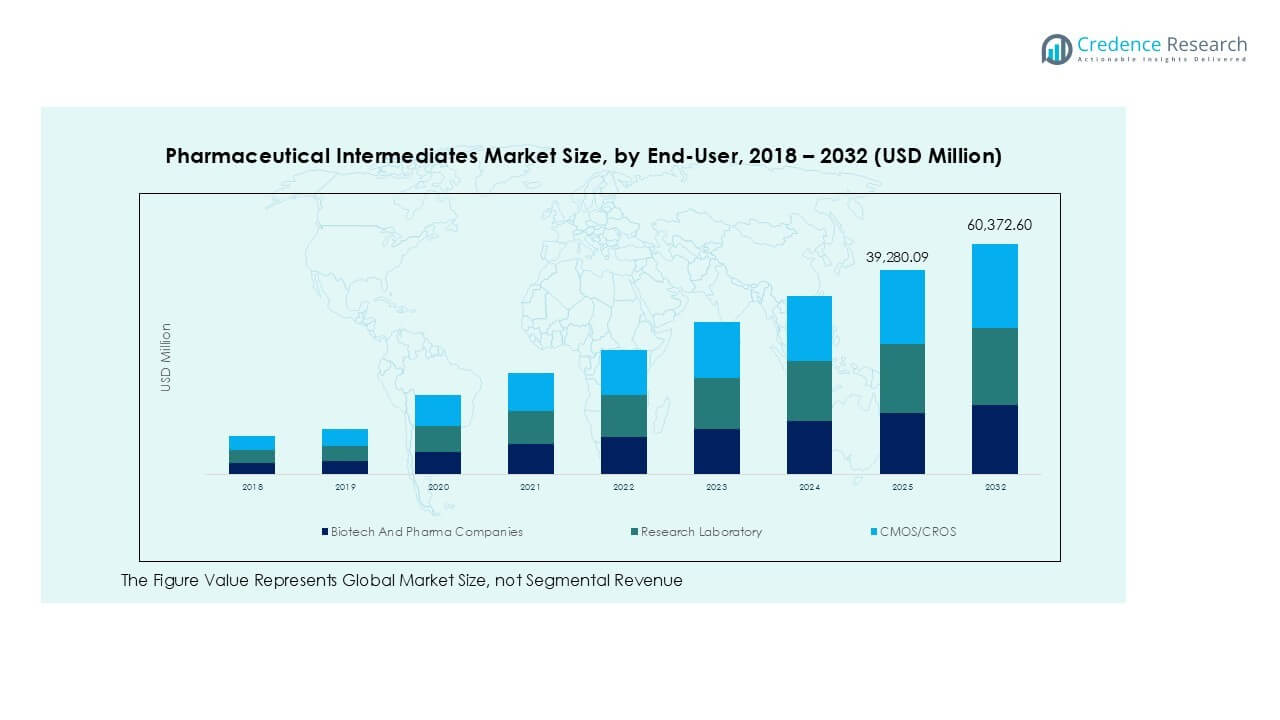
Pharmaceutical Intermediates Market Segmentations:
By Product:
- Chemical Intermediates
- Bulk Drug Intermediates
- Chiral Intermediates
- Achiral Intermediates
- Custom Intermediates
By Application:
- Analgesics
- Anti-Inflammatory Drugs
- Cardiovascular Drugs
- Anti-Diabetic Drugs
- Antimicrobial Drugs
- Anti-Cancer Drugs
- Others
By End-User:
- Biotech and Pharma Companies
- Research Laboratory
- CMOs/CROs
By Category:
- Branded Drug Intermediates
- Generic Drug Intermediates
By Geography
- North America
- U.S.
- Canada
- Mexico
- Europe
- Germany
- France
- U.K.
- Italy
- Spain
- Rest of Europe
- Asia Pacific
- China
- Japan
- India
- South Korea
- South-east Asia
- Rest of Asia Pacific
- Latin America
- Brazil
- Argentina
- Rest of Latin America
- Middle East & Africa
- GCC Countries
- South Africa
- Rest of the Middle East and Africa
Pharmaceutical Intermediates Market Competitive Landscape
The Pharmaceutical Intermediates market features a mix of global chemical conglomerates, API manufacturers, and specialized custom synthesis providers. Leading players such as BASF SE, Merck KGaA, Thermo Fisher Scientific, and Sanofi SA dominate with diversified product portfolios, strong global footprints, and high investments in R&D and regulatory compliance. Companies like Lonza Group and Wuxi AppTec are notable for contract manufacturing and custom intermediates. Asian firms including Aurobindo Pharma and Dishman Carbogen Amcis strengthen their presence through cost-effective bulk production and expanding export reach. The market remains highly competitive, with players focusing on strategic partnerships, capacity expansions, and technology upgrades to meet evolving regulatory and quality standards. Mergers and acquisitions are common, aimed at enhancing production capabilities and geographic reach. Firms increasingly invest in high-purity, chiral, and specialty intermediates to align with growing demand from complex drug formulations. The competitive environment favors companies with scale, regulatory strength, and innovation capabilities.
Key Player Analysis
- BASF SE (Germany)
- Sanofi SA (France)
- Thermo Fisher Scientific Inc. (US)
- Merck KGaA (Germany)
- Dishman Carbogen Amcis Ltd. (India)
- Evonik Industries AG (Germany)
- Arkema Inc. (France)
- Lonza Group AG (Switzerland)
- Wuxi AppTec Co., Ltd. (China)
- Aurobindo Pharma Limited (India)
- Aceto Corporation (US)
- Interchem Corporation (US)
- Midas Pharma GmbH (Germany)
- Arbiom (US)
Recent Developments
- In February 2025, Ardena obtained Catalent’s Somerset, NJ facility, planning a new bioanalytical lab by late 2025.
- In October 2024, Lonza collaborated with major global biopharmaceutical companies for extending their long-term collaboration of manufacturing antibody-drug conjugates.
- In 2024, Jiangsu Run'an Pharmaceutical Co. Ltd., attended CPHI China, an internal conference for expansion of their customer base in the international market.
Report Coverage
The research report offers an in-depth analysis based on Product, Application, End-User, Category and Geography. It details leading market players, providing an overview of their business, product offerings, investments, revenue streams, and key applications. Additionally, the report includes insights into the competitive environment, SWOT analysis, current market trends, as well as the primary drivers and constraints. Furthermore, it discusses various factors that have driven market expansion in recent years. The report also explores market dynamics, regulatory scenarios, and technological advancements that are shaping the industry. It assesses the impact of external factors and global economic changes on market growth. Lastly, it provides strategic recommendations for new entrants and established companies to navigate the complexities of the market.
Future Outlook
- Demand for pharmaceutical intermediates will grow steadily with expanding global drug manufacturing.
- Oncology and chronic disease drug pipelines will drive specialty intermediate consumption.
- Generic drug approvals will continue boosting bulk intermediate requirements across emerging markets.
- Advanced intermediates will gain traction due to rising biologics and targeted therapies.
- Contract manufacturing organizations will expand capabilities to meet outsourcing trends.
- Regulatory compliance and quality certifications will remain critical for market competitiveness.
- Asia Pacific will continue strengthening its role as a global production hub.
- North America will lead in innovation-driven intermediate demand for high-purity compounds.
- Digitalization and process automation will enhance production efficiency and scalability.
- Strategic partnerships and acquisitions will shape competitive positioning and global reach.
Request a Free Sample
Fill in your details and we'll send you a free sample report.
- Sample data tables & charts
- Research methodology
Market Dynamics
Rising Global API Manufacturing Demand
The increasing production of active pharmaceutical ingredients (APIs) worldwide, especially in Asia Pacific, is driving demand for pharmaceutical intermediates. This is fueled by the expansion of generic and branded drug manufacturing and government initiatives to boost domestic pharmaceutical output.
Expansion of Generic and Branded Drug Pipelines
Patent expiries and the growing approval of generic drugs require a consistent supply of intermediates, while the development of complex branded drugs, particularly in oncology and specialty care, increases the need for advanced and custom intermediates.
Growth of Contract Manufacturing and Outsourcing
Pharmaceutical companies are increasingly outsourcing intermediate production to CMOs and CROs to reduce costs and accelerate drug development. This trend is especially strong among small and mid-sized firms and is boosting demand for both bulk and specialty intermediates.
Rising Demand for High-Purity and Specialty Intermediates
The shift toward high-potency, chiral, and specialty drugs, particularly in oncology and rare diseases, is increasing the need for high-purity and technically advanced intermediates. Regulatory requirements for quality and traceability further support this trend.
Regional Manufacturing Localization Initiatives
Government incentives and policies promoting local pharmaceutical production are encouraging the establishment of intermediate manufacturing facilities in emerging regions. This enhances supply chain resilience and creates new growth opportunities, particularly in the Middle East, Latin America, and Africa.
Need a Custom Version of This Report?
Tailor the scope, geography, or segments to your exact requirements.
- Custom geography or segment scope
- Direct access to our analyst team
Frequently Asked Questions
What is the current market size for the Pharmaceutical Intermediates market, and what is its projected size in 2032?
At what Compound Annual Growth Rate is the Pharmaceutical Intermediates market projected to grow between 2024 and 2032?
Which Pharmaceutical Intermediates market segment held the largest share in 2024?
What are the primary factors fueling the growth of the Pharmaceutical Intermediates market?
Who are the leading companies in the Pharmaceutical Intermediates market?
Which region commanded the largest share of the Pharmaceutical Intermediates market in 2024?
Table of Content
Chapter 1 Market Segmentation
- 1.1 Segmentation Framework
- 1.1.1 Product and Service Classification
- 1.1.2 Application and End-Use Classification
- 1.1.3 Technology and Solution Classification
- 1.1.4 Customer and Distribution Channel Classification
- 1.1.5 Geographic Segmentation
- 1.1.6 Market Segment Definitions and Boundaries
- 1.2 By Product
- 1.2.1 Chemical Intermediates
- 1.2.2 Bulk Drug Intermediates
- 1.2.3 Chiral Intermediates
- 1.2.4 Achiral Intermediates
- 1.2.5 Custom Intermediates
- 1.3 By Category
- 1.3.1 Branded Drug Intermediates
- 1.3.2 Generic Drug Intermediates
- 1.4 By End-User
- 1.4.1 Biotech and Pharma Companies
- 1.4.2 Research Laboratory
- 1.4.3 CMOs/CROs
- 1.5 By Application
- 1.5.1 Analgesics
- 1.5.2 Anti-Inflammatory Drugs
- 1.5.3 Cardiovascular Drugs
- 1.5.4 Anti-Diabetic Drugs
- 1.5.5 Antimicrobial Drugs
- 1.5.6 Anti-Cancer Drugs
- 1.5.7 Others
Chapter 2 Introduction
- 2.1 Report Objectives and Scope
- 2.2 Product Definition and Industry Terminology
- 2.3 Market Inclusions and Exclusions
- 2.4 Research Process
- 2.4.1 Primary Research and Expert Interviews
- 2.4.2 Secondary Research and Source Review
- 2.4.3 Top-Down and Bottom-Up Estimation
- 2.4.4 Data Triangulation and Verification
- 2.5 Market Size Measurement Basis
- 2.5.1 2024: USD 37,009.08 million → 2032: USD 60,372.60 million
- 2.6 Historical and Forecast Reference Periods
- 2.6.1 Base Year: 2024
- 2.6.2 Forecast Period: 2024-2032
- 2.7 Research Assumptions and Limitations
Chapter 3 Executive Summary
- 3.1 Market Snapshot and Key Findings
- 3.2 Base-Year Market Size, 2024
- 3.3 Forecast Market Size, 2032
- 3.4 Revenue and Volume Growth Outlook
- 3.5 Key Demand and Supply Indicators
- 3.6 Leading Market Segments
- 3.7 Fastest-Growing Market Opportunities
- 3.8 Regional Performance Highlights
- 3.9 Technology and Industry Transformation
- 3.10 Competitive Landscape Summary
- 3.11 Analyst View and Strategic Implications
Chapter 4 Global Pharmaceutical Intermediates Market Trends and Developments
- 4.1 Historical Industry Development
- 4.2 Recent Market Trends and Developments
- 4.3 Demand and Customer Behavior Trends
- 4.4 Technology and Product Innovation
- 4.5 Artificial Intelligence, Automation and Digitalization
- 4.6 Local Manufacturing and Supply Chain Realignment
- 4.7 Industry Partnerships, Mergers and Acquisitions
- 4.8 Sustainability and Circular Economy Developments
- 4.9 Government and Private Sector Investment Trends
- 4.10 Emerging Business Models and Commercialization
- 4.11 Industry Developments and Announcements
Chapter 5 Global Pharmaceutical Intermediates Market Production, Supply and Demand Analysis
- 5.1 Demand Trend and Consumption Analysis
- 5.2 Demand Forecast, 2024-2032
- 5.3 Production and Output Trend
- 5.4 Production and Output Forecast, 2024-2032
- 5.5 Installed Capacity and Capacity Utilization
- 5.6 Company-Wise Production Plants and Statistics
- 5.6.1 Installed Production Capacity
- 5.6.2 Actual Production
- 5.6.3 Planned Capacity and Expansion Targets
- 5.7 Supply Chain Structure and Procurement Trends
- 5.8 Supply-Demand Gap and Bottlenecks
- 5.9 Import Dependence and Sourcing Structure
- 5.10 Contract Manufacturing and Outsourcing
- 5.11 Regional Supply and Demand Concentration
Chapter 6 Global Pharmaceutical Intermediates Market Pricing Analysis
- 6.1 Pricing Structure and Measurement
- 6.2 Historical Pricing Trends
- 6.3 Pricing Outlook, 2024-2032
- 6.4 Average Selling Price and Unit Economics
- 6.5 Pricing by Product and Market Segment
- 6.6 Geographic Pricing Differences
- 6.7 Key Input, Energy, Labor and Logistics Costs
- 6.8 Contract Pricing and Purchasing Models
- 6.9 Pricing Sensitivity and Competitive Positioning
- 6.10 Price, Margin and Profitability Implications
Chapter 7 Global Pharmaceutical Intermediates Market Dynamics
- 7.1 Market Growth Drivers
- 7.1.1 Demand-Side Drivers
- 7.1.2 Technology and Innovation Drivers
- 7.1.3 Infrastructure and Investment Drivers
- 7.1.4 Regulatory and Policy Drivers
- 7.2 Market Restraints
- 7.2.1 Cost and Affordability Constraints
- 7.2.2 Technology and Adoption Barriers
- 7.2.3 Supply Chain and Operational Constraints
- 7.3 Market Challenges
- 7.3.1 Competitive Pressure and Margin Erosion
- 7.3.2 Skills, Infrastructure and Implementation Gaps
- 7.4 Emerging Market Opportunities
- 7.5 Market Dynamics Impact and Time-Horizon Assessment
Chapter 8 Global Pharmaceutical Intermediates Value Chain Analysis
- 8.1 Industry Value Chain Overview
- 8.2 Upstream Suppliers and Critical Inputs
- 8.3 Technology and Component Providers
- 8.4 Manufacturing or Service Delivery
- 8.5 Distribution, Channel Partners and Integrators
- 8.6 Downstream Applications and End Users
- 8.7 Value Addition and Profit Pools
- 8.8 Vertical Integration and Outsourcing
- 8.9 Supplier Concentration and Risk
- 8.10 Supply Chain Localization and Resilience
Chapter 9 Global Pharmaceutical Intermediates Market Regulations and Policies
- 9.1 Relevant Laws, Standards and Compliance Frameworks
- 9.2 Product, Service, Safety and Quality Requirements
- 9.3 Government Policies, Incentives and Subsidies
- 9.4 Imports, Exports and Trade Barriers
- 9.5 Public Procurement and Local Content Requirements
- 9.6 Environmental and Sustainability Compliance
- 9.7 Upcoming Policy Changes and Market Implications
Chapter 10 Global Pharmaceutical Intermediates Market Hotspots and Opportunities
- 10.1 Market Opportunity Mapping and Growth Hotspots
- 10.2 High-Growth Applications and Customer Groups
- 10.3 Underserved Markets and White-Space Opportunities
- 10.4 Emerging Technology and Product Opportunities
- 10.5 New Capacity and Investment Hotspots
- 10.6 Market Entry and Expansion Opportunities
- 10.7 Distribution and Partnership Opportunities
- 10.8 Near-Term and Long-Term Commercial Potential
- 10.9 Opportunity Attractiveness and Execution Risks
Chapter 11 Global Pharmaceutical Intermediates Market Outlook, 2024-2032
- 11.1 Market Size and Analysis
- 11.1.1 Revenue (Market Measurement: 2024: USD 37,009.08 million → 2032: USD 60,372.60 million)
- 11.1.2 Market Volume and Quantity Sold
- 11.1.3 Historical Market Size
- 11.1.4 Base-Year Market Size, 2024
- 11.2 Market Forecast, 2024-2032
- 11.2.1 Revenue Forecast to 2032
- 11.2.2 Volume Forecast to 2032
- 11.2.3 CAGR and Year-on-Year Growth
- 11.2.4 Incremental Revenue Opportunity
- 11.3 Forecast Assumptions and Scenario Analysis
- 11.3.1 Base-Case Forecast
- 11.3.2 Optimistic and Conservative Scenarios
- 11.3.3 Technology, Pricing and Policy Sensitivities
- 11.4 Market Attractiveness and Growth Outlook
Chapter 12 Global Pharmaceutical Intermediates Market Segmentation and Outlook
- 12.1 Segmentation Summary and Market Shares, 2024
- 12.2 Largest and Fastest-Growing Segments
- 12.3 By Product - Market Size and Forecast, 2024-2032
- 12.3.1 Segment Definition and Scope
- 12.3.2 Historical Market Size
- 12.3.3 Revenue Forecast, 2024-2032
- 12.3.4 Volume Forecast, 2024-2032
- 12.3.5 Base-Year Market Share, 2024
- 12.3.6 Segment CAGR and Growth Drivers
- 12.3.7 Subsegment Market Size and Forecast
- 12.3.7.1 Chemical Intermediates
- 12.3.7.2 Bulk Drug Intermediates
- 12.3.7.3 Chiral Intermediates
- 12.3.7.4 Achiral Intermediates
- 12.3.7.5 Custom Intermediates
- 12.3.8 Subsegment Pricing and Adoption Trends
- 12.3.9 Leading Suppliers and Competition
- 12.3.10 Regional Demand and Opportunities
- 12.4 By Category - Market Size and Forecast, 2024-2032
- 12.4.1 Segment Definition and Scope
- 12.4.2 Historical Market Size
- 12.4.3 Revenue Forecast, 2024-2032
- 12.4.4 Volume Forecast, 2024-2032
- 12.4.5 Base-Year Market Share, 2024
- 12.4.6 Segment CAGR and Growth Drivers
- 12.4.7 Subsegment Market Size and Forecast
- 12.4.7.1 Branded Drug Intermediates
- 12.4.7.2 Generic Drug Intermediates
- 12.4.8 Subsegment Pricing and Adoption Trends
- 12.4.9 Leading Suppliers and Competition
- 12.4.10 Regional Demand and Opportunities
- 12.5 By End-User - Market Size and Forecast, 2024-2032
- 12.5.1 Segment Definition and Scope
- 12.5.2 Historical Market Size
- 12.5.3 Revenue Forecast, 2024-2032
- 12.5.4 Volume Forecast, 2024-2032
- 12.5.5 Base-Year Market Share, 2024
- 12.5.6 Segment CAGR and Growth Drivers
- 12.5.7 Subsegment Market Size and Forecast
- 12.5.7.1 Biotech and Pharma Companies
- 12.5.7.2 Research Laboratory
- 12.5.7.3 CMOs/CROs
- 12.5.8 Subsegment Pricing and Adoption Trends
- 12.5.9 Leading Suppliers and Competition
- 12.5.10 Regional Demand and Opportunities
- 12.6 By Application - Market Size and Forecast, 2024-2032
- 12.6.1 Segment Definition and Scope
- 12.6.2 Historical Market Size
- 12.6.3 Revenue Forecast, 2024-2032
- 12.6.4 Volume Forecast, 2024-2032
- 12.6.5 Base-Year Market Share, 2024
- 12.6.6 Segment CAGR and Growth Drivers
- 12.6.7 Subsegment Market Size and Forecast
- 12.6.7.1 Analgesics
- 12.6.7.2 Anti-Inflammatory Drugs
- 12.6.7.3 Cardiovascular Drugs
- 12.6.7.4 Anti-Diabetic Drugs
- 12.6.7.5 Antimicrobial Drugs
- 12.6.7.6 Anti-Cancer Drugs
- 12.6.7.7 Others
- 12.6.8 Subsegment Pricing and Adoption Trends
- 12.6.9 Leading Suppliers and Competition
- 12.6.10 Regional Demand and Opportunities
- 12.7 Segment Growth Comparison
- 12.8 Segment Attractiveness and Priority Matrix
Chapter 13 Global Pharmaceutical Intermediates End-Use and Application Market Outlook
- 13.1 End-Use Industry and Customer Demand Structure
- 13.2 Leading Applications and Customer Groups
- 13.3 End-Use Market Size, Share and Forecast
- 13.4 Major End-Use Industry Deep Dives
- 13.4.1 Customer Requirements and Use Cases
- 13.4.2 Demand and Replacement Cycles
- 13.4.3 Technical and Regulatory Considerations
- 13.4.4 Purchasing and Procurement Models
- 13.4.5 Leading Vendors and Distribution Channels
- 13.4.6 Forecast and Commercial Opportunities
- 13.5 Emerging Applications and Cross-Segment Demand
- 13.6 End-Use Industry Investment Priorities
Chapter 14 Global Pharmaceutical Intermediates Geographic Market Outlook, 2024-2032
- 14.1 Regional Market Size and Share, 2024
- 14.2 Regional Market Forecast, 2024-2032
- 14.3 Regional Pricing, Production and Demand Differences
- 14.4 North America
- 14.4.1 United States
- 14.4.2 Canada
- 14.4.3 Mexico
- 14.5 Europe
- 14.5.1 Germany
- 14.5.2 France
- 14.5.3 Italy
- 14.5.4 United Kingdom
- 14.5.5 Spain
- 14.5.6 Poland
- 14.5.7 Russia
- 14.5.8 Netherlands
- 14.5.9 Belgium
- 14.5.10 Sweden
- 14.5.11 Denmark
- 14.5.12 Norway
- 14.5.13 Rest of Europe
- 14.6 Asia Pacific
- 14.6.1 China
- 14.6.2 India
- 14.6.3 Japan
- 14.6.4 South Korea
- 14.6.5 Thailand
- 14.6.6 Indonesia
- 14.6.7 Vietnam
- 14.6.8 Malaysia
- 14.6.9 Australia
- 14.6.10 Rest of Asia Pacific
- 14.7 Latin America
- 14.7.1 Brazil
- 14.7.2 Argentina
- 14.7.3 Colombia
- 14.7.4 Chile
- 14.7.5 Rest of Latin America
- 14.8 Middle East
- 14.8.1 Saudi Arabia
- 14.8.2 United Arab Emirates
- 14.8.3 Turkey
- 14.8.4 Israel
- 14.8.5 Iran
- 14.8.6 Rest of the Middle East
- 14.9 Africa
- 14.9.1 South Africa
- 14.9.2 Egypt
- 14.9.3 Nigeria
- 14.9.4 Morocco
- 14.9.5 Rest of Africa
- 14.10 Regional Investment, Policy and Supply Chain Differences
- 14.11 Regional Competitive Landscape
- 14.12 Geographic Growth Hotspots
Chapter 15 Global Pharmaceutical Intermediates Technology, Innovation and Sustainability Outlook
- 15.1 Technology Landscape and Maturity
- 15.2 Product, Process and Service Innovation
- 15.3 AI, Automation and Digital Tools in the Industry
- 15.4 Technology Adoption and Performance Benchmarking
- 15.5 Innovation Pipeline and R&D Investment
- 15.6 Patent and Intellectual Property Trends
- 15.7 Energy Efficiency and Resource Management
- 15.8 Sustainability, Recycling and Circularity
- 15.9 Technology Roadmap, 2024-2032
- 15.10 Risks of Obsolescence and Technology Substitution
Chapter 16 Global Pharmaceutical Intermediates Market Key Strategic Imperatives
- 16.1 Growth and Market Entry Priorities
- 16.2 High-Return Products and Segments
- 16.3 Pricing, Profitability and Cost Optimization
- 16.4 Technology Investment and Product Differentiation
- 16.5 Supply Chain Localization and Resilience
- 16.6 Distribution and Customer Acquisition
- 16.7 Partnership, Acquisition and Capacity Strategy
- 16.8 Regional Expansion Priorities
- 16.9 Short-, Medium- and Long-Term Actions
Chapter 17 Competition Outlook
- 17.1 Industry Competition Characteristics
- 17.2 Market Structure and Concentration
- 17.3 Market Share and Competitive Positioning, 2024
- 17.4 Company-Wise Revenue and Product Benchmarking
- 17.5 Production and Service Capacity Benchmarking
- 17.6 Technology, Pricing and Differentiation
- 17.7 Regional Footprint and Distribution Strength
- 17.8 Mergers, Acquisitions and Strategic Alliances
- 17.9 New Entrants and Competitive Threats
- 17.10 Porter's Five Forces and Industry Attractiveness
- 17.11 Competitive Outlook, 2024-2032
Chapter 18 Company Profiles
- 18.1 Company Coverage and Selection Criteria
- 18.2 BASF SE
- 18.2.1 Business Description
- 18.2.2 Company Ownership and Geographic Presence
- 18.2.3 Product and Service Portfolio
- 18.2.4 Manufacturing and Operating Footprint
- 18.2.5 Production Capacity and Expansion Plans
- 18.2.6 Financial Performance and Investment
- 18.2.7 Market Share and Competitive Position
- 18.2.8 Technology and Innovation Capabilities
- 18.2.9 Strategic Alliances or Partnerships
- 18.2.10 Recent Developments
- 18.2.11 Growth Strategy and Outlook
- 18.3 Sanofi SA
- 18.4 Thermo Fisher Scientific Inc.
- 18.5 Merck KGaA
- 18.6 Lonza Group AG
- 18.7 Aurobindo Pharma Limited
- 18.8 Wuxi AppTec Co., Ltd.
- 18.9 Dishman Carbogen Amcis Ltd.
- 18.10 Evonik Industries AG
- 18.11 Aceto Corporation
- 18.12 Other Relevant Market Participants
Note: Every listed company is profiled on the structure shown under the first company. The company list is preliminary and may change based on research findings, market developments, data availability and client requirements.
Chapter 19 Disclaimer
- 19.1 Research and Forecast Disclaimer
- 19.2 Data Source and Estimation Limitations
Note: The depth of individual sections depends on data availability for this market. Volume, capacity, trade and other unit-based metrics are included where applicable.