Analytical Standards Market Overview:
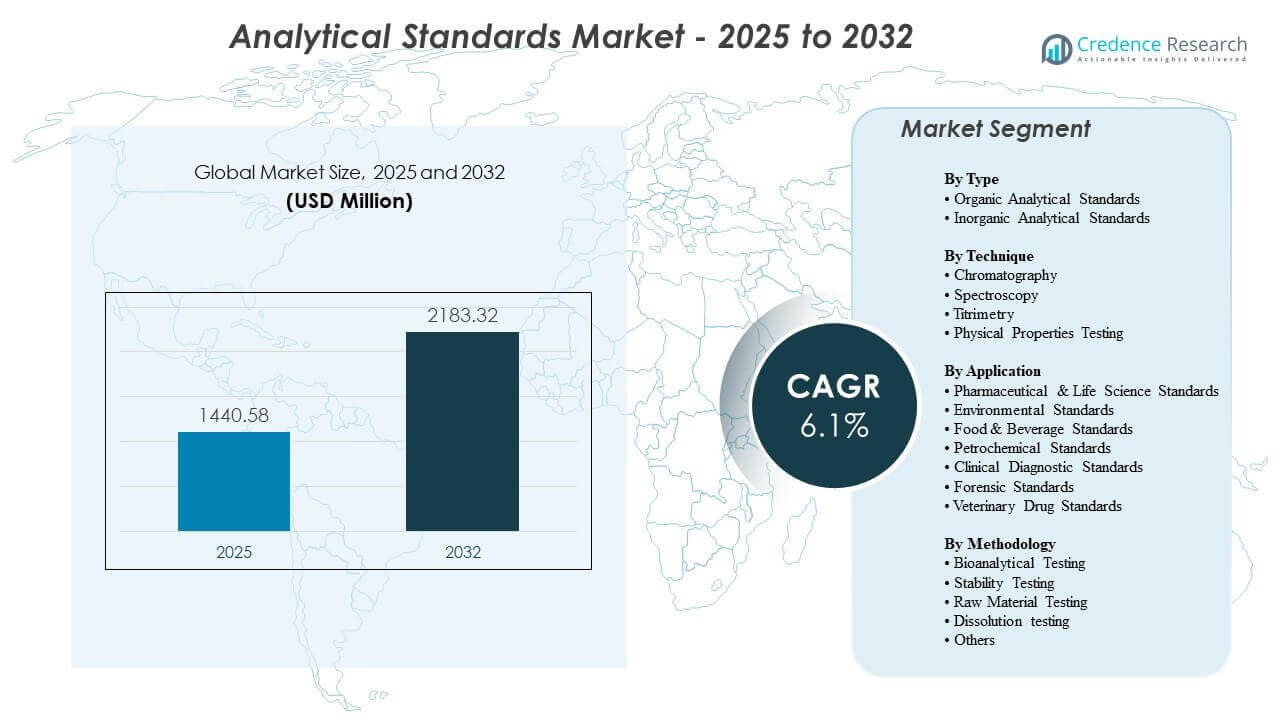
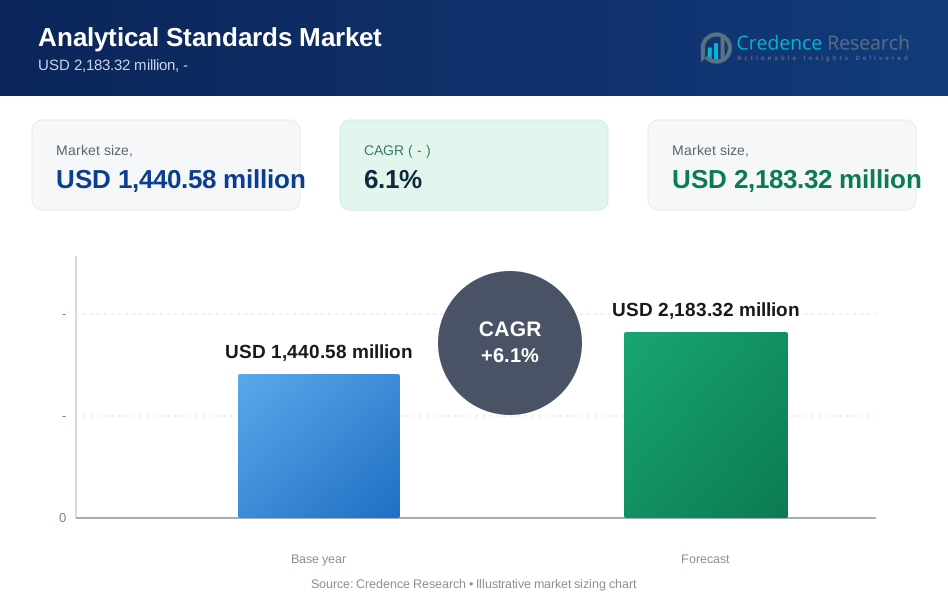
The Analytical Standards Market is projected to grow from USD 1,440.58 million in 2025 to an estimated USD 2,183.32 million by 2032, with a compound annual growth rate (CAGR) of 6.1% from 2025 to 2032.
| REPORT ATTRIBUTE | DETAILS |
|---|---|
| Historical Period | 2020-2023 |
| Base Year | 2024 |
| Forecast Period | 2025-2032 |
| Analytical Standards Market Size 2025 | USD 1,440.58 million |
| Analytical Standards Market, CAGR | 6.1% |
| Analytical Standards Market Size 2032 | USD 2,183.32 million |
Market growth is driven by increasing regulatory scrutiny and the need for validated analytical methods across highly regulated sectors. Expanding pharmaceutical pipelines, growth in biologics, and rising generic drug production push laboratories to use certified reference materials for impurity testing, stability studies, and assay verification. Advancements in chromatography, spectroscopy, and mass spectrometry expand the use of complex calibration standards to achieve trace-level detection. Environmental monitoring programs and food safety rules further strengthen demand for accurate and traceable analytical standards.
North America leads the Analytical Standards Market due to strong research activity, strict compliance requirements, and widespread adoption of advanced analytical technologies. Europe follows with robust environmental regulations, structured pharmaceutical quality frameworks, and well-established laboratory networks. Asia Pacific emerges as the fastest-growing region, driven by expanding pharmaceutical manufacturing in China and India and rising investment in food safety and environmental testing. Latin America and the Middle East show steady progress as regulatory frameworks improve and laboratory infrastructure expands.
Analytical Standards Market Insights:
- The Analytical Standards Market is projected to grow from USD 1,440.58 million in 2025 to USD 2,183.32 million by 2032, reflecting a 6.1% CAGR, driven by rising adoption of certified reference materials across regulated industries.
- Strong market momentum comes from regulatory pressure across pharmaceuticals, food safety, and environmental testing, which increases the need for validated analytical methods and high-purity reference standards.
- Market restraints include high production costs for ultra-pure standards, complex certification processes, and logistical challenges linked to global supply chain dependencies.
- North America leads the market due to stringent regulatory requirements and advanced laboratory ecosystems, while Europe maintains strong demand through structured compliance frameworks.
- Asia Pacific is the fastest-growing region, driven by expanding pharmaceutical manufacturing, increasing environmental surveillance, and rising investment in laboratory modernization.
Analytical Standards Market Drivers
Rising Regulatory Enforcement Across Pharmaceuticals, Food Safety, And Environmental Testing Frameworks
Strict regulatory frameworks drive demand for certified reference materials across global laboratories. Drug approval authorities require validated analytical methods before product commercialization. Food safety agencies enforce residue and contaminant limits in processed products. Environmental bodies mandate trace-level pollutant detection in water and soil samples. Laboratories rely on high-purity standards to meet compliance audits. Quality assurance teams prioritize traceability and documentation in every test cycle. The Analytical Standards Market benefits from stronger inspection regimes across developed economies. Expanding compliance mandates push laboratories to upgrade calibration protocols and certified materials.
- For instance, SPEX CertiPrep’s EPA-approved inorganic CRMs support laboratories in meeting Method 200.7 and 200.8 requirements for over 35 regulated metals.
Expansion Of Pharmaceutical Research And Complex Drug Development Pipelines
Biopharma companies expand research pipelines that require impurity profiling and stability studies. Advanced biologics and cell therapies demand precise analytical validation tools. Contract research organizations increase procurement of multi-component standards for method validation. Clinical trial growth supports routine analytical verification across batches. Laboratories adopt pharmacopeial standards for accurate quantification of active ingredients. Rising generic drug production also strengthens routine testing demand. Precision analytics support product consistency and safety validation. Investment in research facilities sustains recurring purchases of reference compounds.
- For instance, Cerilliant supplies more than 400 isotopically labeled standards used globally for pharmacokinetic and toxicology workflows.
Technological Advancements In Chromatography And Spectrometry Platforms
Modern analytical instruments require compatible and high-grade reference materials. High-performance liquid chromatography systems depend on validated calibration standards. Mass spectrometry platforms demand ultra-pure compounds for trace analysis. Multi-residue testing methods require mixed and matrix-matched standards. Instrument manufacturers recommend certified materials for optimal performance. Automation in laboratories strengthens demand for consistent calibration products. Laboratories seek improved reproducibility in quantitative results. Technical upgrades increase dependence on reliable analytical inputs.
Growth In Food Processing, Chemical Manufacturing, And Industrial Quality Control Programs
Food processors adopt strict internal testing to meet export standards. Chemical manufacturers rely on impurity detection to ensure batch uniformity. Industrial labs perform routine calibration checks to avoid production losses. Toxicology studies depend on accurate reference compounds. Cross-border trade increases scrutiny on product composition. Quality control teams demand repeatable and verifiable results. The Analytical Standards Market gains momentum through industrial compliance initiatives. Corporate governance policies reinforce structured analytical verification practices.
Analytical Standards Market Trends
Shift Toward Multi-Component And Custom Analytical Standard Solutions For Complex Testing Needs
Laboratories increasingly request multi-analyte mixtures tailored to specific applications. Custom standards reduce preparation time and improve workflow efficiency. Vendors expand portfolios with matrix-specific and industry-focused kits. Research labs seek flexible packaging formats to suit batch sizes. Small-volume standards gain preference for niche applications. The Analytical Standards Market reflects a gradual move toward specialized product offerings. Suppliers focus on faster delivery timelines for custom formulations. Personalized testing protocols shape procurement strategies across sectors.
- For instance, Restek Corporation expanded its custom reference standard program to offer mixtures containing over 100 individual analytes in a single ampoule, maintaining a shelf-life stability of 24 months for complex pesticide residues.
Integration Of Digital Traceability And Blockchain-Based Certification Systems
Manufacturers embed digital certificates within product documentation systems. Blockchain-backed verification enhances transparency and authenticity assurance. Laboratories prefer electronic access to compliance data. QR codes on packaging allow quick validation of product origin. Digital documentation reduces audit preparation time. Global supply chains adopt secure data exchange platforms. Traceability systems strengthen trust between suppliers and end users. Technology-driven transparency becomes a core differentiator in supplier selection.
- For instance, Merck KGaA expanded its SmartChemicals digital ecosystem by integrating QR-enabled packaging that allows instant access to Certificates of Analysis through a cloud-based platform, improving documentation accuracy and supporting streamlined laboratory workflows.
Rising Demand For Sustainable And Environmentally Responsible Reference Materials
Manufacturers introduce eco-friendly packaging to reduce waste. Laboratories favor reduced solvent formulations in calibration products. Suppliers adopt energy-efficient production facilities. Biodegradable labeling materials gain traction in regulated markets. Sustainability metrics influence vendor contracts and tenders. Green procurement policies shape purchasing decisions. Corporate sustainability targets drive innovation in product development. Environmental responsibility becomes a strategic theme across the value chain.
Expansion Of E-Commerce And Direct Procurement Channels For Laboratory Supplies
Online procurement platforms simplify ordering processes for laboratories. Digital catalogs provide instant access to technical specifications. Automated inventory systems trigger repeat purchases of key standards. Direct sales models shorten delivery cycles. Smaller laboratories gain broader supplier access through online channels. Subscription-based replenishment models support routine calibration needs. Data analytics tools track purchasing trends and usage cycles. Digital sales infrastructure enhances supplier reach and customer engagement.
Analytical Standards Market Challenges Analysis
High Production Costs And Complex Certification Processes For High-Purity Standards
Manufacturing ultra-pure reference materials requires advanced purification systems. Quality validation involves rigorous batch testing and documentation. Certification demands compliance with global pharmacopeial guidelines. Production cycles remain lengthy for complex compounds. Limited raw material availability raises input costs. Small-scale production reduces economies of scale. Laboratories expect competitive pricing despite strict standards. The Analytical Standards Market faces pressure to balance cost efficiency with uncompromised quality.
Supply Chain Disruptions And Dependence On Specialized Chemical Inputs
Reference material production relies on specialized precursor chemicals. Geopolitical tensions can restrict cross-border material movement. Transportation delays impact timely laboratory supply. Limited global suppliers create sourcing risks. Cold chain logistics increase operational complexity for certain compounds. Regulatory approvals vary across countries, complicating distribution. Stock shortages disrupt laboratory workflows and research timelines. Firms must diversify sourcing strategies to maintain supply stability.
Market Opportunities
Expansion Of Analytical Testing In Emerging Economies With Growing Industrial Infrastructure
Developing countries expand pharmaceutical and food processing capacity. National regulators strengthen laboratory accreditation systems. Private diagnostic chains invest in advanced analytical platforms. Industrial export growth increases compliance testing demand. Local research institutes procure certified standards for quality assurance. International trade agreements encourage stricter product validation. The Analytical Standards Market can capture growth through regional distribution partnerships. Capacity-building initiatives support wider adoption of certified materials.
Innovation In Biopharmaceutical And Advanced Material Testing Applications
Cell and gene therapy research requires precise impurity standards. Nanomaterial testing opens demand for novel calibration solutions. Biologic drug analysis requires peptide and protein reference materials. Personalized medicine supports specialized compound development. Advanced polymer testing expands industrial laboratory needs. Research collaborations drive demand for custom-certified materials. Suppliers can invest in high-value specialty segments. Innovation-focused industries create long-term revenue streams for specialized analytical products.
Analytical Standards Market Segmentation Analysis:
By Type
Organic analytical standards hold strong demand due to their role in pharmaceutical impurity profiling, metabolite studies, and complex mixture identification. Laboratories use these standards to support validated chromatographic and spectrometric methods. High-purity organic compounds strengthen data reliability in drug development and life-science research. Inorganic analytical standards gain traction across environmental, water, and food testing due to strict trace-element monitoring rules. These standards support regulatory screening of metals, minerals, and contaminants. Industries depend on consistent calibration materials to meet compliance goals. The Analytical Standards Market benefits from wide adoption across regulated sectors.
- For instance, Merck KGaA (Supelco) manufactures a broad range of ISO 17034–accredited organic certified reference materials, many exceeding 99.5% purity to support pharmaceutical impurity profiling and regulatory validation.
By Technique
Chromatography remains a core technique due to its precision in quantifying multi-component samples. HPLC leads demand across pharmaceutical and food testing labs. GC supports volatile compound analysis in environmental and petrochemical workflows. LC–MS gains share due to its sensitivity for trace-level detection. Spectroscopy techniques expand through broad instrument adoption. Atomic absorption and UV/Vis methods remain essential for routine elemental testing. IR and NMR deliver structural elucidation across research labs. Titrimetry and physical properties testing support quality checks across chemicals and industrial materials.
By Application
Pharmaceutical and life-science standards dominate demand due to expanding drug pipelines and regulatory expectations. Environmental standards support pollution monitoring and water-quality surveillance. Food and beverage standards gain use in contaminant, additive, and nutritional testing. Petrochemical standards ensure process stability and fuel-quality verification. Clinical diagnostic standards strengthen assay accuracy in hospital and reference labs. Forensic standards guide toxicology and evidence validation. Veterinary drug standards support residue testing in livestock and food-animal products. Each segment reinforces the Analytical Standards Market through recurring laboratory needs.
By Methodology
Bioanalytical testing drives strong use of certified reference materials in drug metabolism and pharmacokinetic studies. Stability testing relies on high-purity standards to track degradation pathways. Raw material testing strengthens quality control in pharmaceuticals, chemicals, and food manufacturing. Dissolution testing supports drug-release analysis and regulatory submissions. Other methodologies include validation, proficiency testing, and instrument calibration. Laboratories integrate these workflows into routine operations. Regulatory oversight pushes adoption of method-specific standards. The Analytical Standards Market gains consistent growth through widespread application across sectors.
- For instance, LGC Standards expanded its VHG® portfolio with multi-element oil standards containing 21 wear-metal analytes designed for ICP-based lubricant testing, with products manufactured under strict quality systems and traceability linked to relevant NIST SRMs such as SRM 1085b.
Analytical Standards Market Segmentation:
By Type
- Organic Analytical Standards
- Inorganic Analytical Standards
By Technique
- Chromatography
- HPLC
- GC
- LC–MS
- Spectroscopy
- Atomic Absorption
- Mass Spectrometry
- IR
- NMR
- UV/Vis
- Titrimetry
- Physical Properties Testing
By Application
- Pharmaceutical & Life Science Standards
- Environmental Standards
- Food & Beverage Standards
- Petrochemical Standards
- Clinical Diagnostic Standards
- Forensic Standards
- Veterinary Drug Standards
By Methodology
- Bioanalytical Testing
- Stability Testing
- Raw Material Testing
- Dissolution testing
- Others
By Region
- North America
- U.S.
- Canada
- Mexico
- Europe
- Germany
- France
- U.K.
- Italy
- Spain
- Rest of Europe
- Asia Pacific
- China
- Japan
- India
- South Korea
- South-east Asia
- Rest of Asia Pacific
- Latin America
- Brazil
- Argentina
- Rest of Latin America
- Middle East & Africa
- GCC Countries
- South Africa
- Rest of the Middle East and Africa
Regional Analysis:
North America holds the largest share of the Analytical Standards Market due to strong pharmaceutical research activity, strict quality regulations, and broad adoption of advanced analytical technologies. Laboratories in the United States drive recurring demand for certified standards across drug development, environmental surveillance, and food testing. The region benefits from well-established regulatory bodies and frequent inspection cycles. It supports high procurement volumes across industrial, clinical, and academic labs. Vendor presence also strengthens supply and distribution reliability. The Analytical Standards Market gains sustained growth in this region through continuous compliance requirements and strong R&D investments.
Europe represents the second-largest regional share, supported by strict environmental, chemical, and food safety directives. Countries like Germany, the United Kingdom, and France maintain strong laboratory ecosystems and high testing workloads. Regulatory frameworks such as REACH strengthen routine adoption of inorganic and organic standards. Pharmaceutical manufacturing and biotechnology clusters across the region expand demand for high-purity calibration materials. Research institutions prioritize advanced chromatographic and spectroscopic validation. It benefits from stable procurement patterns from public and private laboratories. Market share remains steady due to mature testing capabilities.
Asia Pacific shows the fastest growth and continues to expand its overall market share each year. China, India, and Japan lead regional consumption through rapid manufacturing growth and laboratory modernization. Pharmaceutical production and contract research outsourcing strengthen multi-industry adoption of certified reference materials. Food safety monitoring increases in scope with rising export requirements. Environmental testing expands due to stricter pollution controls. It gains momentum from rising investments in clinical diagnostics and industrial quality control workflows. Regional share continues to rise due to strong sectoral diversification.
Key Player Analysis:
- Merck KGaA
- Sigma-Aldrich (Merck)
- Thermo Fisher Scientific
- Agilent Technologies
- Waters Corporation
- LGC Group
- Restek Corporation
- PerkinElmer Inc.
- SPEX CertiPrep
- AccuStandard
- Mallinckrodt Pharmaceuticals
- GFS Chemicals
- Shimadzu Corporation
- Chiron AS
- Cytiva (Danaher)
Competitive Analysis:
The Analytical Standards Market is highly competitive, with global companies focusing on purity levels, certification accuracy, and validated documentation to strengthen market presence. Key players expand portfolios to cover multi-component standards, matrix-matched solutions, and pharmacopeial references. Competition centers on quality assurance, faster lead times, and strong regulatory alignment. Companies invest in digital traceability systems to support audit readiness for end users. It benefits from collaborations with pharmaceutical and environmental laboratories that require long-term supply agreements. Vendors enhance production capacity to support rising demand from emerging regions. Strategic acquisitions and product innovations shape competitive positioning and help companies differentiate through specialized and high-value analytical standards.
Recent Developments:
- In September 2025, Sigma-Aldrich (Merck) extended its strategic partnership with Siemens through a new memorandum of understanding to accelerate AI and data-driven drug discovery, development, and digital transformation in life sciences, including analytics for standards validation.
- In June 2025, Thermo Fisher Scientific launched the Orbitrap Astral Zoom and Orbitrap Excedion Pro mass spectrometry systems, which improve scan speed by 35% and throughput by 40%.
Report Coverage:
The research report offers an in-depth analysis based on Type, Technique, Application, and Methodology. It details leading market players, providing an overview of their business, product offerings, investments, revenue streams, and key applications. Additionally, the report includes insights into the competitive environment, SWOT analysis, current market trends, as well as the primary drivers and constraints. Furthermore, it discusses various factors that have driven market expansion in recent years. The report also explores market dynamics, regulatory scenarios, and technological advancements that are shaping the industry. It assesses the impact of external factors and global economic changes on market growth. Lastly, it provides strategic recommendations for new entrants and established companies to navigate the complexities of the market.
Future Outlook:
- The Analytical Standards Market will strengthen through rising global demand for validated testing across pharmaceuticals, food, and environmental laboratories.
- Regulatory pressure will push laboratories to adopt certified reference materials to support method accuracy and traceability.
- Growth in biologics, advanced therapies, and complex drug formulations will expand the need for specialized organic standards.
- Environmental monitoring programs will increase consumption of inorganic standards for pollutant and trace-metal detection.
- Chromatography and mass spectrometry advancements will drive higher adoption of multi-component calibration mixtures.
- Digital certification and blockchain-enabled traceability will enhance supply transparency and audit readiness.
- Asia Pacific will remain the fastest-growing region due to expanding manufacturing and rising quality-control investments.
- Custom analytical standards will gain demand from research institutions with unique testing requirements.
- Food safety modernization and export compliance rules will broaden the use of certified standards.
- Industry collaborations and capacity expansions will support long-term supply stability for the Analytical Standards Market.
Request a Free Sample
Fill in your details and we'll send you a free sample report.
- Sample data tables & charts
- Research methodology
Need a Custom Version of This Report?
Tailor the scope, geography, or segments to your exact requirements.
- Custom geography or segment scope
- Direct access to our analyst team
Frequently Asked Questions
What is the current market size for Analytical Standards Market, and what is its projected size in 2032?
At what Compound Annual Growth Rate is the Analytical Standards Market projected to grow between 2025 and 2032?
Which Analytical Standards Market segment held the largest share in 2025?
What are the primary factors fueling the growth of the Analytical Standards Market?
Who are the leading companies in the Analytical Standards Market?
Which region commanded the largest share of the Analytical Standards Market in 2025?
Table of Content
Chapter 1 Market Segmentation
- 1.1 Segmentation Framework
- 1.1.1 Product and Service Classification
- 1.1.2 Application and End-Use Classification
- 1.1.3 Technology and Solution Classification
- 1.1.4 Customer and Distribution Channel Classification
- 1.1.5 Geographic Segmentation
- 1.1.6 Market Segment Definitions and Boundaries
Chapter 2 Introduction
- 2.1 Report Objectives and Scope
- 2.2 Product Definition and Industry Terminology
- 2.3 Market Inclusions and Exclusions
- 2.4 Research Process
- 2.4.1 Primary Research and Expert Interviews
- 2.4.2 Secondary Research and Source Review
- 2.4.3 Top-Down and Bottom-Up Estimation
- 2.4.4 Data Triangulation and Verification
- 2.5 Market Size Measurement Basis
- 2.5.1 2025: USD 1,440.58 million → 2032: USD 2,183.32 million
- 2.6 Historical and Forecast Reference Periods
- 2.6.1 Base Year: 2025
- 2.6.2 Forecast Period: 2025-2032
- 2.7 Research Assumptions and Limitations
Chapter 3 Executive Summary
- 3.1 Market Snapshot and Key Findings
- 3.2 Base-Year Market Size, 2025
- 3.3 Forecast Market Size, 2032
- 3.4 Revenue and Volume Growth Outlook
- 3.5 Key Demand and Supply Indicators
- 3.6 Leading Market Segments
- 3.7 Fastest-Growing Market Opportunities
- 3.8 Regional Performance Highlights
- 3.9 Technology and Industry Transformation
- 3.10 Competitive Landscape Summary
- 3.11 Analyst View and Strategic Implications
Chapter 4 Global Analytical Standards Market Trends and Developments
- 4.1 Historical Industry Development
- 4.2 Recent Market Trends and Developments
- 4.3 Demand and Customer Behavior Trends
- 4.4 Technology and Product Innovation
- 4.5 Artificial Intelligence, Automation and Digitalization
- 4.6 Local Manufacturing and Supply Chain Realignment
- 4.7 Industry Partnerships, Mergers and Acquisitions
- 4.8 Sustainability and Circular Economy Developments
- 4.9 Government and Private Sector Investment Trends
- 4.10 Emerging Business Models and Commercialization
- 4.11 Industry Developments and Announcements
Chapter 5 Global Analytical Standards Market Production, Supply and Demand Analysis
- 5.1 Demand Trend and Consumption Analysis
- 5.2 Demand Forecast, 2025-2032
- 5.3 Production and Output Trend
- 5.4 Production and Output Forecast, 2025-2032
- 5.5 Installed Capacity and Capacity Utilization
- 5.6 Company-Wise Production Plants and Statistics
- 5.6.1 Installed Production Capacity
- 5.6.2 Actual Production
- 5.6.3 Planned Capacity and Expansion Targets
- 5.7 Supply Chain Structure and Procurement Trends
- 5.8 Supply-Demand Gap and Bottlenecks
- 5.9 Import Dependence and Sourcing Structure
- 5.10 Contract Manufacturing and Outsourcing
- 5.11 Regional Supply and Demand Concentration
Chapter 6 Global Analytical Standards Market Pricing Analysis
- 6.1 Pricing Structure and Measurement
- 6.2 Historical Pricing Trends
- 6.3 Pricing Outlook, 2025-2032
- 6.4 Average Selling Price and Unit Economics
- 6.5 Pricing by Product and Market Segment
- 6.6 Geographic Pricing Differences
- 6.7 Key Input, Energy, Labor and Logistics Costs
- 6.8 Contract Pricing and Purchasing Models
- 6.9 Pricing Sensitivity and Competitive Positioning
- 6.10 Price, Margin and Profitability Implications
Chapter 7 Global Analytical Standards Market Dynamics
- 7.1 Market Growth Drivers
- 7.1.1 Demand-Side Drivers
- 7.1.2 Technology and Innovation Drivers
- 7.1.3 Infrastructure and Investment Drivers
- 7.1.4 Regulatory and Policy Drivers
- 7.2 Market Restraints
- 7.2.1 Cost and Affordability Constraints
- 7.2.2 Technology and Adoption Barriers
- 7.2.3 Supply Chain and Operational Constraints
- 7.3 Market Challenges
- 7.3.1 Competitive Pressure and Margin Erosion
- 7.3.2 Skills, Infrastructure and Implementation Gaps
- 7.4 Emerging Market Opportunities
- 7.5 Market Dynamics Impact and Time-Horizon Assessment
Chapter 8 Global Analytical Standards Value Chain Analysis
- 8.1 Industry Value Chain Overview
- 8.2 Upstream Suppliers and Critical Inputs
- 8.3 Technology and Component Providers
- 8.4 Manufacturing or Service Delivery
- 8.5 Distribution, Channel Partners and Integrators
- 8.6 Downstream Applications and End Users
- 8.7 Value Addition and Profit Pools
- 8.8 Vertical Integration and Outsourcing
- 8.9 Supplier Concentration and Risk
- 8.10 Supply Chain Localization and Resilience
Chapter 9 Global Analytical Standards Market Regulations and Policies
- 9.1 Relevant Laws, Standards and Compliance Frameworks
- 9.2 Product, Service, Safety and Quality Requirements
- 9.3 Government Policies, Incentives and Subsidies
- 9.4 Imports, Exports and Trade Barriers
- 9.5 Public Procurement and Local Content Requirements
- 9.6 Environmental and Sustainability Compliance
- 9.7 Upcoming Policy Changes and Market Implications
Chapter 10 Global Analytical Standards Market Hotspots and Opportunities
- 10.1 Market Opportunity Mapping and Growth Hotspots
- 10.2 High-Growth Applications and Customer Groups
- 10.3 Underserved Markets and White-Space Opportunities
- 10.4 Emerging Technology and Product Opportunities
- 10.5 New Capacity and Investment Hotspots
- 10.6 Market Entry and Expansion Opportunities
- 10.7 Distribution and Partnership Opportunities
- 10.8 Near-Term and Long-Term Commercial Potential
- 10.9 Opportunity Attractiveness and Execution Risks
Chapter 11 Global Analytical Standards Market Outlook, 2025-2032
- 11.1 Market Size and Analysis
- 11.1.1 Revenue (Market Measurement: 2025: USD 1,440.58 million → 2032: USD 2,183.32 million)
- 11.1.2 Market Volume and Quantity Sold
- 11.1.3 Historical Market Size
- 11.1.4 Base-Year Market Size, 2025
- 11.2 Market Forecast, 2025-2032
- 11.2.1 Revenue Forecast to 2032
- 11.2.2 Volume Forecast to 2032
- 11.2.3 CAGR and Year-on-Year Growth
- 11.2.4 Incremental Revenue Opportunity
- 11.3 Forecast Assumptions and Scenario Analysis
- 11.3.1 Base-Case Forecast
- 11.3.2 Optimistic and Conservative Scenarios
- 11.3.3 Technology, Pricing and Policy Sensitivities
- 11.4 Market Attractiveness and Growth Outlook
Chapter 12 Global Analytical Standards Market Segmentation and Outlook
- 12.1 Segmentation Summary and Market Shares, 2025
- 12.2 Largest and Fastest-Growing Segments
- 12.3 Segment Growth Comparison
- 12.4 Segment Attractiveness and Priority Matrix
Chapter 13 Global Analytical Standards Geographic Market Outlook, 2025-2032
- 13.1 Regional Market Size and Share, 2025
- 13.2 Regional Market Forecast, 2025-2032
- 13.3 Regional Pricing, Production and Demand Differences
- 13.4 North America
- 13.4.1 United States
- 13.4.2 Canada
- 13.4.3 Mexico
- 13.5 Europe
- 13.5.1 Germany
- 13.5.2 France
- 13.5.3 Italy
- 13.5.4 United Kingdom
- 13.5.5 Spain
- 13.5.6 Poland
- 13.5.7 Russia
- 13.5.8 Netherlands
- 13.5.9 Belgium
- 13.5.10 Sweden
- 13.5.11 Denmark
- 13.5.12 Norway
- 13.5.13 Rest of Europe
- 13.6 Asia Pacific
- 13.6.1 China
- 13.6.2 India
- 13.6.3 Japan
- 13.6.4 South Korea
- 13.6.5 Thailand
- 13.6.6 Indonesia
- 13.6.7 Vietnam
- 13.6.8 Malaysia
- 13.6.9 Australia
- 13.6.10 Rest of Asia Pacific
- 13.7 Latin America
- 13.7.1 Brazil
- 13.7.2 Argentina
- 13.7.3 Colombia
- 13.7.4 Chile
- 13.7.5 Rest of Latin America
- 13.8 Middle East
- 13.8.1 Saudi Arabia
- 13.8.2 United Arab Emirates
- 13.8.3 Turkey
- 13.8.4 Israel
- 13.8.5 Iran
- 13.8.6 Rest of the Middle East
- 13.9 Africa
- 13.9.1 South Africa
- 13.9.2 Egypt
- 13.9.3 Nigeria
- 13.9.4 Morocco
- 13.9.5 Rest of Africa
- 13.10 Regional Investment, Policy and Supply Chain Differences
- 13.11 Regional Competitive Landscape
- 13.12 Geographic Growth Hotspots
Chapter 14 Global Analytical Standards Technology, Innovation and Sustainability Outlook
- 14.1 Technology Landscape and Maturity
- 14.2 Product, Process and Service Innovation
- 14.3 AI, Automation and Digital Tools in the Industry
- 14.4 Technology Adoption and Performance Benchmarking
- 14.5 Innovation Pipeline and R&D Investment
- 14.6 Patent and Intellectual Property Trends
- 14.7 Energy Efficiency and Resource Management
- 14.8 Sustainability, Recycling and Circularity
- 14.9 Technology Roadmap, 2025-2032
- 14.10 Risks of Obsolescence and Technology Substitution
Chapter 15 Global Analytical Standards Market Key Strategic Imperatives
- 15.1 Growth and Market Entry Priorities
- 15.2 High-Return Products and Segments
- 15.3 Pricing, Profitability and Cost Optimization
- 15.4 Technology Investment and Product Differentiation
- 15.5 Supply Chain Localization and Resilience
- 15.6 Distribution and Customer Acquisition
- 15.7 Partnership, Acquisition and Capacity Strategy
- 15.8 Regional Expansion Priorities
- 15.9 Short-, Medium- and Long-Term Actions
Chapter 16 Competition Outlook
- 16.1 Industry Competition Characteristics
- 16.2 Market Structure and Concentration
- 16.3 Market Share and Competitive Positioning, 2025
- 16.4 Company-Wise Revenue and Product Benchmarking
- 16.5 Production and Service Capacity Benchmarking
- 16.6 Technology, Pricing and Differentiation
- 16.7 Regional Footprint and Distribution Strength
- 16.8 Mergers, Acquisitions and Strategic Alliances
- 16.9 New Entrants and Competitive Threats
- 16.10 Porter's Five Forces and Industry Attractiveness
- 16.11 Competitive Outlook, 2025-2032
Chapter 17 Company Profiles
- 17.1 Company Coverage and Selection Criteria
- 17.2 Leading Market Participants – Standard Profile Structure
- 17.2.1 Business Description
- 17.2.2 Company Ownership and Geographic Presence
- 17.2.3 Product and Service Portfolio
- 17.2.4 Manufacturing and Operating Footprint
- 17.2.5 Production Capacity and Expansion Plans
- 17.2.6 Financial Performance and Investment
- 17.2.7 Market Share and Competitive Position
- 17.2.8 Technology and Innovation Capabilities
- 17.2.9 Strategic Alliances or Partnerships
- 17.2.10 Recent Developments
- 17.2.11 Growth Strategy and Outlook
- 17.3 Other Relevant Market Participants
Note: Every listed company is profiled on the structure shown under the first company. The company list is preliminary and may change based on research findings, market developments, data availability and client requirements.
Chapter 18 Disclaimer
- 18.1 Research and Forecast Disclaimer
- 18.2 Data Source and Estimation Limitations
Note: The depth of individual sections depends on data availability for this market. Volume, capacity, trade and other unit-based metrics are included where applicable.