Market Overview:
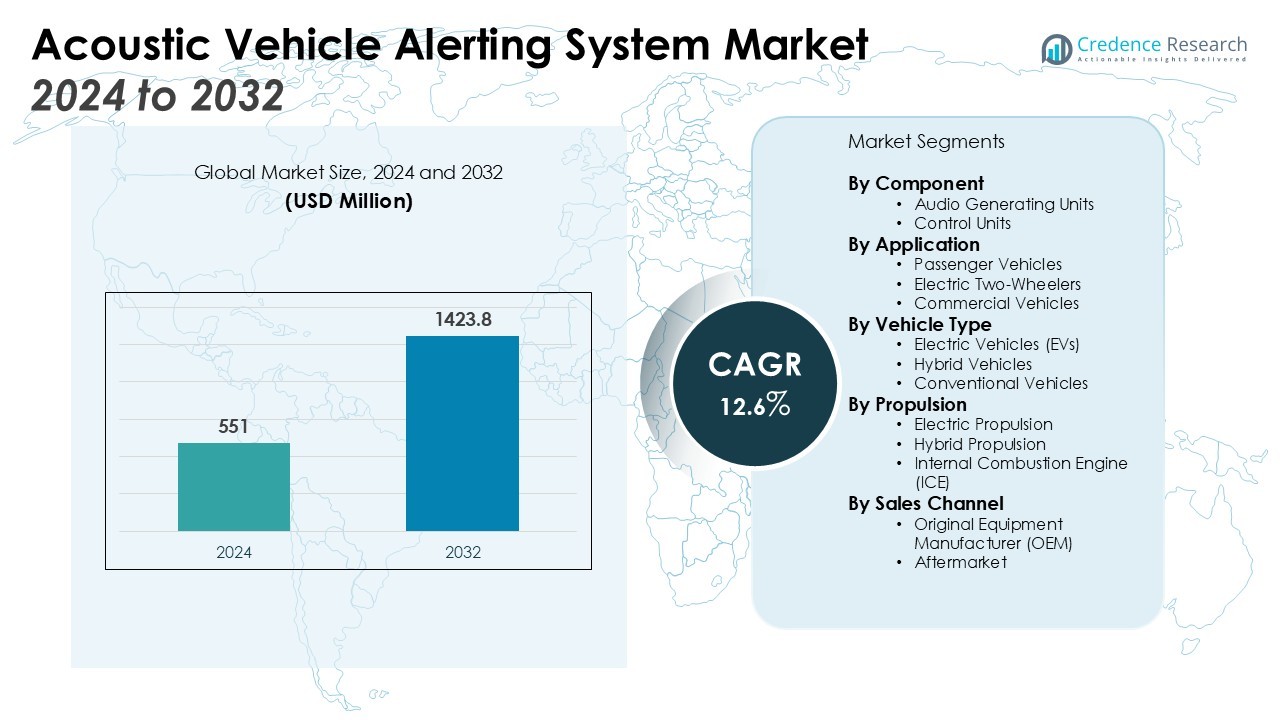
The Acoustic Vehicle Alerting System Market size was valued at USD 551 million in 2024 and is anticipated to reach USD 1423.8 million by 2032, at a CAGR of 12.6% during the forecast period (2024-2032).
| REPORT ATTRIBUTE | DETAILS |
|---|---|
| Historical Period | 2020-2024 |
| Base Year | 2024 |
| Forecast Period | 2025-2032 |
| Acoustic Vehicle Alerting System Market Size 2024 | USD 551 Million |
| Acoustic Vehicle Alerting System Market, CAGR | 12.6% |
| Acoustic Vehicle Alerting System Market Size 2032 | USD 1423.8 Million |
Key drivers of the AVAS market include stringent regulations requiring EVs to emit artificial sounds at low speeds to enhance pedestrian safety. This regulatory push, coupled with the growing adoption of electric two-wheelers and the development of autonomous vehicles, has accelerated the deployment of AVAS technologies. Additionally, advancements in sensor technologies and vehicle-to-everything (V2X) communication are enabling more sophisticated and context-aware alert systems. The increasing emphasis on sustainable transportation and government incentives for EV adoption further supports the market's expansion.
Regionally, Asia Pacific holds the highest market share, attributed to the rapid penetration of EVs in countries like China and Japan. The region's focus on smart-city initiatives and the integration of AVAS with V2X infrastructure further bolster its dominance. North America and Europe also exhibit substantial growth, driven by regulatory frameworks and increasing consumer demand for enhanced vehicle safety features. Additionally, strong investments in EV infrastructure in these regions are contributing to the increased adoption of AVAS technologies.
Market Insights:
- The Acoustic Vehicle Alerting System (AVAS) Market was valued at USD 551 million in 2024 and is expected to reach USD 1,423.8 million by 2032, growing at a CAGR of 12.6%.
- The growing adoption of electric vehicles, driven by environmental concerns and government incentives, significantly boosts the demand for AVAS technologies.
- Advancements in sensor technologies and vehicle-to-everything (V2X) communication enable more dynamic, context-sensitive alerts, enhancing safety without noise pollution.
- The rise of autonomous vehicles amplifies the need for AVAS integration, ensuring pedestrian safety in the absence of human drivers.
- Variations in regional sound emission standards pose challenges to global AVAS standardization, increasing costs for automakers.
- High implementation costs and technical complexities, such as AI integration, limit adoption, especially for smaller manufacturers in emerging markets.
- Asia Pacific leads the market with a 35% share, while North America and Europe see significant growth driven by regulatory frameworks and consumer demand for enhanced safety.
Market Drivers:
Stringent Regulatory Requirements for Pedestrian Safety
The Acoustic Vehicle Alerting System (AVAS) market is significantly driven by strict regulations that mandate electric vehicles (EVs) to generate artificial sounds at low speeds. These regulations are enforced to ensure pedestrian safety, especially in urban environments where quieter EVs can go unnoticed. Authorities across the globe, including the European Union, the United States, and Japan, have introduced guidelines requiring the implementation of AVAS in EVs, particularly at speeds below 30 km/h. This push is crucial in preventing accidents and enhancing public awareness of the presence of silent vehicles on the road.
- For instance, Brigade Electronics has developed its Quiet Vehicle Sounder AVAS to operate within the legally mandated sound level, which according to UN Regulation 138 must not exceed 75 decibels.
Rise in Electric Vehicle Adoption
The increasing adoption of electric vehicles (EVs) directly contributes to the growing demand for AVAS technologies. EV sales have surged globally due to heightened environmental concerns, stricter emission regulations, and government incentives. The rapid penetration of electric two-wheelers and passenger vehicles, especially in regions like Asia Pacific, further accelerates the need for AVAS systems. These vehicles, often too quiet for pedestrians to hear, necessitate artificial sound systems for safety, creating a robust demand for AVAS solutions in the automotive market.
- For instance, BYD's Super e-Platform technology, launched on new models in 2025, enables its vehicles to add 400 kilometers of range with just a 5-minute charge.
Technological Advancements in Sensor and Communication Systems
Advancements in sensor technologies and vehicle-to-everything (V2X) communication have propelled the evolution of Acoustic Vehicle Alerting Systems. These technologies enable AVAS to generate more dynamic and context-sensitive alerts that respond to real-time environmental conditions, such as traffic density and pedestrian presence. With sensors becoming increasingly more accurate and efficient, AVAS can now provide tailored alerts, improving safety without causing noise pollution, further expanding its market adoption.
Expansion of Autonomous and Connected Vehicle Markets
The rise of autonomous vehicles (AVs) and connected car technologies is another major driver for the AVAS market. As AVs lack traditional human drivers, the need for systems that ensure pedestrian safety is amplified. AVAS solutions are integrated into these vehicles to provide audio cues that signify vehicle movement, alerting nearby pedestrians of potential hazards. The convergence of autonomous driving technology and AVAS not only enhances safety but also opens up new opportunities for growth within the market.
Market Trends:
Integration of Smart Technologies in Acoustic Vehicle Alerting Systems
The Acoustic Vehicle Alerting System (AVAS) market is witnessing a significant trend toward the integration of smart technologies. The incorporation of sensors, artificial intelligence (AI), and vehicle-to-everything (V2X) communication is enhancing the effectiveness of AVAS. These technologies enable the system to produce sound alerts based on real-time environmental factors, such as traffic conditions, pedestrian movement, and vehicle speed. By utilizing AI, AVAS can generate tailored and context-specific sounds, offering a more personalized safety experience. This trend is gaining traction, particularly in advanced markets such as North America and Europe, where the focus is on increasing vehicle safety and reducing road accidents. The integration of smart technologies not only improves pedestrian safety but also contributes to the development of autonomous and connected vehicle ecosystems.
- For instance, the ROHM group company LAPIS Technology has developed the ML22120xx series of speech synthesis ICs specifically for AVAS, which use a hardware-based configuration.
Rising Consumer Demand for Customizable and Aesthetic Sound Options
Another key trend in the Acoustic Vehicle Alerting System market is the growing consumer demand for customizable and aesthetically pleasing sound options. As electric vehicles (EVs) become more mainstream, manufacturers are moving beyond basic alert sounds and offering consumers the option to personalize the auditory experience. This shift reflects a desire for more human-centric, pleasant, and brand-specific sounds that align with a vehicle's overall design and driving experience. Car manufacturers are increasingly investing in R&D to create sounds that are not only effective in ensuring pedestrian safety but also enhance the vehicle's appeal. With a focus on enhancing the driving experience and aligning with eco-friendly innovations, AVAS is evolving to cater to a more personalized market segment.
- For instance, Audi's sound engineers composed the unique e-sound for the e-tron GT by layering and mixing 32 separate acoustic sound elements to create a distinctive and high-quality driving sound.
Market Challenges Analysis:
Challenges in Standardizing Acoustic Vehicle Alerting Systems
The Acoustic Vehicle Alerting System (AVAS) market faces challenges in establishing global standards for sound emission requirements. While several regions have implemented regulations, such as the European Union’s requirement for AVAS in electric vehicles (EVs), inconsistencies in sound level standards and sound types still exist across different markets. These variations can lead to difficulties for automakers trying to develop systems that comply with multiple regulations while maintaining a consistent user experience. The lack of uniformity also complicates the global supply chain and increases costs for manufacturers, who must tailor systems to meet specific local requirements. This challenge is amplified as the market moves towards more autonomous and connected vehicles, which demand even stricter and more specific regulations.
Cost Constraints and Technical Limitations
The cost of implementing high-quality AVAS solutions remains a significant challenge for manufacturers. Advanced technologies, such as AI integration and real-time sensor data processing, increase the overall cost of acoustic systems. Smaller manufacturers, especially in emerging markets, may find it difficult to adopt these advanced technologies, leading to slower market penetration. Technical limitations also exist in balancing the effectiveness of sound alerts with noise pollution concerns. Striking the right balance between safety and minimizing sound disturbance is complex, and improving this aspect of AVAS requires continuous innovation and investment in research.
Market Opportunities:
Expansion of Electric Vehicle Market Presents Growth Opportunities
The rapid expansion of the electric vehicle (EV) market presents significant opportunities for the Acoustic Vehicle Alerting System (AVAS) market. As the global shift towards electric mobility accelerates, the need for safety features like AVAS becomes more pronounced. With increasing government regulations around EVs, such as mandatory sound emission standards for low-speed operation, automakers are investing in AVAS technologies to comply with these rules. This trend creates a growing market for advanced, customizable AVAS solutions, providing opportunities for manufacturers to innovate and offer tailored products that align with different market preferences. Furthermore, the proliferation of EVs in regions like Asia-Pacific and North America opens up substantial growth potential for AVAS deployment.
Integration with Autonomous Vehicle Technologies
The rise of autonomous vehicles (AVs) also presents a unique opportunity for the AVAS market. As self-driving vehicles continue to gain traction, there is a need for systems that ensure pedestrian awareness and vehicle presence. AVAS technology, integrated into AVs, will help bridge the safety gap in environments where traditional sound cues from human-driven vehicles are absent. The demand for AVAS in autonomous vehicles is expected to increase as these vehicles move towards mainstream adoption. This integration not only supports pedestrian safety but also aligns with the ongoing advancements in smart transportation ecosystems.
Market Segmentation Analysis:
By Component:
The market is divided into two main components: audio generating units and control units. Audio generating units hold the largest market share, driven by their role in emitting sound to alert pedestrians and cyclists of a vehicle’s presence. Control units, responsible for managing the sound output, are expected to grow steadily as vehicle manufacturers increasingly incorporate advanced control systems to meet regulatory requirements.
- For instance, the NTI Audio FX100 Audio Analyzer, used for comprehensive audio analysis in research and quality control, offers a wide level measurement range starting from 1 µV.
By Application:
The primary applications of AVAS include passenger vehicles, electric two-wheelers, and commercial vehicles. Passenger vehicles dominate the market due to the increasing number of electric and hybrid vehicles. The electric two-wheeler segment is growing rapidly, especially in regions with high EV adoption, such as Asia Pacific. Commercial vehicles also present significant growth potential as regulations extend to larger electric vehicles.
- For instance, a 2024 scientific study on the perceptual evaluation of AVAS conducted detailed measurements and auralizations on the specific warning sounds from 3 different models of electric passenger cars: a Tesla Model Y, a Volkswagen ID.3, and a Nissan Leaf.
By Vehicle Type:
The AVAS market is segmented into electric vehicles (EVs), hybrid vehicles, and conventional vehicles. EVs account for the largest share, driven by stringent regulations in regions like North America and Europe requiring artificial sound emission at low speeds. Hybrid vehicles follow closely, as they combine electric and internal combustion engine systems. Conventional vehicles, while not a major focus for AVAS, continue to contribute to the market as manufacturers adopt electric technologies in their fleets.
Segmentations:
- By Component:
- Audio Generating Units
- Control Units
- By Application:
- Passenger Vehicles
- Electric Two-Wheelers
- Commercial Vehicles
- By Vehicle Type:
- Electric Vehicles (EVs)
- Hybrid Vehicles
- Conventional Vehicles
- By Propulsion:
- Electric Propulsion
- Hybrid Propulsion
- Internal Combustion Engine (ICE)
- By Sales Channel:
- Original Equipment Manufacturer (OEM)
- Aftermarket
- By Region:
- North America
- Europe
- Asia Pacific
- Rest of the World
Regional Analysis:
North America: Leading the Acoustic Vehicle Alerting System Market
North America dominates the Acoustic Vehicle Alerting System (AVAS) Market with a market share of 35%, driven by stringent regulatory standards and growing concerns about pedestrian safety. The U.S. leads the market, with the National Highway Traffic Safety Administration (NHTSA) mandating the use of AVAS in electric and hybrid vehicles to improve their detectability in low-speed environments. The increasing number of electric vehicles (EVs) in the region further supports the demand for these systems. The market's growth is further fueled by substantial automotive industry investments in advanced technologies and the region's focus on enhancing vehicle safety features.
Europe: Strong Regulatory Frameworks and Advancements in Technology
Europe accounts for 30% of the Acoustic Vehicle Alerting System Market, driven by robust regulations such as the European Union's mandate for AVAS in electric and hybrid vehicles. These regulations ensure that vehicles produce sufficient noise to alert pedestrians and cyclists, addressing safety concerns in urban areas. Additionally, the automotive industry in Europe is actively integrating innovative technologies, such as artificial intelligence and machine learning, to enhance AVAS functionality. This technological advancement contributes to improving the system's effectiveness, leading to increased adoption across European countries.
Asia-Pacific: Rapid Urbanization and Growing EV Adoption
The Asia-Pacific region holds 25% of the Acoustic Vehicle Alerting System Market, driven by rapid urbanization, industrialization, and the rise of electric vehicle adoption. Countries like China, Japan, and South Korea are witnessing significant advancements in the EV sector, with government incentives and policies further promoting electric mobility. As the number of electric vehicles on the road increases, the need for AVAS becomes more pronounced, particularly in densely populated urban areas. The region's growing awareness of pedestrian safety and environmental concerns also drives the adoption of AVAS technology.
Key Player Analysis:
- Kendrion NV
- Mercedes-Benz AG
- Kufatec GmbH & Co. Kg
- Texas Instruments
- Hella Gmbh & Co. KGaA
- Harman International
- Honda Motor Company
- Brigade Electronics
- Continental Engineering Services GmbH
- Soundracer AB
Competitive Analysis:
The Acoustic Vehicle Alerting System (AVAS) Market is highly competitive, with several key players focusing on technological advancements and regulatory compliance to gain market share. Leading companies include Continental AG, Bosch, Delphi Technologies, and Denso Corporation. These players are investing heavily in R&D to develop advanced AVAS solutions that offer dynamic sound generation, integration with vehicle-to-everything (V2X) systems, and improved pedestrian safety features. The market is also witnessing collaborations between automotive manufacturers and AVAS solution providers to meet stringent regulatory standards for electric and hybrid vehicles. Companies are expanding their product portfolios by introducing systems tailored to specific vehicle types, such as electric two-wheelers and commercial vehicles. The competitive landscape is further shaped by the growing emphasis on autonomous vehicle integration, with players focusing on seamless AVAS technology integration in these advanced systems.
Recent Developments:
- In July 2025, Hella launched its first series production of the 48V Flatpack energy management solution in China.
- In February 2025, Hella formed a strategic partnership with BrightView Technologies, Inc. to advance automotive lighting technologies.
- In May 2025, Harman announced an agreement to acquire the audio brands Bowers & Wilkins, Denon, Polk, and Marantz from Masimo.
Market Concentration & Characteristics:
The Acoustic Vehicle Alerting System (AVAS) Market is moderately concentrated, with a few dominant players controlling the majority of market share. Leading companies such as Continental AG, Bosch, and Delphi Technologies have established strong positions through extensive R&D and strategic partnerships with automotive manufacturers. These players focus on developing advanced technologies that comply with stringent regulations and address the growing demand for pedestrian safety in electric and hybrid vehicles. The market is characterized by high competition in innovation, with companies striving to enhance sound clarity, integration with vehicle-to-everything (V2X) systems, and customization for various vehicle types. New entrants face challenges in competing with established players due to the high capital investment required for R&D and compliance with regulatory standards. Despite this, the market continues to evolve with increasing demand for safer and smarter AVAS solutions in both urban and autonomous vehicle settings.
Report Coverage:
The research report offers an in-depth analysis based on Component, Application, Vehicle Type, Propulsion, Sales Channel and Region. It details leading market players, providing an overview of their business, product offerings, investments, revenue streams, and key applications. Additionally, the report includes insights into the competitive environment, SWOT analysis, current market trends, as well as the primary drivers and constraints. Furthermore, it discusses various factors that have driven market expansion in recent years. The report also explores market dynamics, regulatory scenarios, and technological advancements that are shaping the industry. It assesses the impact of external factors and global economic changes on market growth. Lastly, it provides strategic recommendations for new entrants and established companies to navigate the complexities of the market.
Future Outlook:
- The Acoustic Vehicle Alerting System (AVAS) Market is set to expand significantly, driven by increasing adoption of electric and hybrid vehicles.
- Regulatory mandates worldwide are enforcing the integration of AVAS in electric vehicles to enhance pedestrian safety.
- Technological advancements are leading to the development of more efficient and context-aware alert systems.
- The rise of autonomous vehicles is creating new opportunities for AVAS integration to ensure pedestrian awareness.
- Consumer awareness regarding pedestrian safety is prompting demand for vehicles equipped with AVAS.
- Advancements in sensor technologies are improving the effectiveness of AVAS in various environmental conditions.
- The expansion of electric vehicle infrastructure is facilitating the widespread adoption of AVAS.
- Collaborations between automotive manufacturers and technology providers are accelerating AVAS development.
- The focus on sustainable transportation is indirectly promoting the growth of the AVAS market.
- Investments in research and development are leading to innovative solutions in AVAS technology.
- The global push towards smart cities is integrating AVAS with vehicle-to-everything (V2X) communication systems.

Request a Free Sample
Fill in your details and we'll send you a free sample report.
- Sample data tables & charts
- Research methodology
Market Dynamics
Stringent Regulatory Requirements for Pedestrian Safety
Global regulations now mandate that electric and hybrid vehicles emit artificial sounds at low speeds to alert pedestrians, directly driving the adoption of AVAS technologies across automotive manufacturers.
Rapid Growth in Electric Vehicle Adoption
The surge in electric vehicle sales, fueled by environmental concerns and government incentives, is increasing the need for AVAS to ensure pedestrian safety, especially as EVs are much quieter than traditional vehicles.
Advancements in Sensor and V2X Communication Technologies
Innovations in sensor accuracy and vehicle-to-everything (V2X) communication enable AVAS to deliver context-aware, dynamic alerts, making these systems more effective and attractive to automakers and consumers.
Expansion of Autonomous and Connected Vehicle Markets
As autonomous and connected vehicles become more prevalent, the need for reliable AVAS integration grows to compensate for the absence of human drivers and to enhance pedestrian awareness.
Government Incentives and Support for Sustainable Transportation
Policies promoting electric mobility and investments in EV infrastructure are indirectly boosting AVAS market growth by increasing the number of vehicles that require these safety systems.
Need a Custom Version of This Report?
Tailor the scope, geography, or segments to your exact requirements.
- Custom geography or segment scope
- Direct access to our analyst team
Frequently Asked Questions
What is the current market size for Acoustic Vehicle Alerting System, and what is its projected size in 2032?
At what Compound Annual Growth Rate is the Acoustic Vehicle Alerting System market projected to grow between 2024 and 2032?
Which Acoustic Vehicle Alerting System market segment held the largest share in 2024?
What are the primary factors fueling the growth of the Acoustic Vehicle Alerting System market?
Who are the leading companies in the Acoustic Vehicle Alerting System market?
Which region commanded the largest share of the Acoustic Vehicle Alerting System market in 2024?
Table of Content
Chapter 1 Market Segmentation
- 1.1 Segmentation Framework
- 1.1.1 Product and Service Classification
- 1.1.2 Application and End-Use Classification
- 1.1.3 Technology and Solution Classification
- 1.1.4 Customer and Distribution Channel Classification
- 1.1.5 Geographic Segmentation
- 1.1.6 Market Segment Definitions and Boundaries
- 1.2 By Component
- 1.2.1 Audio Generating Units
- 1.2.2 Control Units
- 1.3 By Application
- 1.3.1 Passenger Vehicles
- 1.3.2 Electric Two-Wheelers
- 1.3.3 Commercial Vehicles
- 1.4 By Vehicle Type
- 1.4.1 Electric Vehicles (EVs)
- 1.4.2 Hybrid Vehicles
- 1.4.3 Conventional Vehicles
- 1.5 By Sales Channel
- 1.5.1 Original Equipment Manufacturer (OEM)
- 1.5.2 Aftermarket
Chapter 2 Introduction
- 2.1 Report Objectives and Scope
- 2.2 Product Definition and Industry Terminology
- 2.3 Market Inclusions and Exclusions
- 2.4 Research Process
- 2.4.1 Primary Research and Expert Interviews
- 2.4.2 Secondary Research and Source Review
- 2.4.3 Top-Down and Bottom-Up Estimation
- 2.4.4 Data Triangulation and Verification
- 2.5 Market Size Measurement Basis
- 2.5.1 2024: USD 551 million → 2032: USD 1,423.8 million
- 2.6 Historical and Forecast Reference Periods
- 2.6.1 Base Year: 2024
- 2.6.2 Forecast Period: 2024-2032
- 2.7 Research Assumptions and Limitations
Chapter 3 Executive Summary
- 3.1 Market Snapshot and Key Findings
- 3.2 Base-Year Market Size, 2024
- 3.3 Forecast Market Size, 2032
- 3.4 Revenue and Volume Growth Outlook
- 3.5 Key Demand and Supply Indicators
- 3.6 Leading Market Segments
- 3.7 Fastest-Growing Market Opportunities
- 3.8 Regional Performance Highlights
- 3.9 Technology and Industry Transformation
- 3.10 Competitive Landscape Summary
- 3.11 Analyst View and Strategic Implications
Chapter 4 Global Acoustic Vehicle Alerting System Market Trends and Developments
- 4.1 Historical Industry Development
- 4.2 Recent Market Trends and Developments
- 4.3 Demand and Customer Behavior Trends
- 4.4 Technology and Product Innovation
- 4.5 Artificial Intelligence, Automation and Digitalization
- 4.6 Local Manufacturing and Supply Chain Realignment
- 4.7 Industry Partnerships, Mergers and Acquisitions
- 4.8 Sustainability and Circular Economy Developments
- 4.9 Government and Private Sector Investment Trends
- 4.10 Emerging Business Models and Commercialization
- 4.11 Industry Developments and Announcements
Chapter 5 Global Acoustic Vehicle Alerting System Market Production, Supply and Demand Analysis
- 5.1 Demand Trend and Consumption Analysis
- 5.2 Demand Forecast, 2024-2032
- 5.3 Production and Output Trend
- 5.4 Production and Output Forecast, 2024-2032
- 5.5 Installed Capacity and Capacity Utilization
- 5.6 Company-Wise Production Plants and Statistics
- 5.6.1 Installed Production Capacity
- 5.6.2 Actual Production
- 5.6.3 Planned Capacity and Expansion Targets
- 5.7 Supply Chain Structure and Procurement Trends
- 5.8 Supply-Demand Gap and Bottlenecks
- 5.9 Import Dependence and Sourcing Structure
- 5.10 Contract Manufacturing and Outsourcing
- 5.11 Regional Supply and Demand Concentration
Chapter 6 Global Acoustic Vehicle Alerting System Market Pricing Analysis
- 6.1 Pricing Structure and Measurement
- 6.2 Historical Pricing Trends
- 6.3 Pricing Outlook, 2024-2032
- 6.4 Average Selling Price and Unit Economics
- 6.5 Pricing by Product and Market Segment
- 6.6 Geographic Pricing Differences
- 6.7 Key Input, Energy, Labor and Logistics Costs
- 6.8 Contract Pricing and Purchasing Models
- 6.9 Pricing Sensitivity and Competitive Positioning
- 6.10 Price, Margin and Profitability Implications
Chapter 7 Global Acoustic Vehicle Alerting System Market Dynamics
- 7.1 Market Growth Drivers
- 7.1.1 Demand-Side Drivers
- 7.1.2 Technology and Innovation Drivers
- 7.1.3 Infrastructure and Investment Drivers
- 7.1.4 Regulatory and Policy Drivers
- 7.2 Market Restraints
- 7.2.1 Cost and Affordability Constraints
- 7.2.2 Technology and Adoption Barriers
- 7.2.3 Supply Chain and Operational Constraints
- 7.3 Market Challenges
- 7.3.1 Competitive Pressure and Margin Erosion
- 7.3.2 Skills, Infrastructure and Implementation Gaps
- 7.4 Emerging Market Opportunities
- 7.5 Market Dynamics Impact and Time-Horizon Assessment
Chapter 8 Global Acoustic Vehicle Alerting System Value Chain Analysis
- 8.1 Industry Value Chain Overview
- 8.2 Upstream Suppliers and Critical Inputs
- 8.3 Technology and Component Providers
- 8.4 Manufacturing or Service Delivery
- 8.5 Distribution, Channel Partners and Integrators
- 8.6 Downstream Applications and End Users
- 8.7 Value Addition and Profit Pools
- 8.8 Vertical Integration and Outsourcing
- 8.9 Supplier Concentration and Risk
- 8.10 Supply Chain Localization and Resilience
Chapter 9 Global Acoustic Vehicle Alerting System Market Regulations and Policies
- 9.1 Relevant Laws, Standards and Compliance Frameworks
- 9.2 Product, Service, Safety and Quality Requirements
- 9.3 Government Policies, Incentives and Subsidies
- 9.4 Imports, Exports and Trade Barriers
- 9.5 Public Procurement and Local Content Requirements
- 9.6 Environmental and Sustainability Compliance
- 9.7 Upcoming Policy Changes and Market Implications
Chapter 10 Global Acoustic Vehicle Alerting System Market Hotspots and Opportunities
- 10.1 Market Opportunity Mapping and Growth Hotspots
- 10.2 High-Growth Applications and Customer Groups
- 10.3 Underserved Markets and White-Space Opportunities
- 10.4 Emerging Technology and Product Opportunities
- 10.5 New Capacity and Investment Hotspots
- 10.6 Market Entry and Expansion Opportunities
- 10.7 Distribution and Partnership Opportunities
- 10.8 Near-Term and Long-Term Commercial Potential
- 10.9 Opportunity Attractiveness and Execution Risks
Chapter 11 Global Acoustic Vehicle Alerting System Market Outlook, 2024-2032
- 11.1 Market Size and Analysis
- 11.1.1 Revenue (Market Measurement: 2024: USD 551 million → 2032: USD 1,423.8 million)
- 11.1.2 Market Volume and Quantity Sold
- 11.1.3 Historical Market Size
- 11.1.4 Base-Year Market Size, 2024
- 11.2 Market Forecast, 2024-2032
- 11.2.1 Revenue Forecast to 2032
- 11.2.2 Volume Forecast to 2032
- 11.2.3 CAGR and Year-on-Year Growth
- 11.2.4 Incremental Revenue Opportunity
- 11.3 Forecast Assumptions and Scenario Analysis
- 11.3.1 Base-Case Forecast
- 11.3.2 Optimistic and Conservative Scenarios
- 11.3.3 Technology, Pricing and Policy Sensitivities
- 11.4 Market Attractiveness and Growth Outlook
Chapter 12 Global Acoustic Vehicle Alerting System Market Segmentation and Outlook
- 12.1 Segmentation Summary and Market Shares, 2024
- 12.2 Largest and Fastest-Growing Segments
- 12.3 By Component - Market Size and Forecast, 2024-2032
- 12.3.1 Segment Definition and Scope
- 12.3.2 Historical Market Size
- 12.3.3 Revenue Forecast, 2024-2032
- 12.3.4 Volume Forecast, 2024-2032
- 12.3.5 Base-Year Market Share, 2024
- 12.3.6 Segment CAGR and Growth Drivers
- 12.3.7 Subsegment Market Size and Forecast
- 12.3.7.1 Audio Generating Units
- 12.3.7.2 Control Units
- 12.3.8 Subsegment Pricing and Adoption Trends
- 12.3.9 Leading Suppliers and Competition
- 12.3.10 Regional Demand and Opportunities
- 12.4 By Application - Market Size and Forecast, 2024-2032
- 12.4.1 Segment Definition and Scope
- 12.4.2 Historical Market Size
- 12.4.3 Revenue Forecast, 2024-2032
- 12.4.4 Volume Forecast, 2024-2032
- 12.4.5 Base-Year Market Share, 2024
- 12.4.6 Segment CAGR and Growth Drivers
- 12.4.7 Subsegment Market Size and Forecast
- 12.4.7.1 Passenger Vehicles
- 12.4.7.2 Electric Two-Wheelers
- 12.4.7.3 Commercial Vehicles
- 12.4.8 Subsegment Pricing and Adoption Trends
- 12.4.9 Leading Suppliers and Competition
- 12.4.10 Regional Demand and Opportunities
- 12.5 By Vehicle Type - Market Size and Forecast, 2024-2032
- 12.5.1 Segment Definition and Scope
- 12.5.2 Historical Market Size
- 12.5.3 Revenue Forecast, 2024-2032
- 12.5.4 Volume Forecast, 2024-2032
- 12.5.5 Base-Year Market Share, 2024
- 12.5.6 Segment CAGR and Growth Drivers
- 12.5.7 Subsegment Market Size and Forecast
- 12.5.7.1 Electric Vehicles (EVs)
- 12.5.7.2 Hybrid Vehicles
- 12.5.7.3 Conventional Vehicles
- 12.5.8 Subsegment Pricing and Adoption Trends
- 12.5.9 Leading Suppliers and Competition
- 12.5.10 Regional Demand and Opportunities
- 12.6 By Sales Channel - Market Size and Forecast, 2024-2032
- 12.6.1 Segment Definition and Scope
- 12.6.2 Historical Market Size
- 12.6.3 Revenue Forecast, 2024-2032
- 12.6.4 Volume Forecast, 2024-2032
- 12.6.5 Base-Year Market Share, 2024
- 12.6.6 Segment CAGR and Growth Drivers
- 12.6.7 Subsegment Market Size and Forecast
- 12.6.7.1 Original Equipment Manufacturer (OEM)
- 12.6.7.2 Aftermarket
- 12.6.8 Subsegment Pricing and Adoption Trends
- 12.6.9 Leading Suppliers and Competition
- 12.6.10 Regional Demand and Opportunities
- 12.7 Segment Growth Comparison
- 12.8 Segment Attractiveness and Priority Matrix
Chapter 13 Global Acoustic Vehicle Alerting System End-Use and Application Market Outlook
- 13.1 End-Use Industry and Customer Demand Structure
- 13.2 Leading Applications and Customer Groups
- 13.3 End-Use Market Size, Share and Forecast
- 13.4 Major End-Use Industry Deep Dives
- 13.4.1 Customer Requirements and Use Cases
- 13.4.2 Demand and Replacement Cycles
- 13.4.3 Technical and Regulatory Considerations
- 13.4.4 Purchasing and Procurement Models
- 13.4.5 Leading Vendors and Distribution Channels
- 13.4.6 Forecast and Commercial Opportunities
- 13.5 Emerging Applications and Cross-Segment Demand
- 13.6 End-Use Industry Investment Priorities
Chapter 14 Global Acoustic Vehicle Alerting System Geographic Market Outlook, 2024-2032
- 14.1 Regional Market Size and Share, 2024
- 14.2 Regional Market Forecast, 2024-2032
- 14.3 Regional Pricing, Production and Demand Differences
- 14.4 North America
- 14.4.1 United States
- 14.4.2 Canada
- 14.4.3 Mexico
- 14.5 Europe
- 14.5.1 Germany
- 14.5.2 France
- 14.5.3 Italy
- 14.5.4 United Kingdom
- 14.5.5 Spain
- 14.5.6 Poland
- 14.5.7 Russia
- 14.5.8 Netherlands
- 14.5.9 Belgium
- 14.5.10 Sweden
- 14.5.11 Denmark
- 14.5.12 Norway
- 14.5.13 Rest of Europe
- 14.6 Asia Pacific
- 14.6.1 China
- 14.6.2 India
- 14.6.3 Japan
- 14.6.4 South Korea
- 14.6.5 Thailand
- 14.6.6 Indonesia
- 14.6.7 Vietnam
- 14.6.8 Malaysia
- 14.6.9 Australia
- 14.6.10 Rest of Asia Pacific
- 14.7 Latin America
- 14.7.1 Brazil
- 14.7.2 Argentina
- 14.7.3 Colombia
- 14.7.4 Chile
- 14.7.5 Rest of Latin America
- 14.8 Middle East
- 14.8.1 Saudi Arabia
- 14.8.2 United Arab Emirates
- 14.8.3 Turkey
- 14.8.4 Israel
- 14.8.5 Iran
- 14.8.6 Rest of the Middle East
- 14.9 Africa
- 14.9.1 South Africa
- 14.9.2 Egypt
- 14.9.3 Nigeria
- 14.9.4 Morocco
- 14.9.5 Rest of Africa
- 14.10 Regional Investment, Policy and Supply Chain Differences
- 14.11 Regional Competitive Landscape
- 14.12 Geographic Growth Hotspots
Chapter 15 Global Acoustic Vehicle Alerting System Technology, Innovation and Sustainability Outlook
- 15.1 Technology Landscape and Maturity
- 15.2 Product, Process and Service Innovation
- 15.3 AI, Automation and Digital Tools in the Industry
- 15.4 Technology Adoption and Performance Benchmarking
- 15.5 Innovation Pipeline and R&D Investment
- 15.6 Patent and Intellectual Property Trends
- 15.7 Energy Efficiency and Resource Management
- 15.8 Sustainability, Recycling and Circularity
- 15.9 Technology Roadmap, 2024-2032
- 15.10 Risks of Obsolescence and Technology Substitution
Chapter 16 Global Acoustic Vehicle Alerting System Market Key Strategic Imperatives
- 16.1 Growth and Market Entry Priorities
- 16.2 High-Return Products and Segments
- 16.3 Pricing, Profitability and Cost Optimization
- 16.4 Technology Investment and Product Differentiation
- 16.5 Supply Chain Localization and Resilience
- 16.6 Distribution and Customer Acquisition
- 16.7 Partnership, Acquisition and Capacity Strategy
- 16.8 Regional Expansion Priorities
- 16.9 Short-, Medium- and Long-Term Actions
Chapter 17 Competition Outlook
- 17.1 Industry Competition Characteristics
- 17.2 Market Structure and Concentration
- 17.3 Market Share and Competitive Positioning, 2024
- 17.4 Company-Wise Revenue and Product Benchmarking
- 17.5 Production and Service Capacity Benchmarking
- 17.6 Technology, Pricing and Differentiation
- 17.7 Regional Footprint and Distribution Strength
- 17.8 Mergers, Acquisitions and Strategic Alliances
- 17.9 New Entrants and Competitive Threats
- 17.10 Porter's Five Forces and Industry Attractiveness
- 17.11 Competitive Outlook, 2024-2032
Chapter 18 Company Profiles
- 18.1 Company Coverage and Selection Criteria
- 18.2 Continental AG
- 18.2.1 Business Description
- 18.2.2 Company Ownership and Geographic Presence
- 18.2.3 Product and Service Portfolio
- 18.2.4 Manufacturing and Operating Footprint
- 18.2.5 Production Capacity and Expansion Plans
- 18.2.6 Financial Performance and Investment
- 18.2.7 Market Share and Competitive Position
- 18.2.8 Technology and Innovation Capabilities
- 18.2.9 Strategic Alliances or Partnerships
- 18.2.10 Recent Developments
- 18.2.11 Growth Strategy and Outlook
- 18.3 Bosch
- 18.4 Delphi Technologies
- 18.5 Denso Corporation
- 18.6 Harman International
- 18.7 Hella GmbH & Co. KGaA
- 18.8 Kendrion NV
- 18.9 Brigade Electronics
- 18.10 Kufatec GmbH & Co. Kg
- 18.11 Soundracer AB
- 18.12 Other Relevant Market Participants
Note: Every listed company is profiled on the structure shown under the first company. The company list is preliminary and may change based on research findings, market developments, data availability and client requirements.
Chapter 19 Disclaimer
- 19.1 Research and Forecast Disclaimer
- 19.2 Data Source and Estimation Limitations
Note: The depth of individual sections depends on data availability for this market. Volume, capacity, trade and other unit-based metrics are included where applicable.