
Market Overview
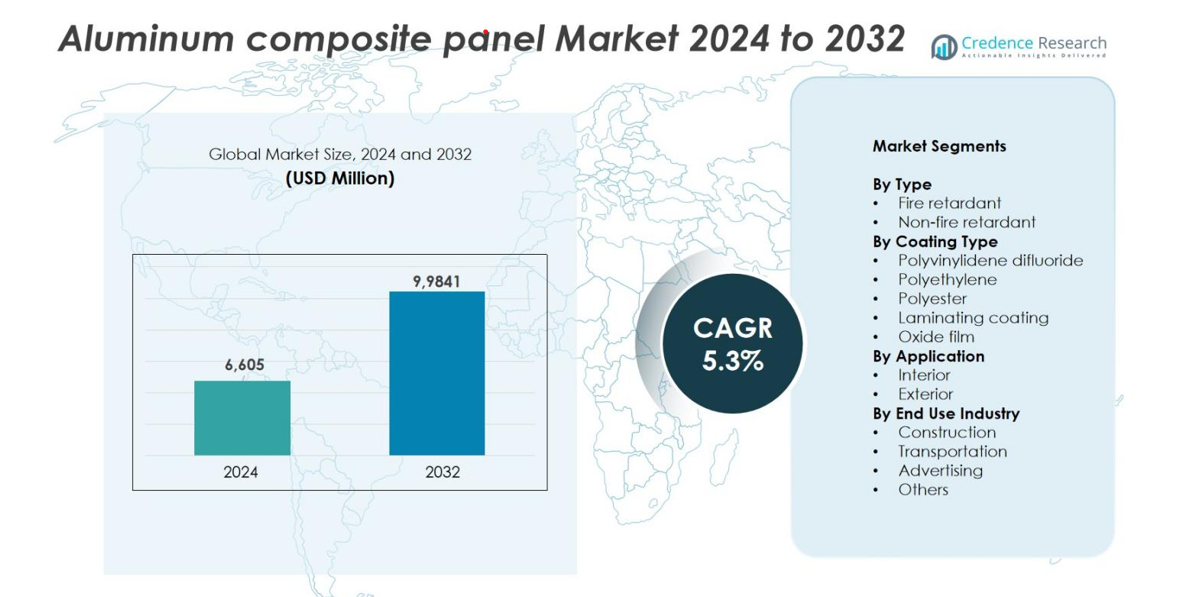
The Aluminum Composite Panel Market size was valued at USD 6,605 million in 2024 and is anticipated to reach USD 9,984 million by 2032, growing at a CAGR of 5.3% during the forecast period.
| REPORT ATTRIBUTE | DETAILS |
|---|---|
| Historical Period | 2020-2023 |
| Base Year | 2024 |
| Forecast Period | 2025-2032 |
| Aluminum Composite Panel Market Size 2024 | USD 6,605 million |
| Aluminum Composite Panel Market, CAGR | 5.3% |
| Aluminum Composite Panel Market Size 2032 | USD 9,984 million |
The aluminum composite panel market is led by diversified global and regional specialists. Key players include Mitsubishi Chemical Corporation (ALPOLIC), Alpolic Materials, Alcoa, Alstrong, Alucopanel, Alfrex, Alumax Industrial, Alutec, Alumaze, and Alumanate. Vendors compete on certified fire-retardant grades, PVDF weatherability, recyclability, and design customization. Asia-Pacific leads the market with 37% share, supported by rapid urbanization and large infrastructure pipelines.
Market Insights
- The Aluminum Composite Panel Market was valued at USD 6,605 million in 2024 and is expected to reach USD 9,984 million by 2032, growing at a CAGR of 5.3% during the forecast period.
- Rising demand for modern, fire-retardant facades in commercial and residential construction is a major market driver, supported by strict building safety regulations and sustainable architecture trends.
- Technological advancements in PVDF coatings, digital printing, and recyclable composite materials enhance performance and design versatility, shaping evolving market trends.
- The competitive landscape features companies such as Mitsubishi Chemical Corporation, Alpolic Materials, Alcoa, Alstrong, and Alucopanel focusing on innovation, lightweight structures, and global distribution expansion.
- Asia-Pacific leads with 37% share, followed by Europe with 27%, while the fire-retardant segment dominates the market, driven by strong construction growth and regulatory compliance in high-rise and public infrastructure projects.
Market Segmentation Analysis:
By Type
The fire-retardant segment dominates the aluminum composite panel market with the largest market share. Its widespread use in commercial buildings, airports, and high-rise constructions is driven by rising safety standards and strict fire regulations. These panels provide superior thermal resistance and limit flame spread, making them ideal for exterior cladding applications. Governments and building authorities increasingly mandate fire-safe materials, accelerating adoption. The non-fire-retardant segment continues to serve low-risk and interior applications where cost efficiency and easy installation remain key priorities.
- For instance, Viva ACP produces fire-retardant panels with cores comprising 70-90% mineral content like Magnesium Hydroxide and Aluminium Trihydroxide, offering superior fire resistance for both residential and commercial structures.
By Coating Type
The polyvinylidene difluoride (PVDF) coating segment holds the dominant share in the market, supported by its excellent weather resistance, color stability, and UV protection. PVDF-coated panels are widely preferred for outdoor structures such as facades and signage due to their long-term durability and resistance to corrosion. The growing use of PVDF coatings in sustainable and energy-efficient building designs further enhances their market position. Meanwhile, polyester and polyethylene coatings cater to cost-sensitive indoor projects that demand aesthetic appeal and smooth finishes.
- For instance, PVDF-coated aluminum panels are extensively used in building facades for their resistance to coastal environmental conditions, ensuring long-term durability.
By Oxide Film and Laminating Coating
Within the advanced surface treatments, the oxide film segment is gaining steady growth owing to its superior hardness, scratch resistance, and enhanced adhesion properties. Oxide film coatings improve the panel’s resistance to wear and environmental damage, extending lifespan in industrial and architectural settings. Laminating coatings also contribute to design flexibility by offering varied textures and finishes suitable for premium interiors. The demand for durable, visually appealing materials in modern infrastructure projects continues to boost adoption across both oxide film and laminating-coated aluminum composite panels.
Key Growth Drivers
Rising Demand for Modern Building Facades
The growing adoption of aluminum composite panels (ACPs) in modern architecture is a key growth driver. Architects and builders increasingly prefer ACPs for their light weight, design flexibility, and sleek appearance. The panels enhance building aesthetics while ensuring structural integrity, making them ideal for both commercial and residential projects. Rapid urbanization, infrastructure modernization, and smart city projects in Asia-Pacific and the Middle East further stimulate demand. Fire-retardant and weather-resistant ACPs are now widely used in skyscrapers, airports, and corporate offices to meet safety and sustainability standards, accelerating global market expansion.
- For instance, 3A Composites manufactures ALUCORE®, a next-generation composite material widely used in India and exported globally, including Asia-Pacific and the Middle East, known for its fire safety, durability, and sustainable features.
Expansion in Industrial and Transportation Applications
The application of aluminum composite panels extends beyond construction to transportation and industrial sectors. Manufacturers are integrating ACPs in vehicle bodies, rail interiors, and marine structures due to their corrosion resistance, acoustic insulation, and lightweight properties. This reduces fuel consumption and enhances durability, aligning with green mobility initiatives. Industrial facilities also adopt ACPs for wall cladding and insulation, contributing to energy-efficient infrastructure. Continuous innovation in coatings and composite technologies further enhances panel performance, driving broader cross-sector adoption across global industries.
- For instance, Alumaze’s ACP sheets are widely used in bus bodies due to their lightweight properties that enhance fuel efficiency and corrosion resistance, supporting greener mobility initiatives.
Technological Advancements and Material Innovation
Advancements in coating technologies and material engineering are fueling ACP market growth. New formulations such as PVDF, nano-PVDF, and fluoropolymer coatings offer enhanced UV protection, self-cleaning properties, and extended color durability. Manufacturers are also developing recyclable and eco-friendly ACP variants to comply with environmental regulations and green building certifications like LEED and BREEAM. Automation in panel fabrication and precision lamination processes improves consistency and reduces production costs. These innovations strengthen product competitiveness, making ACPs more appealing to developers seeking high-performance, low-maintenance facade materials.
Key Trends & Opportunities
Growing Focus on Sustainable and Energy-Efficient Construction
Sustainability is reshaping market dynamics, with a strong shift toward energy-efficient and eco-friendly ACPs. Companies are producing recyclable panels and low-emission coatings to support green building initiatives. Reflective and insulated ACPs contribute to lower energy consumption in buildings by maintaining interior temperature stability. Government incentives for sustainable construction, along with consumer demand for environmentally responsible materials, drive further adoption. The trend aligns with the global push toward net-zero emissions and is expected to redefine product innovation in the ACP market over the coming decade.
- For instance, in Ahmedabad, India, ACP sheets coated with PVDF and Nano-PVDF reflect solar radiation and provide thermal insulation, significantly reducing the need for air conditioning and leading to substantial energy savings during hot summers.
Expanding Use in Renovation and Refurbishment Projects
The renovation of aging infrastructure across developed economies presents a major opportunity for ACP manufacturers. Retrofitting projects increasingly use ACPs to enhance building aesthetics, insulation, and durability without heavy structural changes. Lightweight and customizable ACPs allow faster installation and minimal disruption during renovation. Public buildings, shopping centers, and educational institutions are adopting these materials to meet updated safety and design standards. With governments emphasizing urban renewal, the demand for fire-safe and eco-friendly ACPs in refurbishment continues to rise globally.
Integration of Digital Printing and Custom Design Solutions
Technological innovation in digital printing and design customization is creating new growth avenues. Advanced surface printing techniques allow manufacturers to deliver panels in diverse textures and finishes such as wood, metallic, or stone patterns. These customizable options meet architectural and branding needs across retail and corporate sectors. The rising preference for visually distinct facades in modern construction enhances demand for digitally printed ACPs. This trend enables companies to differentiate products and cater to premium market segments focused on aesthetics and personalization.
Key Challenges
Fluctuating Raw Material Prices
Volatility in aluminum and polymer resin prices poses a major challenge to ACP manufacturers. Global supply chain disruptions, trade restrictions, and fluctuating energy costs impact raw material availability and pricing. Since aluminum accounts for a significant portion of production cost, even minor price increases can compress profit margins. Manufacturers are adopting long-term supply agreements and recycling initiatives to mitigate price risks. However, sustained volatility continues to pressure small and mid-sized producers, affecting market stability and long-term competitiveness.
Stringent Environmental and Fire Safety Regulations
Compliance with evolving fire safety and environmental standards remains a critical challenge. Governments worldwide are imposing stricter norms for facade materials following incidents involving non-compliant panels. Manufacturers must invest heavily in research and testing to develop panels that meet Class A fire ratings and low-VOC standards. The certification process increases production costs and extends time-to-market. Companies that fail to adapt risk losing certifications or facing restricted market access. Ensuring consistent regulatory compliance while maintaining profitability remains a complex balance for industry players.
Regional Analysis
North America
North America holds a market share of 22% in the aluminum composite panel market, driven by the strong adoption of advanced facade systems in commercial and institutional buildings. The United States leads the regional growth, supported by modernization projects and sustainability-focused construction. Fire-retardant ACPs are gaining traction due to strict safety standards and energy-efficient building mandates. The growing renovation of public infrastructure, coupled with the popularity of lightweight, low-maintenance materials, continues to boost demand. Technological innovation and product customization by regional manufacturers further enhance market competitiveness and adoption rates.
Europe
Europe accounts for 27% of the global aluminum composite panel market, driven by the increasing use of eco-friendly materials in green building projects. Countries like Germany, France, and the U.K. emphasize sustainable construction practices, supported by stringent EU energy efficiency directives. The market benefits from advanced architectural designs and refurbishment of aging infrastructure across urban areas. Fire-rated and recyclable ACPs are gaining preference in compliance with EN standards. Manufacturers in the region focus on product durability and design flexibility to meet evolving regulatory and aesthetic requirements in the construction sector.
Asia-Pacific
Asia-Pacific dominates the global market with a 37% share, fueled by rapid urbanization, industrial expansion, and government-led infrastructure projects. China, India, and Japan are major contributors, with large-scale investments in smart cities and commercial complexes. Affordable labor, strong manufacturing capabilities, and rising demand for high-performance construction materials drive growth. The region also benefits from expanding transportation and industrial applications of ACPs. Continuous technological advancements in coating and lamination processes strengthen local production capacity, positioning Asia-Pacific as the global hub for aluminum composite panel manufacturing and export.
Latin America
Latin America represents 8% of the aluminum composite panel market, supported by growing construction activity in Brazil, Mexico, and Chile. Rapid urban development, renovation of public spaces, and expanding retail infrastructure boost ACP adoption. Local manufacturers focus on cost-effective, weather-resistant panels to meet regional climate conditions. Government programs promoting energy-efficient and aesthetic building materials also contribute to demand. While price sensitivity limits premium product penetration, increasing awareness of fire safety and durability standards presents new opportunities for market growth across the region’s developing economies.
Middle East & Africa
The Middle East & Africa region accounts for 6% of the global market, driven by extensive infrastructure projects and tourism-related developments. Countries such as the UAE, Saudi Arabia, and South Africa lead regional demand with investments in smart cities and commercial real estate. High resistance to extreme temperatures and modern design appeal make ACPs ideal for architectural facades. The region’s growing focus on sustainable and fire-resistant materials further accelerates market expansion. Strategic partnerships with global manufacturers and large-scale construction initiatives continue to strengthen regional adoption and market share.
Market Segmentations:
By Type
- Fire retardant
- Non-fire retardant
By Coating Type
- Polyvinylidene difluoride
- Polyethylene
- Polyester
- Laminating coating
- Oxide film
By Application
- Interior
- Exterior
By End Use Industry
- Construction
- Transportation
- Advertising
- Others
By Geography
- North America
- U.S.
- Canada
- Mexico
- Europe
- Germany
- France
- U.K.
- Italy
- Spain
- Rest of Europe
- Asia Pacific
- China
- Japan
- India
- South Korea
- South-east Asia
- Rest of Asia Pacific
- Latin America
- Brazil
- Argentina
- Rest of Latin America
- Middle East & Africa
- GCC Countries
- South Africa
- Rest of the Middle East and Africa
Competitive Landscape
The aluminum composite panel market features a competitive landscape with global and regional players focusing on innovation, product diversification, and sustainability. Leading companies such as Mitsubishi Chemical Corporation, Alpolic Materials, Alcoa, Alstrong, Alutec, Alucopanel, Alfrex, Alumax Industrial, Alumaze, and Alumanate emphasize advanced coating technologies and fire-retardant panel development to meet global safety and environmental standards. Strategic initiatives, including mergers, joint ventures, and geographic expansion, strengthen their market presence. Firms invest in R&D to produce lightweight, weather-resistant, and recyclable panels for modern architectural applications. Manufacturers are also integrating digital printing and nano-coating technologies to enhance aesthetics and durability. Partnerships with construction firms and distributors help expand product reach, while competitive pricing and customization options attract diverse end-users. The growing demand for sustainable materials continues to push manufacturers toward eco-friendly innovations and circular production models, intensifying competition within the market.
Key Player Analysis
- Alutec
- Alpolic Materials
- Alstrong
- Alumax Industrial
- Alcoa
- Mitsubishi Chemical Corporation
- Alucopanel
- Alfrex
- Alumaze
- Alumanate
Recent Developments
- In January 2025, Viva launched Solid X India's first pre-coated, ready-to-install solid aluminum panels. This game-changing product marks a new era in architectural design, combining outstanding strength, versatility, and sustainability to revolutionize modern facades and interiors.
- In November 2024, Alucobond introduced "Alucodual," a new advanced addition to its range of premium aluminum composite materials. Created to expand the company's portfolio of technology-driven cladding solutions, Alucodual is specifically designed for use in architectural applications where enhanced design and functionality are paramount.
- In 2024, Viva introduced its latest collection, Pure Aura. This new line of anodized aluminum panels personifies purity, combining ageless natural beauty with contemporary workmanship. With Pure Aura, Viva makes a big leap in the revolution of architectural design, offering a practical, top-quality solution that responds to aesthetics and green building principles
Report Coverage
The research report offers an in-depth analysis based on Type, Coating, Application, End Use Industry and Geography. It details leading market players, providing an overview of their business, product offerings, investments, revenue streams, and key applications. Additionally, the report includes insights into the competitive environment, SWOT analysis, current market trends, as well as the primary drivers and constraints. Furthermore, it discusses various factors that have driven market expansion in recent years. The report also explores market dynamics, regulatory scenarios, and technological advancements that are shaping the industry. It assesses the impact of external factors and global economic changes on market growth. Lastly, it provides strategic recommendations for new entrants and established companies to navigate the complexities of the market.
Future Outlook
- The market will witness steady expansion driven by urban infrastructure and commercial construction growth.
- Increasing adoption of fire-retardant and sustainable ACPs will boost product innovation.
- Technological advances in nano-coatings and digital printing will enhance design flexibility.
- Manufacturers will focus on recyclable and low-emission materials to meet green building standards.
- Asia-Pacific will remain the leading regional hub due to large-scale infrastructure projects.
- Demand from transportation and industrial sectors will rise for lightweight, durable materials.
- Renovation and refurbishment projects in developed regions will sustain long-term demand.
- Stringent fire safety regulations will push manufacturers toward certified high-performance panels.
- Strategic mergers and partnerships will strengthen global distribution and production networks.
- The integration of smart materials and advanced coatings will define the next growth phase.

Request a Free Sample
Fill in your details and we'll send you a free sample report.
- Sample data tables & charts
- Research methodology
Market Dynamics
Modern Building Facade Demand
The shift toward contemporary architectural designs and the need for lightweight, aesthetically versatile materials are driving the adoption of aluminum composite panels in both commercial and residential construction. Their ability to meet strict fire safety and sustainability standards further accelerates market growth.
Stringent Fire Safety and Building Regulations
Increasingly rigorous global fire safety codes and building regulations are compelling developers to use certified fire-retardant aluminum composite panels, especially in high-rise and public infrastructure projects, boosting demand for advanced, compliant products.
Technological Advancements in Coatings and Materials
Innovations such as PVDF and nano-PVDF coatings, digital printing, and recyclable core materials are enhancing the durability, weather resistance, and design flexibility of aluminum composite panels, making them more attractive for a wide range of applications.
Expansion in Transportation and Industrial Sectors
The lightweight, corrosion-resistant, and insulating properties of aluminum composite panels are leading to their increased use in transportation (vehicle bodies, rail interiors) and industrial infrastructure, supporting energy efficiency and green mobility initiatives.
Sustainability and Green Building Initiatives
Growing emphasis on sustainable construction and energy-efficient buildings is driving demand for recyclable, low-emission aluminum composite panels, with government incentives and green certification requirements further supporting market expansion.
Need a Custom Version of This Report?
Tailor the scope, geography, or segments to your exact requirements.
- Custom geography or segment scope
- Direct access to our analyst team
Frequently Asked Questions
What is the current size of the Aluminum Composite Panels market?
At what Compound Annual Growth Rate is the Aluminum Composite Panel Market projected to grow between 2025 and 2032?
What factors are driving the growth of the Aluminum Composite Panels market?
What are some challenges faced by the Aluminum Composite Panels market?
Who are the major players in the Aluminum Composite Panels market?
Which region commanded the largest share of the Aluminum Composite Panel Market in 2024?
Table of Content
Chapter 1 Market Segmentation
- 1.1 Segmentation Framework
- 1.1.1 Product and Service Classification
- 1.1.2 Application and End-Use Classification
- 1.1.3 Technology and Solution Classification
- 1.1.4 Customer and Distribution Channel Classification
- 1.1.5 Geographic Segmentation
- 1.1.6 Market Segment Definitions and Boundaries
- 1.2 By Type
- 1.2.1 Fire retardant
- 1.2.2 Non-fire retardant
- 1.3 By Application
- 1.3.1 Interior
- 1.3.2 Exterior
- 1.4 By Coating Type
- 1.4.1 Polyvinylidene difluoride (PVDF)
- 1.4.2 Polyethylene
- 1.4.3 Polyester
- 1.4.4 Laminating coating
- 1.4.5 Oxide film
- 1.5 By End Use Industry
- 1.5.1 Construction
- 1.5.2 Transportation
- 1.5.3 Advertising
- 1.5.4 Others
Chapter 2 Introduction
- 2.1 Report Objectives and Scope
- 2.2 Product Definition and Industry Terminology
- 2.3 Market Inclusions and Exclusions
- 2.4 Research Process
- 2.4.1 Primary Research and Expert Interviews
- 2.4.2 Secondary Research and Source Review
- 2.4.3 Top-Down and Bottom-Up Estimation
- 2.4.4 Data Triangulation and Verification
- 2.5 Market Size Measurement Basis
- 2.5.1 2024: USD 6,605 million → 2032: USD 9,984 million
- 2.6 Historical and Forecast Reference Periods
- 2.6.1 Base Year: 2024
- 2.6.2 Forecast Period: 2024-2032
- 2.7 Research Assumptions and Limitations
Chapter 3 Executive Summary
- 3.1 Market Snapshot and Key Findings
- 3.2 Base-Year Market Size, 2024
- 3.3 Forecast Market Size, 2032
- 3.4 Revenue and Volume Growth Outlook
- 3.5 Key Demand and Supply Indicators
- 3.6 Leading Market Segments
- 3.7 Fastest-Growing Market Opportunities
- 3.8 Regional Performance Highlights
- 3.9 Technology and Industry Transformation
- 3.10 Competitive Landscape Summary
- 3.11 Analyst View and Strategic Implications
Chapter 4 Global Aluminum Composite Panels Market Trends and Developments
- 4.1 Historical Industry Development
- 4.2 Recent Market Trends and Developments
- 4.3 Demand and Customer Behavior Trends
- 4.4 Technology and Product Innovation
- 4.5 Artificial Intelligence, Automation and Digitalization
- 4.6 Local Manufacturing and Supply Chain Realignment
- 4.7 Industry Partnerships, Mergers and Acquisitions
- 4.8 Sustainability and Circular Economy Developments
- 4.9 Government and Private Sector Investment Trends
- 4.10 Emerging Business Models and Commercialization
- 4.11 Industry Developments and Announcements
Chapter 5 Global Aluminum Composite Panels Market Production, Supply and Demand Analysis
- 5.1 Demand Trend and Consumption Analysis
- 5.2 Demand Forecast, 2024-2032
- 5.3 Production and Output Trend
- 5.4 Production and Output Forecast, 2024-2032
- 5.5 Installed Capacity and Capacity Utilization
- 5.6 Company-Wise Production Plants and Statistics
- 5.6.1 Installed Production Capacity
- 5.6.2 Actual Production
- 5.6.3 Planned Capacity and Expansion Targets
- 5.7 Supply Chain Structure and Procurement Trends
- 5.8 Supply-Demand Gap and Bottlenecks
- 5.9 Import Dependence and Sourcing Structure
- 5.10 Contract Manufacturing and Outsourcing
- 5.11 Regional Supply and Demand Concentration
Chapter 6 Global Aluminum Composite Panels Market Pricing Analysis
- 6.1 Pricing Structure and Measurement
- 6.2 Historical Pricing Trends
- 6.3 Pricing Outlook, 2024-2032
- 6.4 Average Selling Price and Unit Economics
- 6.5 Pricing by Product and Market Segment
- 6.6 Geographic Pricing Differences
- 6.7 Key Input, Energy, Labor and Logistics Costs
- 6.8 Contract Pricing and Purchasing Models
- 6.9 Pricing Sensitivity and Competitive Positioning
- 6.10 Price, Margin and Profitability Implications
Chapter 7 Global Aluminum Composite Panels Market Dynamics
- 7.1 Market Growth Drivers
- 7.1.1 Demand-Side Drivers
- 7.1.2 Technology and Innovation Drivers
- 7.1.3 Infrastructure and Investment Drivers
- 7.1.4 Regulatory and Policy Drivers
- 7.2 Market Restraints
- 7.2.1 Cost and Affordability Constraints
- 7.2.2 Technology and Adoption Barriers
- 7.2.3 Supply Chain and Operational Constraints
- 7.3 Market Challenges
- 7.3.1 Competitive Pressure and Margin Erosion
- 7.3.2 Skills, Infrastructure and Implementation Gaps
- 7.4 Emerging Market Opportunities
- 7.5 Market Dynamics Impact and Time-Horizon Assessment
Chapter 8 Global Aluminum Composite Panels Value Chain Analysis
- 8.1 Industry Value Chain Overview
- 8.2 Upstream Suppliers and Critical Inputs
- 8.3 Technology and Component Providers
- 8.4 Manufacturing or Service Delivery
- 8.5 Distribution, Channel Partners and Integrators
- 8.6 Downstream Applications and End Users
- 8.7 Value Addition and Profit Pools
- 8.8 Vertical Integration and Outsourcing
- 8.9 Supplier Concentration and Risk
- 8.10 Supply Chain Localization and Resilience
Chapter 9 Global Aluminum Composite Panels Market Regulations and Policies
- 9.1 Relevant Laws, Standards and Compliance Frameworks
- 9.2 Product, Service, Safety and Quality Requirements
- 9.3 Government Policies, Incentives and Subsidies
- 9.4 Imports, Exports and Trade Barriers
- 9.5 Public Procurement and Local Content Requirements
- 9.6 Environmental and Sustainability Compliance
- 9.7 Upcoming Policy Changes and Market Implications
Chapter 10 Global Aluminum Composite Panels Market Hotspots and Opportunities
- 10.1 Market Opportunity Mapping and Growth Hotspots
- 10.2 High-Growth Applications and Customer Groups
- 10.3 Underserved Markets and White-Space Opportunities
- 10.4 Emerging Technology and Product Opportunities
- 10.5 New Capacity and Investment Hotspots
- 10.6 Market Entry and Expansion Opportunities
- 10.7 Distribution and Partnership Opportunities
- 10.8 Near-Term and Long-Term Commercial Potential
- 10.9 Opportunity Attractiveness and Execution Risks
Chapter 11 Global Aluminum Composite Panels Market Outlook, 2024-2032
- 11.1 Market Size and Analysis
- 11.1.1 Revenue (Market Measurement: 2024: USD 6,605 million → 2032: USD 9,984 million)
- 11.1.2 Market Volume and Quantity Sold
- 11.1.3 Historical Market Size
- 11.1.4 Base-Year Market Size, 2024
- 11.2 Market Forecast, 2024-2032
- 11.2.1 Revenue Forecast to 2032
- 11.2.2 Volume Forecast to 2032
- 11.2.3 CAGR and Year-on-Year Growth
- 11.2.4 Incremental Revenue Opportunity
- 11.3 Forecast Assumptions and Scenario Analysis
- 11.3.1 Base-Case Forecast
- 11.3.2 Optimistic and Conservative Scenarios
- 11.3.3 Technology, Pricing and Policy Sensitivities
- 11.4 Market Attractiveness and Growth Outlook
Chapter 12 Global Aluminum Composite Panels Market Segmentation and Outlook
- 12.1 Segmentation Summary and Market Shares, 2024
- 12.2 Largest and Fastest-Growing Segments
- 12.3 By Type - Market Size and Forecast, 2024-2032
- 12.3.1 Segment Definition and Scope
- 12.3.2 Historical Market Size
- 12.3.3 Revenue Forecast, 2024-2032
- 12.3.4 Volume Forecast, 2024-2032
- 12.3.5 Base-Year Market Share, 2024
- 12.3.6 Segment CAGR and Growth Drivers
- 12.3.7 Subsegment Market Size and Forecast
- 12.3.7.1 Fire retardant
- 12.3.7.2 Non-fire retardant
- 12.3.8 Subsegment Pricing and Adoption Trends
- 12.3.9 Leading Suppliers and Competition
- 12.3.10 Regional Demand and Opportunities
- 12.4 By Application - Market Size and Forecast, 2024-2032
- 12.4.1 Segment Definition and Scope
- 12.4.2 Historical Market Size
- 12.4.3 Revenue Forecast, 2024-2032
- 12.4.4 Volume Forecast, 2024-2032
- 12.4.5 Base-Year Market Share, 2024
- 12.4.6 Segment CAGR and Growth Drivers
- 12.4.7 Subsegment Market Size and Forecast
- 12.4.7.1 Interior
- 12.4.7.2 Exterior
- 12.4.8 Subsegment Pricing and Adoption Trends
- 12.4.9 Leading Suppliers and Competition
- 12.4.10 Regional Demand and Opportunities
- 12.5 By Coating Type - Market Size and Forecast, 2024-2032
- 12.5.1 Segment Definition and Scope
- 12.5.2 Historical Market Size
- 12.5.3 Revenue Forecast, 2024-2032
- 12.5.4 Volume Forecast, 2024-2032
- 12.5.5 Base-Year Market Share, 2024
- 12.5.6 Segment CAGR and Growth Drivers
- 12.5.7 Subsegment Market Size and Forecast
- 12.5.7.1 Polyvinylidene difluoride (PVDF)
- 12.5.7.2 Polyethylene
- 12.5.7.3 Polyester
- 12.5.7.4 Laminating coating
- 12.5.7.5 Oxide film
- 12.5.8 Subsegment Pricing and Adoption Trends
- 12.5.9 Leading Suppliers and Competition
- 12.5.10 Regional Demand and Opportunities
- 12.6 By End Use Industry - Market Size and Forecast, 2024-2032
- 12.6.1 Segment Definition and Scope
- 12.6.2 Historical Market Size
- 12.6.3 Revenue Forecast, 2024-2032
- 12.6.4 Volume Forecast, 2024-2032
- 12.6.5 Base-Year Market Share, 2024
- 12.6.6 Segment CAGR and Growth Drivers
- 12.6.7 Subsegment Market Size and Forecast
- 12.6.7.1 Construction
- 12.6.7.2 Transportation
- 12.6.7.3 Advertising
- 12.6.7.4 Others
- 12.6.8 Subsegment Pricing and Adoption Trends
- 12.6.9 Leading Suppliers and Competition
- 12.6.10 Regional Demand and Opportunities
- 12.7 Segment Growth Comparison
- 12.8 Segment Attractiveness and Priority Matrix
Chapter 13 Global Aluminum Composite Panels End-Use and Application Market Outlook
- 13.1 End-Use Industry and Customer Demand Structure
- 13.2 Leading Applications and Customer Groups
- 13.3 End-Use Market Size, Share and Forecast
- 13.4 Major End-Use Industry Deep Dives
- 13.4.1 Customer Requirements and Use Cases
- 13.4.2 Demand and Replacement Cycles
- 13.4.3 Technical and Regulatory Considerations
- 13.4.4 Purchasing and Procurement Models
- 13.4.5 Leading Vendors and Distribution Channels
- 13.4.6 Forecast and Commercial Opportunities
- 13.5 Emerging Applications and Cross-Segment Demand
- 13.6 End-Use Industry Investment Priorities
Chapter 14 Global Aluminum Composite Panels Geographic Market Outlook, 2024-2032
- 14.1 Regional Market Size and Share, 2024
- 14.2 Regional Market Forecast, 2024-2032
- 14.3 Regional Pricing, Production and Demand Differences
- 14.4 North America
- 14.4.1 United States
- 14.4.2 Canada
- 14.4.3 Mexico
- 14.5 Europe
- 14.5.1 Germany
- 14.5.2 France
- 14.5.3 Italy
- 14.5.4 United Kingdom
- 14.5.5 Spain
- 14.5.6 Poland
- 14.5.7 Russia
- 14.5.8 Netherlands
- 14.5.9 Belgium
- 14.5.10 Sweden
- 14.5.11 Denmark
- 14.5.12 Norway
- 14.5.13 Rest of Europe
- 14.6 Asia Pacific
- 14.6.1 China
- 14.6.2 India
- 14.6.3 Japan
- 14.6.4 South Korea
- 14.6.5 Thailand
- 14.6.6 Indonesia
- 14.6.7 Vietnam
- 14.6.8 Malaysia
- 14.6.9 Australia
- 14.6.10 Rest of Asia Pacific
- 14.7 Latin America
- 14.7.1 Brazil
- 14.7.2 Argentina
- 14.7.3 Colombia
- 14.7.4 Chile
- 14.7.5 Rest of Latin America
- 14.8 Middle East
- 14.8.1 Saudi Arabia
- 14.8.2 United Arab Emirates
- 14.8.3 Turkey
- 14.8.4 Israel
- 14.8.5 Iran
- 14.8.6 Rest of the Middle East
- 14.9 Africa
- 14.9.1 South Africa
- 14.9.2 Egypt
- 14.9.3 Nigeria
- 14.9.4 Morocco
- 14.9.5 Rest of Africa
- 14.10 Regional Investment, Policy and Supply Chain Differences
- 14.11 Regional Competitive Landscape
- 14.12 Geographic Growth Hotspots
Chapter 15 Global Aluminum Composite Panels Technology, Innovation and Sustainability Outlook
- 15.1 Technology Landscape and Maturity
- 15.2 Product, Process and Service Innovation
- 15.3 AI, Automation and Digital Tools in the Industry
- 15.4 Technology Adoption and Performance Benchmarking
- 15.5 Innovation Pipeline and R&D Investment
- 15.6 Patent and Intellectual Property Trends
- 15.7 Energy Efficiency and Resource Management
- 15.8 Sustainability, Recycling and Circularity
- 15.9 Technology Roadmap, 2024-2032
- 15.10 Risks of Obsolescence and Technology Substitution
Chapter 16 Global Aluminum Composite Panels Market Key Strategic Imperatives
- 16.1 Growth and Market Entry Priorities
- 16.2 High-Return Products and Segments
- 16.3 Pricing, Profitability and Cost Optimization
- 16.4 Technology Investment and Product Differentiation
- 16.5 Supply Chain Localization and Resilience
- 16.6 Distribution and Customer Acquisition
- 16.7 Partnership, Acquisition and Capacity Strategy
- 16.8 Regional Expansion Priorities
- 16.9 Short-, Medium- and Long-Term Actions
Chapter 17 Competition Outlook
- 17.1 Industry Competition Characteristics
- 17.2 Market Structure and Concentration
- 17.3 Market Share and Competitive Positioning, 2024
- 17.4 Company-Wise Revenue and Product Benchmarking
- 17.5 Production and Service Capacity Benchmarking
- 17.6 Technology, Pricing and Differentiation
- 17.7 Regional Footprint and Distribution Strength
- 17.8 Mergers, Acquisitions and Strategic Alliances
- 17.9 New Entrants and Competitive Threats
- 17.10 Porter's Five Forces and Industry Attractiveness
- 17.11 Competitive Outlook, 2024-2032
Chapter 18 Company Profiles
- 18.1 Company Coverage and Selection Criteria
- 18.2 Mitsubishi Chemical Corporation (ALPOLIC)
- 18.2.1 Business Description
- 18.2.2 Company Ownership and Geographic Presence
- 18.2.3 Product and Service Portfolio
- 18.2.4 Manufacturing and Operating Footprint
- 18.2.5 Production Capacity and Expansion Plans
- 18.2.6 Financial Performance and Investment
- 18.2.7 Market Share and Competitive Position
- 18.2.8 Technology and Innovation Capabilities
- 18.2.9 Strategic Alliances or Partnerships
- 18.2.10 Recent Developments
- 18.2.11 Growth Strategy and Outlook
- 18.3 Alpolic Materials
- 18.4 Alcoa
- 18.5 Alstrong
- 18.6 Alucopanel
- 18.7 Alfrex
- 18.8 Alumax Industrial
- 18.9 Alutec
- 18.10 Alumaze
- 18.11 Alumanate
- 18.12 Other Relevant Market Participants
Note: Every listed company is profiled on the structure shown under the first company. The company list is preliminary and may change based on research findings, market developments, data availability and client requirements.
Chapter 19 Disclaimer
- 19.1 Research and Forecast Disclaimer
- 19.2 Data Source and Estimation Limitations
Note: The depth of individual sections depends on data availability for this market. Volume, capacity, trade and other unit-based metrics are included where applicable.

