
Export crops and crushing define Argentine grain value
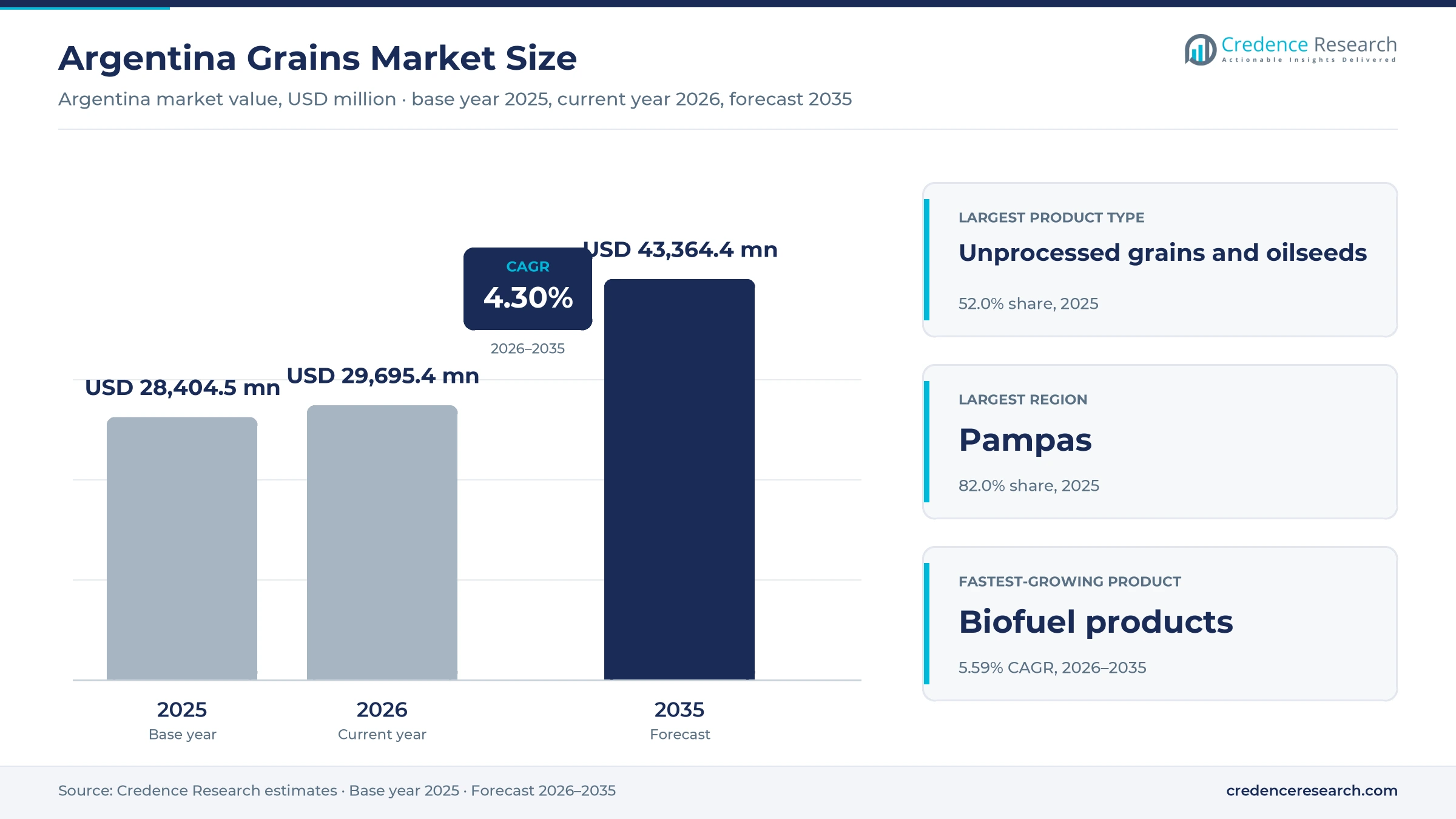
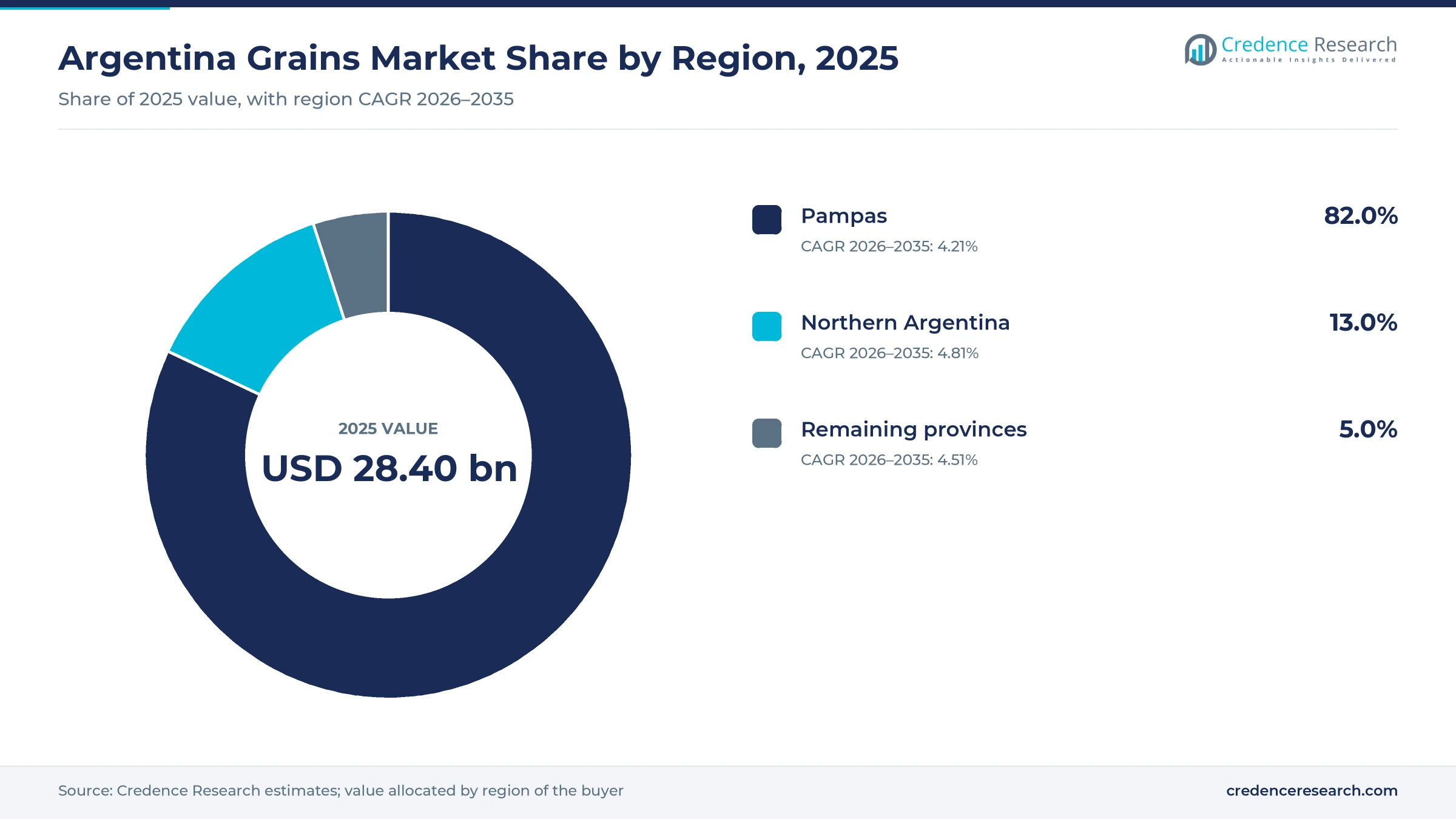
The Argentina grains market was valued at USD 28.40 billion in 2025 and is projected to increase from USD 29.70 billion in 2026 to USD 43.36 billion by 2035, registering a CAGR of 4.30% during 2026–2035. Demand rests on overseas buyers of corn, soybean meal and vegetable oil, supported by domestic feed, milling and fuel blending. The Pampas held the largest regional share, 82.0% in 2025, because the Greater Rosario corridor concentrates crushing plants and river terminals near the main crop belt. Northern Argentina is the fastest-growing region at 4.81% a year, as duty relief improves returns in provinces where freight absorbs the largest part of the crop price. Commercially, Decree 877/2025 lowered export duties in December 2025, and a further cut for wheat and barley took effect in June 2026. As a result, exporters and cooperatives are committing new capital to crushing and port assets.
What does the Argentine grain chain sell, and who buys it?
The market counts first-sale value of grains and oilseeds, along with the protein meals, vegetable oils and biofuels made from them inside Argentina. Producers sell through direct contracts with exporters, through cooperative networks or through independent elevators, and most volume then moves by truck to river terminals on the Paraná.
Retail flour, packaged foods, compound feed and meat are excluded, although those industries appear as buyers of grain and meal. The chain runs from farm storage and country elevators to crushing plants, ethanol plants, flour mills and export vessels, with international commodity buyers setting most reference prices.
Argentina Grains Market Insights
- The Argentina grains market grows from USD 28.40 billion in 2025 to USD 43.36 billion by 2035, a 4.30% annual pace from USD 29.70 billion in 2026.
- The Pampas accounted for 82.0% of 2025 value, anchored by a Greater Rosario corridor holding about 75% of national oilseed crushing capacity.
- Unprocessed grains and oilseeds led product demand with 52.0% of 2025 value, as corn alone was forecast to ship 40 million tons in 2025/26.
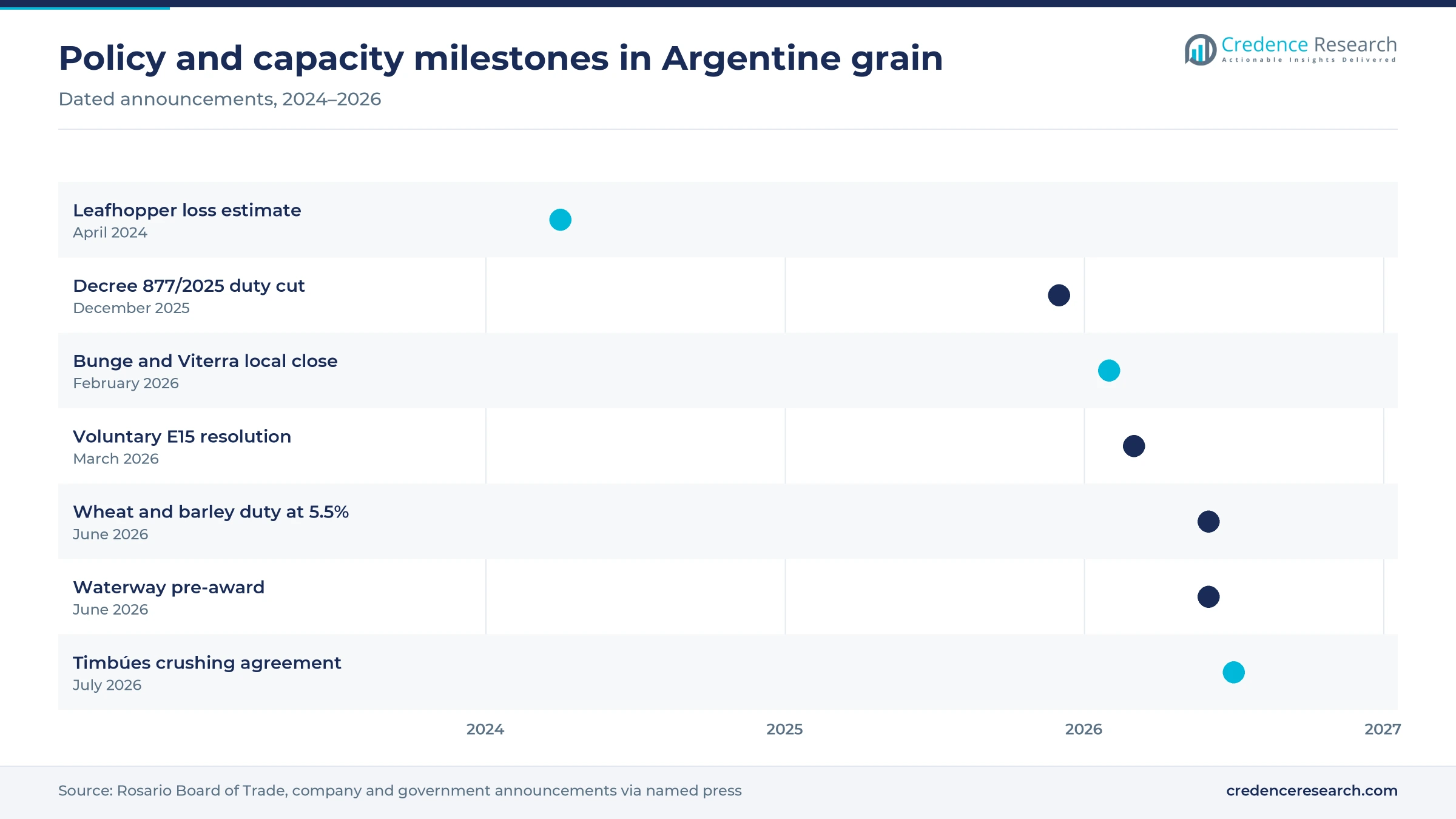
- Decree 877/2025 cut soybean duty to 24% in December 2025, and a May 2026 announcement scheduled monthly soybean reductions starting January 2027.
- Molinos Agro and Asociación de Cooperativas Argentinas agreed in July 2026 to build a 15,000-ton-per-day crushing plant at Timbúes, showing how origination and processing are converging.
Bulk exports lead while biofuels and corn gain ground
Why bulk shipments still outweigh processed products
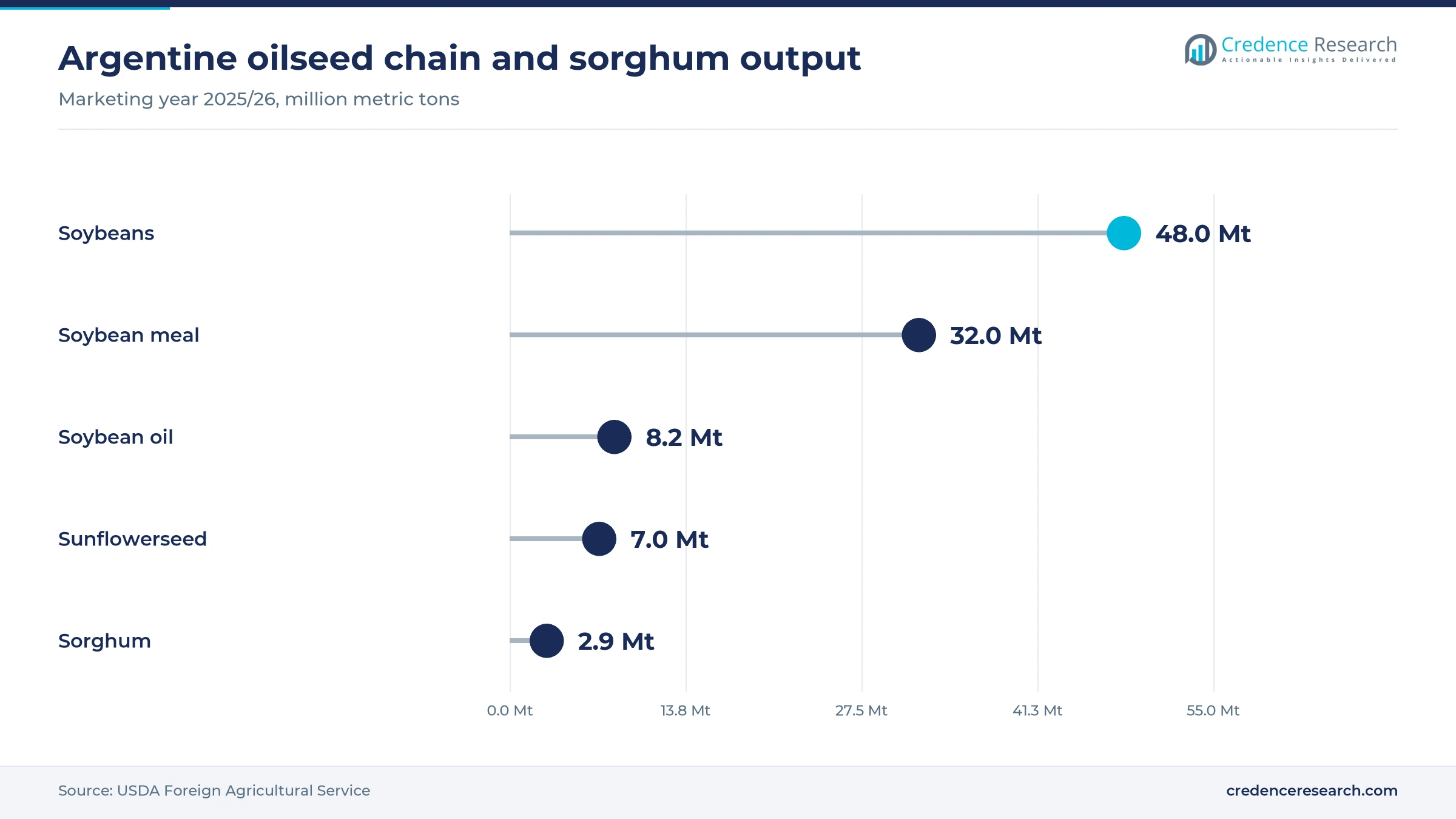
Based on product type, the market is categorized into unprocessed grains and oilseeds, protein meals, vegetable oils and biofuel products. Unprocessed grains and oilseeds led with 52.0% of 2025 value because World Grain reported in April 2026 that corn exports alone would reach 40 million tons in 2025/26. Protein meals follow, with USDA Foreign Agricultural Service data showing 31.98 million tons of soybean meal output in the same year. Biofuel products grow fastest at 5.59% a year as USDA forecast a record 1.35 billion liters of fuel ethanol for 2026.
How oilseeds and corn divide crop value
Based on crop type, the market is categorized into oilseeds, coarse cereals, winter cereals and rice. Oilseeds led with 55.0% of 2025 value because soybean and sunflower processing adds meal and oil value, with about 43 million tons of soybeans crushed in 2025/26, according to World Grain. Coarse cereals grow fastest at 4.74% a year as the Rosario Board of Trade's April 2025 scenario raised corn area 16.8% by 2035. Rice keeps a small share, with export demand of 502,000 tons in 2025, according to the same exchange.
Where feed, food and fuel demand separates
Based on application, the market is categorized into food, feed, bioenergy and material processing. Feed led with 47.0% of 2025 value because soybean meal dominates exports, and the Rosario Board of Trade estimated domestic feed use of corn alone at 12.3 million tons in 2024/25. Food follows, with 6.9 million tons of wheat going to Argentine mills in 2025/26, according to World Grain. Bioenergy grows fastest at 5.45% a year as USDA counted 12 corn-based ethanol plants in August 2026, using about 3% of the corn crop.
How producers reach exporters and processors
Based on sales channel, the market is categorized into direct producer contracts, cooperative aggregation and independent elevators. Direct producer contracts led with 46.0% of 2025 value because large exporters buy at scale, and Cargill alone declared 17.31 million tons of 2025 sales, according to Bichos de Campo. Elevators remain widespread, with a Rosario Board of Trade count of 1,259 companies and 2,458 plants cited by Agrofy in January 2022. Cooperative aggregation grows fastest at 4.78% a year as Asociación de Cooperativas Argentinas agreed in July 2026 to co-develop a Timbúes crushing plant.
| Segment Group | Leading Sub-segment | Share, 2025 | Fastest-growing Sub-segment | CAGR, 2026–2035 |
|---|---|---|---|---|
| By Product Type | Unprocessed grains and oilseeds | 52.0% | Biofuel products | 5.59% |
| By Crop Type | Oilseeds | 55.0% | Coarse cereals | 4.74% |
| By Application | Feed | 47.0% | Bioenergy | 5.45% |
| By Sales Channel | Direct producer contracts | 46.0% | Cooperative aggregation | 4.78% |
Request a Free Sample
Fill in your details and we'll send you a free sample report.
- Sample data tables & charts
- Research methodology
Duty cuts and crush capacity lift Argentine origination
Export incentives and commercial visibility
Lower export duties raise the price exporters can pay at the farm gate, and a published schedule helps producers plan planting. Decree 877/2025, reported by Tridge in December 2025, cut soybeans from 26% to 24%, soybean by-products from 24.5% to 22.5% and corn from 9.5% to 8.5%. In turn, President Javier Milei announced on May 21, 2026, that wheat and barley would fall to 5.5% from June, according to Hellenic Shipping News. The same plan brings monthly soybean cuts of 0.25 to 0.5 percentage points starting in January 2027. Because the path is now public, companies can underwrite plants against rising supply, and coarse cereals, growing 4.74% a year, benefit from wider rotations.
Differentiated international commodity demand
Argentine sales are spreading across buyers that want different products, which reduces dependence on any single destination. Indian demand reached 3.53 million tons of Argentine edible oils in 2025, including 2.88 million tons of crude soybean oil, according to the oilseed chamber CIARA and exporter group CEC. China opened another route when COFCO completed three cargoes totaling 160,000 tons of wheat in December 2025, the first such shipments since 1989, World Grain reported. Europe adds a separate quality market, as the European Union typically buys about a quarter of Argentina's soybean meal, according to DatamarNews. This mix supports meal and feed sales while vegetable oil and wheat find additional outlets abroad.
Integrated origination and industrial networks
Companies are linking grain buying, crushing and port access, because owning the full route protects margins when crops swing. The Greater Rosario corridor already holds 30 port terminals and more than 52 million tons of annual crushing capacity, according to the Rosario Board of Trade. Molinos Agro and Asociación de Cooperativas Argentinas then agreed in July 2026 to build a 15,000-ton-per-day plant at Timbúes, iProfesional reported. Louis Dreyfus Company also announced on June 8, 2026 a 4,000-ton-per-day sunflower and soybean plant at Bahía Blanca, with construction due to begin by the end of 2026. As a result, cooperatives gain an industrial outlet, and processing stays concentrated near the Paraná terminals.
Domestic feed and milling absorb more cereal
Domestic livestock and food industries give producers a second outlet when export premiums weaken, and they lower the share of crop exposed to river freight. The Rosario Board of Trade estimated corn feed demand at 12.3 million tons in 2024/25, including 4.4 million tons for poultry and eggs and 3.9 million tons for beef cattle. World Grain then reported record domestic corn consumption of 18 million tons for 2025/26, a clear step up in local demand. Wheat has a similar base, as nearly 160 Argentine flour mills process about 6.9 million tons with capacity almost double current output. Together, these buyers keep demand steady in interior provinces when vessel premiums soften.
Traceability and biofuel reform reshape grain channels
Traceability shifts premiums in the meal trade
Proof of origin is starting to carry a price, which rewards exporters that can document where soybeans were grown. S&P Global assessed Argentine meal at a $24-per-short-ton premium over futures on Sept. 29, 2026, against $18.50 for Brazilian meal at Paranaguá. S&P linked that widest gap since mid-May to buying ahead of the European Union's deforestation rule, which binds large operators from Dec. 30, 2026. COFCO had earlier shipped 18,000 tons of certified deforestation-free meal from Timbúes to Irish feed maker R&H Hall, World Grain reported, using the Visec monitoring platform. This shift favors direct producer contracts, at 46.0% of 2025 value, because exporters can specify records in the contract.
Merged exporters rise up the declared-sales ranking
Exporter scale is concentrating, which changes how many large bidders a producer can realistically approach during harvest. Sworn export declarations, a direct measure of overseas demand, reached 105.5 million tons in 2025, up 53% from 68.9 million tons in 2024, with Cargill first at 17.31 million tons, according to Bichos de Campo. El Cronista reported on Feb. 5, 2026, that Bunge had closed its local merger with Viterra and named Vladimir Barisic as country manager. AgroLatam then showed Bunge leading the first half of 2026 at 11.6 million tons, ahead of Cargill, COFCO, Louis Dreyfus Company and ADM Agro. In response, cooperative aggregation is gaining bargaining weight and growing at 4.78% a year.
Opportunity in a higher biofuel blending mandate
A larger blending mandate would create a domestic corn and soybean oil outlet that is not exposed to export duties or ocean freight. Argentina's Senate is reviewing bills to replace Biofuels Law 27,640, raising bioethanol from 12% to 15% and biodiesel from 7.5% to 10%, S&P Global reported in August 2026. Secretariat of Energy Resolution 79/2026 already allows voluntary gasoline blends above the current mandate. Spare capacity is available because USDA expects biodiesel plants to run at about 27% of installed capacity in 2026. Agricultores Federados Argentinos is also weighing a bioethanol plant costing $150 million to $170 million, so bioenergy can sustain 5.45% a year if the law passes.
Opening from a renewed Paraná waterway concession
Cheaper river logistics would raise farm-gate prices without any change in world quotes, which makes the waterway a direct opening for exporters and producers. Argentina pre-awarded the dredging and buoy concession to a consortium of Jan De Nul and Servimagnus, the Buenos Aires Times reported on June 5, 2026. The government said the project could cut logistics costs by almost 15%, on a route that carries nearly 80% of Argentine exports. The stakes are large, as Greater Rosario shipped 75.7 million tons of grain, oil and by-products in 2024/25, according to AgroLatam. Northern Argentina could gain most, because its long truck routes end at these same river terminals.
Freight, pests and access rules squeeze producer returns
Long-distance trucking erodes northern returns
Truck freight takes a far larger share of crop value outside the core belt, which limits how much northern land stays in corn. The Rosario Board of Trade found in the second quarter of 2025 that moving corn from Salta to Greater Rosario consumed 28% of its price, against 11% near the ports. Argentine road transportation also cost 32% more than Brazil's on 320-kilometer hauls. Producers respond by shifting crops or feeding grain locally, while the longer-term remedy depends on rail and waterway investment.
Corn leafhopper losses disrupt planting plans
Crop losses from pests have made producers more cautious about corn, especially in the north. The Rosario Board of Trade put 2023/24 leafhopper losses at $1.268 billion in April 2024, after cutting its crop forecast by 6.5 million tons. Bolsa de Cereales still expected corn area in northwest and northeast Argentina to fall in its Aug. 25, 2026, report, even with national area steady at 8.4 million hectares. Elevators and feed buyers therefore face uneven supply, and seed and monitoring programs are the main defense.
Unapproved traits threaten soybean meal access
A small planted area can disrupt a large trade when importers reject mixed cargoes. DatamarNews reported on May 7, 2026, that the Netherlands rejected Argentine soybean meal cargoes containing HB4, a drought-tolerant trait from Bioceres not authorized in the European Union. Dutch buyers now favor Brazilian meal, according to S&P Global. Crushers bear the risk, since the bloc buys about a quarter of Argentina's meal, so industry has georeferenced HB4 fields and routes those trucks directly to a single non-crushing port.
War-driven input costs narrow producer margins
Higher input and shipping costs can absorb the gain from lower duties, particularly on rented land and in distant provinces. The Rosario Board of Trade said in April 2026 that ocean freight had risen as much as 50% and wheat planting costs by $58 per hectare, almost 11%. Bolsa de Cereales then recorded diesel up 48.7% from a year earlier in August 2026. Rice growers are most exposed, as Agriculture Secretariat data show negative net margins since the third quarter of 2024, which helps explain a 14% area cut.
Pampas supply dominates as northern freight limits margin
| Region | Value, 2025 (USD billion) | Share, 2025 | CAGR, 2026–2035 |
|---|---|---|---|
| Pampas | 23.29 | 82.0% | 4.21% |
| Northern Argentina | 3.69 | 13.0% | 4.81% |
| Remaining provinces | 1.42 | 5.0% | 4.51% |
Pampas holds the crop belt and the crushing plants
The Pampas held 82.0% of 2025 value and grows at 4.21% a year, because crop land and industry sit close together. Census data published by La Nación showed Buenos Aires with 3.8 million hectares of soybeans and Córdoba with 3.4 million hectares and 1.9 million hectares of corn. Santa Fe adds the Greater Rosario corridor, which holds about 75% of national crushing capacity. Short hauls keep freight near 7% of the soybean price, supporting stronger farm-gate returns than anywhere else.
Northern Argentina grows from a smaller, costlier base
Northern Argentina held 13.0% of 2025 value and grows fastest at 4.81% a year, as duty relief matters most where transport absorbs the largest share of price. Soybeans from Salta lose about 19% of their price to freight, according to the Rosario Board of Trade, so each duty cut lifts local margins noticeably. Rice also anchors Corrientes, which together with neighboring Entre Ríos holds more than 70% of national rice area, the same exchange reported. However, leafhopper caution continues to restrain corn planting across the zone.
Remaining provinces serve interior and southern needs
The Remaining provinces held 5.0% of 2025 value and grow at 4.51% a year, mainly through feed sales and crops on marginal land. USDA noted that sunflower expansion is reaching marginal zones, which suits drier western and southern districts. Their supply base is thin, as provinces outside Santa Fe, Córdoba and Buenos Aires host only about 5% of the agrimachinery manufacturing base, according to the chamber CAFMA. Long hauls also favor selling grain to nearby livestock buyers rather than distant export terminals.
Duty decrees and new crush plants mark 2025 and 2026
| Development | Status and market relevance |
|---|---|
| In December 2025, Argentina published Decree 877/2025, cutting soybean duty to 24%, wheat and barley to 7.5% and corn and sorghum to 8.5%. | In force; improves netbacks across all main crops |
| In February 2026, Bunge closed its local merger with Viterra and named Vladimir Barisic country manager for Argentina and the Southern Cone. | Closed locally; regulatory steps continue |
| In May 2026, President Javier Milei announced wheat and barley duties of 5.5% from June and monthly soybean cuts from January 2027. | Wheat and barley cut in force; soybean path pending |
| In June 2026, Louis Dreyfus Company announced a 4,000-ton-per-day sunflower and soybean crushing plant at its Bahía Blanca site. | Construction expected to begin by the end of 2026 |
| In July 2026, Molinos Agro and Asociación de Cooperativas Argentinas agreed to build a 15,000-ton-per-day soybean crushing plant at Timbúes. | Agreement signed; construction expected to take about three years |
Segregation, traceability and ethanol change handling
- Satellite and origin monitoring through the Visec platform supports certified deforestation-free meal, as shown by COFCO cargo sold to R&H Hall in Ireland.
- Trait segregation keeps HB4 soybeans apart by georeferencing fields and sending each truck directly to a single port with no crushing facilities, according to DatamarNews.
- Corn-based ethanol supplies about 60% of Argentine fuel ethanol output, drawing on 12 plants counted by USDA in its 2026 outlook.
- Advanced fuel pathways would gain explicit legal status for sustainable aviation fuel and renewable diesel under bills reviewed by the Senate, according to USDA and S&P Global.
Need a Custom Version of This Report?
Tailor the scope, geography, or segments to your exact requirements.
- Custom geography or segment scope
- Direct access to our analyst team
Global traders and cooperatives compete for origination
Competition centers on who secures grain at the farm and who controls crushing and river access. Global traders such as Cargill, Bunge, COFCO International, Louis Dreyfus Company and ADM rely on terminals and crush plants along the Paraná, and they ranked among the leading five by declared sales in the first half of 2026, according to AgroLatam. Local groups Aceitera General Deheza and Molinos Agro stayed in the top ten, with Molinos Agro second in soybeans. Cooperatives compete through reach, because Asociación de Cooperativas Argentinas markets about 26 million tons through 60 development centers and Agricultores Federados Argentinos handles about 7 million tons for more than 15,000 producers. CHS works on a smaller scale through a stake in a Quequén terminal. Consequently, producers can compare trader, crusher, cooperative and elevator bids, although merger activity is reducing the number of the largest buyers.
Companies active in Argentine grain trade and processing
| Company | Type | Role in the market |
|---|---|---|
| Cargill | Global trader and exporter | Led 2025 sworn export declarations at 17.31 million tons and led soybean, corn and wheat categories |
| Bunge | Global trader and crusher | Closed local Viterra merger and led declared sales in the first half of 2026 |
| COFCO International | State-backed trader | Ranked third in 2025; shipped first wheat cargoes to China since 1989 |
| Louis Dreyfus Company | Global trader and processor | Ranked fourth in early 2026 and is adding a Bahía Blanca crushing plant |
| ADM | Global trader | Ranked fifth in the first half of 2026 with 3.6 million tons of declared corn |
| Aceitera General Deheza | Local crusher and exporter | Named among top-ten local exporters in early 2026 |
| Molinos Agro | Local crusher and exporter | Runs a 20,000-ton-per-day San Lorenzo plant and partners on Timbúes |
| Asociación de Cooperativas Argentinas | Cooperative association | Markets about 26 million tons through 60 development centers |
| Agricultores Federados Argentinos | Producer cooperative | Handles about 7 million tons with storage above 3.2 million tons |
| CHS | Cooperative-owned trader | Ranked 10th among 2024 exporters at 1.37 million tons, holds a Quequén terminal stake |
Value depends on duty policy and logistics delivery
Credence Research's view is that Argentina grains value now depends less on crop size alone and more on policy delivery and logistics. Duty cuts have raised farm returns, yet the soybean schedule starting in January 2027 still needs to be carried out on time. Meanwhile, new Timbúes and Bahía Blanca capacity assumes rising supply, which makes corn rotation and pest control central to returns. Buyers should watch the waterway award, the Senate biofuels bills and HB4 segregation, because those three decisions will decide who captures the margin between the farm gate and the vessel.
How the Argentine grain estimates were built
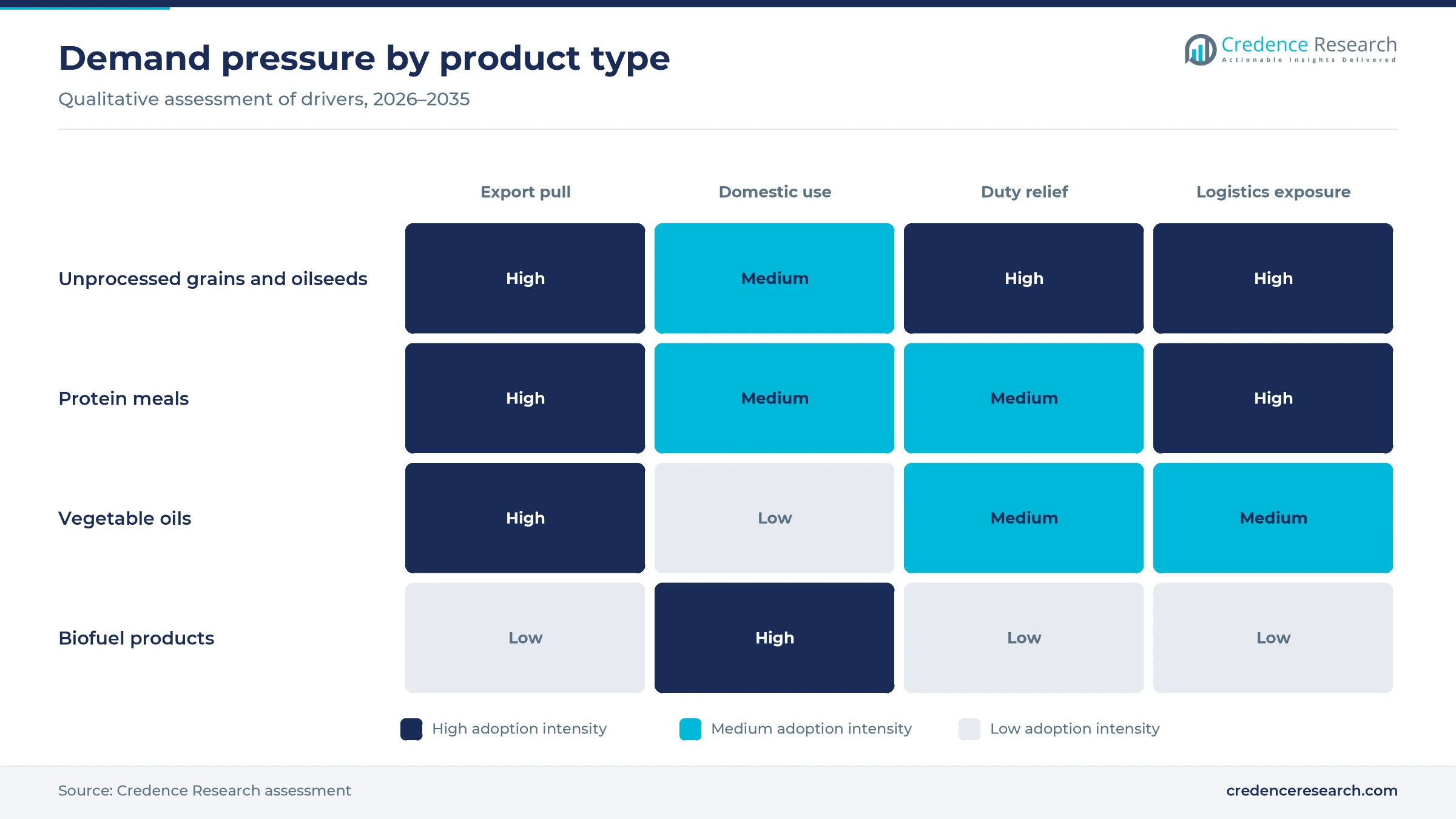
The report uses 2025 as the base year and 2026 to 2035 as the forecast period, with market values taken from the Credence Research model. Segment and regional shares and growth rates are Credence Research estimates, informed by public production, trade and capacity data. Sources include the USDA Foreign Agricultural Service, the Rosario Board of Trade, Bolsa de Cereales, published census data, company announcements and specialist trade press. No interviews or surveys were conducted for this edition, and a qualitative assessment supports the heat map.
Corn, crushing and biofuels steer growth through 2035
The Argentina grains market should reach USD 43.36 billion by 2035, growing at 4.30% a year from USD 29.70 billion in 2026. Corn is likely to gain the most, helped by rotation back from soybeans, feed use and ethanol, while soybeans benefit from scheduled duty cuts. The Rosario Board of Trade's optimistic scenario of April 2025 shows total output above 250 million tons by 2035, a level that would require yields far above today's. Actual growth will be more modest, depending on sustained policy, waterway delivery and access to European and Asian meal buyers.
Frequently Asked Questions
How big is the Argentina grains market?
Which product type leads Argentine grain sales?
Which region holds the largest share?
What are the current Argentine export duties on grains?
Why is Northern Argentina the fastest-growing region?
How do biofuels affect demand for Argentine grain?
What are the main challenges for Argentine producers?
Who are the leading companies in the Argentine grain trade?
Table of Content
Chapter 1 Market Segmentation
- 1.1 Segmentation Framework
- 1.1.1 Product and Service Classification
- 1.1.2 Application and End-Use Classification
- 1.1.3 Technology and Solution Classification
- 1.1.4 Customer and Distribution Channel Classification
- 1.1.5 Geographic Segmentation
- 1.1.6 Market Segment Definitions and Boundaries
- 1.2 By Product Type
- 1.2.1 Unprocessed grains and oilseeds
- 1.2.2 Protein meals
- 1.2.3 Vegetable oils
- 1.2.4 Biofuel products
- 1.3 By Crop Type
- 1.3.1 Oilseeds
- 1.3.2 Coarse cereals
- 1.3.3 Winter cereals
- 1.3.4 Rice
- 1.4 By Application
- 1.4.1 Feed
- 1.4.2 Food
- 1.4.3 Material processing
- 1.4.4 Bioenergy
- 1.5 By Sales Channel
- 1.5.1 Direct producer contracts
- 1.5.2 Independent elevators
- 1.5.3 Cooperative aggregation
Chapter 2 Introduction
- 2.1 Report Objectives and Scope
- 2.2 Product Definition and Industry Terminology
- 2.3 Market Inclusions and Exclusions
- 2.4 Research Process
- 2.4.1 Primary Research and Expert Interviews
- 2.4.2 Secondary Research and Source Review
- 2.4.3 Top-Down and Bottom-Up Estimation
- 2.4.4 Data Triangulation and Verification
- 2.5 Market Size Measurement Basis
- 2.5.1 2025: USD 28.40 billion → 2035: USD 43.36 billion
- 2.6 Historical and Forecast Reference Periods
- 2.6.1 Historical Period: 2018-2025
- 2.6.2 Base Year: 2025
- 2.6.3 Forecast Period: 2025-2035
- 2.7 Research Assumptions and Limitations
Chapter 3 Executive Summary
- 3.1 Market Snapshot and Key Findings
- 3.2 Base-Year Market Size, 2025
- 3.3 Forecast Market Size, 2035
- 3.4 Revenue and Volume Growth Outlook
- 3.5 Key Demand and Supply Indicators
- 3.6 Leading Market Segments
- 3.7 Fastest-Growing Market Opportunities
- 3.8 Regional Performance Highlights
- 3.9 Technology and Industry Transformation
- 3.10 Competitive Landscape Summary
- 3.11 Analyst View and Strategic Implications
Chapter 4 Argentina Grains Market Trends and Developments
- 4.1 Historical Industry Development, 2018-2025
- 4.2 Recent Market Trends and Developments
- 4.3 Demand and Customer Behavior Trends
- 4.4 Technology and Product Innovation
- 4.5 Artificial Intelligence, Automation and Digitalization
- 4.6 Local Manufacturing and Supply Chain Realignment
- 4.7 Industry Partnerships, Mergers and Acquisitions
- 4.8 Sustainability and Circular Economy Developments
- 4.9 Government and Private Sector Investment Trends
- 4.10 Emerging Business Models and Commercialization
- 4.11 Industry Developments and Announcements
Chapter 5 Argentina Grains Market Production, Supply and Demand Analysis
- 5.1 Demand Trend and Consumption Analysis, 2018-2025
- 5.2 Demand Forecast, 2025-2035
- 5.3 Production and Output Trend, 2018-2025
- 5.4 Production and Output Forecast, 2025-2035
- 5.5 Installed Capacity and Capacity Utilization
- 5.6 Company-Wise Production Plants and Statistics
- 5.6.1 Installed Production Capacity
- 5.6.2 Actual Production
- 5.6.3 Planned Capacity and Expansion Targets
- 5.7 Supply Chain Structure and Procurement Trends
- 5.8 Supply-Demand Gap and Bottlenecks
- 5.9 Import Dependence and Sourcing Structure
- 5.10 Contract Manufacturing and Outsourcing
- 5.11 Regional Supply and Demand Concentration
Chapter 6 Argentina Grains Market Pricing Analysis
- 6.1 Pricing Structure and Measurement
- 6.2 Historical Pricing Trends, 2018-2025
- 6.3 Pricing Outlook, 2025-2035
- 6.4 Average Selling Price and Unit Economics
- 6.5 Pricing by Product and Market Segment
- 6.6 Geographic Pricing Differences
- 6.7 Key Input, Energy, Labor and Logistics Costs
- 6.8 Contract Pricing and Purchasing Models
- 6.9 Pricing Sensitivity and Competitive Positioning
- 6.10 Price, Margin and Profitability Implications
Chapter 7 Argentina Grains Market Dynamics
- 7.1 Market Growth Drivers
- 7.1.1 Demand-Side Drivers
- 7.1.2 Technology and Innovation Drivers
- 7.1.3 Infrastructure and Investment Drivers
- 7.1.4 Regulatory and Policy Drivers
- 7.2 Market Restraints
- 7.2.1 Cost and Affordability Constraints
- 7.2.2 Technology and Adoption Barriers
- 7.2.3 Supply Chain and Operational Constraints
- 7.3 Market Challenges
- 7.3.1 Competitive Pressure and Margin Erosion
- 7.3.2 Skills, Infrastructure and Implementation Gaps
- 7.4 Emerging Market Opportunities
- 7.5 Market Dynamics Impact and Time-Horizon Assessment
Chapter 8 Argentina Grains Value Chain Analysis
- 8.1 Industry Value Chain Overview
- 8.2 Upstream Suppliers and Critical Inputs
- 8.3 Technology and Component Providers
- 8.4 Manufacturing or Service Delivery
- 8.5 Distribution, Channel Partners and Integrators
- 8.6 Downstream Applications and End Users
- 8.7 Value Addition and Profit Pools
- 8.8 Vertical Integration and Outsourcing
- 8.9 Supplier Concentration and Risk
- 8.10 Supply Chain Localization and Resilience
Chapter 9 Argentina Grains Market Regulations and Policies
- 9.1 Relevant Laws, Standards and Compliance Frameworks
- 9.2 Product, Service, Safety and Quality Requirements
- 9.3 Government Policies, Incentives and Subsidies
- 9.4 Imports, Exports and Trade Barriers
- 9.5 Public Procurement and Local Content Requirements
- 9.6 Environmental and Sustainability Compliance
- 9.7 Upcoming Policy Changes and Market Implications
Chapter 10 Argentina Grains Market Hotspots and Opportunities
- 10.1 Market Opportunity Mapping and Growth Hotspots
- 10.2 High-Growth Applications and Customer Groups
- 10.3 Underserved Markets and White-Space Opportunities
- 10.4 Emerging Technology and Product Opportunities
- 10.5 New Capacity and Investment Hotspots
- 10.6 Market Entry and Expansion Opportunities
- 10.7 Distribution and Partnership Opportunities
- 10.8 Near-Term and Long-Term Commercial Potential
- 10.9 Opportunity Attractiveness and Execution Risks
Chapter 11 Argentina Grains Market Outlook, 2025-2035
- 11.1 Market Size and Analysis
- 11.1.1 Revenue (Market Measurement: 2025: USD 28.40 billion → 2035: USD 43.36 billion)
- 11.1.2 Market Volume and Quantity Sold
- 11.1.3 Historical Market Size, 2018-2025
- 11.1.4 Base-Year Market Size, 2025
- 11.2 Market Forecast, 2025-2035
- 11.2.1 Revenue Forecast to 2035
- 11.2.2 Volume Forecast to 2035
- 11.2.3 CAGR and Year-on-Year Growth
- 11.2.4 Incremental Revenue Opportunity
- 11.3 Forecast Assumptions and Scenario Analysis
- 11.3.1 Base-Case Forecast
- 11.3.2 Optimistic and Conservative Scenarios
- 11.3.3 Technology, Pricing and Policy Sensitivities
- 11.4 Market Attractiveness and Growth Outlook
Chapter 12 Argentina Grains Market Segmentation and Outlook
- 12.1 Segmentation Summary and Market Shares, 2025
- 12.2 Largest and Fastest-Growing Segments
- 12.3 By Product Type - Market Size and Forecast, 2025-2035
- 12.3.1 Segment Definition and Scope
- 12.3.2 Historical Market Size, 2018-2025
- 12.3.3 Revenue Forecast, 2025-2035
- 12.3.4 Volume Forecast, 2025-2035
- 12.3.5 Base-Year Market Share, 2025
- 12.3.6 Segment CAGR and Growth Drivers
- 12.3.7 Subsegment Market Size and Forecast
- 12.3.7.1 Unprocessed grains and oilseeds
- 12.3.7.2 Protein meals
- 12.3.7.3 Vegetable oils
- 12.3.7.4 Biofuel products
- 12.3.8 Subsegment Pricing and Adoption Trends
- 12.3.9 Leading Suppliers and Competition
- 12.3.10 Regional Demand and Opportunities
- 12.4 By Crop Type - Market Size and Forecast, 2025-2035
- 12.4.1 Segment Definition and Scope
- 12.4.2 Historical Market Size, 2018-2025
- 12.4.3 Revenue Forecast, 2025-2035
- 12.4.4 Volume Forecast, 2025-2035
- 12.4.5 Base-Year Market Share, 2025
- 12.4.6 Segment CAGR and Growth Drivers
- 12.4.7 Subsegment Market Size and Forecast
- 12.4.7.1 Oilseeds
- 12.4.7.2 Coarse cereals
- 12.4.7.3 Winter cereals
- 12.4.7.4 Rice
- 12.4.8 Subsegment Pricing and Adoption Trends
- 12.4.9 Leading Suppliers and Competition
- 12.4.10 Regional Demand and Opportunities
- 12.5 By Application - Market Size and Forecast, 2025-2035
- 12.5.1 Segment Definition and Scope
- 12.5.2 Historical Market Size, 2018-2025
- 12.5.3 Revenue Forecast, 2025-2035
- 12.5.4 Volume Forecast, 2025-2035
- 12.5.5 Base-Year Market Share, 2025
- 12.5.6 Segment CAGR and Growth Drivers
- 12.5.7 Subsegment Market Size and Forecast
- 12.5.7.1 Feed
- 12.5.7.2 Food
- 12.5.7.3 Material processing
- 12.5.7.4 Bioenergy
- 12.5.8 Subsegment Pricing and Adoption Trends
- 12.5.9 Leading Suppliers and Competition
- 12.5.10 Regional Demand and Opportunities
- 12.6 By Sales Channel - Market Size and Forecast, 2025-2035
- 12.6.1 Segment Definition and Scope
- 12.6.2 Historical Market Size, 2018-2025
- 12.6.3 Revenue Forecast, 2025-2035
- 12.6.4 Volume Forecast, 2025-2035
- 12.6.5 Base-Year Market Share, 2025
- 12.6.6 Segment CAGR and Growth Drivers
- 12.6.7 Subsegment Market Size and Forecast
- 12.6.7.1 Direct producer contracts
- 12.6.7.2 Independent elevators
- 12.6.7.3 Cooperative aggregation
- 12.6.8 Subsegment Pricing and Adoption Trends
- 12.6.9 Leading Suppliers and Competition
- 12.6.10 Regional Demand and Opportunities
- 12.7 Segment Growth Comparison
- 12.8 Segment Attractiveness and Priority Matrix
Chapter 13 Argentina Grains End-Use and Application Market Outlook
- 13.1 End-Use Industry and Customer Demand Structure
- 13.2 Leading Applications and Customer Groups
- 13.3 End-Use Market Size, Share and Forecast
- 13.4 Major End-Use Industry Deep Dives
- 13.4.1 Customer Requirements and Use Cases
- 13.4.2 Demand and Replacement Cycles
- 13.4.3 Technical and Regulatory Considerations
- 13.4.4 Purchasing and Procurement Models
- 13.4.5 Leading Vendors and Distribution Channels
- 13.4.6 Forecast and Commercial Opportunities
- 13.5 Emerging Applications and Cross-Segment Demand
- 13.6 End-Use Industry Investment Priorities
Chapter 14 Argentina Grains Geographic Market Outlook, 2025-2035
- 14.1 Domestic Market Distribution and Demand Clusters
- 14.2 State- or Province-Wise Market Size and Forecast, 2025-2035
- 14.3 City and Metropolitan Market Outlook
- 14.4 Industrial, Manufacturing and Commercial Clusters
- 14.5 Geographic Concentration of Key End Users
- 14.6 Local Pricing and Purchasing Differences
- 14.7 Domestic Production Facilities and Capacity Map
- 14.8 Local Infrastructure and Project Pipeline
- 14.9 State-Level Policy and Incentive Differences
- 14.10 Subnational Investment Hotspots and Opportunities
- 14.11 Distribution and Logistics Networks
- 14.12 Domestic Competitive Footprint
Chapter 15 Argentina Grains Technology, Innovation and Sustainability Outlook
- 15.1 Technology Landscape and Maturity
- 15.2 Product, Process and Service Innovation
- 15.3 AI, Automation and Digital Tools in the Industry
- 15.4 Technology Adoption and Performance Benchmarking
- 15.5 Innovation Pipeline and R&D Investment
- 15.6 Patent and Intellectual Property Trends
- 15.7 Energy Efficiency and Resource Management
- 15.8 Sustainability, Recycling and Circularity
- 15.9 Technology Roadmap, 2025-2035
- 15.10 Risks of Obsolescence and Technology Substitution
Chapter 16 Argentina Grains Market Key Strategic Imperatives
- 16.1 Growth and Market Entry Priorities
- 16.2 High-Return Products and Segments
- 16.3 Pricing, Profitability and Cost Optimization
- 16.4 Technology Investment and Product Differentiation
- 16.5 Supply Chain Localization and Resilience
- 16.6 Distribution and Customer Acquisition
- 16.7 Partnership, Acquisition and Capacity Strategy
- 16.8 Regional Expansion Priorities
- 16.9 Short-, Medium- and Long-Term Actions
Chapter 17 Competition Outlook
- 17.1 Industry Competition Characteristics
- 17.2 Market Structure and Concentration
- 17.3 Market Share and Competitive Positioning, 2025
- 17.4 Company-Wise Revenue and Product Benchmarking
- 17.5 Production and Service Capacity Benchmarking
- 17.6 Technology, Pricing and Differentiation
- 17.7 Regional Footprint and Distribution Strength
- 17.8 Mergers, Acquisitions and Strategic Alliances
- 17.9 New Entrants and Competitive Threats
- 17.10 Porter's Five Forces and Industry Attractiveness
- 17.11 Competitive Outlook, 2025-2035
Chapter 18 Company Profiles
- 18.1 Company Coverage and Selection Criteria
- 18.2 Bunge
- 18.2.1 Business Description
- 18.2.2 Company Ownership and Geographic Presence
- 18.2.3 Product and Service Portfolio
- 18.2.4 Manufacturing and Operating Footprint
- 18.2.5 Production Capacity and Expansion Plans
- 18.2.6 Financial Performance and Investment
- 18.2.7 Market Share and Competitive Position
- 18.2.8 Technology and Innovation Capabilities
- 18.2.9 Strategic Alliances or Partnerships
- 18.2.10 Recent Developments
- 18.2.11 Growth Strategy and Outlook
- 18.3 Cargill
- 18.4 COFCO International
- 18.5 Aceitera General Deheza
- 18.6 Louis Dreyfus Company
- 18.7 ADM
- 18.8 Asociación de Cooperativas Argentinas
- 18.9 Molinos Agro
- 18.10 CHS
- 18.11 Agricultores Federados Argentinos
- 18.12 Other Relevant Market Participants
Note: Every listed company is profiled on the structure shown under the first company. The company list is preliminary and may change based on research findings, market developments, data availability and client requirements.
Chapter 19 Disclaimer
- 19.1 Research and Forecast Disclaimer
- 19.2 Data Source and Estimation Limitations
Note: The depth of individual sections depends on data availability for this market. Volume, capacity, trade and other unit-based metrics are included where applicable.

