Asia Pacific Gastrointestinal Drugs Market Overview:
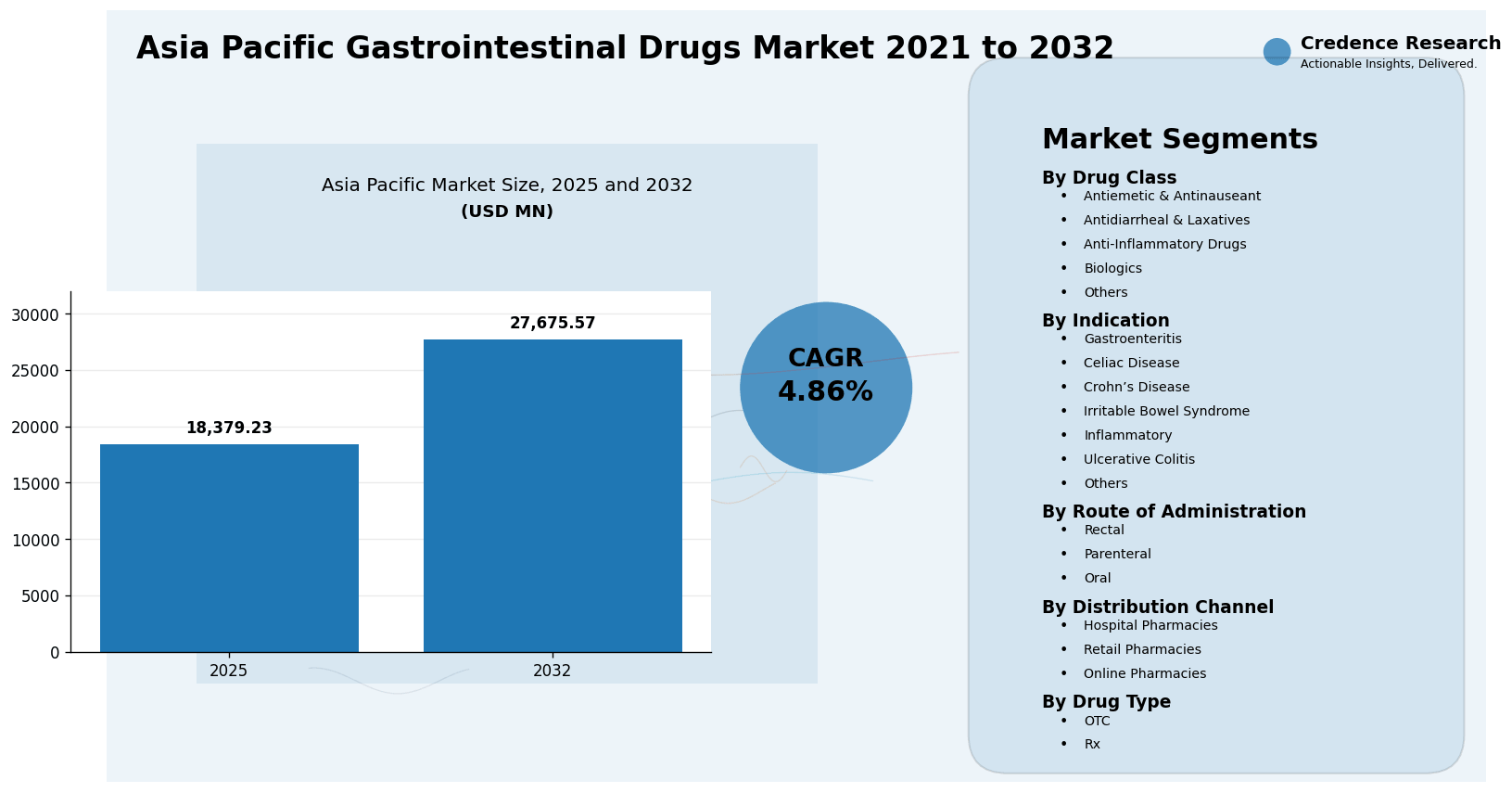
The Asia Pacific Gastrointestinal Drugs Market size was valued at USD 14,076.07 MN in 2021 and reached USD 18,379.23 MN in 2025. It is anticipated to reach USD 27,675.57 MN by 2032, growing at a CAGR of 4.86% during the forecast period.
| REPORT ATTRIBUTE | DETAILS |
|---|---|
| Historical Period | 2021-2024 |
| Base Year | 2025 |
| Forecast Period | 2025-2032 |
| Asia Pacific Gastrointestinal Drugs Market Size 2025 | USD 18,379.23 million |
| Asia Pacific Gastrointestinal Drugs Market, CAGR | 4.86% |
| Asia Pacific Gastrointestinal Drugs Market Size 2032 | USD 27,675.57 million |
Asia Pacific Gastrointestinal Drugs Market Insights
- Market growth is supported by high gastrointestinal disease burden, rising inflammatory bowel disease treatment, broader access to OTC digestive medicines, biologic adoption and expansion of retail and online pharmacy channels.
- Antidiarrheal & Laxatives hold a strong position because gastroenteritis, diarrhea, constipation and irritable bowel syndrome create frequent demand across OTC and Rx pathways.
- Biologics are gaining momentum as Crohn’s Disease and Ulcerative Colitis treatment shifts toward targeted therapies in specialist hospital and retail-linked channels.
- Oral holds the leading route of administration because most gastrointestinal drugs are used in outpatient settings through tablets, capsules, solutions and suspensions.
Asia Pacific Gastrointestinal Drugs Market Segment Insights
By drug class
By drug class, Antidiarrheal & Laxatives held a strong position in 2025 because acute gastroenteritis, diarrhea, constipation and irritable bowel syndrome require frequent treatment across hospitals, retail pharmacies and OTC channels. Antiemetic & Antinauseant drugs support demand across gastroenteritis, chemotherapy-related nausea, postoperative care, pregnancy-related nausea and general digestive complaints. Anti-Inflammatory Drugs remain important for inflammatory bowel disease, including Crohn’s Disease and Ulcerative Colitis. Biologics are gaining value as advanced gastrointestinal care shifts toward targeted immune-modulating therapies. Others include proton pump inhibitors, antacids, prokinetics, bile acid modulators, antispasmodics and emerging microbiome-linked therapies.
By indication
By indication, Gastroenteritis held a strong position in 2025 because acute gastrointestinal infection and diarrheal illness remain common across Asia Pacific. Irritable Bowel Syndrome supports steady OTC and prescription demand for laxatives, antidiarrheals, antispasmodics and symptom-control products. Crohn’s Disease and Ulcerative Colitis are gaining attention because inflammatory bowel disease treatment is shifting toward biologics, targeted oral therapies and maintenance regimens. Celiac Disease remains a smaller but relevant indication requiring diagnostic awareness and symptom management. Inflammatory supports treatment demand across immune-mediated gastrointestinal conditions. Others include acid-related disorders, functional gastrointestinal disorders, short bowel syndrome and related digestive conditions.
By route of administration
By route of administration, Oral held the strongest position in 2025 because most gastrointestinal drugs are administered through tablets, capsules, powders, suspensions and oral solutions. Oral therapy supports convenient outpatient treatment across Gastroenteritis, Irritable Bowel Syndrome, Celiac Disease, Inflammatory, Ulcerative Colitis and other digestive disorders. Parenteral administration remains important in hospitals for biologics, severe inflammatory bowel disease, dehydration-related care, antiemetics and complex gastrointestinal cases. Rectal administration remains relevant for localized ulcerative colitis therapy, bowel preparation, constipation management and selected anti-inflammatory treatment. Route growth will depend on disease severity, patient age, adherence, drug format and clinical setting.
By Distribution Channel
By distribution channel, Retail Pharmacies held a strong position in 2025 because gastrointestinal drugs are frequently used for outpatient treatment, self-care and chronic prescription refills. Hospital Pharmacies remain important for parenteral therapy, biologics, severe inflammatory bowel disease, dehydration management and acute care. Online Pharmacies are gaining traction because consumers increasingly seek convenience, home delivery and repeat prescription fulfillment for chronic gastrointestinal conditions. Retail access also supports OTC demand for antidiarrheals, laxatives, antiemetics, antacids and related digestive medicines. Channel growth will favor pharmacy networks that improve affordability, product availability, patient education and refill continuity.
By drug type
By drug type, OTC held a strong position in 2025 because many gastrointestinal conditions are managed through self-care products. Antidiarrheals, laxatives, antiemetics, antacids, oral rehydration products and digestive symptom-control drugs are widely purchased through retail and online pharmacies. Rx drugs remain essential for Crohn’s Disease, Ulcerative Colitis, severe gastroenteritis, persistent inflammatory conditions and complex gastrointestinal disorders requiring physician oversight. Rx demand is expanding through biologics, advanced anti-inflammatory therapies and targeted oral products. Growth across OTC and Rx segments will depend on consumer behavior, diagnosis rates, payer access, physician prescribing and regulatory controls.
Key Market Drivers
High gastroenteritis and diarrheal disease burden
High gastroenteritis and diarrheal disease burden represents a major growth driver for the Asia Pacific Gastrointestinal Drugs Market. Acute diarrhea and gastrointestinal infection create frequent demand for Antidiarrheal & Laxatives, Antiemetic & Antinauseant drugs, oral rehydration products and supportive therapies. Retail Pharmacies and Online Pharmacies benefit from high self-care demand, while Hospital Pharmacies support severe cases requiring parenteral treatment and dehydration management.
WHO reports that diarrheal disease is a leading cause of child mortality and morbidity globally and kills about 443,832 children each year, while its Western Pacific office describes diarrhea as a major cause of death and serious illness among children younger than 5 years old. This disease burden supports continued demand for oral and parenteral gastrointestinal therapies across Asia Pacific.
Inflammatory bowel disease treatment expansion
Inflammatory bowel disease treatment expansion supports strong demand for Anti-Inflammatory Drugs, Biologics and targeted Rx therapies. Crohn’s Disease and Ulcerative Colitis require chronic treatment, escalation pathways and maintenance therapy. Hospitals and specialist clinics remain central for diagnosis, biologic initiation and severe disease management, while retail and online channels support long-term refill access.
Takeda reported that first-half fiscal 2025 Gastroenterology revenue reached 692.8 billion yen and grew 3.2% on a constant exchange rate basis, while ENTYVIO for ulcerative colitis and Crohn’s disease grew 5.1% on the same basis. This supports demand for biologics and advanced gastrointestinal therapies across major Asia Pacific markets.
Growth in biologics and targeted gastrointestinal therapies
Growth in biologics and targeted gastrointestinal therapies is strengthening market value as treatment shifts from broad symptom control to pathway-specific disease management. Biologics and advanced oral therapies support patients with moderate to severe inflammatory bowel disease who do not respond to conventional treatment.
AbbVie reported full-year 2025 global immunology portfolio net revenues of USD 30.406 billion, with Skyrizi at USD 17.562 billion and Rinvoq at USD 8.304 billion, while both products have inflammatory bowel disease indications in major markets. Johnson & Johnson also received U.S. FDA approval for TREMFYA in adults with moderately to severely active Crohn’s disease in March 2025 after prior ulcerative colitis approval, underscoring continued investment in IL-23 pathway therapies.
Expansion of retail and online pharmacy access
Expansion of retail and online pharmacy access supports market growth by improving access to OTC and Rx gastrointestinal drugs. Patients frequently use pharmacies for antidiarrheals, laxatives, antiemetics, antacids, oral rehydration products and chronic gastrointestinal prescriptions. Online Pharmacies are gaining value in urban markets because they support refill convenience, home delivery and access to repeat prescriptions.
Pfizer Japan received approval in June 2025 for Velsipity tablets for moderate to severe ulcerative colitis, while Bristol Myers Squibb launched Zeposia in Japan in March 2025 as a once-daily oral therapy for moderate to severe ulcerative colitis. These oral Rx therapies support outpatient dispensing opportunities and wider channel participation beyond infusion-only treatment.
Key Trends and Opportunities
Biologics gain stronger role in IBD care
Biologics are gaining a stronger role in inflammatory bowel disease care as physicians seek deeper remission, better maintenance outcomes and improved options after conventional therapy failure. Crohn’s Disease and Ulcerative Colitis remain key opportunities because patients often need long-term therapy and periodic treatment switching. Johnson & Johnson said TREMFYA received Japan approval in 2025 for adults with moderate to severe Ulcerative Colitis and Crohn’s Disease after inadequate response or intolerance to existing therapies, and its subcutaneous formulation later received approval for ulcerative colitis induction therapy in Japan in 2026. This trend supports growth for Biologics, Parenteral therapies and Hospital Pharmacies, while subcutaneous formats can support broader outpatient care.
Oral advanced therapies expand convenience
Oral advanced therapies are creating growth opportunities because patients and providers value convenient treatment formats for chronic gastrointestinal diseases. Oral therapies can reduce infusion center dependence, support outpatient care and improve patient acceptance when safety and efficacy align with clinical needs. Pfizer Japan received approval for Velsipity tablets in June 2025 for moderate to severe ulcerative colitis, while Bristol Myers Squibb launched Zeposia in Japan in March 2025 after approval for moderate to severe ulcerative colitis. This trend supports Rx drugs, Oral administration and Retail Pharmacies. It also strengthens competition among companies developing small molecules for inflammatory bowel disease.
OTC digestive care expands through self-medication
OTC digestive care is expanding as consumers manage mild gastrointestinal symptoms through retail and online pharmacy channels. Antidiarrheals, laxatives, antacids, antiemetics and oral rehydration products support frequent purchases across urban and semi-urban markets. Demand is strongest where consumers seek quick symptom relief, convenience and lower-cost access without specialist consultation. Retail Pharmacies remain central because pharmacists can guide product selection and identify cases that need referral. Online Pharmacies add convenience through fast delivery and repeat purchases. This trend supports OTC growth but also requires responsible labeling, safe use education and clear referral guidance for severe symptoms.
Key Market Challenges
Pricing pressure and affordability constraints
Pricing pressure and affordability constraints remain key challenges for the Asia Pacific Gastrointestinal Drugs Market. Many consumers rely on out-of-pocket spending, especially for OTC products, chronic therapies and specialist gastrointestinal medicines. Biologics and targeted Rx drugs can face reimbursement barriers in emerging markets because prices remain high compared with conventional therapies. Payers and hospitals often require strong clinical evidence before adopting premium gastrointestinal drugs. Retail channels also face price competition from generics and private-label products. Manufacturers must balance innovation with affordability, access programs and country-specific pricing strategies.
Uneven diagnosis and specialist access
Uneven diagnosis and specialist access can slow adoption of advanced gastrointestinal drugs. Crohn’s Disease, Ulcerative Colitis, Celiac Disease and Irritable Bowel Syndrome require accurate diagnosis, specialist referral and follow-up. Many emerging markets face gaps in gastroenterologists, endoscopy capacity, laboratory diagnostics and chronic disease management. Patients may use OTC products before receiving a formal diagnosis, which can delay treatment for inflammatory or severe disease. This challenge limits biologic and Rx adoption outside major cities. Improving referral pathways, diagnostic capacity and clinician education will be important for market expansion.
Safety and adherence concerns
Safety and adherence concerns affect long-term gastrointestinal drug use. Biologics, anti-inflammatory drugs and immunomodulators require monitoring for infection risk, adverse events and treatment response. Oral therapies improve convenience but still require adherence, especially in chronic conditions such as ulcerative colitis, Crohn’s disease and irritable bowel syndrome. OTC products also carry misuse risk when consumers overuse laxatives, antidiarrheals or antiemetics without medical advice. Pharmacies and physicians must support education, monitoring and escalation when symptoms persist. Companies that provide clear safety guidance and patient support will improve persistence.
Regional Analysis
China
China represents a major opportunity within the Asia Pacific Gastrointestinal Drugs Market due to its large patient base, expanding hospital infrastructure, growing retail pharmacy network and increasing access to advanced Rx therapies. Demand is broad across Gastroenteritis, Irritable Bowel Syndrome, Inflammatory, Ulcerative Colitis and Crohn’s Disease. Oral therapies and OTC products support strong consumer use, while biologics and advanced anti-inflammatory drugs are gaining ground in specialist care. Hospital Pharmacies remain important for severe disease and parenteral therapies. Retail and online pharmacy channels are expanding quickly in urban markets. Growth will depend on reimbursement, domestic competition, diagnosis rates and patient access.
Japan
Japan supports strong demand for gastrointestinal drugs due to mature health care infrastructure, specialist access, aging demographics and broader availability of advanced therapies. Ulcerative Colitis and Crohn’s Disease are key areas for biologics and oral targeted drugs. The market also supports demand for OTC digestive medicines, antiemetics, laxatives and symptom-control therapies through retail pharmacies. Hospital Pharmacies play a central role in biologic initiation and severe disease management, while Retail Pharmacies and Online Pharmacies support chronic refills. Japan remains an important market for product launches, including oral IBD therapies and biologic innovations.
India
India is an expanding market supported by a large population, high gastroenteritis burden, growing retail pharmacy access and rising diagnosis of chronic gastrointestinal conditions. OTC products such as antidiarrheals, laxatives, antacids, antiemetics and oral rehydration products remain important due to self-medication and affordability needs. Rx demand is increasing in private hospitals and specialty clinics for Crohn’s Disease, Ulcerative Colitis, Celiac Disease and Irritable Bowel Syndrome. Oral remains the leading route due to affordability and convenience. Growth will depend on diagnosis access, physician awareness, insurance coverage and availability of advanced therapies.
South Korea
South Korea represents a technologically advanced market supported by strong hospital systems, specialist networks and high awareness of chronic gastrointestinal conditions. Demand is strong across inflammatory bowel disease, irritable bowel syndrome and advanced Rx therapies. Hospital Pharmacies support biologic and parenteral treatment, while Retail Pharmacies manage outpatient refills and OTC digestive care. Online pharmacy growth remains shaped by regulation, but digital health engagement supports patient awareness and disease management. South Korea remains attractive for advanced gastrointestinal therapies due to strong clinical infrastructure and physician adoption.
Australia and New Zealand
Australia and New Zealand represent mature gastrointestinal drugs markets supported by structured health systems, specialist referral pathways and evidence-based reimbursement decisions. Demand is strong across Crohn’s Disease, Ulcerative Colitis, Irritable Bowel Syndrome, Gastroenteritis and OTC digestive care. Hospital Pharmacies support biologics, parenteral therapies and severe disease treatment, while Retail Pharmacies support chronic refills and self-care products. Access to premium Rx drugs depends on reimbursement, clinical criteria and national drug funding processes. These markets are expected to support steady demand for biologics, oral therapies and patient-friendly treatment formats.
Southeast Asia
Southeast Asia offers high growth potential due to rising urbanization, expanding retail pharmacy networks, private hospital growth and frequent gastrointestinal infection burden. Gastroenteritis and diarrhea support strong demand for OTC and oral therapies. Crohn’s Disease and Ulcerative Colitis remain smaller but growing indications as diagnosis improves in Singapore, Thailand, Malaysia, Indonesia, Vietnam and the Philippines. Hospital Pharmacies remain important for severe cases and biologics, while Retail Pharmacies and Online Pharmacies support broader access to OTC digestive products. Growth will depend on affordability, reimbursement, diagnosis capacity and pharmacy modernization.
Report Attribute Details
| Report Attribute | Details |
| Historical Period | 2021–2024 |
| Base Year | 2025 |
| Forecast Period | 2025–2032 |
| Market Size in 2021 | USD 14,076.07 MN |
| Market Size in 2025 | USD 18,379.23 MN |
| Market Size in 2032 | USD 27,675.57 MN |
| CAGR | 4.86% |
| Segments Covered | Drug Class, Indication, Route of Administration, Distribution Channel, Drug Type and Geography |
| Key Companies Covered | AbbVie, Bristol-Myers Squibb, Johnson & Johnson, Takeda Pharmaceutical Company, Pfizer, Merck & Co., Amgen, Gilead Sciences, AstraZeneca, Sun Pharmaceutical Ltd., Cipla Limited and Mylan N.V. |
Asia Pacific Gastrointestinal Drugs Market Segmentations
By Drug Class
- Antiemetic & Antinauseant
- Antidiarrheal & Laxatives
- Anti-Inflammatory Drugs
- Biologics
- Others
By Indication
- Gastroenteritis
- Celiac Disease
- Crohn’s Disease
- Irritable Bowel Syndrome
- Inflammatory
- Ulcerative Colitis
- Others
By Route of Administration
- Rectal
- Parenteral
- Oral
By Distribution Channel
- Hospital Pharmacies
- Retail Pharmacies
- Online Pharmacies
By Drug Type
- OTC
- Rx
Key Players
- AbbVie
- Bristol-Myers Squibb
- Johnson & Johnson
- Takeda Pharmaceutical Company
- Pfizer
- Merck & Co.
- Amgen
- Gilead Sciences
- AstraZeneca
- Sun Pharmaceutical Ltd.
- Cipla Limited
- Mylan N.V.
Recent Developments
- In March 2025, Bristol Myers Squibb launched Zeposia in Japan as a once-daily oral therapy for moderate to severe ulcerative colitis after approval in December 2024.
- In June 2025, Pfizer Japan received approval for Velsipity tablets as a new oral treatment option for moderate to severe ulcerative colitis.
- In first-half fiscal 2025, Takeda reported Gastroenterology revenue of 692.8 billion yen, up 3.2% at constant exchange rates, with ENTYVIO for ulcerative colitis and Crohn’s disease up 5.1%.
- In February 2026, Johnson & Johnson said Japan approved a partial change for the subcutaneous formulation of TREMFYA for induction therapy in moderate to severe ulcerative colitis after inadequate response to existing treatment.
Report coverage
The research report offers an in-depth analysis based on drug class, indication, route of administration, distribution channel, drug type and geography. It details leading market players, providing an overview of their business positioning, gastrointestinal portfolios, biologic strategies, OTC and Rx exposure, oral therapy development and strategic relevance in the Asia Pacific Gastrointestinal Drugs Market. The report includes insights into the competitive environment, market trends, growth drivers, restraints and opportunities. It also examines gastroenteritis burden, inflammatory bowel disease treatment expansion, biologic adoption, oral advanced therapies, OTC digestive care and pharmacy channel evolution as major factors shaping market development. The report assesses the impact of affordability, uneven diagnosis, specialist access, safety concerns and adherence challenges on market growth. It provides strategic recommendations for pharmaceutical companies, hospital systems, retail pharmacy networks, online pharmacies, distributors, investors and new entrants seeking to navigate Asia Pacific’s gastrointestinal drugs ecosystem.
Future Outlook
- Demand for gastrointestinal drugs will continue to rise as digestive disease burden, self-care demand and chronic inflammatory conditions expand across Asia Pacific.
- Antidiarrheal & Laxatives will remain a major category due to high use across gastroenteritis, diarrhea, constipation and irritable bowel syndrome.
- Antiemetic & Antinauseant drugs will support steady demand across acute illness, hospital care and supportive treatment settings.
- Anti-Inflammatory Drugs will remain important for inflammatory bowel disease and other chronic gastrointestinal conditions.
- Biologics will gain value as Crohn’s Disease and Ulcerative Colitis treatment shifts toward targeted therapy.
- Oral will remain the leading route of administration due to convenience, affordability and outpatient use.
- Parenteral therapies will gain relevance through biologics and severe gastrointestinal disease management.
- Retail Pharmacies will remain central to OTC access, chronic refills and patient education.
- Online Pharmacies will gain share as digital refill management and home delivery expand in urban markets.
- Competition will increase as companies compete on biologic efficacy, oral convenience, affordability, channel access and country-specific reimbursement.

Request a Free Sample
Fill in your details and we'll send you a free sample report.
- Sample data tables & charts
- Research methodology
Need a Custom Version of This Report?
Tailor the scope, geography, or segments to your exact requirements.
- Custom geography or segment scope
- Direct access to our analyst team
Frequently Asked Questions
What is the current market size for the Asia Pacific Gastrointestinal Drugs Market and what is its projected size in 2032?
At what CAGR is the Asia Pacific Gastrointestinal Drugs Market projected to grow?
Which drug class segment is expected to lead the market?
Which indication supports strong market demand?
Which route of administration holds the strongest position?
Who are the leading companies in the market?
Which countries are important in the Asia Pacific market?
Table of Content
Chapter 1 Market Segmentation
- 1.1 Segmentation Framework
- 1.1.1 Product and Service Classification
- 1.1.2 Application and End-Use Classification
- 1.1.3 Technology and Solution Classification
- 1.1.4 Customer and Distribution Channel Classification
- 1.1.5 Geographic Segmentation
- 1.1.6 Market Segment Definitions and Boundaries
Chapter 2 Introduction
- 2.1 Report Objectives and Scope
- 2.2 Product Definition and Industry Terminology
- 2.3 Market Inclusions and Exclusions
- 2.4 Research Process
- 2.4.1 Primary Research and Expert Interviews
- 2.4.2 Secondary Research and Source Review
- 2.4.3 Top-Down and Bottom-Up Estimation
- 2.4.4 Data Triangulation and Verification
- 2.5 Market Size Measurement Basis
- 2.5.1 2025: USD 18,379.23 MN → 2032: USD 27,675.57 MN
- 2.6 Historical and Forecast Reference Periods
- 2.6.1 Base Year: 2025
- 2.6.2 Forecast Period: 2025-2032
- 2.7 Research Assumptions and Limitations
Chapter 3 Executive Summary
- 3.1 Market Snapshot and Key Findings
- 3.2 Base-Year Market Size, 2025
- 3.3 Forecast Market Size, 2032
- 3.4 Revenue and Volume Growth Outlook
- 3.5 Key Demand and Supply Indicators
- 3.6 Leading Market Segments
- 3.7 Fastest-Growing Market Opportunities
- 3.8 Regional Performance Highlights
- 3.9 Technology and Industry Transformation
- 3.10 Competitive Landscape Summary
- 3.11 Analyst View and Strategic Implications
Chapter 4 Asia Pacific Gastrointestinal Drugs Market Trends and Developments
- 4.1 Historical Industry Development
- 4.2 Recent Market Trends and Developments
- 4.3 Demand and Customer Behavior Trends
- 4.4 Technology and Product Innovation
- 4.5 Artificial Intelligence, Automation and Digitalization
- 4.6 Local Manufacturing and Supply Chain Realignment
- 4.7 Industry Partnerships, Mergers and Acquisitions
- 4.8 Sustainability and Circular Economy Developments
- 4.9 Government and Private Sector Investment Trends
- 4.10 Emerging Business Models and Commercialization
- 4.11 Industry Developments and Announcements
Chapter 5 Asia Pacific Gastrointestinal Drugs Market Production, Supply and Demand Analysis
- 5.1 Demand Trend and Consumption Analysis
- 5.2 Demand Forecast, 2025-2032
- 5.3 Production and Output Trend
- 5.4 Production and Output Forecast, 2025-2032
- 5.5 Installed Capacity and Capacity Utilization
- 5.6 Company-Wise Production Plants and Statistics
- 5.6.1 Installed Production Capacity
- 5.6.2 Actual Production
- 5.6.3 Planned Capacity and Expansion Targets
- 5.7 Supply Chain Structure and Procurement Trends
- 5.8 Supply-Demand Gap and Bottlenecks
- 5.9 Import Dependence and Sourcing Structure
- 5.10 Contract Manufacturing and Outsourcing
- 5.11 Regional Supply and Demand Concentration
Chapter 6 Asia Pacific Gastrointestinal Drugs Market Pricing Analysis
- 6.1 Pricing Structure and Measurement
- 6.2 Historical Pricing Trends
- 6.3 Pricing Outlook, 2025-2032
- 6.4 Average Selling Price and Unit Economics
- 6.5 Pricing by Product and Market Segment
- 6.6 Geographic Pricing Differences
- 6.7 Key Input, Energy, Labor and Logistics Costs
- 6.8 Contract Pricing and Purchasing Models
- 6.9 Pricing Sensitivity and Competitive Positioning
- 6.10 Price, Margin and Profitability Implications
Chapter 7 Asia Pacific Gastrointestinal Drugs Market Dynamics
- 7.1 Market Growth Drivers
- 7.1.1 Demand-Side Drivers
- 7.1.2 Technology and Innovation Drivers
- 7.1.3 Infrastructure and Investment Drivers
- 7.1.4 Regulatory and Policy Drivers
- 7.2 Market Restraints
- 7.2.1 Cost and Affordability Constraints
- 7.2.2 Technology and Adoption Barriers
- 7.2.3 Supply Chain and Operational Constraints
- 7.3 Market Challenges
- 7.3.1 Competitive Pressure and Margin Erosion
- 7.3.2 Skills, Infrastructure and Implementation Gaps
- 7.4 Emerging Market Opportunities
- 7.5 Market Dynamics Impact and Time-Horizon Assessment
Chapter 8 Asia Pacific Gastrointestinal Drugs Value Chain Analysis
- 8.1 Industry Value Chain Overview
- 8.2 Upstream Suppliers and Critical Inputs
- 8.3 Technology and Component Providers
- 8.4 Manufacturing or Service Delivery
- 8.5 Distribution, Channel Partners and Integrators
- 8.6 Downstream Applications and End Users
- 8.7 Value Addition and Profit Pools
- 8.8 Vertical Integration and Outsourcing
- 8.9 Supplier Concentration and Risk
- 8.10 Supply Chain Localization and Resilience
Chapter 9 Asia Pacific Gastrointestinal Drugs Market Regulations and Policies
- 9.1 Relevant Laws, Standards and Compliance Frameworks
- 9.2 Product, Service, Safety and Quality Requirements
- 9.3 Government Policies, Incentives and Subsidies
- 9.4 Imports, Exports and Trade Barriers
- 9.5 Public Procurement and Local Content Requirements
- 9.6 Environmental and Sustainability Compliance
- 9.7 Upcoming Policy Changes and Market Implications
Chapter 10 Asia Pacific Gastrointestinal Drugs Market Hotspots and Opportunities
- 10.1 Market Opportunity Mapping and Growth Hotspots
- 10.2 High-Growth Applications and Customer Groups
- 10.3 Underserved Markets and White-Space Opportunities
- 10.4 Emerging Technology and Product Opportunities
- 10.5 New Capacity and Investment Hotspots
- 10.6 Market Entry and Expansion Opportunities
- 10.7 Distribution and Partnership Opportunities
- 10.8 Near-Term and Long-Term Commercial Potential
- 10.9 Opportunity Attractiveness and Execution Risks
Chapter 11 Asia Pacific Gastrointestinal Drugs Market Outlook, 2025-2032
- 11.1 Market Size and Analysis
- 11.1.1 Revenue (Market Measurement: 2025: USD 18,379.23 MN → 2032: USD 27,675.57 MN)
- 11.1.2 Market Volume and Quantity Sold
- 11.1.3 Historical Market Size
- 11.1.4 Base-Year Market Size, 2025
- 11.2 Market Forecast, 2025-2032
- 11.2.1 Revenue Forecast to 2032
- 11.2.2 Volume Forecast to 2032
- 11.2.3 CAGR and Year-on-Year Growth
- 11.2.4 Incremental Revenue Opportunity
- 11.3 Forecast Assumptions and Scenario Analysis
- 11.3.1 Base-Case Forecast
- 11.3.2 Optimistic and Conservative Scenarios
- 11.3.3 Technology, Pricing and Policy Sensitivities
- 11.4 Market Attractiveness and Growth Outlook
Chapter 12 Asia Pacific Gastrointestinal Drugs Market Segmentation and Outlook
- 12.1 Segmentation Summary and Market Shares, 2025
- 12.2 Largest and Fastest-Growing Segments
- 12.3 Segment Growth Comparison
- 12.4 Segment Attractiveness and Priority Matrix
Chapter 13 Asia Pacific Gastrointestinal Drugs Geographic Market Outlook, 2025-2032
- 13.1 Regional Market Size and Country-Level Shares, 2025
- 13.2 Country Market Size Comparison, 2025
- 13.3 Country Market Forecasts, 2025-2032
- 13.4 Subregional Industrial and Demand Clusters
- 13.5 Intra-Regional Pricing and Cost Differences
- 13.6 Cross-Border Trade and Supply Networks
- 13.7 Regional Supply and Demand Balances
- 13.8 Country Opportunity Comparison and Prioritization
Note: Every listed country is covered on the structure shown under the first country.
Chapter 14 Asia Pacific Gastrointestinal Drugs Technology, Innovation and Sustainability Outlook
- 14.1 Technology Landscape and Maturity
- 14.2 Product, Process and Service Innovation
- 14.3 AI, Automation and Digital Tools in the Industry
- 14.4 Technology Adoption and Performance Benchmarking
- 14.5 Innovation Pipeline and R&D Investment
- 14.6 Patent and Intellectual Property Trends
- 14.7 Energy Efficiency and Resource Management
- 14.8 Sustainability, Recycling and Circularity
- 14.9 Technology Roadmap, 2025-2032
- 14.10 Risks of Obsolescence and Technology Substitution
Chapter 15 Asia Pacific Gastrointestinal Drugs Market Key Strategic Imperatives
- 15.1 Growth and Market Entry Priorities
- 15.2 High-Return Products and Segments
- 15.3 Pricing, Profitability and Cost Optimization
- 15.4 Technology Investment and Product Differentiation
- 15.5 Supply Chain Localization and Resilience
- 15.6 Distribution and Customer Acquisition
- 15.7 Partnership, Acquisition and Capacity Strategy
- 15.8 Regional Expansion Priorities
- 15.9 Short-, Medium- and Long-Term Actions
Chapter 16 Competition Outlook
- 16.1 Industry Competition Characteristics
- 16.2 Market Structure and Concentration
- 16.3 Market Share and Competitive Positioning, 2025
- 16.4 Company-Wise Revenue and Product Benchmarking
- 16.5 Production and Service Capacity Benchmarking
- 16.6 Technology, Pricing and Differentiation
- 16.7 Regional Footprint and Distribution Strength
- 16.8 Mergers, Acquisitions and Strategic Alliances
- 16.9 New Entrants and Competitive Threats
- 16.10 Porter's Five Forces and Industry Attractiveness
- 16.11 Competitive Outlook, 2025-2032
Chapter 17 Company Profiles
- 17.1 Company Coverage and Selection Criteria
- 17.2 Leading Market Participants – Standard Profile Structure
- 17.2.1 Business Description
- 17.2.2 Company Ownership and Geographic Presence
- 17.2.3 Product and Service Portfolio
- 17.2.4 Manufacturing and Operating Footprint
- 17.2.5 Production Capacity and Expansion Plans
- 17.2.6 Financial Performance and Investment
- 17.2.7 Market Share and Competitive Position
- 17.2.8 Technology and Innovation Capabilities
- 17.2.9 Strategic Alliances or Partnerships
- 17.2.10 Recent Developments
- 17.2.11 Growth Strategy and Outlook
- 17.3 Other Relevant Market Participants
Note: Every listed company is profiled on the structure shown under the first company. The company list is preliminary and may change based on research findings, market developments, data availability and client requirements.
Chapter 18 Disclaimer
- 18.1 Research and Forecast Disclaimer
- 18.2 Data Source and Estimation Limitations
Note: The depth of individual sections depends on data availability for this market. Volume, capacity, trade and other unit-based metrics are included where applicable.