
Ulcerative Colitis Treatment Market Overview:
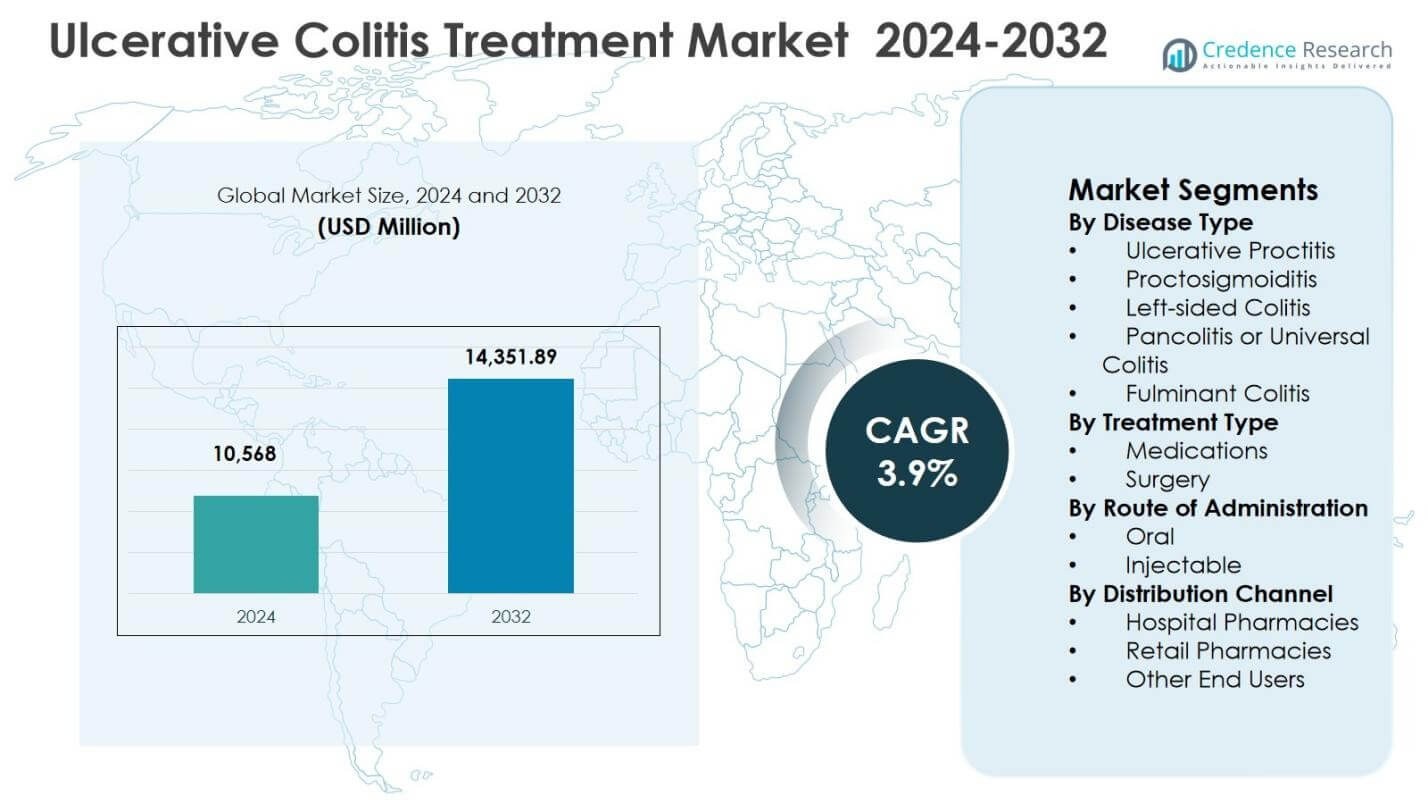
The Ulcerative Colitis Treatment Market size was valued at USD 10,568 million in 2024 and is anticipated to reach USD 14,351.89 million by 2032, growing at a CAGR of 3.9% during the forecast period.
| REPORT ATTRIBUTE | DETAILS |
|---|---|
| Historical Period | 2020-2023 |
| Base Year | 2024 |
| Forecast Period | 2025-2032 |
| Ulcerative Colitis Treatment Market Size 2024 | USD 10,568 million |
| Ulcerative Colitis Treatment Market, CAGR | 3.9% |
| Ulcerative Colitis Treatment Market Size 2032 | USD 14,351.89 million |
Ulcerative Colitis Treatment Market is driven by the strong presence of established pharmaceutical companies such as AbbVie, Takeda Pharmaceuticals, Johnson & Johnson Services, Inc., Pfizer, Bristol Myers Squibb, Merck & Co., Sanofi, Novartis, Ferring Pharmaceuticals, and Bausch Health, which focus on biologics, targeted therapies, and advanced oral formulations to improve long-term disease management. These players invest heavily in research and development, lifecycle management, and geographic expansion to strengthen product portfolios and address unmet clinical needs. North America leads the Ulcerative Colitis Treatment Market with a 41.8% market share, supported by high disease prevalence, early adoption of innovative therapies, and favorable reimbursement frameworks. Europe follows with 29.6% market share, driven by strong public healthcare systems and rising biosimilar uptake.
Ulcerative Colitis Treatment Market Insights
- Ulcerative Colitis Treatment Market was valued at USD 10,568 million in 2024 and is projected to reach USD 14,351.89 million by 2032, expanding at a CAGR of 3.9% during the forecast period.
- Market growth is driven by rising prevalence of ulcerative colitis, earlier diagnosis, and increasing long-term therapy adoption, with medications holding a 78.6% segment share in 2024 due to strong reliance on biologics and targeted drugs.
- Key market trends include growing use of biologics, expanding adoption of oral small-molecule therapies, and increasing focus on personalized treatment approaches to improve remission and patient compliance.
- Market structure is shaped by strong presence of global pharmaceutical players investing in pipeline expansion, biosimilar development, and geographic reach, while high therapy costs and long-term safety concerns remain key restraints.
- Regionally, North America led with 41.8% market share in 2024, followed by Europe at 29.6%, Asia Pacific at 19.3%, Latin America at 6.1%, and Middle East & Africa at 3.2%, reflecting differences in healthcare access and treatment adoption.
Ulcerative Colitis Treatment Market Segmentation Analysis:
By Disease Type:
The Ulcerative Colitis Treatment Market, segmented by disease type, is led by Left-sided Colitis, which accounted for 36.4% of the market share in 2024. This dominance is driven by its higher prevalence compared to other disease forms and the need for long-term maintenance therapy to manage moderate disease progression. Patients with left-sided colitis frequently require continuous pharmacological intervention, including aminosalicylates and biologics, supporting sustained treatment demand. Additionally, improved diagnostic accuracy and earlier disease detection have increased treated patient pools, reinforcing the strong revenue contribution of this sub-segment within the Ulcerative Colitis Treatment Market.
- For instance, Takeda Pharmaceuticals' ENTYVIO (vedolizumab), approved for ulcerative colitis including left-sided disease, targets gut-specific inflammation, supporting long-term maintenance in patients needing biologics beyond aminosalicylates.
By Treatment Type:
By treatment type, Medications dominated the Ulcerative Colitis Treatment Market with a 78.6% market share in 2024, reflecting the preference for non-invasive, long-term disease management. The dominance of this sub-segment is driven by widespread use of biologics, immunosuppressants, corticosteroids, and advanced targeted therapies that effectively control inflammation and reduce relapse rates. Continuous drug innovation, increasing adoption of biologics, and strong reimbursement coverage in developed markets further support segment growth. Surgery remains limited to severe or refractory cases, reinforcing medications as the primary revenue-generating treatment approach.
- For instance, Janssen's Stelara (ustekinumab) delivered clinical remission in 45% of ulcerative colitis patients after one year of maintenance therapy in clinical studies. Real-world data further showed steroid-free remission in 31% and clinical response in 84% of treated adults.
By Route of Administration:
Based on route of administration, Oral therapies held the dominant position in the Ulcerative Colitis Treatment Market, capturing 52.1% of the total market share in 2024. This leadership is driven by higher patient compliance, ease of administration, and suitability for long-term maintenance therapy. Oral formulations, including aminosalicylates and small-molecule drugs, are widely prescribed across mild to moderate disease stages. The growing availability of advanced oral agents with improved efficacy and safety profiles continues to strengthen this segment, while injectable therapies remain essential for moderate-to-severe cases requiring biologic intervention.
Key Growth Drivers
Rising Prevalence of Ulcerative Colitis
The Ulcerative Colitis Treatment Market is driven by the increasing prevalence of ulcerative colitis across both developed and emerging economies. Changing dietary habits, urban lifestyles, and rising stress levels have contributed to higher disease incidence. Improved diagnostic awareness and greater access to colonoscopy and imaging techniques have resulted in earlier and more frequent diagnosis. The expanding diagnosed patient population has increased demand for long-term maintenance therapies and advanced treatment options. As ulcerative colitis is a chronic condition requiring continuous management, the growing patient pool directly supports sustained market growth.
- For instance, AbbVie's HUMIRA (adalimumab) achieved remission in 18.5% of patients with moderate to severe ulcerative colitis at 8 weeks in a clinical study, compared to 9.2% on placebo, highlighting early response in newly diagnosed cases.
Advancements in Biologic and Targeted Therapies
Continuous innovation in biologic and targeted therapies is a major growth driver in the Ulcerative Colitis Treatment Market. The introduction of tumor necrosis factor inhibitors, integrin receptor antagonists, and Janus kinase inhibitors has significantly improved remission rates in moderate-to-severe cases. These therapies offer higher specificity and improved safety profiles compared to conventional treatments. Strong research pipelines, ongoing clinical trials, and increasing regulatory approvals for novel mechanisms of action continue to expand therapeutic options, driving higher adoption and revenue generation within the market.
- For instance, Vedolizumab (Entyvio) from Takeda yielded 41.8% clinical remission at week 52 in the GEMINI 1 trial's every-8-week dosing arm for moderate-to-severe cases. This gut-selective therapy showed sustained efficacy versus 15.9% for placebo.
Favorable Reimbursement and Expanding Healthcare Infrastructure
Supportive reimbursement policies and expanding healthcare infrastructure are accelerating growth in the Ulcerative Colitis Treatment Market. In developed regions, insurance coverage for biologics and specialty drugs has improved treatment affordability and patient adherence. Simultaneously, rising healthcare investments in emerging economies have strengthened hospital networks and access to advanced therapies. Government initiatives focused on chronic disease management and increased healthcare spending have further enhanced treatment availability, creating a favorable environment for market expansion.
Key Trends & Opportunities
Shift Toward Personalized and Precision Medicine
Personalized medicine is emerging as a key trend and opportunity in the Ulcerative Colitis Treatment Market. Advances in biomarker identification, genetic testing, and disease phenotyping are enabling clinicians to tailor therapies based on individual patient response and disease severity. This approach improves treatment outcomes while reducing adverse effects and therapy failures. Pharmaceutical companies are increasingly investing in targeted drug development and companion diagnostics, creating opportunities for differentiated products and improved long-term disease management.
- For instance, InDex Pharmaceuticals developed a companion diagnostic test for its lead candidate Kappaproct (cobitolimod), an immunomodulatory DNA sequence targeting TLR9 in steroid-resistant ulcerative colitis patients.
Growing Demand for Oral Small-Molecule Therapies
The increasing development and adoption of oral small-molecule therapies represent a significant opportunity in the Ulcerative Colitis Treatment Market. Oral treatments offer greater convenience, improved patient compliance, and reduced dependency on hospital-based infusion services. Clinical evidence supporting their effectiveness in moderate-to-severe disease stages has expanded their use across diverse patient populations. Continued innovation in oral formulations is expected to enhance treatment accessibility and support market growth, particularly in cost-sensitive regions.
- For instance, Pfizer's tofacitinib (Xeljanz), a pan-JAK inhibitor targeting JAK1 and JAK3, achieved significantly higher clinical remission rates than placebo in the phase 3 Octave induction trials at week 8 and in the Octave Sustain trial at week 52 among patients with moderate-to-severe ulcerative colitis.
Key Challenges
High Cost of Treatment and Limited Accessibility
High treatment costs pose a major challenge in the Ulcerative Colitis Treatment Market, particularly for biologics and advanced targeted therapies. Long-term treatment expenses can limit patient access, especially in developing regions with constrained healthcare budgets. Even in developed markets, reimbursement limitations and administrative hurdles can delay therapy initiation. These cost-related barriers affect patient adherence and continuity of care, emphasizing the need for affordable alternatives such as biosimilars and cost-effective treatment strategies.
Safety Concerns and Long-Term Therapy Risks
Safety concerns associated with prolonged use of ulcerative colitis therapies present another significant challenge for the Ulcerative Colitis Treatment Market. Long-term immunosuppression increases the risk of infections and other adverse events, leading to cautious prescribing and close patient monitoring. Variability in treatment response and potential loss of efficacy over time further complicate disease management. Addressing these risks through safer drug profiles and long-term clinical evidence remains critical for sustained market adoption.
Regional Analysis
North America
North America dominated the Ulcerative Colitis Treatment Market with a 41.8% market share in 2024, driven by a high prevalence of inflammatory bowel disease, strong awareness levels, and advanced diagnostic capabilities. The region benefits from early adoption of biologics and targeted therapies, supported by favorable reimbursement policies and well-established healthcare infrastructure. The presence of leading pharmaceutical companies and continuous clinical research activity further strengthen market growth. High treatment adherence, access to specialty gastroenterology centers, and strong insurance coverage continue to support sustained demand for both biologic and oral therapies across the region.
Europe
Europe accounted for 29.6% of the Ulcerative Colitis Treatment Market share in 2024, supported by a significant patient population and well-structured public healthcare systems. Countries such as Germany, the United Kingdom, and France show strong adoption of advanced therapies due to standardized treatment guidelines and broad reimbursement coverage. Increasing use of biosimilars has improved treatment affordability, expanding patient access. Ongoing research initiatives and rising disease awareness contribute to stable market growth. The region continues to benefit from government-backed healthcare funding and growing emphasis on early diagnosis and long-term disease management.
Asia Pacific
Asia Pacific captured 19.3% of the Ulcerative Colitis Treatment Market share in 2024, reflecting rapid growth driven by improving healthcare infrastructure and rising disease awareness. Increasing urbanization, dietary changes, and better diagnostic access have expanded the treated patient population. Countries such as China, Japan, and South Korea are witnessing growing adoption of biologics alongside conventional therapies. Expanding healthcare expenditure and government initiatives to strengthen specialty care services support market expansion. The growing presence of multinational pharmaceutical companies and improving reimbursement frameworks further contribute to long-term regional growth.
Latin America
Latin America held 6.1% of the Ulcerative Colitis Treatment Market share in 2024, supported by gradual improvements in healthcare access and increasing diagnosis rates. Brazil and Mexico are key contributors due to expanding gastroenterology services and rising awareness of inflammatory bowel diseases. While conventional therapies remain dominant, adoption of biologics is increasing in urban healthcare centers. Government-led healthcare reforms and growing private healthcare investment are enhancing treatment availability. Despite cost constraints, improving insurance coverage and the introduction of biosimilars are expected to support steady market growth across the region.
Middle East & Africa
The Middle East & Africa accounted for 3.2% of the Ulcerative Colitis Treatment Market share in 2024, reflecting limited but steadily improving market penetration. Growth is driven by expanding healthcare infrastructure, particularly in the Gulf Cooperation Council countries, where access to advanced therapies is increasing. Rising awareness, improved diagnostic capabilities, and growing investment in specialty care facilities support treatment uptake. However, limited reimbursement coverage and uneven access across African countries constrain growth. Ongoing healthcare modernization initiatives and increasing private sector participation are expected to gradually enhance regional market performance.
Ulcerative Colitis Treatment Market Segmentations:
By Disease Type
- Ulcerative Proctitis
- Proctosigmoiditis
- Left-sided Colitis
- Pancolitis or Universal Colitis
- Fulminant Colitis
By Treatment Type
- Medications
- Surgery
By Route of Administration
- Oral
- Injectable
By Distribution Channel
- Hospital Pharmacies
- Retail Pharmacies
- Other End Users
By Geography
- North America
- U.S.
- Canada
- Mexico
- Europe
- Germany
- France
- U.K.
- Italy
- Spain
- Rest of Europe
- Asia Pacific
- China
- Japan
- India
- South Korea
- South-east Asia
- Rest of Asia Pacific
- Latin America
- Brazil
- Argentina
- Rest of Latin America
- Middle East & Africa
- GCC Countries
- South Africa
- Rest of the Middle East and Africa
Competitive Landscape
Competitive landscape analysis of the Ulcerative Colitis Treatment Market is shaped by leading players including AbbVie, Takeda Pharmaceuticals, Johnson & Johnson Services, Inc., Pfizer, Bristol Myers Squibb, Merck & Co., Ferring Pharmaceuticals, Sanofi, Novartis, and Bausch Health. The market is characterized by strong competition focused on biologics, targeted therapies, and advanced oral formulations aimed at improving long-term disease control and patient outcomes. Companies prioritize research and development to expand indications, enhance efficacy, and reduce safety risks associated with chronic treatment. Strategic initiatives such as product lifecycle management, biosimilar development, and geographic expansion strengthen market positioning. Collaborations with research institutes and healthcare providers support clinical innovation and pipeline advancement. In addition, pricing strategies, reimbursement negotiations, and patient support programs play a critical role in maintaining market presence, while regulatory approvals and real-world evidence continue to influence competitive differentiation across regions.
Key Player Analysis
- Bausch Health
- Pfizer
- Ferring Pharmaceuticals
- Johnson & Johnson Services, Inc.
- Novartis
- AbbVie
- Sanofi
- Merck & Co.
- Bristol Myers Squibb
- Takeda Pharmaceuticals
Recent Developments
- In October 2025, Johnson & Johnson entered discussions to acquire Protagonist Therapeutics, strengthening its pipeline in ulcerative colitis therapies and expanding its immunology portfolio.
- In September 2025, the FDA approved a subcutaneous induction regimen of guselkumab (Tremfya) for adults with moderately to severely active ulcerative colitis.
- In April 2025, Johnson & Johnson announced European Commission approval for TREMFYA (guselkumab) in treating moderately to severely active ulcerative colitis.
Report Coverage
The research report offers an in-depth analysis based on Disease Type, Treatment Type, Route of Administration, Distribution Channel and Geography. It details leading market players, providing an overview of their business, product offerings, investments, revenue streams, and key applications. Additionally, the report includes insights into the competitive environment, SWOT analysis, current market trends, as well as the primary drivers and constraints. Furthermore, it discusses various factors that have driven market expansion in recent years. The report also explores market dynamics, regulatory scenarios, and technological advancements that are shaping the industry. It assesses the impact of external factors and global economic changes on market growth. Lastly, it provides strategic recommendations for new entrants and established companies to navigate the complexities of the market.
Future Outlook
- The Ulcerative Colitis Treatment Market will continue to expand due to the rising prevalence of inflammatory bowel diseases worldwide.
- Adoption of advanced biologic and targeted therapies will increase as clinicians seek improved long-term remission outcomes.
- Oral small-molecule therapies will gain wider acceptance due to convenience and improved patient adherence.
- Biosimilars will play a growing role in improving treatment affordability and market accessibility.
- Personalized treatment approaches will become more common through the use of biomarkers and disease stratification.
- Research and development activity will intensify, leading to novel mechanisms of action entering the treatment landscape.
- Expansion of healthcare infrastructure in emerging economies will support broader access to ulcerative colitis therapies.
- Long-term safety and efficacy data will increasingly influence prescribing decisions and therapy selection.
- Strategic partnerships and collaborations will accelerate clinical development and market penetration.
- Focus on patient-centric care and improved quality of life outcomes will shape future treatment strategies.
Request a Free Sample
Fill in your details and we'll send you a free sample report.
- Sample data tables & charts
- Research methodology
Need a Custom Version of This Report?
Tailor the scope, geography, or segments to your exact requirements.
- Custom geography or segment scope
- Direct access to our analyst team
Frequently Asked Questions
What is the current market size for the Intraosseous Devices Market, and what is its projected size in 2032?
At what Compound Annual Growth Rate is the Intraosseous Devices Market projected to grow between 2024 and 2032?
Which Intraosseous Devices Market segment held the largest share in 2024?
What are the primary factors fueling the growth of the Intraosseous Devices Market?
Who are the leading companies in the Intraosseous Devices Market?
Which region commanded the largest share of the Intraosseous Devices Market in 2024?
Table of Content
Chapter 1. Report Introduction
- 1.1 Report Description & Purpose
- 1.1.1 Report Title & Market Definition
- 1.1.2 Unique Selling Propositions (USP) & Key Differentiators
- 1.1.3 Value Proposition for Stakeholders
- 1.2 Research Objectives
- 1.2.1 Market Sizing Objectives (Volume & Revenue)
- 1.2.2 Segmentation Objectives
- 1.2.3 Competitive Intelligence Objectives
- 1.2.4 Forecast & Scenario Objectives
- 1.3 Report Scope
- 1.3.1 Ulcerative Colitis Treatment Scope – Types & Subtypes Covered
- 1.3.2 Geographic Scope – Regions & Countries Covered
- 1.3.3 Historical Period, Base Year & Forecast Period (2024; forecast to 2032)
- 1.3.4 Inclusions & Exclusions
- 1.4 HS Code & Classification Framework
- 1.5 Currency, Units & Pricing Basis
- 1.6 Target Stakeholders
- 1.7 Limitations & Assumptions
Chapter 2. Executive Summary
- 2.1 Global Ulcerative Colitis Treatment Market Snapshot
- 2.1.1 Market Size – Historical (2024) & Forecast (2024-2032) (2024: USD 448 million → 2032: USD 612.55 million)
- 2.1.2 Volume & Revenue – Global Totals
- 2.1.3 Key Market Highlights – Top Five Facts
- 2.2 Ulcerative Colitis Treatment Market Segmentation Snapshot
- 2.2.1 Market Split by Region – 2024 vs. 2032
- 2.3 Competitive Snapshot
- 2.3.1 Top 10 Players by Revenue Share – 2024
- 2.3.2 Top 10 Players by Volume Share – 2024
- 2.3.3 Recent Strategic Developments (18-Month Summary)
- 2.4 Key Investment Highlights & Strategic Conclusions
Chapter 3. Ulcerative Colitis Treatment Market Dynamics & Industry Analysis
- 3.1 Market Overview & Context
- 3.1.1 Ulcerative Colitis Treatment Market Position in the Broader Automotive Value Chain
- 3.1.2 OEM vs. Replacement Market Dynamics
- 3.1.3 Market Maturity & Development Stage by Region
- 3.2 Ulcerative Colitis Treatment Market Drivers
- 3.3 Ulcerative Colitis Treatment Market Restraints & Challenges
- 3.4 Ulcerative Colitis Treatment Market Opportunities
- 3.5 Porter's Five Forces Analysis
- 3.5.1 Threat of New Entrants
- 3.5.2 Bargaining Power of Suppliers
- 3.5.3 Bargaining Power of Buyers
- 3.5.4 Threat of Substitutes
- 3.5.5 Competitive Rivalry – Intensity Assessment
- 3.6 Ulcerative Colitis Treatment Value Chain Analysis
- 3.6.1 Upstream – Raw Material/Input Suppliers
- 3.6.1.1 Raw Material/Input 1
- 3.6.1.2 Raw Material/Input 2
- 3.6.1.3 Raw Material/Input 3
- 3.6.2 Midstream – Production/Manufacturing/Service Delivery
- 3.6.2.1 Production/Process Overview
- 3.6.2.2 Key Facility Locations & Capacity by Manufacturer
- 3.6.3 Downstream – Distribution & End Consumer
- 3.6.3.1 Primary Channel – B2B/OEM
- 3.6.3.2 Secondary Channels – Dealer, Retail, Online, Direct
- 3.6.4 Value Chain Profitability Analysis
- 3.6.1 Upstream – Raw Material/Input Suppliers
- 3.7 PESTEL Analysis
- 3.7.1 Political Factors
- 3.7.2 Economic Factors
- 3.7.3 Social Factors
- 3.7.4 Technological Factors
- 3.7.5 Environmental Factors
- 3.7.6 Legal Factors
- 3.8 Ulcerative Colitis Treatment Supply Chain Analysis
- 3.8.1 Raw Material/Input Supply Risk Assessment
- 3.8.2 Manufacturing Concentration Risk (Geographic Exposure)
- 3.8.3 Trade Disruption Impact Analysis
- 3.9 Regulatory & Policy Landscape
Note: The regulatory and policy landscape section covers regulations based on their applicability to the market, Ulcerative Colitis Treatment category, geography, and scope of the study. Only regulatory frameworks with a material impact on operations, compliance, trade, sustainability, or market access are analyzed in detail.
Chapter 4. Key Investment Pockets & Opportunity Analysis
- 4.1 Ulcerative Colitis Treatment Market Attractiveness Analysis
- 4.1.1 By Region – Investment Attractiveness Matrix (Volume × CAGR)
- 4.2 Absolute Revenue Growth Opportunity
- 4.2.1 By Region – Absolute USD Growth Through 2032
- 4.3 Incremental Volume Opportunity
- 4.3.1 By Region – Incremental Volume Through 2032
- 4.3.2 Segment – Incremental Volume
- 4.4 Emerging Submarket Opportunity Deep Dive (Subject to Applicability)
- 4.5 Emerging Market Opportunity Scorecards
- 4.5.1 United States
- 4.5.2 Europe
- 4.5.3 Asia
- 4.5.4 Middle East & Africa
Note: Emerging Market Opportunity Scorecards will be included based on relevance and strategic importance. Regions listed are indicative and may vary depending on data availability and market dynamics.
Chapter 5. Ulcerative Colitis Treatment Import-Export Analysis & Trade Flows
- 5.1 Global Trade Overview
- 5.1.1 Global Export Value by Country (2024)
- 5.1.2 Global Export Volume by Country (2024)
- 5.1.3 Global Import Value by Country (2024)
- 5.1.4 Global Import Volume by Country (2024)
- 5.1.5 Net Trade Balance by Country (2024)
- 5.2 Export Analysis – Segment
- 5.2.1 Type 1 (HS Code)
- 5.2.2 Type 2 (HS Code)
- 5.2.3 Type 3 (HS Code)
- 5.2.4 Type 4 (HS Code)
- 5.2.5 Type 5 (HS Code)
- 5.3 Import Analysis – Segment
- 5.3.1 Type 1 (HS Code)
- 5.3.2 Type 2 (HS Code)
- 5.3.3 Type 3 (HS Code)
- 5.3.4 Type 4 (HS Code)
- 5.3.5 Type 5 (HS Code)
- 5.4 Average Unit Trade Prices
- 5.4.1 Average Export Price – Segment & Country
- 5.4.2 Average Import Price – Segment & Source Country
- 5.4.3 Price Trends (2024)
- 5.5 Key Trade Route Analysis
- 5.5.1 Trade Route 1
- 5.5.2 Trade Route 2
- 5.5.3 Trade Route 3
- 5.5.4 Trade Route 4
- 5.5.5 Trade Route 5
- 5.6 Trade Policy Impact Assessment
- 5.6.1 US Anti-Dumping & Section 301 Tariffs
- 5.6.2 EU Customs Union Impact
- 5.6.3 Major Free Trade Agreements
- 5.6.4 USMCA Rules of Origin
Note: Trade policy analysis will be included only where relevant to the Ulcerative Colitis Treatment market.
Chapter 6. Competitive Landscape & Company Benchmarking
- 6.1 Ulcerative Colitis Treatment Market Concentration & Structure
- 6.1.1 Herfindahl-Hirschman Index (HHI) – vs. 2024
- 6.1.2 Tier 1, Tier 2 & Tier 3 Market Structure
- 6.1.3 Global, Regional & Local Player Dynamics
- 6.2 Ulcerative Colitis Treatment Market Share Analysis – 2024
- 6.2.1 Global Revenue Share by Company
- 6.2.2 Global Volume Share by Company
- 6.2.3 Regional Revenue Share
- 6.2.4 Market Share Evolution ( vs. 2024)
- 6.2.5 OEM Segment Share by Company
- 6.2.6 Replacement Segment Share by Company
- 6.3 Production/Delivery Capacity & Facility Analysis
- 6.3.1 Global Installed Capacity
- 6.3.2 Capacity Utilization Rates
- 6.3.3 Production/Output Volume
- 6.3.4 Facility Locations & Capacity Map
- 6.3.5 Planned Capacity Additions
- 6.4 Ulcerative Colitis Treatment Competitive Benchmarking Matrix
- 6.4.1 Revenue, Volume, CAGR & Profitability Comparison
- 6.4.2 Channel Revenue Mix
- 6.4.3 Geographic Revenue Exposure
- 6.4.4 R&D Intensity
- 6.4.5 Sustainability Maturity
- 6.5 Strategic Developments in Ulcerative Colitis Treatment (Last 24 Months)
- 6.5.1 Mergers, Acquisitions & Divestments
- 6.5.2 New Ulcerative Colitis Treatment Launches
- 6.5.3 Facility Expansions
- 6.5.4 Strategic Alliances, Joint Ventures & Partnerships
- 6.5.5 Distribution Expansion & Market Entry
- 6.5.6 Sustainability & ESG Initiatives
- 6.6 Competitive Strategy Mapping
- 6.6.1 Leader, Challenger, Follower & Niche Classification
- 6.6.2 Pricing Strategy Comparison
- 6.6.3 Channel Strategy Matrix
Note: Strategic developments are included based on their materiality and the availability of reliable information.
Chapter 7. Global Ulcerative Colitis Treatment Market – By Distribution Channel
- 7.1 Segment Overview
- 7.1.1 Volume & Revenue Split by Channel (2024 & 2032)
- 7.1.2 Channel Mix Evolution (2024-2032)
Chapter 8. Regional Market Analysis – Global Overview
- 8.1 Global Regional Overview
- 8.1.1 Regional Volume Share
- 8.1.2 Regional Revenue Share
- 8.1.3 Regional Volume by Region
- 8.1.4 Regional Revenue by Region
- 8.1.5 Regional Forecast Through 2032
- 8.2 Cross-Regional Segment Analysis
- 8.2.1 By Distribution Channel
- 8.2.2 By Brand/Price Tier
Chapter 9. North America Ulcerative Colitis Treatment Market
- 9.1 United States
- 9.2 Canada
- 9.3 Mexico
Chapter 10. Europe Ulcerative Colitis Treatment Market
- 10.1 Germany
- 10.2 France
- 10.3 Italy
- 10.4 United Kingdom
- 10.5 Spain
- 10.6 Poland
- 10.7 Russia
- 10.8 Netherlands
- 10.9 Belgium
- 10.10 Sweden
- 10.11 Denmark
- 10.12 Norway
- 10.13 Rest of Europe
Chapter 11. Asia Pacific Ulcerative Colitis Treatment Market
- 11.1 China
- 11.2 India
- 11.3 Japan
- 11.4 South Korea
- 11.5 Thailand
- 11.6 Indonesia
- 11.7 Vietnam
- 11.8 Malaysia
- 11.9 Australia
- 11.10 Rest of Asia Pacific
Chapter 12. Latin America Ulcerative Colitis Treatment Market
- 12.1 Brazil
- 12.2 Argentina
- 12.3 Colombia
- 12.4 Chile
- 12.5 Rest of Latin America
Chapter 13. Middle East Ulcerative Colitis Treatment Market
- 13.1 Saudi Arabia
- 13.2 United Arab Emirates
- 13.3 Turkey
- 13.4 Israel
- 13.5 Iran
- 13.6 Rest of the Middle East
Chapter 14. Africa Ulcerative Colitis Treatment Market
- 14.1 South Africa
- 14.2 Egypt
- 14.3 Nigeria
- 14.4 Morocco
- 14.5 Rest of Africa
Chapter 15. Ulcerative Colitis Treatment Company Profiles
- 15.1 [Company 01]
- 15.1.1 Company Overview
- 15.1.2 Key Management Personnel
- 15.1.3 Products & Services Portfolio
- 15.1.4 Financial Performance
- 15.1.5 Key Market Focus & Geographic Presence
- 15.1.6 Recent Developments & Strategic Initiatives
Note: The company profile list is preliminary and may change based on research findings, market developments, data availability, and client requirements.
Chapter 16. Appendices
- Appendix A – List of Abbreviations & Acronyms
- Appendix B – Industry Classification Code Reference – Full Series
- Appendix C – Production & Capacity Data Tables
- Appendix D – End-Use & Demand Base Tables
- Appendix E – Consumption & Replacement Rate Assumptions
- Appendix F – ASP Reference Tables
- Appendix G – Manufacturing & Facility Database
- Appendix H – Import-Export Data Tables
- Appendix I – Regulatory Summary Tables
- Appendix J – Primary Research Participant List (Anonymized)
- Appendix K – Primary Research Questionnaire Framework
- Appendix L – Data Sources & Bibliography
- Appendix M – Market Size Divergence & Source Comparison
Chapter 17. Research Methodology
- 17.1 Research Framework & Philosophy
- 17.2 Secondary Research – Sources, Hierarchy & Data Extraction
- 17.3 Data Modeling – Bottom-Up & Top-Down Market Sizing
- 17.4 Primary Research – Stakeholder Framework, LOI & Sample Sizes
- 17.5 Forecast Methodology – Regression, Scenario & Sensitivity Analysis
- 17.6 Quality Control – Four-Layer Validation Framework
- 17.7 Limitations & Standard Assumptions
- 17.8 Disclaimer
