
Market Overview
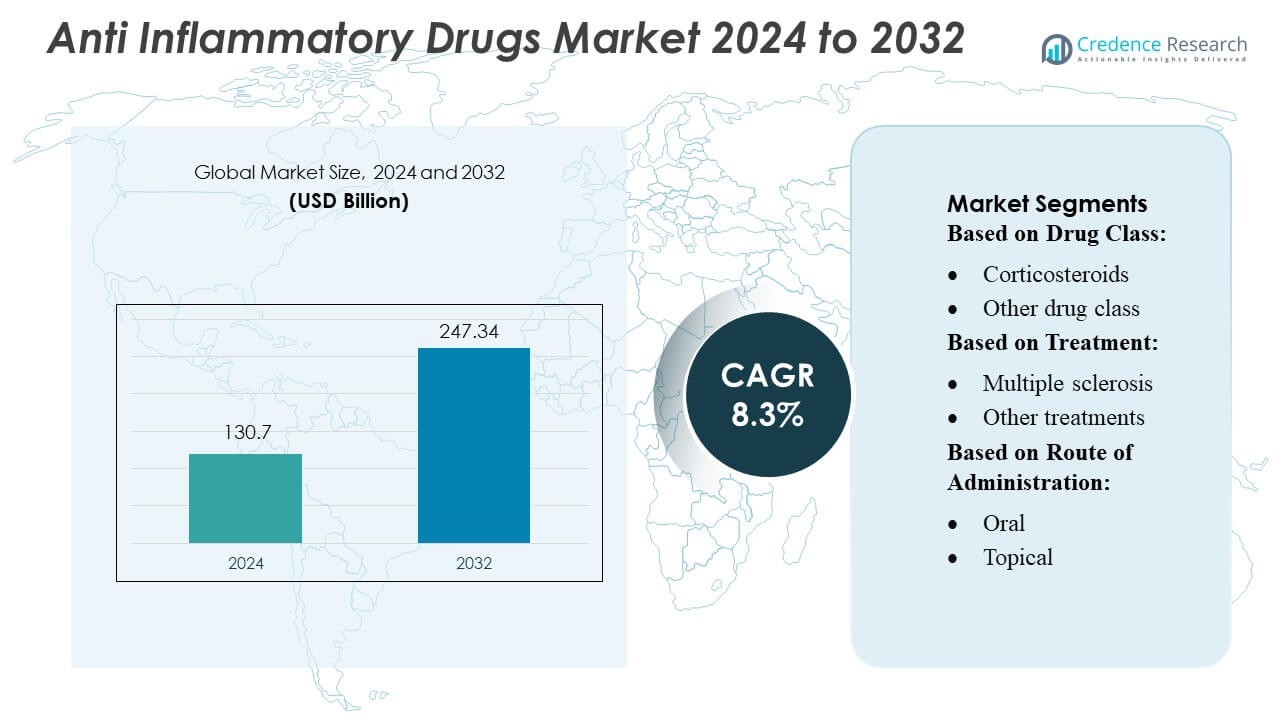
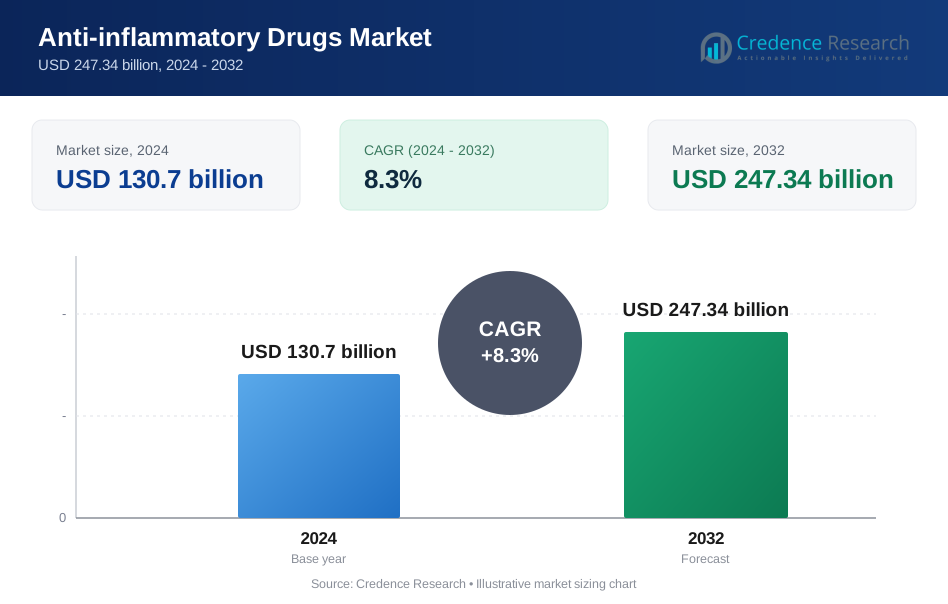
Anti Inflammatory Drugs Market size was valued USD 130.7 billion in 2024 and is anticipated to reach USD 247.34 billion by 2032, at a CAGR of 8.3% during the forecast period.
| REPORT ATTRIBUTE | DETAILS |
|---|---|
| Historical Period | 2020-2023 |
| Base Year | 2024 |
| Forecast Period | 2025-2032 |
| Anti Inflammatory Drugs Market Size 2024 | USD 130.7 Billion |
| Anti Inflammatory Drugs Market, CAGR | 8.3% |
| Anti Inflammatory Drugs Market Size 2032 | USD 247.34 Billion |
The global anti-inflammatory drugs market is dominated by major pharmaceutical firms such as Pfizer, Johnson & Johnson, Novartis, Merck, AbbVie, Amgen, Sanofi, Eli Lilly, Roche, and AstraZeneca, all of which drive innovation across both biologic and small-molecule therapies. North America leads the market, accounting for approximately 44.1% of global share, underpinned by its robust R&D infrastructure, high healthcare spending, and strong adoption of NSAIDs and biologics.
Market Insights
- The market was valued at USD 130.7 billion in 2024 and is expected to reach USD 247.34 billion by 2032 at a CAGR of 8.3%, driven by expanding adoption of biologics and advanced anti-inflammatory therapies.
- Rising prevalence of chronic inflammatory diseases and strong uptake of targeted immunomodulators continue to drive market growth across major therapeutic segments.
- Biologics represent the fastest-growing segment, accounting for a significant share due to higher efficacy in autoimmune and chronic inflammatory conditions.
- Market competition intensifies as global leaders such as Pfizer, Johnson & Johnson, AbbVie, Novartis, and Roche invest in next-generation biologics, biosimilars, and small-molecule innovations.
- North America dominates the market with 44.1% share, supported by high healthcare spending and strong R&D capabilities, while Europe follows closely; meanwhile, the Asia Pacific region shows the fastest growth due to rising disease incidence and expanding pharmaceutical infrastructure.
Market Segmentation Analysis:
By Drug Class
Anti-inflammatory biologics lead the market with an estimated 45–50% share, driven by their targeted mechanism of action and superior efficacy in chronic autoimmune diseases. Their dominance is reinforced by the expanding use of TNF-α, IL-6, IL-17, and JAK-inhibitor therapies that offer sustained symptom control and reduced relapse rates. In contrast, NSAIDs and corticosteroids maintain stable demand for acute symptom relief but face limitations due to long-term side-effect risks. Growing adoption of next-generation biologics and biosimilars continues to fuel market expansion by improving accessibility and lowering treatment costs.
- For instance, Glenmark Pharmaceuticals strengthened its biologics capabilities through its monoclonal antibody program, including GBR 830, which progressed through Phase 2 trials involving more than 250 patients, and its respiratory portfolio advancement with Ryaltris®, supported by clinical data from over 3,000 participants across multiple global studies.
By Treatment
The arthritis segment holds the largest share—approximately 40% of the overall treatment landscape—supported by high global prevalence of rheumatoid arthritis and osteoarthritis, and increased prescription of biologics and DMARD-adjacent anti-inflammatory therapies. Rising aging populations, early diagnostic rates, and broader access to chronic disease management programs further sustain segment leadership. IBD and COPD segments demonstrate strong growth momentum due to advancing biologic pipelines, while multiple sclerosis treatments gain traction with improved immunomodulatory options. Other inflammatory conditions contribute steadily through expanded off-label and adjunctive therapy usage.
- For instance, Pfizer’s tofacitinib (XELJANZ) has been studied in over 6,200 rheumatoid arthritis patients globally across its Phase 3 programme, yielding more than 19,400 patient-years of exposure, per company data.
By Route of Administration
Oral administration dominates the market with an estimated 50–55% share, driven by patient convenience, strong adherence rates, and the extensive availability of NSAIDs, corticosteroids, and selective immunomodulators in oral formulations. Demand is reinforced by widening use of chronic maintenance therapies and lower overall treatment costs. Injectable routes continue gaining traction due to the rising adoption of biologics requiring subcutaneous or intravenous delivery, while topical and intranasal formulations retain niche but essential roles in localized and acute inflammatory conditions, offering rapid symptom relief with minimal systemic exposure.
Key Growth Drivers
- Rising Prevalence of Chronic Inflammatory Diseases The growing burden of chronic inflammatory diseases—including arthritis, inflammatory bowel disease, COPD, and multiple sclerosis—continues to drive strong demand for advanced anti-inflammatory therapies. Aging demographics, increased autoimmune disorders, and lifestyle-linked inflammation contribute significantly to rising prescription volumes. Healthcare systems worldwide are adopting long-term management protocols, expanding patient access to biologics and combination therapies. The steady increase in diagnosed cases and treatment-seeking behavior strengthens the market’s foundation and accelerates the need for more effective and durable anti-inflammatory treatment options.
- For instance, Hikma is developing a biosimilar to ustekinumab, BAT2206, through a partnership with Bio-Thera; the molecule, which targets IL-12 and IL-23, is currently in a global Phase III program.
- Expansion of Biologics and Targeted Therapies Rapid advancements in biologics, biosimilars, and targeted small molecules underpin major market growth. Innovations in TNF-α inhibitors, IL-17/IL-23 blockers, and JAK inhibitors offer superior efficacy and lower relapse rates compared with traditional therapies. Pharmaceutical companies are investing heavily in next-generation immunomodulators capable of precision targeting to minimize systemic adverse effects. As clinical success rates improve and regulatory approvals accelerate, biologics continue to expand their penetration across multiple inflammatory conditions, positioning them as high-value drivers of both revenue growth and therapeutic transformation.
- For instance, Novartis’ Cosentyx® (secukinumab), a fully-human IL-17A inhibitor, demonstrated sustained efficacy over five years in a pivotal extension study involving more than 1,100 patients (PASI 90 maintained in ~66% of participants at Year 4).
- Increased Healthcare Investment and Access to Treatment Rising healthcare expenditure, government reimbursement support, and expanding insurance coverage amplify patient access to advanced anti-inflammatory drugs. Emerging economies are strengthening chronic disease management programs and upgrading treatment standards, enabling greater uptake of modern therapies. The proliferation of specialty clinics, telemedicine platforms, and digital prescription systems enhances treatment continuity and drug adherence. These improvements, combined with wider availability of biosimilars, reduce cost barriers and support broader market adoption—ultimately driving sustained growth across both developed and developing healthcare ecosystems.
Key Trends & Opportunities
- Growing Adoption of Biosimilars The expanding biosimilar pipeline presents a significant opportunity to reduce treatment costs and increase affordability, especially for biologic-heavy indications such as arthritis and IBD. As patents for major biologics expire, biosimilars are rapidly gaining regulatory approvals and market penetration. Their comparable clinical efficacy and strong economic value encourage broader physician adoption and patient access. Pharmaceutical manufacturers are increasingly focusing on high-demand biosimilar categories, creating competitive pricing environments that stimulate treatment uptake while supporting long-term market expansion.
- For instance, Lupin’s biosimilar Etanercept (YLB 113) completed a global Phase III trial over 52 weeks involving more than 500 rheumatoid arthritis patients across 11 countries, confirming clinical equivalence with the reference product.
- Advancements in Personalized and Precision Medicine Precision-based anti-inflammatory therapies are becoming a critical trend as companies develop treatments tailored to genetic, biomarker, and immunologic profiles. Advances in molecular diagnostics, pharmacogenomics, and AI-driven predictive modeling enable more accurate patient stratification and optimized drug response. This shift supports the emergence of targeted small molecules with higher therapeutic specificity and reduced systemic risk. Precision medicine also enhances clinical trial efficiency and accelerates regulatory approvals, offering significant commercial opportunities for manufacturers developing customized immunomodulatory solutions.
- For instance, Bayer and Hurdle recently developed “InflammAge,” a saliva-based DNA methylation biomarker for systemic chronic inflammation, quantifying epigenetic changes in more than 450 CpG sites.
- Shift Toward Novel Delivery Technologies Innovations in drug delivery—such as extended-release oral systems, self-injectable biologics, transdermal patches, and intranasal formulations—offer new opportunities to improve patient compliance and expand therapeutic applications. These technologies enhance pharmacokinetic control, reduce dosing frequency, and minimize side effects associated with conventional delivery routes. Companies are increasingly investing in user-friendly, home-administered devices to meet rising demand for convenience and decentralized care. This trend strengthens market differentiation and supports the adoption of both biologic and non-biologic anti-inflammatory drugs.
Key Challenges
- High Treatment Costs and Limited Affordability The high cost of biologics and advanced targeted therapies remains a major barrier to widespread adoption, particularly in low- and middle-income countries. Limited insurance coverage and out-of-pocket payment structures restrict patient access to long-term treatment. While biosimilars help mitigate cost pressures, pricing remains significantly above traditional NSAIDs and corticosteroids. Healthcare systems also face budget constraints in supporting chronic inflammatory disease management. These cost-related challenges hinder treatment continuity and slow market expansion despite the clinical advantages of newer therapies.
- Safety Concerns and Adverse Effects Anti-inflammatory drugs—particularly NSAIDs, corticosteroids, and certain biologics—continue to face scrutiny due to risks such as gastrointestinal complications, cardiovascular issues, immunosuppression, and long-term organ damage. Regulatory agencies emphasize post-marketing surveillance and safety compliance, increasing the burden on manufacturers. Safety concerns may limit prescribing frequency, restrict long-term use, and affect regulatory approvals for emerging drug classes. As patient awareness grows, demand shifts toward safer alternatives, challenging companies to balance efficacy with improved safety profiles in future product development.
Regional Analysis
North America
North America holds the largest share of the Anti-Inflammatory Drugs Market, accounting for around 38–40%, driven by high prevalence of arthritis, IBD, and respiratory inflammatory disorders. Strong adoption of biologics and JAK inhibitors, coupled with rapid uptake of biosimilars, strengthens regional dominance. Well-established healthcare infrastructure, high per-capita healthcare spending, and widespread insurance coverage accelerate access to advanced therapies. The presence of leading pharmaceutical companies and robust clinical research activity further supports market expansion. Rising demand for targeted immunomodulators and continuous regulatory approvals reinforce the region’s position as the primary revenue contributor.
Europe
Europe represents the second-largest market with approximately 28–30% share, supported by strong public healthcare systems and well-structured reimbursement mechanisms that facilitate access to high-cost biologics. Increasing incidence of chronic inflammatory conditions, such as rheumatoid arthritis, ulcerative colitis, and multiple sclerosis, continues to drive drug consumption. The region benefits from an active biosimilar landscape, enabling cost-effective treatment expansion. Regulatory harmonization under the EMA accelerates approvals for innovative therapies. Growing R&D collaborations, aging demographics, and rising adoption of precision-medicine approaches further contribute to Europe’s steady and sustainable growth trajectory in anti-inflammatory therapeutics.
Asia-Pacific
Asia-Pacific is the fastest-growing region, holding around 20–22% market share, propelled by expanding patient populations, rapid urbanization, and increased diagnosis of inflammatory diseases. Rising healthcare expenditures in countries such as China, India, and Japan drive access to both biologics and cost-effective generics. Government initiatives aimed at improving chronic disease management and insurance penetration further enhance market adoption. Pharmaceutical companies are increasing investments in local manufacturing and clinical research, enabling competitive pricing. The region’s strong growth outlook is supported by biosimilar expansion, improving healthcare infrastructure, and a shift toward advanced immunomodulatory treatment options.
Latin America
Latin America contributes about 6–7% of the global market, with growth driven by increasing awareness of chronic inflammatory conditions and improving access to essential therapies. Brazil and Mexico lead regional demand due to expanding public healthcare coverage and gradual adoption of biologics through government procurement programs. However, cost constraints and uneven reimbursement availability limit broad penetration of advanced anti-inflammatory therapies. Growing availability of generics and biosimilars is helping mitigate affordability challenges. Investments in healthcare modernization and partnerships between multinational pharmaceutical firms and local distributors support incremental growth across the region.
Middle East & Africa
The Middle East & Africa region holds approximately 4–5% market share, characterized by rising incidence of autoimmune and inflammatory diseases alongside improving healthcare capacity in GCC countries. Higher-income markets such as Saudi Arabia and the UAE drive biologic adoption through expanding insurance coverage and investment in specialty clinics. In contrast, lower-income nations experience limited access due to high treatment costs and infrastructure gaps. Increased government spending on healthcare digitization, widening availability of generics, and collaborations with global pharmaceutical companies support gradual market development. Continued economic diversification and healthcare reforms are expected to enhance long-term growth.
Market Segmentations:
By Drug Class:
- Corticosteroids
- Other drug class
By Treatment:
- Multiple sclerosis
- Other treatments
By Route of Administration:
- Oral
- Topical
By Geography
- North America
- U.S.
- Canada
- Mexico
- Europe
- Germany
- France
- U.K.
- Italy
- Spain
- Rest of Europe
- Asia Pacific
- China
- Japan
- India
- South Korea
- South-east Asia
- Rest of Asia Pacific
- Latin America
- Brazil
- Argentina
- Rest of Latin America
- Middle East & Africa
- GCC Countries
- South Africa
- Rest of the Middle East and Africa
Competitive Landscape
The competitive landscape of the Anti-Inflammatory Drugs Market is characterized by the presence of major global and regional players, including Glenmark Pharmaceuticals, Pfizer, Hikma Pharmaceuticals, Novartis, Lupin, Bayer AG, Dr. Reddy’s Laboratories, Cipla, Johnson & Johnson, and Abbott Laboratories. the Anti-Inflammatory Drugs Market is defined by intensifying innovation, expanding biologics pipelines, and growing investment in advanced immunomodulatory therapies. Companies compete by accelerating research in targeted mechanisms such as TNF-α, IL-17, IL-23, and JAK pathways to achieve higher efficacy with improved safety profiles. Biosimilars continue to reshape pricing dynamics and broaden patient access, particularly in chronic conditions like arthritis and IBD. Firms are also prioritizing lifecycle management strategies, including extended-release formulations, novel delivery systems, and patient-friendly self-injectable devices. Strategic collaborations, regulatory approvals, and expansion into high-growth emerging markets further strengthen competition and diversify therapeutic portfolios.
Key Player Analysis
- Glenmark Pharmaceuticals
- Pfizer
- Hikma Pharmaceuticals
- Novartis
- Lupin
- Bayer AG
- Reddy’s Laboratories
- Cipla
- Johnson & Johnson
- Abbott Laboratories
Recent Developments
- In May 2024, Eisai Co., Ltd. and Biogen Inc. announced that, following the FDA's Fast Track designation, Eisai had started rolling submission of a Biologics License Application (BLA) to the U.S. Food and Drug Administration (FDA) for lecanemab-irmb (U.S. brand name: LEQEMBI) subcutaneous autoinjector for weekly maintenance dosing.
- In April 2024, Glenmark Pharmaceuticals received final approval from the U.S. Food & Drug Administration (US FDA) for its Acetaminophen and Ibuprofen Tablets, 250 mg/125 mg (OTC). The FDA determined these tablets to be bioequivalent to Advil Dual Action with Acetaminophen Tablets, 250 mg/125 mg (OTC), produced by Haleon US Holdings.
- In February 2024, Hikma Pharmaceuticals PLC (Hikma), a multinational pharmaceutical company, announced the launch of COMBOGESIC IV (acetaminophen and ibuprofen) injection in the U.S. COMBOGESIC IV is an opioid-free, intravenous pain relief medication that combines 1,000 mg of acetaminophen with 300 mg of ibuprofen, a nonsteroidal anti-inflammatory drug (NSAID).
Report Coverage
The research report offers an in-depth analysis based on Drug Class, Treatment, Route of Administration and Geography. It details leading market players, providing an overview of their business, product offerings, investments, revenue streams, and key applications. Additionally, the report includes insights into the competitive environment, SWOT analysis, current market trends, as well as the primary drivers and constraints. Furthermore, it discusses various factors that have driven market expansion in recent years. The report also explores market dynamics, regulatory scenarios, and technological advancements that are shaping the industry. It assesses the impact of external factors and global economic changes on market growth. Lastly, it provides strategic recommendations for new entrants and established companies to navigate the complexities of the market.
Future Outlook
- The market will expand as chronic inflammatory diseases continue to rise globally.
- Companies will accelerate development of biologics and targeted therapies with improved safety profiles.
- Demand for personalized anti-inflammatory treatments will grow with advances in genomic and biomarker research.
- Oral and topical formulations will continue evolving to offer faster onset and longer-lasting relief.
- Biosimilars will gain stronger market penetration as major biologics lose exclusivity.
- Digital health platforms will support better disease monitoring and treatment adherence.
- Research will increasingly focus on non-opioid pain management alternatives.
- Regulatory agencies will encourage development of safer long-term therapies.
- Emerging markets will adopt advanced anti-inflammatory solutions as healthcare access improves.
- Collaborations between biotech firms and pharmaceutical companies will accelerate innovation in novel drug mechanisms.
Request a Free Sample
Fill in your details and we'll send you a free sample report.
- Sample data tables & charts
- Research methodology
Need a Custom Version of This Report?
Tailor the scope, geography, or segments to your exact requirements.
- Custom geography or segment scope
- Direct access to our analyst team
Frequently Asked Questions
What is the current market size for the Anti-Inflammatory Drugs Market, and what is its projected size in 2032?
At what Compound Annual Growth Rate is the Anti-Inflammatory Drugs Market projected to grow between 2025 and 2032?
Which Anti-Inflammatory Drugs Market segment held the largest share in 2024?
What are the primary factors fueling the growth of the Anti-Inflammatory Drugs Market?
Who are the leading companies in the Anti-Inflammatory Drugs Market?
Which region commanded the largest share of the Anti-Inflammatory Drugs Market in 2024?
Table of Content
Chapter 1. Report Introduction
- 1.1 Report Description & Purpose
- 1.1.1 Report Title & Market Definition
- 1.1.2 Unique Selling Propositions (USP) & Key Differentiators
- 1.1.3 Value Proposition for Stakeholders
- 1.2 Research Objectives
- 1.2.1 Market Sizing Objectives (Volume & Revenue)
- 1.2.2 Segmentation Objectives
- 1.2.3 Competitive Intelligence Objectives
- 1.2.4 Forecast & Scenario Objectives
- 1.3 Report Scope
- 1.3.1 Anti-inflammatory Drugs Scope – Types & Subtypes Covered
- 1.3.2 Geographic Scope – Regions & Countries Covered
- 1.3.3 Historical Period, Base Year & Forecast Period (2024; forecast to 2032)
- 1.3.4 Inclusions & Exclusions
- 1.4 HS Code & Classification Framework
- 1.5 Currency, Units & Pricing Basis
- 1.6 Target Stakeholders
- 1.7 Limitations & Assumptions
Chapter 2. Executive Summary
- 2.1 Global Anti-inflammatory Drugs Market Snapshot
- 2.1.1 Market Size – Historical (2024) & Forecast (2024-2032) (2024: USD 130.7 billion → 2032: USD 247.34 billion)
- 2.1.2 Volume & Revenue – Global Totals
- 2.1.3 Key Market Highlights – Top Five Facts
- 2.2 Anti-inflammatory Drugs Market Segmentation Snapshot
- 2.2.1 Market Split by Region – 2024 vs. 2032
- 2.3 Competitive Snapshot
- 2.3.1 Top 10 Players by Revenue Share – 2024
- 2.3.2 Top 10 Players by Volume Share – 2024
- 2.3.3 Recent Strategic Developments (18-Month Summary)
- 2.4 Key Investment Highlights & Strategic Conclusions
Chapter 3. Anti-inflammatory Drugs Market Dynamics & Industry Analysis
- 3.1 Market Overview & Context
- 3.1.1 Anti-inflammatory Drugs Market Position in the Broader Automotive Value Chain
- 3.1.2 OEM vs. Replacement Market Dynamics
- 3.1.3 Market Maturity & Development Stage by Region
- 3.2 Anti-inflammatory Drugs Market Drivers
- 3.3 Anti-inflammatory Drugs Market Restraints & Challenges
- 3.4 Anti-inflammatory Drugs Market Opportunities
- 3.5 Porter's Five Forces Analysis
- 3.5.1 Threat of New Entrants
- 3.5.2 Bargaining Power of Suppliers
- 3.5.3 Bargaining Power of Buyers
- 3.5.4 Threat of Substitutes
- 3.5.5 Competitive Rivalry – Intensity Assessment
- 3.6 Anti-inflammatory Drugs Value Chain Analysis
- 3.6.1 Upstream – Raw Material/Input Suppliers
- 3.6.1.1 Raw Material/Input 1
- 3.6.1.2 Raw Material/Input 2
- 3.6.1.3 Raw Material/Input 3
- 3.6.2 Midstream – Production/Manufacturing/Service Delivery
- 3.6.2.1 Production/Process Overview
- 3.6.2.2 Key Facility Locations & Capacity by Manufacturer
- 3.6.3 Downstream – Distribution & End Consumer
- 3.6.3.1 Primary Channel – B2B/OEM
- 3.6.3.2 Secondary Channels – Dealer, Retail, Online, Direct
- 3.6.4 Value Chain Profitability Analysis
- 3.6.1 Upstream – Raw Material/Input Suppliers
- 3.7 PESTEL Analysis
- 3.7.1 Political Factors
- 3.7.2 Economic Factors
- 3.7.3 Social Factors
- 3.7.4 Technological Factors
- 3.7.5 Environmental Factors
- 3.7.6 Legal Factors
- 3.8 Anti-inflammatory Drugs Supply Chain Analysis
- 3.8.1 Raw Material/Input Supply Risk Assessment
- 3.8.2 Manufacturing Concentration Risk (Geographic Exposure)
- 3.8.3 Trade Disruption Impact Analysis
- 3.9 Regulatory & Policy Landscape
Note: The regulatory and policy landscape section covers regulations based on their applicability to the market, Anti-inflammatory Drugs category, geography, and scope of the study. Only regulatory frameworks with a material impact on operations, compliance, trade, sustainability, or market access are analyzed in detail.
Chapter 4. Key Investment Pockets & Opportunity Analysis
- 4.1 Anti-inflammatory Drugs Market Attractiveness Analysis
- 4.1.1 By Region – Investment Attractiveness Matrix (Volume × CAGR)
- 4.2 Absolute Revenue Growth Opportunity
- 4.2.1 By Region – Absolute USD Growth Through 2032
- 4.3 Incremental Volume Opportunity
- 4.3.1 By Region – Incremental Volume Through 2032
- 4.3.2 Segment – Incremental Volume
- 4.4 Emerging Submarket Opportunity Deep Dive (Subject to Applicability)
- 4.5 Emerging Market Opportunity Scorecards
- 4.5.1 United States
- 4.5.2 Europe
- 4.5.3 Asia
- 4.5.4 Middle East & Africa
Note: Emerging Market Opportunity Scorecards will be included based on relevance and strategic importance. Regions listed are indicative and may vary depending on data availability and market dynamics.
Chapter 5. Anti-inflammatory Drugs Import-Export Analysis & Trade Flows
- 5.1 Global Trade Overview
- 5.1.1 Global Export Value by Country (2024)
- 5.1.2 Global Export Volume by Country (2024)
- 5.1.3 Global Import Value by Country (2024)
- 5.1.4 Global Import Volume by Country (2024)
- 5.1.5 Net Trade Balance by Country (2024)
- 5.2 Export Analysis – Segment
- 5.2.1 Type 1 (HS Code)
- 5.2.2 Type 2 (HS Code)
- 5.2.3 Type 3 (HS Code)
- 5.2.4 Type 4 (HS Code)
- 5.2.5 Type 5 (HS Code)
- 5.3 Import Analysis – Segment
- 5.3.1 Type 1 (HS Code)
- 5.3.2 Type 2 (HS Code)
- 5.3.3 Type 3 (HS Code)
- 5.3.4 Type 4 (HS Code)
- 5.3.5 Type 5 (HS Code)
- 5.4 Average Unit Trade Prices
- 5.4.1 Average Export Price – Segment & Country
- 5.4.2 Average Import Price – Segment & Source Country
- 5.4.3 Price Trends (2024)
- 5.5 Key Trade Route Analysis
- 5.5.1 Trade Route 1
- 5.5.2 Trade Route 2
- 5.5.3 Trade Route 3
- 5.5.4 Trade Route 4
- 5.5.5 Trade Route 5
- 5.6 Trade Policy Impact Assessment
- 5.6.1 US Anti-Dumping & Section 301 Tariffs
- 5.6.2 EU Customs Union Impact
- 5.6.3 Major Free Trade Agreements
- 5.6.4 USMCA Rules of Origin
Note: Trade policy analysis will be included only where relevant to the Anti-inflammatory Drugs market.
Chapter 6. Competitive Landscape & Company Benchmarking
- 6.1 Anti-inflammatory Drugs Market Concentration & Structure
- 6.1.1 Herfindahl-Hirschman Index (HHI) – vs. 2024
- 6.1.2 Tier 1, Tier 2 & Tier 3 Market Structure
- 6.1.3 Global, Regional & Local Player Dynamics
- 6.2 Anti-inflammatory Drugs Market Share Analysis – 2024
- 6.2.1 Global Revenue Share by Company
- 6.2.2 Global Volume Share by Company
- 6.2.3 Regional Revenue Share
- 6.2.4 Market Share Evolution ( vs. 2024)
- 6.2.5 OEM Segment Share by Company
- 6.2.6 Replacement Segment Share by Company
- 6.3 Production/Delivery Capacity & Facility Analysis
- 6.3.1 Global Installed Capacity
- 6.3.2 Capacity Utilization Rates
- 6.3.3 Production/Output Volume
- 6.3.4 Facility Locations & Capacity Map
- 6.3.5 Planned Capacity Additions
- 6.4 Anti-inflammatory Drugs Competitive Benchmarking Matrix
- 6.4.1 Revenue, Volume, CAGR & Profitability Comparison
- 6.4.2 Channel Revenue Mix
- 6.4.3 Geographic Revenue Exposure
- 6.4.4 R&D Intensity
- 6.4.5 Sustainability Maturity
- 6.5 Strategic Developments in Anti-inflammatory Drugs (Last 24 Months)
- 6.5.1 Mergers, Acquisitions & Divestments
- 6.5.2 New Anti-inflammatory Drugs Launches
- 6.5.3 Facility Expansions
- 6.5.4 Strategic Alliances, Joint Ventures & Partnerships
- 6.5.5 Distribution Expansion & Market Entry
- 6.5.6 Sustainability & ESG Initiatives
- 6.6 Competitive Strategy Mapping
- 6.6.1 Leader, Challenger, Follower & Niche Classification
- 6.6.2 Pricing Strategy Comparison
- 6.6.3 Channel Strategy Matrix
Note: Strategic developments are included based on their materiality and the availability of reliable information.
Chapter 7. Global Anti-inflammatory Drugs Market – By Distribution Channel
- 7.1 Segment Overview
- 7.1.1 Volume & Revenue Split by Channel (2024 & 2032)
- 7.1.2 Channel Mix Evolution (2024-2032)
Chapter 8. Regional Market Analysis – Global Overview
- 8.1 Global Regional Overview
- 8.1.1 Regional Volume Share
- 8.1.2 Regional Revenue Share
- 8.1.3 Regional Volume by Region
- 8.1.4 Regional Revenue by Region
- 8.1.5 Regional Forecast Through 2032
- 8.2 Cross-Regional Segment Analysis
- 8.2.1 By Distribution Channel
- 8.2.2 By Brand/Price Tier
Chapter 9. North America Anti-inflammatory Drugs Market
- 9.1 United States
- 9.2 Canada
- 9.3 Mexico
Chapter 10. Europe Anti-inflammatory Drugs Market
- 10.1 Germany
- 10.2 France
- 10.3 Italy
- 10.4 United Kingdom
- 10.5 Spain
- 10.6 Poland
- 10.7 Russia
- 10.8 Netherlands
- 10.9 Belgium
- 10.10 Sweden
- 10.11 Denmark
- 10.12 Norway
- 10.13 Rest of Europe
Chapter 11. Asia Pacific Anti-inflammatory Drugs Market
- 11.1 China
- 11.2 India
- 11.3 Japan
- 11.4 South Korea
- 11.5 Thailand
- 11.6 Indonesia
- 11.7 Vietnam
- 11.8 Malaysia
- 11.9 Australia
- 11.10 Rest of Asia Pacific
Chapter 12. Latin America Anti-inflammatory Drugs Market
- 12.1 Brazil
- 12.2 Argentina
- 12.3 Colombia
- 12.4 Chile
- 12.5 Rest of Latin America
Chapter 13. Middle East Anti-inflammatory Drugs Market
- 13.1 Saudi Arabia
- 13.2 United Arab Emirates
- 13.3 Turkey
- 13.4 Israel
- 13.5 Iran
- 13.6 Rest of the Middle East
Chapter 14. Africa Anti-inflammatory Drugs Market
- 14.1 South Africa
- 14.2 Egypt
- 14.3 Nigeria
- 14.4 Morocco
- 14.5 Rest of Africa
Chapter 15. Anti-inflammatory Drugs Company Profiles
- 15.1 [Company 01]
- 15.1.1 Company Overview
- 15.1.2 Key Management Personnel
- 15.1.3 Products & Services Portfolio
- 15.1.4 Financial Performance
- 15.1.5 Key Market Focus & Geographic Presence
- 15.1.6 Recent Developments & Strategic Initiatives
Note: The company profile list is preliminary and may change based on research findings, market developments, data availability, and client requirements.
Chapter 16. Appendices
- Appendix A – List of Abbreviations & Acronyms
- Appendix B – Industry Classification Code Reference – Full Series
- Appendix C – Production & Capacity Data Tables
- Appendix D – End-Use & Demand Base Tables
- Appendix E – Consumption & Replacement Rate Assumptions
- Appendix F – ASP Reference Tables
- Appendix G – Manufacturing & Facility Database
- Appendix H – Import-Export Data Tables
- Appendix I – Regulatory Summary Tables
- Appendix J – Primary Research Participant List (Anonymized)
- Appendix K – Primary Research Questionnaire Framework
- Appendix L – Data Sources & Bibliography
- Appendix M – Market Size Divergence & Source Comparison
Chapter 17. Research Methodology
- 17.1 Research Framework & Philosophy
- 17.2 Secondary Research – Sources, Hierarchy & Data Extraction
- 17.3 Data Modeling – Bottom-Up & Top-Down Market Sizing
- 17.4 Primary Research – Stakeholder Framework, LOI & Sample Sizes
- 17.5 Forecast Methodology – Regression, Scenario & Sensitivity Analysis
- 17.6 Quality Control – Four-Layer Validation Framework
- 17.7 Limitations & Standard Assumptions
- 17.8 Disclaimer
