
Closure gains ground as an alternative to anticoagulants
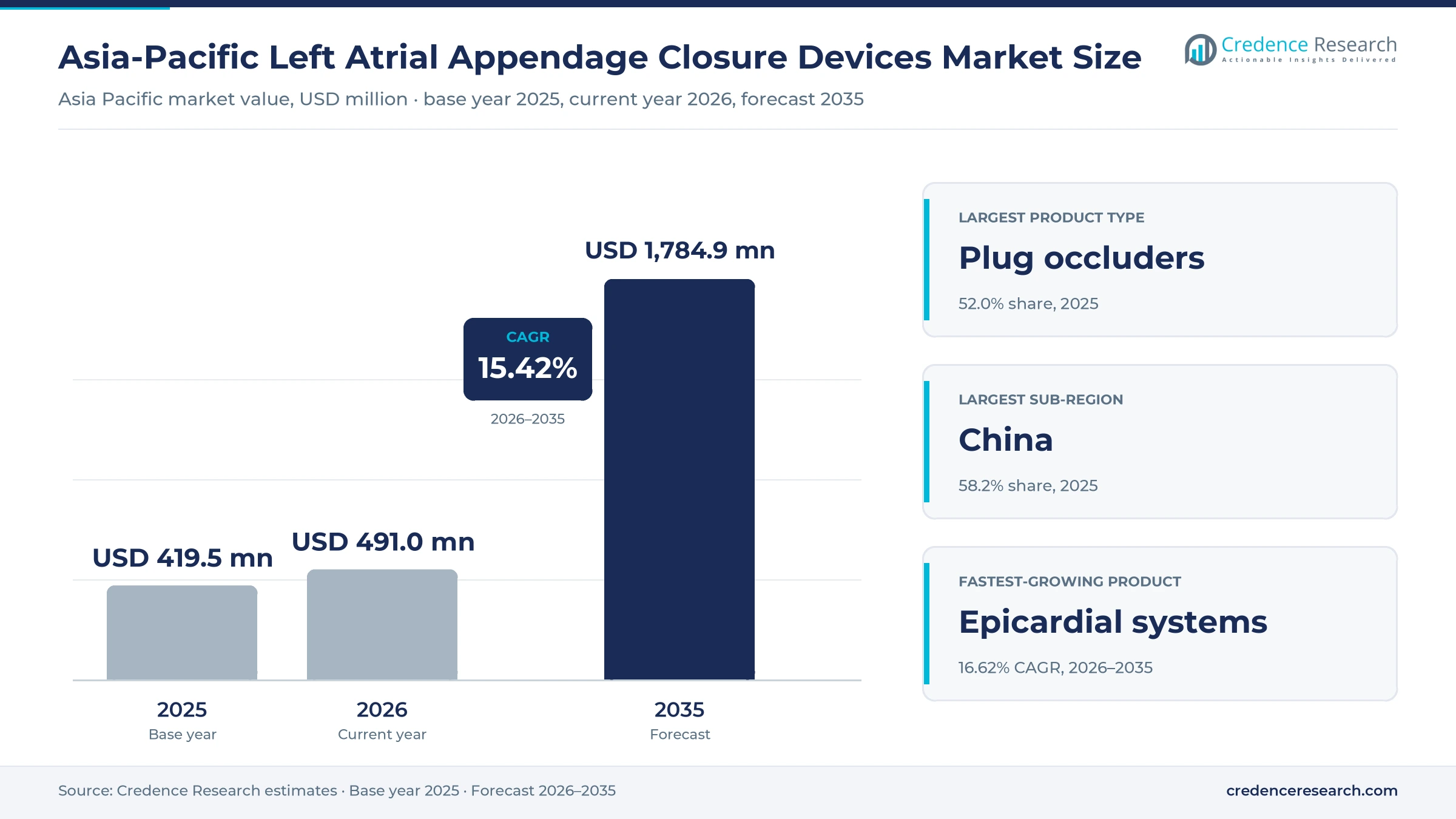
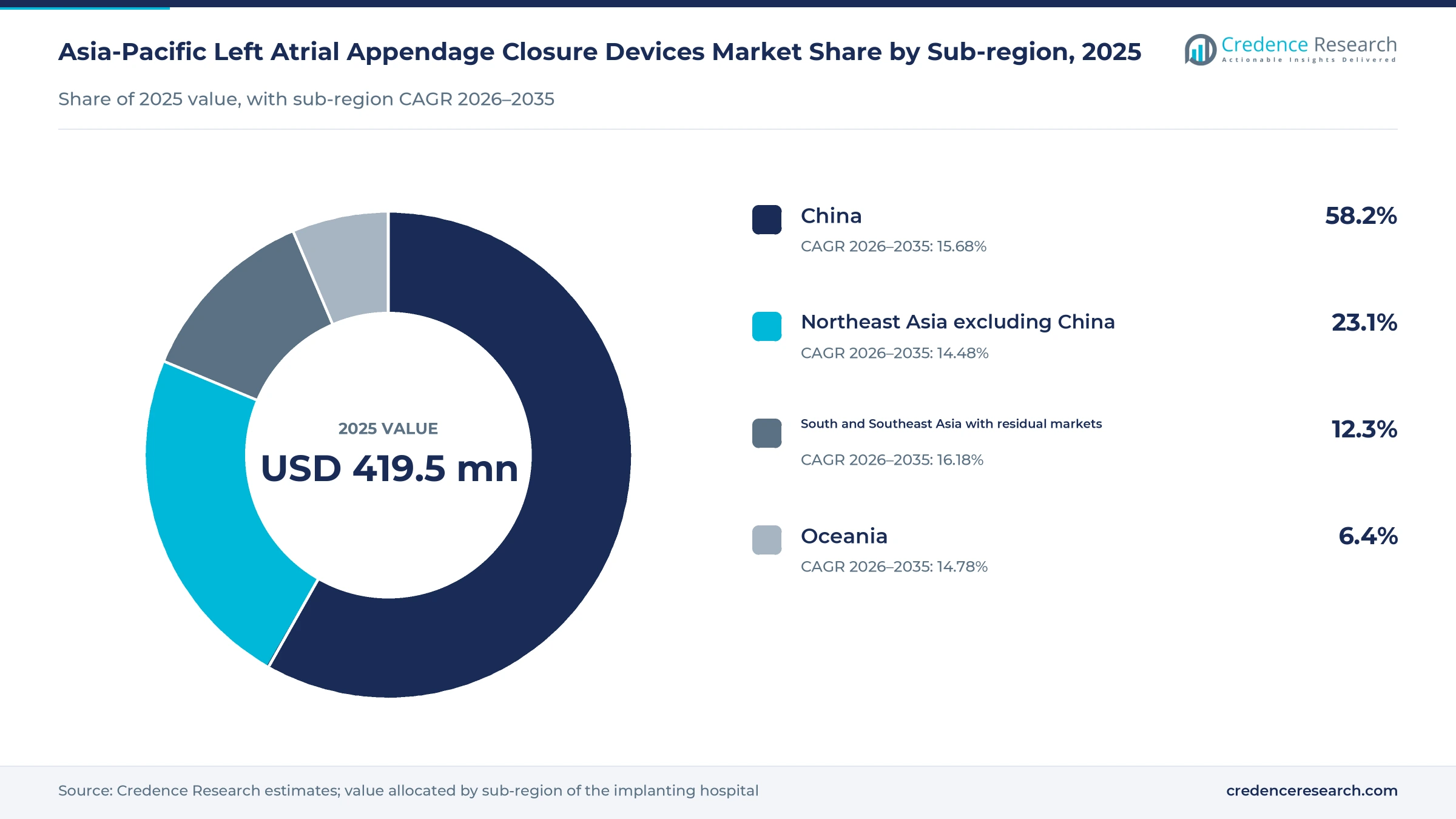
The Asia-Pacific left atrial appendage closure devices market was valued at USD 419.5 million in 2025 and is projected to increase from USD 491.0 million in 2026 to USD 1.78 billion by 2035, registering a CAGR of 15.42% during 2026–2035. Demand comes from older patients with non-valvular atrial fibrillation who face bleeding risk on long-term anticoagulants, and from electrophysiologists who now pair appendage closure with catheter ablation. China held the largest sub-regional share, 58.2% in 2025, because domestic occluders and a large atrial fibrillation population support high implant volumes. South and Southeast Asia with residual markets is the fastest-growing sub-region at 16.18% a year, as cardiac centers in India and Southeast Asia add structural heart programs. Three-year randomized data presented in March 2026 showed that closure can serve as a first-line alternative to anticoagulants, which broadens the patient pool that clinicians can discuss.
Which closure products and procedures does the estimate cover?
The estimate measures hospital spending on implants that seal the left atrial appendage to reduce stroke risk in atrial fibrillation across Asia Pacific. It covers transcatheter plug occluders, transcatheter disc occluders and epicardial exclusion systems, used in standalone procedures or combined with catheter ablation or cardiac surgery. Values are measured at the price paid by public, private and nonprofit hospitals through direct contracts, distributors or public procurement frameworks.
The estimate excludes delivery sheaths sold separately, imaging services, ablation catheters and the physician and hospital fees for the procedure itself. The value chain runs from implant makers in the United States and China through distributors and procurement bodies to catheter laboratories and cardiac surgery units in China, Northeast Asia excluding China, Oceania and South and Southeast Asia with residual markets.
Asia-Pacific Left Atrial Appendage Closure Devices Market Insights
- The Asia-Pacific left atrial appendage closure devices market was valued at USD 419.5 million in 2025 and is projected to reach USD 1.78 billion by 2035, registering a CAGR of 15.42% during 2026–2035.
- China held a 58.2% share of 2025 value, because an estimated 8 million people live with atrial fibrillation there and domestic occluders widen supply.
- Transcatheter plug occluders led product demand with a 52.0% share of 2025 value, because the first closure implants approved in China and Japan used a plug design.
- More than 10,000 closure procedures had been performed in Japan by August 2025, six years after the first implant won approval and insurance coverage there in 2019.
- South Korea's Health Insurance Review and Assessment Service designates closure procedure institutions that meet volume, staffing and equipment rules, and it renewed one in September 2026.
Plug occluders lead while epicardial systems grow fastest
Why do plug occluders lead product demand?
Based on product type, the market is categorized into transcatheter plug occluders, transcatheter disc occluders and epicardial exclusion systems. Transcatheter plug occluders led with a 52.0% share of 2025 value, because the first approved implants in China and Japan used a plug design that operators know well. Epicardial exclusion systems grow fastest at 16.62% a year, as clip systems gained Chinese approval in 2024.
How does combined ablation change application demand?
Based on application, the market is categorized into standalone transcatheter stroke prevention, concomitant catheter ablation and concomitant cardiac surgery. Standalone transcatheter stroke prevention led with a 50.0% share of 2025 value, because most patients are referred for bleeding risk alone. Concomitant catheter ablation grows fastest at 16.04% a year, since Chinese centers often close the appendage during the same ablation session.
Why do overnight admissions still dominate care settings?
Based on care setting, the market is categorized into overnight catheter-laboratory admissions, same-day catheter-laboratory admissions and surgical inpatient admissions. Overnight catheter-laboratory admissions led with a 76.0% share of 2025 value, because most hospitals keep patients for imaging checks after the implant. Same-day catheter-laboratory admissions grow fastest at 17.39% a year, as smaller sheaths and ultrasound guidance shorten recovery.
How do distributors shape hospital purchasing?
Based on sales channel, the market is categorized into manufacturer-negotiated hospital contracts, distributor-negotiated hospital contracts and public procurement frameworks. Distributor-negotiated hospital contracts led with a 38.0% share of 2025 value, because device makers rely on local partners across many health systems. Public procurement frameworks grow fastest at 16.02% a year, as Chinese provinces add structural heart implants to pooled tenders.
| Segment Group | Leading Sub-segment | Share, 2025 | Fastest-growing Sub-segment | CAGR, 2026–2035 |
|---|---|---|---|---|
| By Product Type | Transcatheter plug occluders | 52.0% | Epicardial exclusion systems | 16.62% |
| By Application | Standalone transcatheter stroke prevention | 50.0% | Concomitant catheter ablation | 16.04% |
| By Care Setting | Overnight catheter-laboratory admissions | 76.0% | Same-day catheter-laboratory admissions | 17.39% |
| By Sales Channel | Distributor-negotiated hospital contracts | 38.0% | Public procurement frameworks | 16.02% |
Request a Free Sample
Fill in your details and we'll send you a free sample report.
- Sample data tables & charts
- Research methodology
Trial data, local implants and new pathways widen LAAC use
How is clinical evidence broadening the treatment discussion?
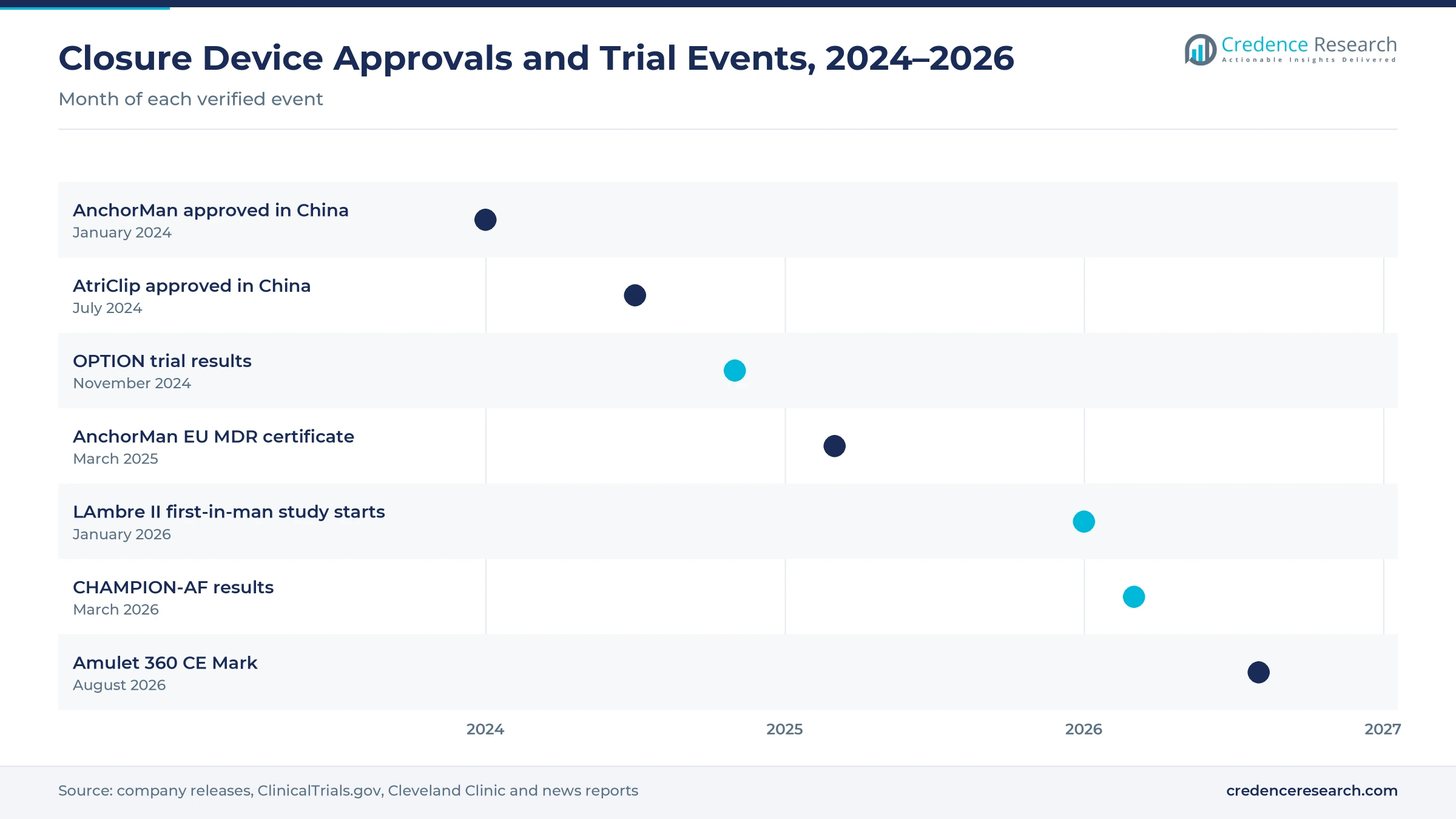
Large randomized trials now show that appendage closure can replace long-term anticoagulants for a wider group of patients, which gives cardiologists in the region stronger grounds to refer. Boston Scientific reported on March 28, 2026, that its CHAMPION-AF trial of 3,000 patients met all endpoints, with lower bleeding than anticoagulants at 36 months, according to a company release. The OPTION trial of 1,600 patients at 114 sites found any bleeding in 8.5% of closure patients versus 18.1% on anticoagulants, according to Cleveland Clinic. In China, the RECORD registry followed 3,096 patients at 39 centers for one year. As a result, standalone transcatheter stroke prevention holds a 50.0% share of 2025 value.
Why do domestic platforms expand supplier choice?
Chinese manufacturers now offer several approved closure implants, which gives hospitals more sizes, designs and price points than a market served by imports alone. Lepu ScienTech Medical commercialized its first-generation occluder in 2020 and has started multicenter enrollment for a biodegradable version, according to its March 2025 results announcement. MicroPort CardioFlow received Chinese approval for its AnchorMan system in January 2024 and reported 41 implants across 12 provinces by September 2024. LifeTech Scientific began a first-in-man study of its LAmbre II occluder in Hong Kong on Jan. 19, 2026, according to ClinicalTrials.gov. In turn, wider domestic supply helps China grow at 15.68% a year through the forecast period.
How do more flexible care pathways support throughput?
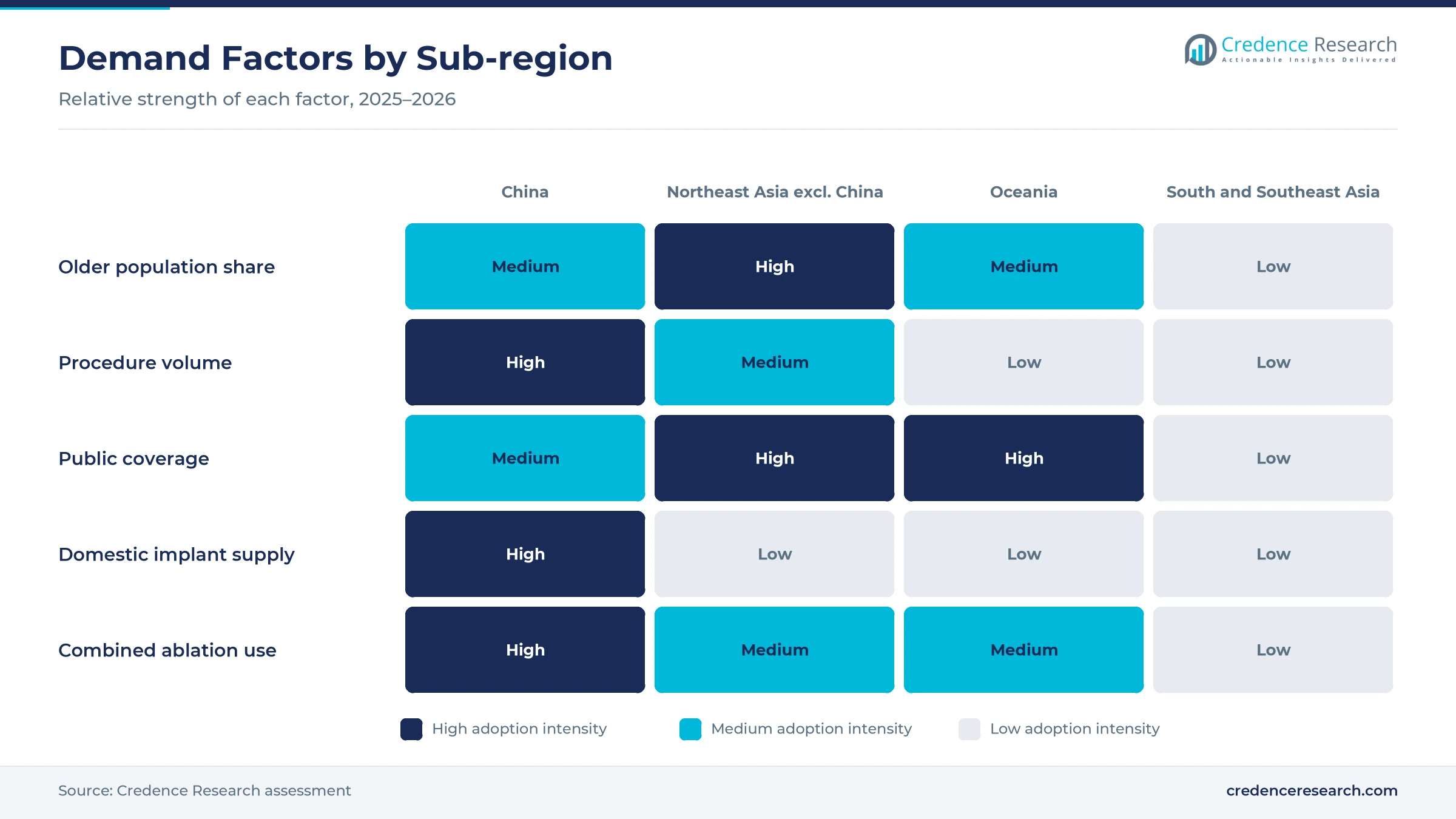
Hospitals are finding ways to treat more patients per catheter laboratory, which raises implant volumes without new operating rooms. Japan approved national reimbursement for closure guided by intracardiac echocardiography in 2025 after domestic feasibility trials, according to a December 2025 review in Cardiovascular Intervention and Therapeutics. The same review said more than 10,000 procedures had been performed in Japan by August 2025. In China, 42.0% of RECORD registry patients had closure combined with catheter ablation in one session. In the OPTION trial, closure performed after ablation succeeded in 99% of patients, which supports pairing both procedures in one hospital stay. As a result, same-day admissions grow at 17.39% a year.
Why does public coverage in Oceania and Korea sustain demand?
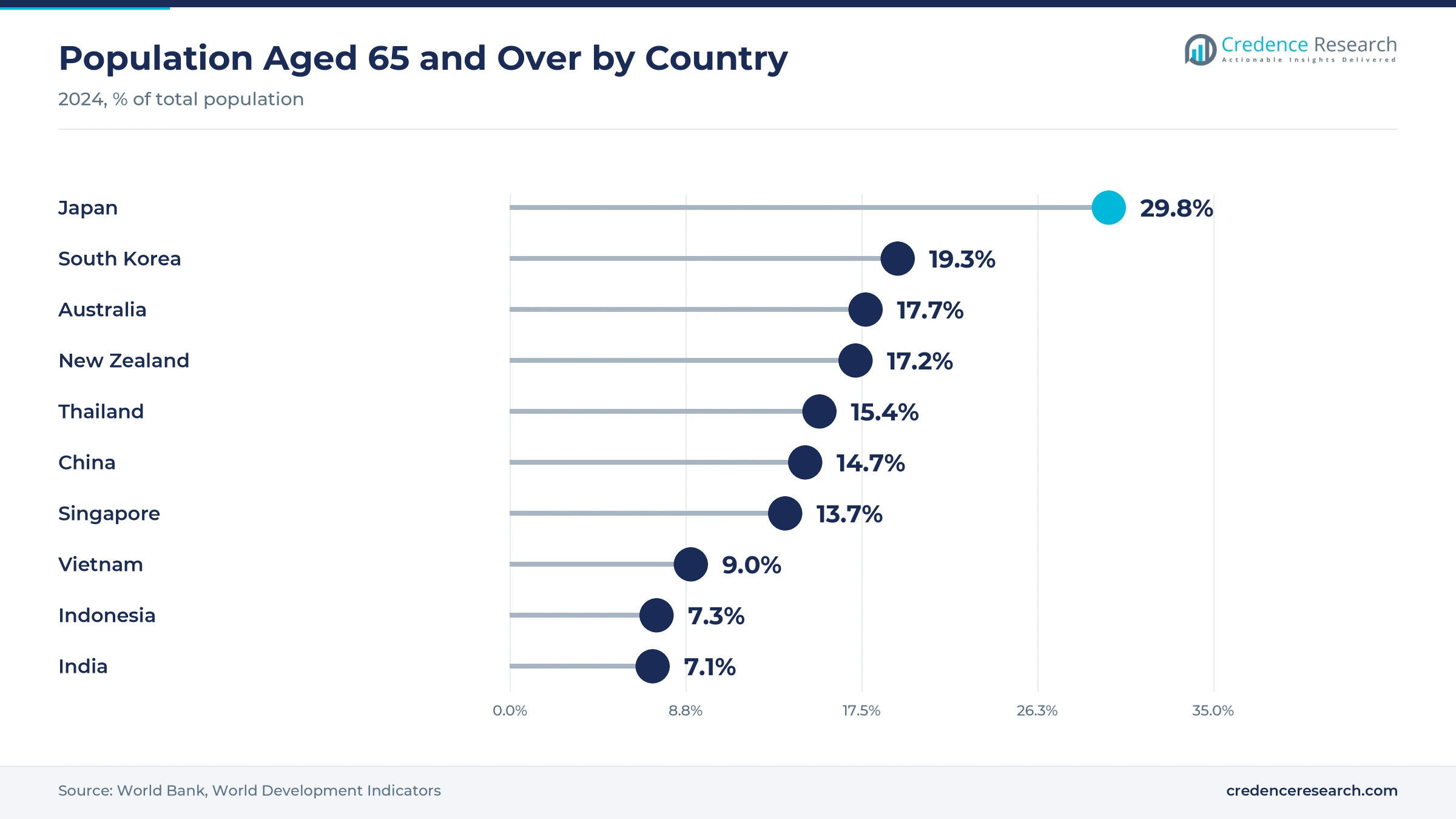
Public payers in Australia and South Korea now set rules for funded closure in selected patients, which lowers the cost barrier for older adults. Australia's Medical Services Advisory Committee supported transcatheter closure for patients who cannot take anticoagulants, and the procedure is funded as MBS item 38276, according to its consumer summary. In Korea, the Health Insurance Review and Assessment Service redesignated Incheon Sejong Hospital as a closure procedure institution for the ninth time in September 2026, according to CBS NoCut News. People aged 65 and over also made up 29.8% of Japan's population and 19.3% of South Korea's in 2024, according to World Bank data. In turn, Oceania grows at 14.78% a year under funded access for older adults.
Combined ablation, CT planning and new designs reshape care
How is the shift to one-stop ablation and closure spreading?
Chinese electrophysiologists increasingly treat rhythm and stroke risk in one session, which turns many ablation patients into closure candidates. The RECORD registry, published in JACC Asia in October 2024, found that 1,295 of 3,096 patients had a combined procedure. The combined group had a lower rate of death, stroke or systemic embolism than closure alone, 3.5% versus 5.2% at one year. Guangdong Provincial People's Hospital also began a 200-patient trial of ablation plus closure versus anticoagulation in frail elderly patients on March 24, 2026. As a result, concomitant catheter ablation grows at 16.04% a year, and demand for cryoablation catheters moves alongside closure volumes.
Why is CT-based planning on the rise?
Hospitals are testing heart CT as a replacement for swallowed ultrasound probes before closure, which could make planning easier for patients and staff. Shanghai Zhongshan Hospital began a 590-patient trial comparing CT-guided and esophageal ultrasound-guided planning in September 2026, according to ClinicalTrials.gov. A separate 238-patient Shantou study compares CT and angiography for occluder sizing during combined ablation and closure. Wider CT use would also let hospitals plan cases from scans that many patients already receive before ablation. Fewer esophageal probes also free anesthesia teams and shorten preparation time in busy catheter laboratories. In turn, same-day catheter-laboratory admissions gain room to grow from a 76.0% base held by overnight stays.
Can biodegradable and next-generation implants open new demand?
Device makers are developing implants that leave less permanent metal or seal more appendage shapes, which could widen use in younger patients and complex anatomy. Lepu ScienTech Medical has moved its Bio-Lefort biodegradable occluder into multicenter clinical enrollment. Abbott received a CE Mark for its Amulet 360 occluder on Aug. 27, 2026, with a softer lobe and smaller anchors than the earlier model. The company said the new lobe is designed to treat more appendage shapes than the first-generation device. LifeTech Scientific is also testing a next-generation disc occluder in a 10-patient first-in-man study. As a result, disc designs gain ground on plug occluders, which still hold a 52.0% share of 2025 value.
Is there room for growth in surgical epicardial exclusion?
Cardiac surgeons in China now have an approved clip option, which opens a new channel for patients who already need open-heart or bypass surgery. AtriCure announced on July 23, 2024, that China's National Medical Products Administration approved several AtriClip models, according to Business Wire. The company said its clips had been used in more than 550,000 patients worldwide. China's National Center for Cardiovascular Diseases is also running a 290-patient trial of appendage clipping versus anticoagulants in non-paroxysmal atrial fibrillation. Positive results would give surgeons in large Chinese centers clearer grounds to add clipping to bypass and valve surgery. In turn, epicardial exclusion systems grow at 16.62% a year, linked to demand for surgical AF treatment.
Price pressure, thin coverage and skill gaps slow adoption
How does procurement pricing squeeze supplier margins?
Chinese provinces buy many cardiovascular implants through pooled tenders, which pushes suppliers to cut prices in exchange for volume. Imported implants face the strongest pressure because domestic makers can bid lower. As a result, value growth in China trails procedure growth in years when new tenders take effect. Suppliers respond by adding lower-cost models and by focusing on combined procedures where hospitals value speed and seal quality.
Why does uneven reimbursement limit access outside China?
Coverage varies widely across the region, which leaves many eligible patients to pay for the implant themselves. Australia, by contrast, funds the procedure under a dedicated Medicare item for patients who cannot take anticoagulants. In India and much of Southeast Asia, public schemes rarely cover the implant in full. In turn, procedures concentrate in private hospitals in large cities, and suppliers work with payers to build local cost evidence.
How do skill and imaging requirements slow new centers?
Closure requires trained structural operators, transseptal access skills and imaging support, which many smaller hospitals lack. Each new program must also build referral links with neurologists and arrhythmia clinics before its case numbers rise. As a result, new centers take time to reach steady volumes, and early cases carry higher risk. Companies respond with proctoring, simulation training and simpler delivery systems that shorten learning curves.
Why do device-related thrombus and leaks remain concerns?
Clots on the implant surface and small leaks around the seal remain known risks after closure, which makes some clinicians cautious about referral. A December 2025 Japanese review listed both as major unresolved issues. In turn, patients need imaging follow-up and short courses of blood thinners, which add cost and visits. Makers respond with surface-modified implants, softer frames and dual-seal designs that aim to reduce both problems.
China leads, South and Southeast Asia grows fastest
| Sub-region | Value, 2025 (USD million) | Share, 2025 | CAGR, 2026–2035 |
|---|---|---|---|
| China | 244.1 | 58.2% | 15.68% |
| Northeast Asia excluding China | 96.9 | 23.1% | 14.48% |
| South and Southeast Asia with residual markets | 51.6 | 12.3% | 16.18% |
| Oceania | 26.8 | 6.4% | 14.78% |
Why does China hold the largest share?
China has an estimated 8 million people with atrial fibrillation, according to a 2024 study in BMC Cardiovascular Disorders, and the WATCHMAN implant was the first closure device approved there. As a result, China held a 58.2% share of 2025 value and grows at 15.68% a year. Domestic occluders from Lepu ScienTech Medical, LifeTech Scientific and MicroPort CardioFlow now compete with imports, while combined ablation and closure is common in large centers.
How does Northeast Asia excluding China support premium demand?
Japan and South Korea pair aging populations with established coverage, which supports steady use of premium implants. Northeast Asia excluding China held a 23.1% share of 2025 value and grows at 14.48% a year. Japan approved its first closure implant in 2019 and saw Abbott's Amulet become available in 2025. Korean institutions must meet volume, staffing and equipment rules to keep their designation as procedure centers.
Why is South and Southeast Asia growing fastest?
Structural heart programs are expanding from a small base in India, Thailand, Vietnam and Indonesia, where most patients are still treated with anticoagulants alone. South and Southeast Asia with residual markets held a 12.3% share of 2025 value and grows at 16.18% a year. Private hospitals lead adoption, and lower-cost Chinese occluders give these centers more affordable options than imports alone.
What shapes demand in Oceania?
Oceania held a 6.4% share of 2025 value and grows at 14.78% a year, because Australia funds the procedure for patients who cannot take anticoagulants under MBS item 38276. People aged 65 and over made up 17.7% of Australia's population and 17.2% of New Zealand's in 2024, according to World Bank data. Private hospitals and experienced structural teams keep demand steady, and closure forms part of wider stroke management planning.
Approvals, trials and coverage moves from 2024 to 2026
| Development | Status and market relevance |
|---|---|
| In January 2024, MicroPort CardioFlow received Chinese approval for its AnchorMan left atrial appendage closure system. | Adds a semi-closed domestic design in China |
| In July 2024, AtriCure announced Chinese approval of several AtriClip left atrial appendage exclusion models. | Opens an epicardial option for cardiac surgeons |
| In November 2024, the OPTION trial reported less bleeding with closure than with anticoagulants after ablation. | Supports combined ablation and closure |
| In January 2026, LifeTech Scientific began a first-in-man study of its LAmbre II occluder in Hong Kong. | Tests a next-generation disc design |
| In March 2026, Boston Scientific reported that CHAMPION-AF met all primary and secondary endpoints. | Supports closure as a first-line option |
Plug, disc and clip designs compete on seal and safety
- Conventional endocardial implants use a nitinol frame and fabric cover placed through a vein, which suits most patients with a typical appendage shape.
- Disc-and-lobe occluders add an outer disc that covers the appendage mouth, which helps seal wide or short appendages.
- Surface-modified endocardial implants use coatings or softer frames to reduce clot formation on the device, which aims to shorten blood thinner use after the implant.
- Epicardial mechanical exclusion places a clip on the outside of the heart during surgery, which closes the appendage without leaving metal inside the heart.
Need a Custom Version of This Report?
Tailor the scope, geography, or segments to your exact requirements.
- Custom geography or segment scope
- Direct access to our analyst team
Global and Chinese makers compete on design and evidence
Competition in closure devices across Asia Pacific combines two U.S. structural heart leaders with fast-growing Chinese makers. Boston Scientific supplies the WATCHMAN family, which was the first closure implant approved in China and Japan, and it now cites three-year randomized data for first-line use. Abbott sells the Amulet occluder, which became available in Japan in 2025, and won a CE Mark for Amulet 360 in August 2026. Lepu ScienTech Medical, LifeTech Scientific and MicroPort CardioFlow offer domestic occluders in China and are testing next-generation or biodegradable designs. AtriCure adds an epicardial clip for surgeons after its 2024 Chinese approval. Companies compete on seal quality, clinical data, procurement pricing and training support for new centers.
Companies profiled and their roles in this market
| Company | Type | Role in the market |
|---|---|---|
| Boston Scientific | Global device maker | Supplies WATCHMAN implants, the first closure devices approved in China and Japan |
| Abbott | Global device maker | Sells the Amulet occluder, available in Japan since 2025 |
| Lepu ScienTech Medical | Chinese device maker | Commercialized an occluder in 2020 and is testing a biodegradable version |
| LifeTech Scientific | Chinese device maker | Develops disc-design occluders, including a next-generation model in early study |
| MicroPort CardioFlow | Chinese device maker | Sells a domestic semi-closed closure system in China |
Credence Research view on regional LAAC adoption
Credence Research's view is that closure device demand in Asia Pacific will grow quickly because randomized trials now support closure for a wider group of atrial fibrillation patients. Plug occluders stay the largest product group, while epicardial systems and disc designs gain share as new approvals arrive. China keeps the largest share as domestic makers add supply, and South and Southeast Asia grows fastest from a small base. However, procurement pricing and uneven coverage will hold back value growth. Suppliers that pair evidence with training and affordable models should gain share.
How the regional LAAC estimate was built
The report uses 2025 as the base year on a calendar basis, and market values come from the Credence Research model. That model combines atrial fibrillation prevalence, procedure volumes, device approvals, coverage decisions, population aging statistics and company information on products and trials. Segment splits, sub-regional shares and growth rates are Credence Research estimates. Sources used are official statistics, regulator and payer documents, trial registries, peer-reviewed studies, company releases and news reports, and no interviews or surveys were used.
Evidence and domestic supply carry growth to 2035
Regional closure device value is expected to reach USD 1.78 billion by 2035, a 15.42% CAGR during 2026–2035, as more clinicians offer closure as an alternative to lifelong anticoagulants. Growth should be strongest through 2030 while combined ablation and closure spreads in China and new implants complete trials. After that, wider coverage in Southeast Asia and simpler imaging should add volume. Faster coverage decisions and first-line label changes would raise this outlook, while deeper tender price cuts or safety concerns over device clots would lower it.
Frequently Asked Questions
How big is the Asia-Pacific left atrial appendage closure devices market?
Which product type leads regional demand?
Which sub-region leads the regional market?
How did recent trials affect demand?
Why is combined ablation and closure important?
Which sales channel leads the market?
Who are the leading companies in the region?
What are the main challenges for suppliers?
Table of Content
Chapter 1 Market Segmentation
- 1.1 Segmentation Framework
- 1.1.1 Product and Service Classification
- 1.1.2 Application and End-Use Classification
- 1.1.3 Technology and Solution Classification
- 1.1.4 Customer and Distribution Channel Classification
- 1.1.5 Geographic Segmentation
- 1.1.6 Market Segment Definitions and Boundaries
- 1.2 By Product Type
- 1.2.1 Transcatheter plug occluders
- 1.2.2 Transcatheter disc occluders
- 1.2.3 Epicardial exclusion systems
- 1.3 By Application
- 1.3.1 Standalone transcatheter stroke prevention
- 1.3.2 Concomitant catheter ablation
- 1.3.3 Concomitant cardiac surgery
- 1.4 By Care Setting
- 1.4.1 Overnight catheter-laboratory admissions
- 1.4.2 Same-day catheter-laboratory admissions
- 1.4.3 Surgical inpatient admissions
- 1.5 By Sales Channel
- 1.5.1 Manufacturer-negotiated hospital contracts
- 1.5.2 Distributor-negotiated hospital contracts
- 1.5.3 Public procurement frameworks
- 1.6 By Sub-region
- 1.6.1 China
- 1.6.2 Northeast Asia excluding China
- 1.6.3 Oceania
- 1.6.4 South and Southeast Asia with residual markets
Chapter 2 Introduction
- 2.1 Report Objectives and Scope
- 2.2 Product Definition and Industry Terminology
- 2.3 Market Inclusions and Exclusions
- 2.4 Research Process
- 2.4.1 Primary Research and Expert Interviews
- 2.4.2 Secondary Research and Source Review
- 2.4.3 Top-Down and Bottom-Up Estimation
- 2.4.4 Data Triangulation and Verification
- 2.5 Market Size Measurement Basis
- 2.5.1 2025: USD 419.5 million → 2035: USD 1.78 billion
- 2.6 Historical and Forecast Reference Periods
- 2.6.1 Historical Period: 2018-2025
- 2.6.2 Base Year: 2025
- 2.6.3 Forecast Period: 2025-2035
- 2.7 Research Assumptions and Limitations
Chapter 3 Executive Summary
- 3.1 Market Snapshot and Key Findings
- 3.2 Base-Year Market Size, 2025
- 3.3 Forecast Market Size, 2035
- 3.4 Revenue and Volume Growth Outlook
- 3.5 Key Demand and Supply Indicators
- 3.6 Leading Market Segments
- 3.7 Fastest-Growing Market Opportunities
- 3.8 Regional Performance Highlights
- 3.9 Technology and Industry Transformation
- 3.10 Competitive Landscape Summary
- 3.11 Analyst View and Strategic Implications
Chapter 4 Asia-Pacific Left Atrial Appendage Closure Devices Market Trends and Developments
- 4.1 Historical Industry Development, 2018-2025
- 4.2 Recent Market Trends and Developments
- 4.3 Demand and Customer Behavior Trends
- 4.4 Technology and Product Innovation
- 4.5 Artificial Intelligence, Automation and Digitalization
- 4.6 Local Manufacturing and Supply Chain Realignment
- 4.7 Industry Partnerships, Mergers and Acquisitions
- 4.8 Sustainability and Circular Economy Developments
- 4.9 Government and Private Sector Investment Trends
- 4.10 Emerging Business Models and Commercialization
- 4.11 Industry Developments and Announcements
Chapter 5 Asia-Pacific Left Atrial Appendage Closure Devices Market Production, Supply and Demand Analysis
- 5.1 Demand Trend and Consumption Analysis, 2018-2025
- 5.2 Demand Forecast, 2025-2035
- 5.3 Production and Output Trend, 2018-2025
- 5.4 Production and Output Forecast, 2025-2035
- 5.5 Installed Capacity and Capacity Utilization
- 5.6 Company-Wise Production Plants and Statistics
- 5.6.1 Installed Production Capacity
- 5.6.2 Actual Production
- 5.6.3 Planned Capacity and Expansion Targets
- 5.7 Supply Chain Structure and Procurement Trends
- 5.8 Supply-Demand Gap and Bottlenecks
- 5.9 Import Dependence and Sourcing Structure
- 5.10 Contract Manufacturing and Outsourcing
- 5.11 Regional Supply and Demand Concentration
Chapter 6 Asia-Pacific Left Atrial Appendage Closure Devices Market Pricing Analysis
- 6.1 Pricing Structure and Measurement
- 6.2 Historical Pricing Trends, 2018-2025
- 6.3 Pricing Outlook, 2025-2035
- 6.4 Average Selling Price and Unit Economics
- 6.5 Pricing by Product and Market Segment
- 6.6 Geographic Pricing Differences
- 6.7 Key Input, Energy, Labor and Logistics Costs
- 6.8 Contract Pricing and Purchasing Models
- 6.9 Pricing Sensitivity and Competitive Positioning
- 6.10 Price, Margin and Profitability Implications
Chapter 7 Asia-Pacific Left Atrial Appendage Closure Devices Market Dynamics
- 7.1 Market Growth Drivers
- 7.1.1 Demand-Side Drivers
- 7.1.2 Technology and Innovation Drivers
- 7.1.3 Infrastructure and Investment Drivers
- 7.1.4 Regulatory and Policy Drivers
- 7.2 Market Restraints
- 7.2.1 Cost and Affordability Constraints
- 7.2.2 Technology and Adoption Barriers
- 7.2.3 Supply Chain and Operational Constraints
- 7.3 Market Challenges
- 7.3.1 Competitive Pressure and Margin Erosion
- 7.3.2 Skills, Infrastructure and Implementation Gaps
- 7.4 Emerging Market Opportunities
- 7.5 Market Dynamics Impact and Time-Horizon Assessment
Chapter 8 Asia-Pacific Left Atrial Appendage Closure Devices Value Chain Analysis
- 8.1 Industry Value Chain Overview
- 8.2 Upstream Suppliers and Critical Inputs
- 8.3 Technology and Component Providers
- 8.4 Manufacturing or Service Delivery
- 8.5 Distribution, Channel Partners and Integrators
- 8.6 Downstream Applications and End Users
- 8.7 Value Addition and Profit Pools
- 8.8 Vertical Integration and Outsourcing
- 8.9 Supplier Concentration and Risk
- 8.10 Supply Chain Localization and Resilience
Chapter 9 Asia-Pacific Left Atrial Appendage Closure Devices Market Regulations and Policies
- 9.1 Relevant Laws, Standards and Compliance Frameworks
- 9.2 Product, Service, Safety and Quality Requirements
- 9.3 Government Policies, Incentives and Subsidies
- 9.4 Imports, Exports and Trade Barriers
- 9.5 Public Procurement and Local Content Requirements
- 9.6 Environmental and Sustainability Compliance
- 9.7 Upcoming Policy Changes and Market Implications
Chapter 10 Asia-Pacific Left Atrial Appendage Closure Devices Market Hotspots and Opportunities
- 10.1 Market Opportunity Mapping and Growth Hotspots
- 10.2 High-Growth Applications and Customer Groups
- 10.3 Underserved Markets and White-Space Opportunities
- 10.4 Emerging Technology and Product Opportunities
- 10.5 New Capacity and Investment Hotspots
- 10.6 Market Entry and Expansion Opportunities
- 10.7 Distribution and Partnership Opportunities
- 10.8 Near-Term and Long-Term Commercial Potential
- 10.9 Opportunity Attractiveness and Execution Risks
Chapter 11 Asia-Pacific Left Atrial Appendage Closure Devices Market Outlook, 2025-2035
- 11.1 Market Size and Analysis
- 11.1.1 Revenue (Market Measurement: 2025: USD 419.5 million → 2035: USD 1.78 billion)
- 11.1.2 Market Volume and Quantity Sold
- 11.1.3 Historical Market Size, 2018-2025
- 11.1.4 Base-Year Market Size, 2025
- 11.2 Market Forecast, 2025-2035
- 11.2.1 Revenue Forecast to 2035
- 11.2.2 Volume Forecast to 2035
- 11.2.3 CAGR and Year-on-Year Growth
- 11.2.4 Incremental Revenue Opportunity
- 11.3 Forecast Assumptions and Scenario Analysis
- 11.3.1 Base-Case Forecast
- 11.3.2 Optimistic and Conservative Scenarios
- 11.3.3 Technology, Pricing and Policy Sensitivities
- 11.4 Market Attractiveness and Growth Outlook
Chapter 12 Asia-Pacific Left Atrial Appendage Closure Devices Market Segmentation and Outlook
- 12.1 Segmentation Summary and Market Shares, 2025
- 12.2 Largest and Fastest-Growing Segments
- 12.3 By Product Type - Market Size and Forecast, 2025-2035
- 12.3.1 Segment Definition and Scope
- 12.3.2 Historical Market Size, 2018-2025
- 12.3.3 Revenue Forecast, 2025-2035
- 12.3.4 Volume Forecast, 2025-2035
- 12.3.5 Base-Year Market Share, 2025
- 12.3.6 Segment CAGR and Growth Drivers
- 12.3.7 Subsegment Market Size and Forecast
- 12.3.7.1 Transcatheter plug occluders
- 12.3.7.2 Transcatheter disc occluders
- 12.3.7.3 Epicardial exclusion systems
- 12.3.8 Subsegment Pricing and Adoption Trends
- 12.3.9 Leading Suppliers and Competition
- 12.3.10 Regional Demand and Opportunities
- 12.4 By Application - Market Size and Forecast, 2025-2035
- 12.4.1 Segment Definition and Scope
- 12.4.2 Historical Market Size, 2018-2025
- 12.4.3 Revenue Forecast, 2025-2035
- 12.4.4 Volume Forecast, 2025-2035
- 12.4.5 Base-Year Market Share, 2025
- 12.4.6 Segment CAGR and Growth Drivers
- 12.4.7 Subsegment Market Size and Forecast
- 12.4.7.1 Standalone transcatheter stroke prevention
- 12.4.7.2 Concomitant catheter ablation
- 12.4.7.3 Concomitant cardiac surgery
- 12.4.8 Subsegment Pricing and Adoption Trends
- 12.4.9 Leading Suppliers and Competition
- 12.4.10 Regional Demand and Opportunities
- 12.5 By Care Setting - Market Size and Forecast, 2025-2035
- 12.5.1 Segment Definition and Scope
- 12.5.2 Historical Market Size, 2018-2025
- 12.5.3 Revenue Forecast, 2025-2035
- 12.5.4 Volume Forecast, 2025-2035
- 12.5.5 Base-Year Market Share, 2025
- 12.5.6 Segment CAGR and Growth Drivers
- 12.5.7 Subsegment Market Size and Forecast
- 12.5.7.1 Overnight catheter-laboratory admissions
- 12.5.7.2 Same-day catheter-laboratory admissions
- 12.5.7.3 Surgical inpatient admissions
- 12.5.8 Subsegment Pricing and Adoption Trends
- 12.5.9 Leading Suppliers and Competition
- 12.5.10 Regional Demand and Opportunities
- 12.6 By Sales Channel - Market Size and Forecast, 2025-2035
- 12.6.1 Segment Definition and Scope
- 12.6.2 Historical Market Size, 2018-2025
- 12.6.3 Revenue Forecast, 2025-2035
- 12.6.4 Volume Forecast, 2025-2035
- 12.6.5 Base-Year Market Share, 2025
- 12.6.6 Segment CAGR and Growth Drivers
- 12.6.7 Subsegment Market Size and Forecast
- 12.6.7.1 Manufacturer-negotiated hospital contracts
- 12.6.7.2 Distributor-negotiated hospital contracts
- 12.6.7.3 Public procurement frameworks
- 12.6.8 Subsegment Pricing and Adoption Trends
- 12.6.9 Leading Suppliers and Competition
- 12.6.10 Regional Demand and Opportunities
- 12.7 By Sub-region - Market Size and Forecast, 2025-2035
- 12.7.1 Segment Definition and Scope
- 12.7.2 Historical Market Size, 2018-2025
- 12.7.3 Revenue Forecast, 2025-2035
- 12.7.4 Volume Forecast, 2025-2035
- 12.7.5 Base-Year Market Share, 2025
- 12.7.6 Segment CAGR and Growth Drivers
- 12.7.7 Subsegment Market Size and Forecast
- 12.7.7.1 China
- 12.7.7.2 Northeast Asia excluding China
- 12.7.7.3 Oceania
- 12.7.7.4 South and Southeast Asia with residual markets
- 12.7.8 Subsegment Pricing and Adoption Trends
- 12.7.9 Leading Suppliers and Competition
- 12.7.10 Regional Demand and Opportunities
- 12.8 Segment Growth Comparison
- 12.9 Segment Attractiveness and Priority Matrix
Chapter 13 Asia-Pacific Left Atrial Appendage Closure Devices End-Use and Application Market Outlook
- 13.1 End-Use Industry and Customer Demand Structure
- 13.2 Leading Applications and Customer Groups
- 13.3 End-Use Market Size, Share and Forecast
- 13.4 Major End-Use Industry Deep Dives
- 13.4.1 Customer Requirements and Use Cases
- 13.4.2 Demand and Replacement Cycles
- 13.4.3 Technical and Regulatory Considerations
- 13.4.4 Purchasing and Procurement Models
- 13.4.5 Leading Vendors and Distribution Channels
- 13.4.6 Forecast and Commercial Opportunities
- 13.5 Emerging Applications and Cross-Segment Demand
- 13.6 End-Use Industry Investment Priorities
Chapter 14 Asia-Pacific Left Atrial Appendage Closure Devices Geographic Market Outlook, 2025-2035
- 14.1 Regional Market Size and Country-Level Shares, 2025
- 14.2 Country Market Size Comparison, 2025
- 14.3 Country Market Forecasts, 2025-2035
- 14.4 Subregional Industrial and Demand Clusters
- 14.5 Intra-Regional Pricing and Cost Differences
- 14.6 Cross-Border Trade and Supply Networks
- 14.7 Regional Supply and Demand Balances
- 14.8 Country Opportunity Comparison and Prioritization
Note: Every listed country is covered on the structure shown under the first country.
Chapter 15 Asia-Pacific Left Atrial Appendage Closure Devices Technology, Innovation and Sustainability Outlook
- 15.1 Technology Landscape and Maturity
- 15.2 Product, Process and Service Innovation
- 15.3 AI, Automation and Digital Tools in the Industry
- 15.4 Technology Adoption and Performance Benchmarking
- 15.5 Innovation Pipeline and R&D Investment
- 15.6 Patent and Intellectual Property Trends
- 15.7 Energy Efficiency and Resource Management
- 15.8 Sustainability, Recycling and Circularity
- 15.9 Technology Roadmap, 2025-2035
- 15.10 Risks of Obsolescence and Technology Substitution
Chapter 16 Asia-Pacific Left Atrial Appendage Closure Devices Market Key Strategic Imperatives
- 16.1 Growth and Market Entry Priorities
- 16.2 High-Return Products and Segments
- 16.3 Pricing, Profitability and Cost Optimization
- 16.4 Technology Investment and Product Differentiation
- 16.5 Supply Chain Localization and Resilience
- 16.6 Distribution and Customer Acquisition
- 16.7 Partnership, Acquisition and Capacity Strategy
- 16.8 Regional Expansion Priorities
- 16.9 Short-, Medium- and Long-Term Actions
Chapter 17 Competition Outlook
- 17.1 Industry Competition Characteristics
- 17.2 Market Structure and Concentration
- 17.3 Market Share and Competitive Positioning, 2025
- 17.4 Company-Wise Revenue and Product Benchmarking
- 17.5 Production and Service Capacity Benchmarking
- 17.6 Technology, Pricing and Differentiation
- 17.7 Regional Footprint and Distribution Strength
- 17.8 Mergers, Acquisitions and Strategic Alliances
- 17.9 New Entrants and Competitive Threats
- 17.10 Porter's Five Forces and Industry Attractiveness
- 17.11 Competitive Outlook, 2025-2035
Chapter 18 Company Profiles
- 18.1 Company Coverage and Selection Criteria
- 18.2 Boston Scientific
- 18.2.1 Business Description
- 18.2.2 Company Ownership and Geographic Presence
- 18.2.3 Product and Service Portfolio
- 18.2.4 Manufacturing and Operating Footprint
- 18.2.5 Production Capacity and Expansion Plans
- 18.2.6 Financial Performance and Investment
- 18.2.7 Market Share and Competitive Position
- 18.2.8 Technology and Innovation Capabilities
- 18.2.9 Strategic Alliances or Partnerships
- 18.2.10 Recent Developments
- 18.2.11 Growth Strategy and Outlook
- 18.3 Lepu ScienTech Medical
- 18.4 LifeTech Scientific
- 18.5 MicroPort CardioFlow
- 18.6 Abbott
- 18.7 Other Relevant Market Participants
Note: Every listed company is profiled on the structure shown under the first company. The company list is preliminary and may change based on research findings, market developments, data availability and client requirements.
Chapter 19 Disclaimer
- 19.1 Research and Forecast Disclaimer
- 19.2 Data Source and Estimation Limitations
Note: The depth of individual sections depends on data availability for this market. Volume, capacity, trade and other unit-based metrics are included where applicable.

