| REPORT ATTRIBUTE | DETAILS |
|---|---|
| Historical Period | 2019-2022 |
| Base Year | 2023 |
| Forecast Period | 2024-2032 |
| Stroke Management Market Size 2024 | USD 19995 Million |
| Stroke Management Market, CAGR | 6% |
| Stroke Management Market Size 2032 | USD 31868.99 Million |
Market Overview:
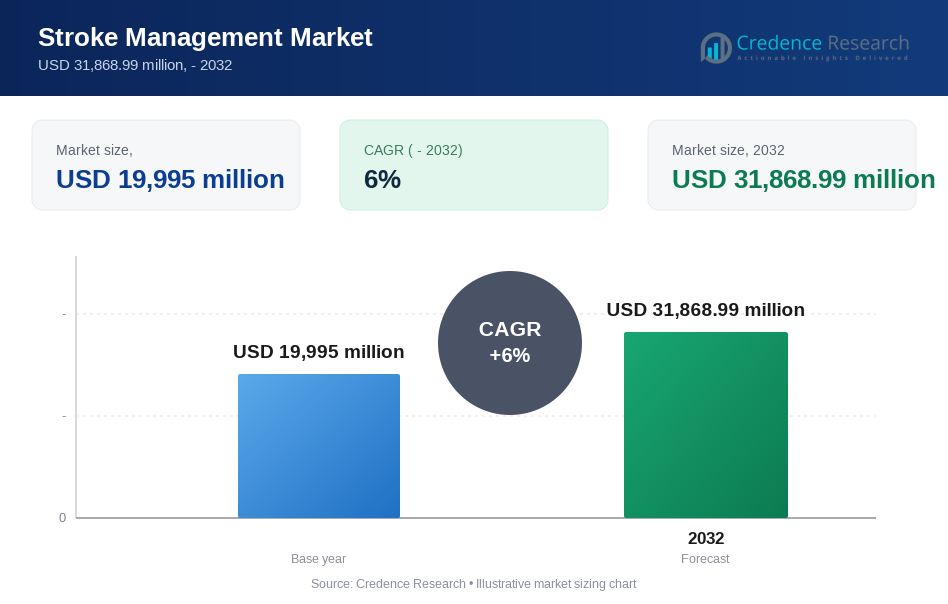
The Stroke Management Market is projected to grow from USD 19995 million in 2024 to an estimated USD 31868.99 million by 2032, with a compound annual growth rate (CAGR) of 6% from 2024 to 2032.
Several key factors are driving the growth of the stroke management market. One of the primary drivers is the increasing prevalence of stroke globally, largely attributable to rising rates of lifestyle-related risk factors such as hypertension, obesity, and diabetes. Technological advancements in stroke diagnostics, such as advanced imaging techniques and artificial intelligence, are also enhancing early detection and treatment, which is crucial for effective stroke management. Furthermore, healthcare providers and governments worldwide are investing in public health campaigns to raise awareness about stroke symptoms and prevention strategies. These initiatives have led to higher demand for acute stroke treatment options, rehabilitation services, and post-stroke care. Additionally, innovative medical devices, such as clot retrieval devices and neurostimulation therapies, are significantly improving patient outcomes and driving market growth.
Regionally, North America holds a substantial share of the stroke management market due to a well-established healthcare infrastructure, high healthcare expenditure, and growing awareness about stroke management options. The United States, in particular, leads the market, driven by a high prevalence of stroke and favorable reimbursement policies. Europe follows closely, with countries like Germany, France, and the UK witnessing rising demand for advanced stroke management solutions as the aging population increases. The Asia-Pacific region is expected to see the fastest growth during the forecast period, primarily due to rapid urbanization, a growing elderly population, and increasing healthcare investments in emerging economies like China and India. Additionally, the rising prevalence of lifestyle diseases in these regions is expected to fuel demand for stroke management solutions. Latin America and the Middle East & Africa are also projected to experience steady growth as awareness about stroke prevention and treatment continues to rise in these regions.
Market Drivers:
Rising Prevalence of Stroke:
One of the primary drivers of the stroke management market is the rising prevalence of stroke globally. Factors such as an aging population, sedentary lifestyles, and increasing rates of chronic diseases like hypertension, diabetes, and obesity have all contributed to a higher incidence of stroke worldwide. For instance, according to the World Health Organization (WHO), Annually, 15 million people worldwide suffer a stroke. Of these, 5 million die and another 5 million are left permanently disabled. As populations age, the risk of stroke naturally increases, and the growing number of elderly individuals in regions like North America, Europe, and parts of Asia is expected to lead to greater demand for stroke management solutions. This trend is further exacerbated by lifestyle changes that contribute to cardiovascular risk factors, underscoring the need for effective stroke prevention, treatment, and rehabilitation options across healthcare systems.
Advances in Diagnostic Technologies:
Technological advancements in diagnostic tools are significantly enhancing stroke management and are a crucial market driver. Early diagnosis of stroke is essential for minimizing long-term damage and improving patient outcomes. Recent innovations in imaging technologies, such as computed tomography (CT), magnetic resonance imaging (MRI), and advanced brain scanning techniques, have made it possible to detect strokes more quickly and accurately. The widespread availability and affordability of computed tomography (CT) scans have enabled more rapid and accurate diagnosis of stroke. For instance, according to a study published in the New England Journal of Medicine, CT scans are now used in over 90% of stroke cases in the United States. Additionally, artificial intelligence (AI) is being integrated into diagnostic processes to help clinicians interpret imaging results faster, enabling rapid decision-making and treatment initiation. This progress in diagnostics has not only improved early stroke identification but also heightened the demand for advanced diagnostic tools, supporting overall market growth.
Growth in Innovative Treatment Options:
The development of new and innovative treatment options is also driving the stroke management market. Clot retrieval devices, thrombolytic therapies, and neurostimulation devices represent some of the latest advances in acute stroke treatment, and these technologies are improving patient recovery rates and reducing complications. Clot retrieval devices, for example, have revolutionized ischemic stroke treatment, allowing for the effective removal of blood clots, which restores blood flow and reduces the risk of brain damage. Likewise, the introduction of neurostimulation therapies is expanding treatment possibilities for patients who suffer from chronic stroke-related disabilities. These innovations are not only enhancing the range of treatment options available but are also encouraging healthcare providers to invest in advanced stroke management technologies.
Growing Awareness and Government Initiatives:
Increasing awareness about stroke symptoms and preventive measures, combined with proactive government initiatives, is further driving market growth. Health organizations and governments worldwide are implementing campaigns and educational programs to inform the public about the importance of recognizing stroke symptoms early and seeking immediate medical attention. For instance, public awareness initiatives like the FAST (Face, Arms, Speech, Time) campaign have been instrumental in helping people identify stroke symptoms and act quickly, improving outcomes. Furthermore, government funding and grants for stroke research and the expansion of stroke centers are improving access to advanced stroke care services. These initiatives, coupled with investments in healthcare infrastructure, are contributing to the rising demand for stroke management solutions, ensuring that more patients receive timely and effective treatment.
Market Trends:
Integration of Artificial Intelligence in Stroke Diagnostics:
One prominent trend in the stroke management market is the integration of artificial intelligence (AI) into diagnostic processes. AI-driven technologies are being employed to enhance the accuracy and speed of stroke detection, particularly in imaging analysis. For example, a machine-learning algorithm developed by researchers at Florida International University can diagnose strokes with an accuracy of 83%, analyzing data from 143,203 patients, of which 73% had a stroke. Advanced algorithms can analyze CT and MRI scans to identify signs of stroke, facilitating faster decision-making for healthcare providers. AI’s ability to detect subtle abnormalities that might not be visible to the human eye is particularly valuable in emergency settings, where timely intervention is critical. This trend is likely to continue as healthcare providers seek efficient tools to streamline stroke diagnosis and improve outcomes, ultimately reducing long-term disability and healthcare costs.
Increased Focus on Neurorehabilitation and Post-Stroke Care:
As stroke survival rates improve due to advancements in acute treatment, there is a growing focus on neurorehabilitation and post-stroke care. The shift towards comprehensive, long-term stroke management solutions reflects a broader trend of prioritizing recovery and quality of life for stroke survivors. Innovative rehabilitation tools, including robotic-assisted therapy, virtual reality (VR) platforms, and brain-computer interface technologies, are increasingly being used to aid recovery and improve functional outcomes. Moreover, rehabilitation programs are expanding to include cognitive and emotional support, reflecting an understanding that recovery is not solely physical. This trend supports the overall growth of the stroke management market by addressing the diverse needs of patients in the post-stroke phase and contributing to their improved well-being and reintegration into daily life.
Rising Popularity of Minimally Invasive Stroke Treatments:
Minimally invasive treatments are gaining traction in the stroke management market, particularly for ischemic strokes. Technologies such as mechanical thrombectomy devices allow healthcare providers to remove blood clots with minimal disruption to surrounding tissues, reducing recovery time and the risk of complications. This approach is increasingly preferred over traditional, more invasive procedures, as it can offer better outcomes and shorter hospital stays. Additionally, the demand for minimally invasive treatments is fueled by the growing elderly population, who often present higher surgical risks and benefit from less invasive options. As technological advancements continue to enhance the efficacy and safety of these treatments, the market for minimally invasive stroke management solutions is expected to expand significantly.
Expansion of Telemedicine for Stroke Management:
The expansion of telemedicine is reshaping the stroke management landscape, offering new avenues for remote diagnosis, monitoring, and patient education. Telemedicine platforms enable healthcare providers to assess stroke symptoms in real-time; for example, during a study conducted across 77 hospitals in China, telemedicine allowed neurologists to guide on-site physicians in delivering prompt treatment through telestroke care. Beyond acute management, telemedicine is also being used for follow-up care; approximately 21,579 participants completed three-month follow-ups after receiving care through these platforms. This trend is likely to grow as telemedicine technologies advance and as healthcare systems increasingly recognize the benefits of remote care in improving access, efficiency, and outcomes for stroke patients.
Market Restraints and Challenges:
High Costs of Advanced Stroke Treatments and Devices:
One significant restraint in the stroke management market is the high cost associated with advanced stroke treatments and medical devices. Technologies like mechanical thrombectomy devices, robotic rehabilitation tools, and specialized neuroimaging systems require substantial investment, both for healthcare providers and patients. These costs can limit access to the latest treatments, especially in low- and middle-income countries where healthcare budgets are constrained. Additionally, the costs of advanced rehabilitation services can be prohibitive for patients needing long-term care, which poses a challenge to market expansion. For healthcare facilities, the financial burden of acquiring and maintaining state-of-the-art equipment can be a significant barrier to adopting advanced stroke management solutions, impacting the availability of these treatments.
Limited Awareness and Early Diagnosis in Emerging Markets:
Another key challenge in the stroke management market is the limited awareness and early diagnosis of stroke in emerging markets. In many regions, knowledge of stroke symptoms and the importance of prompt medical attention is low, resulting in delays in seeking treatment. Early diagnosis is critical in reducing the risk of long-term disability, but in some emerging economies, there is a lack of access to diagnostic tools like CT and MRI scanners. Furthermore, a shortage of trained healthcare professionals to recognize and manage stroke symptoms exacerbates the issue. This challenge limits the effectiveness of stroke management in these regions and can ultimately hinder market growth as fewer patients access timely and effective treatments.
Stringent Regulatory Requirements:
The stroke management market also faces challenges from stringent regulatory requirements associated with medical devices and pharmaceuticals. New stroke management technologies, particularly those involving invasive procedures or pharmacological interventions, must meet strict regulatory standards to ensure safety and efficacy. The process for obtaining approvals from regulatory bodies, such as the FDA in the United States or the EMA in Europe, can be lengthy and costly, delaying the time to market for new products. Additionally, regulatory requirements can vary significantly between countries, complicating the process for companies seeking to launch products globally. These regulatory hurdles can impede innovation and increase the costs associated with bringing advanced stroke management solutions to market, posing a challenge for manufacturers and healthcare providers.
Shortage of Skilled Healthcare Professionals:
A shortage of skilled healthcare professionals, particularly in neurology and rehabilitation, is another constraint in the stroke management market. Treating and managing stroke requires specialized expertise, but many regions face a shortage of neurologists, rehabilitation specialists, and trained caregivers. This shortage can impact the quality and accessibility of stroke management services, particularly in rural and underserved areas. The lack of skilled personnel may also contribute to delayed diagnoses and suboptimal care, limiting the effectiveness of stroke management efforts. Addressing this workforce challenge is essential for expanding access to high-quality stroke care and supporting the market’s long-term growth.
Market Segmentation Analysis:
By Type, ischemic stroke holds a dominant share due to its high prevalence, driven by risk factors like hypertension, diabetes, and obesity. Hemorrhagic stroke, although less common, requires specialized management tools, and the segment is seeing growth due to advances in therapeutic devices. Transient Ischemic Attacks (TIAs) are gaining attention, as early intervention is crucial to prevent full-blown strokes, making this segment significant for preventative care solutions.
By Product segmentation, diagnostic devices are essential for early stroke detection and include technologies such as MRI, CT scans, and cerebral angiography. These tools play a pivotal role in diagnosing stroke types and facilitating timely treatment. Therapeutic devices, including stent retrievers, embolic coils, and aspiration catheters, are crucial in acute stroke management, particularly in the removal of clots for ischemic stroke. The ongoing innovation in therapeutic devices, such as flow diverters and surgical clips, supports the demand for minimally invasive procedures, which are favored for better patient outcomes.
By End-use segmentation highlights hospitals as the primary setting for stroke management, providing comprehensive diagnostic and therapeutic services. Ambulatory Surgery Centers (ASCs) are also playing an increasingly important role, particularly in offering specialized stroke interventions in a cost-effective, outpatient setting. Diagnostic Centers, equipped with advanced imaging technologies, are essential for timely and accurate stroke diagnoses. These end-use segments collectively contribute to the market’s expansion as demand for effective, accessible stroke management solutions continues to rise.
Segmentation:
By Type
- Ischemic
- Hemorrhagic
- Transient Ischemic Attack (TIA)
- Others
By Product
- Diagnostic Devices
- Magnetic Resonance Imaging (MRI)
- Computed Tomography Scan (CT scan)
- Electrocardiography
- Carotid Ultrasound
- Cerebral Angiography
- Others
- Therapeutic Devices
- Stent retriever
- Surgical clips
- Embolic coils
- Flow diverters
- Aspiration catheters
- Others
By End-use
- Hospitals
- Ambulatory Surgery Centers
- Diagnostic Centers
- Others
- North America
- U.S.
- Canada
- Mexico
- Europe
- Germany
- France
- U.K.
- Italy
- Spain
- Rest of Europe
- Asia Pacific
- China
- Japan
- India
- South Korea
- South-east Asia
- Rest of Asia Pacific
- Latin America
- Brazil
- Argentina
- Rest of Latin America
- Middle East & Africa
- GCC Countries
- South Africa
- Rest of the Middle East and Africa
Regional Analysis:
North America
North America holds a significant share of the global stroke management market, accounting for approximately 35% of the total market. This region’s leadership is driven by the high prevalence of stroke, a well-established healthcare infrastructure, and a focus on early diagnosis and advanced treatment options. The United States is the largest contributor within this region, fueled by robust healthcare spending, extensive public awareness campaigns, and favorable reimbursement policies for stroke treatment and rehabilitation. Additionally, the presence of major medical device companies and ongoing research in stroke management technologies are further supporting market growth. Canada also contributes to the region's market share, with increasing investments in healthcare infrastructure and rising awareness about the importance of timely stroke intervention. North America’s emphasis on cutting-edge diagnostic technologies and innovative therapeutic devices is expected to sustain its dominant position in the global market.
Europe
Europe represents around 30% of the global stroke management market, with countries like Germany, France, and the United Kingdom playing key roles. The aging population across Europe significantly contributes to the demand for stroke management solutions, as older adults are at higher risk of stroke. Additionally, stringent healthcare regulations and the European Union’s support for healthcare innovation drive the adoption of advanced stroke management products. There is also a growing focus on stroke rehabilitation and post-stroke care, reflecting the region's holistic approach to stroke management. Europe’s emphasis on cost-effective healthcare has also led to the expansion of ambulatory surgical centers and diagnostic facilities, which cater to patients in need of prompt stroke diagnosis and treatment. With increasing investments in healthcare technology and an emphasis on quality patient care, Europe is expected to remain a prominent market for stroke management solutions.
Asia-Pacific
The Asia-Pacific region is anticipated to experience the fastest growth in the stroke management market, currently holding about 25% of the market share. Rapid urbanization, an aging population, and the rising prevalence of lifestyle-related diseases such as hypertension and diabetes are key factors driving the market in this region. Countries like China, Japan, and India are investing heavily in healthcare infrastructure, creating opportunities for the adoption of advanced diagnostic and therapeutic devices. Moreover, governments in the region are increasingly focused on public health awareness campaigns to educate the population about stroke prevention and the importance of early intervention. With rising healthcare expenditures and improvements in medical facilities, Asia-Pacific is expected to witness continued growth in demand for comprehensive stroke management solutions. The market’s expansion in this region is also supported by partnerships between global medical device manufacturers and local healthcare providers.
Latin America and Middle East & Africa
Latin America and the Middle East & Africa together account for roughly 10% of the global stroke management market. In Latin America, Brazil and Mexico are the primary contributors, driven by a growing awareness of stroke symptoms and increasing investments in healthcare services. The demand for stroke management solutions in this region is also fueled by a higher prevalence of cardiovascular diseases and limited access to advanced treatment facilities. In the Middle East & Africa, countries such as Saudi Arabia, the UAE, and South Africa are investing in healthcare infrastructure to address the rising burden of stroke. Although these regions currently have a smaller market share, increasing urbanization and healthcare advancements are expected to contribute to steady market growth, with a focus on improving access to diagnostic and therapeutic services in underserved areas.
Key Player Analysis:
- Abbott Laboratories
- Aidoc
- Braun SE
- Boston Scientific Corporation
- Brainomix
- Bristol-Myers Squibb Company
- Cardinal Health
- Deepnoid Co.
- General Electric Company
- Heuron Co.
- iSchemaView
- JLK
- Koninklijke Philips N.V.
- Medtronic
- Merck & Co. Inc
- METHINKS
- NeuraSignal
- Qure.ai
- Siemens AG
- VasSol Inc.
- Viz.ai
Competitive Analysis:
The global stroke management market is highly competitive, with leading players such as Medtronic, Stryker Corporation, Boston Scientific, Siemens Healthineers, and GE Healthcare driving innovation and market presence. These companies leverage extensive research and development capabilities to introduce advanced diagnostic and therapeutic devices, including neuroimaging tools and minimally invasive treatments like mechanical thrombectomy devices. Strategic partnerships, mergers, and acquisitions are common strategies as these companies aim to enhance their product portfolios and expand their geographic reach. Additionally, regional players are emerging in the Asia-Pacific and Latin American markets, offering cost-effective solutions to meet rising local demand. The competition is further intensified by the growing emphasis on patient-centric care and the adoption of digital health solutions, such as telemedicine, for remote diagnosis and post-stroke monitoring. As healthcare systems increasingly prioritize early intervention and improved rehabilitation, market players are likely to focus on innovation, cost-efficiency, and expanding access to high-quality stroke management solutions.
Recent Developments:
- In May 2023, Siemens Healthineers and CommonSpirit Health acquired Block Imaging, a medical device company. This acquisition aims to offer more sustainable solutions for imaging parts and services, catering to the growing demand from U.S. hospitals, health systems, and other healthcare facilities.
- In April 2023, Medtronic entered into a partnership with AI innovator Qure.ai to transform stroke management. Through this collaboration, Qure's AI-powered solutions were integrated into primary stroke centers, enhancing diagnostic accuracy and speed for improved patient outcomes.
Market Concentration & Characteristics:
The stroke management market is moderately concentrated, with a few major players, such as Medtronic, Stryker Corporation, Siemens Healthineers, and Boston Scientific, holding a significant share due to their advanced product portfolios, technological expertise, and strong global presence. These companies invest heavily in research and development to drive innovation, particularly in minimally invasive treatments and AI-powered diagnostic tools. This focus on innovation enables them to cater to diverse needs across acute care, rehabilitation, and diagnostic segments, reinforcing their market leadership. The market is characterized by rapid technological advancements, with an emphasis on early diagnosis, effective treatment options, and improved rehabilitation solutions. Additionally, there is a rising demand for patient-centric care approaches and telemedicine integration, allowing for remote monitoring and follow-up care. The presence of regional players in emerging markets contributes to increased competition, offering cost-effective solutions tailored to local healthcare demands, which broadens access to stroke management options globally.
Report Coverage:
The research report offers an in-depth analysis based on By Type, By Product and By End-use. It details leading market players, providing an overview of their business, product offerings, investments, revenue streams, and key applications. Additionally, the report includes insights into the competitive environment, SWOT analysis, current market trends, as well as the primary drivers and constraints. Furthermore, it discusses various factors that have driven market expansion in recent years. The report also explores market dynamics, regulatory scenarios, and technological advancements that are shaping the industry. It assesses the impact of external factors and global economic changes on market growth. Lastly, it provides strategic recommendations for new entrants and established companies to navigate the complexities of the market.
Future Outlook:
- Increased adoption of AI-powered diagnostic tools will enhance early detection and streamline treatment decisions.
- Growing emphasis on minimally invasive treatments, such as mechanical thrombectomy, will drive demand for advanced therapeutic devices.
- Expansion of telemedicine for stroke care will improve access to specialized treatment, especially in remote areas.
- Rising investments in stroke rehabilitation technologies, including robotic therapy, will support patient recovery and long-term care.
- Enhanced public awareness campaigns on stroke symptoms will lead to higher rates of early intervention.
- Demand for cost-effective solutions in emerging markets will encourage the development of affordable diagnostic and treatment options.
- Regulatory support for innovative stroke management technologies will accelerate product approvals and market entry.
- Increasing prevalence of lifestyle diseases will contribute to higher stroke incidence, driving overall market growth.
- Collaborative partnerships between healthcare providers and tech firms will accelerate advancements in stroke care.
- Focus on patient-centric care approaches will boost demand for comprehensive, personalized stroke management solutions.
Request a Free Sample
Fill in your details and we'll send you a free sample report.
- Sample data tables & charts
- Research methodology
Market Dynamics
Rising Prevalence of Stroke
The global increase in risk factors such as hypertension, diabetes, and obesity, coupled with an aging population, is leading to a higher incidence of stroke, thereby driving demand for effective stroke management solutions.
Advancements in Diagnostic Technologies
Innovations in imaging modalities like CT, MRI, and AI-powered diagnostic tools are enabling earlier and more accurate stroke detection, which is crucial for timely intervention and improved patient outcomes.
Growth in Innovative Treatment Options
The development and adoption of advanced therapeutic devices such as clot retrieval systems, neurostimulation therapies, and minimally invasive procedures are improving recovery rates and expanding the range of available stroke treatments.
Expansion of Telemedicine and Remote Care
Telemedicine platforms are increasing access to stroke diagnosis and follow-up care, especially in remote and underserved regions, supporting faster intervention and continuity of care.
Government Initiatives and Public Awareness
Proactive government campaigns and funding for stroke awareness, prevention, and research are increasing early recognition of symptoms and access to acute and rehabilitative stroke care, further fueling market growth.
Need a Custom Version of This Report?
Tailor the scope, geography, or segments to your exact requirements.
- Custom geography or segment scope
- Direct access to our analyst team
Frequently Asked Questions
What is the projected growth rate of the stroke management market?
What will be the market size by 2032?
What are the primary factors driving market growth?
Which regions hold the largest market shares?
What are the main challenges facing the stroke management market?
Table of Content
Chapter 1 Market Segmentation
- 1.1 Segmentation Framework
- 1.1.1 Product and Service Classification
- 1.1.2 Application and End-Use Classification
- 1.1.3 Technology and Solution Classification
- 1.1.4 Customer and Distribution Channel Classification
- 1.1.5 Geographic Segmentation
- 1.1.6 Market Segment Definitions and Boundaries
- 1.2 By Type
- 1.2.1 Ischemic
- 1.2.2 Hemorrhagic
- 1.2.3 Transient Ischemic Attack (TIA)
- 1.2.4 Others
- 1.3 By End-use
- 1.3.1 Hospitals
- 1.3.2 Ambulatory Surgery Centers
- 1.3.3 Diagnostic Centers
- 1.3.4 Others
- 1.4 By Product
- 1.4.1 Diagnostic Devices
- 1.4.2 Therapeutic Devices
Chapter 2 Introduction
- 2.1 Report Objectives and Scope
- 2.2 Product Definition and Industry Terminology
- 2.3 Market Inclusions and Exclusions
- 2.4 Research Process
- 2.4.1 Primary Research and Expert Interviews
- 2.4.2 Secondary Research and Source Review
- 2.4.3 Top-Down and Bottom-Up Estimation
- 2.4.4 Data Triangulation and Verification
- 2.5 Market Size Measurement Basis
- 2.5.1 2024: USD 19,995 million → 2032: USD 31,868.99 million
- 2.6 Historical and Forecast Reference Periods
- 2.6.1 Base Year: 2024
- 2.6.2 Forecast Period: 2024-2032
- 2.7 Research Assumptions and Limitations
Chapter 3 Executive Summary
- 3.1 Market Snapshot and Key Findings
- 3.2 Base-Year Market Size, 2024
- 3.3 Forecast Market Size, 2032
- 3.4 Revenue and Volume Growth Outlook
- 3.5 Key Demand and Supply Indicators
- 3.6 Leading Market Segments
- 3.7 Fastest-Growing Market Opportunities
- 3.8 Regional Performance Highlights
- 3.9 Technology and Industry Transformation
- 3.10 Competitive Landscape Summary
- 3.11 Analyst View and Strategic Implications
Chapter 4 Global Stroke Management Market Trends and Developments
- 4.1 Historical Industry Development
- 4.2 Recent Market Trends and Developments
- 4.3 Demand and Customer Behavior Trends
- 4.4 Technology and Product Innovation
- 4.5 Artificial Intelligence, Automation and Digitalization
- 4.6 Local Manufacturing and Supply Chain Realignment
- 4.7 Industry Partnerships, Mergers and Acquisitions
- 4.8 Sustainability and Circular Economy Developments
- 4.9 Government and Private Sector Investment Trends
- 4.10 Emerging Business Models and Commercialization
- 4.11 Industry Developments and Announcements
Chapter 5 Global Stroke Management Market Production, Supply and Demand Analysis
- 5.1 Demand Trend and Consumption Analysis
- 5.2 Demand Forecast, 2024-2032
- 5.3 Production and Output Trend
- 5.4 Production and Output Forecast, 2024-2032
- 5.5 Installed Capacity and Capacity Utilization
- 5.6 Company-Wise Production Plants and Statistics
- 5.6.1 Installed Production Capacity
- 5.6.2 Actual Production
- 5.6.3 Planned Capacity and Expansion Targets
- 5.7 Supply Chain Structure and Procurement Trends
- 5.8 Supply-Demand Gap and Bottlenecks
- 5.9 Import Dependence and Sourcing Structure
- 5.10 Contract Manufacturing and Outsourcing
- 5.11 Regional Supply and Demand Concentration
Chapter 6 Global Stroke Management Market Pricing Analysis
- 6.1 Pricing Structure and Measurement
- 6.2 Historical Pricing Trends
- 6.3 Pricing Outlook, 2024-2032
- 6.4 Average Selling Price and Unit Economics
- 6.5 Pricing by Product and Market Segment
- 6.6 Geographic Pricing Differences
- 6.7 Key Input, Energy, Labor and Logistics Costs
- 6.8 Contract Pricing and Purchasing Models
- 6.9 Pricing Sensitivity and Competitive Positioning
- 6.10 Price, Margin and Profitability Implications
Chapter 7 Global Stroke Management Market Dynamics
- 7.1 Market Growth Drivers
- 7.1.1 Demand-Side Drivers
- 7.1.2 Technology and Innovation Drivers
- 7.1.3 Infrastructure and Investment Drivers
- 7.1.4 Regulatory and Policy Drivers
- 7.2 Market Restraints
- 7.2.1 Cost and Affordability Constraints
- 7.2.2 Technology and Adoption Barriers
- 7.2.3 Supply Chain and Operational Constraints
- 7.3 Market Challenges
- 7.3.1 Competitive Pressure and Margin Erosion
- 7.3.2 Skills, Infrastructure and Implementation Gaps
- 7.4 Emerging Market Opportunities
- 7.5 Market Dynamics Impact and Time-Horizon Assessment
Chapter 8 Global Stroke Management Value Chain Analysis
- 8.1 Industry Value Chain Overview
- 8.2 Upstream Suppliers and Critical Inputs
- 8.3 Technology and Component Providers
- 8.4 Manufacturing or Service Delivery
- 8.5 Distribution, Channel Partners and Integrators
- 8.6 Downstream Applications and End Users
- 8.7 Value Addition and Profit Pools
- 8.8 Vertical Integration and Outsourcing
- 8.9 Supplier Concentration and Risk
- 8.10 Supply Chain Localization and Resilience
Chapter 9 Global Stroke Management Market Regulations and Policies
- 9.1 Relevant Laws, Standards and Compliance Frameworks
- 9.2 Product, Service, Safety and Quality Requirements
- 9.3 Government Policies, Incentives and Subsidies
- 9.4 Imports, Exports and Trade Barriers
- 9.5 Public Procurement and Local Content Requirements
- 9.6 Environmental and Sustainability Compliance
- 9.7 Upcoming Policy Changes and Market Implications
Chapter 10 Global Stroke Management Market Hotspots and Opportunities
- 10.1 Market Opportunity Mapping and Growth Hotspots
- 10.2 High-Growth Applications and Customer Groups
- 10.3 Underserved Markets and White-Space Opportunities
- 10.4 Emerging Technology and Product Opportunities
- 10.5 New Capacity and Investment Hotspots
- 10.6 Market Entry and Expansion Opportunities
- 10.7 Distribution and Partnership Opportunities
- 10.8 Near-Term and Long-Term Commercial Potential
- 10.9 Opportunity Attractiveness and Execution Risks
Chapter 11 Global Stroke Management Market Outlook, 2024-2032
- 11.1 Market Size and Analysis
- 11.1.1 Revenue (Market Measurement: 2024: USD 19,995 million → 2032: USD 31,868.99 million)
- 11.1.2 Market Volume and Quantity Sold
- 11.1.3 Historical Market Size
- 11.1.4 Base-Year Market Size, 2024
- 11.2 Market Forecast, 2024-2032
- 11.2.1 Revenue Forecast to 2032
- 11.2.2 Volume Forecast to 2032
- 11.2.3 CAGR and Year-on-Year Growth
- 11.2.4 Incremental Revenue Opportunity
- 11.3 Forecast Assumptions and Scenario Analysis
- 11.3.1 Base-Case Forecast
- 11.3.2 Optimistic and Conservative Scenarios
- 11.3.3 Technology, Pricing and Policy Sensitivities
- 11.4 Market Attractiveness and Growth Outlook
Chapter 12 Global Stroke Management Market Segmentation and Outlook
- 12.1 Segmentation Summary and Market Shares, 2024
- 12.2 Largest and Fastest-Growing Segments
- 12.3 By Type - Market Size and Forecast, 2024-2032
- 12.3.1 Segment Definition and Scope
- 12.3.2 Historical Market Size
- 12.3.3 Revenue Forecast, 2024-2032
- 12.3.4 Volume Forecast, 2024-2032
- 12.3.5 Base-Year Market Share, 2024
- 12.3.6 Segment CAGR and Growth Drivers
- 12.3.7 Subsegment Market Size and Forecast
- 12.3.7.1 Ischemic
- 12.3.7.2 Hemorrhagic
- 12.3.7.3 Transient Ischemic Attack (TIA)
- 12.3.7.4 Others
- 12.3.8 Subsegment Pricing and Adoption Trends
- 12.3.9 Leading Suppliers and Competition
- 12.3.10 Regional Demand and Opportunities
- 12.4 By End-use - Market Size and Forecast, 2024-2032
- 12.4.1 Segment Definition and Scope
- 12.4.2 Historical Market Size
- 12.4.3 Revenue Forecast, 2024-2032
- 12.4.4 Volume Forecast, 2024-2032
- 12.4.5 Base-Year Market Share, 2024
- 12.4.6 Segment CAGR and Growth Drivers
- 12.4.7 Subsegment Market Size and Forecast
- 12.4.7.1 Hospitals
- 12.4.7.2 Ambulatory Surgery Centers
- 12.4.7.3 Diagnostic Centers
- 12.4.7.4 Others
- 12.4.8 Subsegment Pricing and Adoption Trends
- 12.4.9 Leading Suppliers and Competition
- 12.4.10 Regional Demand and Opportunities
- 12.5 By Product - Market Size and Forecast, 2024-2032
- 12.5.1 Segment Definition and Scope
- 12.5.2 Historical Market Size
- 12.5.3 Revenue Forecast, 2024-2032
- 12.5.4 Volume Forecast, 2024-2032
- 12.5.5 Base-Year Market Share, 2024
- 12.5.6 Segment CAGR and Growth Drivers
- 12.5.7 Subsegment Market Size and Forecast
- 12.5.7.1 Diagnostic Devices
- 12.5.7.2 Therapeutic Devices
- 12.5.8 Subsegment Pricing and Adoption Trends
- 12.5.9 Leading Suppliers and Competition
- 12.5.10 Regional Demand and Opportunities
- 12.6 Segment Growth Comparison
- 12.7 Segment Attractiveness and Priority Matrix
Chapter 13 Global Stroke Management End-Use and Application Market Outlook
- 13.1 End-Use Industry and Customer Demand Structure
- 13.2 Leading Applications and Customer Groups
- 13.3 End-Use Market Size, Share and Forecast
- 13.4 Major End-Use Industry Deep Dives
- 13.4.1 Customer Requirements and Use Cases
- 13.4.2 Demand and Replacement Cycles
- 13.4.3 Technical and Regulatory Considerations
- 13.4.4 Purchasing and Procurement Models
- 13.4.5 Leading Vendors and Distribution Channels
- 13.4.6 Forecast and Commercial Opportunities
- 13.5 Emerging Applications and Cross-Segment Demand
- 13.6 End-Use Industry Investment Priorities
Chapter 14 Global Stroke Management Geographic Market Outlook, 2024-2032
- 14.1 Regional Market Size and Share, 2024
- 14.2 Regional Market Forecast, 2024-2032
- 14.3 Regional Pricing, Production and Demand Differences
- 14.4 North America
- 14.4.1 United States
- 14.4.2 Canada
- 14.4.3 Mexico
- 14.5 Europe
- 14.5.1 Germany
- 14.5.2 France
- 14.5.3 Italy
- 14.5.4 United Kingdom
- 14.5.5 Spain
- 14.5.6 Poland
- 14.5.7 Russia
- 14.5.8 Netherlands
- 14.5.9 Belgium
- 14.5.10 Sweden
- 14.5.11 Denmark
- 14.5.12 Norway
- 14.5.13 Rest of Europe
- 14.6 Asia Pacific
- 14.6.1 China
- 14.6.2 India
- 14.6.3 Japan
- 14.6.4 South Korea
- 14.6.5 Thailand
- 14.6.6 Indonesia
- 14.6.7 Vietnam
- 14.6.8 Malaysia
- 14.6.9 Australia
- 14.6.10 Rest of Asia Pacific
- 14.7 Latin America
- 14.7.1 Brazil
- 14.7.2 Argentina
- 14.7.3 Colombia
- 14.7.4 Chile
- 14.7.5 Rest of Latin America
- 14.8 Middle East
- 14.8.1 Saudi Arabia
- 14.8.2 United Arab Emirates
- 14.8.3 Turkey
- 14.8.4 Israel
- 14.8.5 Iran
- 14.8.6 Rest of the Middle East
- 14.9 Africa
- 14.9.1 South Africa
- 14.9.2 Egypt
- 14.9.3 Nigeria
- 14.9.4 Morocco
- 14.9.5 Rest of Africa
- 14.10 Regional Investment, Policy and Supply Chain Differences
- 14.11 Regional Competitive Landscape
- 14.12 Geographic Growth Hotspots
Chapter 15 Global Stroke Management Technology, Innovation and Sustainability Outlook
- 15.1 Technology Landscape and Maturity
- 15.2 Product, Process and Service Innovation
- 15.3 AI, Automation and Digital Tools in the Industry
- 15.4 Technology Adoption and Performance Benchmarking
- 15.5 Innovation Pipeline and R&D Investment
- 15.6 Patent and Intellectual Property Trends
- 15.7 Energy Efficiency and Resource Management
- 15.8 Sustainability, Recycling and Circularity
- 15.9 Technology Roadmap, 2024-2032
- 15.10 Risks of Obsolescence and Technology Substitution
Chapter 16 Global Stroke Management Market Key Strategic Imperatives
- 16.1 Growth and Market Entry Priorities
- 16.2 High-Return Products and Segments
- 16.3 Pricing, Profitability and Cost Optimization
- 16.4 Technology Investment and Product Differentiation
- 16.5 Supply Chain Localization and Resilience
- 16.6 Distribution and Customer Acquisition
- 16.7 Partnership, Acquisition and Capacity Strategy
- 16.8 Regional Expansion Priorities
- 16.9 Short-, Medium- and Long-Term Actions
Chapter 17 Competition Outlook
- 17.1 Industry Competition Characteristics
- 17.2 Market Structure and Concentration
- 17.3 Market Share and Competitive Positioning, 2024
- 17.4 Company-Wise Revenue and Product Benchmarking
- 17.5 Production and Service Capacity Benchmarking
- 17.6 Technology, Pricing and Differentiation
- 17.7 Regional Footprint and Distribution Strength
- 17.8 Mergers, Acquisitions and Strategic Alliances
- 17.9 New Entrants and Competitive Threats
- 17.10 Porter's Five Forces and Industry Attractiveness
- 17.11 Competitive Outlook, 2024-2032
Chapter 18 Company Profiles
- 18.1 Company Coverage and Selection Criteria
- 18.2 Medtronic
- 18.2.1 Business Description
- 18.2.2 Company Ownership and Geographic Presence
- 18.2.3 Product and Service Portfolio
- 18.2.4 Manufacturing and Operating Footprint
- 18.2.5 Production Capacity and Expansion Plans
- 18.2.6 Financial Performance and Investment
- 18.2.7 Market Share and Competitive Position
- 18.2.8 Technology and Innovation Capabilities
- 18.2.9 Strategic Alliances or Partnerships
- 18.2.10 Recent Developments
- 18.2.11 Growth Strategy and Outlook
- 18.3 Siemens Healthineers
- 18.4 Boston Scientific Corporation
- 18.5 GE Healthcare
- 18.6 Abbott Laboratories
- 18.7 Stryker Corporation
- 18.8 Philips Healthcare
- 18.9 B. Braun SE
- 18.10 Bristol-Myers Squibb Company
- 18.11 Cardinal Health
- 18.12 Other Relevant Market Participants
Note: Every listed company is profiled on the structure shown under the first company. The company list is preliminary and may change based on research findings, market developments, data availability and client requirements.
Chapter 19 Disclaimer
- 19.1 Research and Forecast Disclaimer
- 19.2 Data Source and Estimation Limitations
Note: The depth of individual sections depends on data availability for this market. Volume, capacity, trade and other unit-based metrics are included where applicable.