Market Overview
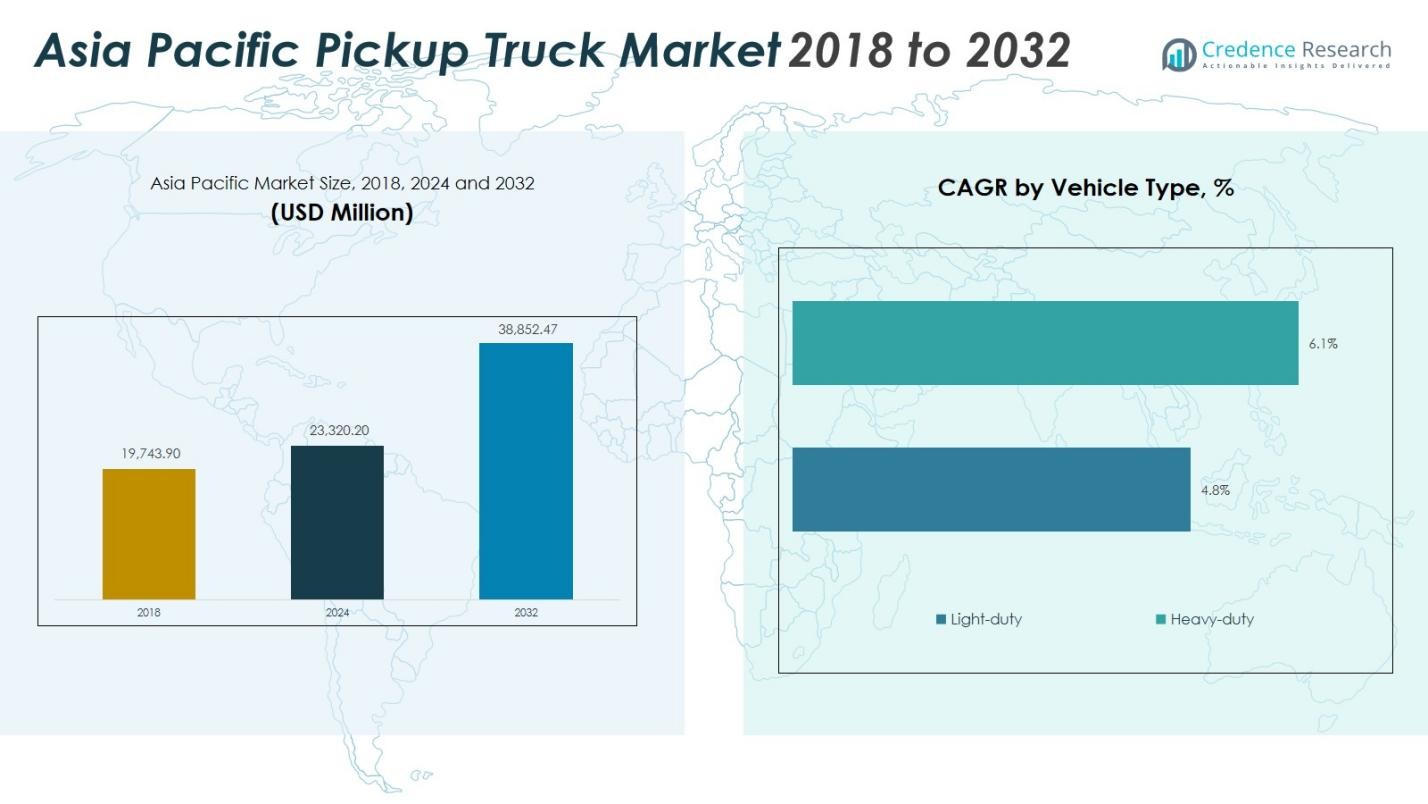
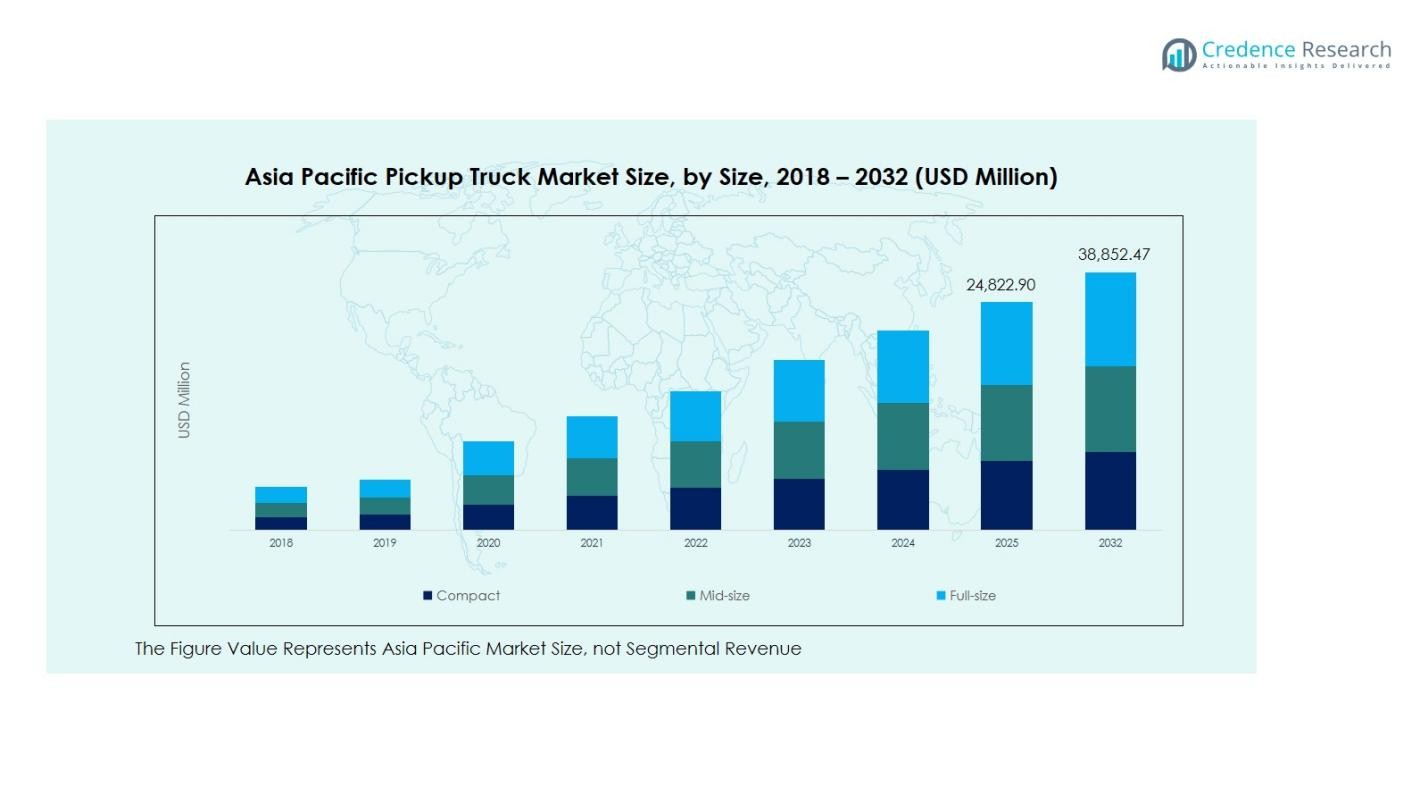
Asia Pacific Pickup Truck Market size was valued at USD 19,743.90 Million in 2018 to USD 23,320.20 Million in 2024 and is anticipated to reach USD 38,852.47 Million by 2032, at a CAGR of 6.59% during the forecast period.
| REPORT ATTRIBUTE | DETAILS |
|---|---|
| Historical Period | 2020-2023 |
| Base Year | 2024 |
| Forecast Period | 2025-2032 |
| Asia Pacific Pickup Truck Market Size 2024 | USD 23,320.20 Million |
| Asia Pacific Pickup Truck Market, CAGR | 6.59% |
| Asia Pacific Pickup Truck Market Size 2032 | USD 38,852.47 Million |
Asia Pacific Pickup Truck Market features key players such as Ford Motor Company, Isuzu Motors Ltd., Mitsubishi Motors Corporation, Nissan Motor Co., Ltd., and Tata Motors Ltd., each focusing on expanding product portfolios and integrating advanced powertrain technologies. These manufacturers are strengthening their foothold through innovative designs, increasing electrification, and tailored offerings for commercial and personal use. China emerges as the leading region, commanding 38.2% market share in 2024, driven by its rapidly growing logistics sector, robust infrastructure development, and rising adoption of electric pickup models. Other key markets include Japan, India, and Australia, each contributing significantly to regional growth.
Market Insights
- Asia Pacific Pickup Truck Market size reached USD 23,320.20 Million in 2024 and is projected to grow at a CAGR of 6.59% through 2032.
- Growth is driven by rising industrial uptake, expanding construction activities, and increased use for commercial logistics, particularly in emerging economies such as India, Indonesia, and Vietnam.
- Key trends include the growing adoption of electric and hybrid pickup models, integration of connected vehicle technologies, and rising demand for mid-size and light-duty pickups for dual-purpose use.
- Leading manufacturers like Ford, Isuzu, and Tata Motors are expanding portfolios and local production while facing challenges from high total ownership costs and inconsistent regulatory frameworks across countries.
- China accounts for 38.2% of regional market share, followed by Japan with 16.5% and India with 14.9%, while the light-duty segment dominates overall with 63.5% share due to versatility, fuel efficiency, and suitability for urban and semi-urban applications.
 Market Segmentation Analysis:
By Vehicle Type:
The Asia Pacific Pickup Truck Market is primarily dominated by the Light-duty segment, accounting for 63.5% share in 2024. This dominance stems from widespread use in commercial and personal applications, particularly in urban and semi-urban areas where maneuverability and fuel efficiency are key. Light-duty models are favored for transportation, last-mile logistics, and small business operations across markets in India, Japan, and Southeast Asia. Additionally, rising trends in adventure tourism and lifestyle utility are supporting steady growth. The Heavy-duty segment, while smaller, is gaining traction with infrastructure development and mining projects driving demand.
- For instance, in South India, small commercial vehicles such as pickup trucks are preferred for last-mile deliveries due to their ability to navigate narrow streets and congested areas efficiently, with manufacturers like Tata Motors and Mahindra playing key roles in this segment.
By Application:
The Commercial segment leads the Asia Pacific Pickup Truck Market with 48.2% market share in 2024. Commercial users rely heavily on pickup trucks for logistics, construction, agriculture, and small business operations, especially in developing economies like India, Indonesia, and the Philippines. Industrial applications follow, driven by sectors such as mining and energy. The Personal segment is also expanding due to lifestyle shifts and the popularity of pickup trucks as dual-purpose vehicles for family and recreation. Growing e-commerce penetration is further propelling the commercial use of pickups across the region.
- For instance, in India, pickup models like the Mahindra Bolero Camper and Isuzu D-Max are widely used by small businesses and farmers for their reliable load capacity and affordability.
By Fuel Type:
The Diesel segment dominates the Asia Pacific Pickup Truck Market with a market share of 68.4% in 2024. Diesel pickup trucks are preferred for their superior torque, towing capabilities, and fuel economy, making them suitable for both commercial and heavy-duty applications. Petrol variants hold a smaller share, appealing mainly to urban consumers with light-duty needs. The Electric segment, though nascent with a modest share, is expected to grow rapidly due to regional emission regulations, government incentives, and increasing adoption of EV platforms by leading manufacturers in China and South Korea.
Key Growth Drivers
Urbanization and Infrastructure Expansion
Rapid urbanization and expanding infrastructure across Asia Pacific continue to drive demand for pickup trucks, especially in emerging economies like India, Indonesia, and Vietnam. Government-led construction projects, industrial zones, and improvements in rural connectivity are boosting the need for versatile vehicles capable of handling diverse terrains and workloads. Pickup trucks are increasingly used for transportation of goods and machinery in developing areas, making them essential for economic activities. The segment is benefiting from ongoing investment in logistics and road networks, enhancing mobility and boosting commercial vehicle adoption.
- For instance, Indonesia's industrial zones and mining expansions require robust heavy-duty trucks for transporting goods and machinery, supporting growth in commercial vehicle adoption.
Growing Popularity of Lifestyle and Personal Use
Pickup trucks are gaining popularity among personal and lifestyle users in Asia Pacific, driven by rising disposable incomes, adventure tourism, and a shift toward multifunctional vehicles. Consumers are attracted to pickups for their combination of utility, comfort, and performance attributes. Countries like Australia and China are seeing an uptick in 4WD and off-road models among young buyers. Additionally, social media and online communities are promoting pickup culture as a symbol of rugged independence, further contributing to the growth of this high-margin personal-use segment.
- For instance, social media influencers and online communities are actively promoting pickup culture as a symbol of rugged independence and outdoor lifestyle, especially across markets like Australia and China, boosting interest and sales in this high-margin segment.
Government Incentives and Emission Norms Encouraging EV Adoption
Government policies aimed at reducing emissions and promoting cleaner mobility are accelerating electric pickup adoption in the region. Subsidies, tax benefits, and infrastructure development for EVs in markets like China and South Korea are encouraging manufacturers to diversify their portfolios with electric variants. Prominent OEMs are introducing hybrid and fully electric pickups to meet tightening environmental regulations. This shift is also supported by rising fuel costs and growing awareness of sustainability among fleet operators and consumers, positioning electric pickups as a promising growth frontier in the long term.
Key Trends & Opportunities
Expansion of Connected and Smart Technologies
The Asia Pacific Pickup Truck Market is witnessing increased integration of connected vehicle technologies, such as telematics, in-vehicle diagnostics, and personalized infotainment systems. Smart safety features like ADAS, IoT-enabled fleet management tools, and autonomous-ready functionalities are making pickups more appealing to both commercial and personal users. The adoption of these features not only enhances performance and safety but also creates opportunities for OEMs to differentiate offerings and command premium pricing. Digital platforms and connectivity are also enabling fleet optimization and predictive maintenance across regional logistics networks.
- For instance, Tata Motors became the first in India to introduce trucks equipped with Advanced Driver Assistance Systems (ADAS) in 2022, including collision mitigation, lane departure warning, and driver monitoring systems, certified by the Automotive Research Association of India.
Rise of Electric and Hybrid Pickup Models
Electrification is emerging as a major trend, with OEMs launching electric and hybrid pickup models to tap into evolving environmental and regulatory landscapes. Markets like China are leading, driven by strong government support for EVs, while Japan and South Korea are investing in fuel cell and hybrid technologies. The opportunity lies in creating affordable, high-range electric pickups tailored to regional needs, including rural logistics and agricultural applications. Battery swapping, fast charging networks, and fleet electrification initiatives present significant growth avenues for industry players.
- For instance, in China, companies like Great Wall Motors, Dongfeng, and Geely’s Radar brand have launched or announced electric pickup models addressing rural logistics and commercial uses.
Key Challenges
High Total Ownership Costs
Despite increasing demand, high initial costs and ongoing maintenance expenses remain major challenges in the Asia Pacific Pickup Truck Market. Pickup trucks, especially diesel and 4WD variants, are often more expensive to purchase and operate compared to conventional passenger vehicles. Small businesses and individual buyers in price-sensitive markets face affordability barriers. The lack of widespread financing options and high insurance costs further limit adoption in rural and emerging areas. Manufacturers must find ways to reduce costs through localized production and flexible financing to broaden market access.
Regulatory Variability Across Regions
The region’s diverse regulatory landscape presents challenges for OEMs operating across multiple countries. Varying emission standards, safety requirements, import duties, and certification processes complicate product standardization and increase compliance costs. Emerging markets often lack harmonized regulations, forcing manufacturers to adapt models for specific markets, which affects economies of scale. In addition, sudden changes in policies-such as EV incentive alterations or fuel regulation shifts-can disrupt production planning and investment decisions. Harmonizing standards and anticipating policy changes will be essential for mitigating risks and ensuring sustained growth.
Regional Analysis
China
China leads the Asia Pacific Pickup Truck Market with a market share of 38.2% in 2024. The country’s rapidly expanding construction, logistics, and e-commerce sectors are driving high demand for pickup trucks, especially in tier 2 and 3 cities. Government support for rural mobility and commercial fleet electrification, coupled with rising middle-class aspirations for lifestyle vehicles, is bolstering market growth. Chinese manufacturers like Great Wall Motors and BYD are accelerating innovations in electric pickups to meet sustainability goals. Increasing availability of hybrid and electric models further strengthens China’s position as the region’s dominant pickup market.
Japan
Japan holds a 16.5% share of the Asia Pacific Pickup Truck Market in 2024, driven by advanced automotive engineering, strong export activity, and a growing focus on compact utility vehicles. While domestic demand remains modest compared to SUVs and minivans, the country’s manufacturing strength and technological leadership help drive high-quality exports across Asia and beyond. The shift toward low-emission vehicles and the adoption of hybrid and battery-electric pickup models is progressing, supported by national priorities for carbon neutrality. Japanese brands like Toyota, Nissan, and Mitsubishi continue to influence regional pickup trends through durability and technological innovation.
South Korea
South Korea accounts for 8.7% of the Asia Pacific Pickup Truck Market in 2024, fueled by rising consumer interest in versatile lifestyle vehicles and expanding rural logistics. The market is poised for further growth as domestic brands like Hyundai and Kia introduce advanced pickup models, including electric and fuel-cell variants. South Korea’s focus on hydrogen mobility and smart vehicle technologies, alongside government incentives for zero-emission vehicles, is shaping a modern pickup ecosystem. The country’s strong infrastructure and digital adoption also encourage integration of telematics and AI-driven features, reinforcing its strategic presence in the regional market.
India
India holds a 14.9% share of the Asia Pacific Pickup Truck Market in 2024, driven by rapid urbanization, infrastructure investments, and rising small business activity. Pickup trucks are increasingly replacing traditional light commercial vehicles in applications such as goods transportation, rural mobility, and last-mile delivery. Leading domestic manufacturers like Tata Motors and Mahindra are introducing compact and robust models tailored to price-sensitive buyers. Government initiatives for rural development, road connectivity, and emission standards are enhancing demand for both diesel and emerging electric models. India’s vibrant SME ecosystem continues to stimulate steady growth in this segment.
Australia
Australia commands a 10.3% share of the Asia Pacific Pickup Truck Market in 2024, reflecting its strong pickup culture and widespread use of 4WD utility vehicles. Pickup trucks are preferred for both commercial workloads and lifestyle use, including off-road recreation, towing, and rural transport. Models like the Ford Ranger and Toyota Hilux remain popular due to reliability and high towing capacity. The market is moving toward electrification, supported by rising environmental consciousness and infrastructure readiness. Australia's vast geography and diverse terrain further strengthen demand for durable, high-performance pickups suited to tough conditions.
Southeast Asia
Southeast Asia contributes 7.8% to the Asia Pacific Pickup Truck Market in 2024, with growing demand centered in Thailand, Indonesia, and the Philippines. Pickup trucks are widely used for agriculture, construction, and small business logistics due to their adaptability and cost-efficiency. Thailand serves as a regional manufacturing hub, exporting models across ASEAN markets. Increasing urban logistics and e-commerce demand, coupled with developing road infrastructure, are driving adoption. While diesel dominates, there is growing interest in hybrid and electric pickups, especially in urbanized areas, as governments push for greater adoption of clean transportation technologies.
Rest of Asia Pacific
The Rest of Asia Pacific region holds a 3.6% share of the Asia Pacific Pickup Truck Market in 2024, driven by emerging demand in countries like New Zealand, Pakistan, and smaller South Asian economies. These markets are gradually adopting pickup trucks as essential vehicles for agriculture, tourism, and infrastructure projects. Limited local manufacturing presents opportunities for imports from China, Japan, and Thailand. While growth is steady, challenges include affordability, limited financing options, and evolving regulatory frameworks. However, increasing economic development and trade activity across these countries is expected to contribute modestly to market expansion over the forecast period.
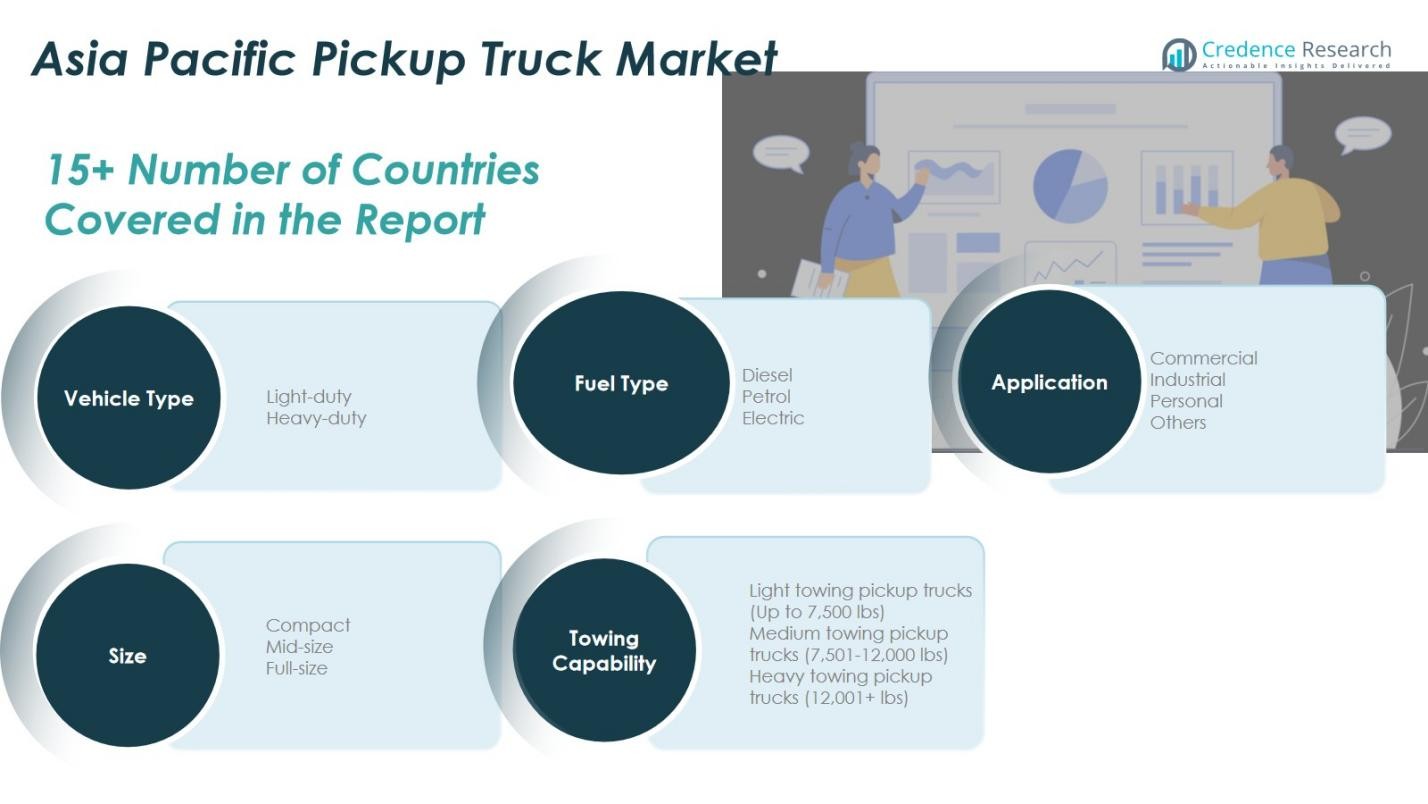
Market Segmentations:
By Vehicle Type
- Light-duty
- Heavy-duty
By Application
- Commercial
- Industrial
- Personal
- Others
By Fuel Type
- Diesel
- Petrol
- Electric
By Size
- Compact
- Mid-size
- Full-size
By Towing Capability
- Light towing (Up to 7,500 lbs)
- Medium towing (7,501–12,000 lbs)
- Heavy towing (12,001+ lbs)
By Region
- China
- Japan
- South Korea
- India
- Australia
- Southeast Asia
- Rest of Asia Pacific
Competitive Landscape
The competitive landscape of the Asia Pacific Pickup Truck Market is shaped by leading players including Ford Motor Company, Isuzu Motors Ltd., Mitsubishi Motors Corporation, Nissan Motor Co., Ltd., Tata Motors Ltd., Mahindra & Mahindra Ltd., BYD Auto Co., Ltd., Dongfeng Motor Corporation, SAIC Motor Corporation Limited, and Suzuki Motor Corporation. These manufacturers compete based on product differentiation, brand strength, and regional adaptability. Japanese and American brands remain strong in mid-size and light-duty categories, while Chinese players are gaining traction in electric pickups and value-oriented offerings. Domestic companies in India and Southeast Asia are focusing on cost-effective, rugged models for commercial use. Increasing investments in electrification, connected technology, and safety features are reshaping the product landscape, with a rising emphasis on sustainability and regulatory compliance. Strategic partnerships, local manufacturing, and after-sales support are central to maintaining competitiveness as customer preferences shift toward modern, multifunctional, and fuel-efficient pickup models across the region.
Key Player Analysis
- Ford Motor Company
- Isuzu Motors Ltd.
- Mitsubishi Motors Corporation
- Nissan Motor Co., Ltd.
- Tata Motors Ltd.
- Mahindra & Mahindra Ltd.
- BYD Auto Co., Ltd.
- Dongfeng Motor Corporation
- Foton Motor Group
- SAIC Motor Corporation Limited
- Jiangling Motors Corporation (JMC)
- Suzuki Motor Corporation
Recent Developments
- In March 2025, KG Mobility (South Korea) officially launched the electric pickup truck “Musso EV”.
- In January 2025, Dongfeng Nissan (via its Zhengzhou Nissan JV) introduced the Z9 pickup truck (ICE version) in China, production from January 2025.
- In March 2024, Toyota Motor Corporation announced that it plans to mass-produce a battery-electric version of its Hilux pickup truck by the end of 2025.
Report Coverage
The research report offers an in-depth analysis based on Vehicle Type, Application, Fuel Type, Size, Towing Capability and Region. It details leading market players, providing an overview of their business, product offerings, investments, revenue streams, and key applications. Additionally, the report includes insights into the competitive environment, SWOT analysis, current market trends, as well as the primary drivers and constraints. Furthermore, it discusses various factors that have driven market expansion in recent years. The report also explores market dynamics, regulatory scenarios, and technological advancements that are shaping the industry. It assesses the impact of external factors and global economic changes on market growth. Lastly, it provides strategic recommendations for new entrants and established companies to navigate the complexities of the market.
Future Outlook
- The Asia Pacific Pickup Truck Market will continue to grow, driven by demand in both commercial and personal segments.
- Electrification will accelerate as manufacturers introduce more hybrid and electric pickup models.
- Government regulations on emissions will push automakers to adopt cleaner powertrain technologies.
- Digital connectivity and smart vehicle systems will increasingly influence consumer preferences.
- Light-duty pickup trucks will dominate due to versatility in urban and semi-urban regions.
- Expansion of rural infrastructure will boost demand for pickups in agricultural and construction sectors.
- China will maintain its leadership as innovation and production hub for electric pickups.
- Increasing interest in lifestyle and recreational pickup use will support mid-size and full-size segment adoption.
- Growing investment in hydrogen and alternative fuels will present new growth opportunities.
- OEMs will focus on localized production, strategic partnerships, and warranty services to enhance market presence.

Request a Free Sample
Fill in your details and we'll send you a free sample report.
- Sample data tables & charts
- Research methodology
Need a Custom Version of This Report?
Tailor the scope, geography, or segments to your exact requirements.
- Custom geography or segment scope
- Direct access to our analyst team
Frequently Asked Questions
What is the current market size for Asia Pacific Pickup Truck Market, and what is its projected size in 2032?
At what Compound Annual Growth Rate is the Asia Pacific Pickup Truck Market projected to grow between 2025 and 2032?
Which Asia Pacific Pickup Truck Market segment held the largest share in 2024?
What are the primary factors fueling the growth of the Asia Pacific Pickup Truck Market?
Who are the leading companies in the Asia Pacific Pickup Truck Market?
Which region commanded the largest share of the Asia Pacific Pickup Truck Market in 2024?
Table of Content
Chapter 1 Market Segmentation
- 1.1 Segmentation Framework
- 1.1.1 Product and Service Classification
- 1.1.2 Application and End-Use Classification
- 1.1.3 Technology and Solution Classification
- 1.1.4 Customer and Distribution Channel Classification
- 1.1.5 Geographic Segmentation
- 1.1.6 Market Segment Definitions and Boundaries
Chapter 2 Introduction
- 2.1 Report Objectives and Scope
- 2.2 Product Definition and Industry Terminology
- 2.3 Market Inclusions and Exclusions
- 2.4 Research Process
- 2.4.1 Primary Research and Expert Interviews
- 2.4.2 Secondary Research and Source Review
- 2.4.3 Top-Down and Bottom-Up Estimation
- 2.4.4 Data Triangulation and Verification
- 2.5 Market Size Measurement Basis
- 2.5.1 2024: USD 23,320.20 Million → 2032: USD 38,852.47 Million
- 2.6 Historical and Forecast Reference Periods
- 2.6.1 Base Year: 2024
- 2.6.2 Forecast Period: 2024-2032
- 2.7 Research Assumptions and Limitations
Chapter 3 Executive Summary
- 3.1 Market Snapshot and Key Findings
- 3.2 Base-Year Market Size, 2024
- 3.3 Forecast Market Size, 2032
- 3.4 Revenue and Volume Growth Outlook
- 3.5 Key Demand and Supply Indicators
- 3.6 Leading Market Segments
- 3.7 Fastest-Growing Market Opportunities
- 3.8 Regional Performance Highlights
- 3.9 Technology and Industry Transformation
- 3.10 Competitive Landscape Summary
- 3.11 Analyst View and Strategic Implications
Chapter 4 Asia Pacific Pickup Truck Market Trends and Developments
- 4.1 Historical Industry Development
- 4.2 Recent Market Trends and Developments
- 4.3 Demand and Customer Behavior Trends
- 4.4 Technology and Product Innovation
- 4.5 Artificial Intelligence, Automation and Digitalization
- 4.6 Local Manufacturing and Supply Chain Realignment
- 4.7 Industry Partnerships, Mergers and Acquisitions
- 4.8 Sustainability and Circular Economy Developments
- 4.9 Government and Private Sector Investment Trends
- 4.10 Emerging Business Models and Commercialization
- 4.11 Industry Developments and Announcements
Chapter 5 Asia Pacific Pickup Truck Market Production, Supply and Demand Analysis
- 5.1 Demand Trend and Consumption Analysis
- 5.2 Demand Forecast, 2024-2032
- 5.3 Production and Output Trend
- 5.4 Production and Output Forecast, 2024-2032
- 5.5 Installed Capacity and Capacity Utilization
- 5.6 Company-Wise Production Plants and Statistics
- 5.6.1 Installed Production Capacity
- 5.6.2 Actual Production
- 5.6.3 Planned Capacity and Expansion Targets
- 5.7 Supply Chain Structure and Procurement Trends
- 5.8 Supply-Demand Gap and Bottlenecks
- 5.9 Import Dependence and Sourcing Structure
- 5.10 Contract Manufacturing and Outsourcing
- 5.11 Regional Supply and Demand Concentration
Chapter 6 Asia Pacific Pickup Truck Market Pricing Analysis
- 6.1 Pricing Structure and Measurement
- 6.2 Historical Pricing Trends
- 6.3 Pricing Outlook, 2024-2032
- 6.4 Average Selling Price and Unit Economics
- 6.5 Pricing by Product and Market Segment
- 6.6 Geographic Pricing Differences
- 6.7 Key Input, Energy, Labor and Logistics Costs
- 6.8 Contract Pricing and Purchasing Models
- 6.9 Pricing Sensitivity and Competitive Positioning
- 6.10 Price, Margin and Profitability Implications
Chapter 7 Asia Pacific Pickup Truck Market Dynamics
- 7.1 Market Growth Drivers
- 7.1.1 Demand-Side Drivers
- 7.1.2 Technology and Innovation Drivers
- 7.1.3 Infrastructure and Investment Drivers
- 7.1.4 Regulatory and Policy Drivers
- 7.2 Market Restraints
- 7.2.1 Cost and Affordability Constraints
- 7.2.2 Technology and Adoption Barriers
- 7.2.3 Supply Chain and Operational Constraints
- 7.3 Market Challenges
- 7.3.1 Competitive Pressure and Margin Erosion
- 7.3.2 Skills, Infrastructure and Implementation Gaps
- 7.4 Emerging Market Opportunities
- 7.5 Market Dynamics Impact and Time-Horizon Assessment
Chapter 8 Asia Pacific Pickup Truck Value Chain Analysis
- 8.1 Industry Value Chain Overview
- 8.2 Upstream Suppliers and Critical Inputs
- 8.3 Technology and Component Providers
- 8.4 Manufacturing or Service Delivery
- 8.5 Distribution, Channel Partners and Integrators
- 8.6 Downstream Applications and End Users
- 8.7 Value Addition and Profit Pools
- 8.8 Vertical Integration and Outsourcing
- 8.9 Supplier Concentration and Risk
- 8.10 Supply Chain Localization and Resilience
Chapter 9 Asia Pacific Pickup Truck Market Regulations and Policies
- 9.1 Relevant Laws, Standards and Compliance Frameworks
- 9.2 Product, Service, Safety and Quality Requirements
- 9.3 Government Policies, Incentives and Subsidies
- 9.4 Imports, Exports and Trade Barriers
- 9.5 Public Procurement and Local Content Requirements
- 9.6 Environmental and Sustainability Compliance
- 9.7 Upcoming Policy Changes and Market Implications
Chapter 10 Asia Pacific Pickup Truck Market Hotspots and Opportunities
- 10.1 Market Opportunity Mapping and Growth Hotspots
- 10.2 High-Growth Applications and Customer Groups
- 10.3 Underserved Markets and White-Space Opportunities
- 10.4 Emerging Technology and Product Opportunities
- 10.5 New Capacity and Investment Hotspots
- 10.6 Market Entry and Expansion Opportunities
- 10.7 Distribution and Partnership Opportunities
- 10.8 Near-Term and Long-Term Commercial Potential
- 10.9 Opportunity Attractiveness and Execution Risks
Chapter 11 Asia Pacific Pickup Truck Market Outlook, 2024-2032
- 11.1 Market Size and Analysis
- 11.1.1 Revenue (Market Measurement: 2024: USD 23,320.20 Million → 2032: USD 38,852.47 Million)
- 11.1.2 Market Volume and Quantity Sold
- 11.1.3 Historical Market Size
- 11.1.4 Base-Year Market Size, 2024
- 11.2 Market Forecast, 2024-2032
- 11.2.1 Revenue Forecast to 2032
- 11.2.2 Volume Forecast to 2032
- 11.2.3 CAGR and Year-on-Year Growth
- 11.2.4 Incremental Revenue Opportunity
- 11.3 Forecast Assumptions and Scenario Analysis
- 11.3.1 Base-Case Forecast
- 11.3.2 Optimistic and Conservative Scenarios
- 11.3.3 Technology, Pricing and Policy Sensitivities
- 11.4 Market Attractiveness and Growth Outlook
Chapter 12 Asia Pacific Pickup Truck Market Segmentation and Outlook
- 12.1 Segmentation Summary and Market Shares, 2024
- 12.2 Largest and Fastest-Growing Segments
- 12.3 Segment Growth Comparison
- 12.4 Segment Attractiveness and Priority Matrix
Chapter 13 Asia Pacific Pickup Truck Geographic Market Outlook, 2024-2032
- 13.1 Regional Market Size and Country-Level Shares, 2024
- 13.2 Country Market Size Comparison, 2024
- 13.3 Country Market Forecasts, 2024-2032
- 13.4 Subregional Industrial and Demand Clusters
- 13.5 Intra-Regional Pricing and Cost Differences
- 13.6 Cross-Border Trade and Supply Networks
- 13.7 Regional Supply and Demand Balances
- 13.8 Country Opportunity Comparison and Prioritization
Note: Every listed country is covered on the structure shown under the first country.
Chapter 14 Asia Pacific Pickup Truck Technology, Innovation and Sustainability Outlook
- 14.1 Technology Landscape and Maturity
- 14.2 Product, Process and Service Innovation
- 14.3 AI, Automation and Digital Tools in the Industry
- 14.4 Technology Adoption and Performance Benchmarking
- 14.5 Innovation Pipeline and R&D Investment
- 14.6 Patent and Intellectual Property Trends
- 14.7 Energy Efficiency and Resource Management
- 14.8 Sustainability, Recycling and Circularity
- 14.9 Technology Roadmap, 2024-2032
- 14.10 Risks of Obsolescence and Technology Substitution
Chapter 15 Asia Pacific Pickup Truck Market Key Strategic Imperatives
- 15.1 Growth and Market Entry Priorities
- 15.2 High-Return Products and Segments
- 15.3 Pricing, Profitability and Cost Optimization
- 15.4 Technology Investment and Product Differentiation
- 15.5 Supply Chain Localization and Resilience
- 15.6 Distribution and Customer Acquisition
- 15.7 Partnership, Acquisition and Capacity Strategy
- 15.8 Regional Expansion Priorities
- 15.9 Short-, Medium- and Long-Term Actions
Chapter 16 Competition Outlook
- 16.1 Industry Competition Characteristics
- 16.2 Market Structure and Concentration
- 16.3 Market Share and Competitive Positioning, 2024
- 16.4 Company-Wise Revenue and Product Benchmarking
- 16.5 Production and Service Capacity Benchmarking
- 16.6 Technology, Pricing and Differentiation
- 16.7 Regional Footprint and Distribution Strength
- 16.8 Mergers, Acquisitions and Strategic Alliances
- 16.9 New Entrants and Competitive Threats
- 16.10 Porter's Five Forces and Industry Attractiveness
- 16.11 Competitive Outlook, 2024-2032
Chapter 17 Company Profiles
- 17.1 Company Coverage and Selection Criteria
- 17.2 Leading Market Participants – Standard Profile Structure
- 17.2.1 Business Description
- 17.2.2 Company Ownership and Geographic Presence
- 17.2.3 Product and Service Portfolio
- 17.2.4 Manufacturing and Operating Footprint
- 17.2.5 Production Capacity and Expansion Plans
- 17.2.6 Financial Performance and Investment
- 17.2.7 Market Share and Competitive Position
- 17.2.8 Technology and Innovation Capabilities
- 17.2.9 Strategic Alliances or Partnerships
- 17.2.10 Recent Developments
- 17.2.11 Growth Strategy and Outlook
- 17.3 Other Relevant Market Participants
Note: Every listed company is profiled on the structure shown under the first company. The company list is preliminary and may change based on research findings, market developments, data availability and client requirements.
Chapter 18 Disclaimer
- 18.1 Research and Forecast Disclaimer
- 18.2 Data Source and Estimation Limitations
Note: The depth of individual sections depends on data availability for this market. Volume, capacity, trade and other unit-based metrics are included where applicable.