Four-wheel drive gearboxes ride on SUV and pickup output
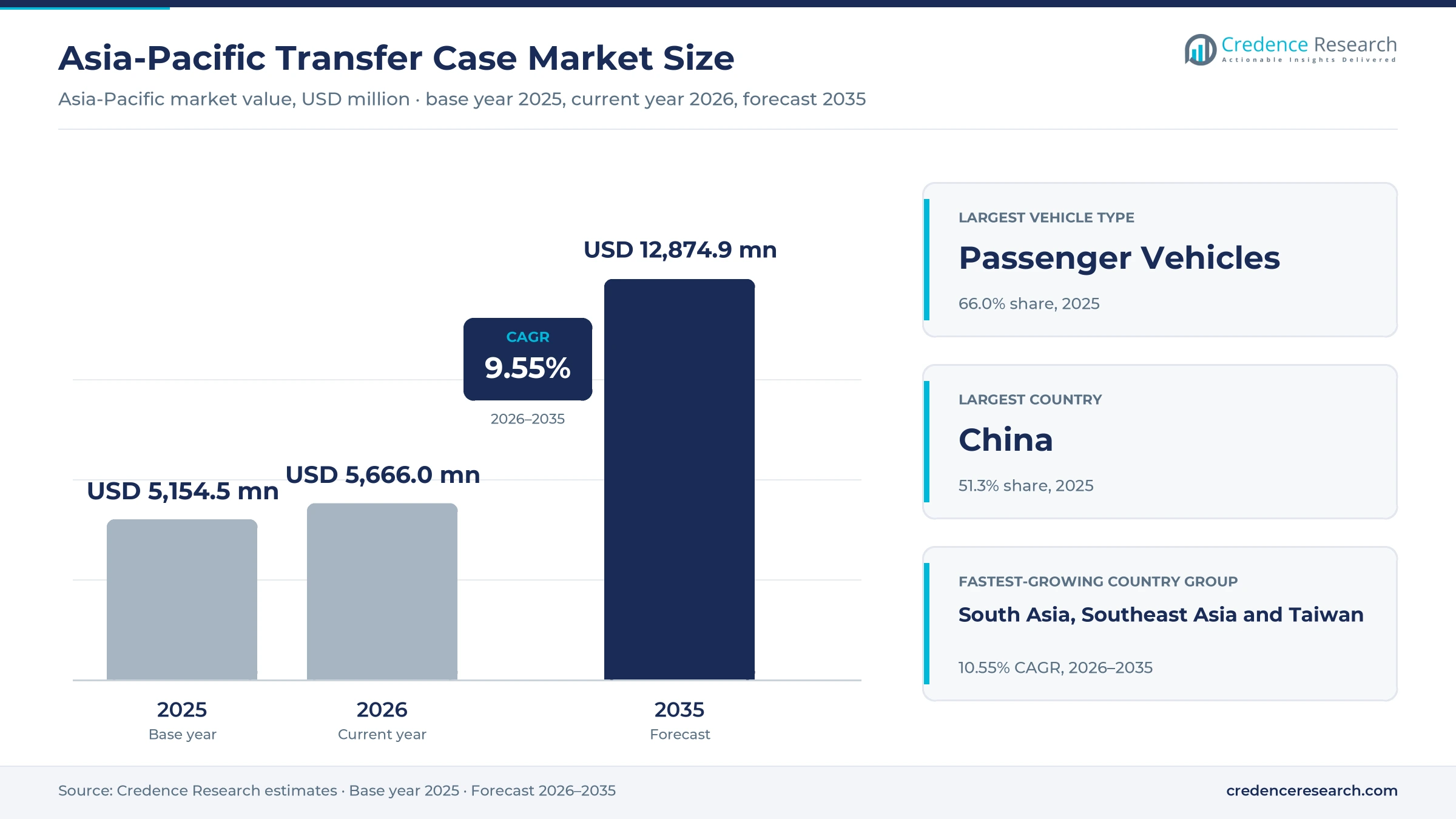
The Asia-Pacific transfer case market was valued at USD 5.15 billion in 2025 and is projected to increase from USD 5.67 billion in 2026 to USD 12.87 billion by 2035, registering a CAGR of 9.55% during 2026–2035. Demand comes from automakers that build part-time and full-time four-wheel drive SUVs, 4x4 pickups, light commercial vehicles and wheeled construction machines, plus workshops that replace worn units. China held the largest share, 51.3% in 2025, because it built about 34.5 million vehicles that year and supplies many body-on-frame SUVs. South Asia, Southeast Asia and Taiwan is the fastest-growing country group at 10.55% a year, as Indian utility vehicles and Thai pickups gain volume. Technology is also changing, because new plug-in hybrid off-roaders keep a mechanical low-range unit behind the electric motor. As a result, hybrid platforms extend demand for geared four-wheel drive hardware rather than replacing it.
Which four-wheel drive gearboxes are counted?
The estimate measures the value of transfer case assemblies fitted by vehicle and equipment makers or sold as replacements across China, Japan and South Korea, Oceania and South Asia, Southeast Asia and Taiwan. It covers part-time units with low range, full-time units with a center differential and torque-on-demand units with an electronically controlled clutch.
The estimate excludes power take-off units used in transverse all-wheel drive cars, electric axles that drive each axle with its own motor and rebuilt units sold without new parts. The value chain runs from gear, chain and clutch suppliers through assembly makers to automakers, equipment builders and repair workshops.
Asia-Pacific Transfer Case Market Insights
- The Asia-Pacific transfer case market was valued at USD 5.15 billion in 2025 and is projected to reach USD 12.87 billion by 2035, registering a CAGR of 9.55% during 2026–2035.
- China held 51.3% of 2025 value, because the country produced about 34.5 million vehicles in 2025, the largest output in the region.
- Passenger vehicles led with 66.0% of 2025 value, as body-on-frame SUVs and compact 4x4 models carry most units sold.
- BorgWarner won a Chinese order in July 2026 for a torque-on-demand unit with mechanical lock, which shows electronic control spreading.
- Hybrid 4x4 models such as the GWM Tank 300 Hi4-T keep a low-range unit, so electrification widens rather than shrinks demand.
Passenger SUVs, road traction and OEM supply lead value
Why do passenger SUVs carry most value?
Based on vehicle type, the market is categorized into Passenger Vehicles, Commercial Vehicles and Off-Highway Equipment. Passenger Vehicles led with 66.0% of 2025 value, because SUVs and compact 4x4 models account for most units fitted in the region. Off-Highway Equipment grows fastest at 10.06% a year, as Chinese and Indian builders of wheel loaders and other wheeled machines raise output and exports.
How does road traction compare with off-road use?
Based on usage type, the market is categorized into On-Road Traction, Off-Road Mobility and Worksite Duty. On-Road Traction led with 57.0% of 2025 value, because most owners use four-wheel drive for wet roads, snow and towing rather than for trails. Off-Road Mobility grows fastest at 9.91% a year, as buyers in India, Australia and China pick models with low range, locking differentials and terrain modes.
How fast are hybrid 4x4 drivelines growing?
Based on powertrain, the market is categorized into Internal Combustion, Mild Hybrid and Mechanically Connected Full and Plug-In Hybrid. Internal Combustion led with 79.0% of 2025 value, because diesel and petrol pickups and SUVs still dominate four-wheel drive output. Mechanically Connected Full and Plug-In Hybrid grows fastest at 14.34% a year, as automakers add electric motors ahead of a geared low-range unit on new off-road platforms.
Why does OEM supply dominate sales?
Based on sales channel, the market is categorized into OEM Direct Supply, Authorized Replacement Channel and Independent Replacement Channel. OEM Direct Supply led with 83.0% of 2025 value, because automakers source each unit under multi-year platform contracts. Authorized Replacement Channel grows fastest at 9.94% a year, as dealers replace chains, clutches and complete units on a rising base of aging 4x4 vehicles under service plans.
| Segment Group | Leading Sub-segment | Share, 2025 | Fastest-growing Sub-segment | CAGR, 2026–2035 |
|---|---|---|---|---|
| By Vehicle Type | Passenger Vehicles | 66.0% | Off-Highway Equipment | 10.06% |
| By Usage Type | On-Road Traction | 57.0% | Off-Road Mobility | 9.91% |
| By Powertrain | Internal Combustion | 79.0% | Mechanically Connected Full and Plug-In Hybrid | 14.34% |
| By Sales Channel | OEM Direct Supply | 83.0% | Authorized Replacement Channel | 9.94% |
Request a Free Sample
Fill in your details and we'll send you a free sample report.
- Sample data tables & charts
- Research methodology
Rugged SUVs, smart torque control and hybrids lift demand
How do body-on-frame SUV platforms lift unit demand?
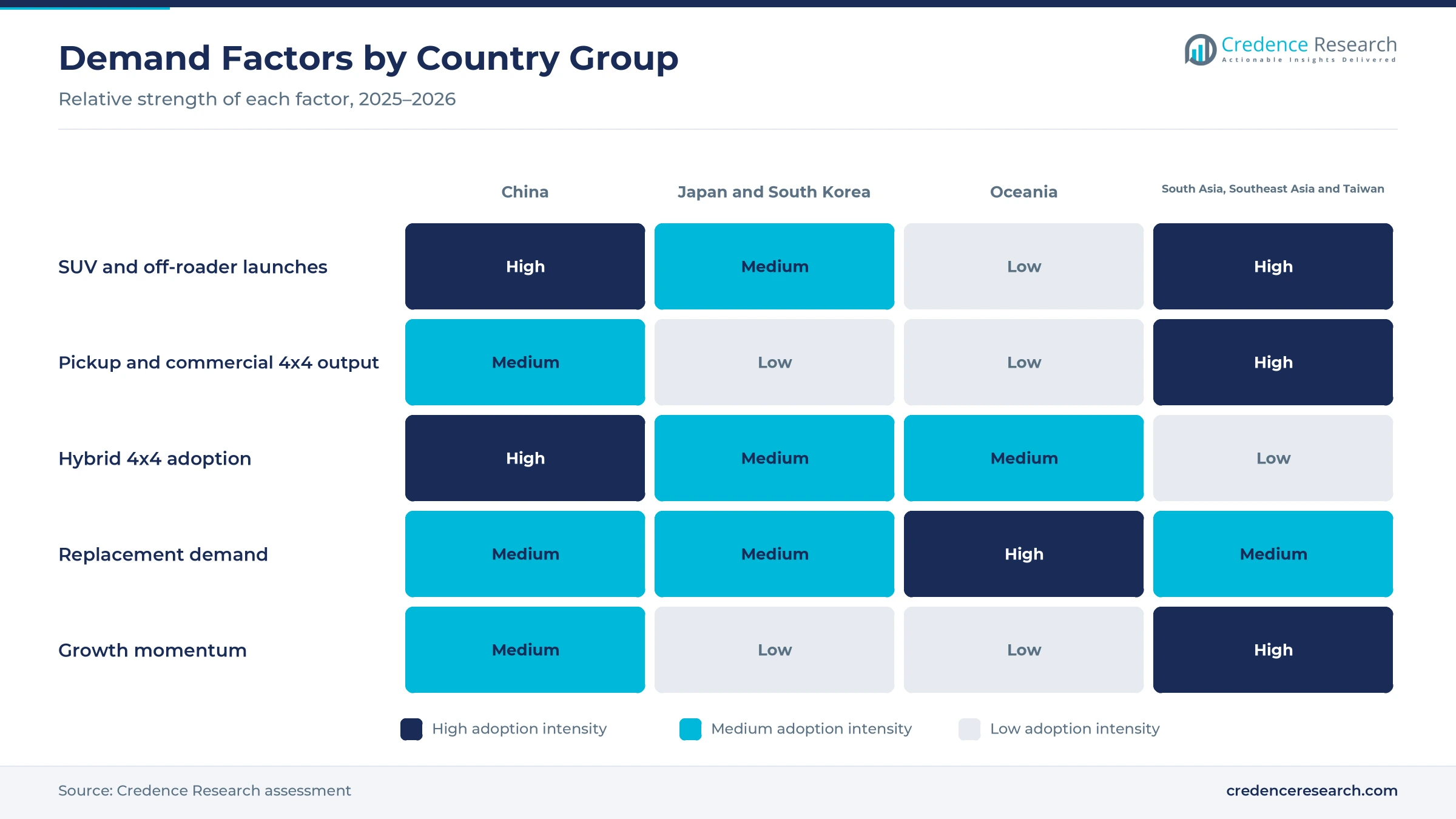
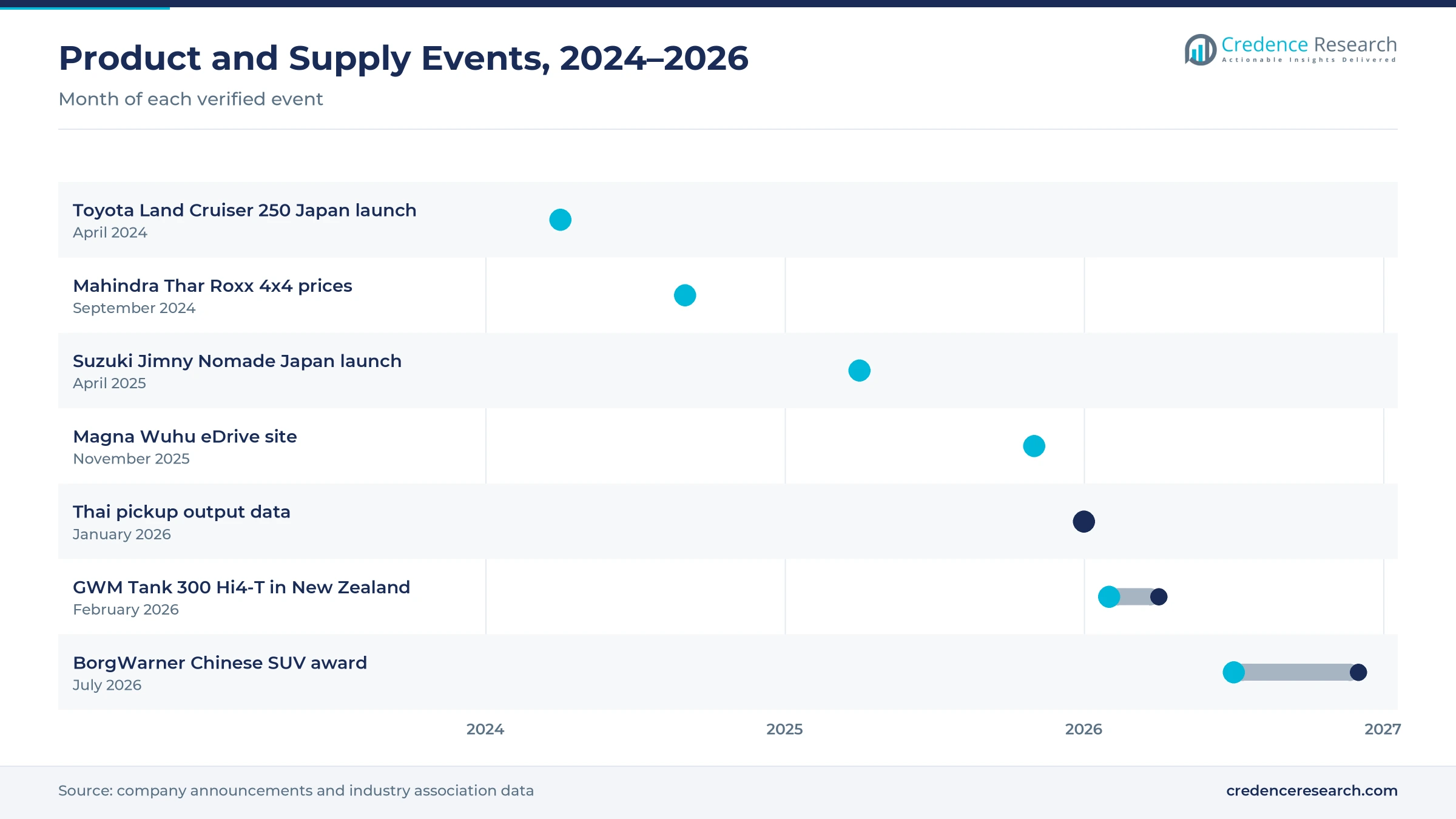
Body-on-frame SUVs and compact off-roaders need a separate gearbox to split torque between axles, so each new model adds a steady stream of units. Toyota launched the Land Cruiser 250 in Japan on April 18, 2024, with full-time four-wheel drive and a TORSEN limited-slip center differential, according to Toyota. The company set a base Japan sales volume of 2,250 units a month. Suzuki launched the Jimny Nomade in Japan on April 3, 2025, keeping part-time four-wheel drive with low-range transfer gear, and Rushlane reported that bookings crossed 50,000 units in four days. As a result, passenger vehicles lead with 66.0% of 2025 value.
Why is electronic torque management spreading?
Automakers want four-wheel drive that engages automatically, because drivers rarely choose the right mode on mixed roads. BorgWarner said on July 27, 2026, that it will supply a torque-on-demand unit with mechanical lock for a new full-size SUV from a Chinese automaker, with production due in the fourth quarter of 2026. The company said the unit distributes torque more intelligently than part-time systems that need manual selection. Mahindra also pairs a low-ratio unit with an electronic locking differential and terrain modes on the Thar Roxx 4x4. Therefore, on-road traction holds 57.0% of 2025 value as automatic systems serve everyday driving.
How do hybrid drivelines keep mechanical 4WD relevant?
New hybrid off-roaders keep a geared low-range unit, which means electrification adds value per vehicle instead of removing the gearbox. GWM said on Feb. 3, 2026, that the Tank 300 Hi4-T pairs a 2.0-liter turbo engine and a 120 kW motor with mechanical four-wheel drive, a low-range unit and front and rear lockers, according to GWM New Zealand. Toyota Australia offers 48-volt V-Active technology on HiLux 4x4 double-cab grades, with fuel use up to about 10% lower in laboratory tests. China produced 16.524 million new energy vehicles in 2025, up 25.1%. As a result, mechanically connected hybrids grow fastest at 14.34% a year.
Why do pickups and commercial 4x4 output support demand?
Pickups and light commercial vehicles add a second large base of four-wheel drive units beyond passenger SUVs. The Federation of Thai Industries reported production of 893,921 one-ton pickups in 2025, of which 728,219 were exported. China's motor vehicle exports reached 8.32 million units in 2025, up 30.0%, according to the National Bureau of Statistics of China. In Australia, the Ford Ranger led 4x4 sales with 53,694 units in 2025, ahead of the Toyota HiLux at 45,839, according to 4X4 Australia, citing VFACTS. Therefore, commercial vehicles add steady volume, because double-cab models made up about 64% of Thai one-ton pickup output in 2025.
Hybrid 4x4 platforms and Indian off-roaders reshape demand
How is the rise of plug-in hybrid off-roaders changing units?
Chinese brands are shifting their off-road lines from diesel and petrol engines to plug-in hybrid drives, but they keep geared low range for trail use. GWM said the Tank 300 Hi4-T offers up to 115 km of electric range on the NEDC cycle while keeping mechanical four-wheel drive. The model reached New Zealand showrooms in March 2026, which shows Chinese hybrid 4x4 exports reaching Oceania. The Hi4-T drive delivers a combined 300 kW and 750 Nm, which is far more torque than a petrol engine alone sends through the gearbox. As a result, units for hybrid platforms need higher torque capacity and electronic shift control, which lifts value per assembly. This also favors suppliers that can validate gearboxes for motor torque at low speed.
Why is the rise of Indian 4x4 lifestyle SUVs notable?
Indian buyers are moving toward rugged utility vehicles, and several models now offer low range as a factory option. Mahindra priced the Thar Roxx 4x4 from 18.79 lakh rupees on Sept. 25, 2024, with a low-ratio unit and an electronic locking differential. Utility vehicles reached 2,797,229 units in fiscal 2025, about 65% of passenger vehicle sales, according to SIAM data reported by Outlook Business. Maruti Suzuki builds the five-door Jimny in Gurugram for export, with output near 3,300 a month by July 2025, according to Rushlane. Therefore, India is becoming both a buyer and an exporter of compact four-wheel drive models with low range.
Can construction machinery exports open new demand?
Wheeled construction machines use heavy-duty drop boxes and transfer gearboxes, so higher Chinese machinery output creates a growing niche for suppliers. The China Construction Machinery Association reported sales of 128,067 loaders in 2025, up 18.4%, with exports of 61,737 units. Excavator sales also rose 17% to 235,257 units in the same year, which points to wider site activity at home and abroad. This growth gives makers of heavy-duty gearboxes a larger installed base of machines to serve with replacement parts in the years ahead. As a result, off-highway equipment is the fastest-growing vehicle type at 10.06% a year, ahead of passenger and commercial vehicles.
Is replacement demand an opening for authorized channels?
The rising base of four-wheel drive vehicles creates an opening for dealers and authorized parts networks that supply chains, clutch packs and complete units. China had 366.11 million civilian motor vehicles at the end of 2025, an increase of 13.43 million in one year, according to national statistics. AISIN sells OE-matched free wheel hubs for part-time four-wheel drive through its Asia Pacific aftermarket business. Thailand's double-cab pickup output reached 571,903 units in 2025, according to Seasia, citing the Federation of Thai Industries. Therefore, the authorized replacement channel grows fastest at 9.94% a year, as owners keep servicing 4x4 models under dealer service plans.
Electric axles and price pressure test gearbox suppliers
Why do dual-motor electric drives threaten units?
Battery electric SUVs and pickups often place a motor on each axle, which removes the need for a mechanical gearbox between axles. China's new energy vehicle fleet reached 43.97 million at the end of 2025, an increase of 12.57 million in one year, according to the National Bureau of Statistics of China. In turn, suppliers face lower volume on crossover and compact SUV platforms, where buyers rarely need low range. Suppliers respond by supplying eDrive units and hybrid-ready gearboxes so they keep content on the same vehicles.
How does price pressure from local suppliers squeeze margins?
Chinese automakers push hard on component prices, and domestic gearbox makers often quote lower prices than global suppliers. Gasgoo reported that China's vehicle sales reached 34.40 million in 2025, citing CAAM, and are expected to edge up only about 1% in 2026, which sharpens cost competition. Units in the lowest price tier compete mainly on cost, which leaves little room for engineering recovery. As a result, global suppliers must localize gears, castings and electronics to stay competitive with domestic rivals. Those that offer electronic control and mechanical locking can still defend higher prices on premium SUV and full-size pickup programs.
Why do program delays and model swings add risk?
Four-wheel drive demand depends on a small number of high-volume SUV and pickup programs in each country. A delayed launch, a recall or a sudden shift in consumer taste can cut orders sharply for a single supplier. Rushlane reported that Jimny Nomade shipments to Japan fell from 1,622 units in July 2025 to 72 in August during a shipment suspension. This means that suppliers carry idle capacity and unrecovered tooling costs when a program slows or ends early. Spreading business across several automakers, vehicle types and countries reduces this risk for assembly makers over a full product cycle.
How do export and trade frictions affect suppliers?
Many four-wheel drive vehicles built in China, Thailand and India are exported, so tariffs and import rules in destination markets affect unit volumes at home. The Federation of Thai Industries reported that one-ton pickup output slipped 0.02% in 2025 while pickup exports rose 2.02%, which shows how domestic demand can weaken while trade grows. In turn, suppliers must follow automakers into new plants abroad, which requires fresh capital. Local assembly in destination markets helps protect supply contracts over time.
China leads while South and Southeast Asia grow fastest
| Country | Value, 2025 (USD billion) | Share, 2025 | CAGR, 2026–2035 |
|---|---|---|---|
| China | 2.64 | 51.3% | 9.45% |
| South Asia, Southeast Asia and Taiwan | 1.34 | 25.9% | 10.55% |
| Japan and South Korea | 0.88 | 17.1% | 8.45% |
| Oceania | 0.29 | 5.7% | 8.95% |
Why does China hold the largest share?
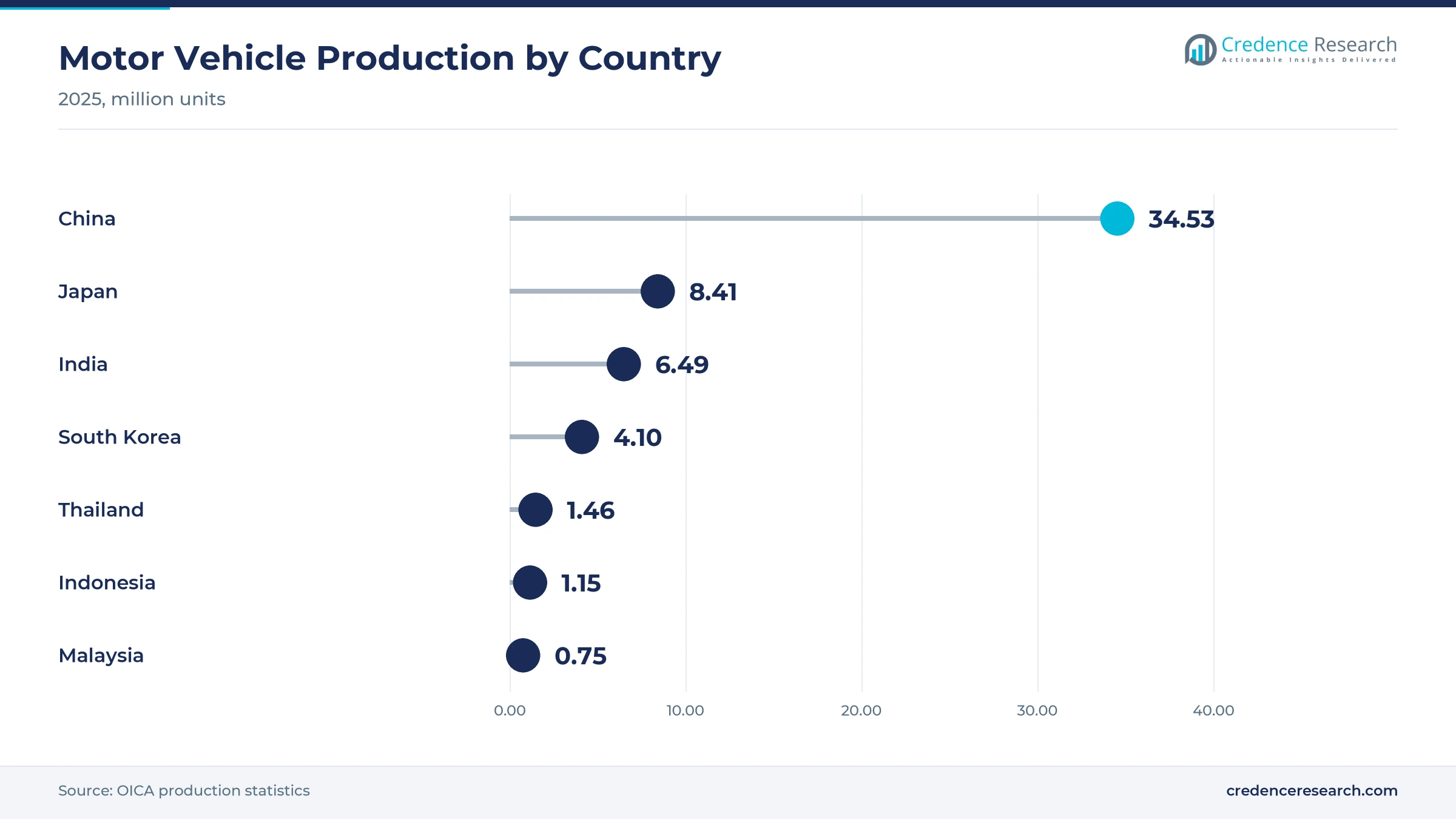
China held 51.3% of 2025 value and grows at 9.45% a year, slightly below the regional rate. The country produced about 34.5 million vehicles in 2025, according to OICA data, and its output of new energy vehicles reached 16.524 million. Chinese brands are also adding hybrid off-roaders and full-size SUVs with torque-on-demand units. As a result, China combines the largest vehicle base with new programs that need advanced four-wheel drive hardware.
Why are South Asia and Southeast Asia growing fastest?
South Asia, Southeast Asia and Taiwan held 25.9% of 2025 value and grows fastest at 10.55% a year. India produced about 6.5 million vehicles in 2025, and utility vehicles now make up about two-thirds of its passenger vehicle sales. Thailand built 893,921 one-ton pickups in 2025, supplying regional demand for pickup trucks with many 4x4 double-cab versions. As a result, the group combines fast-rising domestic sales with a large export base for four-wheel drive models.
How do Japan and South Korea sustain mature demand?
Japan and South Korea held 17.1% of 2025 value and grows at 8.45% a year. Japan produced about 8.4 million vehicles in 2025, and South Korea about 4.1 million, according to OICA data. Japanese automakers continue to fit four-wheel drive on compact models such as the Jimny and on the Land Cruiser line. Growth is slower because output is flat and electric models are gaining share, although Toyota now offers mild hybrid vehicles with 4x4 hardware, such as 48-volt HiLux grades in Australia.
Why does Oceania rely on imported 4x4 vehicles?
Oceania held 5.7% of 2025 value and grows at 8.95% a year. Australia builds almost no vehicles, so units arrive fitted to imported pickups and SUVs, while workshops buy replacement parts locally. The Ford Ranger, Toyota HiLux, Ford Everest and Toyota Prado each sold more than 26,000 4x4 units in 2025. Demand for Australian driveline components therefore reflects a large, heavily used fleet.

New 4x4 launches and supply awards from 2024 to 2026
| Development | Status and market relevance |
|---|---|
| In April 2024, Toyota launched the Land Cruiser 250 in Japan with full-time four-wheel drive and a TORSEN center differential. | Base Japan sales volume set at 2,250 units a month |
| In September 2024, Mahindra announced prices for the 4x4 variants of the Thar Roxx in India. | Low-ratio unit with an electronic locking differential |
| In April 2025, Suzuki launched the Jimny Nomade in Japan with part-time four-wheel drive and low-range transfer gear. | Bookings crossed 50,000 units within four days |
| In February 2026, GWM confirmed pricing for the Tank 300 Hi4-T plug-in hybrid in New Zealand. | Keeps mechanical four-wheel drive with low range and lockers |
| In July 2026, BorgWarner secured a supply award for a torque-on-demand unit for a Chinese full-size SUV. | Production due in the fourth quarter of 2026 |
Torque-on-demand clutches and lockers spread across models
- Torque-on-demand clutches send drive to the front axle only when sensors detect slip, which suits SUVs that spend most of their time on paved roads.
- Mechanical lock modes fix the split between axles for deep sand, mud or steep climbs, and BorgWarner now pairs them with automatic torque control.
- Hybrid-ready housings place an electric motor ahead of the gearbox, which lets plug-in models such as the Tank 300 Hi4-T keep low range.
- Electronic locking differentials work with the gearbox and terrain modes, and they help four-wheel drive vehicles climb uneven ground.
Need a Custom Version of This Report?
Tailor the scope, geography, or segments to your exact requirements.
- Custom geography or segment scope
- Direct access to our analyst team
Global driveline groups and Japanese specialists compete
Competition combines global driveline groups with Japanese specialists and a growing number of Chinese domestic suppliers. BorgWarner competes on torque-on-demand and mechanical lock designs and won a new Chinese SUV program in July 2026, citing its local engineering and manufacturing capabilities. GKN Automotive works through its SDS joint venture with HUAYU Automotive Systems, which runs 10 manufacturing facilities in China and has built all-wheel drive systems there since 2006. AISIN serves Toyota programs and sells four-wheel drive parts through its Asia Pacific aftermarket business. Magna is adding eDrive capacity in Wuhu for Chery, which positions it for hybrid and electric drivelines. Univance specializes in drivetrain units centered on transfer cases from its base in Kosai, Shizuoka. Suppliers compete on torque capacity, shift quality, weight and the ability to localize production near each automaker.
Companies profiled and their roles in this market
| Company | Type | Role in the market |
|---|---|---|
| BorgWarner | Global driveline supplier | Won a July 2026 award for a torque-on-demand unit with mechanical lock for a Chinese full-size SUV |
| GKN Automotive | Global driveline supplier | Runs the SDS joint venture with HUAYU, with 10 manufacturing facilities in China |
| AISIN | Japanese drivetrain supplier | Sells OE-matched four-wheel drive free wheel hubs through its Asia Pacific aftermarket business |
| Magna | Global powertrain supplier | Announced a leased eDrive production site in Wuhu, China, for Chery in November 2025 |
| Univance | Japanese drivetrain specialist | Makes drivetrain units centered on transfer cases in Kosai, Shizuoka |
Credence Research view on mechanical 4WD demand
Credence Research's view is that Asia-Pacific demand for geared four-wheel drive units will grow with SUV and pickup programs rather than fade with electrification. China remains the anchor because of its vehicle output and new hybrid off-roaders, while India and Thailand add the most new volume. Torque-on-demand control and mechanical lock modes raise value per unit on premium models. Suppliers that localize production and design hybrid-ready gearboxes are best placed as automakers launch more rugged models across the region.
How the regional estimate was built
The report uses 2025 as the base year and presents market values in USD billion through 2035. Market values come from the Credence Research model, and country, vehicle type, usage type, powertrain and sales channel splits are Credence Research estimates. Country shares follow the Credence Research regional model, checked against vehicle production statistics, SUV and pickup mix and fleet data for each group. Inputs include national statistics, industry association data, company press releases and automotive media reports. No interviews or surveys were used in preparing these estimates.
Hybrid 4x4 models and Indian SUVs lead growth to 2035
The Asia-Pacific transfer case market is expected to reach USD 12.87 billion by 2035, a 9.55% CAGR during 2026–2035, as automakers launch more rugged SUVs, pickups and hybrid off-roaders. South Asia, Southeast Asia and Taiwan should gain the most share, while China stays the largest country market. Hybrid powertrains, off-highway equipment and authorized replacement sales are expected to grow faster than the regional average. Faster adoption of dual-motor electric drives would lower this outlook, while more hybrid 4x4 programs would raise it.
Frequently Asked Questions
How big is the Asia-Pacific transfer case market?
Which country leads regional demand?
Which country group grows fastest?
Which vehicle type holds the largest share?
Which powertrain grows fastest?
Why is electronic torque management important?
Which sales channel leads the market?
Who are the main companies in the market?
Table of Content
Chapter 1 Market Segmentation
- 1.1 Segmentation Framework
- 1.1.1 Product and Service Classification
- 1.1.2 Application and End-Use Classification
- 1.1.3 Technology and Solution Classification
- 1.1.4 Customer and Distribution Channel Classification
- 1.1.5 Geographic Segmentation
- 1.1.6 Market Segment Definitions and Boundaries
- 1.2 By Vehicle Type
- 1.2.1 Passenger Vehicles
- 1.2.2 Commercial Vehicles
- 1.2.3 Off-Highway Equipment
- 1.3 By Usage Type
- 1.3.1 On-Road Traction
- 1.3.2 Off-Road Mobility
- 1.3.3 Worksite Duty
- 1.4 By Powertrain
- 1.4.1 Internal Combustion
- 1.4.2 Mild Hybrid
- 1.4.3 Mechanically Connected Full and Plug-In Hybrid
- 1.5 By Sales Channel
- 1.5.1 OEM Direct Supply
- 1.5.2 Authorized Replacement Channel
- 1.5.3 Independent Replacement Channel
- 1.6 By Country
- 1.6.1 China
- 1.6.2 Japan and South Korea
- 1.6.3 Oceania
- 1.6.4 South Asia, Southeast Asia and Taiwan
Chapter 2 Introduction
- 2.1 Report Objectives and Scope
- 2.2 Product Definition and Industry Terminology
- 2.3 Market Inclusions and Exclusions
- 2.4 Research Process
- 2.4.1 Primary Research and Expert Interviews
- 2.4.2 Secondary Research and Source Review
- 2.4.3 Top-Down and Bottom-Up Estimation
- 2.4.4 Data Triangulation and Verification
- 2.5 Market Size Measurement Basis
- 2.5.1 2025: USD 5.15 billion → 2035: USD 12.87 billion
- 2.6 Historical and Forecast Reference Periods
- 2.6.1 Historical Period: 2018-2025
- 2.6.2 Base Year: 2025
- 2.6.3 Forecast Period: 2025-2035
- 2.7 Research Assumptions and Limitations
Chapter 3 Executive Summary
- 3.1 Market Snapshot and Key Findings
- 3.2 Base-Year Market Size, 2025
- 3.3 Forecast Market Size, 2035
- 3.4 Revenue and Volume Growth Outlook
- 3.5 Key Demand and Supply Indicators
- 3.6 Leading Market Segments
- 3.7 Fastest-Growing Market Opportunities
- 3.8 Regional Performance Highlights
- 3.9 Technology and Industry Transformation
- 3.10 Competitive Landscape Summary
- 3.11 Analyst View and Strategic Implications
Chapter 4 Asia-Pacific Transfer Case Market Trends and Developments
- 4.1 Historical Industry Development, 2018-2025
- 4.2 Recent Market Trends and Developments
- 4.3 Demand and Customer Behavior Trends
- 4.4 Technology and Product Innovation
- 4.5 Artificial Intelligence, Automation and Digitalization
- 4.6 Local Manufacturing and Supply Chain Realignment
- 4.7 Industry Partnerships, Mergers and Acquisitions
- 4.8 Sustainability and Circular Economy Developments
- 4.9 Government and Private Sector Investment Trends
- 4.10 Emerging Business Models and Commercialization
- 4.11 Industry Developments and Announcements
Chapter 5 Asia-Pacific Transfer Case Market Production, Supply and Demand Analysis
- 5.1 Demand Trend and Consumption Analysis, 2018-2025
- 5.2 Demand Forecast, 2025-2035
- 5.3 Production and Output Trend, 2018-2025
- 5.4 Production and Output Forecast, 2025-2035
- 5.5 Installed Capacity and Capacity Utilization
- 5.6 Company-Wise Production Plants and Statistics
- 5.6.1 Installed Production Capacity
- 5.6.2 Actual Production
- 5.6.3 Planned Capacity and Expansion Targets
- 5.7 Supply Chain Structure and Procurement Trends
- 5.8 Supply-Demand Gap and Bottlenecks
- 5.9 Import Dependence and Sourcing Structure
- 5.10 Contract Manufacturing and Outsourcing
- 5.11 Regional Supply and Demand Concentration
Chapter 6 Asia-Pacific Transfer Case Market Pricing Analysis
- 6.1 Pricing Structure and Measurement
- 6.2 Historical Pricing Trends, 2018-2025
- 6.3 Pricing Outlook, 2025-2035
- 6.4 Average Selling Price and Unit Economics
- 6.5 Pricing by Product and Market Segment
- 6.6 Geographic Pricing Differences
- 6.7 Key Input, Energy, Labor and Logistics Costs
- 6.8 Contract Pricing and Purchasing Models
- 6.9 Pricing Sensitivity and Competitive Positioning
- 6.10 Price, Margin and Profitability Implications
Chapter 7 Asia-Pacific Transfer Case Market Dynamics
- 7.1 Market Growth Drivers
- 7.1.1 Demand-Side Drivers
- 7.1.2 Technology and Innovation Drivers
- 7.1.3 Infrastructure and Investment Drivers
- 7.1.4 Regulatory and Policy Drivers
- 7.2 Market Restraints
- 7.2.1 Cost and Affordability Constraints
- 7.2.2 Technology and Adoption Barriers
- 7.2.3 Supply Chain and Operational Constraints
- 7.3 Market Challenges
- 7.3.1 Competitive Pressure and Margin Erosion
- 7.3.2 Skills, Infrastructure and Implementation Gaps
- 7.4 Emerging Market Opportunities
- 7.5 Market Dynamics Impact and Time-Horizon Assessment
Chapter 8 Asia-Pacific Transfer Case Value Chain Analysis
- 8.1 Industry Value Chain Overview
- 8.2 Upstream Suppliers and Critical Inputs
- 8.3 Technology and Component Providers
- 8.4 Manufacturing or Service Delivery
- 8.5 Distribution, Channel Partners and Integrators
- 8.6 Downstream Applications and End Users
- 8.7 Value Addition and Profit Pools
- 8.8 Vertical Integration and Outsourcing
- 8.9 Supplier Concentration and Risk
- 8.10 Supply Chain Localization and Resilience
Chapter 9 Asia-Pacific Transfer Case Market Regulations and Policies
- 9.1 Relevant Laws, Standards and Compliance Frameworks
- 9.2 Product, Service, Safety and Quality Requirements
- 9.3 Government Policies, Incentives and Subsidies
- 9.4 Imports, Exports and Trade Barriers
- 9.5 Public Procurement and Local Content Requirements
- 9.6 Environmental and Sustainability Compliance
- 9.7 Upcoming Policy Changes and Market Implications
Chapter 10 Asia-Pacific Transfer Case Market Hotspots and Opportunities
- 10.1 Market Opportunity Mapping and Growth Hotspots
- 10.2 High-Growth Applications and Customer Groups
- 10.3 Underserved Markets and White-Space Opportunities
- 10.4 Emerging Technology and Product Opportunities
- 10.5 New Capacity and Investment Hotspots
- 10.6 Market Entry and Expansion Opportunities
- 10.7 Distribution and Partnership Opportunities
- 10.8 Near-Term and Long-Term Commercial Potential
- 10.9 Opportunity Attractiveness and Execution Risks
Chapter 11 Asia-Pacific Transfer Case Market Outlook, 2025-2035
- 11.1 Market Size and Analysis
- 11.1.1 Revenue (Market Measurement: 2025: USD 5.15 billion → 2035: USD 12.87 billion)
- 11.1.2 Market Volume and Quantity Sold
- 11.1.3 Historical Market Size, 2018-2025
- 11.1.4 Base-Year Market Size, 2025
- 11.2 Market Forecast, 2025-2035
- 11.2.1 Revenue Forecast to 2035
- 11.2.2 Volume Forecast to 2035
- 11.2.3 CAGR and Year-on-Year Growth
- 11.2.4 Incremental Revenue Opportunity
- 11.3 Forecast Assumptions and Scenario Analysis
- 11.3.1 Base-Case Forecast
- 11.3.2 Optimistic and Conservative Scenarios
- 11.3.3 Technology, Pricing and Policy Sensitivities
- 11.4 Market Attractiveness and Growth Outlook
Chapter 12 Asia-Pacific Transfer Case Market Segmentation and Outlook
- 12.1 Segmentation Summary and Market Shares, 2025
- 12.2 Largest and Fastest-Growing Segments
- 12.3 By Vehicle Type - Market Size and Forecast, 2025-2035
- 12.3.1 Segment Definition and Scope
- 12.3.2 Historical Market Size, 2018-2025
- 12.3.3 Revenue Forecast, 2025-2035
- 12.3.4 Volume Forecast, 2025-2035
- 12.3.5 Base-Year Market Share, 2025
- 12.3.6 Segment CAGR and Growth Drivers
- 12.3.7 Subsegment Market Size and Forecast
- 12.3.7.1 Passenger Vehicles
- 12.3.7.2 Commercial Vehicles
- 12.3.7.3 Off-Highway Equipment
- 12.3.8 Subsegment Pricing and Adoption Trends
- 12.3.9 Leading Suppliers and Competition
- 12.3.10 Regional Demand and Opportunities
- 12.4 By Usage Type - Market Size and Forecast, 2025-2035
- 12.4.1 Segment Definition and Scope
- 12.4.2 Historical Market Size, 2018-2025
- 12.4.3 Revenue Forecast, 2025-2035
- 12.4.4 Volume Forecast, 2025-2035
- 12.4.5 Base-Year Market Share, 2025
- 12.4.6 Segment CAGR and Growth Drivers
- 12.4.7 Subsegment Market Size and Forecast
- 12.4.7.1 On-Road Traction
- 12.4.7.2 Off-Road Mobility
- 12.4.7.3 Worksite Duty
- 12.4.8 Subsegment Pricing and Adoption Trends
- 12.4.9 Leading Suppliers and Competition
- 12.4.10 Regional Demand and Opportunities
- 12.5 By Powertrain - Market Size and Forecast, 2025-2035
- 12.5.1 Segment Definition and Scope
- 12.5.2 Historical Market Size, 2018-2025
- 12.5.3 Revenue Forecast, 2025-2035
- 12.5.4 Volume Forecast, 2025-2035
- 12.5.5 Base-Year Market Share, 2025
- 12.5.6 Segment CAGR and Growth Drivers
- 12.5.7 Subsegment Market Size and Forecast
- 12.5.7.1 Internal Combustion
- 12.5.7.2 Mild Hybrid
- 12.5.7.3 Mechanically Connected Full and Plug-In Hybrid
- 12.5.8 Subsegment Pricing and Adoption Trends
- 12.5.9 Leading Suppliers and Competition
- 12.5.10 Regional Demand and Opportunities
- 12.6 By Sales Channel - Market Size and Forecast, 2025-2035
- 12.6.1 Segment Definition and Scope
- 12.6.2 Historical Market Size, 2018-2025
- 12.6.3 Revenue Forecast, 2025-2035
- 12.6.4 Volume Forecast, 2025-2035
- 12.6.5 Base-Year Market Share, 2025
- 12.6.6 Segment CAGR and Growth Drivers
- 12.6.7 Subsegment Market Size and Forecast
- 12.6.7.1 OEM Direct Supply
- 12.6.7.2 Authorized Replacement Channel
- 12.6.7.3 Independent Replacement Channel
- 12.6.8 Subsegment Pricing and Adoption Trends
- 12.6.9 Leading Suppliers and Competition
- 12.6.10 Regional Demand and Opportunities
- 12.7 By Country - Market Size and Forecast, 2025-2035
- 12.7.1 Segment Definition and Scope
- 12.7.2 Historical Market Size, 2018-2025
- 12.7.3 Revenue Forecast, 2025-2035
- 12.7.4 Volume Forecast, 2025-2035
- 12.7.5 Base-Year Market Share, 2025
- 12.7.6 Segment CAGR and Growth Drivers
- 12.7.7 Subsegment Market Size and Forecast
- 12.7.7.1 China
- 12.7.7.2 Japan and South Korea
- 12.7.7.3 Oceania
- 12.7.7.4 South Asia, Southeast Asia and Taiwan
- 12.7.8 Subsegment Pricing and Adoption Trends
- 12.7.9 Leading Suppliers and Competition
- 12.7.10 Regional Demand and Opportunities
- 12.8 Segment Growth Comparison
- 12.9 Segment Attractiveness and Priority Matrix
Chapter 13 Asia-Pacific Transfer Case Geographic Market Outlook, 2025-2035
- 13.1 Regional Market Size and Country-Level Shares, 2025
- 13.2 Country Market Size Comparison, 2025
- 13.3 Country Market Forecasts, 2025-2035
- 13.4 Subregional Industrial and Demand Clusters
- 13.5 Intra-Regional Pricing and Cost Differences
- 13.6 Cross-Border Trade and Supply Networks
- 13.7 Regional Supply and Demand Balances
- 13.8 Country Opportunity Comparison and Prioritization
Note: Every listed country is covered on the structure shown under the first country.
Chapter 14 Asia-Pacific Transfer Case Technology, Innovation and Sustainability Outlook
- 14.1 Technology Landscape and Maturity
- 14.2 Product, Process and Service Innovation
- 14.3 AI, Automation and Digital Tools in the Industry
- 14.4 Technology Adoption and Performance Benchmarking
- 14.5 Innovation Pipeline and R&D Investment
- 14.6 Patent and Intellectual Property Trends
- 14.7 Energy Efficiency and Resource Management
- 14.8 Sustainability, Recycling and Circularity
- 14.9 Technology Roadmap, 2025-2035
- 14.10 Risks of Obsolescence and Technology Substitution
Chapter 15 Asia-Pacific Transfer Case Market Key Strategic Imperatives
- 15.1 Growth and Market Entry Priorities
- 15.2 High-Return Products and Segments
- 15.3 Pricing, Profitability and Cost Optimization
- 15.4 Technology Investment and Product Differentiation
- 15.5 Supply Chain Localization and Resilience
- 15.6 Distribution and Customer Acquisition
- 15.7 Partnership, Acquisition and Capacity Strategy
- 15.8 Regional Expansion Priorities
- 15.9 Short-, Medium- and Long-Term Actions
Chapter 16 Competition Outlook
- 16.1 Industry Competition Characteristics
- 16.2 Market Structure and Concentration
- 16.3 Market Share and Competitive Positioning, 2025
- 16.4 Company-Wise Revenue and Product Benchmarking
- 16.5 Production and Service Capacity Benchmarking
- 16.6 Technology, Pricing and Differentiation
- 16.7 Regional Footprint and Distribution Strength
- 16.8 Mergers, Acquisitions and Strategic Alliances
- 16.9 New Entrants and Competitive Threats
- 16.10 Porter's Five Forces and Industry Attractiveness
- 16.11 Competitive Outlook, 2025-2035
Chapter 17 Company Profiles
- 17.1 Company Coverage and Selection Criteria
- 17.2 BorgWarner
- 17.2.1 Business Description
- 17.2.2 Company Ownership and Geographic Presence
- 17.2.3 Product and Service Portfolio
- 17.2.4 Manufacturing and Operating Footprint
- 17.2.5 Production Capacity and Expansion Plans
- 17.2.6 Financial Performance and Investment
- 17.2.7 Market Share and Competitive Position
- 17.2.8 Technology and Innovation Capabilities
- 17.2.9 Strategic Alliances or Partnerships
- 17.2.10 Recent Developments
- 17.2.11 Growth Strategy and Outlook
- 17.3 GKN Automotive
- 17.4 AISIN
- 17.5 Magna
- 17.6 Univance
- 17.7 Other Relevant Market Participants
Note: Every listed company is profiled on the structure shown under the first company. The company list is preliminary and may change based on research findings, market developments, data availability and client requirements.
Chapter 18 Disclaimer
- 18.1 Research and Forecast Disclaimer
- 18.2 Data Source and Estimation Limitations
Note: The depth of individual sections depends on data availability for this market. Volume, capacity, trade and other unit-based metrics are included where applicable.