Petrol bike replacement and city rules reshape demand
The Vietnam urban electric bicycle and moped market was valued at USD 523.1 million in 2025 and is projected to increase from USD 624.0 million in 2026 to USD 3.05 billion by 2035, registering a CAGR of 19.29% during 2026–2035. Demand comes from households replacing aging petrol motorbikes, students who need license-free transport, and ride-hailing and delivery riders who cover long daily distances. Northern Vietnam held the largest regional share, 43.2% in 2025, because Hanoi carries about 6.9 million registered motorcycles and is the first city to phase in petrol access limits. Northern Vietnam is also the fastest-growing region at 19.68% a year, as low-emission zone phases widen and new plants in Bac Ninh lift local supply. VinFast sold 406,453 electric two-wheelers in Vietnam in 2025, almost six times its 2024 volume, which shows how quickly city buyers are switching. Battery swapping and lithium iron phosphate packs are now changing what riders expect from each model.
Which city electric two-wheelers are counted in this estimate?
The estimate measures the retail and fleet sales value of new pedal-equipped electric bicycles, compact seated electric mopeds and full-size step-through electric mopeds bought for urban use in Vietnam. It counts sales to households, self-employed riders and fleet enterprises through independent authorized dealers, manufacturer-controlled stores and direct fleet contracts, with battery packs included in the vehicle price where they are sold together.
The estimate excludes high-speed electric motorcycles, petrol and hybrid motorbikes, electric kick scooters, used vehicles, battery rental and swapping fees and spare parts sold separately. The value chain runs from cell, motor and frame suppliers through local assembly plants and brands to dealers, company stores, ride-hailing platforms and city riders.
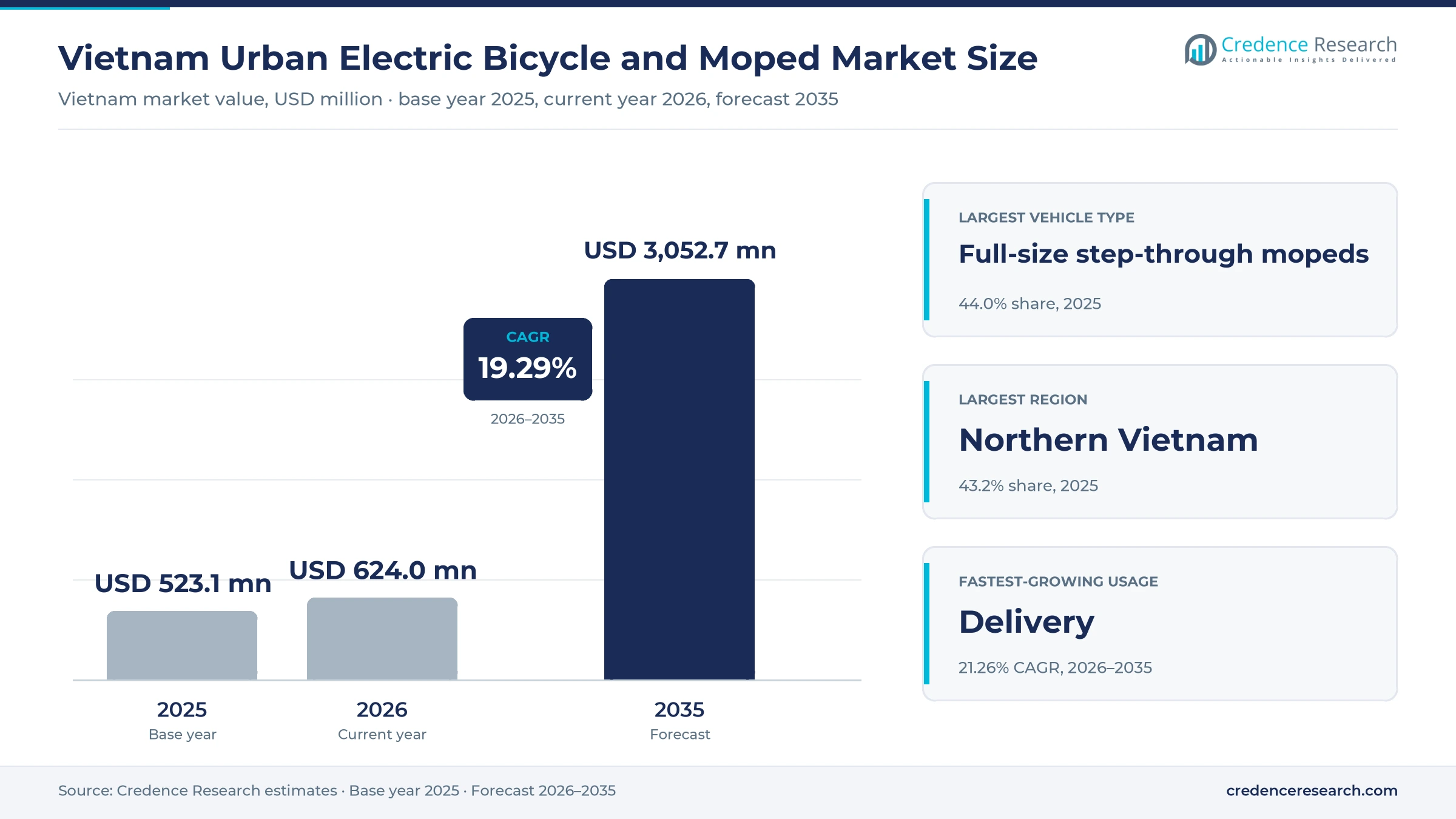
Vietnam Urban Electric Bicycle and Moped Market Insights
- The Vietnam urban electric bicycle and moped market was valued at USD 523.1 million in 2025 and is projected to reach USD 3.05 billion by 2035, registering a CAGR of 19.29% during 2026–2035.
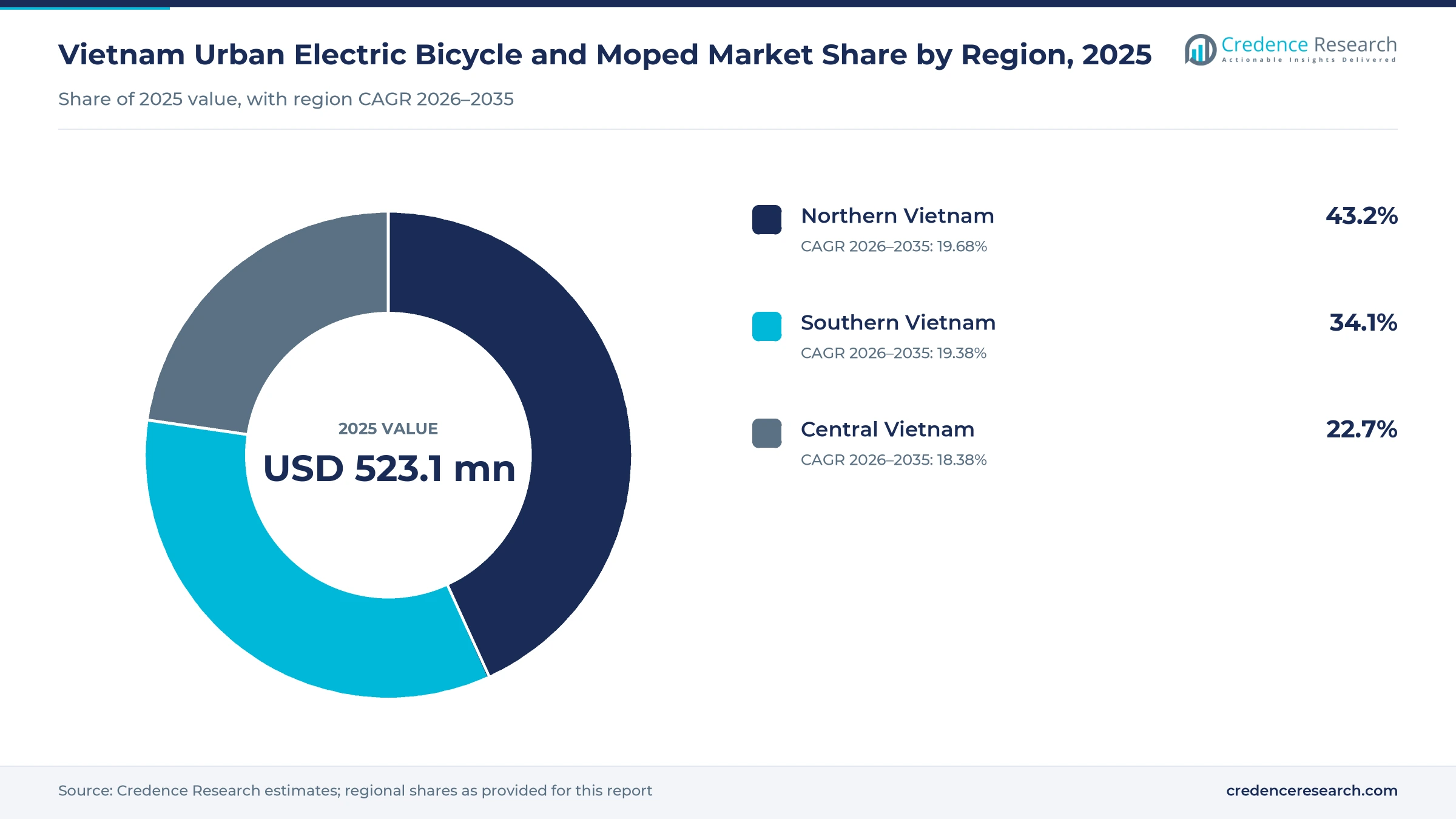
- Northern Vietnam held 43.2% of 2025 value, because Hanoi has about 6.9 million registered motorcycles and leads the country on petrol access rules.
- Full-size step-through mopeds led with 44.0% of 2025 value, since families use them for school runs, shopping and daily commuting.
- Hanoi launched a low-emission zone pilot inside Ring Road 1 on July 1, 2026, which begins the phased shift away from petrol motorbikes in the capital.
- Delivery grows fastest by usage at 21.26% a year during 2026–2035, as Ho Chi Minh City plans to move 400,000 app-based riders to electric by 2029.
Step-through mopeds and LFP packs lead city sales
Why do full-size step-through mopeds lead value?
Based on vehicle type, the market is categorized into pedal-equipped bicycles, compact seated mopeds and full-size step-through mopeds. Full-size step-through mopeds led with 44.0% of 2025 value, because families buy them as direct replacements for petrol scooters and they carry higher prices. Full-size step-through mopeds also grow fastest at 19.89% a year, as swappable batteries and longer range make them practical for full-day city use.
Why are lithium iron phosphate packs taking over?
Based on battery chemistry, the market is categorized into lead-acid, lithium iron phosphate and other lithium-ion packs. Lithium iron phosphate led with 52.0% of 2025 value, because VinFast and other large brands fit these packs to their mainstream mopeds for safety and cycle life. Lithium iron phosphate also grows fastest at 20.54% a year, as battery-swap networks standardize on these packs.
Why does commuting remain the core use case?
Based on usage type, the market is categorized into commuting, education and delivery. Commuting led with 58.0% of 2025 value, because most buyers replace a petrol motorbike used for daily trips to work and markets. Delivery grows fastest at 21.26% a year, as ride-hailing and food delivery riders face city conversion targets and seek lower running costs.
Why do independent dealers still sell most units?
Based on sales channel, the market is categorized into independent authorized dealers, manufacturer-controlled retail and direct fleet contracts. Independent authorized dealers led with 55.0% of 2025 value, because they reach smaller cities and handle financing, registration and repairs for buyers. Direct fleet contracts grow fastest at 21.72% a year, as platforms and logistics firms buy electric mopeds in bulk for their riders.
| Segment Group | Leading Sub-segment | Share, 2025 | Fastest-growing Sub-segment | CAGR, 2026–2035 |
|---|---|---|---|---|
| By Vehicle Type | Full-size step-through mopeds | 44.0% | Full-size step-through mopeds | 19.89% |
| By Battery Chemistry | Lithium iron phosphate | 52.0% | Lithium iron phosphate | 20.54% |
| By Usage Type | Commuting | 58.0% | Delivery | 21.26% |
| By Sales Channel | Independent authorized dealers | 55.0% | Direct fleet contracts | 21.72% |
Request a Free Sample
Fill in your details and we'll send you a free sample report.
- Sample data tables & charts
- Research methodology
Replacement, access rules and local plants lift sales
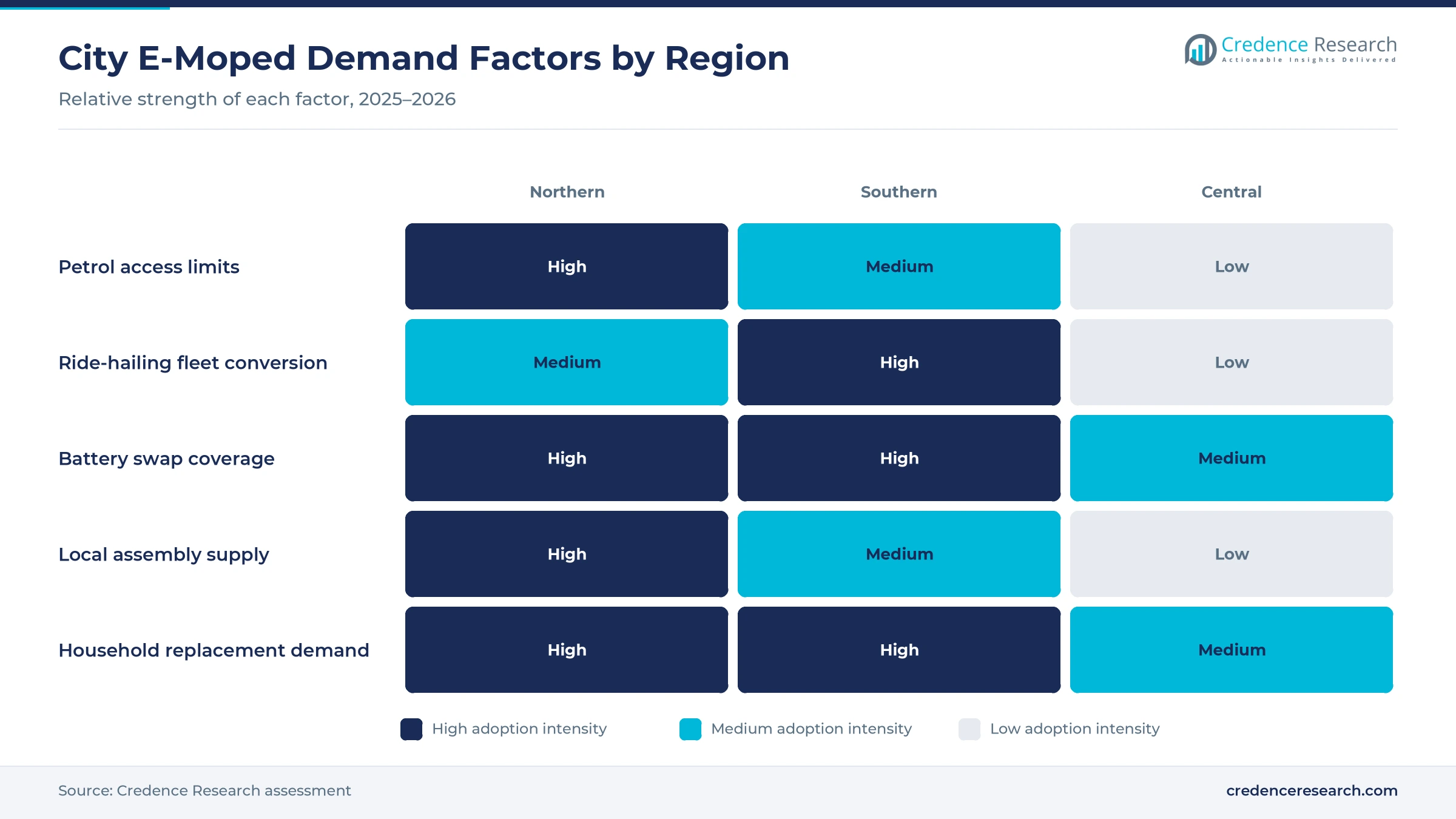
How is petrol motorbike replacement driving city sales?
Households trading in aging bikes provide most demand, because most urban families already own at least one petrol motorbike and now choose an electric model when they trade up. VinFast sold 406,453 electric two-wheelers of all types in Vietnam in 2025, up 473% from 2024, according to Saigon Giai Phong. The same report said the Evo series alone delivered more than 250,000 units, while a January to April 2026 offer added zero-down purchase, a 6% discount and full registration fee support. Honda, the largest petrol brand, sold nearly 2.25 million motorcycles in 2025, which shows the size of the fleet still to be replaced. As a result, commuting leads with 58.0% of 2025 value.
How do phased low-emission access rules push riders to switch?
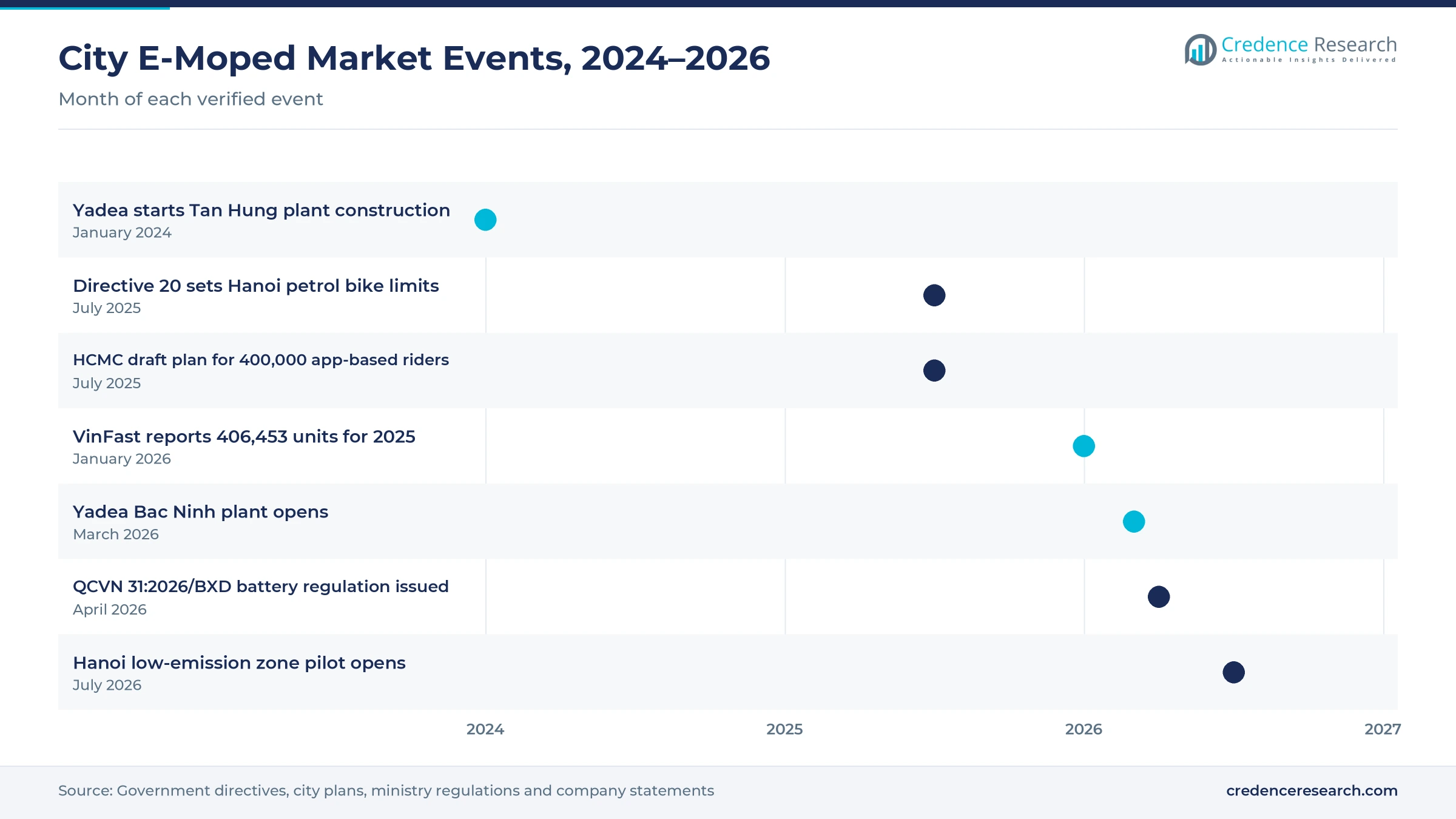
Hanoi's ring-road deadlines are moving buyers toward electric models, because petrol bikes will lose access to the busiest city districts step by step. Directive 20, issued on July 12, 2025, set a petrol motorbike ban inside Hanoi's Ring Road 1 from July 2026, Ring Road 2 from January 2028 and Ring Road 3 from 2030, according to Viet Nam News. The same report said Hanoi has about 6.9 million registered motorcycles and proposed support of VND 3 million to VND 5 million per buyer of an electric bike worth at least VND 15 million. In turn, northern dealers see the earliest wave of trade-ins as the capital's core closes to petrol bikes.
Why does localized supply and distribution expansion matter?
New local plants and wider dealer networks cut prices and waiting times, because brands no longer depend on imported finished bikes. Yadea opened a smart plant at Tan Hung Industrial Park in Bac Ninh on March 1, 2026, with a first-phase capacity of 1 million vehicles a year and more than USD 100 million invested, according to VOV. Viet Nam News reported in August 2026 that some Yadea models already reach about 60% local content, with a 90% target. VinFast also sells through more than 600 authorized distributors nationwide. Consequently, independent authorized dealers lead with 55.0% of 2025 value, while local LFP cell supply supports cheaper packs.
Why do ride-hailing conversion targets add fleet demand?
City plans for app-based drivers add a new layer of buyers, because these riders travel far more than private users and save the most fuel by going electric. A Ho Chi Minh City draft plan aims to move about 400,000 ride-hailing and delivery drivers to electric bikes by December 2029, with 50% converted by December 2026, according to Tuoi Tre. The same plan proposed VND 8 million per vehicle for 10,000 low-income drivers and two years without registration fees. Riders in the plan cover 80 km to 120 km a day, three to four times the average resident. Therefore, delivery grows fastest by usage at 21.26% a year.
Battery swapping, fleet conversion and student models rise
How is the shift to battery swapping changing ownership?
Swap cabinets are spreading fast, because they remove the long home charging times that worry riders in apartments and alleys. VinFast had installed about 4,500 battery-swap stations by January 2026 and planned 45,000 cabinets within the first quarter of 2026, according to SGGP. Viet Nam News reported in October 2025 that Selex Motors planned 300 cabinets by 2026 and 3,000 by 2028, charging VND 8,000 per swap. Honda also began swapping for its CUV e model through 19 dealers in Hanoi, Ho Chi Minh City and Da Nang. As a result, swap networks favor lithium iron phosphate packs, which grow fastest by chemistry at 20.54% a year.
Why are fleet enterprises rising as direct buyers?
Platforms and logistics firms now buy in bulk, because they want uniform bikes, battery plans and service for thousands of riders. VinFast offered 12 months of free battery swapping to drivers registered for fleet work on the Xanh SM platform from January 2026, double the six months given to private buyers. Ho Chi Minh City's draft plan would start its support policies on Jan. 1, 2026, if approved, including 2% interest subsidies on green loans. Hanoi's July 2026 zone rules encourage app-based petrol bikes to limit trips in the central wards. In turn, direct fleet contracts grow fastest by channel at 21.72% a year.
Can pedal-assisted student models open a new segment?
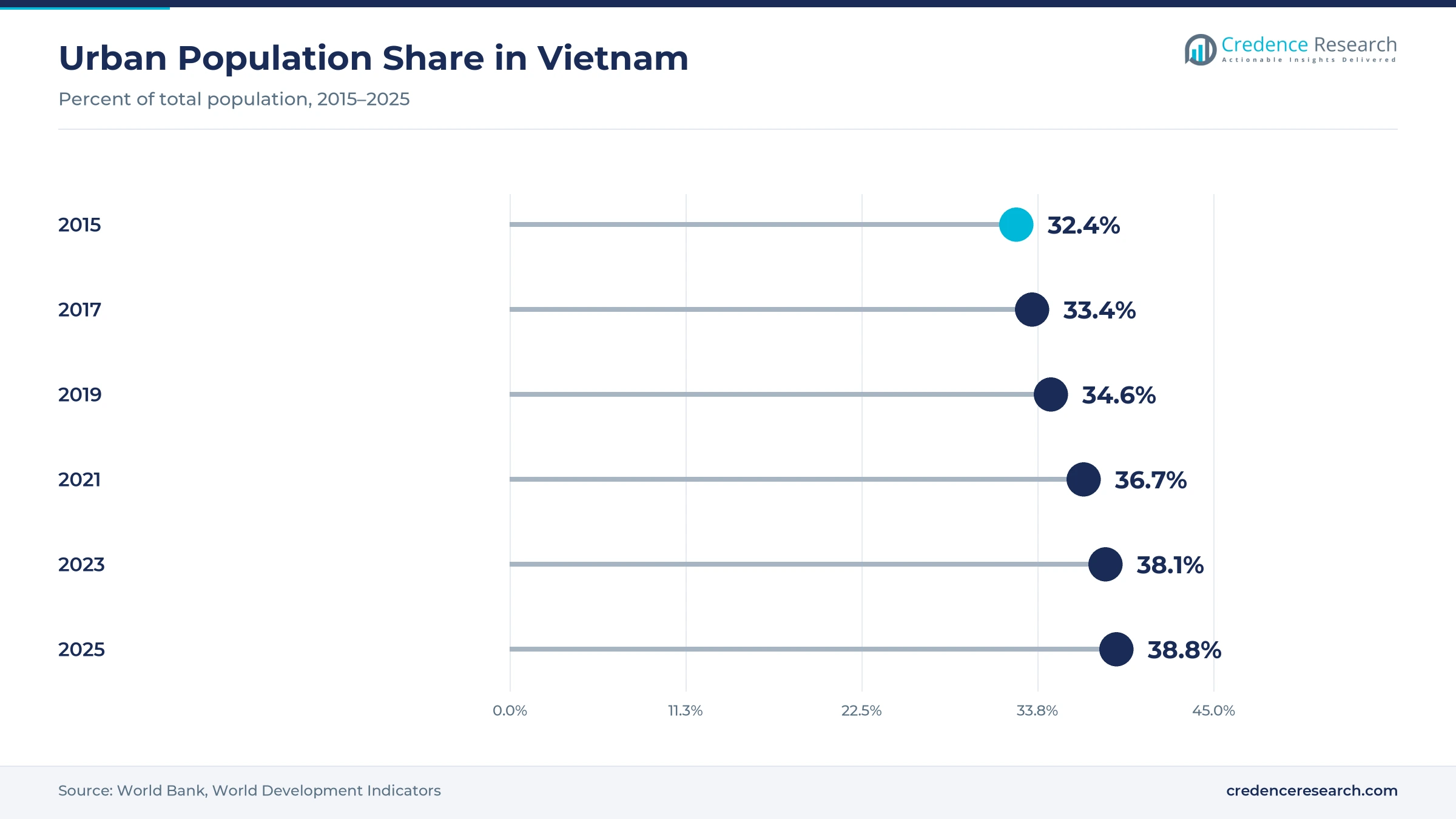
License-free bikes for pupils offer a clear opening, because many secondary school students need their own transport for daily trips to class. Vietnam's urban population share rose from 32.4% in 2015 to 38.8% in 2025, according to World Bank data, which adds school-age riders in cities. VinFast added the Amio, a student model with pedals, to its range in early 2026, alongside license-free models such as the Motio, Zgoo and Flazz. Anbico, founded in 2015 in Vinh Phuc, sells electric bicycles such as the AP1705 and Bat-X beside its mopeds, which keeps entry prices within reach of families. Therefore, education holds a steady share of city demand, and brands that sell lighter lithium packs can win parents who want safer, easier charging.
Will tighter battery standards open room for quality brands?
Stricter national testing gives proven brands an edge, because buyers worry about fires and short battery life on cheap models. The Ministry of Construction issued QCVN 31:2026/BXD under Circular 13/2026/TT-BXD on April 9, 2026, replacing the earlier traction battery regulation for electric motorcycles and mopeds. The regulation covers lead-acid, nickel-metal hydride and lithium-ion packs and tests overcharge, over-discharge, vibration and drops. It also requires lithium-ion packs to deliver at least 100% of their rated capacity. Consequently, brands with tested lithium iron phosphate packs can charge a premium, while full-size step-through mopeds keep 44.0% of 2025 value.
Rule delays, charging limits and lead-acid stock slow uptake
How do delays to city access rules slow switching?
Moving deadlines make many riders wait, because few want to buy before the rules are final. Hanoi People's Council did not approve the Ring Road 1 low-emission zone resolution on May 11, 2026, citing incomplete documents, according to Vietcetera. The zone that opened on July 1, 2026, covers nine wards and starts with weekend evening limits in Hoan Kiem. As a result, full restrictions across Ring Road 1 now arrive in 2028 to 2029, and support schemes matter more for early buyers.
Why do charging limits in dense housing hold buyers back?
Home charging is hard for many city families, because they live in tube houses and apartments with shared parking. Tuoi Tre reported that recent electric bike fires in Ho Chi Minh City were mostly caused by faulty household wiring. Consequently, some buyers delay a switch until swap cabinets reach their street. A Hanoi proposal requiring charging points in 30% of parking spaces in new buildings by the end of 2026 would ease this problem over time.
How does the lead-acid installed base weigh on value?
Older electric bicycles and low-cost mopeds still use heavy packs that wear out within a few years, and this installed base weighs on new sales. Owners often replace lead-acid packs rather than buy a new vehicle, which slows new sales in price-sensitive cities. In turn, lead-acid models lose share of new sales each year as buyers trade up. Trade-in offers and swap subscriptions help brands move these owners to lithium models.
Will grid capacity and flooding limit fast adoption?
Night charging by millions of bikes adds load to local transformers, so power supply and urban flooding can slow adoption. Tuoi Tre reported that Ho Chi Minh City planners are working with agencies on grid capacity for the ride-hailing plan. Seasonal flooding in low districts also raises worries about water damage to batteries and motors. Therefore, brands are adding sealed packs and water-resistant wiring to protect riders and reduce warranty claims.
Northern Vietnam leads as Hanoi tightens access
| Region | Value, 2025 (USD million) | Share, 2025 | CAGR, 2026–2035 |
|---|---|---|---|
| Northern Vietnam | 226.0 | 43.2% | 19.68% |
| Southern Vietnam | 178.4 | 34.1% | 19.38% |
| Central Vietnam | 118.7 | 22.7% | 18.38% |
Why does Northern Vietnam lead and grow fastest?
Northern Vietnam is the largest region, with 43.2% of 2025 market value. The region also grows fastest at 19.68% a year, because Hanoi is the first city to phase petrol motorbikes out of its core under Directive 20. The capital has about 6.9 million registered motorcycles, and the Ring Road 1 area handles up to 1.3 million vehicles daily. Yadea's new plant in Bac Ninh also brings supply close to buyers. As a result, northern dealers see the earliest and largest wave of replacement purchases.
How does Ho Chi Minh City shape Southern Vietnam demand?
Southern Vietnam held 34.1% of 2025 market value, the second-largest regional share. The region grows at 19.38% a year, because Ho Chi Minh City has the country's largest pool of ride-hailing and delivery riders. The city's draft plan targets about 400,000 app-based riders for conversion by 2029, with interest support and lower fees. Swap networks from VinFast and Selex Motors are also expanding across the city. Therefore, fleet contracts weigh more heavily in the south than elsewhere.
Can central Vietnam keep pace with the larger regions?
Central Vietnam held 22.7% of 2025 market value, the smallest regional share. The region grows at 18.38% a year, because Da Nang, Hue and coastal cities have fewer petrol access limits and smaller fleets. Honda offers battery swapping for its CUV e model through dealers in Da Nang, which gives buyers a second network beside VinFast. In turn, demand in the center comes mostly from households replacing older bikes rather than from fleets.
Low-emission zones, new plants and battery rules
| Development | Status and market relevance |
|---|---|
| In July 2025, Directive 20 set phased petrol motorbike limits inside Hanoi's ring roads. | Ring Road 1 from July 2026, Ring Road 2 from January 2028 |
| In January 2026, VinFast reported 406,453 electric two-wheelers sold in Vietnam in 2025. | Up 473% from 2024; more than 600 distributors |
| In March 2026, Yadea opened its Tan Hung plant in Bac Ninh with first-phase capacity of 1 million vehicles a year. | More than USD 100 million invested; rising to over 2 million units |
| In April 2026, the Ministry of Construction issued QCVN 31:2026/BXD on traction batteries for electric motorcycles and mopeds. | Covers lead-acid, nickel-metal hydride and lithium-ion packs |
| In July 2026, Hanoi launched a low-emission zone pilot covering nine wards inside Ring Road 1. | Widens to all of Ring Road 1 during 2028 to 2029 |
Swappable LFP packs and connected models change design
- Swappable lithium iron phosphate packs let riders exchange a depleted battery in seconds, which suits delivery riders who cannot wait hours to charge.
- Higher-torque hub motors help full-size mopeds carry two riders and cargo up ramps and flyovers without overheating.
- Connected dashboards and apps show battery health, find swap cabinets and lock bikes remotely, which helps fleets track riders and assets.
- Tested battery management systems protect packs against overcharge and short circuits, which helps brands meet the April 2026 national battery regulation.
Need a Custom Version of This Report?
Tailor the scope, geography, or segments to your exact requirements.
- Custom geography or segment scope
- Direct access to our analyst team
VinFast leads while Chinese and local brands compete
Competition centers on VinFast, which reported 406,453 electric two-wheelers sold in Vietnam in 2025 and sells through more than 600 authorized distributors with its own swap network. Yadea, a Chinese brand, competes on price and range from its Bac Ninh plant, which opened in March 2026 with first-phase capacity of 1 million vehicles a year. Pega, a Vietnamese brand, sells lithium-ion models such as the Aura and NewTech, while Dibao, which assembles imported kits in Thai Binh province, offers models with lead-acid or lithium packs. Anbico, founded in 2015 in Vinh Phuc, makes electric bicycles and mopeds at the lower end of the price range. Petrol brands such as Honda and Yamaha are entering with swap-ready models. Companies compete on price, financing, battery plans and dealer reach, as the wider market for battery-powered two-wheelers moves toward lithium packs.
Companies profiled and their roles in this market
| Company | Type | Role in the market |
|---|---|---|
| VinFast | Domestic manufacturer | Market leader; 406,453 units sold in Vietnam in 2025; Evo, Feliz and Amio models; swap network |
| Yadea | Chinese manufacturer with local plant | Tan Hung plant in Bac Ninh opened March 2026; 1 million units first-phase capacity |
| Pega | Domestic brand | Lithium-ion models such as Aura and NewTech for city riders |
| Dibao | Kit-assembly brand (Thai Binh) | Gogo SS and Pansy S models with lead-acid or lithium packs |
| Anbico | Domestic manufacturer (Vinh Phuc) | Founded 2015; electric bicycles AP1705 and Bat-X plus low-cost mopeds |
Credence Research view on city fleet replacement
Credence Research's view is that the Vietnam urban electric bicycle and moped market has passed the early adoption stage and is now a replacement market driven by city rules and fleet economics. Hanoi's phased zones and Ho Chi Minh City's ride-hailing plan will set the pace, even if deadlines slip by a year or two. Local plants and swap networks should keep vehicle and battery prices falling. However, charging limits in dense housing and weak grid capacity in older districts will slow adoption unless swap cabinets spread faster.
How the city e-two-wheeler estimate was built
The report uses 2025 as the base year and forecasts values to 2035. Market values come from the Credence Research model, which combines unit sales reported by brands, the installed petrol motorbike fleet in major cities, fleet conversion plans and average selling prices by vehicle type. Regional shares are those set for this report, and splits by vehicle type, battery chemistry, usage and channel are Credence Research estimates. Sources used are government directives and regulations, city plans, World Bank data, company statements and news reports, and no interviews or surveys were used.
Access rules and fleet conversion set the path to 2035
The market is expected to reach USD 3.05 billion by 2035, a 19.29% CAGR during 2026–2035, as city households and app-based riders replace petrol motorbikes with electric models. Growth should be strongest in Northern Vietnam and in delivery use, while full-size step-through mopeds keep the largest share. Swap networks, local plants and the April 2026 battery regulation should support safer and cheaper models. In contrast, further delays to access rules or slow growth in charging capacity would hold back adoption and squeeze smaller brands.
Frequently Asked Questions
How big is the Vietnam urban electric bicycle and moped market?
Which region leads city e-moped sales in Vietnam?
Which region grows fastest?
When do petrol motorbike limits start in Hanoi?
Which vehicle type holds the largest share?
Which usage type grows fastest?
Who are the leading companies in this market?
What are the main risks to growth?
Table of Content
Chapter 1 Market Segmentation
- 1.1 Segmentation Framework
- 1.1.1 Product and Service Classification
- 1.1.2 Application and End-Use Classification
- 1.1.3 Technology and Solution Classification
- 1.1.4 Customer and Distribution Channel Classification
- 1.1.5 Geographic Segmentation
- 1.1.6 Market Segment Definitions and Boundaries
- 1.2 By Vehicle Type
- 1.2.1 Pedal-equipped bicycles
- 1.2.2 Compact seated mopeds
- 1.2.3 Full-size step-through mopeds
- 1.3 By Battery Chemistry
- 1.3.1 Lead-acid
- 1.3.2 Lithium iron phosphate
- 1.3.3 Other lithium-ion
- 1.4 By Usage Type
- 1.4.1 Commuting
- 1.4.2 Education
- 1.4.3 Delivery
- 1.5 By Sales Channel
- 1.5.1 Independent authorized dealers
- 1.5.2 Manufacturer-controlled retail
- 1.5.3 Direct fleet contracts
Chapter 2 Introduction
- 2.1 Report Objectives and Scope
- 2.2 Product Definition and Industry Terminology
- 2.3 Market Inclusions and Exclusions
- 2.4 Research Process
- 2.4.1 Primary Research and Expert Interviews
- 2.4.2 Secondary Research and Source Review
- 2.4.3 Top-Down and Bottom-Up Estimation
- 2.4.4 Data Triangulation and Verification
- 2.5 Market Size Measurement Basis
- 2.5.1 2025: USD 523.1 million → 2035: USD 3.05 billion
- 2.6 Historical and Forecast Reference Periods
- 2.6.1 Historical Period: 2018-2025
- 2.6.2 Base Year: 2025
- 2.6.3 Forecast Period: 2025-2035
- 2.7 Research Assumptions and Limitations
Chapter 3 Executive Summary
- 3.1 Market Snapshot and Key Findings
- 3.2 Base-Year Market Size, 2025
- 3.3 Forecast Market Size, 2035
- 3.4 Revenue and Volume Growth Outlook
- 3.5 Key Demand and Supply Indicators
- 3.6 Leading Market Segments
- 3.7 Fastest-Growing Market Opportunities
- 3.8 Regional Performance Highlights
- 3.9 Technology and Industry Transformation
- 3.10 Competitive Landscape Summary
- 3.11 Analyst View and Strategic Implications
Chapter 4 Vietnam Urban Electric Bicycle and Moped Market Trends and Developments
- 4.1 Historical Industry Development, 2018-2025
- 4.2 Recent Market Trends and Developments
- 4.3 Demand and Customer Behavior Trends
- 4.4 Technology and Product Innovation
- 4.5 Artificial Intelligence, Automation and Digitalization
- 4.6 Local Manufacturing and Supply Chain Realignment
- 4.7 Industry Partnerships, Mergers and Acquisitions
- 4.8 Sustainability and Circular Economy Developments
- 4.9 Government and Private Sector Investment Trends
- 4.10 Emerging Business Models and Commercialization
- 4.11 Industry Developments and Announcements
Chapter 5 Vietnam Urban Electric Bicycle and Moped Market Production, Supply and Demand Analysis
- 5.1 Demand Trend and Consumption Analysis, 2018-2025
- 5.2 Demand Forecast, 2025-2035
- 5.3 Production and Output Trend, 2018-2025
- 5.4 Production and Output Forecast, 2025-2035
- 5.5 Installed Capacity and Capacity Utilization
- 5.6 Company-Wise Production Plants and Statistics
- 5.6.1 Installed Production Capacity
- 5.6.2 Actual Production
- 5.6.3 Planned Capacity and Expansion Targets
- 5.7 Supply Chain Structure and Procurement Trends
- 5.8 Supply-Demand Gap and Bottlenecks
- 5.9 Import Dependence and Sourcing Structure
- 5.10 Contract Manufacturing and Outsourcing
- 5.11 Regional Supply and Demand Concentration
Chapter 6 Vietnam Urban Electric Bicycle and Moped Market Pricing Analysis
- 6.1 Pricing Structure and Measurement
- 6.2 Historical Pricing Trends, 2018-2025
- 6.3 Pricing Outlook, 2025-2035
- 6.4 Average Selling Price and Unit Economics
- 6.5 Pricing by Product and Market Segment
- 6.6 Geographic Pricing Differences
- 6.7 Key Input, Energy, Labor and Logistics Costs
- 6.8 Contract Pricing and Purchasing Models
- 6.9 Pricing Sensitivity and Competitive Positioning
- 6.10 Price, Margin and Profitability Implications
Chapter 7 Vietnam Urban Electric Bicycle and Moped Market Dynamics
- 7.1 Market Growth Drivers
- 7.1.1 Demand-Side Drivers
- 7.1.2 Technology and Innovation Drivers
- 7.1.3 Infrastructure and Investment Drivers
- 7.1.4 Regulatory and Policy Drivers
- 7.2 Market Restraints
- 7.2.1 Cost and Affordability Constraints
- 7.2.2 Technology and Adoption Barriers
- 7.2.3 Supply Chain and Operational Constraints
- 7.3 Market Challenges
- 7.3.1 Competitive Pressure and Margin Erosion
- 7.3.2 Skills, Infrastructure and Implementation Gaps
- 7.4 Emerging Market Opportunities
- 7.5 Market Dynamics Impact and Time-Horizon Assessment
Chapter 8 Vietnam Urban Electric Bicycle and Moped Value Chain Analysis
- 8.1 Industry Value Chain Overview
- 8.2 Upstream Suppliers and Critical Inputs
- 8.3 Technology and Component Providers
- 8.4 Manufacturing or Service Delivery
- 8.5 Distribution, Channel Partners and Integrators
- 8.6 Downstream Applications and End Users
- 8.7 Value Addition and Profit Pools
- 8.8 Vertical Integration and Outsourcing
- 8.9 Supplier Concentration and Risk
- 8.10 Supply Chain Localization and Resilience
Chapter 9 Vietnam Urban Electric Bicycle and Moped Market Regulations and Policies
- 9.1 Relevant Laws, Standards and Compliance Frameworks
- 9.2 Product, Service, Safety and Quality Requirements
- 9.3 Government Policies, Incentives and Subsidies
- 9.4 Imports, Exports and Trade Barriers
- 9.5 Public Procurement and Local Content Requirements
- 9.6 Environmental and Sustainability Compliance
- 9.7 Upcoming Policy Changes and Market Implications
Chapter 10 Vietnam Urban Electric Bicycle and Moped Market Hotspots and Opportunities
- 10.1 Market Opportunity Mapping and Growth Hotspots
- 10.2 High-Growth Applications and Customer Groups
- 10.3 Underserved Markets and White-Space Opportunities
- 10.4 Emerging Technology and Product Opportunities
- 10.5 New Capacity and Investment Hotspots
- 10.6 Market Entry and Expansion Opportunities
- 10.7 Distribution and Partnership Opportunities
- 10.8 Near-Term and Long-Term Commercial Potential
- 10.9 Opportunity Attractiveness and Execution Risks
Chapter 11 Vietnam Urban Electric Bicycle and Moped Market Outlook, 2025-2035
- 11.1 Market Size and Analysis
- 11.1.1 Revenue (Market Measurement: 2025: USD 523.1 million → 2035: USD 3.05 billion)
- 11.1.2 Market Volume and Quantity Sold
- 11.1.3 Historical Market Size, 2018-2025
- 11.1.4 Base-Year Market Size, 2025
- 11.2 Market Forecast, 2025-2035
- 11.2.1 Revenue Forecast to 2035
- 11.2.2 Volume Forecast to 2035
- 11.2.3 CAGR and Year-on-Year Growth
- 11.2.4 Incremental Revenue Opportunity
- 11.3 Forecast Assumptions and Scenario Analysis
- 11.3.1 Base-Case Forecast
- 11.3.2 Optimistic and Conservative Scenarios
- 11.3.3 Technology, Pricing and Policy Sensitivities
- 11.4 Market Attractiveness and Growth Outlook
Chapter 12 Vietnam Urban Electric Bicycle and Moped Market Segmentation and Outlook
- 12.1 Segmentation Summary and Market Shares, 2025
- 12.2 Largest and Fastest-Growing Segments
- 12.3 By Vehicle Type - Market Size and Forecast, 2025-2035
- 12.3.1 Segment Definition and Scope
- 12.3.2 Historical Market Size, 2018-2025
- 12.3.3 Revenue Forecast, 2025-2035
- 12.3.4 Volume Forecast, 2025-2035
- 12.3.5 Base-Year Market Share, 2025
- 12.3.6 Segment CAGR and Growth Drivers
- 12.3.7 Subsegment Market Size and Forecast
- 12.3.7.1 Pedal-equipped bicycles
- 12.3.7.2 Compact seated mopeds
- 12.3.7.3 Full-size step-through mopeds
- 12.3.8 Subsegment Pricing and Adoption Trends
- 12.3.9 Leading Suppliers and Competition
- 12.3.10 Regional Demand and Opportunities
- 12.4 By Battery Chemistry - Market Size and Forecast, 2025-2035
- 12.4.1 Segment Definition and Scope
- 12.4.2 Historical Market Size, 2018-2025
- 12.4.3 Revenue Forecast, 2025-2035
- 12.4.4 Volume Forecast, 2025-2035
- 12.4.5 Base-Year Market Share, 2025
- 12.4.6 Segment CAGR and Growth Drivers
- 12.4.7 Subsegment Market Size and Forecast
- 12.4.7.1 Lead-acid
- 12.4.7.2 Lithium iron phosphate
- 12.4.7.3 Other lithium-ion
- 12.4.8 Subsegment Pricing and Adoption Trends
- 12.4.9 Leading Suppliers and Competition
- 12.4.10 Regional Demand and Opportunities
- 12.5 By Usage Type - Market Size and Forecast, 2025-2035
- 12.5.1 Segment Definition and Scope
- 12.5.2 Historical Market Size, 2018-2025
- 12.5.3 Revenue Forecast, 2025-2035
- 12.5.4 Volume Forecast, 2025-2035
- 12.5.5 Base-Year Market Share, 2025
- 12.5.6 Segment CAGR and Growth Drivers
- 12.5.7 Subsegment Market Size and Forecast
- 12.5.7.1 Commuting
- 12.5.7.2 Education
- 12.5.7.3 Delivery
- 12.5.8 Subsegment Pricing and Adoption Trends
- 12.5.9 Leading Suppliers and Competition
- 12.5.10 Regional Demand and Opportunities
- 12.6 By Sales Channel - Market Size and Forecast, 2025-2035
- 12.6.1 Segment Definition and Scope
- 12.6.2 Historical Market Size, 2018-2025
- 12.6.3 Revenue Forecast, 2025-2035
- 12.6.4 Volume Forecast, 2025-2035
- 12.6.5 Base-Year Market Share, 2025
- 12.6.6 Segment CAGR and Growth Drivers
- 12.6.7 Subsegment Market Size and Forecast
- 12.6.7.1 Independent authorized dealers
- 12.6.7.2 Manufacturer-controlled retail
- 12.6.7.3 Direct fleet contracts
- 12.6.8 Subsegment Pricing and Adoption Trends
- 12.6.9 Leading Suppliers and Competition
- 12.6.10 Regional Demand and Opportunities
- 12.7 Segment Growth Comparison
- 12.8 Segment Attractiveness and Priority Matrix
Chapter 13 Vietnam Urban Electric Bicycle and Moped Geographic Market Outlook, 2025-2035
- 13.1 Domestic Market Distribution and Demand Clusters
- 13.2 State- or Province-Wise Market Size and Forecast, 2025-2035
- 13.3 City and Metropolitan Market Outlook
- 13.4 Industrial, Manufacturing and Commercial Clusters
- 13.5 Geographic Concentration of Key End Users
- 13.6 Local Pricing and Purchasing Differences
- 13.7 Domestic Production Facilities and Capacity Map
- 13.8 Local Infrastructure and Project Pipeline
- 13.9 State-Level Policy and Incentive Differences
- 13.10 Subnational Investment Hotspots and Opportunities
- 13.11 Distribution and Logistics Networks
- 13.12 Domestic Competitive Footprint
Chapter 14 Vietnam Urban Electric Bicycle and Moped Technology, Innovation and Sustainability Outlook
- 14.1 Technology Landscape and Maturity
- 14.2 Product, Process and Service Innovation
- 14.3 AI, Automation and Digital Tools in the Industry
- 14.4 Technology Adoption and Performance Benchmarking
- 14.5 Innovation Pipeline and R&D Investment
- 14.6 Patent and Intellectual Property Trends
- 14.7 Energy Efficiency and Resource Management
- 14.8 Sustainability, Recycling and Circularity
- 14.9 Technology Roadmap, 2025-2035
- 14.10 Risks of Obsolescence and Technology Substitution
Chapter 15 Vietnam Urban Electric Bicycle and Moped Market Key Strategic Imperatives
- 15.1 Growth and Market Entry Priorities
- 15.2 High-Return Products and Segments
- 15.3 Pricing, Profitability and Cost Optimization
- 15.4 Technology Investment and Product Differentiation
- 15.5 Supply Chain Localization and Resilience
- 15.6 Distribution and Customer Acquisition
- 15.7 Partnership, Acquisition and Capacity Strategy
- 15.8 Regional Expansion Priorities
- 15.9 Short-, Medium- and Long-Term Actions
Chapter 16 Competition Outlook
- 16.1 Industry Competition Characteristics
- 16.2 Market Structure and Concentration
- 16.3 Market Share and Competitive Positioning, 2025
- 16.4 Company-Wise Revenue and Product Benchmarking
- 16.5 Production and Service Capacity Benchmarking
- 16.6 Technology, Pricing and Differentiation
- 16.7 Regional Footprint and Distribution Strength
- 16.8 Mergers, Acquisitions and Strategic Alliances
- 16.9 New Entrants and Competitive Threats
- 16.10 Porter's Five Forces and Industry Attractiveness
- 16.11 Competitive Outlook, 2025-2035
Chapter 17 Company Profiles
- 17.1 Company Coverage and Selection Criteria
- 17.2 VinFast
- 17.2.1 Business Description
- 17.2.2 Company Ownership and Geographic Presence
- 17.2.3 Product and Service Portfolio
- 17.2.4 Manufacturing and Operating Footprint
- 17.2.5 Production Capacity and Expansion Plans
- 17.2.6 Financial Performance and Investment
- 17.2.7 Market Share and Competitive Position
- 17.2.8 Technology and Innovation Capabilities
- 17.2.9 Strategic Alliances or Partnerships
- 17.2.10 Recent Developments
- 17.2.11 Growth Strategy and Outlook
- 17.3 Pega
- 17.4 Dibao
- 17.5 Yadea
- 17.6 Anbico
- 17.7 Other Relevant Market Participants
Note: Every listed company is profiled on the structure shown under the first company. The company list is preliminary and may change based on research findings, market developments, data availability and client requirements.
Chapter 18 Disclaimer
- 18.1 Research and Forecast Disclaimer
- 18.2 Data Source and Estimation Limitations
Note: The depth of individual sections depends on data availability for this market. Volume, capacity, trade and other unit-based metrics are included where applicable.