
| REPORT ATTRIBUTE | DETAILS |
|---|---|
| Historical Period | 2020-2023 |
| Base Year | 2024 |
| Forecast Period | 2025-2032 |
| ASIC Design Services Market Size 2024 | USD 14,323.52 million |
| ASIC Design Services Market, CAGR | 7.80% |
| ASIC Design Services Market Size 2032 | USD 26,121.60 million |
Market Overview:
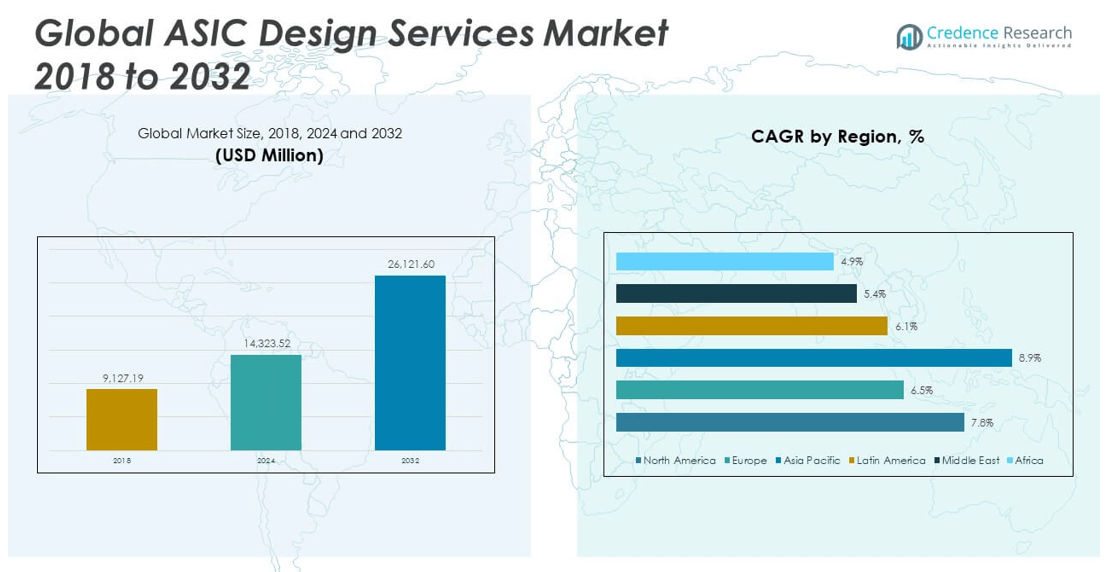
The Global ASIC Design Services Market size was valued at USD 9,127.19 million in 2018 to USD 14,323.52 million in 2024 and is anticipated to reach USD 26,121.60 million by 2032, at a CAGR of 7.80% during the forecast period.
The growth of the global ASIC design services market is driven by the increasing demand for customized and high-performance integrated circuits across a variety of industries. The proliferation of consumer electronics and the rapid expansion of the Internet of Things (IoT) ecosystem have intensified the need for application-specific chips that can deliver superior energy efficiency, speed, and compactness. Additionally, the rise of artificial intelligence (AI), machine learning (ML), and edge computing applications has accelerated the demand for ASICs capable of handling complex algorithms with low latency and minimal power consumption. In sectors such as automotive and industrial automation, the growing deployment of electric vehicles (EVs), advanced driver-assistance systems (ADAS), and robotics is fueling the need for robust ASICs with real-time processing capabilities and high reliability. Furthermore, companies are increasingly outsourcing ASIC design services to specialized providers to reduce development costs, shorten time-to-market, and access niche technical expertise.
Regionally, North America holds a significant share of the ASIC design services market, supported by its well-established semiconductor industry, strong presence of major design service providers, and early adoption of advanced technologies in sectors such as aerospace, defense, and telecom. The U.S., in particular, plays a dominant role due to its concentration of fabless semiconductor companies and high investment in R&D. Europe follows closely, with demand being driven by its automotive and industrial automation sectors, particularly in countries like Germany, France, and the UK. The Asia-Pacific region, however, is witnessing the fastest growth, fueled by the presence of semiconductor manufacturing hubs in countries such as China, Taiwan, South Korea, India, and Japan. Rapid digitalization, increasing investments in AI and IoT infrastructure, and a growing focus on domestic chip development are contributing to Asia-Pacific’s rising prominence in this market. Meanwhile, Latin America, the Middle East, and Africa are gradually emerging as potential markets, with increasing demand for electronic devices and growing investments in industrial and telecom infrastructure paving the way for future expansion.
Market Insights:
- The Global ASIC Design Services Market was valued at USD 14.32 billion in 2024 and is projected to reach USD 26.12 billion by 2032, growing at a CAGR of 7.80%.
- Rapid expansion in consumer electronics and IoT has significantly increased demand for custom, low-power integrated circuits.
- AI and edge computing applications require ASICs with high-speed, real-time processing capabilities, driving design service adoption.
- The automotive industry’s shift toward EVs and ADAS technologies is creating new opportunities for application-specific ASIC development.
- Rising design complexity and shorter product cycles are pushing companies to outsource to specialized design service providers.
- IP protection, high design costs, and supply chain risks remain key challenges limiting broader market participation.
- Asia Pacific is the fastest-growing region, while North America holds the largest share, driven by its strong semiconductor ecosystem and early tech adoption.
Market Drivers:
Rising Demand for Custom Silicon in Consumer Electronics and IoT Applications
The rapid proliferation of connected devices, such as smartphones, smartwatches, home automation systems, and wearables, has created an urgent need for highly customized, energy-efficient integrated circuits. These devices require ASICs that are specifically tailored to perform designated functions with maximum performance and minimal power consumption. The Global ASIC Design Services Market benefits from this trend, as manufacturers seek external expertise to develop unique chip architectures optimized for product-specific requirements. It allows companies to differentiate their offerings in an increasingly competitive consumer electronics space. With the growing scale of IoT adoption across smart homes, healthcare, and industrial environments, demand for small-footprint, low-latency ASIC solutions is expanding. The market continues to attract OEMs and device manufacturers looking to streamline circuit design and reduce size, weight, and cost constraints.
- For example, MediaTek’s ASICs integrate various hardware accelerators and advanced power management, enabling devices to operate with as little as 1.2V core voltage and supporting sub-100-microamp sleep modes ideal for IoT sensors and battery-powered devices.
Acceleration of Artificial Intelligence and Edge Computing Integration
The growing integration of artificial intelligence (AI) and edge computing across multiple industries has intensified the need for high-performance ASICs capable of real-time data processing. Traditional CPUs and GPUs often fall short in meeting latency and efficiency requirements in edge environments, which is driving interest in purpose-built ASICs. The Global ASIC Design Services Market plays a crucial role in enabling companies to develop chips optimized for specific AI models and workloads. It supports the development of edge-based solutions for sectors such as autonomous vehicles, smart surveillance, and industrial automation. These custom designs improve inference speed, reduce power usage, and enhance system responsiveness. Businesses are now prioritizing AI-focused hardware acceleration, which makes ASIC design services an essential part of their product development strategies.
Expansion of Automotive Electronics and Electrification of Mobility
The automotive industry is undergoing a significant transformation through the rise of electric vehicles (EVs), autonomous driving, and vehicle connectivity. These developments require advanced semiconductor components capable of handling sensor fusion, battery management, and onboard AI decision-making. The Global ASIC Design Services Market is well-positioned to serve this demand by offering specialized chip designs for automotive-grade applications. It supports stringent safety and reliability standards while enabling real-time processing for mission-critical functions. Carmakers and tier-1 suppliers are increasingly turning to ASIC design partners to meet functional safety (ISO 26262) requirements and to reduce reliance on general-purpose hardware. The shift toward software-defined vehicles further amplifies the need for custom ASICs tailored to automotive use cases.
Growing Complexity of Semiconductor Architectures and Time-to-Market Pressures
The increasing complexity of semiconductor design, especially for system-on-chip (SoC) configurations, has created a reliance on specialized design service providers. Companies face intense pressure to deliver next-generation products within shorter development cycles while maintaining high performance and efficiency standards. The Global ASIC Design Services Market addresses this challenge by offering advanced design tools, IP integration, and verification services that accelerate development timelines. It enables clients to focus on core innovation while outsourcing intricate design tasks to experienced partners. With escalating costs in semiconductor R&D and frequent design iterations, businesses are seeking flexible, scalable service models. The market continues to grow as companies adopt ASIC design outsourcing to meet aggressive product launch targets and gain competitive advantage.
- For instance, TSMC’s 3nm ASIC platform, introduced in 2023, enables multi-die chiplet integration, supporting modular design and rapid prototyping for cutting-edge custom silicon with up to 250% higher logic density compared to 7nm nodes.
Market Trends:
Adoption of AI-Powered Design Automation in ASIC Workflows
Artificial intelligence is playing an increasingly critical role in enhancing the efficiency of chip design processes. Design service providers are incorporating AI-driven tools for layout optimization, power analysis, and verification, significantly reducing design cycle times. These tools can identify complex design bottlenecks, recommend design adjustments, and automate repetitive tasks across the flow. The Global ASIC Design Services Market is seeing a marked shift toward AI-integrated platforms that allow faster, smarter iterations and more precise performance tuning. It supports engineers in managing growing architectural complexity while improving first-time-right silicon success rates. AI integration is becoming a differentiating factor for service providers seeking to offer high-value, tech-forward solutions to global clients.
Increasing Focus on Open-Source Hardware and RISC-V Architecture
The rise of open-source hardware, particularly the RISC-V instruction set architecture, is reshaping the semiconductor design landscape. Companies are leveraging open standards to reduce licensing fees and gain more control over their chip designs. The Global ASIC Design Services Market is adapting to this trend by offering tailored services for RISC-V implementations and supporting flexible, customizable IP development. It enables clients to adopt modular design strategies and avoid dependency on proprietary ecosystems. Design houses are building capabilities to support open-source toolchains and verification environments, expanding their appeal to startups and academic institutions. This shift is fostering innovation and lowering barriers to entry in ASIC development.
- For example, Andes Technology’s ACE (Andes Custom Extension™) solutionallows its customers to develop RISC-V SoC with domain-specific custom instructions. Andes offers a portfolio of new processor IPs, such as the 64-bit NX25F and AX25, optimized for floating-point and Linux applications, empowering clients to design tailored, high-performance compute solutions and shorten time-to-market.
Strategic Partnerships Between Foundries and Design Service Providers
Semiconductor foundries are increasingly collaborating with ASIC design service firms to offer end-to-end design-to-silicon solutions. These partnerships create vertically integrated ecosystems that streamline the path from concept to fabrication. The Global ASIC Design Services Market benefits from these alliances by gaining early access to process design kits (PDKs), specialized IP blocks, and process optimization support. It improves time-to-market and silicon yield for clients by aligning design goals with manufacturing constraints. Foundries are investing in ecosystem partners to offer reference flows and turnkey design services under one roof. This trend is reinforcing trust and reducing risk for fabless semiconductor companies seeking predictable outcomes.
Expansion of Application-Specific Solutions for Emerging Vertical Markets
Design service providers are developing expertise in serving niche and emerging verticals such as medical devices, aerospace, smart agriculture, and defense. These industries demand strict compliance, miniaturization, and power efficiency, often beyond the scope of generic chip solutions. The Global ASIC Design Services Market is expanding its reach into these segments by offering domain-specific design knowledge, security features, and long product lifecycles. It creates opportunities for differentiation and premium pricing by aligning solutions with sector-specific regulations and performance standards. This trend is shaping the service landscape, prompting design firms to deepen vertical specialization and invest in talent with domain experience.
- For instance, Onsemi offers radiation-hardened ASICs for aerospace, featuring single event effect (SEE) mitigation, error correction codes (ECC), and robust neutron and temperature test data in commercially proven 110nm and 180nm digital processes. This ensures compliance with the high FIT-rate requirements typical in aerospace and defense.
Market Challenges Analysis:
High Development Costs and Resource-Intensive Design Cycles
ASIC development requires substantial upfront investment in design tools, skilled personnel, and validation infrastructure. For many small and mid-sized companies, the cost of engaging in custom ASIC development can exceed project budgets or delay time-to-market objectives. The Global ASIC Design Services Market faces challenges in balancing cost-efficiency with increasing demand for high-performance, low-power, and feature-rich chips. It must also address growing design complexity that stretches engineering bandwidth and lengthens verification timelines. Service providers are under pressure to maintain profitability while delivering tailored, high-quality solutions within compressed development cycles. This financial burden may discourage startups or low-volume clients from pursuing ASIC-based innovations, thereby limiting market accessibility.
Intellectual Property Risks and Supply Chain Vulnerabilities
Clients entrusting third-party firms with proprietary designs and confidential specifications face heightened risks related to intellectual property (IP) security and design theft. The Global ASIC Design Services Market must maintain rigorous IP protection standards while ensuring compliance with international security protocols. It operates in a landscape where geopolitical tensions and export restrictions can disrupt collaboration across borders or constrain access to advanced nodes. Vendors also depend on global foundry networks, which remain exposed to supply chain disruptions, fabrication delays, and material shortages. These vulnerabilities impact delivery schedules and reduce client confidence in outsourcing long-term projects. Ensuring traceability, secure design practices, and robust risk management frameworks remains a top priority for the industry.
Market Opportunities:
Rising Demand for Low-Power Edge AI and Custom IoT Solutions
Edge computing and IoT applications require ASICs that deliver optimized performance with minimal power consumption. The Global ASIC Design Services Market has strong opportunities to support companies building domain-specific chips for wearables, industrial sensors, and AI-enabled edge devices. It can capitalize on this demand by offering energy-efficient architectures, hardware accelerators, and lightweight SoC designs tailored to constrained environments. Growth in smart cities, healthcare devices, and intelligent transportation will continue to drive client interest in bespoke silicon. Design firms that provide flexible engagement models and rapid prototyping capabilities stand to gain significant traction across new verticals.
Emerging Opportunities in Developing Semiconductor Ecosystems
Governments and private sectors in emerging markets are investing in domestic semiconductor capabilities to reduce reliance on imports and build strategic self-sufficiency. The Global ASIC Design Services Market can leverage this trend by partnering with local startups, universities, and government agencies to provide design expertise and IP support. It has the potential to unlock new client bases in regions such as Southeast Asia, Latin America, and the Middle East. With growing interest in homegrown ASIC development, service providers can expand footprints by offering training, design enablement, and co-development programs. These initiatives open avenues for long-term collaborations and diversified revenue streams.
Market Segmentation Analysis:
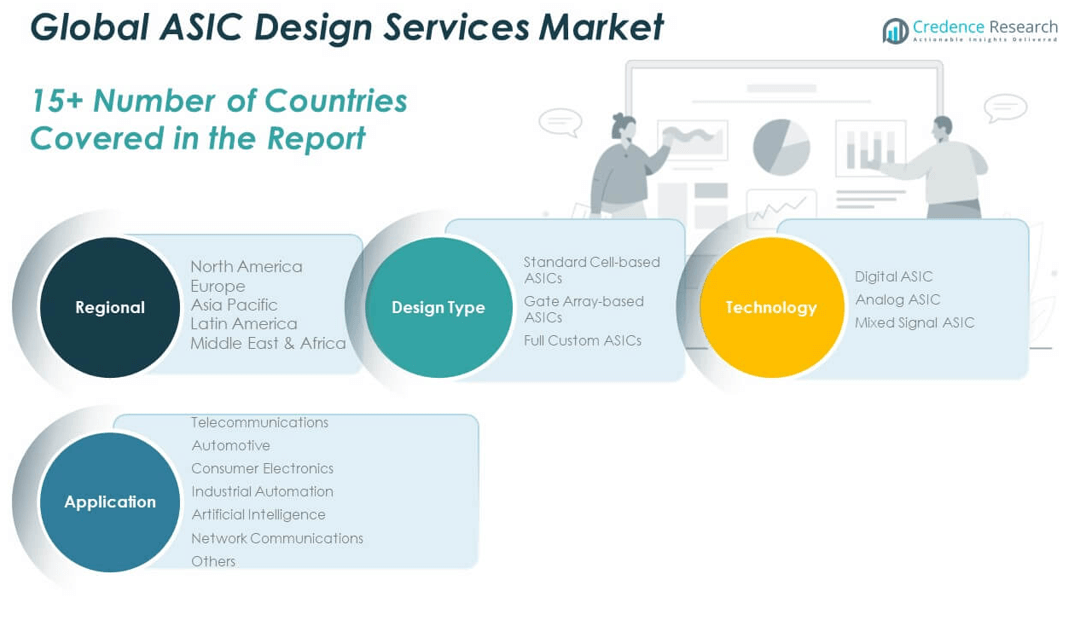
The Global ASIC Design Services Market is segmented by design type, technology, and application, reflecting the broadening scope of customized chip development.
By design type, standard cell-based ASICs hold a significant share due to their balance between flexibility and performance. Gate array-based ASICs offer cost advantages in moderate-volume applications, while full custom ASICs cater to performance-critical sectors requiring complete design control.
- For example, Broadcom’s standard cell ASICs power major switches and routers, exemplified by the Tomahawk series, which delivers up to 51.2 Tbps ethernet switching using advanced 5nm standard cells for optimal performance and silicon efficiency.
By technology, digital ASICs dominate the market, driven by demand from data processing, communication, and embedded system applications. Analog ASICs serve sectors requiring signal conditioning and sensing, such as medical devices and power management. Mixed signal ASICs are gaining traction in applications that require both analog and digital integration, especially in IoT and automotive systems.
By application, the market sees high demand from telecommunications, automotive, and consumer electronics. Industrial automation and artificial intelligence are emerging as strong growth areas. It also supports sectors like network communications and specialized use cases under others, providing tailored solutions to address specific performance, size, and power constraints.
- For instance, Cisco’s Silicon One ASIC, used in high-end routers, can process up to 25.6 Tbps, enabling massive data transmission for global carriers and hyperscale networks. The chip’s programmability and energy efficiency have set new benchmarks for large-scale telecom deployments.
Segmentation:
By Design Type
- Standard Cell-based ASICs
- Gate Array-based ASICs
- Full Custom ASICs
By Technology
- Digital ASIC
- Analog ASIC
- Mixed Signal ASIC
By Application
- Telecommunications
- Automotive
- Consumer Electronics
- Industrial Automation
- Artificial Intelligence
- Network Communications
- Others
By Region (and Key Countries within Regions)
- North America
- U.S.
- Canada
- Mexico
- Europe
- Germany
- France
- U.K.
- Italy
- Spain
- Rest of Europe
- Asia Pacific
- China
- Japan
- India
- South Korea
- South-east Asia
- Rest of Asia Pacific
- Latin America
- Brazil
- Argentina
- Rest of Latin America
- Middle East & Africa
- GCC Countries
- South Africa
- Rest of the Middle East and Africa
Regional Analysis:
The North America ASIC Design Services Market size was valued at USD 3,884.74 million in 2018 to USD 6,031.46 million in 2024 and is anticipated to reach USD 11,030.84 million by 2032, at a CAGR of 7.8% during the forecast period. North America holds the largest share in the Global ASIC Design Services Market, accounting for 32% of the global revenue in 2024. It benefits from a robust ecosystem of fabless semiconductor companies, advanced EDA tool providers, and foundry collaborations. The presence of key players in the U.S. and Canada, alongside strong demand from automotive, aerospace, defense, and consumer electronics sectors, supports sustained growth. The region continues to invest in AI, IoT, and cloud infrastructure, creating steady demand for high-performance ASICs. It also fosters innovation through partnerships with universities and R&D labs that support advanced chip design. Market participants leverage the mature regulatory and intellectual property environment, which helps strengthen outsourcing confidence.
The Europe ASIC Design Services Market size was valued at USD 1,663.25 million in 2018 to USD 2,463.68 million in 2024 and is anticipated to reach USD 4,075.04 million by 2032, at a CAGR of 6.5% during the forecast period. Europe represents 13% of the Global ASIC Design Services Market and continues to expand through its strong automotive, industrial automation, and telecommunications base. Germany, France, and the Netherlands lead the regional adoption, with a growing focus on electrification and digital transformation. Regional emphasis on sustainability and energy efficiency is driving demand for low-power custom chips. Europe’s push for semiconductor sovereignty through programs like the EU Chips Act will strengthen its ASIC design capabilities. The market is also witnessing collaboration between OEMs and local design service providers to develop application-specific solutions aligned with European standards. Increased R&D investments in next-generation mobility and renewable energy systems will further support market growth.
The Asia Pacific ASIC Design Services Market size was valued at USD 2,759.15 million in 2018 to USD 4,561.11 million in 2024 and is anticipated to reach USD 9,040.03 million by 2032, at a CAGR of 8.9% during the forecast period. Asia Pacific holds the second-largest share in the Global ASIC Design Services Market, contributing 24% in 2024. It is the fastest-growing region due to the presence of major semiconductor hubs in China, Taiwan, South Korea, India, and Japan. Strong demand from consumer electronics, mobile communications, and emerging AI workloads is accelerating ASIC development. Governments in the region are investing heavily in chip design talent and infrastructure to achieve technological independence. Regional service providers are rapidly expanding capabilities to meet global outsourcing demand. With an increasing number of local startups and multinational R&D centers, Asia Pacific is becoming a strategic hub for next-generation ASIC development.
The Latin America ASIC Design Services Market size was valued at USD 422.95 million in 2018 to USD 655.34 million in 2024 and is anticipated to reach USD 1,055.12 million by 2032, at a CAGR of 6.1% during the forecast period. Latin America holds a modest 3.5% share in the Global ASIC Design Services Market. It is gradually emerging as a destination for low-cost design services and regional support for industrial and telecom applications. Countries like Brazil and Mexico are showing growing interest in digital transformation and electronic manufacturing, which drives ASIC demand. Regional universities and tech incubators are fostering semiconductor research, contributing to talent development. It continues to attract attention from global firms looking to diversify engineering operations. Government incentives in key markets aim to boost local semiconductor design capabilities. Latin America presents long-term growth potential through regional collaboration and infrastructure expansion.
The Middle East ASIC Design Services Market size was valued at USD 247.56 million in 2018 to USD 354.03 million in 2024 and is anticipated to reach USD 541.15 million by 2032, at a CAGR of 5.4% during the forecast period. The Middle East accounts for 1.8% of the Global ASIC Design Services Market. Growth is led by smart city initiatives, government digitization programs, and demand from defense and telecom sectors. The UAE and Saudi Arabia are investing in semiconductor research and emerging technologies, positioning themselves as digital hubs. ASIC design firms are entering the market through partnerships and local joint ventures. The demand for secure, low-power chips in smart infrastructure and surveillance is rising steadily. Regional design ecosystems are still in the early stages but show clear upward momentum. Long-term investments in tech parks and education are expected to support market expansion.
The Africa ASIC Design Services Market size was valued at USD 149.54 million in 2018 to USD 257.90 million in 2024 and is anticipated to reach USD 379.42 million by 2032, at a CAGR of 4.9% during the forecast period. Africa represents 1.4% of the Global ASIC Design Services Market and is at a nascent stage of development. Countries like South Africa, Nigeria, and Kenya are taking initial steps to grow local digital industries. Growing interest in fintech, healthcare, and telecommunications is creating early-stage demand for ASIC applications. Educational institutions and international development programs are working to build semiconductor knowledge across the region. It still faces challenges in infrastructure, funding, and technical expertise. Global firms view Africa as a long-term opportunity for R&D support and regional service extension. Local collaborations and government-backed tech initiatives will be key to unlocking future growth.
Key Player Analysis:
- Analog Devices
- ON Semiconductor
- Qualcomm
- Intel Corporation
- Texas Instruments
- Broadcom Inc.
- Marvell Technology Group
- MediaTek Inc.
- EnSilica
- Sondrel
Competitive Analysis:
The Global ASIC Design Services Market features a competitive landscape marked by the presence of both large multinational design firms and specialized regional players. Leading companies such as Synopsys, Cadence Design Systems, Wipro, eInfochips, and Broadcom offer end-to-end ASIC development solutions, including design, verification, and layout services. It is shaped by continuous innovation, where differentiation often depends on design tool integration, domain expertise, and the ability to support advanced nodes. Strategic partnerships with foundries, IP providers, and cloud platform vendors are expanding service capabilities and geographic reach. The market favors players with strong R&D investments, scalable engineering teams, and experience across verticals like automotive, AI, and telecommunications. Smaller firms compete by offering flexibility, cost efficiency, and deep specialization in emerging technologies. It remains dynamic, with players focusing on faster turnaround times, secure design environments, and value-added services to strengthen client relationships and capture new business.
Recent Developments:
- In January 2025, Infineon introduced the EiceDRIVER isolated gate driver ICs, which are tailored for traction inverters in electric vehicles. This launch is set to bolster Infineon’s presence in specialized ASIC solutions for the fast-growing EV market.
- In February 2025, RRP Semiconductor, a company based in Maharashtra, entered the global fabless semiconductor market by acquiring full intellectual property for ASIC design from European partners. This acquisition gives RRP capabilities across the full ASIC development cycle, empowering the company to scale automotive chip production rapidly and expand its share of a market projected to grow from $25 million to more than $100 million within two years.
- In July 2025, IC’Alps announced a strategic partnership with GlobalFoundries to strengthen their longstanding collaboration in ASIC development. This alliance is aimed at streamlining ASIC design and accelerating time-to-market for custom solutions, reinforcing both companies’ positions in the advanced semiconductor value chain.
Market Concentration & Characteristics:
The Global ASIC Design Services Market exhibits moderate to high market concentration, with a few dominant players holding significant shares alongside a growing number of niche service providers. It is characterized by high entry barriers due to capital-intensive infrastructure, specialized talent requirements, and strong reliance on proprietary design tools. The market favors firms with end-to-end capabilities, global delivery models, and strategic alliances with foundries and EDA tool vendors. It demonstrates a strong focus on customization, performance optimization, and IP protection. Rapid innovation cycles, increasing design complexity, and demand for application-specific integration shape the competitive dynamics. Clients prioritize providers with proven expertise in advanced nodes, functional safety compliance, and vertical-specific solutions.
Report Coverage:
The research report offers an in-depth analysis based on Design Type, Technology and Application. It details leading market players, providing an overview of their business, product offerings, investments, revenue streams, and key applications. Additionally, the report includes insights into the competitive environment, SWOT analysis, current market trends, as well as the primary drivers and constraints. Furthermore, it discusses various factors that have driven market expansion in recent years. The report also explores market dynamics, regulatory scenarios, and technological advancements that are shaping the industry. It assesses the impact of external factors and global economic changes on market growth. Lastly, it provides strategic recommendations for new entrants and established companies to navigate the complexities of the market.
Future Outlook:
- Demand for domain-specific chips in AI, IoT, and edge computing will accelerate customized ASIC development.
- Advancements in EDA tools and AI-driven design automation will streamline complex workflows.
- Strategic collaborations between design firms and foundries will enhance time-to-silicon efficiency.
- Adoption of RISC-V and open-source architectures will increase design flexibility and reduce licensing costs.
- Expansion of 5G and next-gen wireless technologies will drive new ASIC requirements across telecom infrastructure.
- Growing electrification in automotive will create sustained demand for safety-critical, real-time ASIC solutions.
- Emerging economies will invest in local design capabilities, expanding the global talent and client base.
- Security-focused ASICs will see higher demand in defense, medical, and fintech applications.
- Cloud-based design environments will support remote collaboration and global service scalability.
- Sustainability goals will push the market toward low-power, energy-efficient ASIC architectures.

Request a Free Sample
Fill in your details and we'll send you a free sample report.
- Sample data tables & charts
- Research methodology
Market Dynamics
Proliferation of Consumer Electronics and IoT
The rapid growth of connected devices such as smartphones, wearables, and smart home products is increasing the need for custom, energy-efficient ASICs, driving demand for specialized design services to deliver differentiated, high-performance chips.
Integration of AI and Edge Computing
The adoption of artificial intelligence and edge computing across industries requires ASICs capable of real-time, low-latency data processing, pushing companies to seek advanced design services for chips optimized for complex AI workloads and edge applications.
Automotive Electrification and Advanced Driver Assistance Systems (ADAS)
The shift toward electric vehicles and autonomous driving is creating demand for robust, safety-critical ASICs that can handle sensor fusion, battery management, and real-time processing, leading automotive OEMs and suppliers to outsource to ASIC design specialists.
Rising Design Complexity and Time-to-Market Pressure
Increasing complexity in semiconductor architectures and the need for faster product launches are prompting companies to outsource ASIC design to experienced providers, who can accelerate development cycles and manage intricate verification and integration tasks.
Expansion of Semiconductor Ecosystems in Emerging Markets
Government and private sector investments in domestic semiconductor capabilities, especially in Asia Pacific and emerging regions, are fueling demand for ASIC design services as local companies seek to build custom chips and reduce reliance on imports.
Need a Custom Version of This Report?
Tailor the scope, geography, or segments to your exact requirements.
- Custom geography or segment scope
- Direct access to our analyst team
Frequently Asked Questions
What is the current size of the Global ASIC Design Services Market?
What are the key segments within the Global ASIC Design Services Market?
What are some challenges faced by the Global ASIC Design Services Market?
Who are the major players in the Global ASIC Design Services Market?
Table of Content
Chapter 1 Market Segmentation
- 1.1 Segmentation Framework
- 1.1.1 Product and Service Classification
- 1.1.2 Application and End-Use Classification
- 1.1.3 Technology and Solution Classification
- 1.1.4 Customer and Distribution Channel Classification
- 1.1.5 Geographic Segmentation
- 1.1.6 Market Segment Definitions and Boundaries
- 1.2 By Technology
- 1.2.1 Digital ASIC
- 1.2.2 Analog ASIC
- 1.2.3 Mixed Signal ASIC
- 1.3 By Application
- 1.3.1 Telecommunications
- 1.3.2 Automotive
- 1.3.3 Consumer Electronics
- 1.3.4 Industrial Automation
- 1.3.5 Artificial Intelligence
- 1.3.6 Network Communications
- 1.3.7 Others
- 1.4 By Design Type
- 1.4.1 Standard Cell-based ASICs
- 1.4.2 Gate Array-based ASICs
- 1.4.3 Full Custom ASICs
Chapter 2 Introduction
- 2.1 Report Objectives and Scope
- 2.2 Product Definition and Industry Terminology
- 2.3 Market Inclusions and Exclusions
- 2.4 Research Process
- 2.4.1 Primary Research and Expert Interviews
- 2.4.2 Secondary Research and Source Review
- 2.4.3 Top-Down and Bottom-Up Estimation
- 2.4.4 Data Triangulation and Verification
- 2.5 Market Size Measurement Basis
- 2.5.1 2024: USD 14,323.52 million → 2032: USD 26,121.60 million
- 2.6 Historical and Forecast Reference Periods
- 2.6.1 Base Year: 2024
- 2.6.2 Forecast Period: 2024-2032
- 2.7 Research Assumptions and Limitations
Chapter 3 Executive Summary
- 3.1 Market Snapshot and Key Findings
- 3.2 Base-Year Market Size, 2024
- 3.3 Forecast Market Size, 2032
- 3.4 Revenue and Volume Growth Outlook
- 3.5 Key Demand and Supply Indicators
- 3.6 Leading Market Segments
- 3.7 Fastest-Growing Market Opportunities
- 3.8 Regional Performance Highlights
- 3.9 Technology and Industry Transformation
- 3.10 Competitive Landscape Summary
- 3.11 Analyst View and Strategic Implications
Chapter 4 Global ASIC Design Services Market Trends and Developments
- 4.1 Historical Industry Development
- 4.2 Recent Market Trends and Developments
- 4.3 Demand and Customer Behavior Trends
- 4.4 Technology and Product Innovation
- 4.5 Artificial Intelligence, Automation and Digitalization
- 4.6 Local Manufacturing and Supply Chain Realignment
- 4.7 Industry Partnerships, Mergers and Acquisitions
- 4.8 Sustainability and Circular Economy Developments
- 4.9 Government and Private Sector Investment Trends
- 4.10 Emerging Business Models and Commercialization
- 4.11 Industry Developments and Announcements
Chapter 5 Global ASIC Design Services Market Supply and Demand Analysis
- 5.1 Demand Trend and Consumption Analysis
- 5.2 Demand Forecast, 2024-2032
- 5.3 Supply Chain Structure and Procurement Trends
- 5.4 Supply-Demand Gap and Bottlenecks
- 5.5 Import Dependence and Sourcing Structure
- 5.6 Regional Supply and Demand Concentration
Chapter 6 Global ASIC Design Services Market Pricing Analysis
- 6.1 Pricing Structure and Measurement
- 6.2 Historical Pricing Trends
- 6.3 Pricing Outlook, 2024-2032
- 6.4 Pricing by Product and Market Segment
- 6.5 Geographic Pricing Differences
- 6.6 Key Input, Energy, Labor and Logistics Costs
- 6.7 Contract Pricing and Purchasing Models
- 6.8 Pricing Sensitivity and Competitive Positioning
- 6.9 Price, Margin and Profitability Implications
Chapter 7 Global ASIC Design Services Market Dynamics
- 7.1 Market Growth Drivers
- 7.1.1 Demand-Side Drivers
- 7.1.2 Technology and Innovation Drivers
- 7.1.3 Infrastructure and Investment Drivers
- 7.1.4 Regulatory and Policy Drivers
- 7.2 Market Restraints
- 7.2.1 Cost and Affordability Constraints
- 7.2.2 Technology and Adoption Barriers
- 7.2.3 Supply Chain and Operational Constraints
- 7.3 Market Challenges
- 7.3.1 Competitive Pressure and Margin Erosion
- 7.3.2 Skills, Infrastructure and Implementation Gaps
- 7.4 Emerging Market Opportunities
- 7.5 Market Dynamics Impact and Time-Horizon Assessment
Chapter 8 Global ASIC Design Services Value Chain Analysis
- 8.1 Industry Value Chain Overview
- 8.2 Upstream Suppliers and Critical Inputs
- 8.3 Technology and Component Providers
- 8.4 Manufacturing or Service Delivery
- 8.5 Distribution, Channel Partners and Integrators
- 8.6 Downstream Applications and End Users
- 8.7 Value Addition and Profit Pools
- 8.8 Vertical Integration and Outsourcing
- 8.9 Supplier Concentration and Risk
- 8.10 Supply Chain Localization and Resilience
Chapter 9 Global ASIC Design Services Market Regulations and Policies
- 9.1 Relevant Laws, Standards and Compliance Frameworks
- 9.2 Product, Service, Safety and Quality Requirements
- 9.3 Government Policies, Incentives and Subsidies
- 9.4 Imports, Exports and Trade Barriers
- 9.5 Public Procurement and Local Content Requirements
- 9.6 Data Protection, AI and Cybersecurity Compliance
- 9.7 Upcoming Policy Changes and Market Implications
Chapter 10 Global ASIC Design Services Market Hotspots and Opportunities
- 10.1 Market Opportunity Mapping and Growth Hotspots
- 10.2 High-Growth Applications and Customer Groups
- 10.3 Underserved Markets and White-Space Opportunities
- 10.4 Emerging Technology and Product Opportunities
- 10.5 New Capacity and Investment Hotspots
- 10.6 Market Entry and Expansion Opportunities
- 10.7 Distribution and Partnership Opportunities
- 10.8 Near-Term and Long-Term Commercial Potential
- 10.9 Opportunity Attractiveness and Execution Risks
Chapter 11 Global ASIC Design Services Market Outlook, 2024-2032
- 11.1 Market Size and Analysis
- 11.1.1 Revenue (Market Measurement: 2024: USD 14,323.52 million → 2032: USD 26,121.60 million)
- 11.1.2 Historical Market Size
- 11.1.3 Base-Year Market Size, 2024
- 11.2 Market Forecast, 2024-2032
- 11.2.1 Revenue Forecast to 2032
- 11.2.2 CAGR and Year-on-Year Growth
- 11.2.3 Incremental Revenue Opportunity
- 11.3 Forecast Assumptions and Scenario Analysis
- 11.3.1 Base-Case Forecast
- 11.3.2 Optimistic and Conservative Scenarios
- 11.3.3 Technology, Pricing and Policy Sensitivities
- 11.4 Market Attractiveness and Growth Outlook
Chapter 12 Global ASIC Design Services Market Segmentation and Outlook
- 12.1 Segmentation Summary and Market Shares, 2024
- 12.2 Largest and Fastest-Growing Segments
- 12.3 By Technology - Market Size and Forecast, 2024-2032
- 12.3.1 Segment Definition and Scope
- 12.3.2 Historical Market Size
- 12.3.3 Revenue Forecast, 2024-2032
- 12.3.4 Base-Year Market Share, 2024
- 12.3.5 Segment CAGR and Growth Drivers
- 12.3.6 Subsegment Market Size and Forecast
- 12.3.6.1 Digital ASIC
- 12.3.6.2 Analog ASIC
- 12.3.6.3 Mixed Signal ASIC
- 12.3.7 Subsegment Pricing and Adoption Trends
- 12.3.8 Leading Suppliers and Competition
- 12.3.9 Regional Demand and Opportunities
- 12.4 By Application - Market Size and Forecast, 2024-2032
- 12.4.1 Segment Definition and Scope
- 12.4.2 Historical Market Size
- 12.4.3 Revenue Forecast, 2024-2032
- 12.4.4 Base-Year Market Share, 2024
- 12.4.5 Segment CAGR and Growth Drivers
- 12.4.6 Subsegment Market Size and Forecast
- 12.4.6.1 Telecommunications
- 12.4.6.2 Automotive
- 12.4.6.3 Consumer Electronics
- 12.4.6.4 Industrial Automation
- 12.4.6.5 Artificial Intelligence
- 12.4.6.6 Network Communications
- 12.4.6.7 Others
- 12.4.7 Subsegment Pricing and Adoption Trends
- 12.4.8 Leading Suppliers and Competition
- 12.4.9 Regional Demand and Opportunities
- 12.5 By Design Type - Market Size and Forecast, 2024-2032
- 12.5.1 Segment Definition and Scope
- 12.5.2 Historical Market Size
- 12.5.3 Revenue Forecast, 2024-2032
- 12.5.4 Base-Year Market Share, 2024
- 12.5.5 Segment CAGR and Growth Drivers
- 12.5.6 Subsegment Market Size and Forecast
- 12.5.6.1 Standard Cell-based ASICs
- 12.5.6.2 Gate Array-based ASICs
- 12.5.6.3 Full Custom ASICs
- 12.5.7 Subsegment Pricing and Adoption Trends
- 12.5.8 Leading Suppliers and Competition
- 12.5.9 Regional Demand and Opportunities
- 12.6 Segment Growth Comparison
- 12.7 Segment Attractiveness and Priority Matrix
Chapter 13 Global ASIC Design Services End-Use and Application Market Outlook
- 13.1 End-Use Industry and Customer Demand Structure
- 13.2 Leading Applications and Customer Groups
- 13.3 End-Use Market Size, Share and Forecast
- 13.4 Major End-Use Industry Deep Dives
- 13.4.1 Customer Requirements and Use Cases
- 13.4.2 Demand and Replacement Cycles
- 13.4.3 Technical and Regulatory Considerations
- 13.4.4 Purchasing and Procurement Models
- 13.4.5 Leading Vendors and Distribution Channels
- 13.4.6 Forecast and Commercial Opportunities
- 13.5 Emerging Applications and Cross-Segment Demand
- 13.6 End-Use Industry Investment Priorities
Chapter 14 Global ASIC Design Services Geographic Market Outlook, 2024-2032
- 14.1 Regional Market Size and Share, 2024
- 14.2 Regional Market Forecast, 2024-2032
- 14.3 Regional Pricing, Production and Demand Differences
- 14.4 North America
- 14.4.1 United States
- 14.4.2 Canada
- 14.4.3 Mexico
- 14.5 Europe
- 14.5.1 Germany
- 14.5.2 France
- 14.5.3 Italy
- 14.5.4 United Kingdom
- 14.5.5 Spain
- 14.5.6 Poland
- 14.5.7 Russia
- 14.5.8 Netherlands
- 14.5.9 Belgium
- 14.5.10 Sweden
- 14.5.11 Denmark
- 14.5.12 Norway
- 14.5.13 Rest of Europe
- 14.6 Asia Pacific
- 14.6.1 China
- 14.6.2 India
- 14.6.3 Japan
- 14.6.4 South Korea
- 14.6.5 Thailand
- 14.6.6 Indonesia
- 14.6.7 Vietnam
- 14.6.8 Malaysia
- 14.6.9 Australia
- 14.6.10 Rest of Asia Pacific
- 14.7 Latin America
- 14.7.1 Brazil
- 14.7.2 Argentina
- 14.7.3 Colombia
- 14.7.4 Chile
- 14.7.5 Rest of Latin America
- 14.8 Middle East
- 14.8.1 Saudi Arabia
- 14.8.2 United Arab Emirates
- 14.8.3 Turkey
- 14.8.4 Israel
- 14.8.5 Iran
- 14.8.6 Rest of the Middle East
- 14.9 Africa
- 14.9.1 South Africa
- 14.9.2 Egypt
- 14.9.3 Nigeria
- 14.9.4 Morocco
- 14.9.5 Rest of Africa
- 14.10 Regional Investment, Policy and Supply Chain Differences
- 14.11 Regional Competitive Landscape
- 14.12 Geographic Growth Hotspots
Chapter 15 Global ASIC Design Services Technology, Innovation and Sustainability Outlook
- 15.1 Technology Landscape and Maturity
- 15.2 Product, Process and Service Innovation
- 15.3 AI, Automation and Digital Tools in the Industry
- 15.4 Technology Adoption and Performance Benchmarking
- 15.5 Innovation Pipeline and R&D Investment
- 15.6 Energy Efficiency and Resource Management
- 15.7 Sustainability, Recycling and Circularity
- 15.8 Technology Roadmap, 2024-2032
- 15.9 Risks of Obsolescence and Technology Substitution
Chapter 16 Global ASIC Design Services Market Key Strategic Imperatives
- 16.1 Growth and Market Entry Priorities
- 16.2 High-Return Products and Segments
- 16.3 Pricing, Profitability and Cost Optimization
- 16.4 Technology Investment and Product Differentiation
- 16.5 Supply Chain Localization and Resilience
- 16.6 Distribution and Customer Acquisition
- 16.7 Partnership, Acquisition and Capacity Strategy
- 16.8 Regional Expansion Priorities
- 16.9 Short-, Medium- and Long-Term Actions
Chapter 17 Competition Outlook
- 17.1 Industry Competition Characteristics
- 17.2 Market Structure and Concentration
- 17.3 Market Share and Competitive Positioning, 2024
- 17.4 Company-Wise Revenue and Product Benchmarking
- 17.5 Production and Service Capacity Benchmarking
- 17.6 Technology, Pricing and Differentiation
- 17.7 Regional Footprint and Distribution Strength
- 17.8 Mergers, Acquisitions and Strategic Alliances
- 17.9 New Entrants and Competitive Threats
- 17.10 Porter's Five Forces and Industry Attractiveness
- 17.11 Competitive Outlook, 2024-2032
Chapter 18 Company Profiles
- 18.1 Company Coverage and Selection Criteria
- 18.2 Analog Devices
- 18.2.1 Business Description
- 18.2.2 Company Ownership and Geographic Presence
- 18.2.3 Product and Service Portfolio
- 18.2.4 Manufacturing and Operating Footprint
- 18.2.5 Financial Performance and Investment
- 18.2.6 Market Share and Competitive Position
- 18.2.7 Technology and Innovation Capabilities
- 18.2.8 Strategic Alliances or Partnerships
- 18.2.9 Recent Developments
- 18.2.10 Growth Strategy and Outlook
- 18.3 ON Semiconductor
- 18.4 Qualcomm
- 18.5 Intel Corporation
- 18.6 Texas Instruments
- 18.7 Broadcom Inc.
- 18.8 Marvell Technology Group
- 18.9 MediaTek Inc.
- 18.10 EnSilica
- 18.11 Sondrel
- 18.12 Other Relevant Market Participants
Note: Every listed company is profiled on the structure shown under the first company. The company list is preliminary and may change based on research findings, market developments, data availability and client requirements.
Chapter 19 Disclaimer
- 19.1 Research and Forecast Disclaimer
- 19.2 Data Source and Estimation Limitations
Note: The depth of individual sections depends on data availability for this market. Volume, capacity, trade and other unit-based metrics are included where applicable.

