Executive Summary & Core Metrics
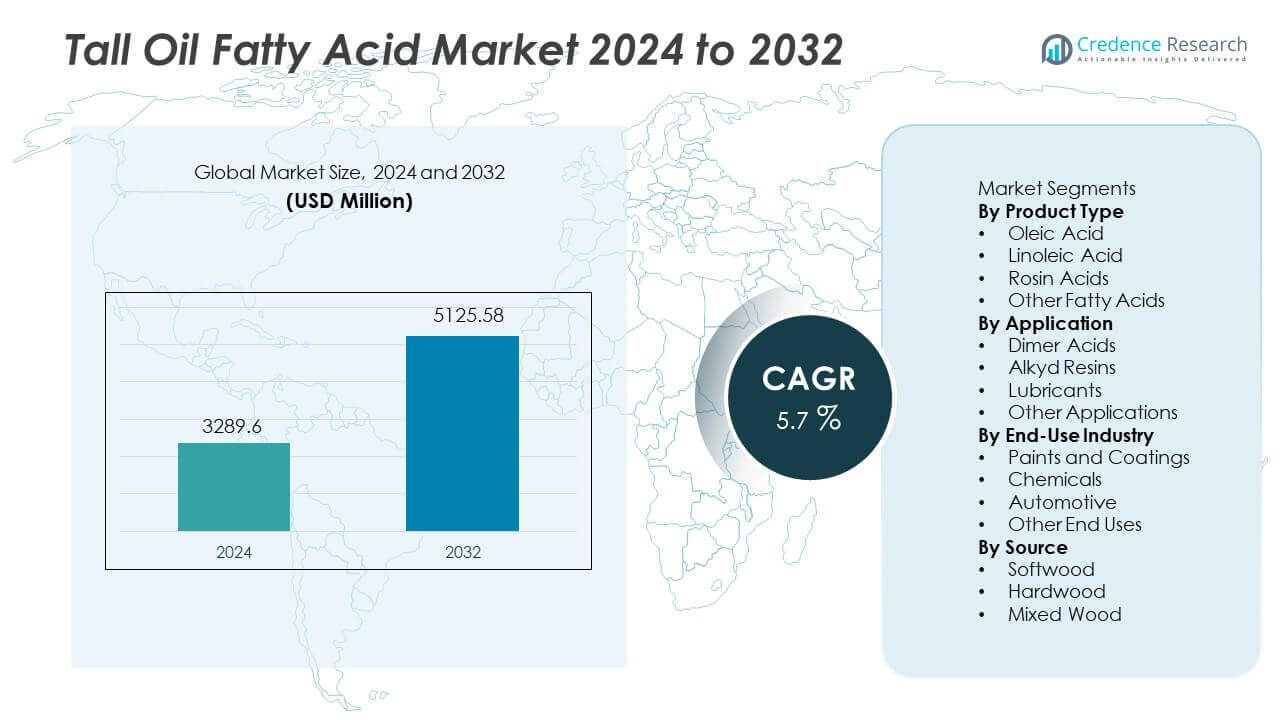
The global tall oil fatty acid market was valued at USD 3,289.6 million in 2024 and is projected to reach USD 5,125.58 million by 2032, expanding at a compound annual growth rate (CAGR) of 5.7% during the forecast period, according to Credence Research. This growth reflects rising adoption of bio-based chemical ingredients across coatings, lubricants, adhesives, surfactants, specialty chemicals and performance additive applications.
| REPORT ATTRIBUTE | DETAILS |
|---|---|
| Historical Period | 2020-2023 |
| Base Year | 2024 |
| Forecast Period | 2025-2032 |
| Tall Oil Fatty Acid Market Size 2024 | USD 3,289.6 million |
| Tall Oil Fatty Acid Market, CAGR | 5.7% |
| Tall Oil Fatty Acid Market Size 2032 | USD 5,125.58 million |
The global tall oil fatty acid market is characterized by the presence of pine chemical producers, specialty chemical manufacturers and refining technology providers competing on feedstock access, refining efficiency, fatty acid purity, sustainability credentials and downstream formulation performance. Leading players focus on oleic-rich grades, linoleic acid fractions, rosin acids, TOFA-based esters, alkyd resin inputs and high-purity derivatives for coatings, lubricants, adhesives and specialty chemical systems. Strategic priorities across the sector include crude tall oil refining capacity expansion, cleaner processing technologies, bio-based product development, high-performance derivatives, sustainable supply chains and deeper integration with resin, lubricant and specialty chemical customers.
Strategic Market Insights
- Market growth is primarily driven by rising demand for bio-based chemical inputs, expanding alkyd resin production and increasing use of TOFA-based esters in lubricants and performance additives.
- Dominant industry trends highlight innovation in specialty chemical formulations, higher adoption of high-purity TOFA grades and stronger use of tall oil-based derivatives across advanced coatings, adhesives, surfactants and industrial applications.
- The competitive landscape is defined by leading players investing in refining capacity, cleaner processing technologies, high-performance derivatives and renewable feedstock strategies to differentiate from petroleum-based alternatives.
- According to Credence Research regional mapping, North America represents the largest market, accounting for a definitive 41% share due to large-scale pulp and paper operations, consistent crude tall oil availability and mature downstream chemical industries.
Tall Oil Fatty Acid Market Segmentation Analysis
By Product Type
- Oleic Acid
- Linoleic Acid
- Rosin Acids
- Other Fatty Acids
Data compiled by Credence Research confirms that oleic acid constitutes the dominant product type, holding an estimated 42% market share. Its leadership is supported by strong demand from alkyd resin producers, lubricant formulators and specialty chemical manufacturers. Oleic-rich tall oil fatty acid grades offer broad compatibility with coating systems, adhesives, surfactants and industrial chemical formulations. Their reactive profile supports use in resin synthesis and performance additive production, helping manufacturers develop more sustainable alternatives to petroleum-derived ingredients.
Linoleic acid continues to gain traction in specialty chemical blends where reactivity and formulation flexibility are important. Rosin acids remain relevant in ink, adhesive and rubber processing applications, while other fatty acids serve niche areas requiring customized performance. Growth across product types aligns with increasing interest in renewable feedstocks, improved formulation efficiency and performance-driven resin and surfactant manufacturing.
Kraton Corporation supplies oleic-rich TOFA grades with high acid values and high iodine values, supporting reactive performance in alkyd resin applications where air-drying properties are important.
By Application
- Dimer Acids
- Alkyd Resins
- Lubricants
- Other Applications
Credence Research identifies alkyd resins as the leading application segment, accounting for approximately 47% of global market share. Alkyd resins dominate because tall oil fatty acids improve film formation, adhesion, gloss, drying behavior and durability in coatings, varnishes and industrial finishes. Coatings manufacturers use TOFA to support low-VOC and more sustainable resin systems while maintaining performance in architectural, industrial and automotive applications. Rising construction activity and infrastructure maintenance continue to increase demand for protective coatings that rely on reliable resin chemistry.
Dimer acids represent a key secondary application due to their role in polyamide resins, high-performance adhesives and specialty polymers. Lubricants also benefit from TOFA-based esters that deliver biodegradability, thermal stability and improved performance in metalworking fluids, hydraulic oils and gear lubricants. Other applications continue to gain momentum as industries replace petroleum-based additives with renewable ingredients.
Ingevity Corporation produces TOFA for alkyd resins with color below 6 on the Gardner scale, supporting viscosity stability across resin cooking temperatures exceeding 240 degrees Celsius.
By End-Use Industry
- Paints and Coatings
- Chemicals
- Automotive
- Other End Uses
Paints and coatings dominate the end-use industry segment with an estimated 39% market share. This leadership is driven by rising consumption of alkyd-based architectural coatings, industrial finishes, protective coatings and specialty paint systems. Manufacturers prefer tall oil fatty acids because they provide consistent quality, strong drying performance and improved coating durability. TOFA also supports sustainability goals in low-VOC formulations and bio-based coating systems.
The chemicals industry follows as a major consumer, using TOFA in esters, surfactants, intermediates, adhesives and specialty formulations. Automotive applications continue to expand through demand for high-performance lubricants, corrosion-resistant coatings and industrial process chemicals. Other end-use categories adopt TOFA as part of a broader shift toward renewable raw materials and improved environmental compliance. Credence Research indicates that paints and coatings will remain the central demand base due to strong integration with alkyd resin chemistry and ongoing coating formulation innovation.
Key Market Dynamics
Primary Market Drivers
Rising Demand for Bio-Based Chemicals
The market is expanding as industries shift from petrochemical feedstocks to renewable raw materials. Tall oil fatty acids support this transition through strong formulation performance, consistent quality and bio-based origin. Manufacturers in coatings, lubricants, adhesives, surfactants and specialty chemicals increasingly adopt TOFA to meet emission rules, carbon reduction goals and customer demand for sustainable ingredients. Corporate environmental, social and governance commitments also strengthen interest in renewable chemical inputs. Credence Research identifies the transition toward bio-based chemicals as a core driver of long-term TOFA demand. Forchem Oy produces tall oil fatty acids with acid values above 195 mg KOH/g and reports renewable carbon content exceeding 95 g per 100 g of product.
Expansion of Alkyd Resin and Industrial Coatings Production
Alkyd resin production remains a major growth driver because TOFA plays a critical role in improving resin drying, adhesion, flexibility and durability. These properties support wide use in architectural finishes, industrial coatings, varnishes, wood coatings and automotive applications. Rising construction activity, infrastructure maintenance and industrial upgrades increase demand for protective coatings with long service life. Manufacturers are also developing low-VOC and waterborne resin systems that rely on TOFA derivatives for performance. Eastman Chemical Company supplies TOFA feedstocks for alkyd resins with color below 5 on the Gardner scale, supporting high-quality coating formulation needs.
Growing Use in Lubricants and Performance Additives
TOFA-based esters are gaining momentum in synthetic and biodegradable lubricants because they support strong thermal stability, lubricity and environmental compliance. Industrial and automotive sectors use these formulations to enhance machinery efficiency, extend equipment life and reduce dependence on mineral oil-based inputs. Regulatory pressure on conventional lubricants further accelerates the shift toward renewable alternatives. Metalworking fluids, hydraulic oils, gear lubricants and performance additives increasingly incorporate TOFA-derived chemistry. Credence Research indicates that lubricant and additive applications will become an important growth outlet as industries prioritize cleaner, high-performance chemical systems.
Key Trends & Structural Opportunities
Advances in Specialty Chemical Formulations
The market is seeing rapid innovation as companies develop customized tall oil-based ingredients with enhanced reactivity, improved stability and better dispersibility for advanced applications. These innovations support growth in adhesives, surfactants, sealants, resins and performance additives. High-purity fatty acids and engineered derivatives are opening opportunities in electronics, personal care, specialty industrial chemicals and high-performance coating systems. The shift toward multifunctional and sustainable raw materials strengthens TOFA’s role in next-generation chemical formulations. Harima Chemicals Group refines tall oil fatty acids into high-purity grades containing a large proportion of fatty acids, with high iodine values supporting strong reactivity in specialty resins and chemical reactions.
Rising Adoption Across Emerging Economies
Emerging regions present strong opportunities due to industrialization, construction growth and rising demand for coatings, lubricants and specialty chemicals. Local manufacturers increasingly adopt TOFA to reduce dependence on petrochemical inputs and improve sustainability performance. Government policies supporting renewable materials and lower-emission products are encouraging adoption across paints, automotive, construction and chemical sectors. New resin, lubricant and specialty chemical production capacities are increasing regional consumption. Segezha Group produces tall oil fatty acids and supplies high-quality product for global resin producers and other customers, supporting broader downstream usage.
Growing Demand for TOFA-Based Esters and High-Purity Grades
TOFA-based esters and high-purity fatty acid grades are gaining traction across advanced coatings, lubricants, adhesives and specialty industrial applications. Customers increasingly require ingredients with consistent quality, tighter specifications and reliable performance across demanding processing conditions. High-purity grades support better formulation control and improved end-product properties. This trend creates opportunities for producers that can invest in advanced refining, purification and derivative production. Credence Research identifies high-performance derivative development as a key opportunity for suppliers seeking stronger margins and improved differentiation from commodity fatty acid products.
Industry Challenges
Fluctuations in Raw Material Supply
Raw material supply remains a major challenge because TOFA production depends on crude tall oil output from the pulp and paper industry. Seasonal changes, mill shutdowns, wood processing variations and shifts in pulp production affect availability and pricing. Supply instability forces manufacturers to manage inventories carefully and develop multi-source procurement strategies. Limited regional production also increases import dependence in several markets, exposing buyers to logistics delays and price volatility. These constraints create uncertainty for downstream chemical producers that require consistent supply for coatings, adhesives, lubricants and specialty formulations.
Competition from Petroleum-Based and Synthetic Alternatives
The tall oil fatty acid market faces strong competition from low-cost petrochemical fatty acids and synthetic additives. These alternatives often provide consistent quality, predictable supply and lower prices in cost-sensitive applications such as coatings, lubricants, surfactants and adhesives. End users compare performance, pricing and sustainability benefits before switching to bio-based alternatives. Producers must clearly demonstrate TOFA’s renewable origin, formulation performance and lifecycle benefits to defend market share. This competitive landscape pushes suppliers to innovate, improve product quality and develop high-value derivatives for advanced applications.
Detailed Regional Analysis
| Region | Market Share (%) | Strategic Regional Catalysts & Insights |
| North America | 41.0% | Global leader. Driven by strong pulp and paper production, consistent crude tall oil supply, mature coatings and lubricant industries and established specialty chemical manufacturing. |
| Europe | 32.0% | Mature regional market. Supported by strict environmental policies, Nordic crude tall oil production, strong bio-based chemical adoption and demand for low-VOC coatings and renewable additives. |
| Asia Pacific | 19.0% | High-growth regional market. Powered by rapid industrialization, construction growth, automotive manufacturing and rising demand for coatings, lubricants and specialty chemicals. |
| Latin America | 5.0% | Developing regional market. Driven by growing use in coatings, adhesives and industrial lubricants, with demand supported by Brazil and Chile. |
| Middle East & Africa | 3.0% | Emerging territory. Supported by industrial lubricants, construction coatings, specialty chemicals and downstream chemical investment across the Gulf and African manufacturing hubs. |
North America leads the global tall oil fatty acid market with a 41% share, according to Credence Research. The region benefits from strong pulp and paper production, consistent crude tall oil supply and well-established chemical manufacturing. High adoption across coatings, lubricants, adhesives and specialty chemicals supports regional leadership. Paints and coatings producers continue to expand alkyd resin use across construction and industrial applications. Industrial modernization and rising demand for bio-based materials further strengthen consumption. Supportive sustainability regulations encourage wider use of renewable feedstocks, positioning North America as the primary hub for TOFA processing and downstream chemical development.
Europe holds a 32% share of the global tall oil fatty acid market, supported by strong environmental regulations, advanced specialty chemical industries and high uptake of bio-based raw materials. The region’s coatings and adhesive manufacturers rely on TOFA for performance-driven alkyd resins and eco-friendly additives. Nordic countries support steady crude tall oil production, ensuring reliable supply for regional processors. Growth in renewable lubricants, industrial cleaners and low-VOC formulations enhances market penetration. Regulations focused on carbon reduction and circular economy principles continue to accelerate adoption across end-use sectors.
Asia Pacific accounts for a growing 19% share of the global market. Rapid industrialization, construction activity and expanding automotive manufacturing in China, India and Southeast Asia are increasing demand for coatings, lubricants and specialty chemicals. Manufacturers across the region adopt TOFA to diversify feedstocks and improve sustainability performance. The region imports much of its crude tall oil, creating opportunities for local chemical processors and distributors. Infrastructure development, industrial machinery growth and automotive production support demand for TOFA-based esters and performance additives. Asia Pacific is expected to remain a high-potential growth market.
Competitive Landscape & Recent Developments
The tall oil fatty acid market is moderately consolidated, with competition shaped by crude tall oil access, refining technology, derivative portfolios and sustainability positioning. Key players include Kraton Corporation, Georgia-Pacific Chemicals, Forchem Oy, Harima Chemicals Group, Arizona Chemical, Eastman Chemical Company, Ingevity Corporation, Segezha Group, OOO Torgoviy Dom Lesokhimik and Resitol Chemical Industry. These companies compete through process efficiency, high-purity fatty acid grades, bio-based chemical production and integration with downstream resin, lubricant and specialty chemical customers.
Market leaders focus on enhancing crude tall oil refining capacity and developing performance-driven fatty acid grades for coatings, adhesives, lubricants, surfactants and specialty intermediates. Partnerships with coatings, adhesives and lubricant manufacturers strengthen integrated supply chains. The competitive environment also emphasizes sustainability, with players adopting cleaner processing technologies and renewable feedstock strategies to align with customer expectations. Innovation in specialty derivatives, energy-efficient production and emerging market expansion continues to support competitive positioning.
Recent Industry Developments (2025)
- In June 2025, Forchem Oy appointed a new supply chain director, supporting supply operations in biofuels and related products, including tall oil fatty acid.
- In 2025, Harima Chemicals Group continued development of resins and adhesives using tall oil fatty acids as key inputs.
- In 2025, Kraton Corporation, which acquired Arizona Chemical in 2016, remained a major TOFA supplier under the Kraton brand, maintaining and expanding its bio-renewable product focus derived from pine chemicals.

Request a Free Sample
Fill in your details and we'll send you a free sample report.
- Sample data tables & charts
- Research methodology
Need a Custom Version of This Report?
Tailor the scope, geography, or segments to your exact requirements.
- Custom geography or segment scope
- Direct access to our analyst team
Frequently Asked Questions
What is the current and projected size of the global tall oil fatty acid market?
What is the projected growth rate of the tall oil fatty acid industry over the forecast period?
Which product type holds the maximum market share within the tall oil fatty acid industry?
Which application segment dominates the tall oil fatty acid market?
Which end-use industry leads the tall oil fatty acid market?
Which region commands the highest market share in the global tall oil fatty acid space?
Table of Content
Chapter 1 Market Segmentation
- 1.1 Segmentation Framework
- 1.1.1 Product and Service Classification
- 1.1.2 Application and End-Use Classification
- 1.1.3 Technology and Solution Classification
- 1.1.4 Customer and Distribution Channel Classification
- 1.1.5 Geographic Segmentation
- 1.1.6 Market Segment Definitions and Boundaries
Chapter 2 Introduction
- 2.1 Report Objectives and Scope
- 2.2 Product Definition and Industry Terminology
- 2.3 Market Inclusions and Exclusions
- 2.4 Research Process
- 2.4.1 Primary Research and Expert Interviews
- 2.4.2 Secondary Research and Source Review
- 2.4.3 Top-Down and Bottom-Up Estimation
- 2.4.4 Data Triangulation and Verification
- 2.5 Market Size Measurement Basis
- 2.5.1 2024: USD 3,289.6 million → 2032: USD 5,125.58 million
- 2.6 Historical and Forecast Reference Periods
- 2.6.1 Base Year: 2024
- 2.6.2 Forecast Period: 2024-2032
- 2.7 Research Assumptions and Limitations
Chapter 3 Executive Summary
- 3.1 Market Snapshot and Key Findings
- 3.2 Base-Year Market Size, 2024
- 3.3 Forecast Market Size, 2032
- 3.4 Revenue and Volume Growth Outlook
- 3.5 Key Demand and Supply Indicators
- 3.6 Leading Market Segments
- 3.7 Fastest-Growing Market Opportunities
- 3.8 Regional Performance Highlights
- 3.9 Technology and Industry Transformation
- 3.10 Competitive Landscape Summary
- 3.11 Analyst View and Strategic Implications
Chapter 4 Global Tall Oil Fatty Acid Market Trends and Developments
- 4.1 Historical Industry Development
- 4.2 Recent Market Trends and Developments
- 4.3 Demand and Customer Behavior Trends
- 4.4 Technology and Product Innovation
- 4.5 Artificial Intelligence, Automation and Digitalization
- 4.6 Local Manufacturing and Supply Chain Realignment
- 4.7 Industry Partnerships, Mergers and Acquisitions
- 4.8 Sustainability and Circular Economy Developments
- 4.9 Government and Private Sector Investment Trends
- 4.10 Emerging Business Models and Commercialization
- 4.11 Industry Developments and Announcements
Chapter 5 Global Tall Oil Fatty Acid Market Production, Supply and Demand Analysis
- 5.1 Demand Trend and Consumption Analysis
- 5.2 Demand Forecast, 2024-2032
- 5.3 Production and Output Trend
- 5.4 Production and Output Forecast, 2024-2032
- 5.5 Installed Capacity and Capacity Utilization
- 5.6 Company-Wise Production Plants and Statistics
- 5.6.1 Installed Production Capacity
- 5.6.2 Actual Production
- 5.6.3 Planned Capacity and Expansion Targets
- 5.7 Supply Chain Structure and Procurement Trends
- 5.8 Supply-Demand Gap and Bottlenecks
- 5.9 Import Dependence and Sourcing Structure
- 5.10 Contract Manufacturing and Outsourcing
- 5.11 Regional Supply and Demand Concentration
Chapter 6 Global Tall Oil Fatty Acid Market Pricing Analysis
- 6.1 Pricing Structure and Measurement
- 6.2 Historical Pricing Trends
- 6.3 Pricing Outlook, 2024-2032
- 6.4 Average Selling Price and Unit Economics
- 6.5 Pricing by Product and Market Segment
- 6.6 Geographic Pricing Differences
- 6.7 Key Input, Energy, Labor and Logistics Costs
- 6.8 Contract Pricing and Purchasing Models
- 6.9 Pricing Sensitivity and Competitive Positioning
- 6.10 Price, Margin and Profitability Implications
Chapter 7 Global Tall Oil Fatty Acid Market Dynamics
- 7.1 Market Growth Drivers
- 7.1.1 Demand-Side Drivers
- 7.1.2 Technology and Innovation Drivers
- 7.1.3 Infrastructure and Investment Drivers
- 7.1.4 Regulatory and Policy Drivers
- 7.2 Market Restraints
- 7.2.1 Cost and Affordability Constraints
- 7.2.2 Technology and Adoption Barriers
- 7.2.3 Supply Chain and Operational Constraints
- 7.3 Market Challenges
- 7.3.1 Competitive Pressure and Margin Erosion
- 7.3.2 Skills, Infrastructure and Implementation Gaps
- 7.4 Emerging Market Opportunities
- 7.5 Market Dynamics Impact and Time-Horizon Assessment
Chapter 8 Global Tall Oil Fatty Acid Value Chain Analysis
- 8.1 Industry Value Chain Overview
- 8.2 Upstream Suppliers and Critical Inputs
- 8.3 Technology and Component Providers
- 8.4 Manufacturing or Service Delivery
- 8.5 Distribution, Channel Partners and Integrators
- 8.6 Downstream Applications and End Users
- 8.7 Value Addition and Profit Pools
- 8.8 Vertical Integration and Outsourcing
- 8.9 Supplier Concentration and Risk
- 8.10 Supply Chain Localization and Resilience
Chapter 9 Global Tall Oil Fatty Acid Market Regulations and Policies
- 9.1 Relevant Laws, Standards and Compliance Frameworks
- 9.2 Product, Service, Safety and Quality Requirements
- 9.3 Government Policies, Incentives and Subsidies
- 9.4 Imports, Exports and Trade Barriers
- 9.5 Public Procurement and Local Content Requirements
- 9.6 Environmental and Sustainability Compliance
- 9.7 Upcoming Policy Changes and Market Implications
Chapter 10 Global Tall Oil Fatty Acid Market Hotspots and Opportunities
- 10.1 Market Opportunity Mapping and Growth Hotspots
- 10.2 High-Growth Applications and Customer Groups
- 10.3 Underserved Markets and White-Space Opportunities
- 10.4 Emerging Technology and Product Opportunities
- 10.5 New Capacity and Investment Hotspots
- 10.6 Market Entry and Expansion Opportunities
- 10.7 Distribution and Partnership Opportunities
- 10.8 Near-Term and Long-Term Commercial Potential
- 10.9 Opportunity Attractiveness and Execution Risks
Chapter 11 Global Tall Oil Fatty Acid Market Outlook, 2024-2032
- 11.1 Market Size and Analysis
- 11.1.1 Revenue (Market Measurement: 2024: USD 3,289.6 million → 2032: USD 5,125.58 million)
- 11.1.2 Market Volume and Quantity Sold
- 11.1.3 Historical Market Size
- 11.1.4 Base-Year Market Size, 2024
- 11.2 Market Forecast, 2024-2032
- 11.2.1 Revenue Forecast to 2032
- 11.2.2 Volume Forecast to 2032
- 11.2.3 CAGR and Year-on-Year Growth
- 11.2.4 Incremental Revenue Opportunity
- 11.3 Forecast Assumptions and Scenario Analysis
- 11.3.1 Base-Case Forecast
- 11.3.2 Optimistic and Conservative Scenarios
- 11.3.3 Technology, Pricing and Policy Sensitivities
- 11.4 Market Attractiveness and Growth Outlook
Chapter 12 Global Tall Oil Fatty Acid Market Segmentation and Outlook
- 12.1 Segmentation Summary and Market Shares, 2024
- 12.2 Largest and Fastest-Growing Segments
- 12.3 Segment Growth Comparison
- 12.4 Segment Attractiveness and Priority Matrix
Chapter 13 Global Tall Oil Fatty Acid Geographic Market Outlook, 2024-2032
- 13.1 Regional Market Size and Share, 2024
- 13.2 Regional Market Forecast, 2024-2032
- 13.3 Regional Pricing, Production and Demand Differences
- 13.4 North America
- 13.4.1 United States
- 13.4.2 Canada
- 13.4.3 Mexico
- 13.5 Europe
- 13.5.1 Germany
- 13.5.2 France
- 13.5.3 Italy
- 13.5.4 United Kingdom
- 13.5.5 Spain
- 13.5.6 Poland
- 13.5.7 Russia
- 13.5.8 Netherlands
- 13.5.9 Belgium
- 13.5.10 Sweden
- 13.5.11 Denmark
- 13.5.12 Norway
- 13.5.13 Rest of Europe
- 13.6 Asia Pacific
- 13.6.1 China
- 13.6.2 India
- 13.6.3 Japan
- 13.6.4 South Korea
- 13.6.5 Thailand
- 13.6.6 Indonesia
- 13.6.7 Vietnam
- 13.6.8 Malaysia
- 13.6.9 Australia
- 13.6.10 Rest of Asia Pacific
- 13.7 Latin America
- 13.7.1 Brazil
- 13.7.2 Argentina
- 13.7.3 Colombia
- 13.7.4 Chile
- 13.7.5 Rest of Latin America
- 13.8 Middle East
- 13.8.1 Saudi Arabia
- 13.8.2 United Arab Emirates
- 13.8.3 Turkey
- 13.8.4 Israel
- 13.8.5 Iran
- 13.8.6 Rest of the Middle East
- 13.9 Africa
- 13.9.1 South Africa
- 13.9.2 Egypt
- 13.9.3 Nigeria
- 13.9.4 Morocco
- 13.9.5 Rest of Africa
- 13.10 Regional Investment, Policy and Supply Chain Differences
- 13.11 Regional Competitive Landscape
- 13.12 Geographic Growth Hotspots
Chapter 14 Global Tall Oil Fatty Acid Technology, Innovation and Sustainability Outlook
- 14.1 Technology Landscape and Maturity
- 14.2 Product, Process and Service Innovation
- 14.3 AI, Automation and Digital Tools in the Industry
- 14.4 Technology Adoption and Performance Benchmarking
- 14.5 Innovation Pipeline and R&D Investment
- 14.6 Patent and Intellectual Property Trends
- 14.7 Energy Efficiency and Resource Management
- 14.8 Sustainability, Recycling and Circularity
- 14.9 Technology Roadmap, 2024-2032
- 14.10 Risks of Obsolescence and Technology Substitution
Chapter 15 Global Tall Oil Fatty Acid Market Key Strategic Imperatives
- 15.1 Growth and Market Entry Priorities
- 15.2 High-Return Products and Segments
- 15.3 Pricing, Profitability and Cost Optimization
- 15.4 Technology Investment and Product Differentiation
- 15.5 Supply Chain Localization and Resilience
- 15.6 Distribution and Customer Acquisition
- 15.7 Partnership, Acquisition and Capacity Strategy
- 15.8 Regional Expansion Priorities
- 15.9 Short-, Medium- and Long-Term Actions
Chapter 16 Competition Outlook
- 16.1 Industry Competition Characteristics
- 16.2 Market Structure and Concentration
- 16.3 Market Share and Competitive Positioning, 2024
- 16.4 Company-Wise Revenue and Product Benchmarking
- 16.5 Production and Service Capacity Benchmarking
- 16.6 Technology, Pricing and Differentiation
- 16.7 Regional Footprint and Distribution Strength
- 16.8 Mergers, Acquisitions and Strategic Alliances
- 16.9 New Entrants and Competitive Threats
- 16.10 Porter's Five Forces and Industry Attractiveness
- 16.11 Competitive Outlook, 2024-2032
Chapter 17 Company Profiles
- 17.1 Company Coverage and Selection Criteria
- 17.2 Leading Market Participants – Standard Profile Structure
- 17.2.1 Business Description
- 17.2.2 Company Ownership and Geographic Presence
- 17.2.3 Product and Service Portfolio
- 17.2.4 Manufacturing and Operating Footprint
- 17.2.5 Production Capacity and Expansion Plans
- 17.2.6 Financial Performance and Investment
- 17.2.7 Market Share and Competitive Position
- 17.2.8 Technology and Innovation Capabilities
- 17.2.9 Strategic Alliances or Partnerships
- 17.2.10 Recent Developments
- 17.2.11 Growth Strategy and Outlook
- 17.3 Other Relevant Market Participants
Note: Every listed company is profiled on the structure shown under the first company. The company list is preliminary and may change based on research findings, market developments, data availability and client requirements.
Chapter 18 Disclaimer
- 18.1 Research and Forecast Disclaimer
- 18.2 Data Source and Estimation Limitations
Note: The depth of individual sections depends on data availability for this market. Volume, capacity, trade and other unit-based metrics are included where applicable.