
Registration rules and care reform shape clinical education
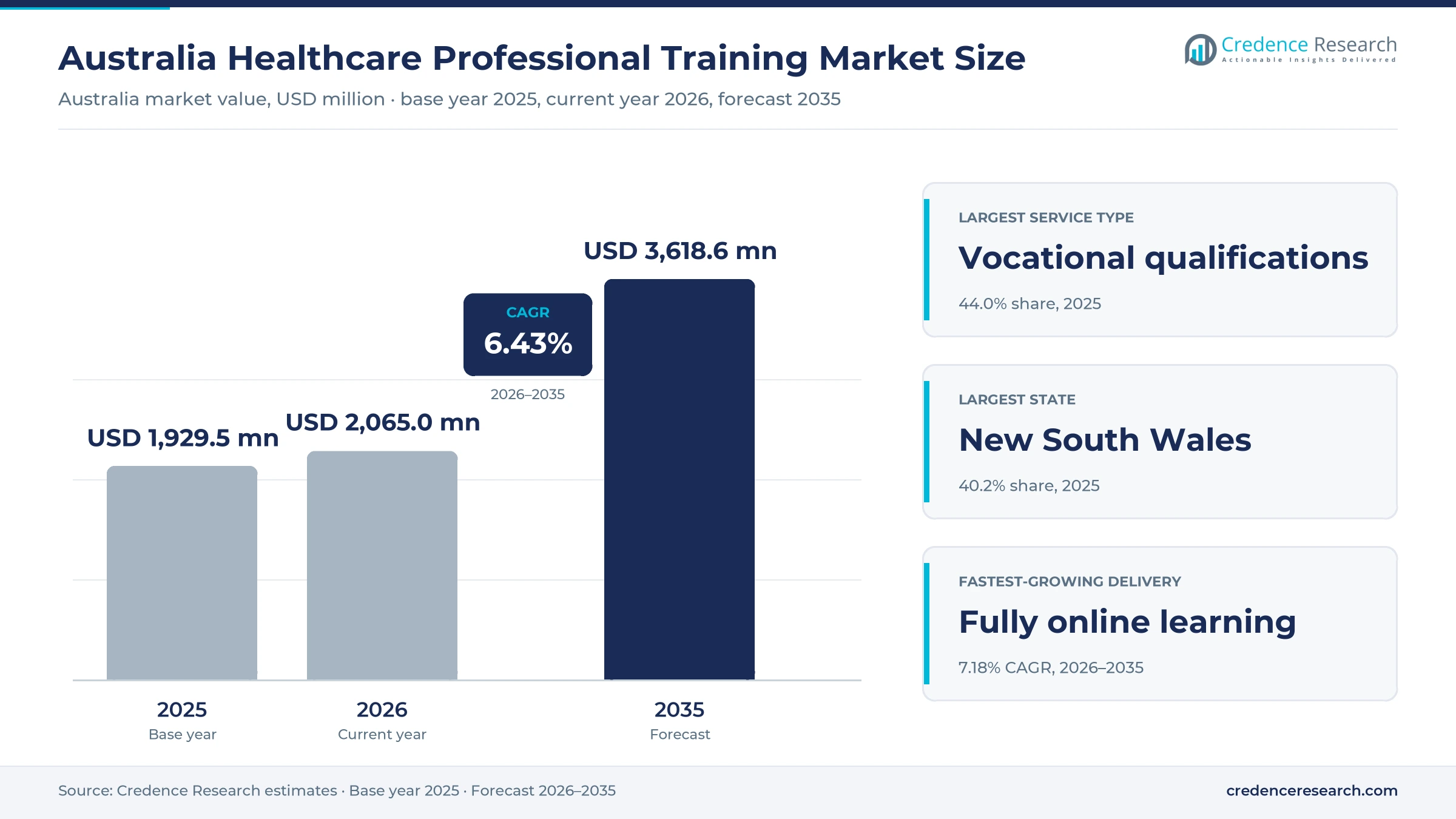
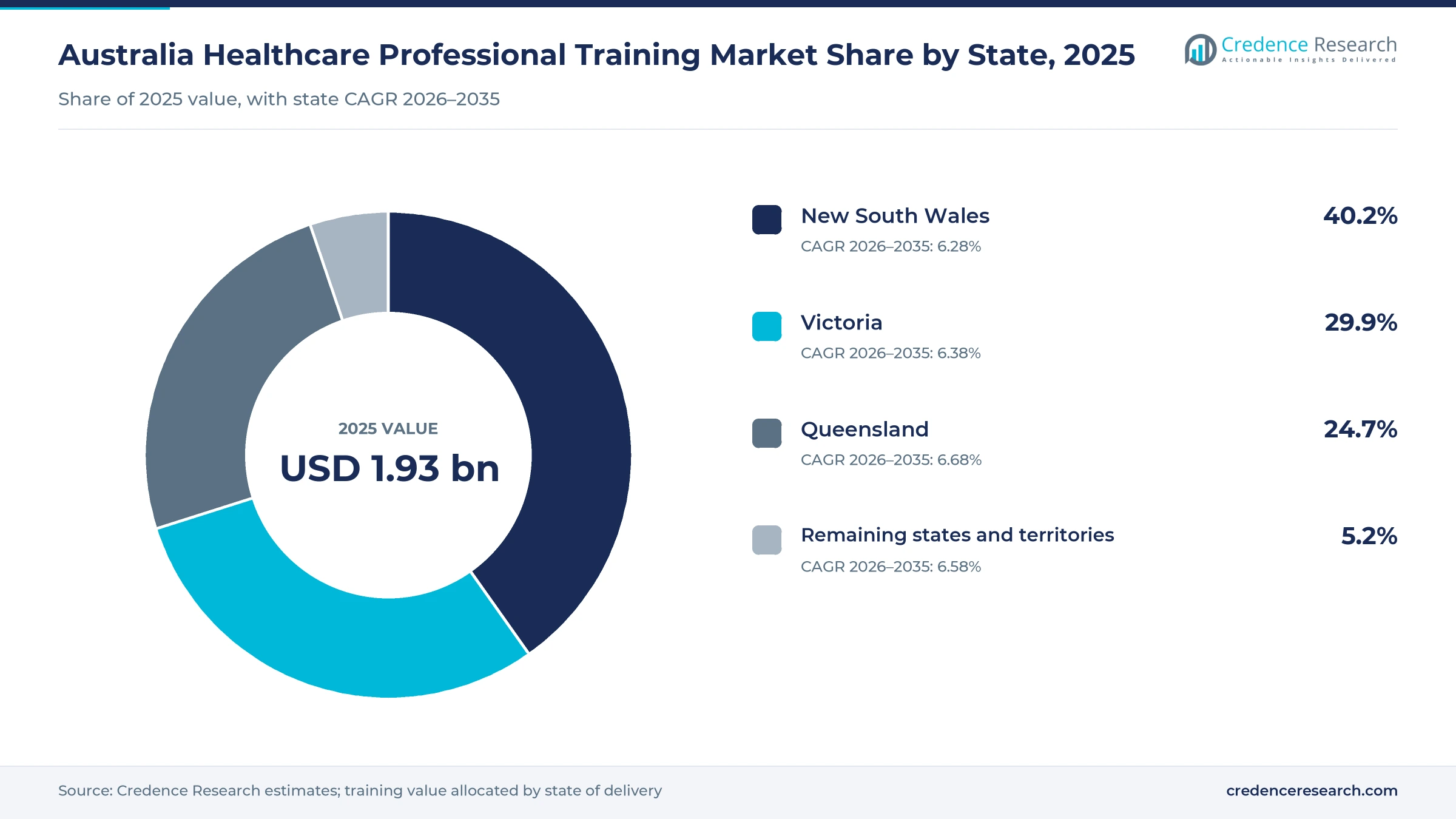
The Australia healthcare professional training market was valued at USD 1.93 billion in 2025 and is projected to increase from USD 2.06 billion in 2026 to USD 3.62 billion by 2035, registering a CAGR of 6.43% during 2026–2035. Demand comes from nurses, midwives, allied health workers, care staff and doctors who must complete entry qualifications and yearly continuing professional development to keep their registration. New South Wales held the largest state share, 40.2% in 2025, because it has the largest health workforce and the biggest public vocational and health service education networks. Queensland is the fastest-growing state at 6.68% a year, as population growth lifts hiring in hospitals and aged care. Public vocational institutes, independent colleges, professional bodies and online platforms all compete for learners and employer contracts. The new Aged Care Act, which started on Nov. 1, 2025, also raised competency expectations for care workers and the providers that employ them.
Which clinical education services does the estimate cover?
The estimate measures spending on vocational health qualifications, continuing professional development courses, contract clinical education for employers and online learning platform licences in Australia. It covers learners in nursing and midwifery, allied health, care and support work and medicine, whether they pay themselves or their employer pays. Values include course fees, training contracts, subscriptions and sponsorship received by education providers.
The estimate excludes university entry-level medical degrees funded through Commonwealth supported places, general school and university courses outside health, and the wages of staff while they learn. The value chain runs from content developers and accrediting bodies through public institutes, independent colleges, professional bodies and online platforms to individual clinicians, hospitals, aged care providers and community health services.
Australia Healthcare Professional Training Market Insights
- The Australia healthcare professional training market was valued at USD 1.93 billion in 2025 and is projected to reach USD 3.62 billion by 2035, registering a CAGR of 6.43% during 2026–2035.
- New South Wales held a 40.2% share of 2025 value, because it has the largest health workforce and public education networks.
- Vocational health qualifications led with a 44.0% share of 2025 value, because diplomas and certificates are the entry route into nursing and care work.
- Australia had 959,858 registered health practitioners at June 30, 2025, up 4.3% over the year, and each must meet yearly education requirements.
- The Commonwealth Prac Payment of $331.65 a week started on July 1, 2025 for nursing and midwifery students on mandatory placements.
Vocational courses lead while platform licences grow fastest
Why do vocational health qualifications lead spending?
Based on service type, the market is categorized into vocational health qualifications, professional development programmes, contract clinical training and learning platform licences. Vocational health qualifications led with a 44.0% share of 2025 value, because diplomas and certificates are the main entry route into enrolled nursing and care work. Learning platform licences grow fastest at 7.75% a year, as hospitals and aged care providers buy online libraries for whole teams.
How do nursing learners and care staff shape demand?
Based on learner segment, the market is categorized into nursing and midwifery learners, allied health learners, care and support learners, and medical and specialist learners. Nursing and midwifery learners led with a 36.0% share of 2025 value, because nurses are the largest registered profession. Care and support learners grow fastest at 6.75% a year, as aged care providers train staff for new quality standards.
Why is fully online learning growing fastest?
Based on delivery model, the market is categorized into face-to-face classroom, blended learning, fully online learning and simulation-based learning. Face-to-face classroom led with a 34.0% share of 2025 value, because practical skills and accredited qualifications still need in-person teaching. Fully online learning grows fastest at 7.18% a year, as clinicians complete yearly education hours around shift work.
How do public institutes compete with independent providers?
Based on institution type, the market is categorized into public vocational institutes, independent education businesses, professional and higher education institutions, and health service education institutes. Public vocational institutes led with a 40.0% share of 2025 value, because fee-free places draw many care and nursing students. Professional and higher education institutions grow fastest at 7.01% a year, as graduate certificates and micro-credentials gain demand.
| Segment Group | Leading Sub-segment | Share, 2025 | Fastest-growing Sub-segment | CAGR, 2026–2035 |
|---|---|---|---|---|
| By Service Type | Vocational health qualifications | 44.0% | Learning platform licences | 7.75% |
| By Learner Segment | Nursing and midwifery learners | 36.0% | Care and support learners | 6.75% |
| By Delivery Model | Face-to-face classroom | 34.0% | Fully online learning | 7.18% |
| By Institution Type | Public vocational institutes | 40.0% | Professional and higher education institutions | 7.01% |
Request a Free Sample
Fill in your details and we'll send you a free sample report.
- Sample data tables & charts
- Research methodology
CPD rules, funded pathways and aged care reform lift demand
How do recurring CPD requirements sustain demand?
Recurring professional development requirements sustain demand, because every registered clinician must complete education hours each year to keep practicing. Australia had 959,858 registered health practitioners at June 30, 2025, up 4.3% over the year, according to Ahpra. Registered nurses, enrolled nurses and midwives must complete at least 20 hours of CPD each year, while nurse practitioners need 30 hours, according to the Nursing and Midwifery Board. Doctors have needed 50 hours a year through an accredited CPD home since Jan. 1, 2023, with at least 25 hours on reviewing performance and measuring outcomes. As a result, professional development programmes form a large and recurring part of 2025 value.
Why do publicly supported clinical pathways widen enrolment?
Publicly supported clinical workforce pathways widen enrolment, because they lower the cost of entering nursing and care careers. The federal government introduced the Commonwealth Prac Payment of $331.65 a week on July 1, 2025 for nursing and midwifery students on mandatory placements, according to the Department of Education. The Free TAFE program funds more than 500,000 places from 2023 to 2026, with care listed as a national priority area. The Free TAFE Act 2025 also guarantees at least 100,000 places a year from 2027. In turn, vocational health qualifications hold a 44.0% share of 2025 value, as public institutes enroll more diploma and certificate students.
How does aged care competency reform lift training spend?
Aged care competency and quality reform lifts training spending, because providers must prove their staff have the right skills under new rules. The new Aged Care Act and strengthened Aged Care Quality Standards started on Nov. 1, 2025, after the start was deferred from July 1, 2025, according to the Aged Care Quality and Safety Commission. Infection prevention leads without specialist training must also complete an interim course on the Alis platform. From April 2026, metropolitan residential providers receive full funding only if they meet care minutes targets. As a result, care and support learners grow at 6.75% a year, as providers of aged care services fund competency programs.
Why does workforce growth expand the learner base?
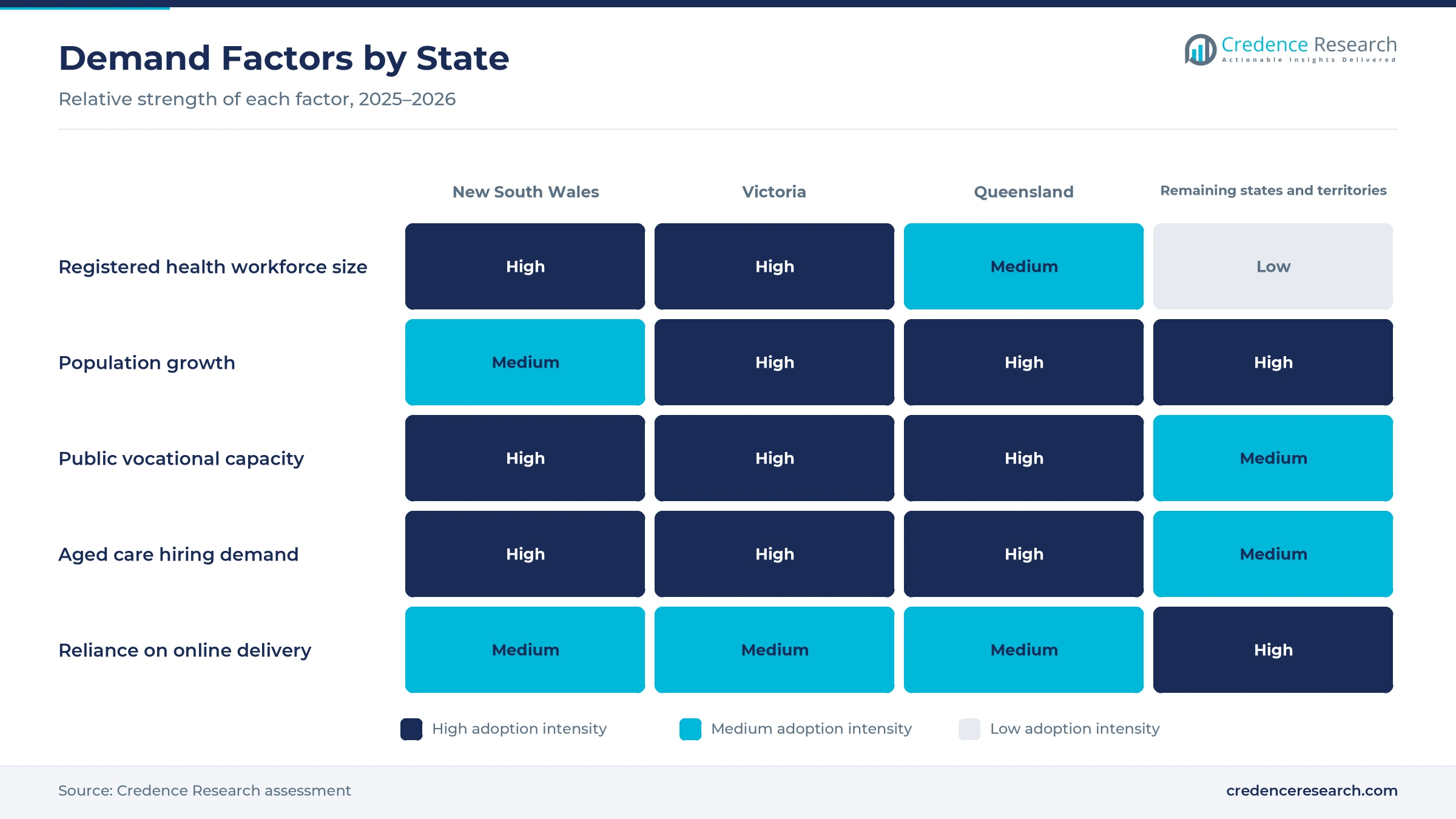
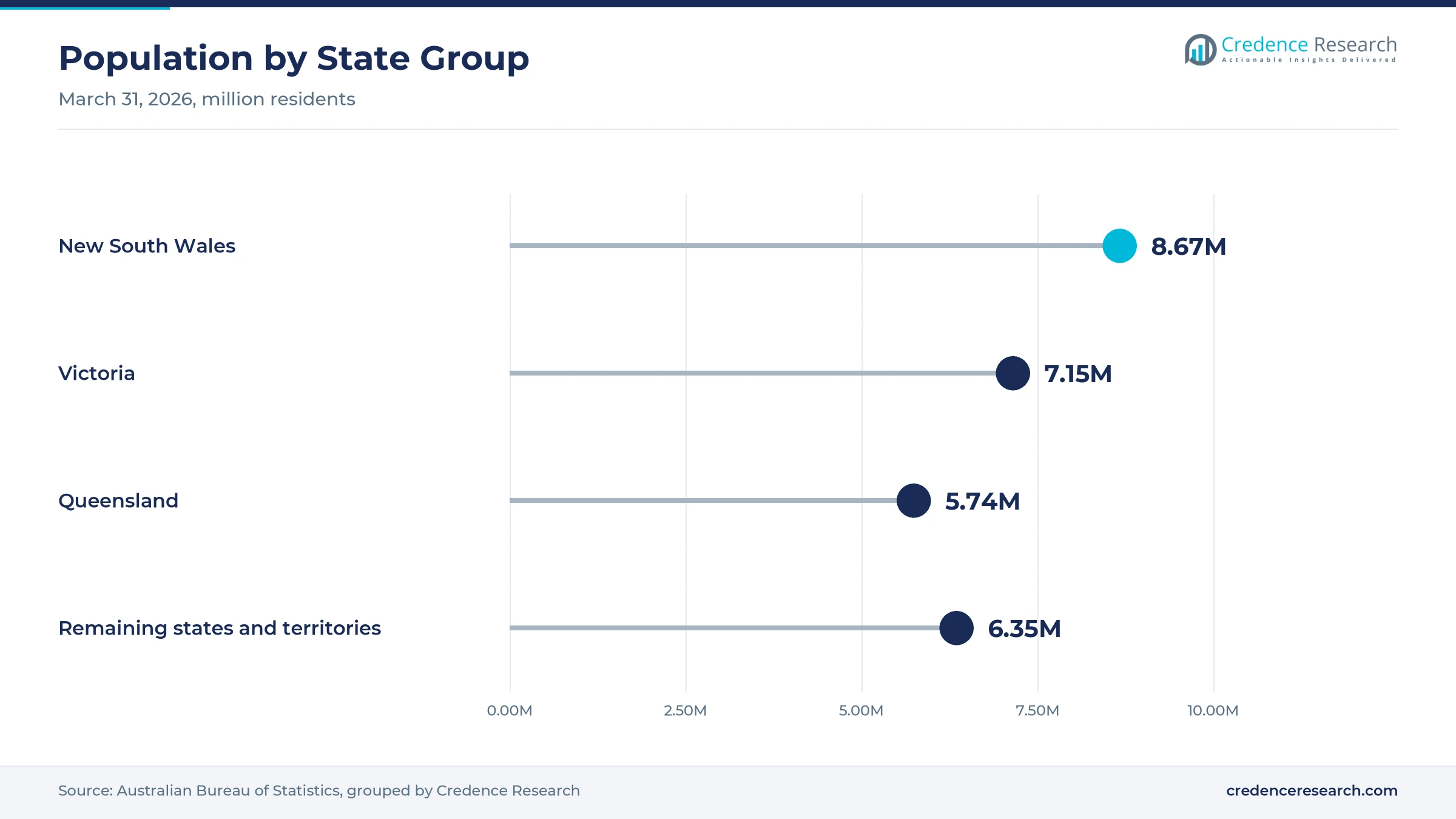
Workforce growth expands the learner base, because new registrants need transition programs and existing staff need upskilling as demand for care rises. Australia had 13.45 nurses and midwives per 1,000 people in 2022, according to World Bank data, which shows the scale of the nursing workforce that must keep learning. Ahpra recorded 69,880 first-time registrants in 2024-25, including more than 26,000 from overseas. The Australian Bureau of Statistics reported a population of 27.92 million at March 31, 2026, up 1.4% over the year. In turn, Queensland records the fastest state growth in the forecast, as hospitals and aged care homes hire more staff.
Online CPD and simulation reshape how clinicians learn
How is the rise of online CPD platforms changing learning?
The rise of online CPD platforms is changing how clinicians learn, because short modules and digital portfolios fit around shift work. Ausmed offers more than 1,000 evidence-based resources through a subscription that includes a personal CPD portfolio. The Health Education and Training Institute provides more than 2,500 eLearning resources to NSW Health staff through My Health Learning. Healthed also runs an online CPD platform with podcasts and records alongside its seminars for general practitioners. As a result, fully online learning grows at 7.18% a year, the fastest delivery rate, as providers expand e-learning libraries for nurses, doctors and care staff.
Why is the shift to simulation and scenario learning gaining ground?
The shift to simulation and scenario learning is gaining ground, because clinicians must show practical skills in emergencies that are rare on the ward. Medcast delivers nationally accredited basic, advanced and pediatric life support courses with collaborative scenario-based learning led by resuscitation experts. The Health Education and Training Institute runs immersive programs alongside its eLearning modules and workshops. Since Jan. 1, 2023, doctors must also spend at least 25 of their 50 yearly CPD hours on reviewing performance and measuring outcomes, which favors hands-on assessment and team drills. In turn, simulation-based learning grows faster than classroom teaching, as hospitals invest in clinical simulation suites and manikins.
Can bridging programs for overseas clinicians open new demand?
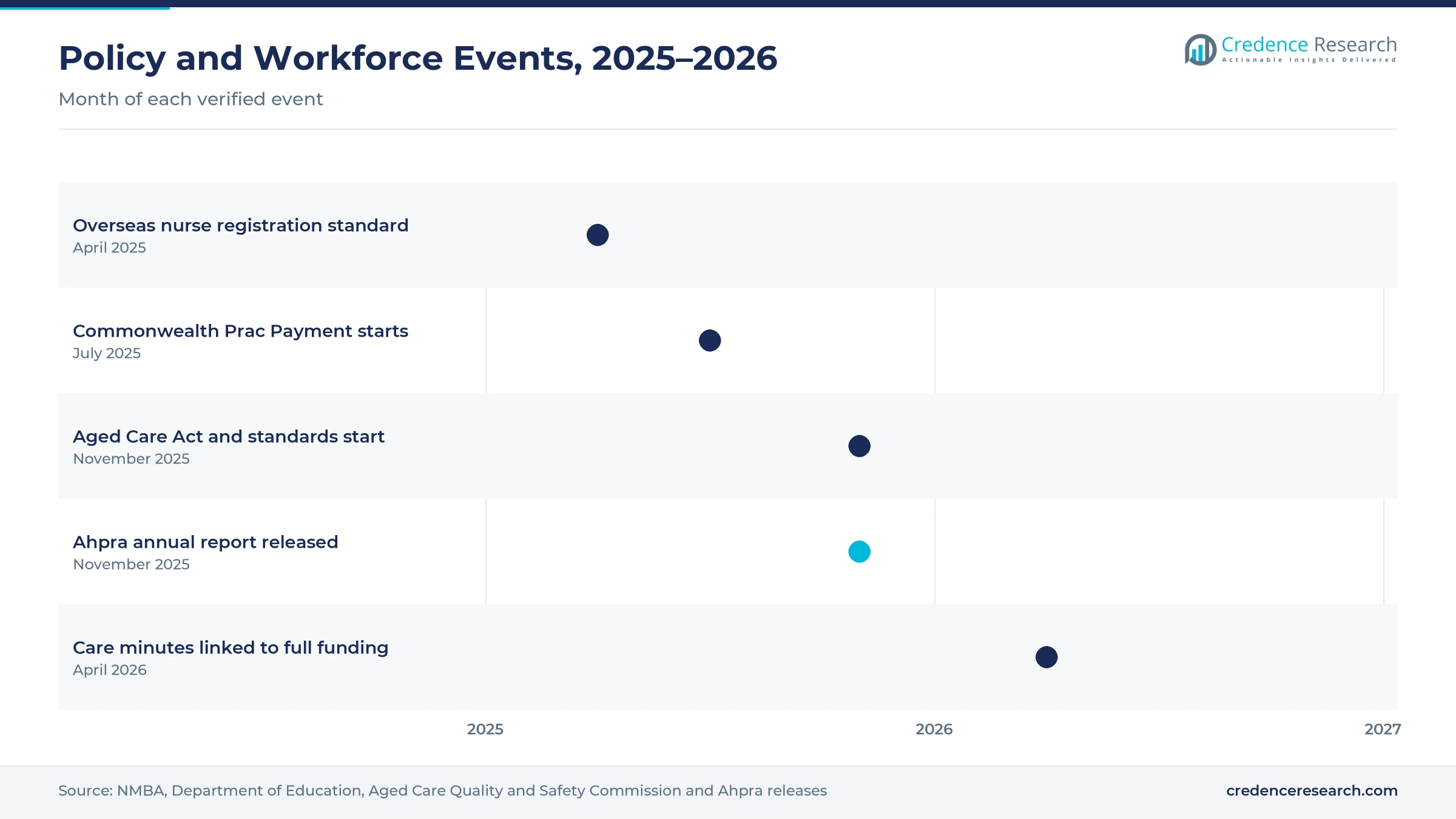
Bridging programs for overseas clinicians open new demand, because internationally qualified staff must learn local practice, law and culture before working safely. The Nursing and Midwifery Board introduced a new registration standard for internationally qualified registered nurses that came into effect on April 23, 2025. Ahpra recorded more than 26,000 first-time registrants from overseas in 2024-25, out of 69,880 new registrants in total. The Australian College of Nursing offers transition to practice, refresher and nursing re-entry courses for these learners. As a result, professional and higher education institutions grow at 7.01% a year, the fastest institution rate, as bridging and graduate certificate demand rises.
Is there room for micro-credentials and employer platform licences?
Micro-credentials and employer platform licences create room for growth, because employers want short, targeted programs they can assign and track across whole teams. The Australian College of Nursing offers microcredential courses, graduate certificates and a dedicated online CPD service for nurses. TAFE Queensland also lists short courses and micro-credentials alongside its full qualifications. Aged care providers must now prove staff competency under standards that started on Nov. 1, 2025, which raises demand for tracked and auditable training records. In turn, learning platform licences grow at 7.75% a year, the fastest service rate, as employers link courses to learning management systems and compliance reports.
Placement shortages, staff time and costs test providers
How do clinical placement shortages limit enrolment?
Clinical placement shortages limit enrolment, because every nursing and care student must complete supervised hours in hospitals or aged care homes. Busy wards have limited supervisors, which caps how many students each site can accept. As a result, colleges sometimes delay course starts or cap intakes. Regional students are hit hardest, because they often travel long distances for placement blocks. Providers respond with simulation hours, placement partnerships with regional services and paid placement support that keeps students enrolled through their practical blocks.
Why does staff time pressure reduce course completion?
Staff time pressure reduces course completion, because nurses and care workers struggle to leave rosters for education during staff shortages. Employers often cannot backfill shifts while their staff attend workshops or study days. In turn, many clinicians complete only the minimum yearly hours and delay longer qualifications. Providers respond with short online modules, evening sessions and employer-paid study time, which help learners finish programs without losing income or shifts.
How do course costs and funding changes affect providers?
Course costs and funding changes affect providers, because fee-free places and subsidies shift learners between public and independent colleges. Independent providers lose enrolments when public places become free, while public institutes face capacity limits. As a result, providers face uneven demand from year to year. Planning trainers and classrooms becomes harder when funding rules change at short notice. Colleges respond by offering employer contracts, international student programs and short paid courses that do not depend on government funding rounds.
Why do quality concerns and regulation raise compliance costs?
Quality concerns and regulation raise compliance costs, because regulators audit training providers and remove those that fail standards. Providers must keep accredited trainers, current course materials and detailed assessment records. In turn, smaller colleges face higher overheads per student than large public institutes. Weak providers that cut corners can also lose accreditation, which leaves enrolled students stranded. Providers respond with shared content libraries, digital assessment tools and partnerships with staffing agencies that guarantee steady enrolments from employers.
New South Wales leads while Queensland grows fastest
| State | Value, 2025 (USD billion) | Share, 2025 | CAGR, 2026–2035 |
|---|---|---|---|
| New South Wales | 0.78 | 40.2% | 6.28% |
| Victoria | 0.58 | 29.9% | 6.38% |
| Queensland | 0.48 | 24.7% | 6.68% |
| Remaining states and territories | 0.10 | 5.2% | 6.58% |
Why does new South Wales hold the largest share?
New South Wales held a 40.2% share of 2025 value and grows at 6.28% a year, because it has the largest population at about 8.67 million in March 2026. The state runs large public education networks through TAFE NSW and the Health Education and Training Institute, which manages medical intern recruitment and student placements. However, growth is slower than in Queensland because population growth was lower at 1.1% over the year.
How does Victoria support nursing and care education?
Victoria held a 29.9% share of 2025 value and grows at 6.38% a year, because Melbourne hosts large public institutes, independent colleges and online education businesses. Victoria added about 109,500 residents in the year to March 2026, which lifts hiring in hospitals and aged care. Holmesglen offers Free TAFE courses, certificates, diplomas and degrees across its Melbourne campuses, which keeps vocational enrolments high.
Why is Queensland the fastest-growing state?
Queensland held a 24.7% share of 2025 value and grows fastest at 6.68% a year, because its population reached about 5.74 million in March 2026 after adding about 90,100 people over the year. Hospitals and aged care homes in growing coastal regions need more nurses and care staff. TAFE Queensland offers short courses and micro-credentials alongside full qualifications, which helps employers upskill staff quickly.
What shapes demand in the remaining states and territories?
The remaining states and territories held a 5.2% share of 2025 value and grow at 6.58% a year, because Western Australia had the fastest state population growth at 2.1%. Remote and regional health services in these states rely on online CPD and visiting educators. As a result, online platforms gain a larger share of spending outside the three largest states.
Placement pay and aged care law marked 2025 to 2026
| Development | Status and market relevance |
|---|---|
| In April 2025, the Nursing and Midwifery Board introduced a registration standard for internationally qualified registered nurses. | Took effect April 23, 2025 and widens demand for bridging programs |
| In July 2025, the federal government started the Commonwealth Prac Payment of $331.65 a week. | Supports nursing and midwifery students on mandatory placements |
| In November 2025, the new Aged Care Act and strengthened Aged Care Quality Standards started. | Raised competency expectations for aged care workers |
| In November 2025, Ahpra announced 959,858 registered health practitioners at June 30, 2025. | Workforce grew 4.3%, widening the CPD learner base |
| In April 2026, full funding for metropolitan residential aged care providers became linked to care minutes targets. | Pushed providers to train and retain more care staff |
Online portfolios, simulation and micro-credentials spread
- Online CPD portfolios record hours, reflections and certificates in one place, which helps clinicians meet yearly registration audits.
- Simulation suites and manikins let learners practice emergencies and procedures safely, which builds skills that are rare on the ward.
- Micro-credentials package short assessed units that stack toward awards, which suits busy staff who cannot study full time.
- Learning management systems assign courses and track completion across teams, which gives aged care and hospital managers compliance records.
Need a Custom Version of This Report?
Tailor the scope, geography, or segments to your exact requirements.
- Custom geography or segment scope
- Direct access to our analyst team
Public institutes and online CPD providers vie for learners
Competition is led by public vocational institutes that enroll large numbers of nursing and care students, alongside independent colleges, professional bodies and online CPD platforms. TAFE NSW, TAFE Queensland and Holmesglen offer diplomas, certificates and Free TAFE places, while the Institute of Health and Nursing Australia offers the Diploma of Nursing. The Health Education and Training Institute trains NSW Health staff through My Health Learning. The Australian College of Nursing offers graduate certificates and micro-credentials, while Ausmed, Healthed, Medcast and HealthCert Education sell CPD courses and certificates to nurses and doctors. Public institutes win on price and fee-free places, while independent colleges win on flexible start dates and online study. CPD providers compete for subscriptions by adding accredited hours, podcasts and portfolio tools that simplify yearly audits. Rivals compete on accreditation, price, flexible delivery, employer contracts and course breadth.
Companies profiled and their roles in this market
| Company | Type | Role in the market |
|---|---|---|
| TAFE NSW | Public vocational institute | Offers health qualifications, short courses and online study |
| TAFE Queensland | Public vocational institute | Offers qualifications, short courses and micro-credentials |
| Holmesglen | Public vocational institute | Offers Free TAFE courses and degrees in Melbourne |
| Institute of Health and Nursing Australia | Independent college | Offers the Diploma of Nursing |
| Health Education and Training Institute | Health service institute | Runs My Health Learning with 2,500+ resources |
| Australian College of Nursing | Professional body | Offers graduate certificates, micro-credentials and re-entry courses |
| Healthed | CPD provider | Runs face-to-face seminars and online CPD for GPs |
| Medcast | CPD provider | Delivers accredited life support courses and online CPD |
| Ausmed | Online CPD platform | Offers 1,000+ resources with a personal CPD portfolio |
| HealthCert Education | CPD provider | Offers CPD-accredited certificates for GPs and nurses |
Credence Research view on Australian clinical education
Credence Research's view is that Australian spending on clinical education will grow steadily because yearly CPD rules, funded entry pathways and aged care reform keep learners coming back. Vocational qualifications remain the base of the market, while online learning and platform licences gain share. A registered workforce of 959,858 practitioners gives demand a broad base. However, placement shortages, staff time pressure and funding changes will keep pressure on providers. Providers that combine accredited courses, simulation and employer tracking tools should gain share fastest.
How the Australian clinical education estimate was built
The report uses 2025 as the base year on a calendar basis, and market values come from the Credence Research model. That model combines practitioner registration data, CPD requirements, government program data on placement payments and fee-free places, aged care reform timelines, population statistics, World Bank workforce data and company information on courses and delivery. Segment splits and state growth rates are Credence Research estimates, while state shares follow the client-defined split. Sources used are public reports, official statistics, regulator websites and company websites, and no interviews or surveys were used.
Care reform and CPD rules carry clinical education to 2035
Spending on clinical education is expected to reach USD 3.62 billion by 2035, a 6.43% CAGR during 2026–2035, as CPD rules, funded pathways and aged care reform keep demand rising. Growth should stay steady through 2028 while aged care providers build staff competency under the new law. After that, online platforms and micro-credentials will carry more growth as classroom teaching matures. Cuts to fee-free places would lower this outlook, while faster workforce growth would raise it. Providers with accredited content, simulation and employer reporting tools are expected to gain the most.
Frequently Asked Questions
How big is the Australia healthcare professional training market?
Which service type leads clinical education spending in Australia?
Which state leads the Australia healthcare professional training market?
Which delivery model is growing fastest?
How much CPD do Australian nurses and doctors need?
How does aged care reform affect clinical education?
Who are the leading clinical education providers in Australia?
What are the main challenges for clinical education providers?
Table of Content
Chapter 1 Market Segmentation
- 1.1 Segmentation Framework
- 1.1.1 Product and Service Classification
- 1.1.2 Application and End-Use Classification
- 1.1.3 Technology and Solution Classification
- 1.1.4 Customer and Distribution Channel Classification
- 1.1.5 Geographic Segmentation
- 1.1.6 Market Segment Definitions and Boundaries
- 1.2 By Service Type
- 1.2.1 Vocational health qualifications
- 1.2.2 Professional development programmes
- 1.2.3 Contract clinical training
- 1.2.4 Learning platform licences
- 1.3 By Learner Segment
- 1.3.1 Nursing and midwifery learners
- 1.3.2 Allied health learners
- 1.3.3 Care and support learners
- 1.3.4 Medical and specialist learners
- 1.4 By Delivery Model
- 1.4.1 Face-to-face classroom
- 1.4.2 Blended learning
- 1.4.3 Fully online learning
- 1.4.4 Simulation-based learning
- 1.5 By Institution Type
- 1.5.1 Public vocational institutes
- 1.5.2 Independent education businesses
- 1.5.3 Professional and higher education institutions
- 1.5.4 Health service education institutes
- 1.6 By State
- 1.6.1 New South Wales
- 1.6.2 Victoria
- 1.6.3 Queensland
- 1.6.4 Remaining states and territories
Chapter 2 Introduction
- 2.1 Report Objectives and Scope
- 2.2 Product Definition and Industry Terminology
- 2.3 Market Inclusions and Exclusions
- 2.4 Research Process
- 2.4.1 Primary Research and Expert Interviews
- 2.4.2 Secondary Research and Source Review
- 2.4.3 Top-Down and Bottom-Up Estimation
- 2.4.4 Data Triangulation and Verification
- 2.5 Market Size Measurement Basis
- 2.5.1 2025: USD 1.93 billion → 2035: USD 3.62 billion
- 2.6 Historical and Forecast Reference Periods
- 2.6.1 Historical Period: 2018-2025
- 2.6.2 Base Year: 2025
- 2.6.3 Forecast Period: 2025-2035
- 2.7 Research Assumptions and Limitations
Chapter 3 Executive Summary
- 3.1 Market Snapshot and Key Findings
- 3.2 Base-Year Market Size, 2025
- 3.3 Forecast Market Size, 2035
- 3.4 Revenue and Volume Growth Outlook
- 3.5 Key Demand and Supply Indicators
- 3.6 Leading Market Segments
- 3.7 Fastest-Growing Market Opportunities
- 3.8 Regional Performance Highlights
- 3.9 Technology and Industry Transformation
- 3.10 Competitive Landscape Summary
- 3.11 Analyst View and Strategic Implications
Chapter 4 Australia Healthcare Professional Training Market Trends and Developments
- 4.1 Historical Industry Development, 2018-2025
- 4.2 Recent Market Trends and Developments
- 4.3 Demand and Customer Behavior Trends
- 4.4 Technology and Product Innovation
- 4.5 Artificial Intelligence, Automation and Digitalization
- 4.6 Local Manufacturing and Supply Chain Realignment
- 4.7 Industry Partnerships, Mergers and Acquisitions
- 4.8 Sustainability and Circular Economy Developments
- 4.9 Government and Private Sector Investment Trends
- 4.10 Emerging Business Models and Commercialization
- 4.11 Industry Developments and Announcements
Chapter 5 Australia Healthcare Professional Training Market Production, Supply and Demand Analysis
- 5.1 Demand Trend and Consumption Analysis, 2018-2025
- 5.2 Demand Forecast, 2025-2035
- 5.3 Production and Output Trend, 2018-2025
- 5.4 Production and Output Forecast, 2025-2035
- 5.5 Installed Capacity and Capacity Utilization
- 5.6 Company-Wise Production Plants and Statistics
- 5.6.1 Installed Production Capacity
- 5.6.2 Actual Production
- 5.6.3 Planned Capacity and Expansion Targets
- 5.7 Supply Chain Structure and Procurement Trends
- 5.8 Supply-Demand Gap and Bottlenecks
- 5.9 Import Dependence and Sourcing Structure
- 5.10 Contract Manufacturing and Outsourcing
- 5.11 Regional Supply and Demand Concentration
Chapter 6 Australia Healthcare Professional Training Market Pricing Analysis
- 6.1 Pricing Structure and Measurement
- 6.2 Historical Pricing Trends, 2018-2025
- 6.3 Pricing Outlook, 2025-2035
- 6.4 Average Selling Price and Unit Economics
- 6.5 Pricing by Product and Market Segment
- 6.6 Geographic Pricing Differences
- 6.7 Key Input, Energy, Labor and Logistics Costs
- 6.8 Contract Pricing and Purchasing Models
- 6.9 Pricing Sensitivity and Competitive Positioning
- 6.10 Price, Margin and Profitability Implications
Chapter 7 Australia Healthcare Professional Training Market Dynamics
- 7.1 Market Growth Drivers
- 7.1.1 Demand-Side Drivers
- 7.1.2 Technology and Innovation Drivers
- 7.1.3 Infrastructure and Investment Drivers
- 7.1.4 Regulatory and Policy Drivers
- 7.2 Market Restraints
- 7.2.1 Cost and Affordability Constraints
- 7.2.2 Technology and Adoption Barriers
- 7.2.3 Supply Chain and Operational Constraints
- 7.3 Market Challenges
- 7.3.1 Competitive Pressure and Margin Erosion
- 7.3.2 Skills, Infrastructure and Implementation Gaps
- 7.4 Emerging Market Opportunities
- 7.5 Market Dynamics Impact and Time-Horizon Assessment
Chapter 8 Australia Healthcare Professional Training Value Chain Analysis
- 8.1 Industry Value Chain Overview
- 8.2 Upstream Suppliers and Critical Inputs
- 8.3 Technology and Component Providers
- 8.4 Manufacturing or Service Delivery
- 8.5 Distribution, Channel Partners and Integrators
- 8.6 Downstream Applications and End Users
- 8.7 Value Addition and Profit Pools
- 8.8 Vertical Integration and Outsourcing
- 8.9 Supplier Concentration and Risk
- 8.10 Supply Chain Localization and Resilience
Chapter 9 Australia Healthcare Professional Training Market Regulations and Policies
- 9.1 Relevant Laws, Standards and Compliance Frameworks
- 9.2 Product, Service, Safety and Quality Requirements
- 9.3 Government Policies, Incentives and Subsidies
- 9.4 Imports, Exports and Trade Barriers
- 9.5 Public Procurement and Local Content Requirements
- 9.6 Environmental and Sustainability Compliance
- 9.7 Upcoming Policy Changes and Market Implications
Chapter 10 Australia Healthcare Professional Training Market Hotspots and Opportunities
- 10.1 Market Opportunity Mapping and Growth Hotspots
- 10.2 High-Growth Applications and Customer Groups
- 10.3 Underserved Markets and White-Space Opportunities
- 10.4 Emerging Technology and Product Opportunities
- 10.5 New Capacity and Investment Hotspots
- 10.6 Market Entry and Expansion Opportunities
- 10.7 Distribution and Partnership Opportunities
- 10.8 Near-Term and Long-Term Commercial Potential
- 10.9 Opportunity Attractiveness and Execution Risks
Chapter 11 Australia Healthcare Professional Training Market Outlook, 2025-2035
- 11.1 Market Size and Analysis
- 11.1.1 Revenue (Market Measurement: 2025: USD 1.93 billion → 2035: USD 3.62 billion)
- 11.1.2 Market Volume and Quantity Sold
- 11.1.3 Historical Market Size, 2018-2025
- 11.1.4 Base-Year Market Size, 2025
- 11.2 Market Forecast, 2025-2035
- 11.2.1 Revenue Forecast to 2035
- 11.2.2 Volume Forecast to 2035
- 11.2.3 CAGR and Year-on-Year Growth
- 11.2.4 Incremental Revenue Opportunity
- 11.3 Forecast Assumptions and Scenario Analysis
- 11.3.1 Base-Case Forecast
- 11.3.2 Optimistic and Conservative Scenarios
- 11.3.3 Technology, Pricing and Policy Sensitivities
- 11.4 Market Attractiveness and Growth Outlook
Chapter 12 Australia Healthcare Professional Training Market Segmentation and Outlook
- 12.1 Segmentation Summary and Market Shares, 2025
- 12.2 Largest and Fastest-Growing Segments
- 12.3 By Service Type - Market Size and Forecast, 2025-2035
- 12.3.1 Segment Definition and Scope
- 12.3.2 Historical Market Size, 2018-2025
- 12.3.3 Revenue Forecast, 2025-2035
- 12.3.4 Volume Forecast, 2025-2035
- 12.3.5 Base-Year Market Share, 2025
- 12.3.6 Segment CAGR and Growth Drivers
- 12.3.7 Subsegment Market Size and Forecast
- 12.3.7.1 Vocational health qualifications
- 12.3.7.2 Professional development programmes
- 12.3.7.3 Contract clinical training
- 12.3.7.4 Learning platform licences
- 12.3.8 Subsegment Pricing and Adoption Trends
- 12.3.9 Leading Suppliers and Competition
- 12.3.10 Regional Demand and Opportunities
- 12.4 By Learner Segment - Market Size and Forecast, 2025-2035
- 12.4.1 Segment Definition and Scope
- 12.4.2 Historical Market Size, 2018-2025
- 12.4.3 Revenue Forecast, 2025-2035
- 12.4.4 Volume Forecast, 2025-2035
- 12.4.5 Base-Year Market Share, 2025
- 12.4.6 Segment CAGR and Growth Drivers
- 12.4.7 Subsegment Market Size and Forecast
- 12.4.7.1 Nursing and midwifery learners
- 12.4.7.2 Allied health learners
- 12.4.7.3 Care and support learners
- 12.4.7.4 Medical and specialist learners
- 12.4.8 Subsegment Pricing and Adoption Trends
- 12.4.9 Leading Suppliers and Competition
- 12.4.10 Regional Demand and Opportunities
- 12.5 By Delivery Model - Market Size and Forecast, 2025-2035
- 12.5.1 Segment Definition and Scope
- 12.5.2 Historical Market Size, 2018-2025
- 12.5.3 Revenue Forecast, 2025-2035
- 12.5.4 Volume Forecast, 2025-2035
- 12.5.5 Base-Year Market Share, 2025
- 12.5.6 Segment CAGR and Growth Drivers
- 12.5.7 Subsegment Market Size and Forecast
- 12.5.7.1 Face-to-face classroom
- 12.5.7.2 Blended learning
- 12.5.7.3 Fully online learning
- 12.5.7.4 Simulation-based learning
- 12.5.8 Subsegment Pricing and Adoption Trends
- 12.5.9 Leading Suppliers and Competition
- 12.5.10 Regional Demand and Opportunities
- 12.6 By Institution Type - Market Size and Forecast, 2025-2035
- 12.6.1 Segment Definition and Scope
- 12.6.2 Historical Market Size, 2018-2025
- 12.6.3 Revenue Forecast, 2025-2035
- 12.6.4 Volume Forecast, 2025-2035
- 12.6.5 Base-Year Market Share, 2025
- 12.6.6 Segment CAGR and Growth Drivers
- 12.6.7 Subsegment Market Size and Forecast
- 12.6.7.1 Public vocational institutes
- 12.6.7.2 Independent education businesses
- 12.6.7.3 Professional and higher education institutions
- 12.6.7.4 Health service education institutes
- 12.6.8 Subsegment Pricing and Adoption Trends
- 12.6.9 Leading Suppliers and Competition
- 12.6.10 Regional Demand and Opportunities
- 12.7 By State - Market Size and Forecast, 2025-2035
- 12.7.1 Segment Definition and Scope
- 12.7.2 Historical Market Size, 2018-2025
- 12.7.3 Revenue Forecast, 2025-2035
- 12.7.4 Volume Forecast, 2025-2035
- 12.7.5 Base-Year Market Share, 2025
- 12.7.6 Segment CAGR and Growth Drivers
- 12.7.7 Subsegment Market Size and Forecast
- 12.7.7.1 New South Wales
- 12.7.7.2 Victoria
- 12.7.7.3 Queensland
- 12.7.7.4 Remaining states and territories
- 12.7.8 Subsegment Pricing and Adoption Trends
- 12.7.9 Leading Suppliers and Competition
- 12.7.10 Regional Demand and Opportunities
- 12.8 Segment Growth Comparison
- 12.9 Segment Attractiveness and Priority Matrix
Chapter 13 Australia Healthcare Professional Training Geographic Market Outlook, 2025-2035
- 13.1 Domestic Market Distribution and Demand Clusters
- 13.2 State- or Province-Wise Market Size and Forecast, 2025-2035
- 13.3 City and Metropolitan Market Outlook
- 13.4 Industrial, Manufacturing and Commercial Clusters
- 13.5 Geographic Concentration of Key End Users
- 13.6 Local Pricing and Purchasing Differences
- 13.7 Domestic Production Facilities and Capacity Map
- 13.8 Local Infrastructure and Project Pipeline
- 13.9 State-Level Policy and Incentive Differences
- 13.10 Subnational Investment Hotspots and Opportunities
- 13.11 Distribution and Logistics Networks
- 13.12 Domestic Competitive Footprint
Chapter 14 Australia Healthcare Professional Training Technology, Innovation and Sustainability Outlook
- 14.1 Technology Landscape and Maturity
- 14.2 Product, Process and Service Innovation
- 14.3 AI, Automation and Digital Tools in the Industry
- 14.4 Technology Adoption and Performance Benchmarking
- 14.5 Innovation Pipeline and R&D Investment
- 14.6 Patent and Intellectual Property Trends
- 14.7 Energy Efficiency and Resource Management
- 14.8 Sustainability, Recycling and Circularity
- 14.9 Technology Roadmap, 2025-2035
- 14.10 Risks of Obsolescence and Technology Substitution
Chapter 15 Australia Healthcare Professional Training Market Key Strategic Imperatives
- 15.1 Growth and Market Entry Priorities
- 15.2 High-Return Products and Segments
- 15.3 Pricing, Profitability and Cost Optimization
- 15.4 Technology Investment and Product Differentiation
- 15.5 Supply Chain Localization and Resilience
- 15.6 Distribution and Customer Acquisition
- 15.7 Partnership, Acquisition and Capacity Strategy
- 15.8 Regional Expansion Priorities
- 15.9 Short-, Medium- and Long-Term Actions
Chapter 16 Competition Outlook
- 16.1 Industry Competition Characteristics
- 16.2 Market Structure and Concentration
- 16.3 Market Share and Competitive Positioning, 2025
- 16.4 Company-Wise Revenue and Product Benchmarking
- 16.5 Production and Service Capacity Benchmarking
- 16.6 Technology, Pricing and Differentiation
- 16.7 Regional Footprint and Distribution Strength
- 16.8 Mergers, Acquisitions and Strategic Alliances
- 16.9 New Entrants and Competitive Threats
- 16.10 Porter's Five Forces and Industry Attractiveness
- 16.11 Competitive Outlook, 2025-2035
Chapter 17 Company Profiles
- 17.1 Company Coverage and Selection Criteria
- 17.2 TAFE NSW
- 17.2.1 Business Description
- 17.2.2 Company Ownership and Geographic Presence
- 17.2.3 Product and Service Portfolio
- 17.2.4 Manufacturing and Operating Footprint
- 17.2.5 Production Capacity and Expansion Plans
- 17.2.6 Financial Performance and Investment
- 17.2.7 Market Share and Competitive Position
- 17.2.8 Technology and Innovation Capabilities
- 17.2.9 Strategic Alliances or Partnerships
- 17.2.10 Recent Developments
- 17.2.11 Growth Strategy and Outlook
- 17.3 TAFE Queensland
- 17.4 Holmesglen
- 17.5 Institute of Health and Nursing Australia
- 17.6 Health Education and Training Institute
- 17.7 Australian College of Nursing
- 17.8 Healthed
- 17.9 Medcast
- 17.10 Ausmed
- 17.11 HealthCert Education
- 17.12 Other Relevant Market Participants
Note: Every listed company is profiled on the structure shown under the first company. The company list is preliminary and may change based on research findings, market developments, data availability and client requirements.
Chapter 18 Disclaimer
- 18.1 Research and Forecast Disclaimer
- 18.2 Data Source and Estimation Limitations
Note: The depth of individual sections depends on data availability for this market. Volume, capacity, trade and other unit-based metrics are included where applicable.

