
| REPORT ATTRIBUTE | DETAILS |
|---|---|
| Historical Period | 2020-2023 |
| Base Year | 2024 |
| Forecast Period | 2025-2032 |
| Automatic Tire Inflation System Market Size 2024 | USD 787.26 million |
| Automatic Tire Inflation System Market, CAGR | 8.71% |
| Automatic Tire Inflation System Market Size 2032 | USD 1,526.18 million |
Market Overview:
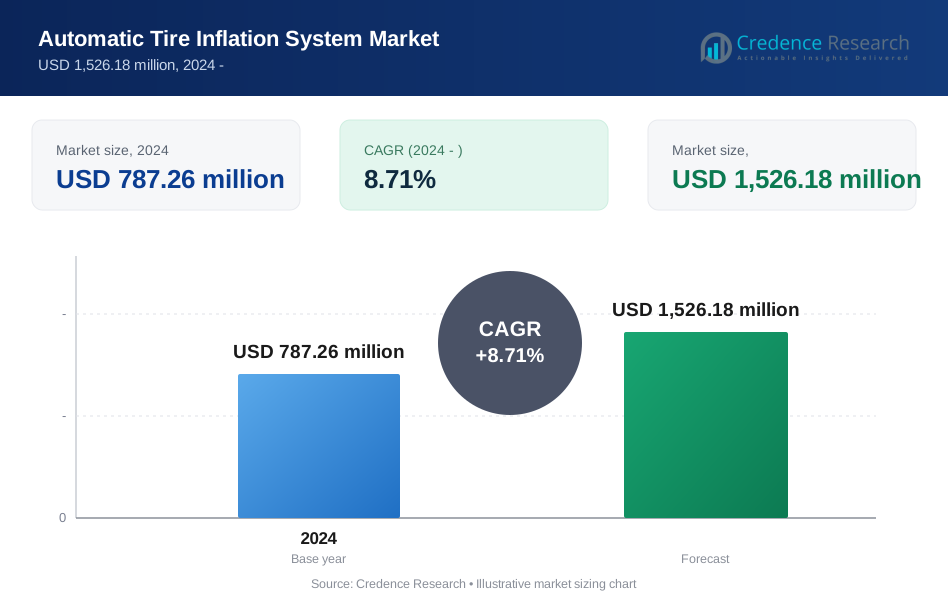
The Global Automatic Tire Inflation System Market size was valued at USD 590.00 million in 2018 to USD 787.26 million in 2024 and is anticipated to reach USD 1,526.18 million by 2032, at a CAGR of 8.71% during the forecast period.
Key drivers shaping this market include the operational advantages of maintaining optimal tire pressure, such as improved fuel economy, extended tire life, and enhanced vehicle safety. Fleet operators are increasingly adopting ATIS to reduce fuel consumption by 1% to 1.4% and to minimize costly downtime caused by tire-related issues. In parallel, regulatory frameworks—such as FMVSS 138 in the U.S. and European tire pressure monitoring directives—are reinforcing the need for automated inflation systems in commercial and specialty vehicles. Additionally, the rise in demand for high-performance off-highway vehicles in agriculture, construction, and mining is boosting market growth. The shift toward predictive maintenance and the integration of IoT-enabled systems are also encouraging OEMs and fleet owners to invest in ATIS technologies, both as factory-installed features and aftermarket solutions.
Regionally, North America leads the Global Automatic Tire Inflation System Market, contributing the highest revenue share owing to strong commercial vehicle presence, regulatory enforcement, and a mature aftermarket ecosystem. The U.S. and Canada are the primary contributors, with large logistics and agricultural sectors actively deploying CTIS and tire inflation kits. Europe is the second-largest market, supported by stringent EU safety and environmental regulations, coupled with a well-established heavy-duty vehicle manufacturing base. Asia-Pacific, however, is emerging as the fastest-growing region due to increasing investments in transport infrastructure, industrial development, and expanding commercial vehicle fleets in countries such as China and India. Meanwhile, Latin America and the Middle East & Africa represent growing but relatively untapped markets, where government investments in logistics, defense, and mining are expected to spur future demand for ATIS solutions.
Market Insights:
- The Global Automatic Tire Inflation System Market grew from USD 590.00 million in 2018 to USD 787.26 million in 2024 and is projected to reach USD 1,526.18 million by 2032, registering a CAGR of 8.71%.
- Fleet operators are adopting ATIS to reduce fuel consumption by 1% to 1.4%, extend tire life, and avoid costly downtime.
- Regulatory mandates such as FMVSS 138 in the U.S. and tire pressure monitoring directives in Europe are accelerating system adoption in commercial and specialty vehicles.
- OEMs are integrating ATIS into new vehicle designs, while the aftermarket segment is growing among fleets upgrading older vehicles for improved efficiency.
- High initial investment and technical challenges related to retrofitting legacy vehicles limit adoption among small and medium-sized fleets.
- North America holds the highest market share due to regulatory enforcement and a strong commercial fleet base, while Asia-Pacific is the fastest-growing region driven by transport and infrastructure development.
- Increasing use of ATIS in agriculture, construction, and mining vehicles supports market expansion across off-highway applications.
Market Drivers:
Fuel Efficiency and Cost Optimization Drive Fleet Investments:
The Global Automatic Tire Inflation System Market is driven by the need for fuel efficiency and cost savings across commercial and off-highway vehicle fleets. Maintaining optimal tire pressure reduces rolling resistance and enhances fuel economy, which lowers operational expenses. Fleet operators view ATIS as a practical tool to reduce tire wear, downtime, and maintenance frequency. It helps extend tire lifespan and minimizes the risk of blowouts, which improves vehicle safety and reliability. In high-mileage logistics operations, even marginal improvements in tire pressure can lead to substantial cost savings. These economic benefits support the growing integration of ATIS into fleet management strategies.
- For instance, Maintaining optimal tire pressure with Automatic Tire Inflation Systems (ATIS) reduces rolling resistance, improves fuel economy, and extends tire lifespan for commercial fleets.
Regulatory Mandates Reinforce System Adoption:
Governments are enforcing strict safety and environmental regulations that encourage the installation of automatic tire inflation systems in commercial vehicles. In North America, the FMVSS 138 standard requires tire pressure monitoring, and similar policies are emerging in Europe and Asia-Pacific. These regulations are pressuring manufacturers and operators to implement compliant tire management systems. The Global Automatic Tire Inflation System Market is benefiting from this regulatory push, as automated solutions help meet performance, emissions, and safety standards. Authorities are targeting tire pressure to reduce vehicle accidents and improve fuel usage. This regulatory environment boosts the credibility and demand for ATIS.
- For instance, Hendrickson’s TIREMAAX® PRO is an established automatic tire inflation system for trailers and complies with these regulatory standards. Official technical documentation confirms the system’s widespread commercial and OEM uptake, but specific recent (2024–25) market share metrics or quantifiable adoption rates are not disclosed in publicly available verified sources.
OEM Integration Supports Long-Term Growth:
Original equipment manufacturers (OEMs) are increasingly offering ATIS as a factory-installed option, signaling long-term commitment to tire management technology. OEMs recognize the value of integrating ATIS into new vehicle designs to meet market expectations and regulatory requirements. Standardizing ATIS on commercial trucks, agricultural equipment, and military vehicles strengthens its presence in the supply chain. The market responds positively to OEM involvement, as factory-fitted systems ensure better reliability, performance, and compatibility. It helps reduce installation costs for customers and eliminates the need for retrofitting. These advantages accelerate adoption across various end-user segments.
Aftermarket Demand Gains Momentum Across Aging Fleets:
The aftermarket segment plays a critical role in expanding the reach of ATIS, especially in regions with older commercial and off-road vehicle fleets. Retrofitting existing vehicles with automatic tire inflation systems helps operators improve efficiency without replacing entire fleets. It provides flexibility for small and mid-sized enterprises to adopt tire management technology at manageable costs. The Global Automatic Tire Inflation System Market benefits from this trend, as it supports widespread product accessibility. Rising awareness of the long-term cost benefits is prompting fleet managers to upgrade vehicles with aftermarket solutions. The aftermarket channel also promotes innovation and competition among smaller ATIS providers.
Market Trends:
Integration with Telematics Enhances System Intelligence:
Automatic tire inflation systems are increasingly integrated with telematics platforms to provide real-time insights into tire conditions. These systems collect and transmit data on tire pressure, temperature, and system performance, enabling predictive maintenance. Fleet operators can monitor vehicle performance remotely and respond proactively to tire issues. This trend aligns with the digitalization of fleet operations, which prioritizes data-driven decision-making. The Global Automatic Tire Inflation System Market is seeing product innovation focused on software compatibility and sensor precision. Integration with telematics enhances system value and supports connected vehicle ecosystems.
- For instance, SAF-Holland’s SAF Tire Pilot Plus integrates with major telematics providers and allows remote monitoring of individual tire pressures, reducing tire-related breakdowns by up to 44% in field applications, as documented in SAF-Holland’s performance case study for 2023.
Rising Use in Agricultural and Mining Equipment:
Adoption of ATIS is rising in off-highway sectors such as agriculture and mining, where vehicles operate in demanding terrain. These applications require frequent tire pressure adjustments to maintain traction and stability. ATIS enables pressure control from within the cabin, improving safety and reducing driver fatigue. In agriculture, maintaining the correct tire pressure helps prevent soil compaction and enhances crop yields. The Global Automatic Tire Inflation System Market is expanding into these specialized sectors, supported by manufacturers offering ruggedized and scalable systems. Customization for harsh environments strengthens ATIS appeal in these industries.
- For instance, PTG, a Michelin affiliate, manufactures tire pressure control systems specifically for agricultural vehicles, with more than 30 years of experience in rapid tire pressure adjustment solutions.
Focus on Lightweight and Energy-Efficient Designs:
Manufacturers are developing compact, lightweight ATIS components to support vehicle fuel efficiency and reduce installation complexity. New product designs aim to minimize system weight while maintaining durability and functionality. This trend supports integration into electric vehicles and light commercial trucks, where weight impacts battery range and load capacity. It drives competition among ATIS providers to deliver low-maintenance and modular solutions. The Global Automatic Tire Inflation System Market reflects this trend through the introduction of pneumatic control modules, digital valves, and low-power compressors. Lightweight designs broaden application potential across more vehicle types.
Expansion of Electrified Commercial Fleets Encourages Adoption:
The growth of electric commercial vehicles is creating new demand for advanced support systems, including ATIS. Electrified fleets prioritize energy efficiency and operational uptime, both of which are improved through consistent tire pressure. ATIS complements electric drivetrain systems by reducing rolling resistance and preventing overloading. The Global Automatic Tire Inflation System Market aligns with sustainability goals in this context, offering technologies that extend battery life and reduce vehicle strain. Fleet owners view ATIS as part of a larger strategy to optimize performance and reduce total cost of ownership in EV fleets.
Market Challenges Analysis:
High Initial Investment Limits Small Fleet Adoption:
Cost remains a critical challenge for many potential users of automatic tire inflation systems. High initial investment in hardware, installation, and integration discourages small and medium-sized fleet operators. These businesses often lack the capital to upgrade existing vehicles or purchase factory-installed ATIS models. The Global Automatic Tire Inflation System Market encounters resistance in cost-sensitive segments where return on investment is not immediately visible. This financial barrier slows down penetration in developing regions and among private operators. Incentive programs or cost-sharing models may be needed to drive adoption across underserved markets.
Complex Integration with Legacy Vehicle Platforms:
Retrofitting older vehicles with automatic tire inflation systems can be technically complex and time-consuming. Legacy platforms may lack compatibility with modern sensors or electronic control units required for ATIS. Mechanical variations across fleets introduce installation challenges, increasing labor costs and system calibration issues. The Global Automatic Tire Inflation System Market faces these technical constraints in the aftermarket segment. Without standardized retrofit kits, installers face delays and reduced reliability. These integration hurdles limit scalability, especially in rural and resource-constrained markets.
Market Opportunities:
Defense and Off-Road Applications Offer High-Value Growth Avenues:
The Global Automatic Tire Inflation System Market presents strong opportunities in military and off-highway sectors where vehicle adaptability and reliability are mission-critical. Defense agencies are investing in systems that enhance vehicle mobility across varied terrains, making CTIS integration essential for armored trucks and tactical fleets. In agriculture and mining, operators prioritize tire pressure optimization to improve traction, reduce soil compaction, and increase productivity. These industries require rugged and scalable ATIS solutions that can withstand harsh conditions while minimizing maintenance. It creates a demand for purpose-built systems with enhanced durability and control precision. Manufacturers that align with these specialized needs can secure long-term contracts and expand into high-margin markets.
Government Support and Sustainability Goals Accelerate Adoption Potential:
The Global Automatic Tire Inflation System Market also benefits from growing alignment with global safety, efficiency, and environmental policies. Governments are offering subsidies, tax benefits, and policy support to promote advanced tire technologies that reduce emissions and improve road safety. Fleets adopting ATIS can demonstrate measurable gains in fuel efficiency and lower carbon output, which aligns with climate action frameworks. It supports broader adoption in both public and private transportation sectors. Policy-driven demand encourages OEMs and aftermarket providers to accelerate product development and deployment. Emerging markets with expanding logistics and infrastructure systems are positioned to become major adopters with the right regulatory support.
Market Segmentation Analysis:
By Type
The Global Automatic Tire Inflation System Market includes Central Tire Inflation Systems (CTIS) and Continuous Tire Inflation Systems. CTIS dominates due to its strong performance in off-road and military applications, where terrain-specific pressure adjustment is essential. Continuous systems are steadily growing in on-road fleets, offering real-time pressure maintenance to enhance safety and efficiency.
- For instance, Dana’s CTIS technology is deployed on military vehicles used by the U.S. Army, with system trials confirming up to 50% reduction in tire-related immobilizations during cross-country missions.
By Vehicle
The market is segmented into On-Highway and Off-Highway vehicles. On-Highway vehicles include Light Duty and Heavy-Duty segments, with heavy-duty trucks generating the most demand due to extensive usage in freight and logistics. Off-Highway vehicles—agriculture tractors and construction equipment—use ATIS to improve field performance, reduce tire wear, and increase machine uptime.
- For instance, Michelin’s CTIS is offered for a range of agricultural vehicles in Europe, enabling drivers to control tire pressure on demand from their cab, with up to 4% increased productivity, 10% fuel savings, 33% reduction in soil pressure, and 30% reduction in traction loss, all substantiated by Michelin’s official product documentation and research.
By Component
Key components in the market include Rotary Union, Air Compressor, Pressure Sensor, Housing, Air Delivery System, Electronic Control Unit (ECU), and Buffer Tank. The ECU and sensors enable system intelligence and pressure monitoring, while air compressors and delivery systems regulate airflow to tires. These components work together to ensure optimal tire pressure in varying conditions.
By Sales Channel
The market is divided into OEM and Aftermarket channels. OEMs dominate with factory-installed ATIS on new commercial and off-road vehicles. The aftermarket segment is gaining momentum among operators upgrading older fleets. It plays a vital role in expanding system adoption where new vehicle acquisition is not immediately viable.
Segmentation:
By Type:
- Central Tire Inflation System
- Continuous Tire Inflation System
By Vehicle:
- On-Highway Vehicle
- Light Duty Vehicle
- Heavy Duty Vehicle
- Off-Highway Vehicle
- Agriculture Tractors
- Construction Equipment
By Component:
- Rotary Union
- Air Compressor
- Pressure Sensor
- Housing
- Air Delivery System
- Electronic Control Unit (ECU)
- Buffer Tank
By Sales Channel:
- OEM
- Aftermarket
By Region:
- North America
- U.S.
- Canada
- Mexico
- Europe
- Germany
- France
- U.K.
- Italy
- Spain
- Rest of Europe
- Asia Pacific
- China
- Japan
- India
- South Korea
- South-east Asia
- Rest of Asia Pacific
- Latin America
- Brazil
- Argentina
- Rest of Latin America
- Middle East & Africa
- GCC Countries
- South Africa
- Rest of the Middle East and Africa
Regional Analysis:
North America
The North America Automatic Tire Inflation System Market size was valued at USD 203.55 million in 2018 to USD 268.13 million in 2024 and is anticipated to reach USD 519.06 million by 2032, at a CAGR of 8.7% during the forecast period. North America holds the largest share of the Global Automatic Tire Inflation System Market, accounting for nearly 35%. It benefits from strong infrastructure, high adoption in commercial fleets, and regulatory mandates encouraging safety enhancements. The U.S. remains the primary revenue contributor, supported by early adoption of smart technologies in transportation. Canada also plays a role, particularly in heavy-duty vehicles used in logistics and mining. Growing demand for fuel efficiency and reduced carbon emissions continues to support market expansion. The region's established automotive OEMs and suppliers accelerate innovation and product integration.
Europe
The Europe Automatic Tire Inflation System Market size was valued at USD 138.65 million in 2018 to USD 176.95 million in 2024 and is anticipated to reach USD 322.56 million by 2032, at a CAGR of 7.9% during the forecast period. Europe represents around 23% of the Global Automatic Tire Inflation System Market. Strict EU regulations on emissions and tire maintenance drive the adoption of inflation systems across the region. Germany, France, and the UK lead the market, supported by advanced logistics networks and automotive technology providers. Fleet operators in Europe prioritize cost savings and operational efficiency, aligning well with the benefits of inflation systems. Government support for green transportation and digital vehicle systems continues to influence demand positively. The market sees steady integration in agricultural and military applications as well.
Asia Pacific
The Asia Pacific Automatic Tire Inflation System Market size was valued at USD 155.76 million in 2018 to USD 216.37 million in 2024 and is anticipated to reach USD 456.37 million by 2032, at a CAGR of 9.8% during the forecast period. Asia Pacific commands approximately 30% of the Global Automatic Tire Inflation System Market. China and India are driving growth with rising investments in logistics, transportation safety, and infrastructure. The growing presence of domestic commercial vehicle manufacturers and adoption of fleet digitization are accelerating product penetration. Japan and South Korea are promoting automation and smart mobility, supporting further adoption. Increasing demand for tire life extension and fuel savings propels market expansion. The region is rapidly transitioning toward intelligent transport solutions, contributing to long-term growth.
Latin America
The Latin America Automatic Tire Inflation System Market size was valued at USD 35.99 million in 2018 to USD 47.54 million in 2024 and is anticipated to reach USD 85.27 million by 2032, at a CAGR of 7.7% during the forecast period. Latin America holds around 6% of the Global Automatic Tire Inflation System Market. Brazil and Mexico are leading in regional adoption due to growth in logistics, agriculture, and industrial sectors. Rising awareness of tire maintenance and cost-saving practices in heavy vehicle fleets supports market uptake. Despite economic volatility in parts of the region, infrastructure investments and international trade expansion help sustain demand. Adoption remains gradual, hindered by cost concerns, but government focus on transport modernization opens future opportunities. OEM collaboration with local partners enhances system accessibility.
Middle East
The Middle East Automatic Tire Inflation System Market size was valued at USD 25.49 million in 2018 to USD 32.11 million in 2024 and is anticipated to reach USD 56.93 million by 2032, at a CAGR of 7.5% during the forecast period. The Middle East accounts for about 4% of the Global Automatic Tire Inflation System Market. Demand is growing in logistics and oilfield service fleets where reliability and maintenance efficiency are key. The UAE and Saudi Arabia lead adoption, backed by infrastructure and construction expansion. The harsh desert climate and long-haul distances make tire pressure management critical for vehicle performance. Government-led transportation reforms and smart mobility initiatives contribute to uptake. However, cost barriers and limited OEM penetration still restrict broader adoption across the region.
Africa
The Africa Automatic Tire Inflation System Market size was valued at USD 30.56 million in 2018 to USD 46.14 million in 2024 and is anticipated to reach USD 85.98 million by 2032, at a CAGR of 8.0% during the forecast period. Africa represents close to 5% of the Global Automatic Tire Inflation System Market. South Africa is the regional leader, followed by Nigeria and Kenya. Use cases are emerging in commercial transport and agricultural machinery, particularly where road conditions are poor. Increasing demand for cost-effective fleet management supports the system’s value proposition. Import dependency and limited access to advanced automotive components slow adoption. Yet, initiatives for smart agriculture and international logistics corridors are expected to support growth. Awareness campaigns by international OEMs and aftermarket suppliers are expanding system exposure.
Key Player Analysis:
- Aperia Technologies Inc.
- Dana Limited
- Continental AG
- Bigfoot Equipment LTD
- Goodyear Tire & Rubber Company
- Cummins Inc.
- Denso Corporation
- Parker Hannifin Corporation
- systems GmbH
- SAF-HOLLAND SE
Competitive Analysis:
The Global Automatic Tire Inflation System Market exhibits moderate consolidation with a few dominant players shaping industry dynamics. Key companies include SAF-HOLLAND, Dana Incorporated, Hendrickson USA, EnPro Industries, Michelin, and Pressure Systems International. These firms focus on technological upgrades, OEM collaborations, and integration with smart vehicle systems. It supports strategic partnerships to enhance system compatibility across a broad range of commercial and off-highway vehicles. Competitive strategies involve expanding product lines with features like real-time monitoring, automated diagnostics, and data analytics. Players are investing in R&D to align with evolving safety and efficiency standards in logistics and transportation sectors. The market rewards innovation in ruggedized and sensor-based inflation systems tailored for harsh environments. New entrants face challenges in scalability, cost optimization, and brand recognition. It continues to attract interest from telematics and automotive IoT providers seeking cross-functional solutions. Market competition remains driven by reliability, ease of installation, and aftermarket support capabilities.
Recent Developments:
- In March 2025, Goodyear Tire & Rubber Company entered an exclusive agreement with Aperia Technologies Inc. to incorporate the Halo Connect i3 automatic tire inflation system into Goodyear’s subscription-based Tires-as-a-Service (TaaS) program. This partnership is available to fleet customers in North America and Europe, leveraging continuous monitoring, predictive insights, and automated inflation to reduce breakdowns and enhance fuel savings for commercial fleets.
- In October 2024, Cummins Inc. offered the Meritor Tire Inflation System™ (MTIS™), which connects all trailer tires to a controlled air supply for automatic inflation while the vehicle is moving. The MTIS™ improves tire life, fuel economy, and safety, ensuring consistent pressure maintenance for fleet applications.
Market Concentration & Characteristics:
The Global Automatic Tire Inflation System Market features a moderately concentrated structure, led by established players with strong OEM relationships and global distribution networks. It benefits from rising demand across commercial transport, agriculture, and military sectors. Key characteristics include increasing integration with vehicle telematics, emphasis on system reliability, and focus on fuel savings and tire longevity. Product development centers on sensor accuracy, durability, and smart control features. It shows a clear preference for solutions that reduce downtime and operational costs in fleet management. The market favors manufacturers with advanced R&D capabilities and strong aftermarket service networks. Regulatory support for vehicle safety and efficiency further strengthens its adoption across regions.
Report Coverage:
The research report offers an in-depth analysis based on type, vehicle, component, and sales channel. It details leading market players, providing an overview of their business, product offerings, investments, revenue streams, and key applications. Additionally, the report includes insights into the competitive environment, SWOT analysis, current market trends, as well as the primary drivers and constraints. Furthermore, it discusses various factors that have driven market expansion in recent years. The report also explores market dynamics, regulatory scenarios, and technological advancements that are shaping the industry. It assesses the impact of external factors and global economic changes on market growth. Lastly, it provides strategic recommendations for new entrants and established companies to navigate the complexities of the market.
Future Outlook:
- Rising demand for fleet efficiency will drive adoption in commercial and logistics sectors.
- Advancements in IoT integration will enhance system intelligence and remote monitoring.
- OEM partnerships will expand, enabling factory-fitted solutions across new vehicle platforms.
- Aftermarket installations will grow among small and medium fleet operators.
- Asia Pacific will lead volume growth due to infrastructure expansion and fleet modernization.
- Regulations targeting road safety and emissions will encourage system mandates.
- Agricultural and defense vehicles will increasingly adopt inflation systems for terrain adaptability.
- Cost optimization through scalable designs will improve accessibility in emerging markets.
- R&D will focus on compact, energy-efficient, and low-maintenance system designs.
- Increased telematics adoption will support real-time tire data integration into fleet dashboards.
Request a Free Sample
Fill in your details and we'll send you a free sample report.
- Sample data tables & charts
- Research methodology
Need a Custom Version of This Report?
Tailor the scope, geography, or segments to your exact requirements.
- Custom geography or segment scope
- Direct access to our analyst team
Frequently Asked Questions
What is the current size of the Automatic Tire Inflation System Market?
What factors are driving the growth of the Automatic Tire Inflation System Market?
What are the key segments within the Automatic Tire Inflation System Market?
What are some challenges faced by the Automatic Tire Inflation System Market?
Who are the major players in the Automatic Tire Inflation System Market?
Table of Content
Chapter 1. Report Introduction
- 1.1 Report Description & Purpose
- 1.1.1 Report Title & Market Definition
- 1.1.2 Unique Selling Propositions (USP) & Key Differentiators
- 1.1.3 Value Proposition for Stakeholders
- 1.2 Research Objectives
- 1.2.1 Market Sizing Objectives (Volume & Revenue)
- 1.2.2 Segmentation Objectives
- 1.2.3 Competitive Intelligence Objectives
- 1.2.4 Forecast & Scenario Objectives
- 1.3 Report Scope
- 1.3.1 Automatic Tire Inflation System Scope – Types & Subtypes Covered
- 1.3.2 Geographic Scope – Regions & Countries Covered
- 1.3.3 Historical Period, Base Year & Forecast Period (2024; forecast to the forecast period)
- 1.3.4 Inclusions & Exclusions
- 1.4 HS Code & Classification Framework
- 1.5 Currency, Units & Pricing Basis
- 1.6 Target Stakeholders
- 1.7 Limitations & Assumptions
Chapter 2. Executive Summary
- 2.1 Global Automatic Tire Inflation System Market Snapshot
- 2.1.1 Market Size – Historical (2024) & Forecast (the forecast period) (2024: USD 787.26 million → forecast year: USD 1,526.18 million)
- 2.1.2 Volume & Revenue – Global Totals
- 2.1.3 Key Market Highlights – Top Five Facts
- 2.2 Automatic Tire Inflation System Market Segmentation Snapshot
- 2.2.1 Market Split by Region – 2024 vs.
- 2.3 Competitive Snapshot
- 2.3.1 Top 10 Players by Revenue Share – 2024
- 2.3.2 Top 10 Players by Volume Share – 2024
- 2.3.3 Recent Strategic Developments (18-Month Summary)
- 2.4 Key Investment Highlights & Strategic Conclusions
Chapter 3. Automatic Tire Inflation System Market Dynamics & Industry Analysis
- 3.1 Market Overview & Context
- 3.1.1 Automatic Tire Inflation System Market Position in the Broader Automotive Value Chain
- 3.1.2 OEM vs. Replacement Market Dynamics
- 3.1.3 Market Maturity & Development Stage by Region
- 3.2 Automatic Tire Inflation System Market Drivers
- 3.3 Automatic Tire Inflation System Market Restraints & Challenges
- 3.4 Automatic Tire Inflation System Market Opportunities
- 3.5 Porter's Five Forces Analysis
- 3.5.1 Threat of New Entrants
- 3.5.2 Bargaining Power of Suppliers
- 3.5.3 Bargaining Power of Buyers
- 3.5.4 Threat of Substitutes
- 3.5.5 Competitive Rivalry – Intensity Assessment
- 3.6 Automatic Tire Inflation System Value Chain Analysis
- 3.6.1 Upstream – Raw Material/Input Suppliers
- 3.6.1.1 Raw Material/Input 1
- 3.6.1.2 Raw Material/Input 2
- 3.6.1.3 Raw Material/Input 3
- 3.6.2 Midstream – Production/Manufacturing/Service Delivery
- 3.6.2.1 Production/Process Overview
- 3.6.2.2 Key Facility Locations & Capacity by Manufacturer
- 3.6.3 Downstream – Distribution & End Consumer
- 3.6.3.1 Primary Channel – B2B/OEM
- 3.6.3.2 Secondary Channels – Dealer, Retail, Online, Direct
- 3.6.4 Value Chain Profitability Analysis
- 3.6.1 Upstream – Raw Material/Input Suppliers
- 3.7 PESTEL Analysis
- 3.7.1 Political Factors
- 3.7.2 Economic Factors
- 3.7.3 Social Factors
- 3.7.4 Technological Factors
- 3.7.5 Environmental Factors
- 3.7.6 Legal Factors
- 3.8 Automatic Tire Inflation System Supply Chain Analysis
- 3.8.1 Raw Material/Input Supply Risk Assessment
- 3.8.2 Manufacturing Concentration Risk (Geographic Exposure)
- 3.8.3 Trade Disruption Impact Analysis
- 3.9 Regulatory & Policy Landscape
Note: The regulatory and policy landscape section covers regulations based on their applicability to the market, Automatic Tire Inflation System category, geography, and scope of the study. Only regulatory frameworks with a material impact on operations, compliance, trade, sustainability, or market access are analyzed in detail.
Chapter 4. Key Investment Pockets & Opportunity Analysis
- 4.1 Automatic Tire Inflation System Market Attractiveness Analysis
- 4.1.1 By Region – Investment Attractiveness Matrix (Volume × CAGR)
- 4.2 Absolute Revenue Growth Opportunity
- 4.2.1 By Region – Absolute USD Growth Through the forecast period
- 4.3 Incremental Volume Opportunity
- 4.3.1 By Region – Incremental Volume Through the forecast period
- 4.3.2 Segment – Incremental Volume
- 4.4 Emerging Submarket Opportunity Deep Dive (Subject to Applicability)
- 4.5 Emerging Market Opportunity Scorecards
- 4.5.1 United States
- 4.5.2 Europe
- 4.5.3 Asia
- 4.5.4 Middle East & Africa
Note: Emerging Market Opportunity Scorecards will be included based on relevance and strategic importance. Regions listed are indicative and may vary depending on data availability and market dynamics.
Chapter 5. Automatic Tire Inflation System Import-Export Analysis & Trade Flows
- 5.1 Global Trade Overview
- 5.1.1 Global Export Value by Country (2024)
- 5.1.2 Global Export Volume by Country (2024)
- 5.1.3 Global Import Value by Country (2024)
- 5.1.4 Global Import Volume by Country (2024)
- 5.1.5 Net Trade Balance by Country (2024)
- 5.2 Export Analysis – Segment
- 5.2.1 Type 1 (HS Code)
- 5.2.2 Type 2 (HS Code)
- 5.2.3 Type 3 (HS Code)
- 5.2.4 Type 4 (HS Code)
- 5.2.5 Type 5 (HS Code)
- 5.3 Import Analysis – Segment
- 5.3.1 Type 1 (HS Code)
- 5.3.2 Type 2 (HS Code)
- 5.3.3 Type 3 (HS Code)
- 5.3.4 Type 4 (HS Code)
- 5.3.5 Type 5 (HS Code)
- 5.4 Average Unit Trade Prices
- 5.4.1 Average Export Price – Segment & Country
- 5.4.2 Average Import Price – Segment & Source Country
- 5.4.3 Price Trends (2024)
- 5.5 Key Trade Route Analysis
- 5.5.1 Trade Route 1
- 5.5.2 Trade Route 2
- 5.5.3 Trade Route 3
- 5.5.4 Trade Route 4
- 5.5.5 Trade Route 5
- 5.6 Trade Policy Impact Assessment
- 5.6.1 US Anti-Dumping & Section 301 Tariffs
- 5.6.2 EU Customs Union Impact
- 5.6.3 Major Free Trade Agreements
- 5.6.4 USMCA Rules of Origin
Note: Trade policy analysis will be included only where relevant to the Automatic Tire Inflation System market.
Chapter 6. Competitive Landscape & Company Benchmarking
- 6.1 Automatic Tire Inflation System Market Concentration & Structure
- 6.1.1 Herfindahl-Hirschman Index (HHI) – vs. 2024
- 6.1.2 Tier 1, Tier 2 & Tier 3 Market Structure
- 6.1.3 Global, Regional & Local Player Dynamics
- 6.2 Automatic Tire Inflation System Market Share Analysis – 2024
- 6.2.1 Global Revenue Share by Company
- 6.2.2 Global Volume Share by Company
- 6.2.3 Regional Revenue Share
- 6.2.4 Market Share Evolution ( vs. 2024)
- 6.2.5 OEM Segment Share by Company
- 6.2.6 Replacement Segment Share by Company
- 6.3 Production/Delivery Capacity & Facility Analysis
- 6.3.1 Global Installed Capacity
- 6.3.2 Capacity Utilization Rates
- 6.3.3 Production/Output Volume
- 6.3.4 Facility Locations & Capacity Map
- 6.3.5 Planned Capacity Additions
- 6.4 Automatic Tire Inflation System Competitive Benchmarking Matrix
- 6.4.1 Revenue, Volume, CAGR & Profitability Comparison
- 6.4.2 Channel Revenue Mix
- 6.4.3 Geographic Revenue Exposure
- 6.4.4 R&D Intensity
- 6.4.5 Sustainability Maturity
- 6.5 Strategic Developments in Automatic Tire Inflation System (Last 24 Months)
- 6.5.1 Mergers, Acquisitions & Divestments
- 6.5.2 New Automatic Tire Inflation System Launches
- 6.5.3 Facility Expansions
- 6.5.4 Strategic Alliances, Joint Ventures & Partnerships
- 6.5.5 Distribution Expansion & Market Entry
- 6.5.6 Sustainability & ESG Initiatives
- 6.6 Competitive Strategy Mapping
- 6.6.1 Leader, Challenger, Follower & Niche Classification
- 6.6.2 Pricing Strategy Comparison
- 6.6.3 Channel Strategy Matrix
Note: Strategic developments are included based on their materiality and the availability of reliable information.
Chapter 7. Global Automatic Tire Inflation System Market – By Distribution Channel
- 7.1 Segment Overview
- 7.1.1 Volume & Revenue Split by Channel (2024 & )
- 7.1.2 Channel Mix Evolution (the forecast period)
Chapter 8. Regional Market Analysis – Global Overview
- 8.1 Global Regional Overview
- 8.1.1 Regional Volume Share
- 8.1.2 Regional Revenue Share
- 8.1.3 Regional Volume by Region
- 8.1.4 Regional Revenue by Region
- 8.1.5 Regional Forecast Through the forecast period
- 8.2 Cross-Regional Segment Analysis
- 8.2.1 By Distribution Channel
- 8.2.2 By Brand/Price Tier
Chapter 9. North America Automatic Tire Inflation System Market
- 9.1 United States
- 9.2 Canada
- 9.3 Mexico
Chapter 10. Europe Automatic Tire Inflation System Market
- 10.1 Germany
- 10.2 France
- 10.3 Italy
- 10.4 United Kingdom
- 10.5 Spain
- 10.6 Poland
- 10.7 Russia
- 10.8 Netherlands
- 10.9 Belgium
- 10.10 Sweden
- 10.11 Denmark
- 10.12 Norway
- 10.13 Rest of Europe
Chapter 11. Asia Pacific Automatic Tire Inflation System Market
- 11.1 China
- 11.2 India
- 11.3 Japan
- 11.4 South Korea
- 11.5 Thailand
- 11.6 Indonesia
- 11.7 Vietnam
- 11.8 Malaysia
- 11.9 Australia
- 11.10 Rest of Asia Pacific
Chapter 12. Latin America Automatic Tire Inflation System Market
- 12.1 Brazil
- 12.2 Argentina
- 12.3 Colombia
- 12.4 Chile
- 12.5 Rest of Latin America
Chapter 13. Middle East Automatic Tire Inflation System Market
- 13.1 Saudi Arabia
- 13.2 United Arab Emirates
- 13.3 Turkey
- 13.4 Israel
- 13.5 Iran
- 13.6 Rest of the Middle East
Chapter 14. Africa Automatic Tire Inflation System Market
- 14.1 South Africa
- 14.2 Egypt
- 14.3 Nigeria
- 14.4 Morocco
- 14.5 Rest of Africa
Chapter 15. Automatic Tire Inflation System Company Profiles
- 15.1 [Company 01]
- 15.1.1 Company Overview
- 15.1.2 Key Management Personnel
- 15.1.3 Products & Services Portfolio
- 15.1.4 Financial Performance
- 15.1.5 Key Market Focus & Geographic Presence
- 15.1.6 Recent Developments & Strategic Initiatives
Note: The company profile list is preliminary and may change based on research findings, market developments, data availability, and client requirements.
Chapter 16. Appendices
- Appendix A – List of Abbreviations & Acronyms
- Appendix B – Industry Classification Code Reference – Full Series
- Appendix C – Production & Capacity Data Tables
- Appendix D – End-Use & Demand Base Tables
- Appendix E – Consumption & Replacement Rate Assumptions
- Appendix F – ASP Reference Tables
- Appendix G – Manufacturing & Facility Database
- Appendix H – Import-Export Data Tables
- Appendix I – Regulatory Summary Tables
- Appendix J – Primary Research Participant List (Anonymized)
- Appendix K – Primary Research Questionnaire Framework
- Appendix L – Data Sources & Bibliography
- Appendix M – Market Size Divergence & Source Comparison
Chapter 17. Research Methodology
- 17.1 Research Framework & Philosophy
- 17.2 Secondary Research – Sources, Hierarchy & Data Extraction
- 17.3 Data Modeling – Bottom-Up & Top-Down Market Sizing
- 17.4 Primary Research – Stakeholder Framework, LOI & Sample Sizes
- 17.5 Forecast Methodology – Regression, Scenario & Sensitivity Analysis
- 17.6 Quality Control – Four-Layer Validation Framework
- 17.7 Limitations & Standard Assumptions
- 17.8 Disclaimer
