
| REPORT ATTRIBUTE | DETAILS |
|---|---|
| Historical Period | 2020-2023 |
| Base Year | 2024 |
| Forecast Period | 2025-2032 |
| Automotive Air Filter Market Size 2024 | USD 4578.000 million |
| Automotive Air Filter Market, CAGR | 6.10% |
| Automotive Air Filter Market Size 2032 | USD 7351.068 million |
Market Overview
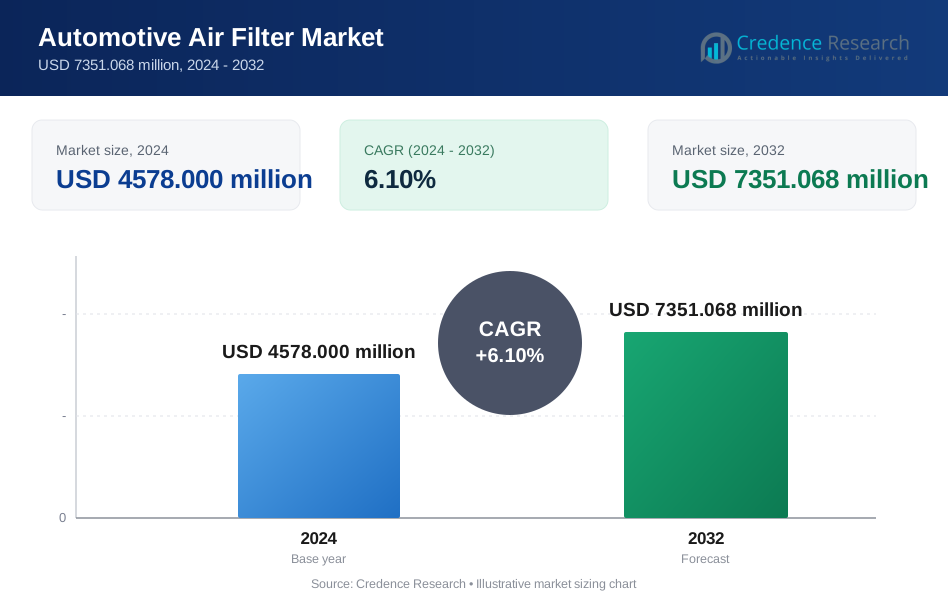
Global Automotive Air Filter market size was valued at USD 4578.000 million in 2024 and is anticipated to reach USD 7351.068 million by 2032, at a CAGR of 6.10% during the forecast period (2024-2032).
The global automotive air filter market is driven by growing environmental concerns and stringent emission regulations, which are prompting manufacturers to develop advanced filtration solutions for vehicles. Rising consumer demand for improved air quality and fuel efficiency further accelerates market growth. The increasing production of electric vehicles (EVs) and hybrid models also boosts the need for high-performance air filters to optimize engine performance and protect sensitive components. Technological advancements, such as the development of smart filters and the use of eco-friendly materials, are key trends reshaping the market. Additionally, the expanding automotive industry in emerging economies, along with the rising awareness about vehicle maintenance and air quality, is contributing to the increased demand for automotive air filters. These factors are expected to continue driving market growth throughout the forecast period, making air filtration a critical aspect of vehicle performance and environmental sustainability.
The global automotive air filter market is influenced by regional automotive production, air quality regulations, and consumer awareness regarding vehicle maintenance. Asia-Pacific leads the market due to rapid industrialization, increasing vehicle ownership, and stringent emission norms in countries like China and India. North America follows with strong demand driven by a well-established automotive sector and strict environmental regulations. Europe remains a significant player, with a focus on sustainability and advanced filtration technologies. Emerging markets in Latin America and the Middle East & Africa are witnessing gradual growth due to rising vehicle sales and improved infrastructure. Key players in the global automotive air filter market include Mann+Hummel Group, Donaldson Company, Robert Bosch GmbH, Mahle GmbH, and Denso Corporation. These companies focus on product innovation, expanding their portfolios with high-efficiency filters to meet evolving emission standards and consumer preferences. Strategic collaborations, acquisitions, and advancements in filtration technology remain crucial to sustaining their market position.
Market Insights
- The global automotive air filters market was valued at approximately USD 4578.000 million in 2024 and is projected to reach USD 7351.068 million by 2032, exhibiting a CAGR of 10% during the forecast period.
- Increasing vehicle production and rising consumer awareness about air quality are driving the demand for both cabin and engine air filters.
- Stringent emission regulations worldwide are compelling manufacturers to integrate advanced air filtration systems to reduce vehicular emissions.
- The growing adoption of electric vehicles (EVs) presents new opportunities, as EVs require specialized air filters for battery cooling systems.
- Fluctuations in raw material prices and the emergence of washable filters pose challenges to market growth.
- Asia-Pacific leads the market, driven by robust automotive manufacturing in countries like China and India.
- Key players such as Mann+Hummel Group, Donaldson Company, Inc., and Robert Bosch GmbH are focusing on product innovation and strategic partnerships to maintain competitive advantage.
Market Drivers
Stringent Emission Regulations and Environmental Concerns
The increasing emphasis on environmental sustainability and the need to reduce harmful vehicle emissions are major drivers of the global automotive air filter market. Governments worldwide are implementing stricter emission standards, such as the Euro 6 and the U.S. EPA regulations, to mitigate air pollution and reduce the automotive industry's environmental impact. For instance, the U.S. EPA has finalized new emission standards that include lower particulate matter limits, requiring the use of advanced air filtration systems like gasoline particulate filters to meet these standards. As a result, manufacturers are investing in advanced air filter technologies that meet these regulatory standards, thereby driving market demand. Additionally, the growing public awareness regarding air quality and climate change has led consumers to prioritize vehicles with cleaner emissions, further propelling the need for efficient automotive air filters.
Technological Advancements in Air Filter Materials
Ongoing advancements in air filter materials and designs are revolutionizing the automotive air filter market. Traditional air filters were primarily made from paper, but now, manufacturers are incorporating synthetic materials, activated carbon, and other high-performance media to enhance the filtration process. For instance, HEPA filters, which are capable of capturing over 99.9% of dust particles, are being integrated into cabin air filtration systems to improve air quality inside vehicles. Moreover, smart air filters, equipped with sensors to monitor filter performance and notify drivers when a replacement is needed, are gaining popularity. These advancements are appealing to consumers seeking more reliable and cost-effective maintenance solutions. As automakers increasingly adopt these technologies to meet performance and sustainability goals, the demand for advanced automotive air filters is expected to rise, stimulating market growth.
Rising Demand for Fuel Efficiency and Engine Performance
Fuel efficiency and engine performance are key considerations for both automakers and consumers. Automotive air filters play a vital role in optimizing engine efficiency by ensuring clean airflow to the engine, which improves combustion and overall performance. As the automotive industry continues to focus on enhancing fuel efficiency and reducing carbon footprints, air filters have become integral components in achieving these goals. By preventing dirt and debris from entering the engine, high-quality air filters reduce the likelihood of engine damage and ensure smoother operation. With the rising cost of fuel and increasing consumer demand for cost-effective, fuel-efficient vehicles, the automotive air filter market is expected to grow as manufacturers incorporate advanced filtration technologies that improve engine longevity and performance.
Growth in Electric Vehicle (EV) and Hybrid Vehicle Production
The global shift towards electric vehicles (EVs) and hybrid vehicles is a significant factor influencing the automotive air filter market. While EVs produce zero tailpipe emissions, air filters still play an essential role in maintaining optimal cabin air quality and ensuring the longevity of certain vehicle components, such as battery cooling systems. Similarly, hybrid vehicles, which combine internal combustion engines with electric motors, require air filtration systems to protect both engine and electric components. As the adoption of EVs and hybrids increases, automakers are developing specialized air filters tailored to the unique needs of these vehicles. The growing demand for electric and hybrid vehicles in markets like North America, Europe, and Asia-Pacific is expected to drive the need for specialized air filtration solutions, further boosting the automotive air filter market. This trend is set to continue as the transition to electric mobility accelerates in the coming years.
Market Trends
Rising Popularity of Electric and Hybrid Vehicles
The increasing production and adoption of electric and hybrid vehicles is another notable trend shaping the automotive air filter market. Although EVs produce zero tailpipe emissions, they still require air filters to maintain cabin air quality, protect battery cooling systems, and ensure efficient operation of other critical vehicle components. For example, luxury brands like Tesla and Mercedes-Benz are incorporating advanced air filtration systems into their EV models to enhance passenger comfort and safety. Similarly, hybrid vehicles, which combine an internal combustion engine with electric motors, demand air filters to protect both engine and electric components. As the demand for EVs and hybrids continues to rise, there is a growing need for specialized air filters tailored to the unique needs of these vehicles.
Shift Towards Eco-friendly and Sustainable Materials
A key trend in the global automotive air filter market is the growing preference for eco-friendly and sustainable materials. With increasing environmental awareness, both consumers and manufacturers are prioritizing sustainable solutions. Traditional automotive air filters made from paper are being replaced by filters crafted from synthetic materials, bio-based plastics, and natural fibers. These alternatives not only enhance the performance of filters but also contribute to a reduction in environmental impact. The shift toward biodegradable and recyclable materials is in line with global sustainability efforts and government regulations aimed at minimizing waste and promoting the use of renewable resources. This trend is expected to intensify as more automotive manufacturers focus on green technologies and environmentally responsible production processes.
Integration of Smart Technology in Air Filters
The integration of smart technology into automotive air filters is becoming a significant market trend. Modern air filters are now being equipped with sensors that can monitor filter efficiency, track contamination levels, and alert drivers when it is time to replace or clean the filter. These smart filters offer enhanced convenience and reduce the likelihood of engine damage due to clogged or inefficient filters. The ability to integrate air filter performance data with vehicle maintenance systems offers a more streamlined and proactive approach to vehicle care, helping consumers optimize their vehicle’s performance. As the automotive industry increasingly embraces connectivity and automation, smart air filters are expected to become a standard feature in both conventional and electric vehicles, contributing to the growth of the market.
Growth in Aftermarket Services and Replacement Filters
Another emerging trend is the rise in aftermarket services and the demand for replacement filters. As the automotive industry shifts towards longer-lasting vehicles, consumers are becoming more conscious of maintaining their vehicles' performance and efficiency. This growing awareness has resulted in an increased demand for high-quality replacement air filters, with consumers seeking filters that provide longer-lasting protection, better filtration, and enhanced engine efficiency. The expansion of online sales platforms and direct-to-consumer distribution models has also made it easier for car owners to access premium replacement filters. The aftermarket segment continues to grow as automotive owners place greater emphasis on routine maintenance and performance optimization.
Market Challenges Analysis
Increased Competition and Price Pressure
One of the primary challenges in the global automotive air filter market is the intense competition and price pressure. The market is highly fragmented, with a large number of manufacturers offering a variety of air filter products. As more companies enter the market, there is a constant drive to lower prices to attract consumers, especially in the highly competitive aftermarket segment. This price sensitivity, combined with the need to offer high-quality products, puts pressure on profit margins. Additionally, the need to meet regulatory requirements while keeping costs competitive further complicates the pricing strategy for manufacturers. Companies are forced to balance cost-effective production with technological innovation to differentiate their products, leading to challenges in maintaining profitability without sacrificing quality.
Challenges in Meeting Evolving Regulatory Standards
Another challenge facing the automotive air filter market is the continuously evolving regulatory landscape. Governments worldwide are implementing stricter emission standards and environmental regulations, compelling manufacturers to develop filters that meet increasingly rigorous requirements. For instance, the U.S. Environmental Protection Agency (EPA) has introduced revised greenhouse gas emissions standards for passenger cars and light trucks, requiring advanced filters to reduce harmful emissions. The complexity of these regulations, particularly in different regions, can make it challenging for companies to ensure their products comply with local laws. Additionally, the rapid pace of technological advancements means that air filter manufacturers must constantly innovate to meet these new standards. This continuous need for research and development to stay ahead of regulatory changes presents both financial and operational challenges, particularly for smaller manufacturers that may lack the resources to keep up with the latest standards and technologies.
Market Opportunities
The global automotive air filter market presents significant growth opportunities driven by emerging trends in the automotive industry. With the increasing demand for cleaner air, stricter emission regulations, and heightened environmental awareness, there is a growing market for high-performance air filters that can effectively meet regulatory standards and optimize vehicle efficiency. The rise of electric vehicles (EVs) and hybrid vehicles also opens new avenues for innovation in air filtration technologies. While EVs produce zero tailpipe emissions, they still require advanced filters for cabin air quality and battery cooling systems, creating opportunities for the development of specialized filters tailored to these vehicles. Manufacturers that can innovate to address these specific needs are well-positioned to capitalize on the growing shift toward electric and hybrid mobility.
Additionally, the expanding aftermarket services segment offers a significant opportunity for growth. As vehicle owners increasingly recognize the importance of regular maintenance to ensure vehicle longevity and performance, the demand for replacement filters is rising. Consumers are seeking high-quality, durable air filters that offer better filtration and longer service life, creating a lucrative market for premium replacement products. The convenience of online platforms and e-commerce channels has made it easier for consumers to access these filters, fueling further growth. Moreover, advancements in smart air filter technology, which integrates sensors to monitor filter performance and offer real-time maintenance alerts, present an opportunity for manufacturers to introduce innovative, value-added products to meet evolving consumer expectations. These opportunities are expected to drive continued market expansion over the forecast period, with manufacturers focusing on sustainability, innovation, and enhanced customer experiences.
Market Segmentation Analysis:
By Type:
The global automotive air filter market is categorized into two primary types: cabin air filters and engine air filters. Cabin air filters are designed to enhance air quality within the vehicle's interior by trapping dust, pollen, and other airborne particles, ensuring a cleaner and healthier environment for passengers. The increasing consumer awareness of air pollution and its health effects has driven the demand for cabin air filters, particularly in urban areas with high pollution levels. Additionally, regulatory standards mandating improved air quality in vehicles further support market growth. On the other hand, engine air filters play a critical role in protecting the engine from contaminants such as dirt, debris, and pollutants that can compromise engine performance. With the rising demand for fuel-efficient and high-performance vehicles, manufacturers are focusing on advanced filtration technologies to enhance engine longevity.
By Material:
Automotive air filters are manufactured using different materials, including paper, foam, and synthetic media, each offering distinct advantages. Paper filters are the most widely used due to their cost-effectiveness, ease of replacement, and efficient filtration of particulate matter. They are commonly utilized in both cabin and engine air filters, making them a preferred choice among automakers and consumers. Foam air filters, known for their durability and reusability, offer superior airflow and are particularly favored in high-performance vehicles and off-road applications. Their ability to be cleaned and reused provides an economic and sustainable advantage over disposable filters. Meanwhile, synthetic air filters provide enhanced filtration efficiency and longevity compared to traditional paper-based filters. They are increasingly gaining traction in premium and electric vehicles due to their high dust-holding capacity and resistance to moisture.
Segments:
Based on Type:
- Cabin Air Filter
- Engine Air Filter
Based on Material:
- Paper
- Foam
- Synthetic
Based on Vehicle:
- Passenger Cars
- Light Commercial Vehicles (LCVs)
- Heavy Commercial Vehicles (HCVs)
Based on Distribution Channel:
- OEMs
- Aftermarket
Based on the Geography:
- North America
- U.S.
- Canada
- Mexico
- Europe
- UK
- France
- Germany
- Italy
- Spain
- Russia
- Belgium
- Netherlands
- Austria
- Sweden
- Poland
- Denmark
- Switzerland
- Rest of Europe
- Asia Pacific
- China
- Japan
- South Korea
- India
- Australia
- Thailand
- Indonesia
- Vietnam
- Malaysia
- Philippines
- Taiwan
- Rest of Asia Pacific
- Latin America
- Brazil
- Argentina
- Peru
- Chile
- Colombia
- Rest of Latin America
- Middle East
- UAE
- KSA
- Israel
- Turkey
- Iran
- Rest of Middle East
- Africa
- Egypt
- Nigeria
- Algeria
- Morocco
- Rest of Africa
Regional Analysis
North America
North America holds a significant share of the global automotive air filter market, accounting for approximately 25% of the total market. The region's dominance is driven by the high penetration of passenger and commercial vehicles, coupled with stringent environmental regulations imposed by agencies such as the Environmental Protection Agency (EPA). The increasing consumer demand for fuel-efficient and low-emission vehicles has further fueled the adoption of advanced air filtration systems. The presence of major automotive manufacturers and aftermarket suppliers in the U.S. and Canada also contributes to market growth. Additionally, the rise in electric vehicle (EV) production and hybrid vehicles in the region has increased the demand for cabin air filters that enhance in-car air quality.
Europe
Europe captures around 30% of the global automotive air filter market, making it one of the leading regions. The market in this region is primarily driven by stringent emission norms enforced by the European Union, pushing automakers to integrate high-quality filtration systems in vehicles. Countries such as Germany, France, and the U.K. are at the forefront of this trend due to their strong automotive industries and high vehicle ownership rates. Furthermore, the increasing adoption of electric and hybrid vehicles, coupled with the rising focus on sustainable and recyclable filtration materials, is shaping the European market. The presence of key automotive OEMs and a well-established supply chain further support the region's market expansion.
Asia-Pacific
The Asia-Pacific region holds the largest market share, accounting for approximately 35% of the global automotive air filter market. This dominance is attributed to the rapid expansion of the automotive industry in countries such as China, India, and Japan. Rising vehicle production, increasing disposable income, and growing urbanization have led to higher sales of both passenger and commercial vehicles, boosting demand for air filters. Additionally, rising air pollution levels and increasing consumer awareness regarding vehicle maintenance have driven the need for efficient air filtration systems. The presence of leading automobile manufacturers and a booming aftermarket sector further contribute to market growth in the region.
Rest of the World (Latin America, Middle East & Africa)
The Rest of the World (RoW) region, comprising Latin America, the Middle East, and Africa, holds a market share of around 10%. While this region has a relatively smaller market share, it is witnessing steady growth due to rising vehicle ownership and increasing industrialization. Countries like Brazil, Mexico, and South Africa are experiencing a surge in automotive sales, which directly boosts the demand for air filters. Additionally, government initiatives aimed at improving air quality and reducing vehicle emissions are encouraging the adoption of high-performance automotive air filters. The expanding automotive aftermarket in these regions also presents growth opportunities for air filter manufacturers.
Key Player Analysis
- Mann+Hummel Group
- Donaldson Company, Inc.
- Robert Bosch GmbH
- Mahle GmbH
- Sogefi S.p.A.
- L. Filter
- Denso Corporation
- Airmatic Filterbau GmbH
- K&N Engineering, Inc.
- Freudenberg Filtration Technologies
Competitive Analysis
The global automotive air filter market is highly competitive, with leading players focusing on technological advancements, product diversification, and strategic partnerships to maintain their market position. Mann+Hummel Group, Donaldson Company, Inc., Robert Bosch GmbH, Mahle GmbH, Denso Corporation, Sogefi S.p.A., A.L. Filter, Airmatic Filterbau GmbH, K&N Engineering, Inc., and Freudenberg Filtration Technologies are among the key players driving market growth. These companies invest heavily in research and development to introduce high-efficiency filters that comply with stringent emission norms and air quality regulations. Innovations such as washable and reusable filters, high-performance synthetic media, and electrostatic filtration technology are gaining traction. Additionally, mergers, acquisitions, and regional expansions are common strategies to strengthen market presence.
The competitive landscape is also influenced by the rising adoption of electric vehicles (EVs), requiring advanced filtration solutions for battery cooling and cabin air purification. As demand grows, market players are focusing on sustainable and eco-friendly filter materials to align with global environmental regulations.
Recent Developments
- In January 2025, Donaldson Company, Inc. partnered with Daimler Truck North America to feature its advanced air filter technology in the Freightliner SuperTruck III, a hydrogen fuel cell truck project.
- In January 2025, Freudenberg Filtration Technologies introduced the "micronAir Gas Shield" line, a premium activated carbon selection for automotive cabin air filters, offering regionally customized options to adsorb harmful gases and odors.
- In July 2024, Mann+Hummel launched nanofiber-based cabin air filters, known as Mann-Filter FreciousPlus, which effectively filter ultra-fine particles and pollutants.
- In January 2024, Robert Bosch GmbH replaced the FILTER+ cabin air filter with the enhanced FILTER+pro, offering improved filtration performance and reduced germ transmission.
Market Concentration & Characteristics
The global automotive air filter market is moderately concentrated, with a mix of established multinational corporations and regional players competing for market share. Leading manufacturers such as Mann+Hummel Group, Donaldson Company, Inc., Robert Bosch GmbH, and Mahle GmbH dominate the industry due to their strong distribution networks, technological expertise, and broad product portfolios. These companies leverage economies of scale and invest heavily in research and development (R&D) to enhance filtration efficiency and durability. Market characteristics are defined by stringent emission regulations, increasing consumer awareness of air quality, and the shift towards sustainable and high-performance filtration solutions. The rise of electric vehicles (EVs) and advancements in nanofiber and electrostatic filtration technologies are reshaping product innovation. Additionally, the aftermarket segment remains competitive, with growing demand for replacement filters and customized solutions. As sustainability trends gain momentum, manufacturers are increasingly adopting eco-friendly materials to align with global environmental standards.
Report Coverage
The research report offers an in-depth analysis based on Type, Material, Vehicle, Distribution Channel and Geography. It details leading market players, providing an overview of their business, product offerings, investments, revenue streams, and key applications. Additionally, the report includes insights into the competitive environment, SWOT analysis, current market trends, as well as the primary drivers and constraints. Furthermore, it discusses various factors that have driven market expansion in recent years. The report also explores market dynamics, regulatory scenarios, and technological advancements that are shaping the industry. It assesses the impact of external factors and global economic changes on market growth. Lastly, it provides strategic recommendations for new entrants and established companies to navigate the complexities of the market.
Future Outlook
- The global automotive air filter market will continue to grow due to rising vehicle production and increasing air quality awareness.
- Stricter emission regulations worldwide will drive the demand for advanced filtration technologies.
- The adoption of electric vehicles (EVs) will create new opportunities for specialized air filtration solutions.
- Manufacturers will focus on developing sustainable and eco-friendly filter materials to meet environmental standards.
- Technological advancements, including nanofiber and electrostatic filtration, will enhance filter efficiency and durability.
- The aftermarket segment will expand as vehicle owners increasingly prioritize maintenance and air filter replacements.
- Growing urbanization and industrialization will fuel demand for high-performance cabin air filters.
- Emerging markets in Asia-Pacific and Latin America will witness significant growth due to rising vehicle ownership.
- Companies will invest in research and development to introduce washable and reusable air filters for cost-effective solutions.
- Strategic partnerships, mergers, and acquisitions will shape the competitive landscape, enhancing product innovation and market reach.
Request a Free Sample
Fill in your details and we'll send you a free sample report.
- Sample data tables & charts
- Research methodology
Market Dynamics
Stringent Emission Regulations and Environmental Concerns
Governments worldwide are enforcing stricter emission standards, compelling automakers to integrate advanced air filtration systems to reduce vehicle emissions and meet regulatory requirements. This regulatory pressure is driving innovation and adoption of high-performance air filters.
Technological Advancements in Air Filter Materials
The shift from traditional paper filters to synthetic, activated carbon, and nanofiber materials is enhancing filtration efficiency and durability. These advancements are attracting both OEMs and consumers seeking better air quality and longer-lasting filters.
Growth in Electric and Hybrid Vehicle Production
The rising adoption of electric and hybrid vehicles, which require specialized air filters for cabin air quality and battery cooling, is expanding the market. As EV and hybrid sales increase, so does the demand for innovative filtration solutions tailored to these vehicles.
Rising Consumer Awareness of Air Quality and Vehicle Maintenance
Consumers are increasingly prioritizing in-cabin air quality and regular vehicle maintenance, leading to higher demand for both cabin and engine air filters. This trend is especially pronounced in urban areas with high pollution levels.
Expansion of the Automotive Industry in Emerging Markets
Rapid industrialization, increasing vehicle ownership, and growing automotive production in emerging economies, particularly in Asia-Pacific and Latin America, are fueling demand for automotive air filters as more vehicles enter the market.
Need a Custom Version of This Report?
Tailor the scope, geography, or segments to your exact requirements.
- Custom geography or segment scope
- Direct access to our analyst team
Frequently Asked Questions
What is the current size of the Global Automotive Air Filter market?
What factors are driving the growth of the Global Automotive Air Filter market?
What are the key segments within the Global Automotive Air Filter market?
What are some challenges faced by the Global Automotive Air Filter market?
Who are the major players in this market?
Table of Content
Chapter 1 Market Segmentation
- 1.1 Segmentation Framework
- 1.1.1 Product and Service Classification
- 1.1.2 Application and End-Use Classification
- 1.1.3 Technology and Solution Classification
- 1.1.4 Customer and Distribution Channel Classification
- 1.1.5 Geographic Segmentation
- 1.1.6 Market Segment Definitions and Boundaries
- 1.2 By Type
- 1.2.1 Cabin Air Filter
- 1.2.2 Engine Air Filter
- 1.3 By Vehicle
- 1.3.1 Passenger Cars
- 1.3.2 Light Commercial Vehicles (LCVs)
- 1.3.3 Heavy Commercial Vehicles (HCVs)
- 1.4 By Material
- 1.4.1 Paper
- 1.4.2 Foam
- 1.4.3 Synthetic
Chapter 2 Introduction
- 2.1 Report Objectives and Scope
- 2.2 Product Definition and Industry Terminology
- 2.3 Market Inclusions and Exclusions
- 2.4 Research Process
- 2.4.1 Primary Research and Expert Interviews
- 2.4.2 Secondary Research and Source Review
- 2.4.3 Top-Down and Bottom-Up Estimation
- 2.4.4 Data Triangulation and Verification
- 2.5 Market Size Measurement Basis
- 2.5.1 2024: USD 4578.000 million → 2032: USD 7351.068 million
- 2.6 Historical and Forecast Reference Periods
- 2.6.1 Base Year: 2024
- 2.6.2 Forecast Period: 2024-2032
- 2.7 Research Assumptions and Limitations
Chapter 3 Executive Summary
- 3.1 Market Snapshot and Key Findings
- 3.2 Base-Year Market Size, 2024
- 3.3 Forecast Market Size, 2032
- 3.4 Revenue and Volume Growth Outlook
- 3.5 Key Demand and Supply Indicators
- 3.6 Leading Market Segments
- 3.7 Fastest-Growing Market Opportunities
- 3.8 Regional Performance Highlights
- 3.9 Technology and Industry Transformation
- 3.10 Competitive Landscape Summary
- 3.11 Analyst View and Strategic Implications
Chapter 4 Global Automotive Air Filter Market Trends and Developments
- 4.1 Historical Industry Development
- 4.2 Recent Market Trends and Developments
- 4.3 Demand and Customer Behavior Trends
- 4.4 Technology and Product Innovation
- 4.5 Artificial Intelligence, Automation and Digitalization
- 4.6 Local Manufacturing and Supply Chain Realignment
- 4.7 Industry Partnerships, Mergers and Acquisitions
- 4.8 Sustainability and Circular Economy Developments
- 4.9 Government and Private Sector Investment Trends
- 4.10 Emerging Business Models and Commercialization
- 4.11 Industry Developments and Announcements
Chapter 5 Global Automotive Air Filter Market Production, Supply and Demand Analysis
- 5.1 Demand Trend and Consumption Analysis
- 5.2 Demand Forecast, 2024-2032
- 5.3 Production and Output Trend
- 5.4 Production and Output Forecast, 2024-2032
- 5.5 Installed Capacity and Capacity Utilization
- 5.6 Company-Wise Production Plants and Statistics
- 5.6.1 Installed Production Capacity
- 5.6.2 Actual Production
- 5.6.3 Planned Capacity and Expansion Targets
- 5.7 Supply Chain Structure and Procurement Trends
- 5.8 Supply-Demand Gap and Bottlenecks
- 5.9 Import Dependence and Sourcing Structure
- 5.10 Contract Manufacturing and Outsourcing
- 5.11 Regional Supply and Demand Concentration
Chapter 6 Global Automotive Air Filter Market Pricing Analysis
- 6.1 Pricing Structure and Measurement
- 6.2 Historical Pricing Trends
- 6.3 Pricing Outlook, 2024-2032
- 6.4 Average Selling Price and Unit Economics
- 6.5 Pricing by Product and Market Segment
- 6.6 Geographic Pricing Differences
- 6.7 Key Input, Energy, Labor and Logistics Costs
- 6.8 Contract Pricing and Purchasing Models
- 6.9 Pricing Sensitivity and Competitive Positioning
- 6.10 Price, Margin and Profitability Implications
Chapter 7 Global Automotive Air Filter Market Dynamics
- 7.1 Market Growth Drivers
- 7.1.1 Demand-Side Drivers
- 7.1.2 Technology and Innovation Drivers
- 7.1.3 Infrastructure and Investment Drivers
- 7.1.4 Regulatory and Policy Drivers
- 7.2 Market Restraints
- 7.2.1 Cost and Affordability Constraints
- 7.2.2 Technology and Adoption Barriers
- 7.2.3 Supply Chain and Operational Constraints
- 7.3 Market Challenges
- 7.3.1 Competitive Pressure and Margin Erosion
- 7.3.2 Skills, Infrastructure and Implementation Gaps
- 7.4 Emerging Market Opportunities
- 7.5 Market Dynamics Impact and Time-Horizon Assessment
Chapter 8 Global Automotive Air Filter Value Chain Analysis
- 8.1 Industry Value Chain Overview
- 8.2 Upstream Suppliers and Critical Inputs
- 8.3 Technology and Component Providers
- 8.4 Manufacturing or Service Delivery
- 8.5 Distribution, Channel Partners and Integrators
- 8.6 Downstream Applications and End Users
- 8.7 Value Addition and Profit Pools
- 8.8 Vertical Integration and Outsourcing
- 8.9 Supplier Concentration and Risk
- 8.10 Supply Chain Localization and Resilience
Chapter 9 Global Automotive Air Filter Market Regulations and Policies
- 9.1 Relevant Laws, Standards and Compliance Frameworks
- 9.2 Product, Service, Safety and Quality Requirements
- 9.3 Government Policies, Incentives and Subsidies
- 9.4 Imports, Exports and Trade Barriers
- 9.5 Public Procurement and Local Content Requirements
- 9.6 Environmental and Sustainability Compliance
- 9.7 Upcoming Policy Changes and Market Implications
Chapter 10 Global Automotive Air Filter Market Hotspots and Opportunities
- 10.1 Market Opportunity Mapping and Growth Hotspots
- 10.2 High-Growth Applications and Customer Groups
- 10.3 Underserved Markets and White-Space Opportunities
- 10.4 Emerging Technology and Product Opportunities
- 10.5 New Capacity and Investment Hotspots
- 10.6 Market Entry and Expansion Opportunities
- 10.7 Distribution and Partnership Opportunities
- 10.8 Near-Term and Long-Term Commercial Potential
- 10.9 Opportunity Attractiveness and Execution Risks
Chapter 11 Global Automotive Air Filter Market Outlook, 2024-2032
- 11.1 Market Size and Analysis
- 11.1.1 Revenue (Market Measurement: 2024: USD 4578.000 million → 2032: USD 7351.068 million)
- 11.1.2 Market Volume and Quantity Sold
- 11.1.3 Historical Market Size
- 11.1.4 Base-Year Market Size, 2024
- 11.2 Market Forecast, 2024-2032
- 11.2.1 Revenue Forecast to 2032
- 11.2.2 Volume Forecast to 2032
- 11.2.3 CAGR and Year-on-Year Growth
- 11.2.4 Incremental Revenue Opportunity
- 11.3 Forecast Assumptions and Scenario Analysis
- 11.3.1 Base-Case Forecast
- 11.3.2 Optimistic and Conservative Scenarios
- 11.3.3 Technology, Pricing and Policy Sensitivities
- 11.4 Market Attractiveness and Growth Outlook
Chapter 12 Global Automotive Air Filter Market Segmentation and Outlook
- 12.1 Segmentation Summary and Market Shares, 2024
- 12.2 Largest and Fastest-Growing Segments
- 12.3 By Type - Market Size and Forecast, 2024-2032
- 12.3.1 Segment Definition and Scope
- 12.3.2 Historical Market Size
- 12.3.3 Revenue Forecast, 2024-2032
- 12.3.4 Volume Forecast, 2024-2032
- 12.3.5 Base-Year Market Share, 2024
- 12.3.6 Segment CAGR and Growth Drivers
- 12.3.7 Subsegment Market Size and Forecast
- 12.3.7.1 Cabin Air Filter
- 12.3.7.2 Engine Air Filter
- 12.3.8 Subsegment Pricing and Adoption Trends
- 12.3.9 Leading Suppliers and Competition
- 12.3.10 Regional Demand and Opportunities
- 12.4 By Vehicle - Market Size and Forecast, 2024-2032
- 12.4.1 Segment Definition and Scope
- 12.4.2 Historical Market Size
- 12.4.3 Revenue Forecast, 2024-2032
- 12.4.4 Volume Forecast, 2024-2032
- 12.4.5 Base-Year Market Share, 2024
- 12.4.6 Segment CAGR and Growth Drivers
- 12.4.7 Subsegment Market Size and Forecast
- 12.4.7.1 Passenger Cars
- 12.4.7.2 Light Commercial Vehicles (LCVs)
- 12.4.7.3 Heavy Commercial Vehicles (HCVs)
- 12.4.8 Subsegment Pricing and Adoption Trends
- 12.4.9 Leading Suppliers and Competition
- 12.4.10 Regional Demand and Opportunities
- 12.5 By Material - Market Size and Forecast, 2024-2032
- 12.5.1 Segment Definition and Scope
- 12.5.2 Historical Market Size
- 12.5.3 Revenue Forecast, 2024-2032
- 12.5.4 Volume Forecast, 2024-2032
- 12.5.5 Base-Year Market Share, 2024
- 12.5.6 Segment CAGR and Growth Drivers
- 12.5.7 Subsegment Market Size and Forecast
- 12.5.7.1 Paper
- 12.5.7.2 Foam
- 12.5.7.3 Synthetic
- 12.5.8 Subsegment Pricing and Adoption Trends
- 12.5.9 Leading Suppliers and Competition
- 12.5.10 Regional Demand and Opportunities
- 12.6 Segment Growth Comparison
- 12.7 Segment Attractiveness and Priority Matrix
Chapter 13 Global Automotive Air Filter Geographic Market Outlook, 2024-2032
- 13.1 Regional Market Size and Share, 2024
- 13.2 Regional Market Forecast, 2024-2032
- 13.3 Regional Pricing, Production and Demand Differences
- 13.4 North America
- 13.4.1 United States
- 13.4.2 Canada
- 13.4.3 Mexico
- 13.5 Europe
- 13.5.1 Germany
- 13.5.2 France
- 13.5.3 Italy
- 13.5.4 United Kingdom
- 13.5.5 Spain
- 13.5.6 Poland
- 13.5.7 Russia
- 13.5.8 Netherlands
- 13.5.9 Belgium
- 13.5.10 Sweden
- 13.5.11 Denmark
- 13.5.12 Norway
- 13.5.13 Rest of Europe
- 13.6 Asia Pacific
- 13.6.1 China
- 13.6.2 India
- 13.6.3 Japan
- 13.6.4 South Korea
- 13.6.5 Thailand
- 13.6.6 Indonesia
- 13.6.7 Vietnam
- 13.6.8 Malaysia
- 13.6.9 Australia
- 13.6.10 Rest of Asia Pacific
- 13.7 Latin America
- 13.7.1 Brazil
- 13.7.2 Argentina
- 13.7.3 Colombia
- 13.7.4 Chile
- 13.7.5 Rest of Latin America
- 13.8 Middle East
- 13.8.1 Saudi Arabia
- 13.8.2 United Arab Emirates
- 13.8.3 Turkey
- 13.8.4 Israel
- 13.8.5 Iran
- 13.8.6 Rest of the Middle East
- 13.9 Africa
- 13.9.1 South Africa
- 13.9.2 Egypt
- 13.9.3 Nigeria
- 13.9.4 Morocco
- 13.9.5 Rest of Africa
- 13.10 Regional Investment, Policy and Supply Chain Differences
- 13.11 Regional Competitive Landscape
- 13.12 Geographic Growth Hotspots
Chapter 14 Global Automotive Air Filter Technology, Innovation and Sustainability Outlook
- 14.1 Technology Landscape and Maturity
- 14.2 Product, Process and Service Innovation
- 14.3 AI, Automation and Digital Tools in the Industry
- 14.4 Technology Adoption and Performance Benchmarking
- 14.5 Innovation Pipeline and R&D Investment
- 14.6 Patent and Intellectual Property Trends
- 14.7 Energy Efficiency and Resource Management
- 14.8 Sustainability, Recycling and Circularity
- 14.9 Technology Roadmap, 2024-2032
- 14.10 Risks of Obsolescence and Technology Substitution
Chapter 15 Global Automotive Air Filter Market Key Strategic Imperatives
- 15.1 Growth and Market Entry Priorities
- 15.2 High-Return Products and Segments
- 15.3 Pricing, Profitability and Cost Optimization
- 15.4 Technology Investment and Product Differentiation
- 15.5 Supply Chain Localization and Resilience
- 15.6 Distribution and Customer Acquisition
- 15.7 Partnership, Acquisition and Capacity Strategy
- 15.8 Regional Expansion Priorities
- 15.9 Short-, Medium- and Long-Term Actions
Chapter 16 Competition Outlook
- 16.1 Industry Competition Characteristics
- 16.2 Market Structure and Concentration
- 16.3 Market Share and Competitive Positioning, 2024
- 16.4 Company-Wise Revenue and Product Benchmarking
- 16.5 Production and Service Capacity Benchmarking
- 16.6 Technology, Pricing and Differentiation
- 16.7 Regional Footprint and Distribution Strength
- 16.8 Mergers, Acquisitions and Strategic Alliances
- 16.9 New Entrants and Competitive Threats
- 16.10 Porter's Five Forces and Industry Attractiveness
- 16.11 Competitive Outlook, 2024-2032
Chapter 17 Company Profiles
- 17.1 Company Coverage and Selection Criteria
- 17.2 Mann+Hummel Group
- 17.2.1 Business Description
- 17.2.2 Company Ownership and Geographic Presence
- 17.2.3 Product and Service Portfolio
- 17.2.4 Manufacturing and Operating Footprint
- 17.2.5 Production Capacity and Expansion Plans
- 17.2.6 Financial Performance and Investment
- 17.2.7 Market Share and Competitive Position
- 17.2.8 Technology and Innovation Capabilities
- 17.2.9 Strategic Alliances or Partnerships
- 17.2.10 Recent Developments
- 17.2.11 Growth Strategy and Outlook
- 17.3 Donaldson Company, Inc.
- 17.4 Robert Bosch GmbH
- 17.5 Mahle GmbH
- 17.6 Denso Corporation
- 17.7 Sogefi S.p.A.
- 17.8 A.L. Filter
- 17.9 Airmatic Filterbau GmbH
- 17.10 K&N Engineering, Inc.
- 17.11 Freudenberg Filtration Technologies
- 17.12 Other Relevant Market Participants
Note: Every listed company is profiled on the structure shown under the first company. The company list is preliminary and may change based on research findings, market developments, data availability and client requirements.
Chapter 18 Disclaimer
- 18.1 Research and Forecast Disclaimer
- 18.2 Data Source and Estimation Limitations
Note: The depth of individual sections depends on data availability for this market. Volume, capacity, trade and other unit-based metrics are included where applicable.

