
Air Filters Market Overview:
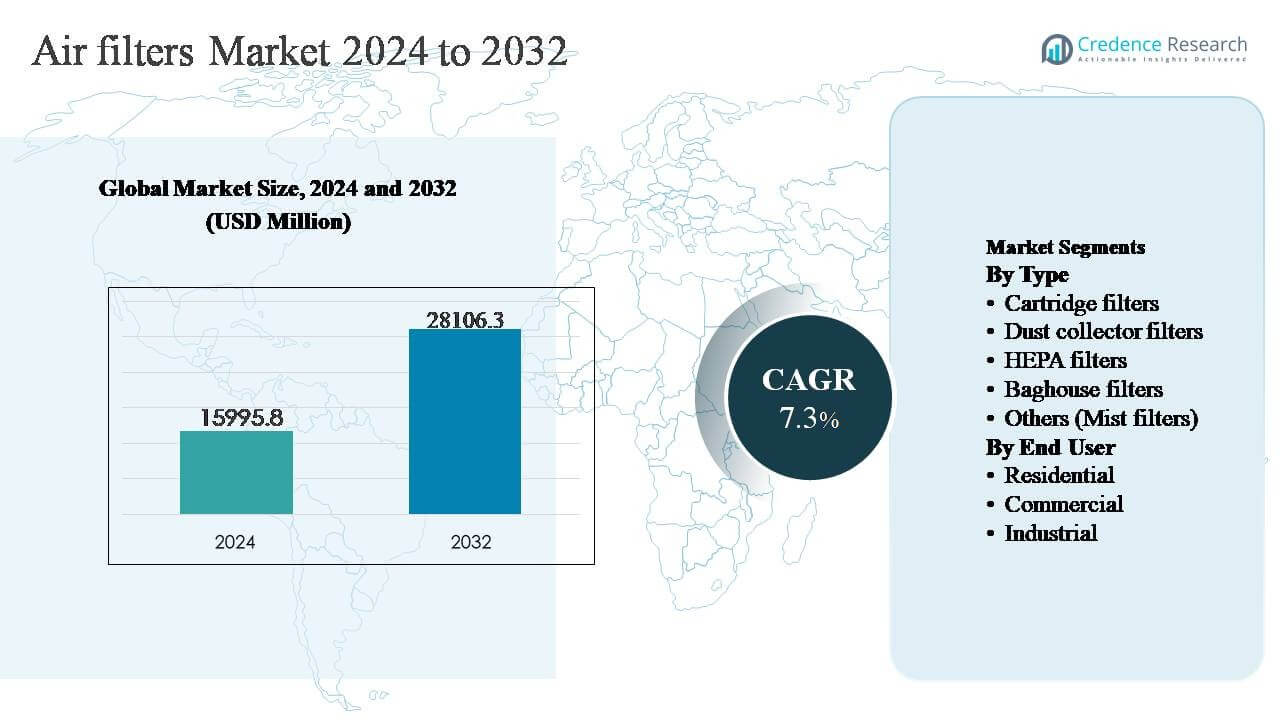
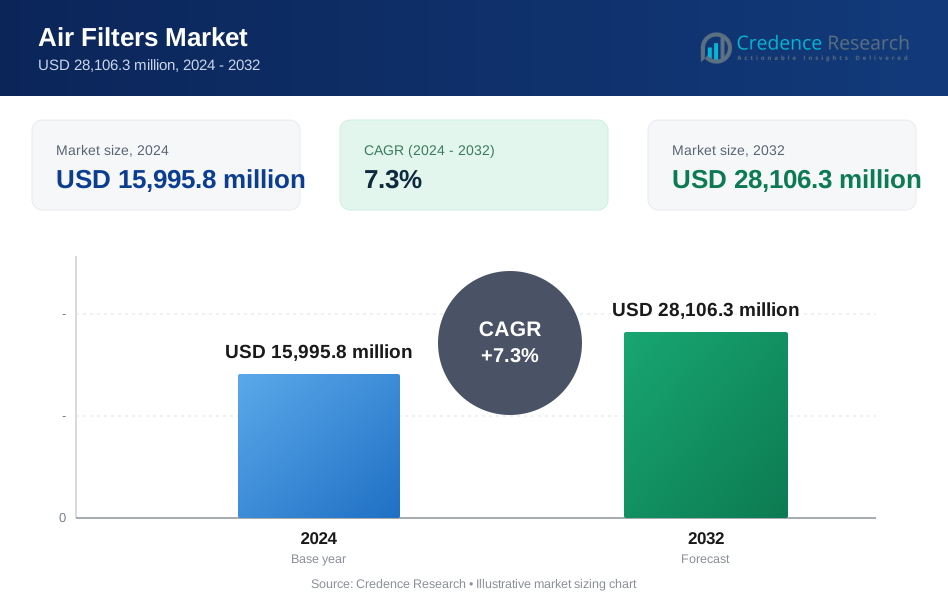
The global air filters market was valued at USD 15,995.8 million in 2024 and is projected to reach USD 28,106.3 million by 2032, expanding at a compound annual growth rate (CAGR) of 7.3% during the forecast period.
| REPORT ATTRIBUTE | DETAILS |
|---|---|
| Historical Period | 2020-2024 |
| Base Year | 2025 |
| Forecast Period | 2026-2032 |
| Air Filters Market Size 2024 | USD 15,995.8 million |
| Air Filters Market, CAGR | 7.3% |
| Air Filters Market Size 2032 | USD 28,106.3 million |
Air Filters Market Insights
- Market growth is driven by stricter emission regulations, rising indoor air quality standards, and increasing health awareness, with HEPA filters dominating by type at around 35-40% share due to high efficiency in capturing fine particulates.
- Key trends include the shift toward high-efficiency and energy-optimized filtration media, growing replacement demand, and increased adoption of advanced HVAC filters in commercial buildings and urban residential applications.
- Competitive intensity remains high, led by global players such as Donaldson, Camfil, MANN+HUMMEL, and Parker Hannifin, focusing on technology innovation, regional capacity expansion, and strong aftermarket networks.
- Asia Pacific leads with approximately 35-38% market share, followed by North America at 30-32% and Europe at 25-27%, while industrial end users dominate demand with nearly 45-50% share globally.
Air Filters Market Segmentation Analysis:
By Type:
By type, HEPA filters represent the dominant sub-segment in the air filters market, accounting for an estimated 35-40% market share, driven by their superior ability to capture fine particulate matter, allergens, and microbial contaminants. Their widespread adoption is supported by stringent indoor air quality standards in healthcare, pharmaceuticals, and commercial buildings. Dust collector and baghouse filters hold a significant share in industrial environments due to their effectiveness in managing high dust loads in cement, metals, and power generation. Cartridge and mist filters support niche applications requiring compact design and oil-aerosol removal.
- For instance, Camfil’s Absolute™ HEPA H14 filters are certified to remove at least 99.995% of particles at the Most Penetrating Particle Size (MPPS), which typically falls between 0.1 and 0.25 micrometers. Because these filters are least efficient at their MPPS, they are often even more efficient at 0.3 micrometers, making them ideal for validated contamination control in hospital operating theatres, pharmaceutical cleanrooms, and high-containment biosafety laboratories."
By End User:
By end user, the industrial segment dominates the air filters market with approximately 45-50% share, supported by continuous demand from manufacturing, mining, energy, and chemical processing industries. Regulatory pressure to control emissions and protect worker health drives sustained investment in high-capacity filtration systems. The commercial segment follows, fueled by HVAC upgrades in offices, hospitals, and retail spaces to meet air quality compliance and occupant comfort requirements. The residential segment, while smaller, is growing steadily due to rising pollution awareness, increased urban living, and adoption of home air purification systems.
- For instance, Donaldson Company supplies industrial dust collectors such as the Torit® PowerCore® CP series, which can handle airflow capacities exceeding 70,000 cubic feet per minute in heavy manufacturing environments, while Camfil’s Gold Series X-Flo industrial collectors are engineered for particulate loads up to 2,500 grams per square meter, enabling long operating cycles in cement, metals, and chemical plants.
Key Growth Drivers
Rising Stringency of Air Quality and Emission Regulations
Tightening air quality regulations across industrialized and emerging economies remain a primary growth driver for the air filters market. Governments and environmental agencies are enforcing stricter limits on particulate matter (PM2.5 and PM10), volatile organic compounds, and industrial emissions to address public health and environmental risks. Compliance requirements across manufacturing, power generation, cement, metals, and chemical processing industries are accelerating the installation of high-efficiency dust collectors, baghouse systems, and HEPA filtration units. In parallel, building codes and occupational safety standards increasingly mandate advanced HVAC filtration in commercial and institutional facilities. This regulatory push not only sustains replacement demand but also encourages upgrades to higher-efficiency filtration technologies, directly supporting long-term market expansion.
- For instance, the European Union’s Industrial Emissions Directive mandates continuous control of dust emissions in large combustion and process plants, pushing operators to deploy high-efficiency baghouse and cartridge systems such as FLSmidth’s Airtech® bag filters, which are engineered to manage gas volumes exceeding 1,000,000 cubic meters per hour in cement kiln applications while maintaining stable particulate capture.
Growing Awareness of Health Impacts from Air Pollution
Rising awareness of the health risks associated with poor indoor and outdoor air quality is significantly driving demand for air filtration solutions. Exposure to airborne pollutants has been linked to respiratory diseases, cardiovascular conditions, and reduced workplace productivity, prompting both public and private sectors to prioritize clean air initiatives. Healthcare facilities, laboratories, and pharmaceutical manufacturing units increasingly rely on HEPA and ultra-fine filtration to control contamination and infection risks. Simultaneously, heightened consumer awareness in urban residential markets is driving adoption of home air purifiers and high-performance HVAC filters. This health-centric demand shift is expanding the addressable market beyond industrial compliance toward preventive and wellness-driven applications.
- For instance, Getinge supplies HEPA-filtered laminar airflow (LAF) ceilings as part of its IN2 modular OR system. These units deliver high volumes of unidirectional air often exceeding 7,500 to 10,000 cubic meters per hour (\(m^{3}/h\)) in large configurations to maintain a sterile 'protection zone' and achieve the 20+ air changes per hour critical for surgical sterility."
Industrial Expansion and Infrastructure Development
Continued industrialization and infrastructure development, particularly in Asia Pacific, the Middle East, and parts of Latin America, are reinforcing air filter demand. Growth in manufacturing capacity, energy projects, mining operations, and construction activity generates sustained requirements for dust control and air pollution mitigation systems. Large-scale infrastructure projects such as airports, metros, data centers, and industrial parks also integrate advanced air filtration as a core design requirement. As production volumes rise, industrial operators increasingly invest in durable, high-capacity filtration systems to maintain operational efficiency and regulatory compliance. This structural expansion supports steady demand across both new installations and aftermarket replacements.
Key Trends & Opportunities
Shift Toward High-Efficiency and Advanced Filtration Technologies
A major trend shaping the air filters market is the transition toward high-efficiency filtration technologies, including HEPA, ULPA, and multi-stage filtration systems. End users increasingly prioritize filters capable of capturing ultra-fine particles, bioaerosols, and hazardous contaminants while maintaining energy efficiency. Technological advancements in filter media, such as synthetic fibers, nanofiber coatings, and electrostatically enhanced materials, are improving filtration performance and service life. This trend creates opportunities for manufacturers to differentiate through innovation, premium product offerings, and customized solutions tailored to specific industrial or commercial requirements.
Growing Demand for Energy-Efficient HVAC Filtration
Energy efficiency has emerged as a key opportunity area, particularly in commercial and residential HVAC systems. Building owners and facility managers seek filtration solutions that balance air quality performance with reduced pressure drop and lower energy consumption. As green building certifications and sustainability targets gain traction, demand is increasing for filters that support energy-efficient airflow while meeting indoor air quality standards. This trend opens opportunities for air filter suppliers to collaborate with HVAC system manufacturers and building developers, integrating advanced filtration into next-generation energy-efficient infrastructure.
Expansion of Aftermarket and Replacement Demand
The air filters market is witnessing growing opportunities in the aftermarket and replacement segment. Filters require periodic replacement to maintain performance, creating a recurring revenue stream across industrial, commercial, and residential applications. Increasing installed base of filtration systems globally, combined with stricter maintenance protocols, is driving consistent replacement demand. Manufacturers that offer extended service life, predictive maintenance compatibility, and reliable supply chains are well-positioned to capture long-term customer value in this segment.
Key Challenges
High Initial and Maintenance Costs of Advanced Filtration Systems
One of the key challenges in the air filters market is the relatively high upfront and maintenance costs associated with advanced filtration systems. High-efficiency filters, such as HEPA and industrial baghouse systems, often require specialized installation, frequent monitoring, and periodic replacement, increasing total cost of ownership. Cost sensitivity among small and medium-sized enterprises can limit adoption, particularly in price-competitive or emerging markets. Additionally, improper maintenance can reduce filter efficiency, discouraging end users from investing in premium solutions. Manufacturers must balance performance improvements with cost optimization to broaden market penetration.
Performance Trade-Offs Between Filtration Efficiency and Energy Consumption
Achieving high filtration efficiency without compromising energy consumption remains a persistent technical challenge. Filters with higher particulate capture rates often create increased airflow resistance, leading to higher energy usage in HVAC and industrial ventilation systems. This trade-off complicates decision-making for end users focused on both air quality and operational efficiency. Failure to optimize this balance can result in higher operating costs and reduced system performance. Addressing this challenge requires continued innovation in filter media design and system integration to deliver efficient, low-resistance filtration solutions.
Regional Analysis
North America:
North America accounts for approximately 30-32% of the global air filters market, supported by stringent environmental regulations and high awareness of indoor air quality standards. The United States leads regional demand due to strict EPA emission norms, widespread adoption of advanced HVAC systems, and strong presence of industrial manufacturing, healthcare, and commercial infrastructure. Replacement demand remains high across industrial dust collection and commercial HVAC filtration. Canada contributes steadily through investments in clean energy and sustainable buildings. Ongoing upgrades of aging infrastructure and emphasis on occupational health and safety continue to reinforce market stability across the region.
Europe:
Europe represents around 25-27% of the global air filters market, driven by robust regulatory frameworks under EU air quality directives and industrial emission standards. Countries such as Germany, France, and the United Kingdom dominate demand due to strong manufacturing bases, advanced automotive production, and high penetration of energy-efficient HVAC systems. Industrial dust control and baghouse filters are widely used in cement, metals, and power generation sectors. The region also benefits from strong adoption of sustainable building practices and green certifications, supporting steady demand for high-efficiency and low-energy air filtration solutions.
Asia Pacific:
Asia Pacific is the largest and fastest-growing region, accounting for approximately 35-38% of the global air filters market. Rapid industrialization, urbanization, and infrastructure development across China, India, Japan, and Southeast Asia drive substantial demand for industrial and commercial air filtration systems. Rising pollution levels and increasing enforcement of emission regulations are accelerating adoption across manufacturing, power, and construction sectors. Residential demand is also expanding due to heightened health awareness in urban centers. Large-scale industrial capacity additions and ongoing investments in smart cities further strengthen the region’s long-term market outlook.
Latin America:
Latin America holds an estimated 5-6% share of the global air filters market, supported by gradual industrial expansion and improving environmental compliance. Brazil and Mexico lead regional demand due to growth in manufacturing, mining, cement, and food processing industries. Increasing awareness of workplace safety and emission control is driving adoption of dust collectors and baghouse filters in industrial settings. Commercial HVAC filtration demand is also rising in urban areas. However, market growth remains moderate due to cost sensitivity and uneven enforcement of environmental regulations across several countries.
Middle East & Africa:
The Middle East & Africa region accounts for approximately 4-5% of the global air filters market. Demand is primarily driven by oil & gas operations, mining activities, power generation, and large-scale infrastructure projects. Gulf countries lead regional adoption due to industrial investments, high construction activity, and increasing focus on indoor air quality in commercial buildings. In Africa, mining and cement industries support demand for industrial filtration systems. While market penetration remains lower than other regions, ongoing industrial development and regulatory improvements are expected to support gradual growth.
Air Filters Market Segmentations:
By Type
- Cartridge filters
- Dust collector filters
- HEPA filters
- Baghouse filters
- Others (Mist filters)
By End User
- Residential
- Commercial
- Industrial
By Geography
- North America
- U.S.
- Canada
- Mexico
- Europe
- Germany
- France
- U.K.
- Italy
- Spain
- Rest of Europe
- Asia Pacific
- China
- Japan
- India
- South Korea
- South-east Asia
- Rest of Asia Pacific
- Latin America
- Brazil
- Argentina
- Rest of Latin America
- Middle East & Africa
- GCC Countries
- South Africa
- Rest of the Middle East and Africa
Competitive Landscape
The competitive landscape of the air filters market is characterized by the presence of global multinational manufacturers and regional specialists competing on filtration efficiency, product durability, regulatory compliance, and service capabilities. Leading players focus on expanding high-efficiency filter portfolios, particularly HEPA and industrial dust collection systems, to address tightening emission standards and rising indoor air quality requirements. Companies actively invest in advanced filter media technologies, energy-efficient designs, and extended service-life products to differentiate offerings and reduce total cost of ownership for end users. Strategic initiatives such as capacity expansions, regional manufacturing localization, and long-term supply agreements strengthen market positioning, especially in high-growth Asia Pacific markets. In parallel, aftermarket services, including replacement filters and maintenance support, play a critical role in customer retention. Competitive intensity remains high as players balance innovation, pricing, and global distribution reach to sustain market share.
Key Player Analysis
- Donaldson Company, Inc.
- Camfil
- Parker Hannifin Corp.
- MANN+HUMMEL
- Daikin Industries Ltd.
- Cummins Inc.
- SPX FLOW, Inc.
- Absolent Group AB
- Lydall Gutsche GmbH & Co. KG
- Purafil, Inc.
Recent Developments
- In March 2025, Camfil launched an AI-powered dashboard platform for real-time industrial filter performance monitoring, enabling facilities to track differential pressure, filter loading status, and maintenance triggers to improve operational uptime.
- In 30 January 2025, Donaldson partnered with Daimler Truck North America on the Freightliner SuperTruck III Project, contributing advanced filtration technologies for hydrogen fuel cell systems to support high-efficiency commercial truck powertrains.
Report Coverage
The research report offers an in-depth analysis based on Type, End-User and Geography. It details leading market players, providing an overview of their business, product offerings, investments, revenue streams, and key applications. Additionally, the report includes insights into the competitive environment, SWOT analysis, current market trends, as well as the primary drivers and constraints. Furthermore, it discusses various factors that have driven market expansion in recent years. The report also explores market dynamics, regulatory scenarios, and technological advancements that are shaping the industry. It assesses the impact of external factors and global economic changes on market growth. Lastly, it provides strategic recommendations for new entrants and established companies to navigate the complexities of the market.
Future Outlook
- Demand for air filters will continue to rise as governments tighten emission control and indoor air quality regulations across industrial and commercial sectors.
- High-efficiency filtration technologies, including HEPA and advanced multi-stage systems, will see wider adoption across healthcare, laboratories, and clean manufacturing environments.
- Industrial end users will remain the largest demand contributors due to sustained growth in manufacturing, energy, mining, and construction activities.
- Replacement and aftermarket sales will gain importance as the installed base of filtration systems expands globally.
- Energy-efficient and low-pressure-drop filter designs will increasingly influence purchasing decisions in HVAC and industrial ventilation systems.
- Urbanization and rising pollution levels will support steady growth in residential air filtration and home air purification solutions.
- Asia Pacific will maintain its leadership position, supported by rapid industrial expansion and infrastructure development.
- Smart filtration systems with monitoring and predictive maintenance capabilities will gain traction in large commercial and industrial facilities.
- Manufacturers will focus on localized production and supply chain resilience to serve high-growth regional markets effectively.
- Sustainability considerations will drive innovation in recyclable filter media and environmentally compliant filtration solutions.
Request a Free Sample
Fill in your details and we'll send you a free sample report.
- Sample data tables & charts
- Research methodology
Need a Custom Version of This Report?
Tailor the scope, geography, or segments to your exact requirements.
- Custom geography or segment scope
- Direct access to our analyst team
Frequently Asked Questions
What is the current market size for air filters, and what is its projected size in 2032?
At what Compound Annual Growth Rate is the air filters market projected to grow between 2024 and 2032?
Which air filters segment held the largest share in 2024?
What are the primary factors fueling the growth of the air filters market?
Who are the leading companies in the air filters market?
Which region commanded the largest share of the air filters market in 2024?
Table of Content
Chapter 1. Report Introduction
- 1.1 Report Description & Purpose
- 1.1.1 Report Title & Market Definition
- 1.1.2 Unique Selling Propositions (USP) & Key Differentiators
- 1.1.3 Value Proposition for Stakeholders
- 1.2 Research Objectives
- 1.2.1 Market Sizing Objectives (Volume & Revenue)
- 1.2.2 Segmentation Objectives
- 1.2.3 Competitive Intelligence Objectives
- 1.2.4 Forecast & Scenario Objectives
- 1.3 Report Scope
- 1.3.1 Air Filters Scope – Types & Subtypes Covered
- 1.3.2 Geographic Scope – Regions & Countries Covered
- 1.3.3 Historical Period, Base Year & Forecast Period (2024; forecast to 2032)
- 1.3.4 Inclusions & Exclusions
- 1.4 HS Code & Classification Framework
- 1.5 Currency, Units & Pricing Basis
- 1.6 Target Stakeholders
- 1.7 Limitations & Assumptions
Chapter 2. Executive Summary
- 2.1 Global Air Filters Market Snapshot
- 2.1.1 Market Size – Historical (2024) & Forecast (2024-2032) (2024: USD 15,995.8 million → 2032: USD 28,106.3 million)
- 2.1.2 Volume & Revenue – Global Totals
- 2.1.3 Key Market Highlights – Top Five Facts
- 2.2 Air Filters Market Segmentation Snapshot
- 2.2.1 Market Split by Region – 2024 vs. 2032
- 2.3 Competitive Snapshot
- 2.3.1 Top 10 Players by Revenue Share – 2024
- 2.3.2 Top 10 Players by Volume Share – 2024
- 2.3.3 Recent Strategic Developments (18-Month Summary)
- 2.4 Key Investment Highlights & Strategic Conclusions
Chapter 3. Air Filters Market Dynamics & Industry Analysis
- 3.1 Market Overview & Context
- 3.1.1 Air Filters Market Position in the Broader Automotive Value Chain
- 3.1.2 OEM vs. Replacement Market Dynamics
- 3.1.3 Market Maturity & Development Stage by Region
- 3.2 Air Filters Market Drivers
- 3.3 Air Filters Market Restraints & Challenges
- 3.4 Air Filters Market Opportunities
- 3.5 Porter's Five Forces Analysis
- 3.5.1 Threat of New Entrants
- 3.5.2 Bargaining Power of Suppliers
- 3.5.3 Bargaining Power of Buyers
- 3.5.4 Threat of Substitutes
- 3.5.5 Competitive Rivalry – Intensity Assessment
- 3.6 Air Filters Value Chain Analysis
- 3.6.1 Upstream – Raw Material/Input Suppliers
- 3.6.1.1 Raw Material/Input 1
- 3.6.1.2 Raw Material/Input 2
- 3.6.1.3 Raw Material/Input 3
- 3.6.2 Midstream – Production/Manufacturing/Service Delivery
- 3.6.2.1 Production/Process Overview
- 3.6.2.2 Key Facility Locations & Capacity by Manufacturer
- 3.6.3 Downstream – Distribution & End Consumer
- 3.6.3.1 Primary Channel – B2B/OEM
- 3.6.3.2 Secondary Channels – Dealer, Retail, Online, Direct
- 3.6.4 Value Chain Profitability Analysis
- 3.6.1 Upstream – Raw Material/Input Suppliers
- 3.7 PESTEL Analysis
- 3.7.1 Political Factors
- 3.7.2 Economic Factors
- 3.7.3 Social Factors
- 3.7.4 Technological Factors
- 3.7.5 Environmental Factors
- 3.7.6 Legal Factors
- 3.8 Air Filters Supply Chain Analysis
- 3.8.1 Raw Material/Input Supply Risk Assessment
- 3.8.2 Manufacturing Concentration Risk (Geographic Exposure)
- 3.8.3 Trade Disruption Impact Analysis
- 3.9 Regulatory & Policy Landscape
Note: The regulatory and policy landscape section covers regulations based on their applicability to the market, Air Filters category, geography, and scope of the study. Only regulatory frameworks with a material impact on operations, compliance, trade, sustainability, or market access are analyzed in detail.
Chapter 4. Key Investment Pockets & Opportunity Analysis
- 4.1 Air Filters Market Attractiveness Analysis
- 4.1.1 By Region – Investment Attractiveness Matrix (Volume × CAGR)
- 4.2 Absolute Revenue Growth Opportunity
- 4.2.1 By Region – Absolute USD Growth Through 2032
- 4.3 Incremental Volume Opportunity
- 4.3.1 By Region – Incremental Volume Through 2032
- 4.3.2 Segment – Incremental Volume
- 4.4 Emerging Submarket Opportunity Deep Dive (Subject to Applicability)
- 4.5 Emerging Market Opportunity Scorecards
- 4.5.1 United States
- 4.5.2 Europe
- 4.5.3 Asia
- 4.5.4 Middle East & Africa
Note: Emerging Market Opportunity Scorecards will be included based on relevance and strategic importance. Regions listed are indicative and may vary depending on data availability and market dynamics.
Chapter 5. Air Filters Import-Export Analysis & Trade Flows
- 5.1 Global Trade Overview
- 5.1.1 Global Export Value by Country (2024)
- 5.1.2 Global Export Volume by Country (2024)
- 5.1.3 Global Import Value by Country (2024)
- 5.1.4 Global Import Volume by Country (2024)
- 5.1.5 Net Trade Balance by Country (2024)
- 5.2 Export Analysis – Segment
- 5.2.1 Type 1 (HS Code)
- 5.2.2 Type 2 (HS Code)
- 5.2.3 Type 3 (HS Code)
- 5.2.4 Type 4 (HS Code)
- 5.2.5 Type 5 (HS Code)
- 5.3 Import Analysis – Segment
- 5.3.1 Type 1 (HS Code)
- 5.3.2 Type 2 (HS Code)
- 5.3.3 Type 3 (HS Code)
- 5.3.4 Type 4 (HS Code)
- 5.3.5 Type 5 (HS Code)
- 5.4 Average Unit Trade Prices
- 5.4.1 Average Export Price – Segment & Country
- 5.4.2 Average Import Price – Segment & Source Country
- 5.4.3 Price Trends (2024)
- 5.5 Key Trade Route Analysis
- 5.5.1 Trade Route 1
- 5.5.2 Trade Route 2
- 5.5.3 Trade Route 3
- 5.5.4 Trade Route 4
- 5.5.5 Trade Route 5
- 5.6 Trade Policy Impact Assessment
- 5.6.1 US Anti-Dumping & Section 301 Tariffs
- 5.6.2 EU Customs Union Impact
- 5.6.3 Major Free Trade Agreements
- 5.6.4 USMCA Rules of Origin
Note: Trade policy analysis will be included only where relevant to the Air Filters market.
Chapter 6. Competitive Landscape & Company Benchmarking
- 6.1 Air Filters Market Concentration & Structure
- 6.1.1 Herfindahl-Hirschman Index (HHI) – vs. 2024
- 6.1.2 Tier 1, Tier 2 & Tier 3 Market Structure
- 6.1.3 Global, Regional & Local Player Dynamics
- 6.2 Air Filters Market Share Analysis – 2024
- 6.2.1 Global Revenue Share by Company
- 6.2.2 Global Volume Share by Company
- 6.2.3 Regional Revenue Share
- 6.2.4 Market Share Evolution ( vs. 2024)
- 6.2.5 OEM Segment Share by Company
- 6.2.6 Replacement Segment Share by Company
- 6.3 Production/Delivery Capacity & Facility Analysis
- 6.3.1 Global Installed Capacity
- 6.3.2 Capacity Utilization Rates
- 6.3.3 Production/Output Volume
- 6.3.4 Facility Locations & Capacity Map
- 6.3.5 Planned Capacity Additions
- 6.4 Air Filters Competitive Benchmarking Matrix
- 6.4.1 Revenue, Volume, CAGR & Profitability Comparison
- 6.4.2 Channel Revenue Mix
- 6.4.3 Geographic Revenue Exposure
- 6.4.4 R&D Intensity
- 6.4.5 Sustainability Maturity
- 6.5 Strategic Developments in Air Filters (Last 24 Months)
- 6.5.1 Mergers, Acquisitions & Divestments
- 6.5.2 New Air Filters Launches
- 6.5.3 Facility Expansions
- 6.5.4 Strategic Alliances, Joint Ventures & Partnerships
- 6.5.5 Distribution Expansion & Market Entry
- 6.5.6 Sustainability & ESG Initiatives
- 6.6 Competitive Strategy Mapping
- 6.6.1 Leader, Challenger, Follower & Niche Classification
- 6.6.2 Pricing Strategy Comparison
- 6.6.3 Channel Strategy Matrix
Note: Strategic developments are included based on their materiality and the availability of reliable information.
Chapter 7. Global Air Filters Market – By Distribution Channel
- 7.1 Segment Overview
- 7.1.1 Volume & Revenue Split by Channel (2024 & 2032)
- 7.1.2 Channel Mix Evolution (2024-2032)
Chapter 8. Regional Market Analysis – Global Overview
- 8.1 Global Regional Overview
- 8.1.1 Regional Volume Share
- 8.1.2 Regional Revenue Share
- 8.1.3 Regional Volume by Region
- 8.1.4 Regional Revenue by Region
- 8.1.5 Regional Forecast Through 2032
- 8.2 Cross-Regional Segment Analysis
- 8.2.1 By Distribution Channel
- 8.2.2 By Brand/Price Tier
Chapter 9. North America Air Filters Market
- 9.1 United States
- 9.2 Canada
- 9.3 Mexico
Chapter 10. Europe Air Filters Market
- 10.1 Germany
- 10.2 France
- 10.3 Italy
- 10.4 United Kingdom
- 10.5 Spain
- 10.6 Poland
- 10.7 Russia
- 10.8 Netherlands
- 10.9 Belgium
- 10.10 Sweden
- 10.11 Denmark
- 10.12 Norway
- 10.13 Rest of Europe
Chapter 11. Asia Pacific Air Filters Market
- 11.1 China
- 11.2 India
- 11.3 Japan
- 11.4 South Korea
- 11.5 Thailand
- 11.6 Indonesia
- 11.7 Vietnam
- 11.8 Malaysia
- 11.9 Australia
- 11.10 Rest of Asia Pacific
Chapter 12. Latin America Air Filters Market
- 12.1 Brazil
- 12.2 Argentina
- 12.3 Colombia
- 12.4 Chile
- 12.5 Rest of Latin America
Chapter 13. Middle East Air Filters Market
- 13.1 Saudi Arabia
- 13.2 United Arab Emirates
- 13.3 Turkey
- 13.4 Israel
- 13.5 Iran
- 13.6 Rest of the Middle East
Chapter 14. Africa Air Filters Market
- 14.1 South Africa
- 14.2 Egypt
- 14.3 Nigeria
- 14.4 Morocco
- 14.5 Rest of Africa
Chapter 15. Air Filters Company Profiles
- 15.1 [Company 01]
- 15.1.1 Company Overview
- 15.1.2 Key Management Personnel
- 15.1.3 Products & Services Portfolio
- 15.1.4 Financial Performance
- 15.1.5 Key Market Focus & Geographic Presence
- 15.1.6 Recent Developments & Strategic Initiatives
Note: The company profile list is preliminary and may change based on research findings, market developments, data availability, and client requirements.
Chapter 16. Appendices
- Appendix A – List of Abbreviations & Acronyms
- Appendix B – Industry Classification Code Reference – Full Series
- Appendix C – Production & Capacity Data Tables
- Appendix D – End-Use & Demand Base Tables
- Appendix E – Consumption & Replacement Rate Assumptions
- Appendix F – ASP Reference Tables
- Appendix G – Manufacturing & Facility Database
- Appendix H – Import-Export Data Tables
- Appendix I – Regulatory Summary Tables
- Appendix J – Primary Research Participant List (Anonymized)
- Appendix K – Primary Research Questionnaire Framework
- Appendix L – Data Sources & Bibliography
- Appendix M – Market Size Divergence & Source Comparison
Chapter 17. Research Methodology
- 17.1 Research Framework & Philosophy
- 17.2 Secondary Research – Sources, Hierarchy & Data Extraction
- 17.3 Data Modeling – Bottom-Up & Top-Down Market Sizing
- 17.4 Primary Research – Stakeholder Framework, LOI & Sample Sizes
- 17.5 Forecast Methodology – Regression, Scenario & Sensitivity Analysis
- 17.6 Quality Control – Four-Layer Validation Framework
- 17.7 Limitations & Standard Assumptions
- 17.8 Disclaimer
