
Automotive Lighting Market Overview:
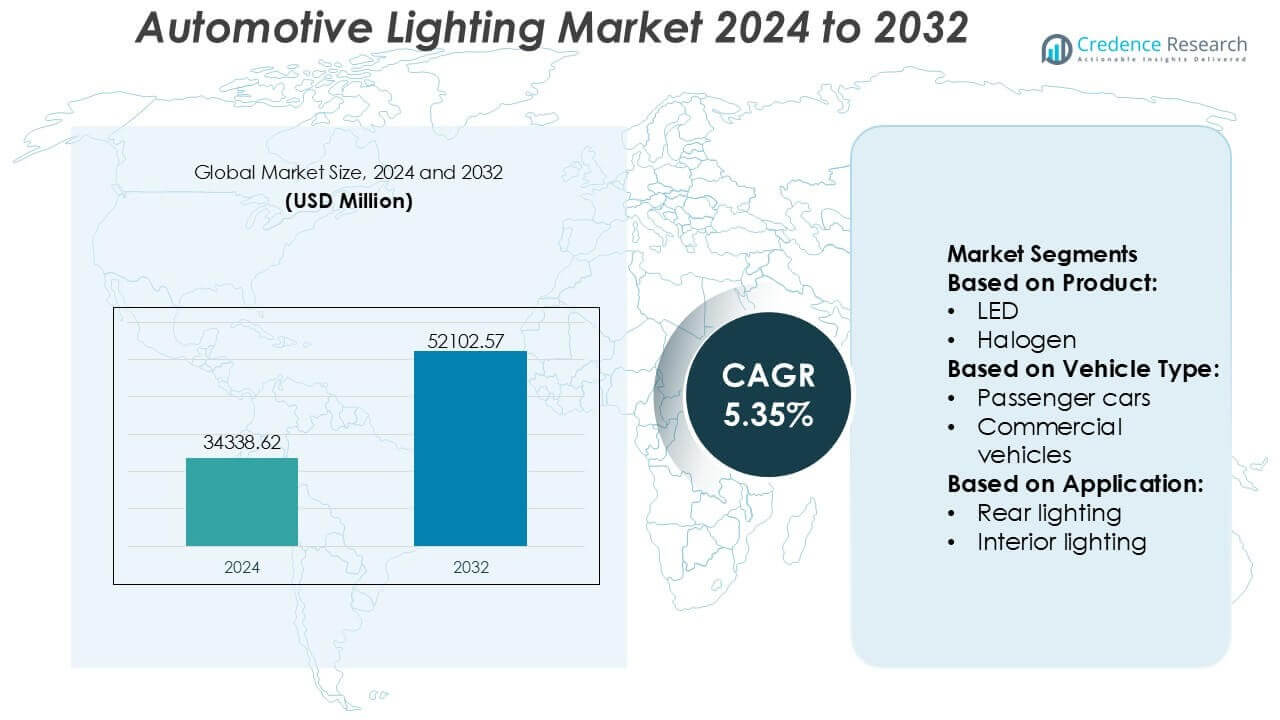
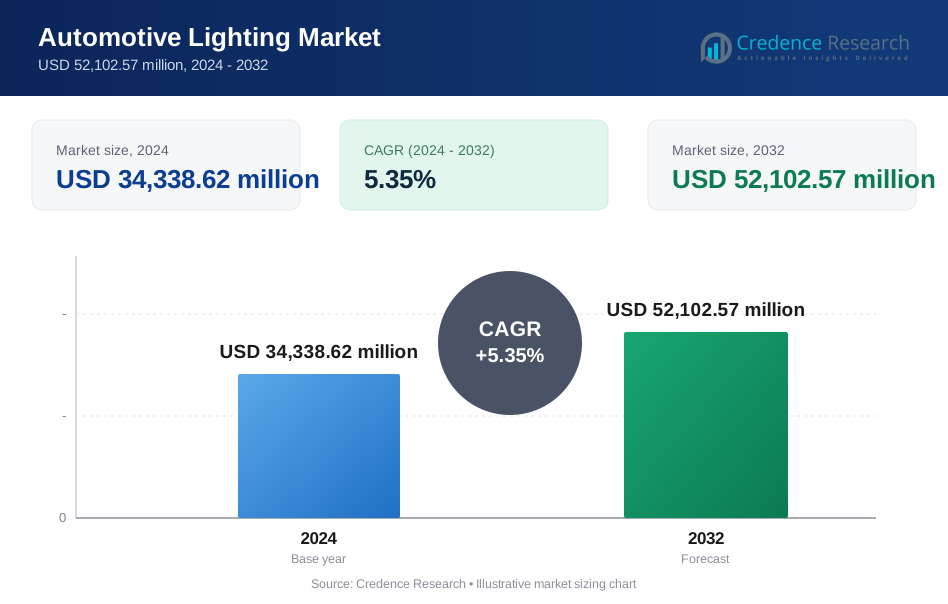
Automotive Lighting Market size was valued USD 34338.62 million in 2024 and is anticipated to reach USD 52102.57 million by 2032, at a CAGR of 5.35% during the forecast period.
| REPORT ATTRIBUTE | DETAILS |
|---|---|
| Historical Period | 2020-2023 |
| Base Year | 2024 |
| Forecast Period | 2025-2032 |
| Automotive Lighting Market Size 2024 | USD 34338.62 million |
| Automotive Lighting Market, CAGR | 5.35% |
| Automotive Lighting Market Size 2032 | USD 52102.57 million |
Automotive Lighting Market Insights
- Market growth is primarily driven by rising adoption of LED lighting systems, which hold the dominant segment share by accounting for more than half of total installations due to energy efficiency and longer lifespan.
- Key trends include increasing integration of adaptive front lighting, ambient interior lighting, and software-controlled lighting systems aligned with ADAS and vehicle personalization.
- The competitive landscape is shaped by global players leveraging advanced semiconductor integration, strong OEM partnerships, and scalable manufacturing to serve both passenger and commercial vehicles.
- Regionally, Asia-Pacific leads with an exact 34% market share, supported by high vehicle production, rapid EV adoption, and cost-efficient manufacturing ecosystems.
Automotive Lighting Market Segmentation Analysis:
By Product
By product, LED lighting dominates the automotive lighting market, holding approximately 62% market share, driven by superior energy efficiency, longer operational life, compact design, and advanced styling flexibility. Automakers increasingly adopt LEDs to support adaptive lighting, matrix beam systems, and signature daytime running lights that enhance both safety and brand differentiation. Regulatory pressure for energy-efficient vehicle components and rising penetration of electric vehicles further accelerate LED adoption. Halogen lamps continue to serve cost-sensitive entry-level vehicles due to low upfront costs, while xenon lighting maintains relevance in select premium applications requiring higher luminous intensity.
- For instance, OmniVision Technologies develops automotive-grade LED-flicker-mitigation image sensors such as the OX08B40, which operates at a resolution of 3840 × 2160 pixels (4K), supports a maximum frame rate of 36 frames per second at full resolution, and utilizes the on-chip HALE (HDR and LFM engine).
By Vehicle Type
By vehicle type, passenger cars represent the dominant segment with around 68% market share, supported by high global production volumes and rapid integration of advanced lighting technologies. Increasing consumer preference for enhanced vehicle aesthetics, safety features, and smart lighting systems such as adaptive headlamps and ambient interior lighting fuels growth. Commercial vehicles follow, driven by regulatory mandates for improved visibility, durability, and safety in logistics and fleet operations. Meanwhile, two-wheelers show steady growth, supported by rising urban mobility demand, mandatory daytime running lights, and increasing adoption of LED headlamps in premium motorcycles.
- For instance, Bosch Sensortec supplies automotive-qualified inertial measurement units such as the SMI230, which integrates a 16-bit accelerometer and 16-bit gyroscope, supports measurement ranges up to ±24 g and ±2000 °/s, and delivers a low noise density of 75–80 µg/√Hz.
By Application
By application, front lighting/headlamps leads the market, accounting for approximately 46% market share, as headlamps are critical for vehicle safety, regulatory compliance, and advanced driver assistance integration. Continuous innovation in adaptive beam systems, automatic high-beam control, and laser-assisted LEDs strengthens this segment’s dominance. Rear lighting follows, driven by enhanced visibility requirements and distinctive design elements such as light bars. Interior lighting gains momentum due to rising demand for ambient and customizable cabin experiences, while side lighting grows steadily, supported by turn indicators and side markers enhancing vehicle visibility and safety.
Automotive Lighting Market Overview
Key Growth Drivers
- Rising Adoption of Advanced Driver Assistance Systems (ADAS)
The rapid integration of ADAS across passenger and commercial vehicles is a major growth driver for the automotive lighting market. Modern lighting systems are increasingly linked with sensors, cameras, and control units to support features such as adaptive headlamps, automatic high-beam control, and glare-free lighting. These systems enhance night-time visibility, improve obstacle detection, and reduce driver fatigue. As OEMs prioritize safety differentiation and regulators mandate advanced safety features, demand for intelligent, electronically controlled lighting solutions continues to accelerate across vehicle segments.
- For instance, Panasonic Corporation has developed automotive-grade front and surround camera modules featuring 8.3-megapixel CMOS sensors with dynamic range exceeding 120 dB and LED-flicker-mitigation support up to 30 kHz, enabling reliable detection of LED headlamps, traffic signals, and adaptive lighting cues.
- Shift Toward Energy-Efficient and Sustainable Lighting Technologies
Energy efficiency and sustainability are strongly driving the transition from conventional halogen and xenon lamps to LED and laser lighting technologies. LEDs offer longer lifespan, lower power consumption, and reduced heat generation, supporting overall vehicle efficiency targets. Automakers also benefit from design flexibility, enabling slimmer headlamp assemblies and distinctive lighting signatures. Growing emphasis on reducing vehicle emissions, improving fuel efficiency, and supporting electric vehicle range further strengthens the adoption of low-energy automotive lighting systems across global markets.
- For instance, Knowles Electronics develops AEC-Q103 qualified automotive MEMS microphones such as the SPH1878, which operates across a supply voltage range of 1.5 V to 3.6 V, delivers a high signal-to-noise ratio of 66.5 dB(A), and maintains stable acoustic performance across an extended operating temperature range of −40 °C to +105 °C, enabling high-fidelity in-cabin voice recognition, hands-free calling, and active noise cancellation.
- Increasing Vehicle Production and Premium Feature Penetration
Growth in global vehicle production, particularly in emerging economies, directly supports demand for automotive lighting systems. At the same time, premium lighting features are rapidly penetrating mid-range and mass-market vehicles. Functions such as ambient interior lighting, dynamic turn indicators, and stylized daytime running lamps are no longer limited to luxury models. This democratization of advanced lighting technologies enables higher per-vehicle lighting content, supporting sustained market growth across passenger cars, two-wheelers, and commercial vehicles.
Key Trends & Opportunities
- Expansion of Adaptive and Intelligent Lighting Systems
Adaptive lighting is emerging as a key trend, driven by the need for real-time response to road, traffic, and weather conditions. Intelligent headlamps that automatically adjust beam pattern, intensity, and direction enhance both safety and driving comfort. Opportunities are expanding for suppliers that integrate software, sensors, and electronics with lighting hardware. As vehicles move toward higher levels of automation, lighting systems are increasingly positioned as active safety components rather than passive illumination devices.
- For instance, Samsung Electronics has introduced automotive-grade image sensors such as the ISOCELL Auto 1H1, featuring a 1/1.7-inch optical format with 2.1 µm pixels, high-dynamic-range performance of 120 dB, and LED flicker mitigation via its CornerPixel™ technology, which enables reliable detection of LED headlamps and traffic signals even in high-contrast lighting environments.
- Growing Demand for Vehicle Customization and Brand Differentiation
Automotive lighting is becoming a critical design and branding tool for OEMs. Distinctive exterior lighting signatures and customizable interior ambient lighting allow manufacturers to differentiate models and enhance user experience. Consumers increasingly value personalization options, creating opportunities for advanced RGB lighting, dynamic color themes, and software-controlled lighting effects. This trend supports higher-margin lighting solutions and encourages collaboration between lighting suppliers, designers, and vehicle software developers.
- For instance, Analog Devices provides automotive-grade solutions such as the MAX20092, a 12-switch matrix manager that pairs with LED drivers to support individual pixel control across multiple channels.
- Integration of Lighting with Vehicle Communication Functions
An emerging opportunity lies in the integration of lighting systems with vehicle-to-vehicle and vehicle-to-pedestrian communication. Exterior lighting elements are being developed to signal vehicle intent, such as braking, turning, or autonomous driving mode. This trend is particularly relevant for electric and autonomous vehicles, where silent operation increases the importance of visual communication. Advanced lighting thus plays a growing role in enhancing road safety and traffic interaction.
Key Challenges
- High Cost of Advanced Lighting Technologies
Despite strong demand, the high cost of advanced lighting systems remains a key challenge. Technologies such as adaptive LED matrices, laser headlamps, and intelligent control electronics significantly increase system complexity and production costs. This can limit adoption in price-sensitive vehicle segments and emerging markets. OEMs must carefully balance feature enhancement with cost targets, while suppliers face pressure to improve manufacturing efficiency and achieve economies of scale.
- Stringent Regulatory and Standardization Requirements
Automotive lighting systems are subject to strict regional regulations governing brightness, beam patterns, color, and safety performance. Differences in standards across regions add complexity to product development and homologation processes. Compliance requires extensive testing and validation, increasing time-to-market and development costs. For global suppliers, adapting lighting solutions to meet diverse regulatory frameworks while maintaining design consistency poses an ongoing operational and strategic challenge.
Regional Analysis
North America
North America holds a strong position in the Automotive Lighting Market with an estimated 29% market share, supported by high vehicle penetration, early adoption of advanced lighting technologies, and stringent safety regulations. OEMs across the U.S. and Canada actively integrate LED and adaptive lighting systems to meet regulatory standards and enhance vehicle aesthetics. Rising demand for premium passenger vehicles, along with widespread adoption of ADAS-enabled headlamps, sustains market growth. The strong presence of global lighting suppliers and continuous R&D investments further reinforce North America’s leadership in innovation-driven automotive lighting solutions.
Europe
Europe accounts for approximately 27% of the Automotive Lighting Market, driven by strict vehicle safety norms and a strong premium automotive manufacturing base. Countries such as Germany, France, and the UK emphasize adaptive front lighting, matrix LED, and laser headlamp technologies to comply with evolving EU regulations. The region benefits from high penetration of luxury and performance vehicles, where advanced exterior and interior lighting is a key differentiator. Sustainability initiatives and energy-efficient lighting adoption further support market expansion across both passenger and commercial vehicle segments.
Asia-Pacific
Asia-Pacific dominates the Automotive Lighting Market with an estimated 34% market share, supported by high vehicle production volumes and rapid urbanization. China, Japan, South Korea, and India drive demand through large-scale passenger car manufacturing and increasing adoption of LED lighting in mid-range vehicles. Cost-effective manufacturing, expanding EV production, and growing consumer preference for modern vehicle aesthetics accelerate regional growth. Local OEMs increasingly integrate advanced lighting features to remain competitive, while favorable government policies and expanding export-oriented production further strengthen Asia-Pacific’s leading position.
Latin America
Latin America represents around 6% of the Automotive Lighting Market, driven by gradual recovery in vehicle production and rising demand for affordable passenger cars. Brazil and Mexico act as key automotive manufacturing hubs, supporting steady adoption of halogen and entry-level LED lighting systems. Cost sensitivity remains a major factor, limiting rapid penetration of advanced lighting technologies. However, improving safety regulations and growing consumer awareness of vehicle aesthetics are encouraging OEMs to upgrade lighting systems, creating moderate but stable growth opportunities across the region.
Middle East & Africa
Middle East & Africa holds nearly 4% market share in the Automotive Lighting Market, supported by increasing vehicle imports and infrastructure development. Demand is primarily driven by passenger vehicles and light commercial vehicles, with LED lighting adoption gradually rising in urban markets. Harsh climatic conditions encourage the use of durable and high-performance lighting systems. While advanced lighting penetration remains limited, growing investments in transportation infrastructure and gradual regulatory improvements are expected to support steady market development across key Middle Eastern and African economies.
Automotive Lighting Market Segmentations:
By Product:
- LED
- Halogen
By Vehicle Type:
- Passenger cars
- Commercial vehicles
By Application:
- Rear lighting
- Interior lighting
By Geography
- North America
- U.S.
- Canada
- Mexico
- Europe
- Germany
- France
- U.K.
- Italy
- Spain
- Rest of Europe
- Asia Pacific
- China
- Japan
- India
- South Korea
- South-east Asia
- Rest of Asia Pacific
- Latin America
- Brazil
- Argentina
- Rest of Latin America
- Middle East & Africa
- GCC Countries
- South Africa
- Rest of the Middle East and Africa
Competitive Landscape
The Automotive Lighting Market players such as Omnivision Technologies, Bosch Sensortec, Panasonic Corporation, Knowles Electronics, Samsung Electronics, Analog Devices, InvenSense, STMicroelectronics, Sony Corporation. The Automotive Lighting Market is characterized by a highly competitive landscape driven by continuous innovation, system integration, and compliance with stringent automotive safety standards. Market participants compete on the basis of lighting performance, energy efficiency, durability, and compatibility with advanced vehicle electronics. Strong emphasis is placed on developing intelligent lighting systems that support adaptive beam control, ambient lighting personalization, and seamless integration with ADAS and sensor-driven vehicle architectures. Companies invest heavily in automotive-grade semiconductors, sensors, and control electronics to improve reliability and reduce system complexity. Long-term collaborations with OEMs and Tier-1 suppliers, along with global manufacturing capabilities, enable scalability across both premium and mass-market vehicles, while cost optimization and technological differentiation remain central to sustaining competitiveness.
Key Player Analysis
- Omnivision Technologies
- Bosch Sensortec
- Panasonic Corporation
- Knowles Electronics
- Samsung Electronics
- Analog Devices
- InvenSense
- STMicroelectronics
- Sony Corporation
- Texas Instruments Incorporated
Recent Developments
- In June 2024, Melexis launched the MLX81123 IC in June 2024, a fourth-generation LIN RGB driver that's smaller (SOIC8 & tiny DFN-8 3x3mm), enabling more flexible, space-saving ambient lighting in vehicles, succeeding the popular MLX81113 and enhancing supply chain stability for OEMs.
- In March 2024, Semilux International Ltd. announced a strategic research and development (R&D) program with academics and researchers from National Chung Hsing University (NCHU) and experts from the Industrial Technology Research Institute (ITRI) and Turing Drive.
- In January 2024, OLEDWorks launched a new brand, Atala, in the automotive lighting industry. This morning at CES, OLEDWorks launched their new automotive brand, Atala, which will support automotive qualified OLED lighting products.
Report Coverage
The research report offers an in-depth analysis based on Product, Vehicle Type, Application and Geography. It details leading market players, providing an overview of their business, product offerings, investments, revenue streams, and key applications. Additionally, the report includes insights into the competitive environment, SWOT analysis, current market trends, as well as the primary drivers and constraints. Furthermore, it discusses various factors that have driven market expansion in recent years. The report also explores market dynamics, regulatory scenarios, and technological advancements that are shaping the industry. It assesses the impact of external factors and global economic changes on market growth. Lastly, it provides strategic recommendations for new entrants and established companies to navigate the complexities of the market.
Future Outlook
- Advanced LED and adaptive lighting systems will see wider adoption across mid-range and entry-level vehicles as costs continue to decline.
- Integration of automotive lighting with ADAS and sensor-based systems will enhance road safety and real-time driver awareness.
- Automakers will increasingly use lighting as a design differentiator, emphasizing customizable ambient and signature lighting features.
- Demand for energy-efficient lighting solutions will grow in parallel with the expansion of electric and hybrid vehicle platforms.
- Regulatory focus on vehicle safety and visibility standards will continue to drive upgrades in exterior lighting technologies.
- Smart lighting systems with software-defined control will enable over-the-air updates and feature enhancements.
- Miniaturization of lighting components will support compact vehicle architectures and improved aerodynamic efficiency.
- Sustainability initiatives will accelerate the use of recyclable materials and low-power lighting solutions.
- Emerging markets will witness gradual penetration of LED lighting as vehicle production and safety awareness increase.
- Collaboration between OEMs and technology suppliers will intensify to accelerate innovation and shorten product development cycles.
Request a Free Sample
Fill in your details and we'll send you a free sample report.
- Sample data tables & charts
- Research methodology
Need a Custom Version of This Report?
Tailor the scope, geography, or segments to your exact requirements.
- Custom geography or segment scope
- Direct access to our analyst team
Frequently Asked Questions
What is the current market size for the Automotive Lighting Market, and what is its projected size in 2032?
At what Compound Annual Growth Rate is the Automotive Lighting Market projected to grow between 2024 and 2032?
Which Automotive Lighting Market segment held the largest share in 2024?
What are the primary factors fueling the growth of the Automotive Lighting Market?
Who are the leading companies in the Automotive Lighting Market?
Which region commanded the largest share of the Automotive Lighting Market in 2024?
Table of Content
Chapter 1. Report Introduction
- 1.1 Report Description & Purpose
- 1.1.1 Report Title & Market Definition
- 1.1.2 Unique Selling Propositions (USP) & Key Differentiators
- 1.1.3 Value Proposition for Stakeholders
- 1.2 Research Objectives
- 1.2.1 Market Sizing Objectives (Volume & Revenue)
- 1.2.2 Segmentation Objectives
- 1.2.3 Competitive Intelligence Objectives
- 1.2.4 Forecast & Scenario Objectives
- 1.3 Report Scope
- 1.3.1 Automotive Lighting Scope – Types & Subtypes Covered
- 1.3.2 Geographic Scope – Regions & Countries Covered
- 1.3.3 Historical Period, Base Year & Forecast Period (2024; forecast to 2032)
- 1.3.4 Inclusions & Exclusions
- 1.4 HS Code & Classification Framework
- 1.5 Currency, Units & Pricing Basis
- 1.6 Target Stakeholders
- 1.7 Limitations & Assumptions
Chapter 2. Executive Summary
- 2.1 Global Automotive Lighting Market Snapshot
- 2.1.1 Market Size – Historical (2024) & Forecast (2024-2032) (2024: USD 34,338.62 million → 2032: USD 52,102.57 million)
- 2.1.2 Volume & Revenue – Global Totals
- 2.1.3 Key Market Highlights – Top Five Facts
- 2.2 Automotive Lighting Market Segmentation Snapshot
- 2.2.1 Market Split by Region – 2024 vs. 2032
- 2.3 Competitive Snapshot
- 2.3.1 Top 10 Players by Revenue Share – 2024
- 2.3.2 Top 10 Players by Volume Share – 2024
- 2.3.3 Recent Strategic Developments (18-Month Summary)
- 2.4 Key Investment Highlights & Strategic Conclusions
Chapter 3. Automotive Lighting Market Dynamics & Industry Analysis
- 3.1 Market Overview & Context
- 3.1.1 Automotive Lighting Market Position in the Broader Automotive Value Chain
- 3.1.2 OEM vs. Replacement Market Dynamics
- 3.1.3 Market Maturity & Development Stage by Region
- 3.2 Automotive Lighting Market Drivers
- 3.3 Automotive Lighting Market Restraints & Challenges
- 3.4 Automotive Lighting Market Opportunities
- 3.5 Porter's Five Forces Analysis
- 3.5.1 Threat of New Entrants
- 3.5.2 Bargaining Power of Suppliers
- 3.5.3 Bargaining Power of Buyers
- 3.5.4 Threat of Substitutes
- 3.5.5 Competitive Rivalry – Intensity Assessment
- 3.6 Automotive Lighting Value Chain Analysis
- 3.6.1 Upstream – Raw Material/Input Suppliers
- 3.6.1.1 Raw Material/Input 1
- 3.6.1.2 Raw Material/Input 2
- 3.6.1.3 Raw Material/Input 3
- 3.6.2 Midstream – Production/Manufacturing/Service Delivery
- 3.6.2.1 Production/Process Overview
- 3.6.2.2 Key Facility Locations & Capacity by Manufacturer
- 3.6.3 Downstream – Distribution & End Consumer
- 3.6.3.1 Primary Channel – B2B/OEM
- 3.6.3.2 Secondary Channels – Dealer, Retail, Online, Direct
- 3.6.4 Value Chain Profitability Analysis
- 3.6.1 Upstream – Raw Material/Input Suppliers
- 3.7 PESTEL Analysis
- 3.7.1 Political Factors
- 3.7.2 Economic Factors
- 3.7.3 Social Factors
- 3.7.4 Technological Factors
- 3.7.5 Environmental Factors
- 3.7.6 Legal Factors
- 3.8 Automotive Lighting Supply Chain Analysis
- 3.8.1 Raw Material/Input Supply Risk Assessment
- 3.8.2 Manufacturing Concentration Risk (Geographic Exposure)
- 3.8.3 Trade Disruption Impact Analysis
- 3.9 Regulatory & Policy Landscape
Note: The regulatory and policy landscape section covers regulations based on their applicability to the market, Automotive Lighting category, geography, and scope of the study. Only regulatory frameworks with a material impact on operations, compliance, trade, sustainability, or market access are analyzed in detail.
Chapter 4. Key Investment Pockets & Opportunity Analysis
- 4.1 Automotive Lighting Market Attractiveness Analysis
- 4.1.1 By Region – Investment Attractiveness Matrix (Volume × CAGR)
- 4.2 Absolute Revenue Growth Opportunity
- 4.2.1 By Region – Absolute USD Growth Through 2032
- 4.3 Incremental Volume Opportunity
- 4.3.1 By Region – Incremental Volume Through 2032
- 4.3.2 Segment – Incremental Volume
- 4.4 Emerging Submarket Opportunity Deep Dive (Subject to Applicability)
- 4.5 Emerging Market Opportunity Scorecards
- 4.5.1 United States
- 4.5.2 Europe
- 4.5.3 Asia
- 4.5.4 Middle East & Africa
Note: Emerging Market Opportunity Scorecards will be included based on relevance and strategic importance. Regions listed are indicative and may vary depending on data availability and market dynamics.
Chapter 5. Automotive Lighting Import-Export Analysis & Trade Flows
- 5.1 Global Trade Overview
- 5.1.1 Global Export Value by Country (2024)
- 5.1.2 Global Export Volume by Country (2024)
- 5.1.3 Global Import Value by Country (2024)
- 5.1.4 Global Import Volume by Country (2024)
- 5.1.5 Net Trade Balance by Country (2024)
- 5.2 Export Analysis – Segment
- 5.2.1 Type 1 (HS Code)
- 5.2.2 Type 2 (HS Code)
- 5.2.3 Type 3 (HS Code)
- 5.2.4 Type 4 (HS Code)
- 5.2.5 Type 5 (HS Code)
- 5.3 Import Analysis – Segment
- 5.3.1 Type 1 (HS Code)
- 5.3.2 Type 2 (HS Code)
- 5.3.3 Type 3 (HS Code)
- 5.3.4 Type 4 (HS Code)
- 5.3.5 Type 5 (HS Code)
- 5.4 Average Unit Trade Prices
- 5.4.1 Average Export Price – Segment & Country
- 5.4.2 Average Import Price – Segment & Source Country
- 5.4.3 Price Trends (2024)
- 5.5 Key Trade Route Analysis
- 5.5.1 Trade Route 1
- 5.5.2 Trade Route 2
- 5.5.3 Trade Route 3
- 5.5.4 Trade Route 4
- 5.5.5 Trade Route 5
- 5.6 Trade Policy Impact Assessment
- 5.6.1 US Anti-Dumping & Section 301 Tariffs
- 5.6.2 EU Customs Union Impact
- 5.6.3 Major Free Trade Agreements
- 5.6.4 USMCA Rules of Origin
Note: Trade policy analysis will be included only where relevant to the Automotive Lighting market.
Chapter 6. Competitive Landscape & Company Benchmarking
- 6.1 Automotive Lighting Market Concentration & Structure
- 6.1.1 Herfindahl-Hirschman Index (HHI) – vs. 2024
- 6.1.2 Tier 1, Tier 2 & Tier 3 Market Structure
- 6.1.3 Global, Regional & Local Player Dynamics
- 6.2 Automotive Lighting Market Share Analysis – 2024
- 6.2.1 Global Revenue Share by Company
- 6.2.2 Global Volume Share by Company
- 6.2.3 Regional Revenue Share
- 6.2.4 Market Share Evolution ( vs. 2024)
- 6.2.5 OEM Segment Share by Company
- 6.2.6 Replacement Segment Share by Company
- 6.3 Production/Delivery Capacity & Facility Analysis
- 6.3.1 Global Installed Capacity
- 6.3.2 Capacity Utilization Rates
- 6.3.3 Production/Output Volume
- 6.3.4 Facility Locations & Capacity Map
- 6.3.5 Planned Capacity Additions
- 6.4 Automotive Lighting Competitive Benchmarking Matrix
- 6.4.1 Revenue, Volume, CAGR & Profitability Comparison
- 6.4.2 Channel Revenue Mix
- 6.4.3 Geographic Revenue Exposure
- 6.4.4 R&D Intensity
- 6.4.5 Sustainability Maturity
- 6.5 Strategic Developments in Automotive Lighting (Last 24 Months)
- 6.5.1 Mergers, Acquisitions & Divestments
- 6.5.2 New Automotive Lighting Launches
- 6.5.3 Facility Expansions
- 6.5.4 Strategic Alliances, Joint Ventures & Partnerships
- 6.5.5 Distribution Expansion & Market Entry
- 6.5.6 Sustainability & ESG Initiatives
- 6.6 Competitive Strategy Mapping
- 6.6.1 Leader, Challenger, Follower & Niche Classification
- 6.6.2 Pricing Strategy Comparison
- 6.6.3 Channel Strategy Matrix
Note: Strategic developments are included based on their materiality and the availability of reliable information.
Chapter 7. Global Automotive Lighting Market – By Distribution Channel
- 7.1 Segment Overview
- 7.1.1 Volume & Revenue Split by Channel (2024 & 2032)
- 7.1.2 Channel Mix Evolution (2024-2032)
Chapter 8. Regional Market Analysis – Global Overview
- 8.1 Global Regional Overview
- 8.1.1 Regional Volume Share
- 8.1.2 Regional Revenue Share
- 8.1.3 Regional Volume by Region
- 8.1.4 Regional Revenue by Region
- 8.1.5 Regional Forecast Through 2032
- 8.2 Cross-Regional Segment Analysis
- 8.2.1 By Distribution Channel
- 8.2.2 By Brand/Price Tier
Chapter 9. North America Automotive Lighting Market
- 9.1 United States
- 9.2 Canada
- 9.3 Mexico
Chapter 10. Europe Automotive Lighting Market
- 10.1 Germany
- 10.2 France
- 10.3 Italy
- 10.4 United Kingdom
- 10.5 Spain
- 10.6 Poland
- 10.7 Russia
- 10.8 Netherlands
- 10.9 Belgium
- 10.10 Sweden
- 10.11 Denmark
- 10.12 Norway
- 10.13 Rest of Europe
Chapter 11. Asia Pacific Automotive Lighting Market
- 11.1 China
- 11.2 India
- 11.3 Japan
- 11.4 South Korea
- 11.5 Thailand
- 11.6 Indonesia
- 11.7 Vietnam
- 11.8 Malaysia
- 11.9 Australia
- 11.10 Rest of Asia Pacific
Chapter 12. Latin America Automotive Lighting Market
- 12.1 Brazil
- 12.2 Argentina
- 12.3 Colombia
- 12.4 Chile
- 12.5 Rest of Latin America
Chapter 13. Middle East Automotive Lighting Market
- 13.1 Saudi Arabia
- 13.2 United Arab Emirates
- 13.3 Turkey
- 13.4 Israel
- 13.5 Iran
- 13.6 Rest of the Middle East
Chapter 14. Africa Automotive Lighting Market
- 14.1 South Africa
- 14.2 Egypt
- 14.3 Nigeria
- 14.4 Morocco
- 14.5 Rest of Africa
Chapter 15. Automotive Lighting Company Profiles
- 15.1 [Company 01]
- 15.1.1 Company Overview
- 15.1.2 Key Management Personnel
- 15.1.3 Products & Services Portfolio
- 15.1.4 Financial Performance
- 15.1.5 Key Market Focus & Geographic Presence
- 15.1.6 Recent Developments & Strategic Initiatives
Note: The company profile list is preliminary and may change based on research findings, market developments, data availability, and client requirements.
Chapter 16. Appendices
- Appendix A – List of Abbreviations & Acronyms
- Appendix B – Industry Classification Code Reference – Full Series
- Appendix C – Production & Capacity Data Tables
- Appendix D – End-Use & Demand Base Tables
- Appendix E – Consumption & Replacement Rate Assumptions
- Appendix F – ASP Reference Tables
- Appendix G – Manufacturing & Facility Database
- Appendix H – Import-Export Data Tables
- Appendix I – Regulatory Summary Tables
- Appendix J – Primary Research Participant List (Anonymized)
- Appendix K – Primary Research Questionnaire Framework
- Appendix L – Data Sources & Bibliography
- Appendix M – Market Size Divergence & Source Comparison
Chapter 17. Research Methodology
- 17.1 Research Framework & Philosophy
- 17.2 Secondary Research – Sources, Hierarchy & Data Extraction
- 17.3 Data Modeling – Bottom-Up & Top-Down Market Sizing
- 17.4 Primary Research – Stakeholder Framework, LOI & Sample Sizes
- 17.5 Forecast Methodology – Regression, Scenario & Sensitivity Analysis
- 17.6 Quality Control – Four-Layer Validation Framework
- 17.7 Limitations & Standard Assumptions
- 17.8 Disclaimer
