Market Overview
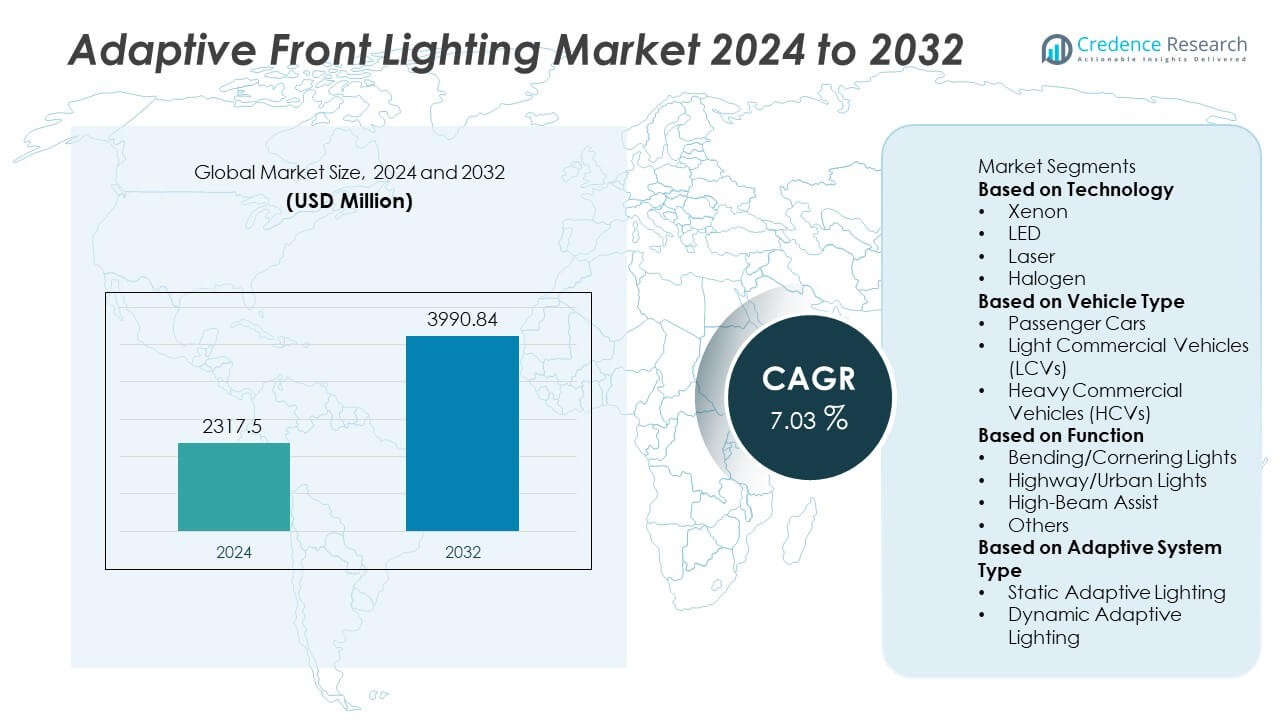
The Adaptive Front Lighting market reached USD 2,317.5 million in 2024 and is projected to rise to USD 3,990.84 million by 2032, supported by a CAGR of 7.03% during the forecast period.
| REPORT ATTRIBUTE | DETAILS |
|---|---|
| Historical Period | 2020-2023 |
| Base Year | 2024 |
| Forecast Period | 2025-2032 |
| Adaptive Front Lighting Market Size 2024 | USD 2,317.5 Million |
| Adaptive Front Lighting Market, CAGR | 7.03% |
| Adaptive Front Lighting Market Size 2032 | USD 3,990.84 Million |
The Adaptive Front Lighting market is shaped by leading players such as HELLA GmbH & Co. KGaA, Koito Manufacturing Co., Ltd., Valeo SA, Stanley Electric Co., Ltd., Magneti Marelli S.p.A., OSRAM Licht AG, ZKW Group, Hyundai Mobis Co., Ltd., Varroc Lighting Systems, and Philips (Signify). These companies focus on advanced LED, laser, and matrix lighting technologies to improve visibility, energy efficiency, and safety performance. Asia Pacific leads the global market with a 35% share, driven by strong vehicle production and rapid ADAS adoption. Europe follows with a 32% share, supported by strict safety regulations and high premium vehicle penetration, while North America holds a 27% share, backed by rising demand for intelligent lighting in SUVs and electric vehicles.
Market Insights
- The market reached USD 2,317.5 million in 2024 and is projected to reach USD 3,990.84 million by 2032, expanding at a 7.03% CAGR during the forecast period.
- Rising demand for safety-focused vehicle systems drives strong adoption of adaptive front lighting, supported by LED-based technologies and growing integration with ADAS features across passenger cars and commercial vehicles.
- LED technology leads with a 52% share, driven by high efficiency and precise beam control, while high-beam assist remains the dominant function with a 41% share due to wide OEM adoption.
- Asia Pacific leads the regional landscape with a 35% share, followed by Europe at 32% and North America at 27%, reflecting strong automotive production and rising deployment of intelligent lighting systems.
- Competition intensifies as key players expand LED, matrix, and laser lighting portfolios, but high system costs and complex electronic integration remain restraints in cost-sensitive markets.
Market Segmentation Analysis:
By Technology
LED technology dominates the segment with a 52% market share, driven by its strong energy efficiency, longer lifespan, and faster response time compared to halogen and xenon systems. Automakers prefer LED-based adaptive front lighting due to improved brightness control, flexible beam shaping, and compatibility with advanced driver assistance systems. Xenon lights follow in applications requiring high-intensity output, while laser systems gain traction in premium models for long-range illumination. Halogen remains present in low-cost vehicles but continues to decline as OEMs shift toward high-performance, low-power lighting technologies across global production lines.
- For instance, Koito Manufacturing introduced its BladeScan™ ADB LED module, a headlamp system that emits LED light to fast-revolving blade mirrors to ensure high-resolution light distribution, which is equivalent to the use of 300 LEDs.
By Vehicle Type
Passenger cars lead the segment with a 63% market share, supported by rising integration of adaptive lighting in mid-range and premium vehicle models. Automakers adopt intelligent lighting systems to enhance road visibility, meet safety regulations, and improve nighttime driving comfort. Light commercial vehicles follow with growing demand for improved illumination in delivery and fleet operations. Heavy commercial vehicles also adopt adaptive lighting to reduce accident risks during long-distance and highway travel. Increasing vehicle electrification and safety-centric consumer preferences further strengthen adoption across major passenger car platforms.
- For instance, Valeo supplied the Peugeot 408 program with Matrix LED headlights that automatically adjust the beam based on driving conditions to provide optimal lighting without blinding other road users.
By Function
High-beam assist holds the dominant position with a 41% market share, driven by its ability to automatically adjust beam intensity based on surrounding traffic, improving visibility without causing glare. Automakers integrate this function widely due to its compatibility with cameras, sensors, and advanced driver assistance systems. Bending and cornering lights follow as users demand better illumination during sharp turns and low-speed maneuvers. Highway and urban lighting modes support optimized brightness for varying speed conditions. Other functions, including dynamic leveling and smart beam shaping, gain traction as manufacturers adopt intelligent lighting to enhance road safety and driving comfort.
Key Growth Drivers
Rising Adoption of Advanced Driver Assistance Systems (ADAS)
Growing implementation of ADAS features drives strong demand for adaptive front lighting as automakers enhance visibility and reduce collision risks. Adaptive lighting works with sensors and cameras to adjust beam angles, improving night-time and curve-driving safety. Governments enforce stricter safety standards, pushing OEMs to integrate intelligent lighting in both premium and mid-range vehicles. Rising consumer preference for safety-equipped cars and expanding electrification further accelerate adoption. Automakers also use adaptive lighting to improve brand differentiation and meet global crash-prevention requirements.
- For instance, HELLA integrated an 84-pixel LED matrix module in the Audi A7, which adjusts beam patterns in real time using a camera delivering 1.3-megapixel detection resolution. The system controls each pixel independently and illuminates a 70-meter forward zone without glare.
Shift Toward LED and Intelligent Lighting Technologies
LED-based adaptive front lighting grows rapidly due to high energy efficiency, long lifespan, and precise beam control. OEMs prefer LED modules because they support lightweight vehicle design and offer faster illumination response. Advanced beam-shaping and pixel-level control enhance driving safety in changing road conditions. The shift toward intelligent lighting also aligns with the increased adoption of digital headlamp systems. Reduced power consumption is another key driver, especially for electric vehicles where energy efficiency remains critical.
- For instance, ZKW Group uses advanced thermal management systems to ensure optimal performance and longevity of their LED modules, such as those with over 50,000 pixels in new Opel models or their laser modules that generate around 500 lumens with precise thermal control, which is essential for maintaining consistent light output and reliability.
Increasing Premium and Mid-Range Vehicle Production
Automakers expand production of premium and mid-range vehicles equipped with smart lighting systems, boosting the use of adaptive front lighting. Rising disposable incomes and strong global demand for feature-rich cars support this trend. Consumers choose vehicles with enhanced visibility, stylish lighting designs, and improved driving comfort. OEMs integrate adaptive lights to strengthen safety ratings and comply with global regulations. Growing urbanization and longer commute times further increase the need for advanced illumination solutions.
Key Trends & Opportunities
Integration of Matrix LED and Laser Lighting Systems
Matrix LED and laser-based adaptive lighting create new opportunities by offering superior illumination range, pixel-level beam control, and glare-free high-beam performance. Premium automakers lead adoption as these systems improve visibility in complex driving environments. Advancements in micro-optics and beam-forming technologies enable precise light distribution. Manufacturers explore cost-effective variants for mid-range vehicles, expanding market reach. As automotive design shifts toward futuristic lighting signatures, matrix and laser systems strengthen the value proposition for OEMs.
- For instance, BMW equipped its Laserlight module with a 600-meter high-beam reach and a laser diode output of 450 milliwatts. The system uses micro-lenses to split the beam into controlled segments for accurate road targeting.
Growing Adoption in Electric and Autonomous Vehicles
Electric and autonomous vehicles create strong opportunities for adaptive front lighting due to the need for efficient, sensor-integrated illumination. EV manufacturers prefer intelligent lighting to reduce power consumption and improve night-time efficiency. Autonomous driving systems rely on adaptive lighting to enhance sensor performance and road-object visibility. Smart headlights that communicate with onboard cameras and navigation systems enhance overall safety. This trend accelerates innovation in dynamic beam-shaping and predictive lighting.
- For instance, Hyundai Mobis engineered an EV-focused headlamp that limits power use to 15 watts per module while delivering a 180-meter forward range. The unit communicates with navigation data to adjust the beam before entering curves.
Key Challenges
Higher Cost of Advanced Lighting Technologies
Adaptive front lighting systems, particularly LED matrix and laser units, remain expensive due to complex optics, sensors, and control electronics. Higher production costs limit penetration in low-cost and entry-level vehicles. OEMs face pricing pressure as they balance regulatory compliance with affordability. Cost-sensitive markets may prefer traditional halogen or basic LED units instead of advanced adaptive systems. Manufacturers must optimize design and scale production to lower costs and expand global adoption.
Complex Integration with Vehicle Electronics and ADAS Systems
Adaptive lighting requires seamless integration with sensors, cameras, steering systems, and electronic control units, creating technical complexity. Calibration issues, software compatibility, and system reliability pose challenges for manufacturers. Any malfunction in sensors can affect beam performance and reduce safety benefits. OEMs must ensure precise coordination between lighting modules and vehicle dynamics. This complexity increases development time and raises engineering costs, slowing adoption in emerging markets.
Regional Analysis
North America
North America holds a 27% market share, supported by strong adoption of ADAS-equipped vehicles and rising demand for premium automotive lighting systems. The United States leads due to higher production of SUVs and luxury cars that integrate LED and high-beam assist technologies. Safety regulations encouraging advanced illumination features also drive market growth. Automakers invest in adaptive lighting to enhance visibility during highway driving and nighttime travel. Growing EV adoption further boosts integration of energy-efficient LED and matrix systems. The region benefits from strong R&D capabilities and expanding partnerships between lighting suppliers and OEMs.
Europe
Europe accounts for a 32% market share, driven by strict road-safety regulations and high penetration of premium vehicles. Germany, France, and the United Kingdom lead adoption due to active use of LED matrix, laser systems, and dynamic bending lights. Automakers invest heavily in intelligent lighting to comply with Euro NCAP safety ratings. Strong presence of luxury brands accelerates innovation in high-precision adaptive beams. Growing EV and hybrid vehicle production also supports advanced illumination technologies. The region’s mature automotive infrastructure and strong engineering capabilities reinforce Europe’s leadership in adaptive front lighting adoption.
Asia Pacific
Asia Pacific leads the global market with a 35% market share, supported by rising vehicle production in China, Japan, South Korea, and India. Growing consumer adoption of mid-range and premium vehicles boosts integration of adaptive lighting systems. Automakers accelerate LED and intelligent lighting adoption to meet safety standards and improve nighttime visibility. Expanding EV manufacturing strengthens demand for energy-efficient headlamp technologies. The region benefits from large-scale automotive manufacturing, cost-effective production capabilities, and rapid adoption of ADAS features. Increasing urbanization and rising road-safety awareness further support long-term growth.
Latin America
Latin America holds a 4% market share, driven by gradual adoption of advanced lighting technologies in Brazil, Mexico, and Argentina. Improving safety regulations and rising sales of mid-range vehicles support the uptake of LED-based adaptive lighting. OEMs introduce upgraded lighting packages to enhance visibility during highway and rural-road driving. Growth in passenger car production and expanding automotive imports also support market penetration. Although cost-sensitive buyers slow premium adoption, rising urban mobility upgrades create steady demand for intelligent headlamp features across regional vehicle fleets.
Middle East & Africa
The Middle East & Africa region holds a 2% market share, supported by rising demand for premium and high-performance vehicles across the UAE, Saudi Arabia, and South Africa. Harsh driving conditions and long-distance travel increase the need for advanced visibility solutions, boosting interest in LED and adaptive systems. Luxury and imported vehicles drive adoption as automakers introduce cornering lights and high-beam assist features. Growing urban development and rising safety awareness support wider market growth. However, cost constraints and limited regional manufacturing restrict deeper penetration across mass-market vehicle segments.
Market Segmentations:
By Technology
- Xenon
- LED
- Laser
- Halogen
By Vehicle Type
- Passenger Cars
- Light Commercial Vehicles (LCVs)
- Heavy Commercial Vehicles (HCVs)
By Function
- Bending/Cornering Lights
- Highway/Urban Lights
- High-Beam Assist
- Others
By Adaptive System Type
- Static Adaptive Lighting
- Dynamic Adaptive Lighting
By Geography
- North America
- U.S.
- Canada
- Mexico
- Europe
- Germany
- France
- U.K.
- Italy
- Spain
- Rest of Europe
- Asia Pacific
- China
- Japan
- India
- South Korea
- South-east Asia
- Rest of Asia Pacific
- Latin America
- Brazil
- Argentina
- Rest of Latin America
- Middle East & Africa
- GCC Countries
- South Africa
- Rest of the Middle East and Africa
Competitive Landscape
The competitive landscape includes major participants such as HELLA GmbH & Co. KGaA, Koito Manufacturing Co., Ltd., Valeo SA, Stanley Electric Co., Ltd., Magneti Marelli S.p.A., OSRAM Licht AG, ZKW Group, Hyundai Mobis Co., Ltd., Varroc Lighting Systems, and Philips (Signify). These companies compete through advancements in LED, laser, and matrix lighting technologies that enhance visibility, energy efficiency, and adaptive beam control. Global suppliers strengthen their positions by expanding production capacity, optimizing optical designs, and integrating intelligent sensors for real-time illumination adjustments. Partnerships with leading automakers support wider deployment of dynamic bending lights, high-beam assist systems, and highway/urban adaptive modes. Firms also invest in software-driven headlamp control units to improve precision and align with ADAS requirements. The market remains highly competitive as suppliers race to deliver lightweight, energy-efficient, and cost-effective lighting modules for both premium and mid-range vehicle platforms.
Key Player Analysis
- HELLA GmbH & Co. KGaA
- Koito Manufacturing Co., Ltd.
- Valeo SA
- Stanley Electric Co., Ltd.
- Magneti Marelli S.p.A.
- OSRAM Licht AG
- ZKW Group
- Hyundai Mobis Co., Ltd.
- Varroc Lighting Systems
- Philips (Signify)
Recent Developments
- In April 2025, Valeo announced a strategic partnership with Appotronics to co-develop next-generation front-lighting systems combining Valeo’s expertise in lighting and ECU/software and Appotronics’ full-colour laser headlight technology.
- In July 2024, HELLA GmbH & Co. KGaA (FORVIA HELLA) developed a new head-lamp concept for the Audi Q6 e-tron that features adaptive lighting functions including glare-free high beam and a digital daytime-running-light matrix with up to eight selectable design signatures.
- In January 2024, ZKW Group (with LG) showcased at CES 2024 intelligent front-lighting modules including digital HD LED modules that dynamically adapt to traffic situations and precisely mask other road users, plus show-car projections of over 1.3 million pixels.
Report Coverage
The research report offers an in-depth analysis based on Technology, Vehicle Type, Function, Adaptive System Type and Geography. It details leading market players, providing an overview of their business, product offerings, investments, revenue streams, and key applications. Additionally, the report includes insights into the competitive environment, SWOT analysis, current market trends, as well as the primary drivers and constraints. Furthermore, it discusses various factors that have driven market expansion in recent years. The report also explores market dynamics, regulatory scenarios, and technological advancements that are shaping the industry. It assesses the impact of external factors and global economic changes on market growth. Lastly, it provides strategic recommendations for new entrants and established companies to navigate the complexities of the market.
Future Outlook
- Demand for adaptive lighting will rise as ADAS-equipped vehicles increase worldwide.
- LED and matrix technologies will become standard in mid-range and premium vehicles.
- Laser-based lighting systems will expand in luxury models due to long-range visibility.
- Automakers will integrate predictive lighting linked to navigation and sensor systems.
- Electric vehicles will drive adoption of energy-efficient, lightweight lighting modules.
- Regulatory pressure will increase the use of advanced illumination for safety compliance.
- OEM–supplier partnerships will strengthen to accelerate intelligent lighting innovation.
- Software-driven beam control and dynamic shaping will gain wider deployment.
- Cost reduction strategies will help adaptive lighting enter more entry-level vehicles.
- Asia Pacific will remain the fastest-growing region due to strong vehicle production.

Request a Free Sample
Fill in your details and we'll send you a free sample report.
- Sample data tables & charts
- Research methodology
Market Dynamics
Rising Adoption of Advanced Driver Assistance Systems (ADAS)
The integration of ADAS features in vehicles is driving demand for adaptive front lighting, as these systems require advanced illumination to enhance visibility, reduce collision risks, and comply with stricter safety regulations. Adaptive lighting works in tandem with sensors and cameras to dynamically adjust beam patterns, improving safety during night-time and curve driving.
Shift Toward LED and Intelligent Lighting Technologies
Automakers are rapidly adopting LED-based adaptive front lighting due to its superior energy efficiency, longer lifespan, and precise beam control. The trend toward intelligent lighting aligns with the need for lightweight, fast-responding, and digitally controlled headlamps, especially in electric and premium vehicles.
Increasing Premium and Mid-Range Vehicle Production
The global rise in production of premium and mid-range vehicles is boosting the adoption of adaptive front lighting, as consumers demand enhanced visibility, stylish lighting designs, and improved safety features. OEMs are integrating adaptive lighting to differentiate their offerings and meet evolving regulatory standards.
Growing Adoption in Electric and Autonomous Vehicles
Electric and autonomous vehicles require energy-efficient and sensor-integrated lighting solutions. Adaptive front lighting supports these needs by reducing power consumption and enhancing the performance of onboard sensors, which is critical for night-time driving and the operation of autonomous systems.
Regulatory Pressure for Enhanced Road Safety
Governments and safety organizations are enforcing stricter regulations on vehicle lighting to improve road safety, pushing automakers to adopt advanced adaptive front lighting systems. Compliance with global safety standards and crash-prevention requirements is accelerating the integration of intelligent lighting technologies across vehicle segments.
Need a Custom Version of This Report?
Tailor the scope, geography, or segments to your exact requirements.
- Custom geography or segment scope
- Direct access to our analyst team
Frequently Asked Questions
What is the current market size for the Adaptive Front Lighting market, and what is its projected size in 2032?
At what Compound Annual Growth Rate is the Adaptive Front Lighting market projected to grow between 2025 and 2032?
Which Adaptive Front Lighting market segment held the largest share in 2024?
What are the primary factors fueling the growth of the Adaptive Front Lighting market?
Who are the leading companies in the Adaptive Front Lighting market?
Which region commanded the largest share of the Adaptive Front Lighting market in 2024?
Table of Content
Chapter 1 Market Segmentation
- 1.1 Segmentation Framework
- 1.1.1 Product and Service Classification
- 1.1.2 Application and End-Use Classification
- 1.1.3 Technology and Solution Classification
- 1.1.4 Customer and Distribution Channel Classification
- 1.1.5 Geographic Segmentation
- 1.1.6 Market Segment Definitions and Boundaries
- 1.2 By Function
- 1.2.1 High-Beam Assist
- 1.2.2 Bending/Cornering Lights
- 1.2.3 Highway/Urban Lights
- 1.2.4 Others
- 1.3 By Technology
- 1.3.1 LED
- 1.3.2 Xenon
- 1.3.3 Laser
- 1.3.4 Halogen
- 1.4 By Vehicle Type
- 1.4.1 Passenger Cars
- 1.4.2 Light Commercial Vehicles (LCVs)
- 1.4.3 Heavy Commercial Vehicles (HCVs)
- 1.5 By Adaptive System Type
- 1.5.1 Static Adaptive Lighting
- 1.5.2 Dynamic Adaptive Lighting
Chapter 2 Introduction
- 2.1 Report Objectives and Scope
- 2.2 Product Definition and Industry Terminology
- 2.3 Market Inclusions and Exclusions
- 2.4 Research Process
- 2.4.1 Primary Research and Expert Interviews
- 2.4.2 Secondary Research and Source Review
- 2.4.3 Top-Down and Bottom-Up Estimation
- 2.4.4 Data Triangulation and Verification
- 2.5 Market Size Measurement Basis
- 2.5.1 2024: USD 2,317.5 million → 2032: USD 3,990.84 million
- 2.6 Historical and Forecast Reference Periods
- 2.6.1 Base Year: 2024
- 2.6.2 Forecast Period: 2024-2032
- 2.7 Research Assumptions and Limitations
Chapter 3 Executive Summary
- 3.1 Market Snapshot and Key Findings
- 3.2 Base-Year Market Size, 2024
- 3.3 Forecast Market Size, 2032
- 3.4 Revenue and Volume Growth Outlook
- 3.5 Key Demand and Supply Indicators
- 3.6 Leading Market Segments
- 3.7 Fastest-Growing Market Opportunities
- 3.8 Regional Performance Highlights
- 3.9 Technology and Industry Transformation
- 3.10 Competitive Landscape Summary
- 3.11 Analyst View and Strategic Implications
Chapter 4 Global Adaptive Front Lighting Market Trends and Developments
- 4.1 Historical Industry Development
- 4.2 Recent Market Trends and Developments
- 4.3 Demand and Customer Behavior Trends
- 4.4 Technology and Product Innovation
- 4.5 Artificial Intelligence, Automation and Digitalization
- 4.6 Local Manufacturing and Supply Chain Realignment
- 4.7 Industry Partnerships, Mergers and Acquisitions
- 4.8 Sustainability and Circular Economy Developments
- 4.9 Government and Private Sector Investment Trends
- 4.10 Emerging Business Models and Commercialization
- 4.11 Industry Developments and Announcements
Chapter 5 Global Adaptive Front Lighting Market Production, Supply and Demand Analysis
- 5.1 Demand Trend and Consumption Analysis
- 5.2 Demand Forecast, 2024-2032
- 5.3 Production and Output Trend
- 5.4 Production and Output Forecast, 2024-2032
- 5.5 Installed Capacity and Capacity Utilization
- 5.6 Company-Wise Production Plants and Statistics
- 5.6.1 Installed Production Capacity
- 5.6.2 Actual Production
- 5.6.3 Planned Capacity and Expansion Targets
- 5.7 Supply Chain Structure and Procurement Trends
- 5.8 Supply-Demand Gap and Bottlenecks
- 5.9 Import Dependence and Sourcing Structure
- 5.10 Contract Manufacturing and Outsourcing
- 5.11 Regional Supply and Demand Concentration
Chapter 6 Global Adaptive Front Lighting Market Pricing Analysis
- 6.1 Pricing Structure and Measurement
- 6.2 Historical Pricing Trends
- 6.3 Pricing Outlook, 2024-2032
- 6.4 Average Selling Price and Unit Economics
- 6.5 Pricing by Product and Market Segment
- 6.6 Geographic Pricing Differences
- 6.7 Key Input, Energy, Labor and Logistics Costs
- 6.8 Contract Pricing and Purchasing Models
- 6.9 Pricing Sensitivity and Competitive Positioning
- 6.10 Price, Margin and Profitability Implications
Chapter 7 Global Adaptive Front Lighting Market Dynamics
- 7.1 Market Growth Drivers
- 7.1.1 Demand-Side Drivers
- 7.1.2 Technology and Innovation Drivers
- 7.1.3 Infrastructure and Investment Drivers
- 7.1.4 Regulatory and Policy Drivers
- 7.2 Market Restraints
- 7.2.1 Cost and Affordability Constraints
- 7.2.2 Technology and Adoption Barriers
- 7.2.3 Supply Chain and Operational Constraints
- 7.3 Market Challenges
- 7.3.1 Competitive Pressure and Margin Erosion
- 7.3.2 Skills, Infrastructure and Implementation Gaps
- 7.4 Emerging Market Opportunities
- 7.5 Market Dynamics Impact and Time-Horizon Assessment
Chapter 8 Global Adaptive Front Lighting Value Chain Analysis
- 8.1 Industry Value Chain Overview
- 8.2 Upstream Suppliers and Critical Inputs
- 8.3 Technology and Component Providers
- 8.4 Manufacturing or Service Delivery
- 8.5 Distribution, Channel Partners and Integrators
- 8.6 Downstream Applications and End Users
- 8.7 Value Addition and Profit Pools
- 8.8 Vertical Integration and Outsourcing
- 8.9 Supplier Concentration and Risk
- 8.10 Supply Chain Localization and Resilience
Chapter 9 Global Adaptive Front Lighting Market Regulations and Policies
- 9.1 Relevant Laws, Standards and Compliance Frameworks
- 9.2 Product, Service, Safety and Quality Requirements
- 9.3 Government Policies, Incentives and Subsidies
- 9.4 Imports, Exports and Trade Barriers
- 9.5 Public Procurement and Local Content Requirements
- 9.6 Environmental and Sustainability Compliance
- 9.7 Upcoming Policy Changes and Market Implications
Chapter 10 Global Adaptive Front Lighting Market Hotspots and Opportunities
- 10.1 Market Opportunity Mapping and Growth Hotspots
- 10.2 High-Growth Applications and Customer Groups
- 10.3 Underserved Markets and White-Space Opportunities
- 10.4 Emerging Technology and Product Opportunities
- 10.5 New Capacity and Investment Hotspots
- 10.6 Market Entry and Expansion Opportunities
- 10.7 Distribution and Partnership Opportunities
- 10.8 Near-Term and Long-Term Commercial Potential
- 10.9 Opportunity Attractiveness and Execution Risks
Chapter 11 Global Adaptive Front Lighting Market Outlook, 2024-2032
- 11.1 Market Size and Analysis
- 11.1.1 Revenue (Market Measurement: 2024: USD 2,317.5 million → 2032: USD 3,990.84 million)
- 11.1.2 Market Volume and Quantity Sold
- 11.1.3 Historical Market Size
- 11.1.4 Base-Year Market Size, 2024
- 11.2 Market Forecast, 2024-2032
- 11.2.1 Revenue Forecast to 2032
- 11.2.2 Volume Forecast to 2032
- 11.2.3 CAGR and Year-on-Year Growth
- 11.2.4 Incremental Revenue Opportunity
- 11.3 Forecast Assumptions and Scenario Analysis
- 11.3.1 Base-Case Forecast
- 11.3.2 Optimistic and Conservative Scenarios
- 11.3.3 Technology, Pricing and Policy Sensitivities
- 11.4 Market Attractiveness and Growth Outlook
Chapter 12 Global Adaptive Front Lighting Market Segmentation and Outlook
- 12.1 Segmentation Summary and Market Shares, 2024
- 12.2 Largest and Fastest-Growing Segments
- 12.3 By Function - Market Size and Forecast, 2024-2032
- 12.3.1 Segment Definition and Scope
- 12.3.2 Historical Market Size
- 12.3.3 Revenue Forecast, 2024-2032
- 12.3.4 Volume Forecast, 2024-2032
- 12.3.5 Base-Year Market Share, 2024
- 12.3.6 Segment CAGR and Growth Drivers
- 12.3.7 Subsegment Market Size and Forecast
- 12.3.7.1 High-Beam Assist
- 12.3.7.2 Bending/Cornering Lights
- 12.3.7.3 Highway/Urban Lights
- 12.3.7.4 Others
- 12.3.8 Subsegment Pricing and Adoption Trends
- 12.3.9 Leading Suppliers and Competition
- 12.3.10 Regional Demand and Opportunities
- 12.4 By Technology - Market Size and Forecast, 2024-2032
- 12.4.1 Segment Definition and Scope
- 12.4.2 Historical Market Size
- 12.4.3 Revenue Forecast, 2024-2032
- 12.4.4 Volume Forecast, 2024-2032
- 12.4.5 Base-Year Market Share, 2024
- 12.4.6 Segment CAGR and Growth Drivers
- 12.4.7 Subsegment Market Size and Forecast
- 12.4.7.1 LED
- 12.4.7.2 Xenon
- 12.4.7.3 Laser
- 12.4.7.4 Halogen
- 12.4.8 Subsegment Pricing and Adoption Trends
- 12.4.9 Leading Suppliers and Competition
- 12.4.10 Regional Demand and Opportunities
- 12.5 By Vehicle Type - Market Size and Forecast, 2024-2032
- 12.5.1 Segment Definition and Scope
- 12.5.2 Historical Market Size
- 12.5.3 Revenue Forecast, 2024-2032
- 12.5.4 Volume Forecast, 2024-2032
- 12.5.5 Base-Year Market Share, 2024
- 12.5.6 Segment CAGR and Growth Drivers
- 12.5.7 Subsegment Market Size and Forecast
- 12.5.7.1 Passenger Cars
- 12.5.7.2 Light Commercial Vehicles (LCVs)
- 12.5.7.3 Heavy Commercial Vehicles (HCVs)
- 12.5.8 Subsegment Pricing and Adoption Trends
- 12.5.9 Leading Suppliers and Competition
- 12.5.10 Regional Demand and Opportunities
- 12.6 By Adaptive System Type - Market Size and Forecast, 2024-2032
- 12.6.1 Segment Definition and Scope
- 12.6.2 Historical Market Size
- 12.6.3 Revenue Forecast, 2024-2032
- 12.6.4 Volume Forecast, 2024-2032
- 12.6.5 Base-Year Market Share, 2024
- 12.6.6 Segment CAGR and Growth Drivers
- 12.6.7 Subsegment Market Size and Forecast
- 12.6.7.1 Static Adaptive Lighting
- 12.6.7.2 Dynamic Adaptive Lighting
- 12.6.8 Subsegment Pricing and Adoption Trends
- 12.6.9 Leading Suppliers and Competition
- 12.6.10 Regional Demand and Opportunities
- 12.7 Segment Growth Comparison
- 12.8 Segment Attractiveness and Priority Matrix
Chapter 13 Global Adaptive Front Lighting Geographic Market Outlook, 2024-2032
- 13.1 Regional Market Size and Share, 2024
- 13.2 Regional Market Forecast, 2024-2032
- 13.3 Regional Pricing, Production and Demand Differences
- 13.4 North America
- 13.4.1 United States
- 13.4.2 Canada
- 13.4.3 Mexico
- 13.5 Europe
- 13.5.1 Germany
- 13.5.2 France
- 13.5.3 Italy
- 13.5.4 United Kingdom
- 13.5.5 Spain
- 13.5.6 Poland
- 13.5.7 Russia
- 13.5.8 Netherlands
- 13.5.9 Belgium
- 13.5.10 Sweden
- 13.5.11 Denmark
- 13.5.12 Norway
- 13.5.13 Rest of Europe
- 13.6 Asia Pacific
- 13.6.1 China
- 13.6.2 India
- 13.6.3 Japan
- 13.6.4 South Korea
- 13.6.5 Thailand
- 13.6.6 Indonesia
- 13.6.7 Vietnam
- 13.6.8 Malaysia
- 13.6.9 Australia
- 13.6.10 Rest of Asia Pacific
- 13.7 Latin America
- 13.7.1 Brazil
- 13.7.2 Argentina
- 13.7.3 Colombia
- 13.7.4 Chile
- 13.7.5 Rest of Latin America
- 13.8 Middle East
- 13.8.1 Saudi Arabia
- 13.8.2 United Arab Emirates
- 13.8.3 Turkey
- 13.8.4 Israel
- 13.8.5 Iran
- 13.8.6 Rest of the Middle East
- 13.9 Africa
- 13.9.1 South Africa
- 13.9.2 Egypt
- 13.9.3 Nigeria
- 13.9.4 Morocco
- 13.9.5 Rest of Africa
- 13.10 Regional Investment, Policy and Supply Chain Differences
- 13.11 Regional Competitive Landscape
- 13.12 Geographic Growth Hotspots
Chapter 14 Global Adaptive Front Lighting Technology, Innovation and Sustainability Outlook
- 14.1 Technology Landscape and Maturity
- 14.2 Product, Process and Service Innovation
- 14.3 AI, Automation and Digital Tools in the Industry
- 14.4 Technology Adoption and Performance Benchmarking
- 14.5 Innovation Pipeline and R&D Investment
- 14.6 Patent and Intellectual Property Trends
- 14.7 Energy Efficiency and Resource Management
- 14.8 Sustainability, Recycling and Circularity
- 14.9 Technology Roadmap, 2024-2032
- 14.10 Risks of Obsolescence and Technology Substitution
Chapter 15 Global Adaptive Front Lighting Market Key Strategic Imperatives
- 15.1 Growth and Market Entry Priorities
- 15.2 High-Return Products and Segments
- 15.3 Pricing, Profitability and Cost Optimization
- 15.4 Technology Investment and Product Differentiation
- 15.5 Supply Chain Localization and Resilience
- 15.6 Distribution and Customer Acquisition
- 15.7 Partnership, Acquisition and Capacity Strategy
- 15.8 Regional Expansion Priorities
- 15.9 Short-, Medium- and Long-Term Actions
Chapter 16 Competition Outlook
- 16.1 Industry Competition Characteristics
- 16.2 Market Structure and Concentration
- 16.3 Market Share and Competitive Positioning, 2024
- 16.4 Company-Wise Revenue and Product Benchmarking
- 16.5 Production and Service Capacity Benchmarking
- 16.6 Technology, Pricing and Differentiation
- 16.7 Regional Footprint and Distribution Strength
- 16.8 Mergers, Acquisitions and Strategic Alliances
- 16.9 New Entrants and Competitive Threats
- 16.10 Porter's Five Forces and Industry Attractiveness
- 16.11 Competitive Outlook, 2024-2032
Chapter 17 Company Profiles
- 17.1 Company Coverage and Selection Criteria
- 17.2 HELLA GmbH & Co. KGaA
- 17.2.1 Business Description
- 17.2.2 Company Ownership and Geographic Presence
- 17.2.3 Product and Service Portfolio
- 17.2.4 Manufacturing and Operating Footprint
- 17.2.5 Production Capacity and Expansion Plans
- 17.2.6 Financial Performance and Investment
- 17.2.7 Market Share and Competitive Position
- 17.2.8 Technology and Innovation Capabilities
- 17.2.9 Strategic Alliances or Partnerships
- 17.2.10 Recent Developments
- 17.2.11 Growth Strategy and Outlook
- 17.3 Koito Manufacturing Co., Ltd.
- 17.4 Valeo SA
- 17.5 Stanley Electric Co., Ltd.
- 17.6 Magneti Marelli S.p.A.
- 17.7 OSRAM Licht AG
- 17.8 ZKW Group
- 17.9 Hyundai Mobis Co., Ltd.
- 17.10 Varroc Lighting Systems
- 17.11 Philips (Signify)
- 17.12 Other Relevant Market Participants
Note: Every listed company is profiled on the structure shown under the first company. The company list is preliminary and may change based on research findings, market developments, data availability and client requirements.
Chapter 18 Disclaimer
- 18.1 Research and Forecast Disclaimer
- 18.2 Data Source and Estimation Limitations
Note: The depth of individual sections depends on data availability for this market. Volume, capacity, trade and other unit-based metrics are included where applicable.